Free E-Mail
Bible Studies
 Apostle Peter
Beginning the Journey (for new Christians). en Español
Old Testament
Abraham
Jacob
Moses
Joshua
Gideon
David, Life of
Elijah
Psalms
Solomon
Songs of Ascent (Ps 120-135)
Isaiah
Advent/Messianic Scriptures
Daniel
Rebuild & Renew: Post-Exilic Books
Gospels
Christmas Incarnation
(Mt, Lk)
Sermon on the Mount
(Mt 5-7)
Mark
Luke's
Gospel
John's Gospel
7 Last Words of Christ
Parables
Jesus and the Kingdom
Resurrection
Apostle Peter
Acts
The Early Church
(Acts 1-12)
Apostle Paul
(Acts 12-28)
Paul's Epistles
Christ Powered Life (Rom 5-8)
1 Corinthians
2 Corinthians
Galatians
Ephesians
Vision for Church
(Eph)
Philippians
Colossians,
Philemon
1
& 2 Thessalonians
1 & 2 Timothy,
Titus
General Epistles
Hebrews
James
1 Peter
2 Peter, Jude
1, 2, and 3 John
Revelation
Revelation
Conquering Lamb of Revelation
Topical
Glorious Kingdom, The
Grace
Great Prayers
Holy Spirit, Disciple's Guide
Humility
Lamb of God
Listening for God's Voice
Lord's Supper
Names of God
Names of Jesus
Christian Art
About Us
Podcasts
Contact Us
Dr. Wilson's Books
Donations
Watercolors
Sitemap
Early Christian Symbols of the Ancient Church from the Catacombs
 Apostle Peter: Disciple Lessons from the Rock
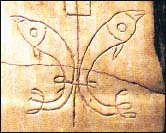 Christian symbols of two fish and what appears to be a trident, which was probably a disguise for the cross symbol, which might identify the person as a Christian and subject his family to persecution. Catacombs.
|
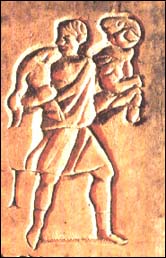
What was early Christianity like? We the archaeology of the Roman catacombs in the second and third centuries AD, give us clues, where the graves of hundreds of thousands of Christians give clues, especially with a number of symbols that reflect the earliest period of the Christian era.
This site contains some photos and drawings of early Christian symbology, with links to many others. Most of these represent Christian visual art prior to 313 A.D., when Emperor Constantine legalized Christianity. During this time, the cross is seldom seen, except disguised in some way as an anchor, a trident, or the mast of a ship. Instead, Christians identified their tombs in the catacombs by other symbols alongside of funerary inscriptions.
|
Christian symbols were first mentioned in writing by Clement of Alexandria (153-217 AD) in Paedogogus 3, 11.
"And let our seals be either a dove, or a fish, or a ship scudding before the wind, or a musical lyre, which Polycrates used, or a ship's anchor, which Seleucus got engraved as a device; and if there be one fishing, he will remember the apostle, and the children drawn out of the water."
So-called Pagan Origins of Christian Symbols
It is without question that nearly all Christian symbols are adaptations of pre-Christian symbols. But as Christianity took hold, these symbols typically lost their pagan associations and took on Christian meanings. There is a certain sort of believer that cries "pagan" or "papist" at any Christian symbol, but that's silly. If we were to rid ourselves of every pagan remnant, we would refuse to use the names of the days of the week or the months of the year.
Thoughtful twenty-first century Christians look at the heart and meaning of the symbols as intended by their early Christian brothers and sisters. We Christians are one with every other true believer in Christ, no matter what denomination or doctrinal stance. We look, listen, and learn from a faith that was forged on persecution and struggle and yet grew and flourished.
Picture Collections
- Christian Symbols and their Meanings (third edition), by Doug Gray
- International Catacomb Society has approximately 5000 photographic images from the catacombs which have been digitized and are searchable online.
- Orthodox Multimedia Gallery (Orthodox Church of Taiwan) catacombs section.
- Simboli delle Catacombe
- Symbols.net
- The Christian Catacombs of Rome, describing (with some pictures), the catacombs of Saint Callixtus, spirituality of the catacombs, etc.
- Catacombs, Image Database for Christian Studies, Yale Divinity School
- Early Christian Salvational Imagery, Kean.edu, J. Tuerk. Thumbnails
- Christian Iconography, site developed by J.R. Stracke, emeritus professor of English, Augusta State University.
- Gallery of paintings from the catacombs of Rome, Wikipedia, "Catacombs of Rome." Shows mostly frescos.
- Early Christian art and architecture from Rome and Ravenna.
- Art History & Archaeology Database, Columbia University. Shows thumbnails.
- The "Fractio Panis" and the Eucharist as Eschatological Banquet, Damien Casey, Australian Ejournal of Theology, Issue 7, 2006. Shows a number of frescos of the Eucharist as an eschatalogical banquet.
Historical Studies
- Barnes, Arthur S., Dove, Catholic Encyclopedia (1909), vol. 5.
- Coleman, Caryl, Birds (In Symbolism), Catholic Encyclopedia (1907), vol. 2.
- Cret, Paul P., Animals in Christian Art, Catholic Encyclopedia (1907), vol. 1.
- de Waal, Anton, Roman Catacombs, Catholic Encyclopedia (1908), vol. 3.
- Hassett, Maurice M., The Anchor (as Symbol), Catholic Encyclopedia (1907), vol. 1.
- Hassett, Maurice M., Early Symbols of the Eucharist, Catholic Encyclopedia (1909), vol. 5.
- Hassett, Maurice M., Alpha and Omega (in Scripture), Catholic Encyclopedia (1907), vol. 1.
- Hassett, Maurice M., Palm in Christian Symbolism, Catholic Encyclopedia (1911), vol. 11.
- Hassett, Maurice M., Symbolism of the Fish, Catholic Encyclopedia (1909), vol. 6.
- Hassett, Maurice M., Labarum (Chi-Rho), Catholic Encyclopedia (1910), vol. 8.
- Hassett, Maurice M., The Lamb (in Early Christian Symbolism), Catholic Encyclopedia (1910), vol. 8.
- Hassett, Maurice M., Monogram of Christ, Catholic Encyclopedia (1911), vol. 10.
- Hassett, Maurice M., Orans (Orante), Catholic Encyclopedia (1911), vol. 10.
- A. Hauck, Jesus Christ, Monogram of, The New Schaff-Herzog Encyclopedia of Religious Knowledge, Vol. 6, p. 167-169.
- Maere, R., IHS Monogram, Catholic Encyclopedia (1910), vol. 7.
- Fortescue, Adrian, Veneration of Images, Catholic Encyclopedia (1910), vol. 7.
- Kaufmann, C.M., Early Christian Inscriptions, Catholic Encyclopedia (1910), vol. 8.
- Marucchi, Orazio, Archaeology of the Cross and Crucifix, Catholic Encyclopedia (1908), vol. 4.
- Palmer, William, An Introduction to Early Christian Symbolism (London: Longman, Green, Longman & Roberts, 1859), digitized book, Google.
- Schaff, Philip, Christian Art, History of the Christian Church (Scribners, 1910), vol. 2, chapter 7, secs. 75-81
- Schaff, Philip, The Church in the Catacombs, History of the Christian Church (Scribners, 1910), vol. 2, chapter 7, secs. 82-87.
- Thurston, Herbert, Sign of the Cross, Catholic Encyclopedia (1912), vol. 13.
- Thurston, Herbert, Symbolism, Catholic Encyclopedia (1912), vol. 14.
- Tyrwhitt, Richard St. John, The Art Teaching of the Primitive Church (1874).
- Williamson, George Charles, Ecclesiastical Art, Catholic Encyclopedia (1909), vol. 5.
Christian Art and Paintings:
Abraham Art | Agnus Dei Art | Angel Art | Annunciation Art |
Celtic Stone Cross Art |
Christian Symbols and Art |
Christmas Art |
David
|
Easter Art |
Elijah |
Passion of Christ
by Tissot |
Gideon |
Hebrew-Jewish Art | Holy Week Art | Jacob | Jesus' Ministry Art | Jesus' Teaching Art |
Jesus Portraits and Art | John the Baptist
| John the Apostle
| Lamb of God Art | Last Supper Art | Madonna & Child Art |
Moses and the
Exodus | Names of God Art | OT Misc Art | Psalms Art | Palm Sunday Art | Paul Art and Paintings | Day of Pentecost Art | Peter Art and Paintings |
Prayer Art | Resurrection Art | Revelation Art |
Solomon |Thanksgiving and Pilgrims Art |
Timothy Art and Paintings
Copyright of artwork. Much, but not all, of the artwork
linked to on this site is in the public domain worldwide due to the date of death of its author (if it is was published outside of the U.S. and the author
has been dead for over 70 years), or due to its date of
publication (if it was first made public in the U.S. before
1923), at least in the United States (see
Bridgeman Art Library v. Corel Corp.), in Germany, and in many other countries.
Copyright © 2025, Ralph F. Wilson. <pastor joyfulheart.com> All rights reserved. A single copy of this article is free. Do not put this on a website. See legal, copyright, and reprint information.
 |
|
In-depth Bible study books
You can purchase one of Dr. Wilson's complete Bible studies in PDF, Kindle, or paperback format -- currently 48 books in the JesusWalk Bible Study Series.
Old Testament
- Abraham, Faith of
- Jacob, Life of
- Moses the Reluctant Leader
- Joshua
- Gideon
- David, Life of
- Elijah
- Psalms
- Solomon
- Songs of Ascent (Psalms 120-134)
- Isaiah
- 28 Advent Scriptures (Messianic)
- Daniel
- Rebuild & Renew: Post-Exilic Books
Gospels
- Christmas Incarnation (Mt, Lk)
- Sermon on the Mount (Mt 5-7)
- Luke's Gospel
- John's Gospel
- Seven Last Words of Christ
- Parables
- Jesus and the Kingdom of God
- Resurrection and Easter Faith
- Apostle Peter
Acts
Pauline Epistles
- Romans 5-8 (Christ-Powered Life)
- 1 Corinthians
- 2 Corinthians
- Galatians
- Ephesians
- Philippians
- Colossians, Philemon
- 1 & 2 Thessalonians
- 1 &2 Timothy, Titus
General Epistles
Revelation
Topical

 To be notified about future articles, stories, and Bible studies, why don't you subscribe to our free newsletter, The Joyful Heart, by placing your e-mail address in the box below. We respect your