


|
Old Testament
New Testament
Gospels
Acts
Paul's Letters
General Letters
Revelation
Topical Studies
Beginning the Journey (for new Christians). en Español

|
Old Testament
New Testament
Gospels
Acts
Paul's Letters
General Letters
Revelation
Topical Studies

|
Home
Bible Studies
Articles
Books
Podcasts
Search
Menu
Donate
About Us
Contact Us
FAQ
Sitemap


Anchor as an Early Christian Symbol
 The Discipleship Process
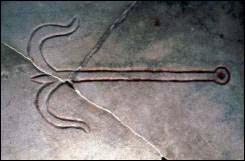 Anchor, IV sec. d.c., Catacomb of Priscilla, via Salaria Nova, Roma |
The anchor was an early Christian symbol commonly found in the Roman catacombs as a symbol of the hope we have in Christ beyond this life, and is a fitting inscription for a Christian tomb. The symbol doubtless comes from this verse:
"We have this hope as an anchor for the soul, firm and secure. It enters the inner sanctuary behind the curtain, where Jesus, who went before us, has entered on our behalf. He has become a high priest forever, in the order of Melchizedek." (Hebrews 6:19-20)
The anchor is found in the first century cemetery of St. Domitilla, the second and third century epitaphs of the catacombs, and especially in the oldest parts of the cemeteries of Sts. Priscilla (about 70 examples in this cemetery alone), Domitilla, Calixtus, and the Coemetarium majus.
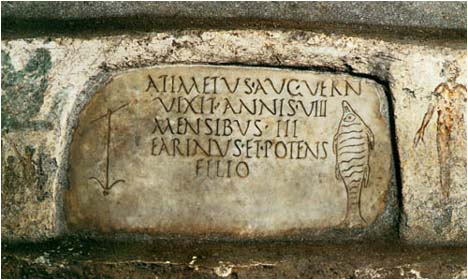 Christian Roman epitaph of Atimetus from the catacombs of St. Sebastian on the Via Appia, Rome. Inscription flanked by Christian symbols, an anchor and a fish. |
- Petroglyphs from catacomb di S. Callisto. Anchor, and other symbols.
- Chi-rho, Fish, and Anchor symbols, Catacombs of St. Sebastian.
- Good shepherd, Chi-Rho, swastika, anchor, fish, and ichthus from Catacombs of St. Sebastian, Rome
"When the early Christians did represent the sign of the cross on their monuments, nearly all sepulchral in character, they felt obliged to disguise it in some artistic and symbolical way. One of the oldest of the symbols of the cross is the anchor. Originally a symbol of hope in general, the anchor takes on in this way a much higher meaning: that of hope based on the Cross of Christ. The similarity of the anchor to the cross made the former an admirable Christian symbol." (Orazio Marucchi, "Archaeology of the Cross and Crucifix," Catholic Encyclopedia (1908), Vol. 4)
In some anchors, the "stock" at the top of the anchor reminded Christians of a cross.
Large iron anchors were found in the Mediterranean as early as the third century B.C. Ancient anchor.
Maurice M. Hassett, The Anchor (as Symbol), Catholic Encyclopedia (1907), vol. 1.
Copyright © 2026, Ralph F. Wilson. <pastor joyfulheart.com> All rights reserved. A single copy of this article is free. Do not put this on a website. See legal, copyright, and reprint information.
 To be notified about future articles, stories, and Bible studies, why don't you subscribe to our free newsletter, The Joyful Heart, by placing your e-mail address in the box below. We respect your