|
Old Testament
New Testament
Gospels
Acts
Paul's Letters
General Letters
Revelation
Topical Studies
Beginning the Journey (for new Christians). en Español

|
Old Testament
New Testament
Gospels
Acts
Paul's Letters
General Letters
Revelation
Topical Studies

|
Home
Bible Studies
Articles
Books
Podcasts
Search
Menu
Donate
About Us
Contact Us
FAQ
Sitemap


10. The God of All Grace
Audio (25:34)
Free
E-mail Bible Study
 Names and Titles of God
Home | Bible Studies | Articles | Books | Podcasts | Search | Menu | Donate | About Us | FAQ | Contact Us
|
|
You may recall that God gave Moses the first set of tablets engraved with the Ten Commandments, which Moses soon shattered in anger when he saw the people worshipping a golden calf built in his absence (Exodus 24:12; 32:15-19).
After dealing with the Israelites' idolatry, Moses is called to return to Sinai, bringing two blank stone tablets in his hands.
"5 Then the LORD came down in the cloud and stood there with him and proclaimed his name, the LORD. 6 And he passed in front of Moses, proclaiming, ‘The LORD, the LORD, the compassionate and gracious God, slow to anger, abounding in love and faithfulness, 7maintaining love to thousands, and forgiving wickedness, rebellion and sin. Yet he does not leave the guilty unpunished; he punishes the children and their children for the sin of the fathers to the third and fourth generation.'" (Exodus 34:1-7, NIV)
I've heard people characterize the God of the New Testament as loving and forgiving and the God of the Old Testament as angry and judgmental. They are wrong! God hasn't changed, and his mercy has been abundant ever since he first revealed himself to man. Our passage is evidence of that.
The context is one of grace and mercy. Though the people have sinned in worshipping the golden calf, God is gracious. After justice and repentance on the part of the people, God gives a second set of the Ten Commandments on stone tablets.
That the awesome God of the Universe would be so patient as to prepare a second set of tablets is a very vivid reminder of Yahweh‘s grace.
The Compassionate and Gracious, Rich in Love and Faithfulness (Exodus 34:5-6)
God proclaims his character before Moses:
5 "Then the LORD came down in the cloud and stood there with him and proclaimed his name, the LORD. 6 And he passed in front of Moses, proclaiming, ‘The LORD, the LORD, the compassionate and gracious God, slow to anger, abounding in love and faithfulness....'" (Exodus 34:5-6)
Carl Friedrich Keil summed it up well:
"All the words that the language contained to express the idea of grace in all its varied manifestations to the sinner, are crowded together here, to reveal the fact that in His inmost being God is love...."258
Let's look at some of the "grace words" compressed into this passage in greater detail:
"Compassionate" (NIV), "merciful" (KJV, NRSV), "tenderness" (NJB), is rachûm, "compassionate, merciful," an adjective used only of God. It is from the root rācham, "love deeply, have mercy, be compassionate," which refers to a deep love (usually of a "superior" for an "inferior") rooted in some natural bond.259
"Gracious" (NIV, NRSV, KJV) and "compassion" (NJB) is channûn, "gracious," from the verb chānan, "be gracious, to pity, "depicting "a heartfelt response by someone who has something to give to one who has a need." The adjective channûn occurs 13 times, 11 times in combination with rachûm, "merciful."260 Found more than 60 times in the Old Testament, the verb chānan denotes "kindness or graciousness in action, often expressed as a gift. In the majority of occurrences of chānan, God is the subject who offers grace, a gift that presupposes lack or need in the human recipients."261
"Love" (NIV), "steadfast love" (NRSV), "faithful love" (NJB), and "goodness" (KJV) are chesed (ḥesed), "kindness, lovingkindness, mercy." The exact meaning of chesed has been the object of some controversy. It is often paired with nouns like mercy, with the implication that chesed is one of the words descriptive of the love of God. Some, on the other hand, see the core of its meaning in fidelity to covenantal obligations real or implied, the ethically binding relationships of relatives, hosts, allies, friends, and rulers.262 Perhaps the best definition of chesed is: intense loyalty and kindness within a relationship, especially when it surpasses ordinary kindness or is undeserved.263 Scholars have characterized it in different ways.
- "Tenacious fidelity in a relationship, readiness and resolve to continue to be loyal to those to whom one is bound" -- Brueggemann264
- "The disposition of one person toward another that surpasses ordinary kindness and friendship; it is the inclination of the heart to express 'amazing grace' to the one who is loved -- Heath265
- "The intentional kindness, generosity or loyalty of a superior to an inferior, especially when it is undeserved."-- Oswalt266
- "The word that most often serves as a substantive for grace in the Old Testament" -- Duffy267
"Faithfulness" (NIV, KJV, NRSV) and "constancy" (NJB) is ‘ĕmet, "firmness, truth, verity," from the root, ‘āman. ‘Ĕmet carries an underlying sense of certainty, dependability. It is often coupled with another attribute of God, chesed, "lovingkindness, mercy, love."268
This verse describes the God of all grace -- compassionate, gracious, loving, faithful. These words form the core of this passage, which is repeated again and again in the Old Testament and the New as a summary statement of God's core character.269
Forgiving Wickedness, Rebellion and Sin (Exodus 34:7a)
This compassion, grace, works itself out in forgiveness: The passage continues:
"... Maintaining love (chesed) to thousands, and forgiving wickedness, rebellion and sin...." (Exodus 34:7a)
"Forgiving" is nāsā', has three separate meanings, (1) "to lift up, (2) "to bear, carry, support," and, as in this verse, (3) "to take, take away." Here the word stresses "the taking away, forgiveness, or pardon of sin, iniquity, and transgression." Often nāsā' is used in prayers of intercession. Sin can be forgiven and forgotten because it is taken up and carried away.270 And just what does God forgive? Sins most heinous:
"Wickedness" (NIV) and "iniquity" (KJV, NRSV) is ‘āwōn. Its root verb has cognates to an Arabic word for "bend, twist" and Aramaic, "offense, iniquity." ‘Āwōn means "iniquity, infraction, crooked behavior, perversion, etc."271
"Rebellion" (NIV) and "transgression" (KJV, NRSV) is pesha', "rebellion, revolt, transgression." The fundamental idea of the root is a breach of relationships, civil or religious, between two parties, a casting off of allegiance, a rebellion against rulers.272
"Sin" is chattā't, the principal word for sin in the Old Testament occurring 580 times. The basic meaning is to miss a mark or a way.273
As I look at this comprehensive list of sins that God forgives, I don't see anything left out -- perversion, wickedness, rebellion against God, sin of all kinds. Wow! God's amazing grace prevails.
Q1. Why was God's willingness to forgive essential to Israel's survival in the wilderness? Was Israel contrite after turning away from the Lord in Exodus 34? What is so amazing about God's forgiveness?
Not Clearing the Guilty (Exodus 34:7b)
But how do we understand the next verse?
"... Yet he does not leave the guilty unpunished; he punishes the children and their children for the sin of the fathers to the third and fourth generation." (Exodus 34:7b) (NIV)
"Leave unpunished" (NIV) or "clear" (KJV, NRSV) is nāqā, "be clear, free, innocent, desolate, cut off." The original sense of the word was probably "empty out." The root nāqā has the meaning "to be clean, pure, spotless," with the derived juridical notion, "to be acquitted, to go unpunished."274
So "the guilty" will not go unpunished. And you and I are certainly guilty. But notice carefully, the words "the guilty" are not actually in the Hebrew text, as indicted by italics in the KJV. So who is he speaking about? Those who reject or ignore his offer of pardon.275 Keil gets the sense of this passage when he says:
"But that grace must be not perverted by sinners into a ground of wantonness, justice is not wanting even here with its solemn threatenings, although it only follows mercy, to show that mercy is mightier than wrath, and that holy love does not punish till sinners despise the riches of the goodness, patience, and long-suffering of God."276
To those who humble themselves in repentance, the gracious God offers pardon. But those who refuse to receive mercy, they will receive the just punishment for their sins. Not only they, but their children. The phrase, "to the third and fourth generation" is "a typical Semitic idiom denoting continuity, not to be understood in an arithmetical sense."277
I don't see this as a curse on unrepentant sinners so much as a statement of the truth that our sins are modeled for and copied by our children, and their children, and theirs through the generations. We must break the cycle. We must repent and submit to God -- for our sake and for our children's children.
Faithful God
We've seen most of the important "grace words" in Exodus 34:6. Now let's examine them as descriptors of God in other passages. First, he is the Faithful God.
"Know therefore that the LORD your God is God, the faithful God who maintains covenant loyalty with those who love him and keep his commandments, to a thousand generations." (Deuteronomy 7:9)
"Faithful" is ‘āman, "to confirm, support, uphold (Qal); to be established, be faithful (Niphal)... The basic root idea is firmness or certainty.... The Niphal participle means ‘to be faithful, sure, dependable.'"278 Here's another verse using this description of the Faithful God:
"The Rock, his work is perfect,
and all his ways are just.
A faithful God, without deceit,
just and upright is he...." (Deuteronomy 32:4, NRSV)
The KJV translates it literally, "a God of truth" while NIV and NRSV render it "faithful God." The noun is ‘ĕmûnâ, from the root ‘āman, that we considered in the previous verse. ‘Ĕmûnâ means "firmness, fidelity, steadiness."279 It is frequently listed among the attributes of God (Psalm 36:5; 40:10). The hymn "Great Is Thy Faithfulness" is built around this word as it appears in Lamentations 3:23. "Faithfulness" also describes God's works (Psalm 33:4) and words (Psalm 119:86; 143:1). Here's a passage of Scripture that was on Jesus' lips as he died.
"Into your hand I commit my spirit;
you have redeemed me,
O LORD,
faithful God." (Psalm 31:5, NRSV)
The NIV and KJV render this verse "God of truth," ‘ĕmet, from the same root, ‘āman. ‘Ĕmet means "firmness, truth, verity." The word carries an underlying sense of certainty, dependability. It is often coupled with another attribute of God, chesed, "lovingkindness, mercy, love."280 One more scripture:
"But the LORD is
the true God;
he is the living God, the eternal King. (Jeremiah 10:10)
"True" is ‘ĕmet that we saw in Exodus 34:6. Here the context suggests "true" rather than "faithful." Let's look at one final scripture on faithfulness. It doesn't have a descriptor of God but it contains an encouraging truth that helps us understand the character of God's faithfulness -- and his mercy to us:
"If we are faithless,
he will remain faithful,
for he cannot disown himself." (2 Timothy 2:13)
He is the faithful God. He keeps his word. His character demands his trustworthiness.
Q2. What does faithfulness have to do with trustworthiness and keeping one's word? What does the Faithful God inspire in you? Why must faithfulness be part of our character as believers?
Forgiving God
Twice we see the phrase "Forgiving God," in verses that are paraphrasing Exodus 34:6-7. In Psalm 99:8, the verb again is nāśā', "take away, forgive," which we saw above.
"O LORD our
God, you answered them;
you were a forgiving God[281]
to them." (Psalm 99:8)
"But you are a forgiving God,
gracious and compassionate,
slow to anger and abounding in love." (Nehemiah 9:17, NIV only)
"Forgiving God" (NIV), "a God ready to pardon" (KJV), "a God ready to forgive" (NRSV) uses the noun selîchâ , "forgiveness," which is used only two other places in the Bible (Psalm 130:4; Daniel 9:9). It comes from the verb sālach, which is used in the Scripture solely of God's offer of pardon and forgiveness to the sinner.282 Micah sees such a readiness to forgive as marvelous:
"Who is a God like you, who pardons sin and forgives the transgression of the remnant of his inheritance? You do not stay angry forever but delight to show mercy. You will again have compassion on us; you will tread our sins underfoot and hurl all our iniquities into the depths of the sea." (Micah 7:18-19)
In the Old Testament, individuals found forgiveness through the sacrificial system performed in the tabernacle and later in the temple. But we know that "it is impossible for the blood of bulls and goats to take away sins" (Hebrews 10:4).
In a sense, God rolled all those sins forward until Christ came. Then they were paid in full on the cross by Jesus, "the Lamb of God, who takes away the sin of the world" (John 1:29). In the ancient prophecy of Isaiah:
"5 But he was pierced for our
transgressions,
he was crushed for our iniquities;
the punishment that brought us peace was upon him,
and by his wounds we are healed.
6 We all, like sheep, have gone astray,
each of us has turned to his own way;
and the Lord has laid on him
the iniquity of us all." (Isaiah 53:5--6)
We are wrong, however, if we look at forgiveness in a cold, transactional manner. We are forgiven because in God's great love and compassion he found a way to be both just and forgiving. The answer is in sending his Son, Jesus Christ, to the cross.
"For God so loved the world that he gave his only begotten Son, that whosoever believes in him should not perish, but have everlasting life." (John 3:16)
It is the Father‘s mission of love, at the cost of his dear Son, and mediated to each of us by the Holy Spirit.
Loving God
He is a loving God indeed! The Apostle John nearly makes God synonymous with "love" in his famous verse: "God is love" (1 John 4:8, 16). No wonder God bends over backwards to help us.
"O my Strength, I watch for you;
you, O God, are my fortress, my
loving God."283
(Psalm 59:10, NIV)
"He is my loving God284
and my fortress,
my stronghold and my deliverer,
my shield, in whom I take refuge...." (Psalms 144:2, NIV)
"... And the God of love and peace will be with you." (2 Corinthians 13:11, NIV)
We'll consider the "God of Peace" (Romans 15:33; 16:20; 1 Thessalonians 5:23; Hebrews 13:20) in chapter 11 when we consider God our Savior and Redeemer.
God is called the "Father of compassion" (NIV) and "Father of Mercies" (NRSV, KJV) in 2 Corinthians 1:3. The noun is oiktirmos, "display of concern over another's misfortune, pity, mercy, compassion."285
Q3. How does God's steadfast love in the Old Testament relate to his mission of love in John 3:16?
Gracious God
|
|
Because he is loving, he is also gracious, a God who delights to give generously to those who are needy and have no way to repay.
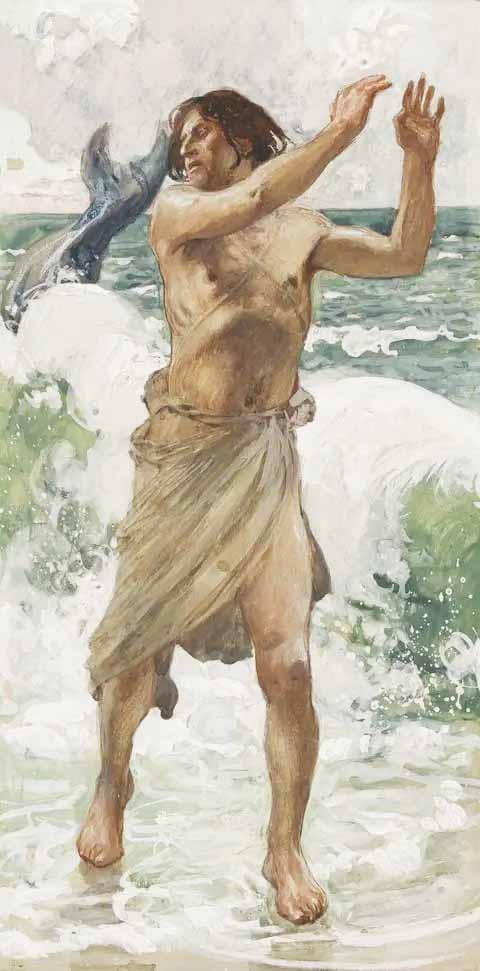
God sends Jonah to preach repentance to Nineveh, capital city of Israel's arch enemy Assyria. Rather than obey, Jonah goes the opposite direction. He is thrown overboard, swallowed by a fish, and unceremoniously vomited out on a beach. This time Jonah goes to Nineveh -- but against his will! He is afraid that if he preaches to the Ninevites and they repent that God will forgive them -- and Jonah hates them too much to want to see that happen.
"That is why I fled to Tarshish at the beginning; for I knew that you are a gracious God and merciful, slow to anger, and abounding in steadfast love (chesed), and ready to relent from punishing. (Jonah 4:2, NRSV)
NIV translates it "gracious and compassionate God." The words, "gracious" (channûn) and merciful (rachûm), we saw earlier in Exodus 34:6. He is called "a gracious and merciful God" in both Deuteronomy 4:31 and Nehemiah 9:31.
The God of all Grace
One of my favorite descriptors for God is "the God of All Grace."
"And the God of all grace, who called you to his eternal glory in Christ, after you have suffered a little while, will himself restore you and make you strong, firm and steadfast." (1 Peter 5:10)
"Grace" (charis) here means, "a beneficent disposition toward someone, favor, grace, gracious care or help, goodwill."286 Grace is that quality of giving freely to a person or a people out of one's own favor, not based on anything deserving about the recipient. When you consider the selfishness, pettiness, cruelty, and deep iniquity of Israel -- or of any nation or person -- God's grace is highlighted in stark relief. The classic passage in scripture that describes his grace is from Paul:
"For it is by grace you have been saved, through faith -- and this not from yourselves, it is the gift of God -- not by works, so that no one can boast." (Ephesians 2:8-9)
Grace is all about God and not about us.
Q4. (1 Peter 5:10) How has God shown his grace to you and your family? Why do you think Peter describes him as the God of all grace?
God of Hope and Encouragement
Because of God's bent of love and forgiveness towards us, he is also the "God of Hope":
"May the God of hope fill you with all joy and peace as you trust in him, so that you may overflow with hope by the power of the Holy Spirit." (Romans 15:13, NIV)
Contrast this with the sad diagnosis of those outside of the Kingdom -- "without hope and without God in the world" (Ephesians 2:12). God is present to encourage us:
"May the God of steadfastness and encouragement grant you to live in harmony with one another, in accordance with Christ Jesus...." (Romans 15:5, NRSV)
"Steadfastness" (NRSV), "endurance" (NIV), "perseverance" (NJB), and "patience"(KJV) is the Greek noun hypomonē, "patience, endurance, fortitude, steadfastness, perseverance, the capacity to hold out or bear up in the face of difficulty."287 The word "encouragement" (NRSV, NIV, NJB) and "consolation" (KJV) is paraklēsis, probably carries the flavor of two related meanings: (1) "the act of emboldening another in belief or course of action, encouragement" and (2) lifting of another's spirits, comfort, consolation."288 The same word, paraklēsis, is found in the title "the God of all comfort" (2 Corinthians 1:3).

Why is God so encouraging, so comforting? Some people love to quote the adage: "Life is hard and then you die." But God sees beyond trouble, sickness, and death. He sees beyond your present hardship.
"‘For I know the plans I have for you,' declares the LORD, ‘plans to prosper you and not to harm you, plans to give you hope and a future.'" (Jeremiah 29:11)
Our Faithful and Loving God sees us with him forever in Paradise. And for the God who loves us with an everlasting love, and for us who are beginning to understand how to love him and reach out to him with our hearts, to be with him forever will be grand and marvelous indeed!
Prayer
Father, thank you for your great, great love. Thank you for your willingness to forgive us when we don't deserve it. Thank you for your compassion that feels our hurts. Thank you for your patience that sees beyond the present. Thank you that you have for us a future and a hope. In Jesus' name, we pray. Amen.
Names of God
- Compassionate and Gracious God
- Faithful God, God of Truth
- Father of Compassion
- Forgiving God
- God of All Comfort
- God of All Grace
- God of Hope
- God of Love and Peace
- God of Steadfastness and Encouragement
- Gracious God and Merciful, Gracious and Compassionate God
- Loving God
- True God
Songs
In this section I'm focusing on songs that lift up the Father‘s love, rather than songs that focus mainly on Jesus' love.
"Amazing Grace," words by John Newton (1779), music in Virginia Harmony by James Carrell and David S. Clayton (1831)
"Dear Lord and Father of Mankind" (... forgive our foolish ways....), words by John G. Whittier (1872), music by Frederick C. Maker (1887)
"Grace that is Greater than Our Sin," words by Julia H. Johnston (1911), music by Daniel B. Towner (1910)
"Great Is Thy Faithfulness" ("Pardon for sin and a peace that endureth...."), words by Thomas O. Chisholm (1923), music by William M. Runyan (1923), (© 1923, 1951, Hope Publishing Co.)
"He Giveth More Grace," words by Annie Johnston Flint, music by Hubert Mitchell (© 1941, 1969, Lillenas Publishing Company, Admin by the Copyright Company)
"Joyful, Joyful, We Adore Thee" ("God of glory, Lord of love ... Thou art giving and forgiving...."), words by Henry J. van Dyke (1907), music "Hymn to Joy," from Beethoven's 9th Symphony, adapted by Edward Hodges (1824)
"Love Divine, All Loves Excelling," words by Charles Wesley (1747), music by John Zundel (1870)
"O for a Thousand Tongues to Sing" (... my great Redeemer‘s praise...."), words by Charles Wesley (1739), music by Carl G. Gläser (1828)
"O Love that Wilt Not Let Me Go," words by George Matheson (1882), music by Albert L. Peace (1884)
"The Love of God Is Greater Far," words by Frederick M. Lehman (1917), music by Claudia L. Mays (1917).
"There Is a Wideness in God's Mercy," words by Frederick W. Faber (1854), music by Lizzie Tourjee (1878)
"The Steadfast Love of the Lord" (Lamentations 3:22), words and music by Edit McNeill (© 1974, 1975, Celebrations Services)
"What Wondrous Love Is This?" words attributed to Alexander Means, music by William Walker (1835)
Endnotes
[258] C.F. Keil, Exodus, Keil & Delitzsch, in loc.
[259] Leonard J. Coppes, rācham, TWOT #2146.
[260] Edwin Yamauchi, chānan, TWOT #694d.
[261] Elaine A. Heath, "Grace," DOTP 371-375, especially p. 372.
[262] When it comes to God, does his chesed arise from fidelity to his covenants or to his everlasting love? R. Laird Harris (chesed, TWOT #698a) concludes that "it is obvious that God was in covenant relation with Israel, also that he expressed this relation in chesed, that God's chesed was eternal.... However, it is by no means clear that chesed necessarily involves a covenant or means fidelity to a covenant. Stoebe argues that it refers to an attitude as well as to actions. This attitude is parallel to love, goodness, etc. It is a kind of love, including mercy, when the object is in a pitiful state. It often takes verbs of action, 'do,' 'keep,' and so refers to acts of love as well as to the attribute. The word 'lovingkindness' of the KJV is archaic, but not far from the fullness of meaning of the word." Important scholarly studies of hesed in the Old Testament include a seminal study by Nelson Glueck, Ḥesed in the Bible (1927); later corrections by Katharine Dobb Sakenfeld, The Meaning of Hesed in the Hebrew Bible: A New Inquiry (Harvard Semitic Monographs, vol. 17; Missoula, Montana: Scholars Press, 1978); and Gordon R. Clark, The Word Hesed in the Hebrew Bible (Journal for the Study of the Old Testament, Supplement Series 157; Sheffield, JSOT Press, 1993).
[263] Though this is the basic idea, the semantic range of ḥesed is broad. Whitley concludes, "Primarily denoting strength or might, the concept developed to include such notions as fortitude, confidence, pledge, resolution, and health" (Charles F. Whitley, "The Semantic Range of Hesed," Biblica, Vol. 62, No. 4 (1981), pp. 519-526).
[264] Walter Brueggemann, Theology of the Old Testament: Testimony, Dispute, Advocacy (Fortress Press, 2005), p. 217, cited by D. I. Block, "God," DOTHB, p. 343.
[265] E. A. Heath, "Grace," in DOTP, p. 372.
[266] John N. Oswalt, "God," DOTWPW, p. 248.
[267] Steven J. Duffy, The Dynamics of Grace: Perspectives in Theological Anthropology (Collegeville, MN: Liturgical Press, 1993), p. 20, cited by cited by E. A. Heath, "Grace," in DOTP, p. 372. See also James A. Montgomery, "Hebrew Hesed and Greek Charis," Harvard Theological Review (Vol 32, No. 2), April 1939, pp. 97-102.
[268] Jack B. Scott, 'āman, TWOT #116k.
[269] Numbers 14:18; Nehemiah 9:17; Psalm 86:15; 103:8; 111:4; 112:4; 116:5; 145:8; Joel 2:13; Jonah 4:2; Nahum 1:7; 2 Chronicles 30:9.
[270] Walter C. Kaiser, nāsā', TWOT #1421.
[271] Carl Schultz, ‘āwā, TWOT #1577a.
[272] G. Herbert Livingston, pāsha‘, TWOT #1846a.
[273] G. Herbert Livingston, chātā', TWOT #638c.
[274] Milton C. Fisher and Bruce K. Waltke, nāqā, TWOT #1412.
[275] God does discipline us. "I will not completely destroy you. I will discipline you but only with justice; I will not let you go entirely unpunished" (Jeremiah 46:28, NIV). But in Exodus 34:7 there is a contrast between those for whom he forgives rebellion and those whom he does not forgive.
[276] C.F. Keil, Exodus, Keil & Delitzsch, in loc. Brevard S. Childs (Exodus, p. 602) translates the phrase, "Yet he does not remit all punishment...." John I. Durham, Exodus (Word Biblical Commentary 3; Word, 1987), p. 450, "... certainly not neglecting just punishment...."
[277] Cole, Exodus, p. 156.
[278] Jack B. Scott, 'āman, TWOT #116.
[279] TWOT #116e.
[280] TWOT #116k.
[281] KJV, "thou wast a God that forgavest them...."
[282] Walter C. Kaiser, sālach, TWOT #1505c.
[283] "Loving God" is translated by the KJV as "God of my mercy" and "My God in his steadfast love will meet me" in the NRSV. The same phrase occurs in verse 17.
[284] The KJV renders it "my goodness," while the NRSV renders it "my rock," follows the parallel passages in Psalm 18:2 and 2 Samuel 22:2, rather than the Hebrew text, "my chesed."
[285] Oiktirmos, BDAG 700.
[286] Charis, BDAG 1079-1081.
[287] Hypomonē, BDAG 1039-1040.
[288] Paraklēsis, BDAG 766.
Copyright © 2026, Ralph F. Wilson. <pastor joyfulheart.com> All rights reserved. A single copy of this article is free. Do not put this on a website. See legal, copyright, and reprint information.
 To be notified about future articles, stories, and Bible studies, why don't you subscribe to our free newsletter, The Joyful Heart, by placing your e-mail address in the box below. We respect your