Free E-Mail
Bible Studies
 King
Solomon
King
SolomonBeginning the Journey (for new Christians). en Español
Old Testament
Abraham
Jacob
Moses
Joshua
Gideon
David, Life of
Elijah
Psalms
Solomon
Songs of Ascent
(Ps 120-135)
Isaiah
Advent/Messianic Scriptures
Daniel
Rebuild & Renew: Post-Exilic Books
Gospels
Christmas Incarnation
(Mt, Lk)
Sermon on the Mount
(Mt 5-7)
Mark
Luke's
Gospel
John's Gospel
7 Last Words of Christ
Parables
Jesus and the Kingdom
Resurrection
Acts
The Early Church
(Acts 1-12)
Apostle Paul
(Acts 12-28)
Paul's Epistles
Christ Powered Life (Rom 5-8)
1 Corinthians
2 Corinthians
Galatians
Ephesians
Vision for Church
(Eph)
Philippians
Colossians,
Philemon
1
& 2 Thessalonians
1 & 2 Timothy,
Titus
General Epistles
Hebrews
James
1 Peter
2 Peter, Jude
1, 2, and 3 John
Revelation
Revelation
Conquering Lamb of Revelation
Topical
Glorious Kingdom, The
Grace
Great Prayers
Holy Spirit, Disciple's Guide
Lamb of God
Listening for God's Voice
Lord's Supper
Names of God
Names of Jesus
Christian Art
About Us
Speaking
Contact Us
Dr. Wilson's Books
Donations
Watercolors
Sitemap

5. The Costliness of the Kingdom (Matthew 13:44-46; Mark 10:17-24)
by Dr. Ralph F. Wilson| Audio (33:31)
 King Solomon: Wisdom, Wealth, Weakness
|
|
In this lesson we'll consider two short parables and one famous incident that will help us hear the undomesticated Gospel of the costliness of the Kingdom..
To begin, in the collection of Jesus' parables found in Matthew 13, the Gospel writer records twin parables -- the Parable of the Hidden Treasure (Matthew 13:44) and the Parable of the Pearl of Great Price (Matthew 13:45-46). Both are short -- only a sentence or two long -- and both have a similar teaching about the costliness of the Kingdom. Let's examine them in greater detail.
The Parable of the Hidden Treasure (Matthew 13:44)
"The kingdom of heaven is like treasure1 hidden2 in a field. When a man found it, he hid it again, and then in his joy went and sold all he had and bought that field."(Matthew 13:44)
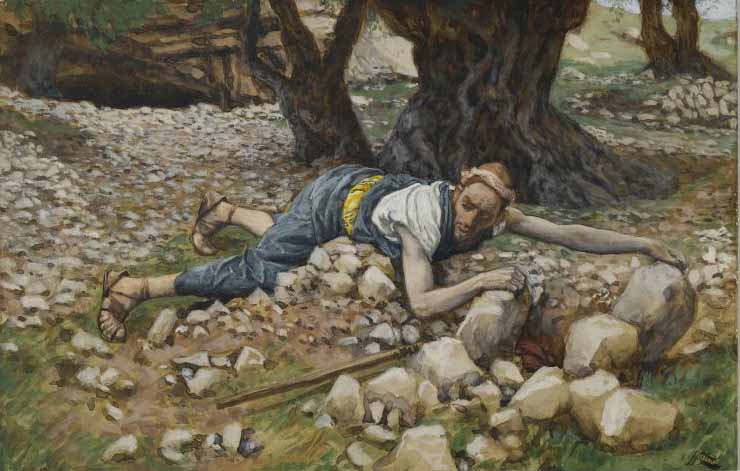
In our day, we can store treasure in the bank or in a safe deposit box. But in Jesus' day, burying treasure was an extremely common way of safeguarding it. In fact, according to rabbinical law, burying a treasure was the most secure way of protecting it.3 One's treasure might be stolen by thieves or plundered by foreign invading armies. But if it were hidden skillfully, rarely it be detected.
|
|
But people often died in such invasions or passed on without disclosing the location of the treasure to a relative. In that case, a hoard of coins or jewels buried in a pottery jar might be discovered that would make its finder rich. Today people dream of getting rich by winning the lottery, but ancient literature is full of stories of people finding buried treasure and becoming fabulously wealthy. Jesus' story along this theme would have captured the imagination of his listeners.
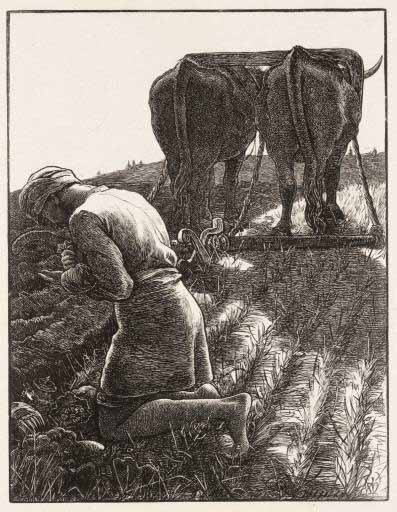
In Jesus' story, a man found the treasure in a rural field.4 Perhaps he was employed as a laborer and his plow hit the container. Or perhaps erosion had uncovered a portion of the treasure. We just don't know.
But when the man finds the treasure he is overcome with joy. He buries the treasure again so that no one else can find it. Then he sells everything he has and buys the field.
Some have questioned the ethics of the man's purchase without disclosing the treasure, but ethics weren't Jesus' point. And according to rabbinical law, it might have been possible to claim legal ownership of personal property that had been found on another's land, but if he had been on the land as an agent or employee of another (say a farm hand), his legal right might have been clouded.5 Therefore, the man didn't take the treasure, but reburied it to hide and protect it, and then purchased6 the land; thus his action was both legal and reasonable. It's quite possible that the original owner of the treasure had died decades or centuries before.
But none of that is Jesus' point. There are two keys to understanding this parable:
- "In his joy..."and
- "sold all he had and bought that field."
Jeremias observes:
"When that great joy, surpassing all measure, seizes a man, it carries him away, penetrates his inmost being, subjugates his mind. All else seems valueless compared with that surpassing worth. No price is too great to pay."7
In the parable, the man's joy is in his good fortune of finding a huge treasure hoard that will make him rich for life. Anything he spends to gain legal right to that treasure is worth it, since the value is so exceedingly much greater. The emphasis here is on the importance of parting with everything we have and own in order to obtain something inestimably greater. This is not a parable about buying salvation, but the incredible value of salvation that far surpasses any amount a poor man might be able to scrape together to try to acquire it.
Parable of the Pearl of Great Price (Matthew 13:45-46)
While the subject of the Parable of the Hidden Treasure is a poor man who can barely scrape up enough money to purchase a piece of land, the subject of the next parable is a wealthy man.
"45Again, the kingdom of heaven is like a merchant looking for fine pearls. 46 When he found one of great value, he went away and sold everything he had and bought it."(Matthew 13:44-46)
He is called a "merchant."The word is emporos, "'one who boards a ship as passenger', then, especially one who travels by ship for business reasons, merchant."Here it "denotes a wholesale dealer in contrast to kapēlos, retailer."8 He specialized in searching for9 and acquiring fine pearls, which he would then sell to retailers. He was doubtless a wealthy man who was used to spending and receiving large sums of money.
|
|
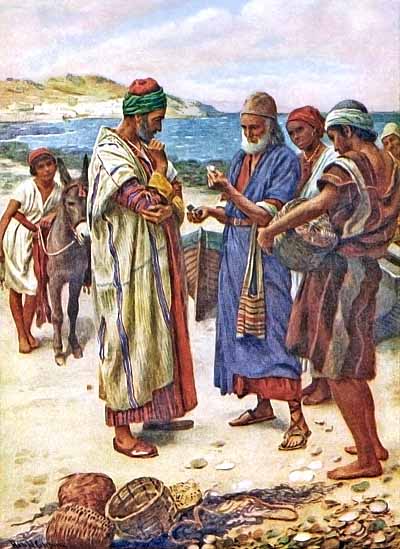
Pearls were highly valued in ancient times. This was before the time of cultured pearls, so pearls were not plentiful. They were regarded as precious stones in antiquity, taken by divers from the Red Sea, the Persian Gulf, and the Indian Ocean. Pearls were used for necklaces and other ornaments, and could be extremely costly, so the word "pearl"came to be a figure of speech for something of supreme worth.10 Ancient literature tells of pearls worth millions of dollars. Caesar presented Brutus'mother with a pearl worth 6 million sesterces (hundreds of thousands of dollars). Cleopatra is said to have possessed a pearl worth 100 million sesterces.11
Thus when the pearl merchant in Jesus' parable finds one "pearl of great price"(KJV), "great value"(NIV, NRSV),12 he leaves the potential seller of this huge pearl, liquidates all his assets down to the last penny -- "sold everything he had"-- and then rushes back to buy the wonderful pearl that has enchanted him.
Jesus' point in the Parable of the Pearl of Great Price is similar to the Parable of the Hidden Treasure. When you find such a valuable pearl, it is worth selling everything you own to obtain it, whether to admire, as some contend,13 or to sell for a much greater profit. When you find the ultimate pearl, you spare nothing to make it your own.
|
Q1. (Matthew 13:44-46) What do the Parables of the Hidden Treasure and Pearl of Great Price have in common? What is the main point of these parables? How should it affect our values? Our lives?https://www.joyfulheart.com/forums/index.php?showtopic=1009
|
The Rich Young Ruler (Mark 10:18-23)
A third way the Gospels teach about the great value of the Kingdom is in the incident of the rich young ruler, where Jesus observes, "How hard it is for the rich to enter the kingdom of God!"(Mark 10:23)
This incident is a troubling one. It was troubling for the disciples, for the wealthy young ruler, and for us. It seems too radical, too abrupt, too ... well, too immoderate to suit our tastes. But it's easy to miss the truth when it is delivered in moderation. The truth, however, can be unmistakable when delivered unvarnished, undiluted. And that kind of powerful truth-telling is what Jesus is known for. It begins earnestly enough:
"As Jesus started on his way, a man ran up to him and fell on his knees before him."(Mark 10:17a)
Jesus is about to leave the town. It is the man's last chance to ask his question, to meet Jesus face-to-face. And so he runs up to him and falls on his knees before him. It is a picture of urgency and humility.
Profile of the Rich Young Ruler
Luke calls this man a "ruler,"archōn, generally, "one who has administrative authority, leader, official."It is used of various Jewish leaders, including those in charge of a synagogue and members of the Sanhedrin.14
|
|
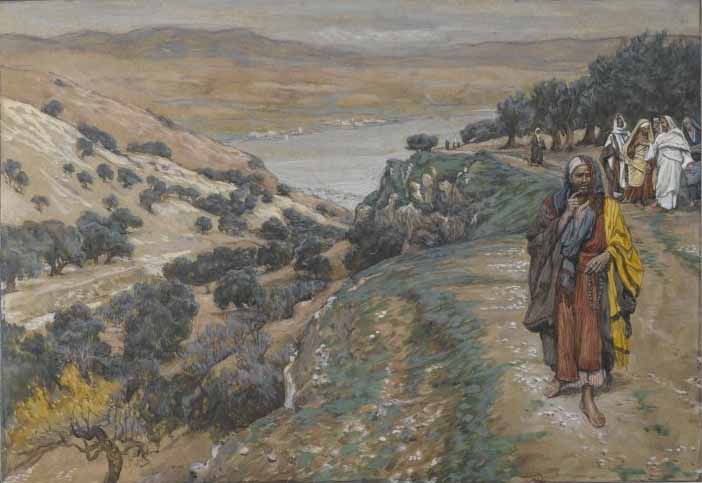
Matthew 19:22 adds another detail and refers to the ruler as a "young man,"Greek neaniskos, "a relatively young man, youth, young man (from about the 24th to the 40th year)."15 Luke 18:23 tells us "he was a man of great wealth.""Wealth"is Greek plousios, "pertaining to having an abundance of earthly possessions that exceeds normal experience, rich, wealthy."16 The adjective "great"translates Greek sphodra, "a very high point on a scale of extent, very (much), extremely, greatly."17
And so we have an earnest young man, wealthy -- very wealthy, indeed -- and probably because of his wealth and earnestness about spiritual matters, a person entrusted with governance in the synagogue, a ruler, a respected person in the community.
I see him in his fine robes, immaculately groomed, kneeling at Jesus' feet in the dirt of the roadside at the edge of town, with a burning question on his heart.
Inheriting Eternal Life (Mark 10:17b)
"'Good teacher,'he asked, 'what must I do to inherit eternal life?'"(Mark 10:17b)
Most of the wealthy, religious people who asked Jesus public questions were trying to trick him into some imprudent statement -- "Should we pay taxes to Caesar?"(Luke 20:22). "Why do your disciples pluck grain on the Sabbath?"(Luke 6:2). But this man's question was no trick. It was a sincere question to which he needed to know the answer -- how to inherit eternal life. The word translated "inherit"is Greek klēronomeō, "acquire, obtain, come into possession of something, inherit."18
The question tells us several things about the young man:
- He must be feeling inadequate in his spiritual preparation somehow or he probably wouldn't ask the question.
- He sides with the Pharisees rather than the Sadducees (another religious party in first century Judaism), since the Sadducees didn't believe in life after death, and this question clearly implies that he does.
- He believes that eternal life is something that one earns or merits by what he does.
Ask the common man or woman in your community and you'll probably come up with a similar belief. You go to heaven if you do good. You go to hell if you do bad things. Well, only very bad things. Eternal life is a reward for what you do on earth. That's what people tell you.
The young man's question betrays both his superficial understanding of inheriting eternal life, and his superficial understanding of a person's ability to do good deeds that are pure, unmixed by ulterior motives. The Prophet Isaiah's scathing words spoken 750 years before, "all our righteous acts are like filthy rags"(Isaiah 64:6), must have somehow escaped the young man.
Notice that in the brief scope of a few verses salvation is spoken of in various terms and figures: "eternal life"(Mark 10:17), "treasure in heaven"(10:21), "entering the Kingdom of God"(10:23), and "being saved"(10:26). These are used synonymously.
No One Is Good -- Except God Alone (Mark 10:18)
In this sincere young man's superficial way, he addresses Jesus as "good teacher,"a somewhat improper way to address a Rabbi. We don't see this expression elsewhere in Rabbinical literature until the fourth century. The word "good"in both verses 17 and 18 is Greek agathos, "pertaining to meeting a high standard of worth and merit, good."19
Jesus rebukes the young man concerning his careless address:
"'Why do you call me good?'Jesus answered. 'No one is good -- except God alone.'"(Mark 10:18)
The young man can't understand anything else Jesus will tell him unless he grasps that our relative standards of goodness are much, much different than God's absolute goodness and God's standards of righteousness.
Some have felt that, by these words, Jesus is somehow denying his own divinity. If Jesus had meant to do so, he would have replied simply that he was a sinner. But Jesus' divinity isn't the issue. Jesus is calling the young man to reflect on his words. Jesus is trying to teach him. Perhaps Jesus is trying to prompt him to reflect on who He is, too. As Jesus said to the woman at the well of Sychar, "If you knew ... who it is that asks you for a drink...."(John 4:10). But this rich man can't see, can't understand.
Comparisons to Jesus' Interview with Nicodemus
I can't help but recall another conversation Jesus had with an earnest Jewish ruler, Nicodemus, related for us in John's Gospel, that we'll study in Lesson 6:
"Now there was a man of the
Pharisees named Nicodemus, a member of the Jewish ruling council. He
came to Jesus at night and said, 'Rabbi, we know you are a teacher
who has come from God. For no one could perform the miraculous signs
you are doing if God were not with him.'
"In reply Jesus declared, 'I tell you the truth, no one can see the
kingdom of God unless he is born again.'"(John 3:1-3)
I notice three points of comparison:
- Both of them greet Jesus with gracious praise.
- Jesus' response is not the expected gracious reply, but seemingly off-the-wall, jarring, and unanticipated.
- Both exhibit lack of spiritual understanding.
Jesus doesn't exchange pleasantries with these men. He comes right to the point, he teaches, but in a completely unexpected way. In both cases, these rulers are hungry for spiritual guidance. But they need to abandon some dangerous presuppositions about their state before God before they will be able to understand any further truth.
Keeping the Commandments (Mark 10:19-20)
After pointing out the young man's inadequate understanding of "goodness,"Jesus proceeds to inquire more of this man's -- and his culture's -- measure of righteousness.
"'You know the commandments: Do not
murder, do not commit adultery, do not steal, do not give false
testimony, do not defraud, honor your father and mother.'
20 'Teacher,'he declared, 'all these I have kept since I
was a boy.'"(Mark 10:19-20)
The verb "kept"(NIV, NRSV), "observed"(KJV) is Greek phylassō, "to continue to keep a law or commandment from being broken, observe, follow."20 The commandments Jesus mentions all relate to the man's relationships with other people. Jesus will approach commandments that relate to God in another manner.
The young man's response is immediate: "All these I have kept since I was a boy"(Mark 10:20), and his answer should not surprise us. The Rabbis held that the law could indeed be kept in its entirety. This might be true if you were defining the commandments as the Pharisees did, but we know from the Sermon on the Mount (Matthew 5:17-48) that Jesus' view of keeping these commandments goes far beyond the legalistic interpretations of his time. In the Sermon on the Mount, Jesus relates murder to its root in anger and adultery to its root in lust.
Sell Everything, Give to the Poor (Mark 10:21)
The young man has kept all the commandments, but feels incomplete, a lack, or else he wouldn't have come to Jesus in the first place. Now Jesus speaks to the young man's point of need:
"Jesus, looking at him, loved him and said, 'You lack one thing; go, sell what you own, and give the money to the poor, and you will have treasure in heaven; then come, follow me.'"(Mark 10:21)
I am struck by Jesus' love here. Jesus isn't just engaged in verbal jousting. He loves this rich young man and is trying to help him be saved. This is tough love, but love strong and true.
Jesus affirms the young man's sense of need.21 Jesus' prescription, however, is unpalatable -- to the young man and to us. "Sell everything"and give the proceeds to the poor. The word translated "give"is Greek diadidōmi, "apportion among various parties, distribute, give."22
If the man does this, Jesus assures him, he will have treasure in heaven. "Treasure"is Greek thesauros, "that which is stored up, treasure,"23 which we saw in Matthew 13:44. It is an ironic exchange that Jesus proposes -- exchanging fabulous wealth here on earth for fabulous wealth in the Kingdom of God. Many in history have tried to buy their way into God's good graces. Many of the world's great cathedrals, temples, and mosques are inscribed with the names of generous benefactors. But Jesus is not proposing buying anything or doing anything glorious. He isn't proposing a massive contribution to the Jesus Christ Evangelistic Association that will spread the Gospel in perpetuity.
Jesus proposes that the man sell all his property and give the proceeds to those who are least able to reciprocate -- the poor. St. James is right when he characterizes true religion:
"Religion that God our Father accepts as pure and faultless is this: to look after orphans and widows in their distress and to keep oneself from being polluted by the world"(James 1:27).
How Money Corrupts
The truth is that money itself has a way of polluting us, that is, tempting us to compromise our values in order to gain and retain it.
"For the love of money is a root of all kinds of evil. Some people, eager for money, have wandered from the faith and pierced themselves with many griefs"(1 Timothy 6:10).
As we saw in Lesson 3, in the Sermon on the Mount, Jesus has taught his disciples about the importance of faithfulness to God as opposed to money: 24
"No one can serve two masters. Either he will hate the one and love the other, or he will be devoted to the one and despise the other. You cannot serve both God and Money."(Matthew 6:24)
Now his disciples have an object lesson to learn from -- an actual rich man, fabulously wealthy. Can he -- will he -- become a disciple?
Money, however, isn't the only thing that Jesus asks the young man to give up:
- Possessions, what money will buy, the accouterments of wealth. A new car, a nice house, a membership in the country club, and fashionable clothing.
- Status and influence that wealth affords. People make way for the wealthy, hoping that some of that wealth might rub off on them. At the very least, people kowtow to the wealthy to keep from becoming their enemies.
- Power. Wealth is power. It buys influence. It buys others who will make it easy for the wealthy to have their own way.
- Community leadership. The man isn't very likely to continue as a respected ruler without his wealth. If he gives up his wealth, he will be misunderstood and resented by the other influential people in his community. No, he won't be a ruler for long.
- Family. The young man probably comes from a wealthy family. But if he disposes of a huge chunk of the family wealth, will his siblings understand and accept it? Will his wife and family? His father or mother if they are still living?
How often have you been tempted to do things that were wrong or unethical or self-serving because of the lure of money, even a little bit of money? Money must either be controlled or it will control us. It is a sad thing when our possessions begin to possess us!
Why Jesus' Words Upset Us
But Jesus' words don't just upset the rich young ruler. They also upset us. As a pastor I have heard many times the response to this passage: "That doesn't mean everyone should sell what they have, does it? If everyone did that it would result in chaos."
Obviously. But why are we even worried with the question? Do we, too, feel possessive of what we have? Do we fear that Jesus may require us to do something that would cost us too much? What are we afraid of? And why do we fear?
We fear because we sense that we are not fully surrendered, that's why. Jesus' words to the rich young ruler are quite consistent with what he has been saying to his disciples throughout his journeys:
"If anyone comes to me and does not hate his father and mother, his wife and children, his brothers and sisters -- yes, even his own life -- he cannot be my disciple. And anyone who does not carry his cross and follow me cannot be my disciple."(Luke 14:26-27)
"In the same way, any of you who does not give up everything he has cannot be my disciple."(Luke 14:33)
"For whoever wants to save his life will lose it, but whoever loses his life for me will save it."(Luke 9:24)
"Whoever tries to keep his life will lose it, and whoever loses his life will preserve it."(Luke 17:33)
|
Q2. (Mark
10:21) Why do you think Jesus requires the rich young ruler
to divest himself of his fortune? Why does this trouble us
so much? If there was no other way for the man to be saved,
what does that say about the spiritual dangers of wealth?
|
Then Come, Follow Me (Mark 20:21b)
The story of the rich young ruler exposes a raw nerve in us that causes a reaction. But disposing of wealth was not all that Jesus asked the man to do.
"Jesus looked at him and loved him. 'One thing you lack,'he said. 'Go, sell everything you have and give to the poor, and you will have treasure in heaven. Then come, follow me.'"(Mark 10:21)
Jesus concludes with two commands. "Come"is Greek deuro, an adverb functioning as an interjection, "here, (come) here, come!"24 The word "follow"is the characteristic word of discipleship, Greek akoloutheō, "follow,"figuratively, "to follow someone as a disciple, be a disciple, follow."25
However, I don't think that the following Jesus invites this man to do is just figurative. Jesus looked at this man and loved him (Mark 10:21). I think Jesus is inviting the rich young man to join him on his journeys, to become one of the disciples who enjoy the immense and unspeakable privilege of spending time with Jesus and learning from him on a day-by-day basis. What a wonderful invitation!
But the invitation implicit to us is no less wonderful. We, too, are invited to come to Jesus, and then to follow him on a spiritual life journey. To enjoy his company, his presence. To be taught along the way by his Word and Spirit. To become part of his great extended family, the Body of Christ throughout the world. And to be filled with hope in the closing days of our journey as we know his promises and feel his comfort within us.
"Come, follow me,"is the invitation Jesus extends to you and me.
He Became Very Sad (Mark 10:22)
But this radical call to discipleship is too much for the rich young ruler.
"At this the man's face fell. He went away sad, because he had great wealth."(Mark 10:22)
"Sad"is lypeō, "be sad, be distressed, grieve."26 The earnest young man with dust on his fine clothing, gets up slowly, his face stricken with grief. He averts his eyes from Jesus, as I see it, turns slowly, and moves away from the band of disciples.
He cannot go with them. He cannot go with Jesus, as much as he would love to. Because he loves one thing more, and he cannot leave that to serve God.
In a very real sense, he has broken the first commandment: "You shall have no other gods before me"(Exodus 20:3). Nor can he obey the Shema, which, as a devout Jew, he recites twice a day: "Hear, O Israel: The Lord our God, the Lord is one. Love the Lord your God with all your heart and with all your soul and with all your strength"(Deuteronomy 6:4).
Jesus has pierced the man's naïveté, and has proved to him, and those who were privy to this conversation, that you cannot serve God and Money! For the wealthy young ruler it is sadly true.
There is more -- Jesus comments on the rarity, the impossibility of the rich or of anyone being saved.
The challenge for disciples remains. My dear friend, is there anything, any hindrance, that you are unwilling to give up to follow Jesus? You may not be wealthy, but if there is something you possess, or that possesses you, laying it down is a vital part of following the Master. He must have your all. And he calls gently to you: "Come, follow me."
|
Q3. (Mark
10:22) Why is poverty and self-sacrifice an inadequate
religion? Why does Jesus ask the man to follow him? In what
senses was this a great privilege that the man was offered?
Why did he reject the offer?
|
How Hard It is to Enter the Kingdom of God (Mark 10:23-24)
The disciples were shocked. In the Judaism of the day, only the Pharisees were considered wealthy enough to keep all the commandments. If they couldn't be saved, who could? Now Jesus zings home his point:
"23 Jesus looked around and said to his disciples, 'How hard it is for the rich to enter the kingdom of God!'24 The disciples were amazed at his words. But Jesus said again, 'Children, how hard it is27 to enter the kingdom of God!'"(Mark 10:23-24)
"Hard"is dyskolos, "pertaining to that which is difficult to fulfill or do, hard, difficult."28 Jesus continues with a parable of impossibility, a camel going through the eye of a needle, but we'll conclude our study here.
We have examined three teachings:
- The Parable of the Hidden Treasure (Matthew 13:44)
- The Parable of the Pearl of Great Price (Matthew 13:45-46)
- The Incident with the Rich Young Ruler (Mark 10:17-24)
Each reinforces a similar theme, that the Kingdom is valuable indeed:
- A farmer is willing to sell all he has to purchase the land containing the buried treasure,
- A wealthy pearl merchant is willing to liquidate all his holdings to purchase the ultimate pearl of great price, and
- A rich young ruler is unwilling to do the same, because he values his wealth more than the Kingdom.
|
Q4. What does Jesus teach us about
the value and worth of the Kingdom? Why are we tempted to
value it so little? What helps us to appreciate its true
value? How might your testimony help a seeking friend to
value the Kingdom more?
|
 A book of the compiled lessons is available in both e-book and paperback formats. |
Dear friend, which of these three men are you most like? Jesus is telling us that the Kingdom cannot be taken lightly. It is not a religion, a faith. It is not trivial. It is of such a cost that a person must be willing to give up all else to enter it.
Come, follow me in the Kingdom, says your Lord.
Prayer
Lord, I know that the more I listen to my culture, the less I value your Kingdom. The world and your Kingdom seem like different, opposed worlds. Help me to esteem your Kingdom properly. Help my actions conform to this radical Kingdom value system. In your holy name, I pray. Amen.
Key Verses
"The kingdom of heaven is like treasure hidden in a field. When a man found it, he hid it again, and then in his joy went and sold all he had and bought that field."(Matthew 13:44, NIV)
Jesus looked at him and loved him. "One thing you lack,"he said. "Go, sell everything you have and give to the poor, and you will have treasure in heaven. Then come, follow me."(Mark 10:21, NIV)
"It is easier for a camel to go through the eye of a needle than for a rich man to enter the kingdom of God.… With man this is impossible, but not with God; all things are possible with God."(Mark 10:24b-25, 27, NIV)
References (Abbreviations)
1"Treasure" is thēsauros (from which we get our English word "thesaurus"). It means, "that which is stored up, treasure" (BDAG 456, 2).
2. "Hidden" is kryptō (from which we get our word, "cryptography"), which means, "to keep something from being divulged or discovered, conceal, hide," of something put in a specific place (BDAG 573, 2).
3. Jeremias (Parables, p. 61, fn. 51) notes that according to rabbinical law, anyone who buried a pledge or deposit immediately upon receipt of it, was free from liability if it went missing (b.B.M. 42a).
4. Agros, "field, land, countryside," here, "land put under cultivation, arable land, field" (BDAG 15, 3).
5. Morris (Matthew, p. 359, fn. 105) cites B. Bat 86a. France (Matthew, p. 540-541, fn. 11) cites J.D.M. Derrett, Law, 1-16, for an explanation and defense of the finder's action according to both Roman and Jewish law. Edersheim (Life and Times, 2:595) asserts that the finder's action "was, at least, in entire accordance with Jewish law," citing B. Meta 25 a, b. Jeremias (Parables, p. 99, fn. 33) notes that his action was "formally legitimate, as he first bought the field," and cites Midr. Cant. 4:12; Mek. Ex on 14:5; and Kidd 1.5: movable effects are included in the purchase of property.
6. Agorazō, to acquire things or services in exchange for money, buy, purchase," both in verse 44 and verse 46 (BDAG 14).
7. Jeremias, Parables, p. 201.
8. Emporos, BDAG 325.
9. "Looking for" (NIV), "in search of" (NRSV), "seeking" (KJV) is zēteō, "try to find something, seek, look for" in order to find, here in the special sense, "seek to buy" (BDAG 428, 1b). We've seen this word before: "But seek first his kingdom and his righteousness..." (Matthew 6:33), where it has the meaning, "desire to possess something" (BDAG 428, 3a).
10. Frederick Hauck, margaritēs, TDNT 472-473.
11. Jeremias (Parables, p. 199, fn. 36 and 37) cites Suetonius, De vita Caesarum, 50, and Plinius, Nist. nat., IX, 119ff.
12. Polytimos, "pertaining to being very high on a monetary scale, very precious, valuable" (BDAG 850). The word is used regarding precious ointment (Matthew 26:27) and of "faith which is more precious than gold" (1 Peter 1:7).
13. Morris (Matthew, p. 360) and France (Matthew, p. 541) suggest that he didn't purchase the pearl to resell, but only to gaze at and admire, thus impoverishing himself. But that interpretation seems to exaggerate the reason why a pearl wholesaler would give anything to purchase this pearl.
14. Archōn, BDAG 140.
15. Neaniskos, BDAG 667.
16. Plousios, BDAG 831.
17. Sphodra, BDAG 980.
18. Klēronomeō, BDAG 547.
19. Agathos, BDAG 3-4.
20. Phylassō, BDAG 1068.
21. The verb translated "lack" is hystereō, "to be in short supply, fail, give out, lack" (BDAG 104, 2). In Luke the word used is leipō, "to be deficient in something that ought to be present for whatever reason, lack" (BDAG 590, 2).
22. Diadidōmi, BDAG 227.
23. Thesauros, BDAG 456.
24. Deuro, BDAG 220.
25. Akoloutheō, BDAG 36-37.
26. Lypeō, BDAG 604, 2b. Luke's account uses the adjective perilypos, "very sad, deeply grieved" (BDAG 802).
27. Some manuscripts include the words, "for those who trust in riches."
28. Dyskolos, BDAG 265.
Copyright © 2024, Ralph F. Wilson. <pastor joyfulheart.com> All rights reserved. A single copy of this article is free. Do not put this on a website. See legal, copyright, and reprint information.
 |

|
In-depth Bible study books
You can purchase one of Dr. Wilson's complete Bible studies in PDF, Kindle, or paperback format -- currently 48 books in the JesusWalk Bible Study Series.
Old Testament
- Abraham, Faith of
- Jacob, Life of
- Moses the Reluctant Leader
- Joshua
- Gideon
- David, Life of
- Elijah
- Psalms
- Solomon
- Songs of Ascent (Psalms 120-134)
- Isaiah
- 28 Advent Scriptures (Messianic)
- Daniel
- Rebuild & Renew: Post-Exilic Books
Gospels
- Christmas Incarnation (Mt, Lk)
- Sermon on the Mount (Mt 5-7)
- Luke's Gospel
- John's Gospel
- Seven Last Words of Christ
- Parables
- Jesus and the Kingdom of God
- Resurrection and Easter Faith
Acts
Pauline Epistles
- Romans 5-8 (Christ-Powered Life)
- 1 Corinthians
- 2 Corinthians
- Galatians
- Ephesians
- Philippians
- Colossians, Philemon
- 1 & 2 Thessalonians
- 1 &2 Timothy, Titus
General Epistles
Revelation
Topical

 To be notified about future articles, stories, and Bible studies, why don't you subscribe to our free newsletter, The Joyful Heart, by placing your e-mail address in the box below. We respect your