Free E-Mail
Bible Studies
 King
Solomon
King
SolomonBeginning the Journey (for new Christians). en Español
Old Testament
Abraham
Jacob
Moses
Joshua
Gideon
David, Life of
Elijah
Psalms
Solomon
Songs of Ascent
(Ps 120-135)
Isaiah
Advent/Messianic Scriptures
Daniel
Rebuild & Renew: Post-Exilic Books
Gospels
Christmas Incarnation
(Mt, Lk)
Sermon on the Mount
(Mt 5-7)
Mark
Luke's
Gospel
John's Gospel
7 Last Words of Christ
Parables
Jesus and the Kingdom
Resurrection
Acts
The Early Church
(Acts 1-12)
Apostle Paul
(Acts 12-28)
Paul's Epistles
Christ Powered Life (Rom 5-8)
1 Corinthians
2 Corinthians
Galatians
Ephesians
Vision for Church
(Eph)
Philippians
Colossians,
Philemon
1
& 2 Thessalonians
1 & 2 Timothy,
Titus
General Epistles
Hebrews
James
1 Peter
2 Peter, Jude
1, 2, and 3 John
Revelation
Revelation
Conquering Lamb of Revelation
Topical
Glorious Kingdom, The
Grace
Great Prayers
Holy Spirit, Disciple's Guide
Lamb of God
Listening for God's Voice
Lord's Supper
Names of God
Names of Jesus
Christian Art
About Us
Speaking
Contact Us
Dr. Wilson's Books
Donations
Watercolors
Sitemap
 King Solomon: Wisdom, Wealth, Weakness
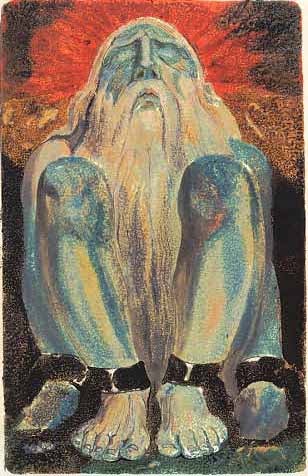
 William Blake, "Urizen in Chains," Plate 20 from The First Book of Urizen (1794). Department of Prints & Drawings, The British Museum. Larger image. |
15 What then? Shall we sin because we are not under law but under grace? By no means! 16 Don't you know that when you offer yourselves to someone to obey him as slaves, you are slaves to the one whom you obey -- whether you are slaves to sin, which leads to death, or to obedience, which leads to righteousness? 17 But thanks be to God that, though you used to be slaves to sin, you wholeheartedly obeyed the form of teaching to which you were entrusted. 18 You have been set free from sin and have become slaves to righteousness.
19 I put this in human terms because you are weak in your natural selves. Just as you used to offer the parts of your body in slavery to impurity and to ever-increasing wickedness, so now offer them in slavery to righteousness leading to holiness. 20 When you were slaves to sin, you were free from the control of righteousness. 21 What benefit did you reap at that time from the things you are now ashamed of? Those things result in death! 22 But now that you have been set free from sin and have become slaves to God, the benefit you reap leads to holiness, and the result is eternal life. 23 For the wages of sin is death, but the gift of God is eternal life in Christ Jesus our Lord. (Romans 6:12-23)
| Big Concept 4. Slaves do what they're told. But sin doesn't "own" you anymore; God owns you now. You no longer have to sin! So give yourself wholeheartedly to serving God. You can do this! |
In the Mediterranean world of Paul's day, Roman society was ruled by a very small number of wealthy persons in upper class orders, but the vast majority who were members of the lower class.99 From a legal standpoint, there were three groups:
- Citizens, who exercised many legal and social privileges
- Freemen and Freedmen, who were not slaves, but still lacked the privileges of citizens
- Slaves, who were owned by the master of a household, a farm holding, or the government
The number of slaves in the Roman Empire was vast, fed by the Roman armies that went out to the edges of the known world to conquer and defend an empire. Many men, women, and children among these conquered peoples were sent back to Rome as prisoners of war, destined to live out their lives as slaves. It is estimated that in Italy during times of expansion, perhaps 16% to 33% of the population were slaves.100 The slave population in cities outside of Italy would be smaller, but significant. The early Christian movement drew heavily from slaves and the poor.
Of course, few in our world have any personal experience of slavery. But as I tried to think back in my life, the closest for me was my six weeks in Army boot camp. My life was controlled from morning to night. Discipline was enforced by shouting drill sergeants who did not allow their sometimes arbitrary commands to be disputed. Disobedience was harshly punished with push-ups or worse. The purpose of this intense indoctrination was designed to produce soldiers who would obey orders without questioning -- essential to an army in time of war. No, I wasn't really a slave, but I certainly felt that my life and destiny were controlled by another.
Being in jail or prison might be a similar experience. Or living under the tyranny of a domineering husband or father. Slavery involves a practice of obeying one's master rather than facing terrible consequences.
Paul has already introduced the metaphor of slavery in chapter 6:
"... That we should no longer be slaves101 to sin..." (6:6b)
"... Death no longer has mastery102 over [Christ]." (6:9b)
Before we were united with Christ, we were enslaved to sin, that is, we followed and obeyed sin as consistently as a slave might obey a master. If we are to be Christ's disciples, this has to change. In today's lesson Paul develops this metaphor of slavery and obedience much more thoroughly, so that we can understand how we are to live this new life of Christ-followers. Notice that in this metaphor, sin becomes almost personified as a slave master or tyrannical ruler.
Countering the Reign of Sinful Passions (6:12-13)
"11 In the same way, count yourselves dead to sin but alive to God in Christ Jesus. 12 Therefore do not let sin reign in your mortal body so that you obey its evil desires. 13 Do not offer the parts of your body to sin, as instruments of wickedness, but rather offer yourselves to God, as those who have been brought from death to life; and offer the parts of your body to him as instruments of righteousness." (6:11-13)
Paul spends the first 10 verses of chapter 6 explaining that we are united with Christ in his death for sin and in subsequent life. Verse 11, which we looked in the last lesson, is the transition. We are to count to be true what we know to be true by faith, that we are dead to sin and at the same time alive to God in Christ Jesus. Because we are dead so far as sin's former control of our lives, we are to live differently.
Paul uses two verbs to describe sin's former dominion -- reign and obey:
"Reign" (NIV, KJV) or "exercise dominion" (NRSV) is the verb basileuō, "to exercise authority at a royal level, be king, rule."103 Paul has used this word figuratively several times in Romans 5 with regard to death (5:14, 17a), sin (21a), and grace (21b) reigning or dominating one's life. While most Westerners haven't really seen a powerful king exercise full personal control of an empire, Paul's readers would immediately think of Caesar,104 emperor of the Roman Empire that dominated Europe for 500 years. In Paul's analogy, sin reigned in or dominated our lives prior to Christ. Before we knew Christ, the enemy reigned in our lives and we were part of his dominion -- an opposing kingdom to God's own Kingdom (Colossians 1:13; Matthew 4:8-9; Luke 22:53).
"Obey" is the verb hupakuō, with the basic meaning of "listen to," but with the connotation here and commonly in the New Testament of "to follow instructions, obey, follow, be subject to."105
Sin in the unregenerate person exercises its reign or dominion in the "mortal body," literally the body that is subject to dying, mortal as opposed to immortal.106 When this mortal body comes into obedience to sin, it obeys the body's "evil desires" (NIV), "lusts" (KJV, NASB), or "passions" (NRSV).107 We follow the course of least resistance and fall easily into self-centeredness and the sins of the flesh, led around by our passions. Actually we are being controlled by the devil (2 Corinthians 4:4; Ephesians 2:2; 2 Timothy 2:26; 1 John 3:8).
Deliberately Offering Ourselves to a New Master (6:13)
Rather than just give in to our passions, the Apostle Paul commands us:
"Do not offer the parts of your body to sin, as instruments of wickedness, but rather offer yourselves to God, as those who have been brought from death to life; and offer the parts of your body to him as instruments of righteousness." (6:13)
The verb here is paristēmi, translated variously as "offer" (NIV) or "present" (NRSV, NASB), or "yield" (KJV). The root meaning is "to stand beside." Here it carries the idea "place beside, put at someone's disposal."108 In Josephus' writings this word is a technical term for offering a sacrifice.109 In the New Testament it is used of presenting the child Jesus in the temple (Luke 2:22), of the Christian presenting himself to God (Romans 6:13; 12:1), of Paul presenting the saved (Colossians 1:28), and of Christ presenting the Church (Ephesians 5:27).110
The object that is to be presented is our bodies as "instruments." The noun is hoplon, "any instrument one uses to prepare or make ready, tool." But most of the references in Paul carry the other meaning, "weapon, an instrument designed to make ready for military engagement," and this meaning is probably implied in verse 13 also.111 In 2 Corinthians 6:7, Paul uses hoplon to refer to "weapons of righteousness in the right hand and in the left." So an instrument or weapon of righteousness, then, would refer to an instrument or weapon used to doing what is righteous.
We can offer ourselves to sin or we can offer ourselves to God. Sin is not merely yielding to temptation, it is willingly placing ourselves and our capabilities in servitude to a false master. This is incompatible for "those who have been brought from death to life," who have been rescued! Rather, "Offer yourselves to God!" (6:13b). James writes, "Submit yourselves, then, to God. Resist the devil, and he will flee from you" (James 4:7).
We must see this clearly! It is not just sin, it is serving the master of sin. It is not just right living, it is serving the Master of Righteousness himself.
"Offer the parts of your body to him as instruments of righteousness." (6:13c)
When we serve Christ, our hands, our words, our heart, our smile become weapons or instruments in the cause of the Kingdom. How can we allow ourselves lapses of allegiance to the enemy? We are in a war for the Kingdom!
| Q1. (Romans 6:12) What does obedience have to do with
the "reign" of sin? http://www.joyfulheart.com/forums/index.php?showtopic=805
|
| Q2. (Romans 6:13) In what ways do you "offer the
members of your body" to either sin or God multiple times in a day? Why
is it that we can sin unconsciously? How can we begin to offer our
members deliberately to God? What changes will it take in our daily life
to do this? http://www.joyfulheart.com/forums/index.php?showtopic=806
|
No Longer under Law but under Grace (6:14-15)
Paul stresses the incongruity of sin. Now he explores the freedom we have within the wonderful favor or grace of God:
14 "For sin shall not be your master, because you are not under law, but under grace. 15 What then? Shall we sin because we are not under law but under grace? By no means!" (6:14-15)
We'll examine this relationship of grace to law further in Romans 7.
You Are Slaves to the One You Obey (6:16)
Verse 16 contains the concept-altering core of this passage:
"Don't you know that when you offer yourselves to someone to obey him as slaves, you are slaves to the one whom you obey -- whether you are slaves to sin, which leads to death, or to obedience, which leads to righteousness?" (6:16)
We take sin way too lightly, dear friends. A decision to sin is a decision to obey, Paul says. Sin is addictive. A slip can easily become a pattern. And a pattern of obedience is the distinctive mark of a slave.
Illustrations of Bondage
Two silly anecdotes come to mind.
First, there's an old story about a man who brought a jar of fleas into a bar and took bets that the fleas wouldn't jump out when he opened the lid. He had a number of takers. But when he opened the lid, the fleas only jumped as high as the top of the jar and no higher.
He had trained the fleas initially by placing them in the jar and screwing on the lid. After they had jumped several times only to bash their flea brains into the lid, even fleas figured out that jumping so high was painful. So eventually those that survived learned to jump only so high and no higher. Even when the lid was off, the trained fleas were unable to jump to freedom. We can develop such habits of sin that even when the lid is removed, we are still enslaved. Praise God, our bondage to sin has been broken by the cross. We are free.
I've also heard of a novel way catch a monkey without chasing him. You chain a cage to the wall, place an orange inside, and allow a monkey to see it. He reaches inside the cage for the orange, but cannot pull the orange through the bars. But neither will he let go of the orange he desires so much. So he is trapped by a cage that he is outside of rather than inside of. We must let go of the attractions of sin, for if we do not, we are enslaved by them.
But You Have Been Set Free (6:17-18)
Paul has outlined the principles of slavery to sin. Now he celebrates his Christian readers' freedom in Christ:
17 "But thanks be to God that, though you used to be slaves to sin, you wholeheartedly obeyed the form of teaching to which you were entrusted. 18 You have been set free from sin and have become slaves to righteousness." (6:17-18)
Notice the opposite of slavery to sin is wholehearted obedience to Christ's teaching. "Wholehearted " obedience (NIV) is obeying "from the heart" (KJV, NRSV). It is not just outward conformity to a Christian rule-set, but an inner desire to obey Christ that manifests itself in obedience.
| Q3. (Romans 6:15-18). What does obedience have to do
with slavery? In what way does doing acts of righteousness demonstrate your
slavery to God? In what ways does doing bad things demonstrate a slavery
to sin? How is such a slavery or bondage broken? What part does
obedience have in breaking this bondage? In what areas is God speaking
to you about a fresh obedience in your life? http://www.joyfulheart.com/forums/index.php?showtopic=807
|
"The Doctrine of Inevitable Sin"
Dear friends, this next section will be very hard for some of you since its teaching is so prevalent in our churches today. To be provocative and get your attention, I'll call it the "Doctrine of Constant Sin" or the "Doctrine of Inevitable Sin." Its followers teach it with phrases and bumper stickers such as:
- I'm not perfect, just forgiven.
- I sin in thought and word and deed every hour, maybe every minute.
- It is impossible to keep from sinning.
This misguided emphasis at its worst has saints feeling like they have to spout defeatist confessions in the name of humility and evangelical political correctness. To listen to them, you'd conclude that sin is more powerful than a Spirit-filled Christian, that there's nothing we can do to be perfectly obedient, that we are defeated before we begin. The new Christian may conclude: Then why try to resist sin at all?
The scripture does declare that we will sin and that no one is sin-free:
"When they sin against you -- for there is no one who does not sin...." (2 Chronicles 6:36)
"Who can say, 'I have kept my heart pure; I am clean and without sin?'" (Proverbs 20:9)
"For all have sinned and fall short of the glory of God." (Romans 3:23)
"We all stumble in many ways. If anyone is never at fault in what he says, he is a perfect man, able to keep his whole body in check." (James 3:2)
"If we claim to be without sin, we deceive ourselves and the truth is not in us." (1 John 1:8)
"If we claim we have not sinned, we make him out to be a liar and his word has no place in our lives." (1 John 1:10)
Yes, Christians do sin. That's a scriptural fact. But Paul teaches in today's lesson that we can find victory over sin. That it is possible to obey God, to set our minds on the things of the Spirit. That it is possible to grow through God's grace to the point where God has dealt with our grossest sins and is now working on sins and attitudes of the heart that we never before understood as sin.
We are constantly "in process." Let us believe the Apostle Paul that we don't have to be slaves to sin. Christ has set us free. Let us declare that as our truth, rather than give constant credit to the power of sin.
Let's say you were struggling to be sober and attended an Alcoholics Anonymous meeting. Is this their message? -- There's no way you can maintain your sobriety if you're an alcoholic. You'll constantly fall back into drunkenness. Face it, there's no hope. No. Their message is: Victory over alcohol will be the most difficult battle you'll fight in your life. You may fall a dozen times, but you can get up. Call us. We're here to help you. I'm tempted constantly to have a drink, but I've been sober now for 10 years.
Do our churches teach the wrong message about sin? Are we too defeatist? Who is happiest about our defeatism? God or Satan?
During the War in the Pacific in World War II, Americans GIs would listen nostalgically to American popular music from a powerful Japanese radio station, interspersed with taunts from Tokyo Rose who would seek to undermine morale by telling the troops night after night that U.S. forces would inevitably be defeated.
In a war, to announce broadly that you expect the enemy to win the battle, you'd be at least shunned for being unpatriotic and at worst locked up for treason.
I'm not naïve. I struggle with sin, too. But I have decided to believe and voice the positive promises of the Word of God, rather than being a mouthpiece of Satan's defeatist dialog. How about you?
The Apostle John had the balance right when he wrote:
"My dear children, I write this to you so that you will not sin. But if anybody does sin, we have one who speaks to the Father in our defense--Jesus Christ, the Righteous One." (1 John 2:1)
Honoring True Christian Doctrine (6:17b)
"... You wholeheartedly obeyed the form of teaching to which you were entrusted." (6:17b)
Notice how Paul honors "the form of teaching" (NIV, NRSV) or "form of doctrine" (KJV). The word "form" is tupos that we saw in 5:14. But in this context the word carries a somewhat different connotation: "a kind, class, or thing that suggests a model or pattern, form, figure, pattern," here "pattern of teaching."112 The word "teaching" or "doctrine" is didachē, here "the content of teaching," that is, instruction in Christian belief and practice.113
I have heard good Christians parrot what they've heard others say: "I don't believe in doctrine, just the Bible!" I know what they mean. But frankly, that's a foolish statement. They mean that they reject human theological interpretations in favor of "simple" Bible teaching. They are reacting, perhaps, against a divisive attitude they've seen in harsh, dogmatic, unloving teachers.
What they don't realize is that their own understanding of the Bible is heavily colored by the teaching (or "doctrine" -- same thing!) that they have heard from preachers and TV evangelists. We cannot and should not avoid "doctrine" or "teaching." But we must ensure that this doctrine is truly Biblical, that is, conforms carefully to the actual teaching of the Bible.
Moreover, we should honor Christine doctrine. Paul uses the phrase, "the form of teaching to which you were entrusted" (NIV, NRSV), "to which you were committed" (NASB), or "form of doctrine that was delivered you" (KJV). The verb is paradidōmi, "to convey something in which one has a relatively strong personal interest, hand over, give (over), deliver, entrust."114 Who delivered this doctrine or teaching to us? God! That is why we cannot just leave it when it suits us. A second connotation of paradidōmi is also apt: "to pass on to another what one knows, of oral or written tradition, hand down, pass on, transmit, relate, teach."115
The apostles were to faithfully pass on Christ's teachings -- without alteration or dilution -- as are we! (1 Corinthians 11:2, 23; 15:3; 2 Timothy 2:2; 2 Peter 2:21; Jude 3). Yes, we must reinterpret Christian truth within the conceptual environment and terminology of the culture in which we live and minister. If we don't, Christianity will appear -- wrongly -- to be irrelevant and old fashioned. But we must make this translation faithfully. That is, we must not water down the message to suit the age or twist its meaning in order to make it politically correct. We are commanded to pass on with faithfulness and accuracy the Christian faith as it was taught by Christ and his apostles.
| Q4. (Romans 6:17b) How does good doctrine affect the
way we live? Why should we honor good doctrine? If we shouldn't look
down on doctrine itself, what kind of teaching should we be avoiding? http://www.joyfulheart.com/forums/index.php?showtopic=808
|
Slaves Either to Sin or to God (6:19-23)
Paul has drawn his analogy of slavery to sin:
19 "I put this in human terms because you are weak in your natural selves. Just as you used to offer the parts of your body in slavery to impurity and to ever-increasing wickedness, so now offer them in slavery to righteousness leading to holiness. 20 When you were slaves to sin, you were free from the control of righteousness. 21 What benefit did you reap at that time from the things you are now ashamed of? Those things result in death! 22 But now that you have been set free from sin and have become slaves to God, the benefit you reap leads to holiness, and the result is eternal life. 23 For the wages of sin is death, but the gift of God is eternal life in Christ Jesus our Lord." (6:19-23)
Notice that our freedom from the slavery of sin is not absolute in this analogy. We are slaves of the one we obey, whether slaves of sin or slaves of God, by obeying him. There is no free middle ground where we are independent. We must choose -- one side or the other.
A slave of righteousness -- which you are, by God's grace -- is one who is accustomed to obeying God and doing righteous or upright deeds. It becomes a way of life, with only occasional slips. This is the mindset of the Spirit-led man and woman:
"Those who live according to the sinful nature have their minds set on what that nature desires; but those who live in accordance with the Spirit have their minds set on what the Spirit desires." (Romans 8:5)
We have our minds set on, focused on, obedience to our Lord. We are learners, disciples, followers in the footsteps of Jesus.
| Q5. (Romans 6:18-22) In Paul's analogy in these verses,
is there a place of independent freedom apart from "slavery" to sin or
to Christ? Why do we long for this kind of independent freedom? Why do
we hesitate to firmly take sides and make our allegiance clear to all? http://www.joyfulheart.com/forums/index.php?showtopic=809
|
The Reward of Righteous Slaves (6:19-23)
This is not a slavery of drudgery and resentment, however. We are love-slaves. And we are beneficiaries of a health-producing way of life. Note the reward promised:
"... Leading to holiness." (6:19)
"... The benefit you reap leads to holiness, and the result is eternal life." (6:22)
"... The gift of God is eternal life in Christ Jesus our Lord." (6:23)
There are two rewards touched on here -- a preliminary result, "holiness," and a final result, "eternal life."
"Holiness," hagiasmos, is defined as "personal dedication to the interests of the deity, holiness, consecration, sanctification," used in the New Testament in a moral sense for a process or, more often, its result (the state of being made holy).116 This process is also known as "sanctification."
"Eternal life," zōēn aiōion. The adjective, "eternal," aiōnios, from the noun aiōn, "a long period of time, without reference to beginning or end, eternity."117 Here the adjective means, "pertaining to a period of unending duration, without end."118
Notice the contrasts in this passage:
| "Impurity and ever-increasing wickedness" (19b) | "Righteousness leading to holiness" (6:19c) | |
| "Sin" ... "things you are now ashamed of" (20-21) | "Holiness"(22b) | |
| "Death" (21b and 23a) | "Eternal life"(22b and 23b) |
In verses 21 and 22, Paul is looking at the end result. Twice he uses the noun telos, "the goal toward which a movement is being directed, end, goal, outcome."119
Foolish people live for the moment, with a devil-may-care attitude. This is common in our world, especially among the young. Wise people, however, look at the end result and then order their lives accordingly. What will be the result of the way you are living? Where will it lead you in the end?
Foolish people shun delayed gratification. "I want to live life to the fullest now!" they shout. But even the success gurus of the world tell us that a thoughtful view to the goal, and then a careful ordering of one's actions to achieve that goal, is the only path towards lasting success.
Wages vs. Gift (6:23)
"For the wages of sin is death, but the gift of God is eternal life in Christ Jesus our Lord." (6:23)
 Available in paperback, Kindle, and PDF book formats. |
Though one might imagine from Paul's analogy of "wages"120 that one can earn eternal life. No! One can earn eternal death, perhaps. However, in contrast to this is the word charisma, "gift" (NIV, KJV) or "free gift" (NRSV, NASB), "that which is freely and graciously given, favor bestowed, gift."121
Wages are due, but a gift comes without any compulsion, lobbying, or expectation. The gift of eternal life is given by God's good pleasure to all who turn their lives to him. Eternal life is truly the free and very gracious gift of God! To Him be all glory through Jesus Christ our Lord!
Prayer
Lord, please teach me obedience to you. So work in my heart of hearts that my life habits and mindset might become more stable tending to obedience. Let me be the kind of person that people might look at and say: There is a faithful servant of God. Forgive me when I disobey and fail you. Forgive my unbelief. And thank you for your awesome free gift of eternal life. Thank you! In Jesus' name, I pray. Amen.
Big Concept
Slaves do what they're told. But sin doesn't "own" you anymore; God owns you now. You no longer have to sin! So give yourself wholeheartedly to serving God. You can do this!
Key Verses
"Therefore do not let sin reign in your mortal body so that you obey its evil desires." (Romans 6:12)
"Don't you know that when you offer yourselves to someone to obey him as slaves, you are slaves to the one whom you obey -- whether you are slaves to sin, which leads to death, or to obedience, which leads to righteousness?" (Romans 6:16)
"For the wages of sin is death, but the gift of God is eternal life in Christ Jesus our Lord." (Romans 6:23)
References
Copyright © 2024, Ralph F. Wilson. <pastor joyfulheart.com> All rights reserved. A single copy of this article is free. Do not put this on a website. See legal, copyright, and reprint information.
 |
|
In-depth Bible study books
You can purchase one of Dr. Wilson's complete Bible studies in PDF, Kindle, or paperback format -- currently 48 books in the JesusWalk Bible Study Series.
Old Testament
- Abraham, Faith of
- Jacob, Life of
- Moses the Reluctant Leader
- Joshua
- Gideon
- David, Life of
- Elijah
- Psalms
- Solomon
- Songs of Ascent (Psalms 120-134)
- Isaiah
- 28 Advent Scriptures (Messianic)
- Daniel
- Rebuild & Renew: Post-Exilic Books
Gospels
- Christmas Incarnation (Mt, Lk)
- Sermon on the Mount (Mt 5-7)
- Luke's Gospel
- John's Gospel
- Seven Last Words of Christ
- Parables
- Jesus and the Kingdom of God
- Resurrection and Easter Faith
Acts
Pauline Epistles
- Romans 5-8 (Christ-Powered Life)
- 1 Corinthians
- 2 Corinthians
- Galatians
- Ephesians
- Philippians
- Colossians, Philemon
- 1 & 2 Thessalonians
- 1 &2 Timothy, Titus
General Epistles
Revelation
Topical