
|
Old Testament
New Testament
Gospels
Acts
Paul's Letters
General Letters
Revelation
Topical Studies
Beginning the Journey (for new Christians). en Español

|
Old Testament
New Testament
Gospels
Acts
Paul's Letters
General Letters
Revelation
Topical Studies

|
Home
Bible Studies
Articles
Books
Podcasts
Search
Menu
Donate
About Us
Contact Us
FAQ
Sitemap


Introduction to the Names and Titles of God
Audio (6:58)
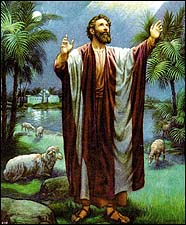 Abraham praying, unknown artist. Standard Publishing Company (about 1950). Larger image. |
Before we begin to examine the names and titles of God, we need to lay some groundwork.
What Is a Title of God?
What exactly is a name or title of God? The word "God" is a generic noun used to designate a divinity. It is not a name or title. The Judeo-Christian God has really only one name -- Yahweh or Jehovah. We'll explore his name in depth in chapter 3. He has several titles. And beyond titles, many metaphors and descriptors. Let's look at some definitions from the Merriam-Webster's Collegiate Dictionary:1
Name. "A word or phrase that constitutes the distinctive designation of a person or thing." Let's use Billy Graham as an example. "Billy" is his first name, "Graham" is his surname. God's revealed name is Yahweh.
Title. "An appellation of dignity, honor, distinction, or preeminence attached to a person or family by virtue of rank, office, precedent, privilege, attainment, or lands." When he is introduced in public he is often called "Reverend Graham" or "Doctor Graham." If he had been a pastor, he might have been referred to as "Pastor Graham." He also might be titled "Evangelist." One of God's titles might be "King of kings," that is, king over all other kings that there might be.
Metaphor. "A figure of speech in which a word or phrase literally denoting one kind of object or idea is used in place of another to suggest a likeness or analogy between them." For example, God is referred to as Rock scores of times. God our Rock is so common in the Bible that Rock is used by itself to refer to God (Deuteronomy 32:4). But what about this verse?
"In that day the LORD of hosts
will be a crown of glory,
and a diadem of beauty,
to the remnant of his people." (Isaiah 28:5)
Clearly, Yahweh is compared metaphorically to a crown and diadem. But if you were to use the term "crown" or "diadem" in conversation with Biblically literate people, few would know that you were referring to God. By no means all metaphors for God become popular terms for God. This study is pretty much limited to metaphors by which God is referred to or addressed in Scripture. For example, he is referred to our Hiding Place, but while the Scriptures contain metaphors of God as a mother hen gathering her chicks to protect them under her wings, since God is not specifically referred to as mother hen, I'm not including it as a focus of this study. Of course, that doesn't make the metaphor any less valid.
Descriptor . "Something (as a word or characteristic feature) that serves to describe or identify." Many metaphors of God could also be called descriptors. In English we have several grammatical constructs used to describe nouns. One is an adjectival phrase, such as "God of mercy." Another is a predicate adjective, such as "God is merciful."2 This describes a quality of God, but is it title? Probably not. But if God is addressed in prayer as "Merciful God," perhaps we should consider it a descriptor. If the phrase is used often enough, perhaps this might even be considered a title.3
Perhaps this helps you see the fuzzy borders of determining what are the names, titles, metaphors, and descriptors of God. Add to that the different translations of the Bible. So let's not be too dogmatic about precisely which are which. What we're really seeking to know is the God who existed long before any names for him were even needed.
The Documentary Hypothesis
Given the history of Old Testament scholarship over the last century, any discussion of the names of God must consider the Documentary Hypothesis.
Though the traditional view is that Moses was the author of the Pentateuch, since the Enlightenment there has been growing speculation about who the authors of the Pentateuch were. The most celebrated and complex theory of authorship was advanced by German Old Testament scholar Julius Wellhausen (1844-1918), known as the Documentary Hypothesis. He posited four strands of sources or "documents" for the Pentateuch which are abbreviated JEDP:
| Source/strand | Name of God | |
| J | Yahwistic | Yahweh |
| E | Eloistic | Elohim |
| D | Deuteronomic | |
| P | Priestly |
The Yahwistic source could be identified, so goes the theory, by the editor's use of Yahweh (Jehovah) or LORD for God; the Eloistic source by the use of El for God. Supposedly, a late but clever editor wove all these strands together into a single narrative. Wellhausen was widely influential and the theory grew more and more complex -- and speculative. His theory captivated much of Old Testament scholarship for more than 100 years. These days, however, Wellhausen's JEDP theory is in disarray. R.N. Whybray commented in 1995 on the state of Pentateuchal studies:

"There is at the present moment no consensus whatever about when, why, how, and through whom the Pentateuch reached its present form, and opinions about the dates of composition of its various parts differ by more than five hundred years."4
Our focus is on the text that comes down to us in the Bible itself, not on speculative theories of sources.
Endnotes
[1] Merriam-Webster's Collegiate Dictionary (Eleventh Edition; Merriam-Webster, Inc., 2003).
[2] Albert H. Marckwardt and Frederic G. Cassidy, Scribner Handbook of English (Third Edition; Charles Scribner's Sons, 1960), p. 256.
[3] An adjectival phrase is a noun together with an adjective modifying it. In Hebrew and Greek, this modifier often appears in the genitive, such as "God of mercy." A predicate adjective is "an adjective which appears in the position of the predicate (i.e., after the verb) but which modifies the subject, such as such as "God is merciful." To make it even more complicated, Hebrew may omit the verb and put a noun side by side with Elohim or Yahweh. Does this make it a title? Maybe.
[4] R.N. Whybray, Introduction to the Pentateuch (Eerdmans, 1995), pp. 12-13, cited in T. Desmond Alexander, "Authorship of the Pentateuch," DOTP 61-72.
Copyright © 2026, Ralph F. Wilson. <pastor joyfulheart.com> All rights reserved. A single copy of this article is free. Do not put this on a website. See legal, copyright, and reprint information.
 To be notified about future articles, stories, and Bible studies, why don't you subscribe to our free newsletter, The Joyful Heart, by placing your e-mail address in the box below. We respect your