Free E-Mail
Bible Studies
 Apostle Peter
Beginning the Journey (for new Christians). en Español
Old Testament
Abraham
Jacob
Moses
Joshua
Gideon
David, Life of
Elijah
Psalms
Solomon
Songs of Ascent (Ps 120-135)
Isaiah
Advent/Messianic Scriptures
Daniel
Rebuild & Renew: Post-Exilic Books
Gospels
Christmas Incarnation
(Mt, Lk)
Sermon on the Mount
(Mt 5-7)
Mark
Luke's
Gospel
John's Gospel
7 Last Words of Christ
Parables
Jesus and the Kingdom
Resurrection
Apostle Peter
Acts
The Early Church
(Acts 1-12)
Apostle Paul
(Acts 12-28)
Paul's Epistles
Christ Powered Life (Rom 5-8)
1 Corinthians
2 Corinthians
Galatians
Ephesians
Vision for Church
(Eph)
Philippians
Colossians,
Philemon
1
& 2 Thessalonians
1 & 2 Timothy,
Titus
General Epistles
Hebrews
James
1 Peter
2 Peter, Jude
1, 2, and 3 John
Revelation
Revelation
Conquering Lamb of Revelation
Topical
Glorious Kingdom, The
Grace
Great Prayers
Holy Spirit, Disciple's Guide
Humility
Lamb of God
Listening for God's Voice
Lord's Supper
Names of God
Names of Jesus
Christian Art
About Us
Podcasts
Contact Us
Dr. Wilson's Books
Donations
Watercolors
Sitemap

 Apostle Peter: Disciple Lessons from the Rock
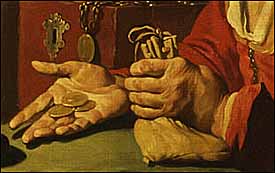 Detail from Matthias Stomer (1600-1650), 'Avarice.' Full image. |
It is so easy to slip into a life focused on wealth and material goods. We work to gain money so we can live, always focused on the material. Once we earn enough to survive, then we look for an apartment and clothes. Then a house of our own, a car, better furniture. Then, as our earning potential increases, a vacation home. John D. Rockefeller (1839-1937), perhaps the richest person in history, was asked, "How much money is enough?" He answered, "Just a little bit more."
6.1 Dealing with Greed (1 Timothy 6:2-19)
Greed was a problem in the church at Ephesus. The false teachers taught that "godliness is a means to financial gain" (6:5), which distorted the whole Gospel. In our day a Prosperity Gospel has made great headway around the world. How well does it fit with sound doctrine? We'll see, as Paul devotes much of this section to the topic of wealth.
Characteristics of False Teachers (1 Timothy 6:2-5)
In verses 2-5 Paul revisits his description of the false teachers that we examined in the introduction and in chapter 1.
"2b These are the things you are to teach and urge on them. 3 If anyone teaches false doctrines and does not agree272 to the sound instruction of our Lord Jesus Christ and to godly teaching, 4 he is conceited and understands nothing. He has an unhealthy interest273 in controversies and quarrels about words that result in envy, strife, malicious talk, evil suspicions 5 and constant friction274 between men of corrupt mind, who have been robbed of the truth and who think275 that godliness is a means to financial gain." (1 Timothy 6:2b-5)
A Corrupt and Defrauded Mind (1 Timothy 6:5)
Paul adds a new element to his description of the false teachers in verse 5:
"... Men of corrupt mind, who have been robbed of the truth and who think that godliness is a means to financial gain." (1 Timothy 6:5)
Let's first consider the state of thinking that Paul describes. The false teachers and their disciples are termed men of "corrupt mind." What is a corrupt mind? It is one that was once sound, but has been corrupted and compromised. It's thinking is no longer true, but somehow warped. The word "corrupt" (NIV, KJV), "depraved" (NRSV) is diaphtheirō, "to cause to become morally corrupt, deprave, ruin,"276 from dia-, "through," a transition from one state to another + phtheirō, "to rot thoroughly."277
Their other condition is "robbed of the truth." "Robbed" (NIV), "bereft" (NRSV), "destitute" (KJV) is apostereō, "to cause another to suffer loss by taking away through illicit means, rob, steal, despoil, defraud."278 I've met people like this. So have you. Someone has deceived them. They have believed a lie and now the truth has been stolen from them, replaced by a bogus belief that will ultimately destroy them. Preaching and teaching truth is so powerful. Lies cannot stand before the white light of the truth. In fact, this is how true disciples are created.
"To the Jews who had believed him, Jesus said, ' If you hold to my teaching, you are really my disciples. Then you will know the truth, and the truth will set you free.' " (John 8:31-32)
This is why sound teaching is so very important.
Godliness Brings Financial Gain (1 Timothy 6:5)
Their false teaching seems on the surface rather innocuous. It's even attractive.
"... Who think that godliness is a means to financial gain."279 (1 Timothy 6:5)
We studied the word "godliness" (eusebeia) on 4:7-8 above. In short, it means, "awesome respect accorded to God, devoutness, piety, godliness,"280 and occurs in both verses 5 and 6.
"A means to financial gain" (NIV), "means of gain" (NRSV), "gain" (KJV) is porismos, "means of gain."281 It is derived from poros, "acquisition, gain."282 In classical Greek the word means "providing, procuring," and is used of "earning a living," "money-getting," and "means of gain," which is the connotation in our text.283
What the false teachers had done was to doctrinally link godliness with wealth. "If you' re godly or religious," they were saying, "you can become wealthy."
We sometimes have teachers in our day proclaim:
- "Poverty is a sin and a bondage."
- "Wealth is God's blessing on the godly."
- "If we believe the promises of God, we will prosper financially."
- "If we tithe, we will get more money, because we can't out-give God."
Of course, there is some truth in these teachings -- and some things that are warped and distorted. Even if the original teachers of these doctrines may have had right hearts towards money, their disciples and modern proponents of these doctrines often don't.
Q1. (1 Timothy 6:5) Why do you think people are so
susceptible to distorted Bible teaching concerning financial gain? Admitting
that there is some truth in popular teachings in our time, what are the
distortions that you may have heard? How do they differ from the truth?
https://www.joyfulheart.com/forums/topic/853-q1-greed/
Godliness with Contentment (1 Timothy 6:6)
Now Paul seeks to instruct Timothy and the Ephesian church about the balance:
"But godliness with contentment is great gain." (1 Timothy 6:6)
The keyword here is "contentment" (autarkeia), "'self-sufficiency' in the sense of 'independence', then general 'sufficiency,'" here internal sufficiency, "state of being content with one's circumstances, contentment, self-sufficiency," a favorite virtue of the Greek Cynics and Stoics.284 The related verb occurs in verse 8 (arkeō), "be satisfied/content with something"285 and in the Letter to the Hebrews:
"Keep your lives free from the love of money and be content (arkeō) with what you have, because God has said, ' Never will I leave you; never will I forsake you.' " (Hebrews 13:5)
Another word from this root occurs in Paul's Letter to the Philippians:
"I have learned to be content (autarkēs286) whatever the circumstances. I know what it is to be in need, and I know what it is to have plenty. I have learned the secret [of being content] in any and every situation, whether well fed or hungry, whether living in plenty or in want. I can do everything through him who gives me strength." (Philippians 4:11-13)
Paul certainly wasn't against wealth, but he saw it as dangerously seductive -- as did Jesus:
"How hard it is for the rich to enter the kingdom of God! Indeed, it is easier for a camel to go through the eye of a needle than for a rich man to enter the kingdom of God." (Luke 18:24-25)
Jesus taught his own disciples the message of simple trust vs. heaping up wealth:
"For the pagans run after all these things, and your heavenly Father knows that you need them. But seek first his kingdom and his righteousness, and all these things will be given to you as well." (Matthew 6:32-33)
American Christians, especially, have so flirted with associating prosperity with Christian faith that they have distorted the Gospel, which is one of contentment with God's sufficiency, a trust in God's provision of our needs, rather than a gospel of present abundance.
Q2. (1 Timothy 6:6) Why should we seek contentment?
Doesn't contentment keep us from trying to get ahead so our families can have
what they need? What's the balance between contentment and the quest for
improvement?
https://www.joyfulheart.com/forums/topic/854-q2-contentment/
The Temptation to Get Rich (1 Timothy 6:7-9)
Paul continues to Timothy:
"7 For we brought nothing into the world, and we can take nothing out of it. 8 But if we have food and clothing, we will be content with that. 9 People who want to get rich fall into temptation and a trap and into many foolish and harmful desires that plunge men into ruin and destruction." (1 Timothy 6:7-9)
Sadly, much Christian stewardship teaching appeals not to sacrifice, but to a desire to get rich287 and an implied promise that if we give, God will bless us financially. He does -- and will (2 Corinthians 9:6-11) -- but if that is the motive for our giving, then we are falling into the temptation to get rich, rather than giving out of a spirit of love and worship. There is a subtle but real difference here!
Look at the strong words that Paul heaps up about the desire for wealth:
"Temptation" here is peirasmos, "an attempt to make one do something wrong, temptation, enticement to sin."288 Jesus faced this same temptation at the hand of Satan himself.
"The devil took him to a very high mountain and showed him all the kingdoms of the world and their splendor. ' All this I will give you,' he said, ' if you will bow down and worship me.' " (Matthew 4:8-9)
We are fed this temptation every day in the media we watch. But the temptation to wealth is not a new one. Nor is it restricted to the rich themselves. Many of the poor desire wealth more than anyone.
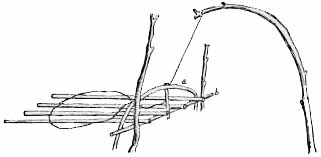 Drawing of a bird snare from the Philippines, in Fay-Cooper Cole, The Wild Tribes of Davao District, Mindanao (Chicago, 1913). |
"Trap" (NIV), "snare" (KJV), "are trapped" (NRSV) is pagis, "a device used to catch animals, trap, snare," then figuratively, "that which causes one to be suddenly endangered or unexpectedly brought under control of a hostile force, trap, snare."289 The Hebrews, along with most of the ancient world -- and rural peoples today -- trapped birds for the meat they provided, however meager. They used a whole variety of traps and nets to do this -- "the snare of the fowler" (Psalms 91:3). The idea is to catch the bird or small animal unawares -- deceptively. As the Proverbs reminds us:
"How useless to spread a net in full view of all the birds!" (Proverbs 1:17)
Snares are often used symbolically of the hidden dangers of sin (Psalms 91:3; Proverbs 7:23; 29:5-6). The desire for wealth is like a snare, ready to be sprung and trap you in its constraints.
"Foolish and harmful desires." Often, we know that our desires290 are out-of-bounds, but we court these desires anyway. How strange we humans are. "Foolish" (NIV, KJV), "senseless" (NRSV) is anoētos, "unintelligent, foolish, dull-witted."291
The Fruit of a Desire for Wealth (1 Timothy 6:9-10)
The results of these temptations are severe:
"... [They] plunge292 men into ruin and destruction." (1 Timothy 6:9)
"Some people, eager for money, have wandered from the faith and pierced themselves with many griefs." (6:10)
"Ruin" (NIV, NRSV), "destruction" (KJV) is olethros, "a state of destruction, ruin, death," from ollymi, "to destroy."293
"Destruction" (NIV, NRSV), "perdition" (KJV) is apōleia, "the destruction that one experiences, annihilation both complete and in process, ruin." The two words combined mean "utter destruction."294
"Wandered from the faith." In my mind I see someone wandering295 over a fog-obscured moor, confused, lost and far away from home.
"Pierced296 themselves with many griefs." Paul warns of those whose quest for riches has resulted in grief, sorrow, and mental distress. 297 Wealth promises happiness, but that is most often elusive.
Lest we take all this with a grain of salt, remember the fate of the rich young ruler whom Jesus loved, but who sadly walked away from Jesus when asked to sell what he had and give to the poor (Mark 10:21-22).
The Love of Money (1 Timothy 6:10)
"For the love of money is a root of all kinds298 of evil. Some people, eager for money, have wandered from the faith and pierced themselves with many griefs." (1 Timothy 6:10)
We see a similar phrase in Hebrews:
"Keep your lives free from the love of money299 and be content with what you have...." (Hebrews 13:5)
"Love of money" in verse 10 is philargyria, "love of money, avarice, miserliness,"300 from philos, "love" + argurion, "silver, money." Ebenezer Scrooge in his counting house comes to mind. But for most of us the temptation is much more subtle.
"Eager for money" comes from a word which means literally, "to stretch oneself, reach out one's hand."301
We love God, we loudly claim. But what will we do if the price is high enough? Many a man and woman has abandoned principles for money. Anybody can be bought, we are told, if the price is high enough. Can you? Can I?
Q3. (1 Timothy 6:7-10) How does love for money grow? How
does it become a trap? How do you escape this deceptive trap?
https://www.joyfulheart.com/forums/topic/855-q3-love-of-money/
The Danger of Riches (1 Timothy 6:17)
Paul changes subjects here and then comes back to wealth. For the sake of continuity, We'll skip to verses 17-19 for a moment, though Paul's commands to the rich are part of his final exhortation to Timothy.
"Command those who are rich in this present world not to be arrogant nor to put their hope in wealth, which is so uncertain, but to put their hope in God, who richly provides us with everything for our enjoyment." (1 Timothy 6:17)
The rich are commanded to hope in God instead of wealth. Why?
- Riches are temporal. We are rich only "in this present world." You can't take it with you. Therefore, we should "lay up treasure ... for the coming age" (1 Timothy 6:19).
- Riches are uncertain.302 Only in heaven, "moth and rust do not destroy, and ... thieves do not break in and steal" (Matthew 6:20). As anyone who owned stocks in 2008 knows, wealth can be an illusion that quickly disappears. Income can vanish as quickly as a job. Savings can shrink with no way to stop them.
- Riches are deceitful. This doesn't come from our passage directly; nevertheless it fits here since the present-only and transitory nature of wealth deceives us. In the Parable of the Sower, Jesus compared the thorny ground to "the deceitfulness of riches" that chokes the word of God and keeps it from growing to maturity (Mark 4:19). Wealth is deceitful in that it promises one thing, but delivers another.
- Riches cause arrogance.303 Strange, isn't it, how wealth produces a feeling of superiority to the poor. Pride and a desire for wealth feed on each other.
- Riches replace God as the source of trust.304 When we have a comfortable life we are often tempted to trust in our relative wealth, rather than to trust in God.
Positive Commands for the Rich (1 Timothy 6:17-18)
Paul gives several positive commands for the rich:
"17 Command those who are rich ... to put their hope in God, who richly provides305 us with everything for our enjoyment.306 18 Command them to do good, to be rich in good deeds, and to be generous and willing to share." (1 Timothy 6:17-18)
Of course, it's almost a cliché to say that we in the West are rich by Third World standards, but it is certainly true. So if you are an American or European, then Paul's commands are specifically for you. Notice that he does not tell us to give all our money to the poor and become poor ourselves. That command was specific for the Rich Young Ruler (Mark 10:21). Rather we are to:
- Hope in God. First, we are to realign our trust system. Where we find ourselves trusting in our wealth, we must repent and turn afresh to God. In times of economic turmoil the object of our trust will become clearer to us. Firmly fix your hope in God and reject the very great temptations to trust your income and savings to get you through.
- Do good.307 Wealth gives us options to do more than just survive. Think of all the good you can do because God has supplied your basic needs. Then do as much of that good as you can.
- Be rich in good deeds. The true riches are found in heaven, so we are to lay up treasures there (Matthew 6:19-20), so that we are "rich in good deeds" (6:18). Dorcas was "abounding with deeds of kindness and charity which she continually did" (Acts 9:36, NASB).
- Be generous,308 literally, "be good at imparting." What a privilege we have to help others with our possessions. What's more, generosity is God-like, and we can share in being like Him. What a blessing!
- Be willing to share. This is a synonym of being generous, "pertaining to giving or sharing what is one's own, liberal, generous."309
Laying Up Treasures in Heaven (1 Timothy 6:19)
"In this way they will lay up treasure for themselves as a firm foundation for the coming age, so that they may take hold of the life that is truly life." (1 Timothy 6:19)
Now Paul explains two results of obedience:
- Rewards in heaven. "In this way they will lay up treasure310 for themselves as a firm foundation for the coming age...." (6:19a). If you have been thoroughly schooled in salvation by grace, you may not be very comfortable with the idea of rewards for faithfulness. However, the idea of rewards in heaven in addition to salvation is clearly part of the teaching of Jesus (Matthew 6:19-20; 10:42; 19:21; 25:34-40; Luke 12:21, 33; 18:22) and Paul (1 Corinthians 3:8; Galatians 6:9). If we serve for the reward, we act in selfishness, but if we serve out of love, the reward is a bonus from our God.
- Authentic life. "... So that they may take hold of the life that is truly life." (6:19b). The luxurious life of a rich person may seem splendid. But when compared to life from God with an eternal quality, it shrivels in importance. We must "take hold of"311 Life with a capital "L". Jesus said, "I have come that they may have life, and have it to the full" (John 10:10b).
Q4. (1 Timothy 6:17-19) What kinds of actions are the
best antidote for the love of money? How can we cultivate generosity so that it
remains healthy, rather than let it go overboard and hurt our families?
https://www.joyfulheart.com/forums/topic/856-q4-defeating-greed/
6.2 Exhortation to a Man of God (1 Timothy 6:11-14)
Pursing the Character of Christ (1 Timothy 6:11)
Now let's come back to Paul's final charge to Timothy concerning his own personal life and holiness:
"But you, man of God, flee from all this, and pursue righteousness, godliness, faith, love, endurance and gentleness." (1 Timothy 6:11)
In this verse (and also 2 Timothy 2:22) Paul uses a pair of verbs, both of which carry strong images of running.
1. Flee. First, Paul commands Timothy to flee "from all of this" -- that is, flee a love of money and the hedonistic lifestyle that it can buy. The verb "flee" (NIV, KJV), "shun" (NRSV) is a strong one: pheugō, "to seek safety in flight," here, figuratively, "to keep from doing something by avoiding it because of its potential damage, flee from, avoid, shun."312 It is a verb of action and running.
2. Pursue. But Paul's command does not consist of primarily running away from sin, but of actively running after and pursuing the life of God. "Pursue" (NIV, NRSV), "follow after" (KJV), diōkō, "press on," here, figuratively, "pursue, strive for, seek after, aspire to something."313 The same word is used for "persecute," to chase something down.
What follows is a six-fold list of virtues to pursue:
- Righteousness is moral uprightness and justice. The end does not justify the means. The means must be just as well as the end.
- Godliness is devoutness, piety, and respect for God. This is a lifestyle of seeking to please God with one's life.
- Faith is trust in the faithful character of God, in his goodness, and in his power through Jesus Christ our Lord.
- Love is the selfless love modeled by Christ, when he gave his all for us. Now we give our all for God and for our fellow human beings.
- Endurance or patience is the "capacity to hold out or bear up in the face of difficulty, patience, endurance, fortitude, steadfastness, perseverance."314
- Gentleness or meekness is "the quality of not being overly impressed by a sense of one's self-importance, gentleness, humility, courtesy, considerateness."315
Fight, Take Hold, Confess, Persevere (1 Timothy 6:12-15a)
"12 Fight the good fight of the faith. Take hold of the eternal life to which you were called when you made your good confession in the presence of many witnesses. 13 In the sight of God, who gives life to everything, and of Christ Jesus, who while testifying before Pontius Pilate made the good confession, I charge you 14 to keep this command without spot or blame until the appearing of our Lord Jesus Christ, 15 which God will bring about in his own time...." (1 Timothy 6:12-15a)
This next series of commands is four-fold (three, but I've included "confess" since the idea is clearly in the text):
Fight the good fight. We see this phrase "fight the good fight" three times in 1 and 2 Timothy. First in 1 Timothy 1:18, here, and finally in 2 Timothy 4:7 in Paul's final words to his young protégé. To fight316 is to carry on the struggle, to not give in to those who would oppose us, to consider our message of the faith to be worth struggling for. This is not being quarrelsome and contentious, but rather continuing on until we achieve what God has put before us to do.
Take hold on eternal life. "Take hold" (NIV, NRSV), "lay hold" (KJV) means to "take hold of, grasp, in order to make it your own."317 The word also appears in verse 19. We are so often casual about the life we have been given. To lay hold on it means to actively commit ourselves to the life that concludes in eternity.
Make a good confession. The "good confession" made at Timothy's commitment to Christ and conversion emulates the "good confession" that Christ made before Pilate. Though it cost him his life, he spoke what was true. The word means "statement of allegiance."318 During the persecution under Diocletian, many Christians broke under threat of death. Those who maintained their confession of faith in Christ in spite of threat, execution, or imprisonment, were honored after the persecution as Confessors, men and women who had kept the faith. St. Nicholas, Bishop of Myra (Santa Claus) was one of these.
Persevere. "Keep" means "to persist in obedience, keep, observe, fulfill," perhaps, "to keep unharmed or undisturbed."319 The content of the command seems to be for Timothy "to persevere in his own faith and ministry, and so save himself and others" (cf. 4:16), so guard what is entrusted to him (6:20).320
The Appearing of Christ (1 Timothy 6:14)
Paul is winding up the letter now, looking to the future, with the hope brought by Christ's Second Coming.
"... Until the appearing of our Lord Jesus Christ, which God will bring about in his own time...." (1 Timothy 6:14b-15a)
The word "appearing" (NIV, KJV), "manifestation" (NRSV) is epiphaneia (from which we get our word "epiphany"), "appearing, appearance," especially also, "the splendid appearance."321 Christ has not yet appeared -- though some claimed it had already taken place (2 Thessalonians 2). It is still future. The one who determines the exact time is God the Father, who will bring it to pass322 "in his own time" (1 Timothy 6:15a).
6.3 Concluding the Letter (1 Timothy 6:15-21)
Doxology (1 Timothy 6:15-16)
Now Paul launches upon a spontaneous doxology -- the second in this letter:
"15b God, the blessed and only Ruler, the King of kings and Lord of lords, 16 who alone is immortal and who lives in unapproachable light, whom no one has seen or can see. To him be honor and might forever. Amen." (1 Timothy 6:15b-16)
The blessed and only Sovereign. "Ruler" (NIV), "Sovereign" (NRSV), "Potentate" (KJV) is dynastēs (from which we get our word "dynasty"), "one who is in relatively high position, ruler, sovereign."323 Though there are other earthly rulers, he is over all, and in that sense the "only" sovereign, expressed in the next phrase.
King of kings and Lord of lords. This term was used of an emperor who ruled over many petty vassal kings -- the emperor of all the kings. Our God is the exalted ruler of all.
Immortal,324 that is, not subject to death.
Lives in unapproachable light. The brilliant glory of God is so overpowering that no one may approach him without being "fried." The psalmist says, "He wraps himself in light as with a garment..." (Psalm 104:2a).
No one can see. People can see manifestations of God when he allows it, but since he is a Spirit and lives in glorious light, no one can or ever has seen him in reality.
To him be honor and might. There is no might325 greater than his. He is worthy of all honor.
Amen. It is the truth! So be it!
Guard the Faith Entrusted to You (1 Timothy 6:20-21)
Now for the last words of this letter. Unlike most of Paul's letters, it has few personal references, and no "greetings" in the last few paragraphs. Paul is writing to Timothy, his friend, repeating for the last time what he has spelled out in great detail earlier in the letter:
"20 Timothy, guard what has been entrusted to your care. Turn away from godless chatter and the opposing ideas of what is falsely called knowledge, 21 which some have professed and in so doing have wandered from the faith.
Grace be with you." (1 Timothy 6:20b-21)
Let me highlight a few phrases.
First, the idea of guarding a trust. "What has been entrusted to your care/to you" (NIV, NRSV), "that which is committed to thy trust" (KJV) is parathēkē, a legal technical term for "property entrusted to another, deposit."326 Paul also uses the term in 2 Timothy 2:12, 14. Pastors and leaders, the faith is not just some denominational party line. It is a sacred trust -- God's message and teaching -- that we have received. We cannot tamper with it, but must pass it on pure and unadulterated.
Paul uses the imperative verb, "guard" (NIV, NRSV), "keep" (KJV) literally, "to carry out sentinel functions, watch, guard," here figuratively, "to protect by taking careful measures."327 This is not a volunteer opportunity, but a holy responsibility.
Second, Paul gives a final warning to Timothy not to be taken in by all the talk and "the opposing ideas of what is falsely called knowledge." I've been around long enough to observe that ideas come and go like fads. What is politically correct this decade is considered naïve in the next decade. It is called "truth." It is called "knowledge."328 These "opposing ideas"329 may be accepted for a few years, but they are not real "knowledge."330 They are just the prevailing thinking of a fickle culture. Those who follow them end up wandering331 from the faith they once claimed to follow.332
So we must hold to the sure word that we have received, the Gospel, as taught by Christ and his apostles, and turn away from the quest to be hip and up-to-date with every philosophical or theological trend. Others may do that, but we have been appointed as guards over a sacred trust.
Q5. (1 Timothy 6:20-21) How can we guard the faith
without becoming narrow, backward-looking people who oppose all change, and
complain about "what things are coming to"? How can guards be at the same time
positive, loving, and pleasant to be around?
https://www.joyfulheart.com/forums/topic/857-q5-faith-with-love/
 Available in paperback, PDF, and Kindle formats. |
Paul concludes with the simple blessing: "Grace -- God's favor -- be with you." And that's what it all comes down to. We continue faithfully only by God's grace and gifts to us.
Prayer
Lord, it's so easy to get caught up in getting ahead, in succeeding financially. And while it's good and needed for our families, it can have a way of capturing us and taking hold in our hearts. Father, forgive us for our attachment to materialism and wealth. Be God fully for us afresh. We refuse to trust in wealth; let us trust in you fully. Then teach us how to use whatever you have given us in a way that pleases you. In Jesus' name, we pray. Amen.
Key Verses
"But godliness with contentment is great gain. For we brought nothing into the world, and we can take nothing out of it. But if we have food and clothing, we will be content with that." (1 Timothy 6:6-8, NIV)
"People who want to get rich fall into temptation and a trap and into many foolish and harmful desires that plunge men into ruin and destruction. For the love of money is a root of all kinds of evil. Some people, eager for money, have wandered from the faith and pierced themselves with many griefs." (1 Timothy 6:9-10, NIV)
"But you, man of God, flee from all this, and pursue righteousness, godliness, faith, love, endurance and gentleness." (1 Timothy 6:11)
"Fight the good fight of the faith. Take hold of the eternal life to which you were called when you made your good confession in the presence of many witnesses." (1 Timothy 6:12, NIV)
"... God, the blessed and only Ruler, the King of kings and Lord of lords, 16 who alone is immortal and who lives in unapproachable light, whom no one has seen or can see. To him be honor and might forever. Amen." (1 Timothy 6:15, NIV)
Endnotes
[272] "Agree" (NIV), "consent" (KJV) is proserchomai, "to apply oneself to something, turn to, occupy oneself with a thing, devote oneself to" (BDAG 878, 2).
[273] "Have an unhealthy interest" (NIV), "have a morbid craving" (NRSV), "doting about" (KJV) is noseō, "be sick, ailing, be ailing with, have a morbid craving for something" (BDAG 678).
[274] "Constant friction" (NIV), "wrangling" (NRSV), "perverse disputing" (KJV) is paradiatribē, "waste of time in unimportant matters, useless occupation" (BDAG 761).
[275] "Think" (NIV), "imagining" (NRSV), "supposing" (KJV) is nomizō, originally "have in common use" (nomos, "law"), then "to form an idea about something but with some suggestion of tentativeness or refraining from a definitive statement, think, believe, hold, consider" (BDAG 675, 2).
[276] Diaphtheirō, BDAG 239, 2.
[277] Diaphtheirō, Thayer.
[278] Apostereō, BDAG 121, 1.
[279] Some less ancient manuscripts (Textus Receptus, Dc K L P Ψ) include the sentence here, "Withdraw yourself from such people" (as the KJV). Earlier manuscripts omit it (Aleph A D* F G vg).
[280] Eusebeia, BDAG 403.
[281] Porismos, BDAG 854.
[282] Porismos, Thayer.
[283] Porismos, Liddell-Scott.
[284] Autarkeia, BDAG 152, 2.
[285] Arkeō, BDAG 132, 2.
[286] Autarkēs, "content, self-sufficient" from autos-, "self" + arkeo, "be content" (BDAG 152).
[287] "Get rich" (NIV), "be rich" (NRSV, KJV) is plouteō, "to be relatively high on a scale of opulence, be rich" (BDAG 833, 1).
[288] Peirasmos, BDAG 793, 2b.
[289] Pagis, BDAG 747, 2.
[290] "Desires" (NIV, NRSV), "lusts" (KJV) is epithymia, "desire," here, negatively, " a desire for something forbidden or simply inordinate, craving, lust" (BDAG 372, 2).
[291] Anoētos, BDAG 84, b.
[292] "Plunge" (NIV, NRSV), "drown" (KJV) is bythizō, "sink," here figuratively " to cause someone to experience disastrous consequences, plunge, expose to" (BDAG 185, 2).
[293] Olethros, BDAG 702, 1.
[294] Apōleia, BDAG 127, 2.
[295] "Wandered (away)" (NIV, NRSV), "erred" (KJV) is apoplanaō, "mislead" (BDAG 119).
[296] "Pierced" is peripeirō, "pierce through, impale" (BDAG 803).
[297] "Griefs" (NIV), "pains" (NRSV), "sorrows" (KJV) is odynē, "mental pain, distress" (BDAG 692).
[298] While KJV translates the phrase, "the root of all evil," the word "root" in the text has no definite article "the," so "a root" is preferred. In this case, "all" (pan) would be rendered, "everything belonging, in kind, to the class designated by the noun, every kind of, all sorts of" (BDAG 784, 5).
[299] Aphilargyros, "not loving money, not greedy" (BDAG 157).
[300] Philargyria, BDAG 105.
[301] "Eagerness" (NIV, NRSV), "coveted after" (KJV) is oregō, figuratively, "to seek to accomplish a specific goal, aspire to, strive for, desire" (BDAG 723).
[302] "Uncertain" (KJV) is adēlotēs, "uncertainty" (BDAG 19). The word comes from a-, "not" + dēlos, "clear, plain, evident," that is, "hidden, indistinct."
[303] "Arrogant" (NIV), "haughty" (NRSV), "highminded" (KJV) is hypsēlophroneō, "be proud, haughty" (BDAG 104).
[304] "Hope" (NIV, NRSV), "trust" (KJV) is elpizō, "hope," with an indication of where one places one's confidence (BDAG 319, 1c).
[305] "Provides" (NIV, NRSV), "gives" (KJV) is parechō, "to cause to experience something, grant, show" (BDAG 776, 2a).
[306] "Enjoyment" (NIV, NRSV), "enjoy" (KJV) is apolausis, "having the benefit of something, and so enjoying it, enjoyment" (BDAG 115).
[307] "Do good" is agathoergeō, "to do that which benefits others, do good, confer benefits" (BDAG 2).
[308] "Generous" (NIV, NRSV), "ready to distribute" (KJV) is eumetadotos, "generous" (BDAG 409), from eu-, "good" + meta-, "in association, partnership, with" + didōmi, "give," that is "good at imparting, i.e., liberal, ready to distribute.
[309] Koinōnikos, BDAG 553--"willing to share" (NIV), "ready to share" (NRSV), "willing to communicate" (KJV).
[310] "Lay up treasure" (NIV), "storing up for themselves the treasure of ..." (NRSV), "laying up in store" is apothēsaurizō, "store up, lay up" (BDAG 110).
[311] "Take hold of" (NIV, NRSV), "lay hold on" (KJV) is epilambanomai, literally, "to make the motion of grasping or taking hold of something, take hold of, grasp, catch," here figuratively, "take hold of in order to make one's own, take hold of" (BDAG 374, 4).
[312] Pheugō, BDAG 105, 3.
[313] Diōkō, BDAG 254, 4b.
[314] Hypomonē, BDAG 103, 1.
[315] Praytēs, BDAG 863.
[316] The verb "fight" is agōnizomai, "engage in a contest," then "fight, struggle" (BDAG 17).
[317] Epilambanomai, "to make the motion of grasping or taking hold of something, take hold of, grasp, catch," here "take hold of in order to make one's own, take hold of" (BDAG 374, 4).
[318] "Confession" (NIV, NRSV), "profession" is "homologia, "statement of allegiance, as content of an action, confession, acknowledgment that one makes" (BDAG 709, 2).
[319] "Keep" is tēreō, "to persist in obedience, keep, observe, fulfill, pay attention to," though the lexicographers see this verse as meaning "to cause a state, condition, or activity to continue, keep, hold, reserve, preserve someone or something," here, "to keep unharmed or undisturbed" (BDAG 1002, 3 or 2b).
[320] Fee, pp. 151-152.
[321] Epiphaneia is a technical term relating to transcendence as it refers to a visible and frequently sudden manifestation of a hidden divinity, either in the form of a personal appearance, or by some deed of power or oracular communication by which its presence is made known. (BDAG 386, 1b). The word also occurs in 2 Timothy 4:1, 8; Titus 2:13; and 2 Thessalonians 2:8.
[322] "Bring about" (NIV, NRSV), "shew" (KJV) is deiknumi, "to exhibit something that can be apprehended by one or more of the senses, point out, show, make known" (BDAG 214, 1).
[323] Dynastēs, BDAG 263, 1a.
[324] "Immortal" (NIV), "immortality" (NRSV, KJV) is athanasia, "immortality" (BDAG 23).
[325] "Might" (NIV), "dominion" (NRSV), "power" (KJV) is kratos, "exercise of ruling ability, power, rule, sovereignty" (BDAG 565, 3).
[326] Parathēkē, BDAG 764.
[327] Phylassō, BDAG 106, 2b.
[328] "Knowledge" (NIV, NRSV), "science" (KJV) is gnōsis, "knowledge" (BDAG 204, 3).
[329] "Opposing ideas" (NIV), "contradictions" (NRSV), "oppositions" (KJV) is antithesis, "a statement that involves contradiction or inconsistency, contradiction" (BDAG 88).
[330] "Falsely called" (NIV, NRSV), "falsely so called" (KJV) is pseudōnymos, "pertaining to using a membership name falsely, falsely bearing a name, falsely called" (BDAG 1097).
[331] "Wandered" (NIV), "missed the mark" (NRSV), "erred" (KJV) is astocheō, originally, "to miss the mark," then, of the inner life, "to go astray by departing from moral or spiritual standards, miss, fail, deviate, depart" (BDAG 146).
[332] "Professed/professing" is epangellomai, "promise, offer," here meaning, "to claim to be well-accomplished in something, profess, lay claim to, give oneself out as an expert in something (BDAG 356, 2).
Copyright © 2025, Ralph F. Wilson. <pastor joyfulheart.com> All rights reserved. A single copy of this article is free. Do not put this on a website. See legal, copyright, and reprint information.
 |

|
In-depth Bible study books
You can purchase one of Dr. Wilson's complete Bible studies in PDF, Kindle, or paperback format -- currently 48 books in the JesusWalk Bible Study Series.
Old Testament
- Abraham, Faith of
- Jacob, Life of
- Moses the Reluctant Leader
- Joshua
- Gideon
- David, Life of
- Elijah
- Psalms
- Solomon
- Songs of Ascent (Psalms 120-134)
- Isaiah
- 28 Advent Scriptures (Messianic)
- Daniel
- Rebuild & Renew: Post-Exilic Books
Gospels
- Christmas Incarnation (Mt, Lk)
- Sermon on the Mount (Mt 5-7)
- Luke's Gospel
- John's Gospel
- Seven Last Words of Christ
- Parables
- Jesus and the Kingdom of God
- Resurrection and Easter Faith
- Apostle Peter
Acts
Pauline Epistles
- Romans 5-8 (Christ-Powered Life)
- 1 Corinthians
- 2 Corinthians
- Galatians
- Ephesians
- Philippians
- Colossians, Philemon
- 1 & 2 Thessalonians
- 1 &2 Timothy, Titus
General Epistles
Revelation
Topical