Free E-Mail
Bible Studies
 Apostle Peter
Beginning the Journey (for new Christians). en Español
Old Testament
Abraham
Jacob
Moses
Joshua
Gideon
David, Life of
Elijah
Psalms
Solomon
Songs of Ascent (Ps 120-135)
Isaiah
Advent/Messianic Scriptures
Daniel
Rebuild & Renew: Post-Exilic Books
Gospels
Christmas Incarnation
(Mt, Lk)
Sermon on the Mount
(Mt 5-7)
Mark
Luke's
Gospel
John's Gospel
7 Last Words of Christ
Parables
Jesus and the Kingdom
Resurrection
Apostle Peter
Acts
The Early Church
(Acts 1-12)
Apostle Paul
(Acts 12-28)
Paul's Epistles
Christ Powered Life (Rom 5-8)
1 Corinthians
2 Corinthians
Galatians
Ephesians
Vision for Church
(Eph)
Philippians
Colossians,
Philemon
1
& 2 Thessalonians
1 & 2 Timothy,
Titus
General Epistles
Hebrews
James
1 Peter
2 Peter, Jude
1, 2, and 3 John
Revelation
Revelation
Conquering Lamb of Revelation
Topical
Glorious Kingdom, The
Grace
Great Prayers
Holy Spirit, Disciple's Guide
Humility
Lamb of God
Listening for God's Voice
Lord's Supper
Names of God
Names of Jesus
Christian Art
About Us
Podcasts
Contact Us
Dr. Wilson's Books
Donations
Watercolors
Sitemap

 Apostle Peter: Disciple Lessons from the Rock
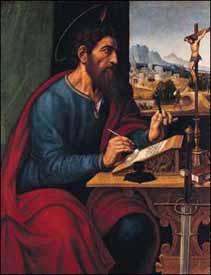 Pier Francesco Sacchi (c. 1485-1528), 'Saint Paul Writing' (1520s), oil on poplar, 106 x 81.9 cm. The National Gallery, Trafalgar Square, London. |
Before we get into 1 and 2 Timothy and Titus it's best to deal with some of the overall, general questions about these letters. This will help us understand better what we are reading when we get to the letters themselves.
Pastoral Epistles
1 and 2 Timothy along with Titus are known as the Pastoral Epistles,5 because they consist largely of pastoral advice on how to deal with problems in churches both in Ephesus and in Crete.
These three epistles have a lot in common with each other. Kümmel summarized it this way:
"They presuppose the same false teachers, the same organization, and entirely similar conditions in the community. They move within the same relative theological concepts and have the same peculiarities of language and style."6
Authorship
The texts of 1 and 2 Timothy and Titus all clearly state in the first verse of each letter that they are written by the Apostle Paul.
The early church clearly accepted them as genuinely Pauline. They were probably known to the author of 1 Clement (ca. 96 AD).7 Several passages in the letters of Ignatius (ca. 110 AD) seem to show dependence on them.8 Polycarp of Smyrna (ca. 117 AD) cited them,9 as did Justin Martyr (ca. 140 AD). They were rejected by the heretical Marcion Canon (ca. 150 AD) according to Tertullian, because of their emphasis on church discipline.10 They are clearly attributed to Paul by Irenaeus (ca. 180 AD).11
It was not until Schleiermacher in the nineteenth century that their authenticity was questioned. Today, a majority of New Testament scholars consider them to be written by a disciple of Paul, not Paul himself. I disagree. I believe that Paul wrote the Pastoral Epistles. I will outline the arguments for and against Pauline authorship below. There is no dispute, however, that the Pastoral Epistles were accepted by the early church as written by Paul himself.
Recipients
First and Second Timothy are so named because they are addressed to Timothy, Paul's travelling companion and assistant on his missionary journeys. In 1 Timothy, Paul, who has gone on to Macedonia, asks Timothy to remain in Ephesus in order to deal with the false teachers that have arisen there (1 Timothy 1:3-4).
It is important, however, to recognize that 1 Timothy, at least, is not intended for Timothy's eyes only. Again and again, Paul underscores both his own authority and that of Timothy, with the assumption that this letter would be read by the church itself.
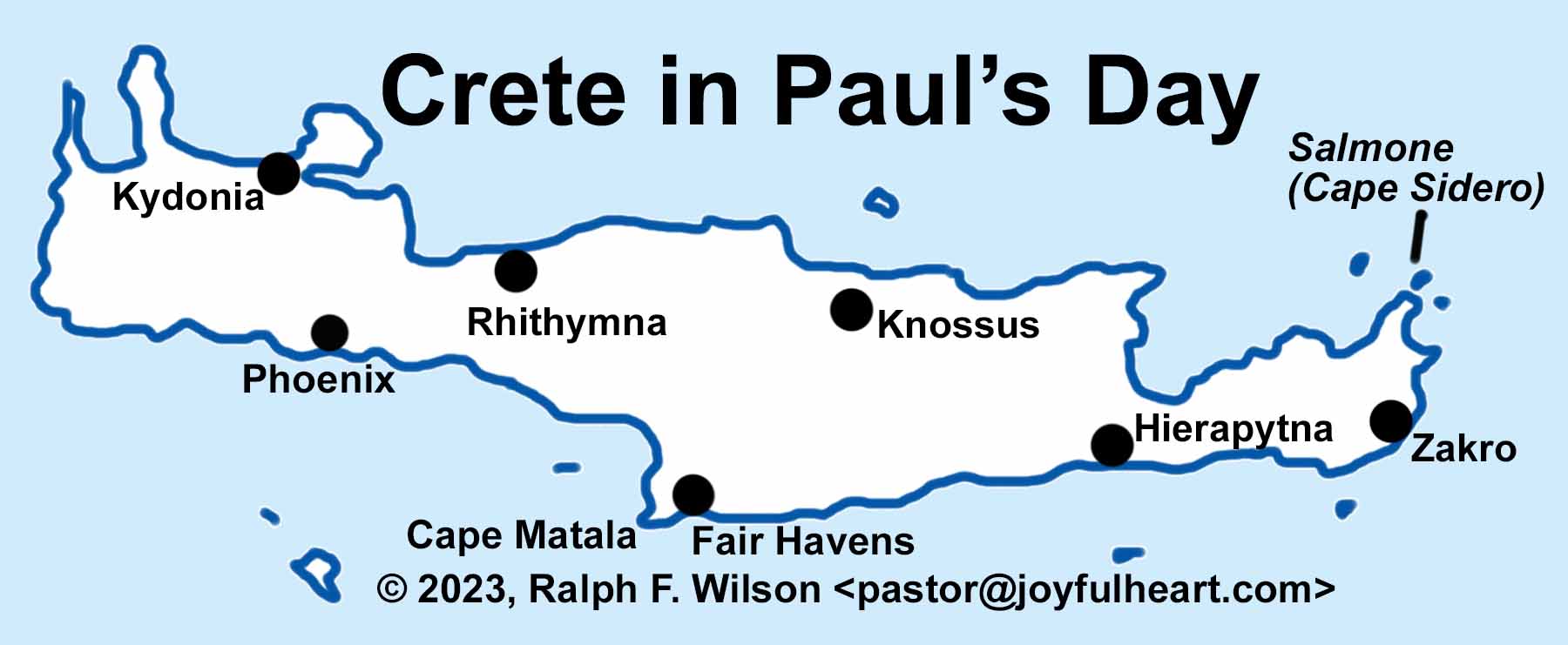
The book of Titus is addressed to a co-worker, Titus, who had ministered with Paul in Crete and was directed to stay there to appoint elders and teach sound doctrine in the churches there.
Timothy
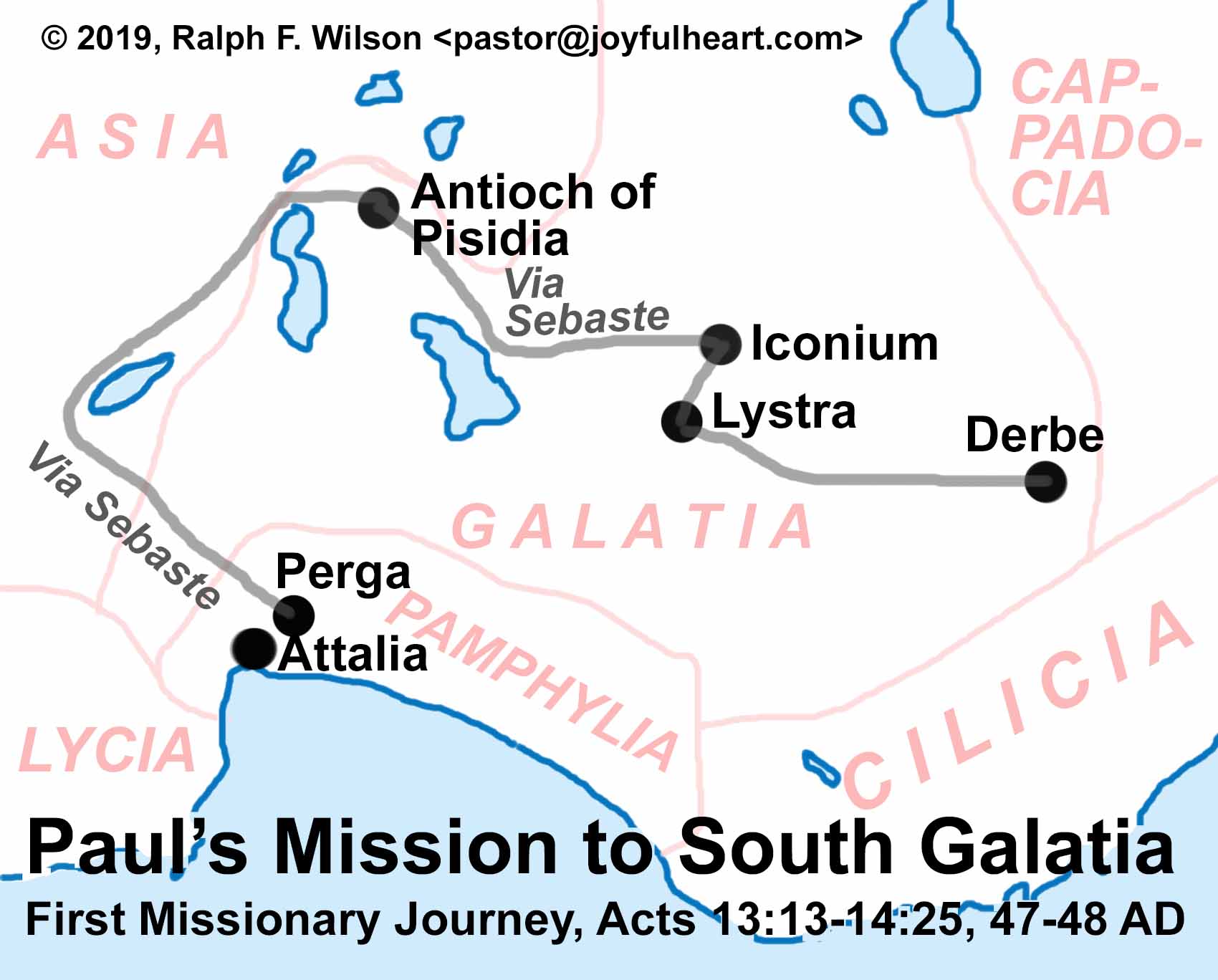
Timothy (whose name means "honoring God" or "venerating God") was born to a mixed marriage of a Jewish mother and a Greek, unbelieving father. His family lived in the city of Lystra.
On Paul's first missionary journey to this city, Timothy, his mother Eunice, and his maternal grandmother Lois become believers (Acts 14:8-20; 2 Timothy 1:5). When Paul visits Lystra on his second missionary journey (Acts 16:1-5), he recognizes the spiritual growth that has taken place in this young man in the intervening years.
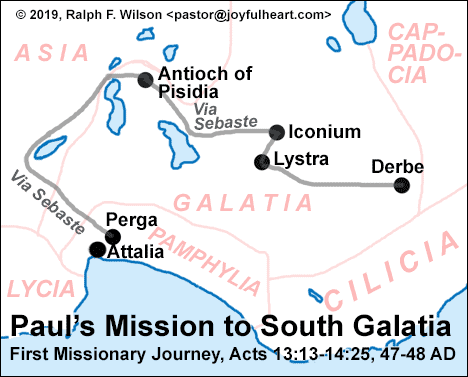 Paul's Mission to South Galatia. Larger map. |
Paul sees in Timothy the makings of an associate who can help him in his missionary endeavors. It may sound strange to us, but one of the qualifications Timothy had to meet in order to work with Paul was to be circumcised. Since Timothy was Jewish through his mother, he could hardly work with Paul in the synagogues of the Mediterranean as an uncircumcised Jew (Acts 16:3).
Timothy is probably commissioned by Paul and the elders in his home church of Lystra. There is a word of prophecy over him, the laying on of hands, and the impartation of a spiritual gift (1 Timothy 1:18; 4:14; 2 Timothy 1:6), perhaps that of evangelist (2 Timothy 4:5).
And so the partnership begins. Timothy travels with Paul's party as an assistant, apprentice, and protégé -- and he gradually proves himself to be a trusted minister in his own right.
He travels with Paul and Silas to Philippi (Acts 16:12) and Berea (Acts 17:14), and joins Paul at Athens. Then he is sent to encourage the church in Thessalonica (1 Thessalonians 3:2) and later is with Paul and Silas in Corinth (1 Thessalonians 1:1; 2 Thessalonians 1:1).
On Paul's third missionary journey, Timothy plays an important role, too. He is sent ahead to Philippi (Acts 19:22), then travels to meet Paul (1 Corinthians 16:10), is with Paul in Corinth (Romans 16:21), and travels with him to Philippi (Acts 20:3-6) before Paul returns to Jerusalem and imprisonment.
When Paul is sent in chains to Rome for trial, Timothy is there with him (Philippians 1:1; 2:19; Colossians 1:1; Philemon 1). He is a great comfort. Paul writes during this time:
"I have no one else like him, who takes a genuine interest in your welfare. For everyone looks out for his own interests, not those of Jesus Christ. But you know that Timothy has proved himself, because as a son with his father he has served with me in the work of the gospel." (Philippians 2:20-22)
It appears that Paul was released from his first imprisonment in Rome (see more on this below). At this time the pair splits up. Paul returns to Philippi while Timothy is dispatched to Ephesus to deal with false teachers who have established some following there. Timothy has his work cut out for him. Paul exhorts him to let no one despise his youth as he appoints elders and deacons, corrects elders bringing false teaching, and regulates care for the church widows. Timothy is still in Ephesus when Paul is imprisoned in Rome (apparently for a second time) and writes his final letter, 2 Timothy.
Later, Timothy spends some time in prison himself (Hebrews 13:23). After that his history gets fuzzy. Church tradition records that he serves as Bishop of Ephesus until 80 AD, when he is beaten to death by pagans.
Titus
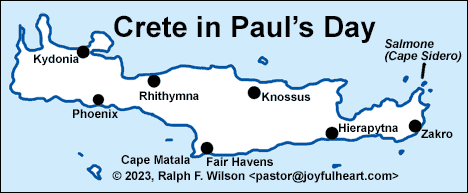 Crete in Paul's Day. Larger map. |
We know much less about Titus than we do Timothy. Titus (Greek titos, Latin titus) was a common Roman name, from the Latin titilus, "title of honor."12 Titus probably came to Christ during the revival in Antioch about 45 AD or later, apparently a convert of Paul himself, since Paul refers to him as "my true son in our common faith" (Titus 1:4). He accompanied Paul and Barnabas on their trip from Antioch to the Jerusalem Council about 49 AD, concerning whether Gentile Christians must be circumcised. It was determined that Titus, who as an uncircumcised Greek believer, need not be circumcised (Galatians 2:1-5).
He was a valued co-worker whom Paul sent on sensitive missions to Corinth (2 Corinthians 7:6-7, 13; 8:6, 16-17; 12:18), so it is a mystery that he is not mentioned in the book of Acts. Paul apparently travels with Titus to Crete following Paul's first release from imprisonment in Rome and leaves him there to set the church in order (Titus 1:5). Later, Paul sends him to Dalmatia (2 Timothy 4:10). Paul refers to him as both a "brother" (2 Corinthians 2:13) as well as "partner and fellow-worker" (2 Corinthians 8:23).
Titus has the heart of a pastor and an earnest devotion to the Church, to his friends and to its leaders. According to a late ninth-century subscription to a Greek manuscript of the epistle to Titus, Titus was the first bishop of Crete.13
Historical Setting in Ephesus
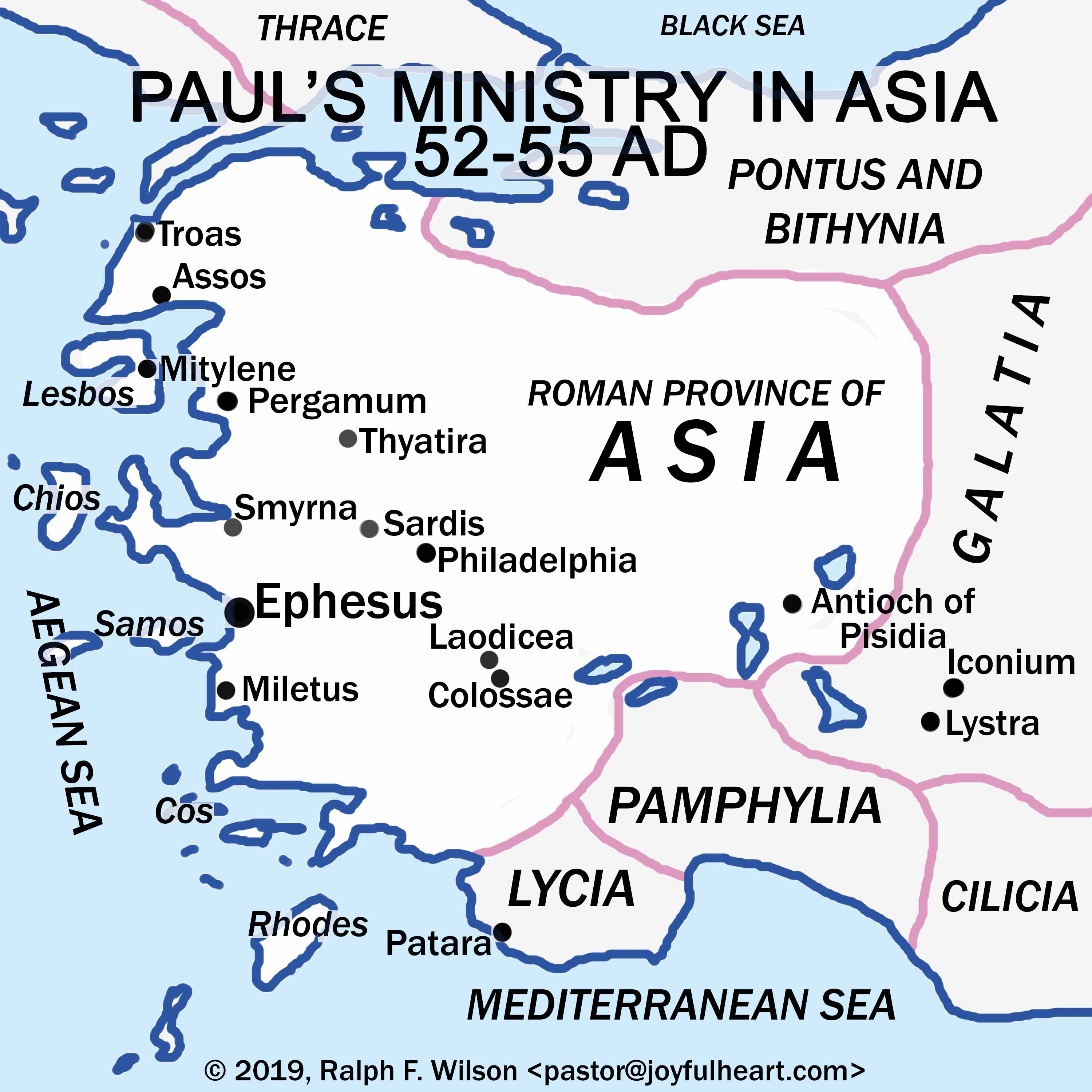
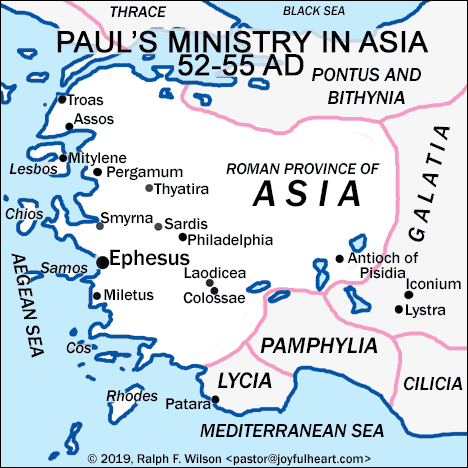 Ministry in Ephesus and the Province of Asia. Larger map |
The letters of 1 and 2 Timothy are written to Timothy while he served as Paul's appointed leader of the church of Ephesus. We'll look at Paul's circumstances as he wrote the letters below, but first let's consider the historical situation of the church in Ephesus.
Ephesus was a wealthy city located on west coast of Asia Minor (modern day Turkey), on the banks of the Cayster River as it enters the Mediterranean, forming an ample harbor. It was an important city, serving as the capital of proconsular Asia, a Roman province. It probably had a population of about half a million.
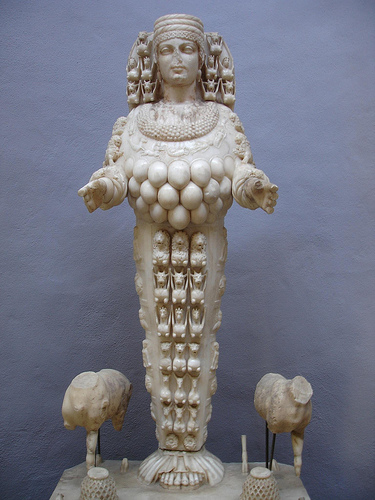
The Ephesians worshipped the goddess Artemis (Diana), whose temple in Ephesus at the time was one of the seven wonders of the ancient world. It was also home to Hellenistic mystery religions, as well as the residence of many Jews. Each of these exerted its influence on the religious climate in the city.
Acts 19 tells the story of Paul's two-year ministry founding the church in Ephesus, probably about 53-54 AD. The city was so important to Paul and early Christianity that it was the recipient of four letters that exist today:
- Paul's Letter to Ephesians
- Paul's Letter to 1 Timothy. (2 Timothy was addressed primarily to Timothy himself while he served as the leader of the church in Ephesus.)
- 1 John was probably written by the Apostle John as a circular letter to the churches in the area, with Ephesus as the most important. John apparently lived there for a number of years, and it is his traditional burial place.
- Letters to the Seven Churches of Revelation (Revelation 2-3) has Ephesus as the first church addressed, encouraged, and admonished (Revelation 2:1-7).
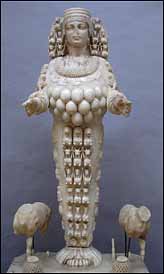 Statue of the goddess Artemis (Diana), first century AD, Ephesus Archaeological Museum, Selcuk, Turkey. Larger image. |
This important church was subject to the winds of heresy from both Judaism on the one hand and the Hellenistic mystery religions on the other. Correction of the false teachers was necessary for the church to survive intact.
Paul's Release and Second Imprisonment
The historical setting of 1 and 2 Timothy and Titus raises some difficult issues. The book of Acts, which chronicles Paul's ministry, ends with him under house arrest in Rome, awaiting trial:
"For two whole years Paul stayed there in his own rented house and welcomed all who came to see him. Boldly and without hindrance he preached the kingdom of God and taught about the Lord Jesus Christ." (Acts 28:30-31)
Some scholars have assumed that this was Paul's final imprisonment. But there are several indications to the contrary in both the Pastoral Epistles, as well as early church tradition. Here is a possible chronology of this period.
| 60-62 AD |
First imprisonment (house arrest) in Rome, 2 years
(Acts 28:30-31). Wrote Philippians (and perhaps Ephesians and Colossians). |
| 62-64 |
Possible mission
to Spain (Romans 15:24; 1 Clement 5:7).14 Second Aegean ministry: Achaia, Crete (Titus 1:5); Macedonia (Titus 1:5; 1 Timothy 1:3), Nicopolis (Titus 3:12), Miletus (2 Timothy 4:20), Troas (2 Timothy 4:13, 20). |
| 62-64 | Wrote 1 Timothy and Titus. |
| Jul 64 | Outbreak of Neronian persecution, fire at Rome |
| 65-67 |
Second
imprisonment in Rome. Wrote 2 Timothy |
| 65-67 | Execution in Rome during the 14th year of Nero15 |
| 68 | Death of Nero |
| 67-70 | Siege and final fall of Jerusalem |
Of course, this reconstruction is speculative; we can't know for sure.
Identity of the False Teachers in Ephesus
Unlike some of the other churches Paul had founded, the false teachers he opposed in the letters to Timothy were primarily insiders, not teachers from outside the church. Most dangerously, these false teachers were the elders or overseers themselves. The church in Ephesus and in other cities was probably composed of house-churches, each presided over by an elder (cf. 1 Corinthians 16:19; Titus 1:11). These elders were, in turn, influencing other elders and house-churches.
Paul had foreseen these problems years before, when he had met with them on the beach at Miletus for the last time. He had told them:
"I know that after I leave, savage wolves will come in among you and will not spare the flock. Even from your own number men will arise and distort the truth in order to draw away disciples after them." (Acts 20:29-30)
Now it had come to pass, and Timothy, as Paul's most trusted co-worker, had been appointed to deal with it. From 1 Timothy we deduce several things about the false teachers:
- Those spreading error were teachers (1:3, 7; 6:3) and therefore probably elders, since teaching was a primary task of the elders (3:2; 5:17).
- One of Paul's emphases in this letter concerns the character, qualifications, and discipline of church leaders, namely overseers/pastors/elders and deacons (3:1-13; 5:17-25).
- Two ringleaders have been named and excommunicated (1:19-20).
- The false teachers' most fruitful field is apparently among women in the congregation (2 Timothy 3:6-9; 1 Timothy 2:9-15; 5:3-16, especially verses 11-15).
- The false teachers seem to have a Jewish cast (1:6-10; 4:3).
Paul doesn't give us a list of the false teaching that Timothy was charged to combat in Ephesus, so we must develop our list in two ways: (1) Specific mentions of false teachings, and (2) reading between the lines to discern from the corrective teachings that Paul gives Timothy.
In compiling this list, I am drawing upon direct statements and hints in all three of the Pastoral Epistles. Of course, 1 and 2 Timothy were written to the situation in Ephesus and Titus to the situation in Crete. But the problems seem similar.
Our first inclination is to look for blatant heresies, that is, teachings that cut to the heart of the nature of God and of Christ -- denying Christ's divinity, for example. But that isn't what we see here. The false teachings are more subtle than that. Towner characterizes the "Ephesian Heresy" as follows:
"A form of aberrant Judaism with Hellenistic / Gnostic tendencies that overemphasized the law and underemphasized Christ and faith, taught dualism (asceticism, denial of a physical resurrection), was unduly interested in the minutiae of the Old Testament, produced sinful lifestyles and irrelevant quibbling about words, and was destroying the reputation of the church in Ephesus."16
Specifically:
1. Speculative Teaching of Jewish Myths and Genealogies
Perhaps the most obvious false teaching has to do with a strong emphasis on Jewish myths and genealogies.
"... Nor to devote themselves to myths and endless genealogies." (1 Timothy 1:4)
"Have nothing to do with godless myths and old wives' tales." (1 Timothy 4:7)
"They will turn their ears away from the truth and turn aside to myths." (2 Timothy 4:4)
"Avoid foolish controversies and genealogies...." (Titus 3:9)
We may find this hard to understand, but consider all the genealogies in the Old Testament and even the New. Jews who could prove their genealogical descent from the patriarchs considered themselves superior. This had been over-emphasized in Ephesus and Crete among the Jewish Christians.
Jewish myths may have included various Jewish allegories of creation, perhaps speculative rabbinic exegesis. Jewish pseudepigraphical writings from the first and second centuries AD are full of such stories.
2. Jewish Legalism
Second, there seems to be a kind of false teaching related to a use of the Old Testament, insisting on adherence to the Mosaic ritual law, kosher food, circumcision, etc.
"They want to be teachers of the law, but they do not know what they are talking about or what they so confidently affirm." (1 Timothy 1:7)
"For there are many rebellious people, mere talkers and deceivers, especially those of the circumcision group." (Titus 1:10)
"... Arguments and quarrels about the law." (Titus 3:9)
"They ... order them to abstain from certain foods, which God created to be received with thanksgiving...." (1 Timothy 4:3)
"... The commands of those who reject the truth." (Titus 1:14)
We see Paul combating a similar kind of legalism in Colossae (Colossians 2:16, 21-23).
3. Downplaying the Role of Marriage
Third, these teachers downplayed the role of marriage, a kind of asceticism.
"They forbid people to marry...." (1 Timothy 4:3)
It may be similar to the situation Paul addressed in 1 Corinthians 7:1-7. It is probably no coincidence that Paul stresses the importance of faithfulness to one's marriage and careful management of one's household for overseers/elders and deacons (1 Timothy 3:1, 4, 12; Titus 1:6). Perhaps this false teaching extended to childbirth as well, occasioning Paul's example concerning childbirth in 1 Timothy 2:15.17
4. Ethical Relativism and Greed
Paul taught that the ritual laws were obsolete in the messianic age, while the ethical laws remained. The false teachers seemed to teach the opposite -- that the ritual laws were binding, but conduct wasn't as important.
"They claim to know God, but by their actions they deny him. They are detestable, disobedient and unfit for doing anything good." (Titus 1:16)
There's the suggestion of taking advantage of some of the church women, perhaps sexually (2 Timothy 3:6). Paul's guidelines for leaders presuppose ethical and behavior problems, for Paul writes:
"Now the overseer must be above reproach, the husband of but one wife, temperate, self-controlled, respectable, hospitable, able to teach, not given to drunkenness, not violent but gentle, not quarrelsome, not a lover of money." (1 Timothy 3:2-3)
Twice more, Paul warns Timothy about the dangers of the love of money (1 Timothy 6:5-10, 17-19), so we can assume that this was one of the heresies being promulgated in Ephesus.
5. Mistaken Eschatology
Next, Paul's opponents in Ephesus taught that the resurrection had already come -- that is, that we no longer look forward to Christ's coming, judgment, and resurrection of the dead.
"They say that the resurrection has already taken place, and they destroy the faith of some." (2 Timothy 2:18)
This may have similarities with teachings in Corinth that denied the resurrection of the dead at all (1 Corinthians 15:12). Two church members had already been excommunicated for such teaching that was causing major problems with some of the members' faith (1 Timothy 1:20; 2 Timothy 2:17).
There are some indications that Paul is dealing with an early form of Gnosticism here that deprecates physical matter, for example -- not full-blown Gnosticism at it would appear a century later, but beginning strands of "the opposing ideas of what is falsely called knowledge" (1 Timothy 6:20).
6. Neglect of Evangelism
Finally, there is an indication that the false teachers were so immersed in speculative controversies that they neglected the very core of the Christian faith -- a situation not unfamiliar today! Why else would Paul talk about his own salvation and then make the point:
"Here is a trustworthy saying that deserves full acceptance: Christ Jesus came into the world to save sinners -- of whom I am the worst." (1 Timothy 1:15)
Finally, he exhorts Timothy:
"Endure hardship, do the work of an evangelist, discharge all the duties of your ministry." (2 Timothy 4:5)
The gospel! The gospel! It is always on Paul's mind. It is his theme, his message -- and is so easy for us to dismiss as "old hat."
It is hard to characterize the heresy at Ephesus in any clear, simple way. Lightfoot correctly describes it as: "Floating speculation, vague theories, coalescing gradually to a great consistency and tendency more or less in one direction."18
Purposes of the Pastoral Epistles
The primary purpose of 1 Timothy is to urge Paul's appointed representative to stop the false teaching. The secondary purpose is to provide written authorization before the church to allow Timothy to carry out this task. He is also to regulate appointment of elders and deacons.
The purpose of 2 Timothy is much more personal -- primarily to call Timothy to his side and to exhort him to faithfulness in his ministry. Paul has seen many defections and desertions during his second imprisonment. He appeals to Timothy's loyalty and longs for him to come to him in Rome
Titus is written to encourage the teaching of sound doctrine and appointment of leaders in the churches, following Paul's ministry with Titus in Crete. He also requests Titus to come to him in Rome.
Arguments Concerning Pauline Authorship
Before we conclude, we need to look briefly at various arguments that have been raised against Paul's authorship of the Pastoral Epistles. In short, here they are:
- A significant part of the characteristic words of the Pastoral Epistles is new vocabulary, and the new terms seem to represent more the language of Hellenism or Hellenistic Judaism. For example, instead of "faith," the author tends to use "godliness," instead of "the gospel" we see "sound teaching." "Sound-minded" and related words predominate as virtues.
- Much of Paul's rich theological vocabulary is lacking, such as those words used to develop themes such as "righteousness," "justification," etc.
- Stylistic features of Greek grammar that are common to the Pastoral Epistles are different than in Paul's earlier letters.
These observations are true -- though they are often overstated by opponents of Pauline authorship. But assuming a different author creates other problems. It is preferable to explain the differences by Paul's use of a different amanuenses (or secretary), as well as the more personal rather than theological nature of these letters.
Opponents of Pauline authorship claim that the Pastoral Epistles were written by a pseudepigraphic writer (perhaps a disciple of Paul), who wrote at the end of the first century. To put it bluntly, they argue that a later writer claiming to be Paul, wrote the letters -- that pseudepigraphy was common and accepted in the early church.
However, we know that many bogus letters or gospels, suspected of being written by someone claiming to be an apostle, were detected and rejected out of hand by the early church. The early church did not accept pseudepigraphic writings as Scripture! Moreover, this assertion of pseudepigraphy creates several other problems:
- The letters are far more Pauline than not in language, style, and theology.
- The historical situation of the Ephesian church presupposed in 1 and 2 Timothy and Titus fits the period of the 60s much better than it fits what we know of the situation at the end of the first century, when critics claim it was written.
- There is no adequate occasion and purpose for a pseudepigraphic author to have written these letters, in particular, three such letters. The argument that the author used some genuine fragments of Pauline letters doesn't explain the questions of occasion and purpose.19
 Available in paperback, PDF, and Kindle formats. |
Added to that the nearly unanimous acceptance of the letters as Pauline in the early church, I conclude that the letters are genuine, from the person of Paul himself, despite the differences between the Pastoral Epistles and Paul's earlier letters.20
Endnotes
[5] As of October 2023, "pastoral" is pronounced PASS-tuhr-uhl, with the emphasis on the first syllable, according to Merriam-Webster.com and the Oxford English Dictionary. Merriam-Webster gives the pronunciation pass-TOR-uhl as "nonstandard." British pronunciation is on the first syllable. For the word "electoral," Merriam-Webster.com gives i-LEK-te-rel as the first pronunciation, e-lek-TOR-el as the second pronunciation. The Oxford English Dictionary shows only pronunciations with emphasis on the second syllable.
[6] W.G. Kümmel, translated by H.C. Kee, Introduction to the New Testament (second edition, Abingdon, 1975), p. 367.
[7] Knight, Pastoral Epistles, p. 13.
[8] Kelly, Pastoral Epistles, p. 3.
[9] Polycarp, Philippians 4:1 cites 1 Timothy 6:7, 10.
[10] Tertullian, Against Marcion 5:21.
[11] Irenaeus, Against Heresies 2.14.7 quotes 1 Timothy 6:20; 3.3.3 refers to 2 Timothy 4:21.
[12] Titus Flavius Vespasianus, son of Emperor Vespasian (69-79 AD), was the general who conquered Jerusalem in 70 AD, later Roman emperor 79 to 81 AD.
[13] I drew upon information in G. F. Hawthorne, "Titus," ISBE 4:864.
[14] 1 Clement 5:7; Acts of Peter (Vercelli) 1-3, 40; the Muratorian Canon; Eusebius, Church History 2.22.1-8.
[15] According to Eusebius's Chronicle (Jerome, Vir. 1; 5; 12), Paul was martyred together with Peter in the fourteenth year of Nero, 67/68.
[16] Mounce, p. 19.
[17] Mounce, p. 146
[18] J.B. Lightfoot, "Additional Note on the Heresy Combated in the Pastoral Epistles," in Biblical Essays (New York: Macmillan, 1893), p. 412, cited by Mounce, p. lxxv.
[19] I have followed here Fee, pp. 23-26.
[20] To explore the issues of authorship in greater detail I recommend the commentaries of Fee, Knight, Towner, Mounce, and Kelly.
Copyright © 2025, Ralph F. Wilson. <pastor joyfulheart.com> All rights reserved. A single copy of this article is free. Do not put this on a website. See legal, copyright, and reprint information.
 |
|
In-depth Bible study books
You can purchase one of Dr. Wilson's complete Bible studies in PDF, Kindle, or paperback format -- currently 48 books in the JesusWalk Bible Study Series.
Old Testament
- Abraham, Faith of
- Jacob, Life of
- Moses the Reluctant Leader
- Joshua
- Gideon
- David, Life of
- Elijah
- Psalms
- Solomon
- Songs of Ascent (Psalms 120-134)
- Isaiah
- 28 Advent Scriptures (Messianic)
- Daniel
- Rebuild & Renew: Post-Exilic Books
Gospels
- Christmas Incarnation (Mt, Lk)
- Sermon on the Mount (Mt 5-7)
- Luke's Gospel
- John's Gospel
- Seven Last Words of Christ
- Parables
- Jesus and the Kingdom of God
- Resurrection and Easter Faith
- Apostle Peter
Acts
Pauline Epistles
- Romans 5-8 (Christ-Powered Life)
- 1 Corinthians
- 2 Corinthians
- Galatians
- Ephesians
- Philippians
- Colossians, Philemon
- 1 & 2 Thessalonians
- 1 &2 Timothy, Titus
General Epistles
Revelation
Topical

 To be notified about future articles, stories, and Bible studies, why don't you subscribe to our free newsletter, The Joyful Heart, by placing your e-mail address in the box below. We respect your