Free E-Mail
Bible Studies
 Apostle Peter
Beginning the Journey (for new Christians). en Español
Old Testament
Abraham
Jacob
Moses
Joshua
Gideon
David, Life of
Elijah
Psalms
Solomon
Songs of Ascent (Ps 120-135)
Isaiah
Advent/Messianic Scriptures
Daniel
Rebuild & Renew: Post-Exilic Books
Gospels
Christmas Incarnation
(Mt, Lk)
Sermon on the Mount
(Mt 5-7)
Mark
Luke's
Gospel
John's Gospel
7 Last Words of Christ
Parables
Jesus and the Kingdom
Resurrection
Apostle Peter
Acts
The Early Church
(Acts 1-12)
Apostle Paul
(Acts 12-28)
Paul's Epistles
Christ Powered Life (Rom 5-8)
1 Corinthians
2 Corinthians
Galatians
Ephesians
Vision for Church
(Eph)
Philippians
Colossians,
Philemon
1
& 2 Thessalonians
1 & 2 Timothy,
Titus
General Epistles
Hebrews
James
1 Peter
2 Peter, Jude
1, 2, and 3 John
Revelation
Revelation
Conquering Lamb of Revelation
Topical
Glorious Kingdom, The
Grace
Great Prayers
Holy Spirit, Disciple's Guide
Humility
Lamb of God
Listening for God's Voice
Lord's Supper
Names of God
Names of Jesus
Christian Art
About Us
Podcasts
Contact Us
Dr. Wilson's Books
Donations
Watercolors
Sitemap

1. The Promise of Resurrection from the Dead
 Apostle Peter: Disciple Lessons from the Rock
 Fra Angelico (c. 1400-55), "Resurrection of Christ and Women at the Tomb" (1440-41), Fresco, 189 x 164 cm, Convento di San Marco, Florence. |
I would guess that many Christians today believe more in the "immortality of the soul" than in resurrection. A belief in "going to heaven" is much more in mind than one's body being physically raised from the dead. But resurrection from the dead -- especially Jesus' own bodily resurrection from the dead after his crucifixion -- is the centerpiece of Christianity.
In this five-week series we're going to examine resurrection carefully. We'll begin by looking its Old Testament roots, Jesus' teaching on the subject, and Jesus' own resurrection from the dead. Then we'll explore the meaning and significance for us of Jesus' resurrection, as well as the proofs we have that his resurrection actually took place. Finally, we'll consider what the Bible says about the resurrection of our own bodies.
Resurrection Defined
Let's begin by defining some terms. By "life after death" people are usually referring to the state of being alive, conscious, or something, after the physical phenomenon of death. But by "resurrection" we are referring not just to the soul or spirit, but specifically to the physical body in some way. The Greek word for resurrection (anastasis), comes from the verb anistēmi, "to raise, arise." The other verb used occasionally is egeirō, "to awaken, rise." Not that the Greeks believed in resurrection. They didn't. The New Testament uses these words to describe a raising up of the body after a period of being dead. The New Testament teaches a raising of our physical bodies at the Last Day to even more life than they had when we were "alive" before.
Gathered to their Fathers
But such a belief wasn't always the case. When we turn back to the era of the Old Testament, in the earliest days, we don't see a belief in resurrection. In Genesis, for example, when Abraham died, he was "gathered to his fathers" (Genesis 25:8). This probably meant that his bones would be stored with theirs, referring to the ancient and widespread practice of secondary burials, collecting and storing the bones after the flesh has decomposed.1
Sheol, the Shades
In the earlier part of the Old Testament we also find the Hebrew word she´ôl, the place of the dead, both good and bad. While the KJV often translates it as "hell," more recent translations render it "the grave" (NIV) or the "realm of the death," or just leave it untranslated and render it as "Sheol"2 (NRSV). Sheol seems to refer to "the dark, deep regions, the land of forgetfulness ... a place of gloom and despair, a place where one can no longer enjoy life, and where the presence of Yahweh himself is withdrawn."3 Thus we find in the Psalms:
"No one remembers you when he is dead.
Who praises you from the grave (she´ôl)?" (Psalm 6:5)
"Do you show your wonders to the dead?
Do those who are dead rise up and praise you?
Is your love declared in the grave,4
your faithfulness in Destruction?5
Are your wonders known in the place of darkness,
or your righteous deeds in the land of oblivion?" (Psalm 88:10-12)
The First Glimmers in Job
But gradually, slowly, God begins to reveal to his prophets that there is something more than darkness beyond death. Theologians call this revealing of more truth as time goes on, "progressive revelation." Job wonders:
"If a man dies, will he live again? All the days of my hard service I will wait for my renewal to come." (Job 14:14)
Later he declares with longing:
"I know that my Redeemer lives,
and that in the end he will stand upon the earth.
And after my skin has been destroyed,
yet in my flesh I will see God;
I myself will see him
with my own eyes -- I, and not another.
How my heart yearns within me!" (Job 19:25-27)
This passage is notoriously difficult to translate.6 But is Job beginning to see something beyond the grave? I think so.
| Q1. How does Job's vision of resurrection
(Job 19:25-27) differ from the Jews' former understanding of
death as Sheol? What is progressive revelation? https://www.joyfulheart.com/forums/index.php?showtopic=567
|
Psalm 16 Refers to Resurrection
A Psalmist declares:
"Therefore my heart is glad and my tongue rejoices;
my body also will rest secure,
because you will not abandon me to the grave (she´ôl),
nor will you let your Holy One see decay.
You have made known to me the path of life;
you will fill me with joy in your presence,
with eternal pleasures at your right hand." (Psalm 16:9-11)
Resurrection in Hosea
In the Prophet Hosea we read:
"I will ransom them from the power of the grave (she´ôl);
I will redeem them from death.
Where, O death, are your plagues?
Where, O grave, is your destruction?" (Hosea 13:14)7
In Hosea 6, we see an intriguing passage, apparently interpreted in terms of resurrection by Jesus himself:
"Come, let us return to the LORD;
for it is he who has torn, and he will heal us;
he has struck down, and he will bind us up.
After two days he will revive us;
on the third day he will raise us up,
that we may live before him." (Hosea 6:1-2)8
It is the first passage that seems to make the explicit statement that Yahweh will give his people a new bodily life on the other side of death.9
The Resurrection in Isaiah
Isaiah the Prophet speaks even more clearly of a bodily resurrection:
"But your dead will live;
their bodies will rise.
You who dwell in the dust,
wake up and shout for joy.
Your dew is like the dew of the morning;
the earth will give birth to her dead." (Isaiah 26:19)
At the conclusion of the Suffering Servant passage of Isaiah 53, we see an wonderful glimmer of hope, brought out best by the New International Version:
"After the suffering of his soul,
he will see the light of life and be satisfied;
by his knowledge my righteous servant will justify many,
and he will bear their iniquities." (Isaiah 53:11)
The phrase "light of life" (NIV) doesn't occur in the Masoretic Hebrew text, but is found in both the Greek Septuagint translation as well as the Hebrew text of the Isaiah scroll found among the Dead Sea Scrolls.10 The Servant's contemporaries saw him as "cut off from the land of the living" (53:8). But 53:11 indicates that the Servant will see "light" -- that is, life outside the grave -- even after his atoning death. I expect that Jesus also saw this promise, which underlies his teaching to his disciples that "it is written" that the Son of Man would be raised from the dead (Luke 24:25-27; 8:31; 9:31; 10:32-34; 14:21).
The Valley of Dry Bones in Ezekiel
In Ezekiel we see a kind of resurrection:
"I saw a great many bones on the floor of the valley, bones that were very dry.
He asked me, 'Son of man, can these bones live?'
I said, 'O Sovereign LORD, you alone know.'
Then he said to me, 'Prophesy to these bones and say to them, "Dry bones, hear the word of the LORD! This is what the Sovereign LORD says to these bones: I will make breath enter you, and you will come to life. I will attach tendons to you and make flesh come upon you and cover you with skin; I will put breath in you, and you will come to life. Then you will know that I am the LORD."'" (Ezekiel 37:2b-6 )
This may not be an actual prophecy of resurrection as much as a figure of the restoration of a nation. Nevertheless, it added to the Israelites' consciousness of resurrection.
Daniel 12:1-2
Probably the clearest reference in the Old Testament to resurrection is found in Daniel:
"There will be a time of distress such as has not happened from the beginning of nations until then. But at that time your people -- everyone whose name is found written in the book -- will be delivered. Multitudes who sleep in the dust of the earth will awake: some to everlasting life, others to shame and everlasting contempt." (Daniel 12:1b-2)
First Century Judaism
By the time the first century rolled around, resurrection -- which had just a few references in the Old Testament -- was now held by the largest number of people in Judaism. There were essentially three beliefs about the resurrection in Jesus' world.
Sadducees
The Sadducees represented the aristocrats, a minority group that held a good deal of power in Judaism. They held a considerable number of seats on the Sanhedrin, the ruling council. The high priests' families were also Sadducees (Acts 5:17). They denied the resurrection of the dead on the last day, and held to a view that the dead were in Sheol, as some of the earlier portions of the Old Testament had taught. They didn't take this position because they were the "liberals"; rather they were the "conservatives" of the time. Since the resurrection wasn't clearly mentioned in the Pentateuch (the first five books of the Bible) and the historical books, they refused to accept it (Matthew 22:23; Acts 23:8). However, the Sadducees didn't exist as a major group in Judaism after the destruction of Jerusalem in 70 AD.
Pharisees
The Pharisees strongly held the view that the there was a resurrection. They were a reform party in Judaism, who believed in a serious commitment to holiness and obedience to every command in the Bible. However, their reformation had become hardened into a brittle and self-serving personal righteousness that tended to keep the letter of the law, but often missed the spirit of the command. Some of Jesus' most scathing commentaries on contemporary Judaism were directed at the Pharisees -- though he agreed with them about the resurrection of the saints at the Last Day.
The Greeks and Romans
The third major group was represented by the Greco-Roman beliefs held by the Roman governor and the army of occupation. They weren't Jews, of course, but represented the dominant worldview met by the apostles when they began to preach the resurrection of Christ outside of Israel in the Mediterranean world. Greeks believed in the immortality of the soul, but scorned the resurrection of the body as a silly belief (Acts 17:18, 32).
Previous Resurrections
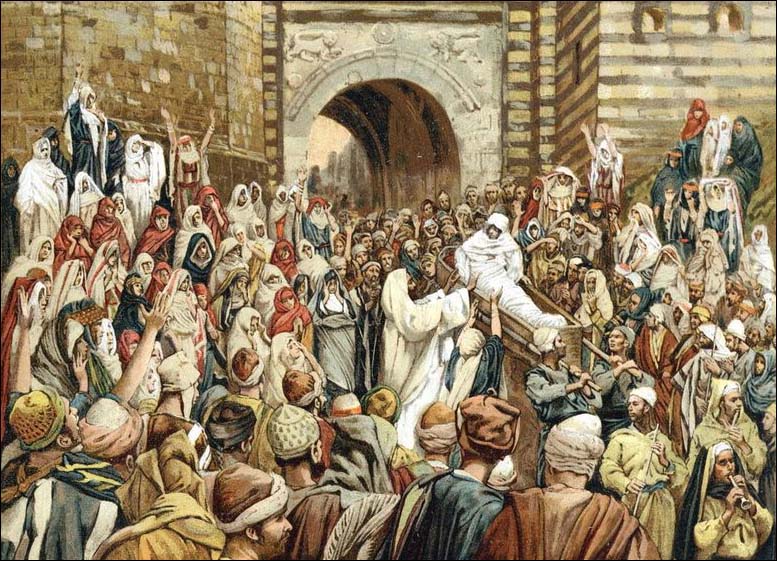 J.J. Tissot, detail of "Jesus Raising the son of the widow at Nain" (1890), original watercolor. Larger full image. |
There had been restorations to life before in the history of Israel. Elijah had restored the son of the widow of Zarepheth (1 Kings 17:17-21). Elisha had raised the son of the Shunnamite woman (2 Kings 4:32-35). Jesus had raised Jairus' daughter (Mark 5:40-42) and the son of the widow of Nain (Luke 7:11-15). Of course, Jesus' friend Lazarus was raised after having been dead four days (John 11). At the hour of Jesus' death, Matthew records that the bodies of "many holy people" were raised to life (Matthew 27:51-53). These resurrections are treated as harbingers of Jesus' coming resurrection, proof that Jesus had death in his own control.11 The difference between these resurrections and the resurrection of Jesus and the saints on the Last Day was that these people later died.
Jesus' Teaching on the Resurrection of the Dead
Now let's examine what Jesus himself taught about the resurrection from the dead. He affirmed that:
"Those who have done good will rise to live, and those who have done evil will rise to be condemned." (John 5:28-29)
Jesus' statement echoed Daniel's prophecy and paralleled the Pharisees' teaching of "a resurrection of both the righteous and the wicked." (Acts 24:15). Jesus taught that this would be a time of reward for those who had followed the Lord: "You will be repaid at the resurrection of the righteous" (Luke 14:14).
| Q2. (John 5:28-29; Acts 24:15) According
to scripture, both the righteous and unrighteous will
experience resurrection. What will be the result of
resurrection for the righteous? https://www.joyfulheart.com/forums/index.php?showtopic=568
|
When the Sadducees asked Jesus a trick question to try to poke fun at the resurrection, Jesus told us something about state of believers at the resurrection:
"The people of this age marry and are given in marriage. But those who are considered worthy of taking part in that age and in the resurrection from the dead will neither marry nor be given in marriage, and they can no longer die; for they are like the angels. They are God's children, since they are children of the resurrection." (Luke 20:34-36)
On that occasion, Jesus also taught that the resurrection of the dead is implied even in the Pentateuch that the Sadducees claimed to honor above all other scriptures:
"But in the account of the bush, even Moses showed that the dead rise, for he calls the Lord 'the God of Abraham, and the God of Isaac, and the God of Jacob.' He is not the God of the dead, but of the living, for to him all are alive." (Luke 20:37-38)
Jesus as the Agent of Resurrection
For Jesus, however, the resurrection wasn't just a belief about a future event. He would be intricately involved himself as the Agent of Resurrection. At the time of Lazarus' death, the following exchange took place between Jesus and Lazarus' sister Martha:
"Jesus said to her, 'Your brother will rise again.'
Martha answered, 'I know he will rise again in the resurrection at the last day.'
Jesus said to her, 'I am the resurrection and the life. He who believes in me will live, even though he dies; and whoever lives and believes in me will never die.'" (John 11:23-25)
Another place, Jesus said:
"I tell you the truth, a time is coming and has now come when the dead will hear the voice of the Son of God and those who hear will live.... A time is coming when all who are in their graves will hear his voice and come out -- those who have done good will rise to live, and those who have done evil will rise to be condemned." (John 5:25, 28-29)
In the discourse about bread, Jesus asserted that he himself would raise up his disciples on that day:
"And this is the will of him who sent me, that I shall lose none of all that he has given me, but raise them up at the last day. For my Father's will is that everyone who looks to the Son and believes in him shall have eternal life, and I will raise him up at the last day.... Whoever eats my flesh and drinks my blood has eternal life, and I will raise him up at the last day." (John 6:39-40, 54)
| Q3. (John 11:23-25) What do you think
Jesus meant when he said, "I am the resurrection and the
life"? What role will Jesus play in the resurrection of the
dead? https://www.joyfulheart.com/forums/index.php?showtopic=569
|
Jesus' Promise of His Own Resurrection
Even more striking is Jesus' teaching that he himself would be raised from the dead on the third day. Jesus predicts both his death and resurrection three times during the latter part of his ministry:
"From that time on Jesus began to explain to his disciples that he must go to Jerusalem and suffer many things at the hands of the elders, chief priests and teachers of the law, and that he must be killed and on the third day be raised to life." (Matthew 16:21; cf. Luke 9:22)
"When they came together in Galilee, he said to them, 'The Son of Man is going to be betrayed into the hands of men. They will kill him, and on the third day he will be raised to life.'" (Matthew 17:22-23)
"Now as Jesus was going up to Jerusalem, he took the twelve disciples aside and said to them, 'We are going up to Jerusalem, and the Son of Man will be betrayed to the chief priests and the teachers of the law. They will condemn him to death and will turn him over to the Gentiles to be mocked and flogged and crucified. On the third day he will be raised to life!'" (Matthew 20:17-19; cf. Luke 18:31-33)
The Third Day, Three Days
Jesus used two figures to speak elliptically of his resurrection on the third day. First, the figure of the temple:
"Then the Jews demanded of him, 'What miraculous sign can you show us to prove your authority to do all this?'
Jesus answered them, 'Destroy this temple, and I will raise it again in three days.'
The Jews replied, 'It has taken forty-six years to build this temple, and you are going to raise it in three days?' But the temple he had spoken of was his body. After he was raised from the dead, his disciples recalled what he had said. Then they believed the Scripture and the words that Jesus had spoken." (John 2:18-22)
 Now all the lessons are available together in e-book and printed book formats. |
Jesus' enemies remembered this saying at his trial (Matthew 27:40; Mark 14:58). The second figure Jesus used was the story of Jonah's three days in the fish's belly as a sign of his own resurrection (Matthew 12:39-40). Though it didn't really seem to register with his disciples (Luke 24:7-8), his words weren't lost on the Pharisees and chief priests:
"The next day, the one after Preparation Day, the chief priests and the Pharisees went to Pilate. 'Sir,' they said, 'we remember that while he was still alive that deceiver said, "After three days I will rise again." So give the order for the tomb to be made secure until the third day. Otherwise, his disciples may come and steal the body and tell the people that he has been raised from the dead. This last deception will be worse than the first.'" (Matthew 27:62-64)
And so Pilate ordered a guard to be placed. We make a distinction between three days and the third day, but in Greek, these two phrases meant the same.12 After his resurrection, Jesus explained: "This is what is written: The Christ will suffer and rise from the dead on the third day...." -- probably a reference to both Hosea 6:1 and Isaiah 53:11.
| Q4. Why did Jesus' enemies heed his
prediction of being raised on the third day even more than
his disciples? Did his enemies expect him to rise? Did his
followers? https://www.joyfulheart.com/forums/index.php?showtopic=570
|
The resurrection of the dead was the strong expectation and hope of Jesus. Is yours? In the next lesson we will examine Jesus' own resurrection from the dead.
Prayer
Lord, implant in us the strong faith in the resurrection that Jesus himself held. In Jesus' name, we pray. Amen.
Key Verses
"I know that my Redeemer lives,
and that in the end he will stand upon the earth.
And after my skin has been destroyed,
yet in my flesh I will see God;
I myself will see him
with my own eyes -- I, and not another.
How my heart yearns within me!" (Job 19:25-27)
"There will be a time of distress such as has not happened from the beginning of nations until then. But at that time your people -- everyone whose name is found written in the book -- will be delivered. Multitudes who sleep in the dust of the earth will awake: some to everlasting life, others to shame and everlasting contempt." (Daniel 12:1b-2)
"Jesus said to her, 'I am the resurrection and the life. He who believes in me will live, even though he dies; and whoever lives and believes in me will never die.'" (John 11:25-26)
References
- Wright, Resurrection, pp. 90-91.
- R. Laird Harris, shā´al, TWOT #2303c.
- Wright, pp. 88-89.
- Hebrew qeber, "grave, sepulcher" (R. Laird Harris, qābar, TWOT #1984a.).
- Hebrew ´ăbaddôn, "destruction, ruin, Abaddon," from ´ābad, "perish, be destroyed, a common word for "to die" (R. Laird Harris, ´ābad, TWOT #2d).
- Wright, Resurrection, pp. 97-98.
- Wright (Resurrection, p. 118) asserts that "the original Hebrew text is almost certainly denying that YHWH will redeem Israel from Sheol and Death. However, the LXX and other ancient versions, and also the New Testament, take the passage in a positive sense...."
- Wright (Resurrection, pp. 118-119) sees this verse as originally indicating a failure to repent, but that it is interpreted in a more positive by later Biblical writers.
- Wright, Resurrection, p. 119.
- This verse can be construed in various ways. The Masoretic Text which underlies the KJV does not include the Hebrew noun &@096;or, "light" (NRSV) or "light of life" (NIV). However, they appear in the both the Septuagint and in all the Dead Sea Scroll (Qumran) copies of Isaiah, which "constitutes strong evidence" (John N. Oswalt, The Book of Isaiah: Chapters 40-66 (New International Commentary on the Old Testament; Eerdmans, 1998), p. 399, fn. 43. Light can symbolize general "life" (Herbert Wolf, TWOT #52). On Psalm 36:10, Mitchell Dahood (Psalms (Anchor Bible; Doubleday) 1:221-222) argues that "to see light" is often really to see the light of God's face in immortality, though this may refer to mortal life as perhaps Psalm 49:19 (so Peter C. Craigie, Psalms 1-50 (Word Biblical Commentary, vol. 19; Word, 1983), p. 292) See a similar idea in Psalm 17:15.
- Grant R. Osborne, "Resurrection," DJG 673-688.
- Ladd, Resurrection, p. 109, writes: "Students of the Greek language have proven that, contrary to English usage, the two phrases were identical in meaning." He cites for this Vincent Taylor, The Gospel according to St. Mark (London: Macmillan, 1952), p. 378.
Copyright © 2025, Ralph F. Wilson. <pastor joyfulheart.com> All rights reserved. A single copy of this article is free. Do not put this on a website. See legal, copyright, and reprint information.
 |

|

In-depth Bible study books
You can purchase one of Dr. Wilson's complete Bible studies in PDF, Kindle, or paperback format -- currently 48 books in the JesusWalk Bible Study Series.
Old Testament
- Abraham, Faith of
- Jacob, Life of
- Moses the Reluctant Leader
- Joshua
- Gideon
- David, Life of
- Elijah
- Psalms
- Solomon
- Songs of Ascent (Psalms 120-134)
- Isaiah
- 28 Advent Scriptures (Messianic)
- Daniel
- Rebuild & Renew: Post-Exilic Books
Gospels
- Christmas Incarnation (Mt, Lk)
- Sermon on the Mount (Mt 5-7)
- Luke's Gospel
- John's Gospel
- Seven Last Words of Christ
- Parables
- Jesus and the Kingdom of God
- Resurrection and Easter Faith
- Apostle Peter
Acts
Pauline Epistles
- Romans 5-8 (Christ-Powered Life)
- 1 Corinthians
- 2 Corinthians
- Galatians
- Ephesians
- Philippians
- Colossians, Philemon
- 1 & 2 Thessalonians
- 1 &2 Timothy, Titus
General Epistles
Revelation
Topical

 To be notified about future articles, stories, and Bible studies, why don't you subscribe to our free newsletter, The Joyful Heart, by placing your e-mail address in the box below. We respect your