Free E-Mail
Bible Studies
 King
Solomon
King
SolomonBeginning the Journey (for new Christians). en Español
Old Testament
Abraham
Jacob
Moses
Joshua
Gideon
David, Life of
Elijah
Psalms
Solomon
Songs of Ascent
(Ps 120-135)
Isaiah
Advent/Messianic Scriptures
Daniel
Rebuild & Renew: Post-Exilic Books
Gospels
Christmas Incarnation
(Mt, Lk)
Sermon on the Mount
(Mt 5-7)
Mark
Luke's
Gospel
John's Gospel
7 Last Words of Christ
Parables
Jesus and the Kingdom
Resurrection
Acts
The Early Church
(Acts 1-12)
Apostle Paul
(Acts 12-28)
Paul's Epistles
Christ Powered Life (Rom 5-8)
1 Corinthians
2 Corinthians
Galatians
Ephesians
Vision for Church
(Eph)
Philippians
Colossians,
Philemon
1
& 2 Thessalonians
1 & 2 Timothy,
Titus
General Epistles
Hebrews
James
1 Peter
2 Peter, Jude
1, 2, and 3 John
Revelation
Revelation
Conquering Lamb of Revelation
Topical
Glorious Kingdom, The
Grace
Great Prayers
Holy Spirit, Disciple's Guide
Lamb of God
Listening for God's Voice
Lord's Supper
Names of God
Names of Jesus
Christian Art
About Us
Speaking
Contact Us
Dr. Wilson's Books
Donations
Watercolors
Sitemap
Preface and Introduction to the Lord's Supper
https://www.jesuswalk.com/lords-supper/0_intro.htm
Audio (10:34)
https://www.jesuswalk.com/lords-supper/0_intro_audio.htm
 King Solomon: Wisdom, Wealth, Weakness
Preface
Trying to discuss sacraments such as the Lord's Supper is dangerous, especially in a study which seeks to be non-sectarian. Many of us come from traditions with rather strict rules, such how to administer communion properly, who can be admitted to the Table, who can administer the sacrament, and what it means. I'm sad to say that in history Christians spilled each others blood over what they believed about the Lord's Supper.
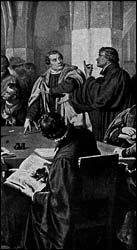 Luther and Zwingli in a heated discussion over the nature of Christ's presence in the Lord's Supper at the Marburg Colloquy (1529) |
When the Swiss and German reformers met at Marburg in 1529 to find areas of agreement, Luther was so upset at Zwingli over the coporaeal presence of Christ's body in the sacrament that he refused to shake his hand at the conclusion. I hope we can learn from the bad examples of our forebears.
I sincerely disagree at some interpretations of my Catholic brothers and sisters and they at mine, for example. But I hope we can still hold Christian fellowship around Jesus Christ as Lord, respect each other's earnestly held differences, and cherish mutual love for one another in Christ.
Unlike most studies where a whole passage is considered together, for this series of meditations we'll be pondering specific words and ideas in each chapter. There'll be a tendency to be impatient, to try to put it all together in one sitting. Struggle to resist that temptation for the sake of the process. Our goal here is to ponder, to meditate, to think deeply about, to pray over, and to internalize the various aspects of what the Lord's Supper means. We're in no hurry. Our goal is to grab hold of the Lord's Supper with such depth, that this study will help enrich our practice of taking communion for years to come.
You may even find this study a bit simple, some will think simplistic. Though we're talking about mysteries here than none of us can fully plumb, I see simplicity as both a virtue and an aid to meditation. As you ponder the simple truths of the Lord's Supper and let them sink down into your spirit, you'll find yourself much richer for it when it comes time to partake of communion once more.
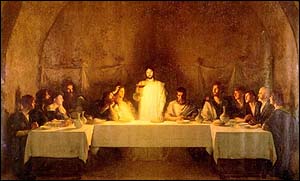 Pascal-Adolphe-Jean Dagnan-Bouvert (French Naturalist painter, 1852-1929), The Last Supper, oil on canvas, private collection. Larger image. |
Introduction
If you're new to the Christian faith, let me provide a simple explanation of the Last Supper.
What Is the Lord's Supper?
The night before Jesus was crucified, Jesus had a last meal, called the Last Supper, with his twelve disciples. On that night Jesus compared bread to his body given as a sacrifice. He spoke of wine as his blood poured out for forgiveness of sins. Then he invited his disciples to partake of the bread and wine that night. Since that time Christians have partaken of the Lord's Supper, a commemoration of the Last Supper instituted by Jesus.
Different branches of the Christian Church have different practices and historical beliefs about the Lord's Supper. Roman Catholics hold a daily Mass. Many groups, including Episcopalians (Anglicans) and Lutherans, Christian Churches, partake weekly. Others, such as Baptists, Presbyterians, and Pentecostals, partake monthly. A few groups partake only once or twice a year.
When Did the Original Lord's Supper Take Place?
Scholars are not agreed whether the Last Supper took place on Passover (which seems likely according to the Synoptic Gospels -- Matthew, Mark, and Luke), or the day before Passover (which can be inferred from John's Gospel). To me it makes the most sense that Last Supper took place on Passover, probably Thursday evening. Several details of the accounts seem to correspond with a Passover Seder.
What Kind of Bread Was Used?
Whether the Lord's Supper occurred on Passover or the day before, the bread they used would have been unleavened bread, since all leaven had been purged from Jewish houses for a week prior to Passover -- the week-long feast of Unleavened Bread which culminated on Passover. In the Roman Catholic Church, altar breads must be made from wheat flour and water only (Code of Canon Law, Canon 924). Eastern Catholic and Orthodox churches use leavened bread made from wheat flour. Most Protestant churches don't have a rule about what kind of bread must be used for communion.
What Kind of Wine Was Used?
It wasn't until Dr. Thomas Bramwell Welch invented a way of pasteurizing and bottling grape juice in 1869 that it was possible to preserve grape juice without it fermenting. Since the grape harvest in Bible times would have taken place in September or October, wine drunk in March or April would have been fermented. Some Protestant denominations that had been part of the Temperance Movement in the early 20th century use grape juice for communion. Today it is often explained as a way not to tempt recovering alcoholics.
How Is Christ Present in Communion?
Let me lay out the main theological differences at the outset and then leave them for more fruitful meditations. The differences occur in how a person interprets Jesus' words: "This is my body." Is the "is" literal or figurative? Is Jesus teaching an exact correspondence between the bread and his body, or a metaphorical relationship between the two?
- Transubstantiation (that is, "change in substance"). Roman Catholics since at least the Ninth Century AD have taught that, when consecrated by an ordained priest, the bread and wine become by a miracle the actual body and blood of Christ. The consecrated elements still they still look, feel, taste, and smell like bread and wine. but their substance is no longer bread and wine, but Christ. Since the consecrated elements are actually Christ, Catholics hold, then they should be venerated as the living Christ and that at mass a propitiatory sacrifice is offered to God. They believe in the corporeal presence or Real Presence of Christ in the sacrament, that the bread becomes Christ's body, and that when they partake they are taking in Christ's actual body.
- Sacramental Union (sometimes called Consubstantiation). Luther taught that while the communion elements were real bread and real wine on the altar, he believed in a real corporeal presence, that somehow Christ's corporeal presence existed in, under, and with the communion elements -- that the bread contains Christ's actual body.
- Symbolic and Spiritual Presence. Following the teaching of John Calvin, most Protestants do not believe that the elements change into Christ's body or that the elements contain Christ's body. Rather, they hold that the bread and wine symbolize the body and blood of Christ and that Christ's spiritual presence is manifest in a special way at communion.1
I'll support the third position in chapter 1, but I'll try to do so gently, since I know that many of my Christian brothers and sisters sincerely believe differently.
Practices of the Lord's Supper
Most organized Christian churches have rather firm rules about the words and prayers to be said at communion, who can preside or administer the Lord's Supper, who can distribute it, who can receive it, preparation necessary for communicants (those who receive communion), how it should be consecrated, handled, and disposed of, and a multitude of other details. Most of these -- originally, at least -- were designed to protect the Lord's Supper from common and careless use. While many such practices are alive and well, I won't spend any time on them here. Different families of believers do things somewhat differently out of respect for the Holy Communion.
In this study it is not my intention to prescribe any right way or correct practice. The tradition of your own congregation can guide you in your practice. It's the meaning of the Lord's Supper that we'll look at together from the Scriptures. What we find, I believe, will unite us and help us together to appreciate the wonder of the Lord's Supper.
 Available as e-book and paperback. |
One more caution. As I've researched the Lord's Supper, I've become aware as never before of the centrality of the Lord's Supper in Christianity. I'm also aware that we Christians may understand and experience the Lord's Supper differently depending on our particular traditions. I call on you to join me in being humble in our study, ready to learn from Scripture and from others, ready to broaden our own experience of communion. For ultimately we are probing together what is a mystery to all of us, the mystery of Christ in our midst whenever we break bread together in the Christian community.
Prayer
Father, we thank you for all our Christians brothers and sisters around the world. Though we differ in some of our worship practices, we are one in you, our God and Father and in the Lord Jesus Christ. Open our hearts to one another and to your Word, which we will be studying. And give us a deep appreciation for being included in your Table. In Jesus' name, we pray. Amen.
References
- Wayne Grudem, Systematic Theology (Zondervan, 1994), pp. 988-1002; M.E. Osterhaven, "Lord's Supper, Views of," in Walter A. Elwell (editor), Evangelical Dictionary of Theology (Baker Book House, 1984), pp. 653-656.
Copyright © 2024, Ralph F. Wilson. <pastor joyfulheart.com> All rights reserved. A single copy of this article is free. Do not put this on a website. See legal, copyright, and reprint information.
 |
|
In-depth Bible study books
You can purchase one of Dr. Wilson's complete Bible studies in PDF, Kindle, or paperback format -- currently 48 books in the JesusWalk Bible Study Series.
Old Testament
- Abraham, Faith of
- Jacob, Life of
- Moses the Reluctant Leader
- Joshua
- Gideon
- David, Life of
- Elijah
- Psalms
- Solomon
- Songs of Ascent (Psalms 120-134)
- Isaiah
- 28 Advent Scriptures (Messianic)
- Daniel
- Rebuild & Renew: Post-Exilic Books
Gospels
- Christmas Incarnation (Mt, Lk)
- Sermon on the Mount (Mt 5-7)
- Luke's Gospel
- John's Gospel
- Seven Last Words of Christ
- Parables
- Jesus and the Kingdom of God
- Resurrection and Easter Faith
Acts
Pauline Epistles
- Romans 5-8 (Christ-Powered Life)
- 1 Corinthians
- 2 Corinthians
- Galatians
- Ephesians
- Philippians
- Colossians, Philemon
- 1 & 2 Thessalonians
- 1 &2 Timothy, Titus
General Epistles
Revelation
Topical

 To be notified about future articles, stories, and Bible studies, why don't you subscribe to our free newsletter, The Joyful Heart, by placing your e-mail address in the box below. We respect your