|
Old Testament
New Testament
Gospels
Acts
Paul's Letters
General Letters
Revelation
Topical Studies
Beginning the Journey (for new Christians). en Español

|
Old Testament
New Testament
Gospels
Acts
Paul's Letters
General Letters
Revelation
Topical Studies

|
Home
Bible Studies
Articles
Books
Podcasts
Search
Menu
Donate
About Us
Contact Us
FAQ
Sitemap

Lamb of God Agnus Dei Artwork and Paintings
Collected by Dr. Ralph F. WilsonPart of JesusWalk -- Behold the Lamb of God
Free
E-mail Bible Study
 Experiencing the Psalms
Home | Bible Studies | Articles | Books | Podcasts | Search | Menu | Donate | About Us | FAQ | Contact Us
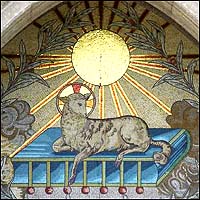 Ontario, Canada, church doorway, Behold the Lamb of God, mosaic with gilded sun above Lamb. |
One of the few Christian symbols dating from the first century is that of the Good Shepherd carrying on His shoulders a lamb or a sheep, with two other sheep at his side. Between the first and the fourth century eighty-eight frescoes of this type were depicted in the Roman catacombs.
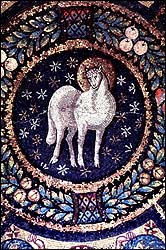 San Vitale, Ravenna (begun 532, consecrated 547A.D), Agnus Dei (Lamb of God) Detail of Central Medallion, large photo, detailed image. |
In the Agnus Dei symbol, the lamb was used to symbolize innocence and was also a sacrificial animal. the Agnus Dei, or Lamb of God, is an ancient symbol of Christ and His sacrifice. The cross stands for Christ's victory over sin and death. Biblical references include John 1:29 and Revelation 14. In ancient examples of the Agnus Dei may be seen lying upon the Book of Seven Seals or carrying the Banner of Victory. It must be crowned with a three-rayed nimbus or halo, signifying that it is a symbol of divinity. In other examples the Lamb stands upon a hill from which flow the Four Rivers of Paradise, signifying the Four Gospels.
In Christian symbolism, the lamb represents Jesus, "the Lamb of God." Standing with a banner, the lamb represents the risen Christ triumphant over death. Standing with a cross and a gash in its side, it symbolizes the passion of Christ. Seated on a throne or a book, the lamb represents the judgment of Christ. Because the lamb is humble, gentle, and innocent, lambs are often engraved on the tombstones of children.
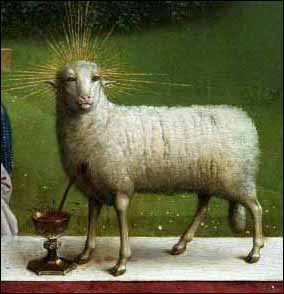 Detail. Adoration of the Lamb, by Jan van Eyck (1432), oil on wood, Ghent altarpiece, Cathedral of St. Bavo, Ghent. |
Paintings of Lamb of God or Agnus Dei
- Drawing for the Agnus Dei, Giulio Romano, ink on paper c.1540
- Lamb of God (mid-12th century) fresco painting, Jorlunde church, Denmark
- The Lamb of God in the heaven, ceiling of the Vatican Embassy in Sofia, Bulgaria
- Romanesque Lamb of God. Contemporary painter.
Woodcuts
|
|
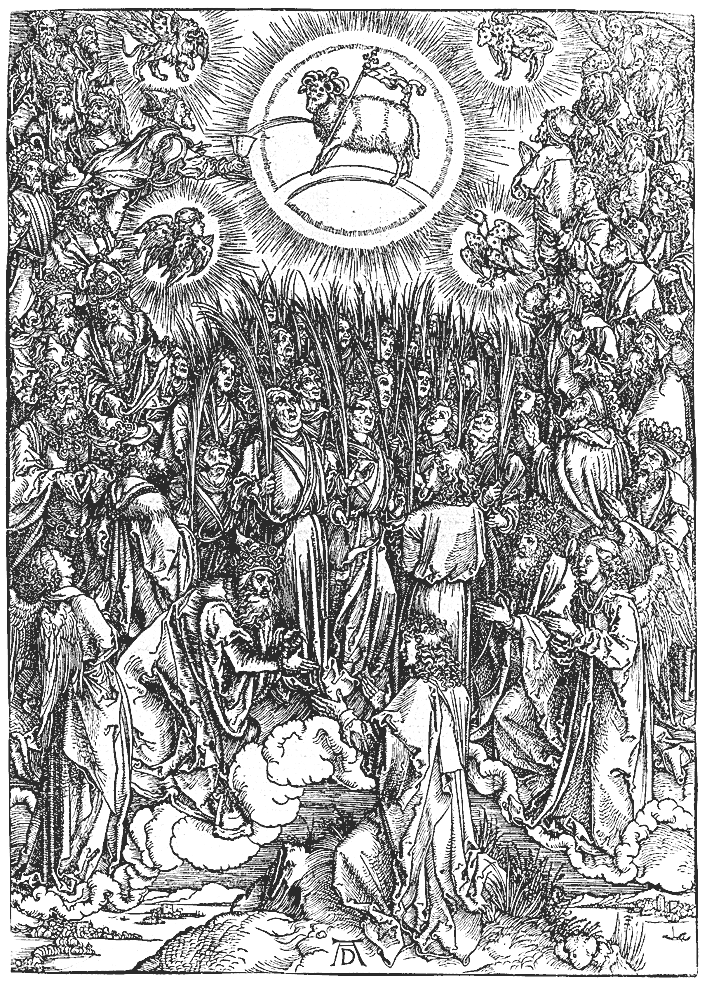
Albrecht Dürer (German painter, 1471-1528), Adoration of the Lamb (1496-98), woodcut in Apocalypse of St. John series, each 39 x 28cm.
-
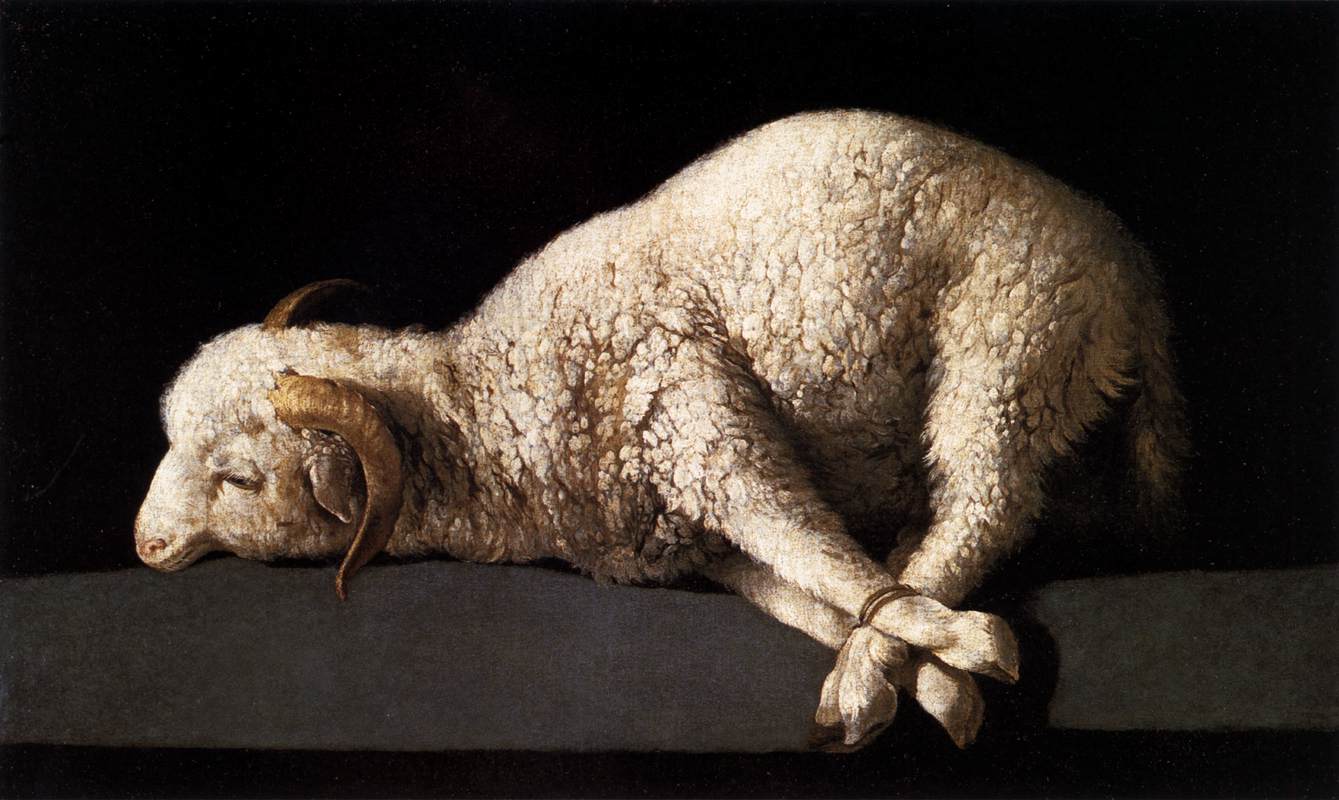
Francisco de Zurbaran, Agnus Dei (1635-40), bound lamb with horns. Canvas 38 x 62 cm. Museo Nacional del Prado, Madrid.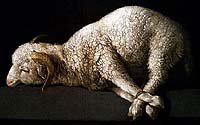
Francisco de Zurbaran (1598-1664), "Agnus Dei" (1635-40) ,Canvas 38 x 62 cm. Museo Nacional del Prado, Madrid. Larger image. - Francisco de Zurbaran, Agnus Dei (1635-40), bound lamb without horns, but with halo, 14 x 20 1/2 inches (35.6 x 52 cm). Oil on canvas, San Diego Museum of Art.
- Fresco of the Agnus Dei (late 18th century) Greek Catholic Cathedral of Hajdúdorog, Hungary.
Sculpture, carving, statue of Lamb of God
- Ivory Plaque with Agnus Dei on a cross between emblems of the Four Evangelists, probably 9th century German or North Italian, Ivory; 9 1/4 x 5 3/8 in. (23.5 x 13.7 cm), Metropolitan Museum, New York
- Spanish Coin: 1/2 Blanca del Agnus Dei (vellón), 1379-1390
- El Cordero de Dios (Agnus Dei), symbol over unknown cathedral entrance
- R.J. de Bruyn (1880) and Hubert Esser (1883), Agnus Dei and saints metal statues in silver (1880-1883) in Museum Catharijneconvent. Utrecht
- Agnus Dei statue on the wall of the Church of Orsanmichele, Florence, Italy. Agnus Dei, Piazza del Mercato Nuovo
- Relief des Agnus Dei mit der Siegesfahne, Liebigstrasse 145 (Köln-Neuehrenfeld).
- Templar 'Lamb of God' seal
- Maulbronn Monastery church Baden-Wuerttemberg, ceiling rib vault bosses (1424), Lamb of God.
- Sisters of the Lamb of God, wooden cross-shaped plaque. Les Servantes de l'Agneau de Dieu
- Medieval Agnus Dei with halo and cross; half-relief on the wall of the atrium Euphrasian Basilica, Poreč, Croatia
Piero della Francesca (1416-1492), Resurrection of Christ (1463-65), Mural in fresco and tempera, 225 x 200 cm, Pinacoteca Comunale, Sansepolcro
Painting of Scene with John the Baptist pointing to Jesus as the Lamb of God
Dieric Bouts (AD 1410-1475), "Ecce Agnus Dei", (1462/64), Holz, 53,8 x 41,2 cm Erworben 1989 mit Unterstützung der Kulturstiftung der Länder.
Agnus Dei Stained Glass Windows
-
Dollis Hill, London, Ecce Agnus Dei, by Margaret Edith Rope ("Tor")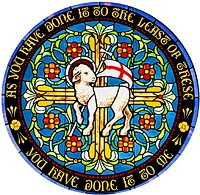
Tim McClure, Agnus Dei window - Croydon, All Saints, Agnus Dei.
- William Morris workshop, Agnus Dei, St John the Baptist, Needham Market, Suffolk
- John Henry Dearle, William Morris and Company, n.d. Agnus Dei, graphite and watercolor.
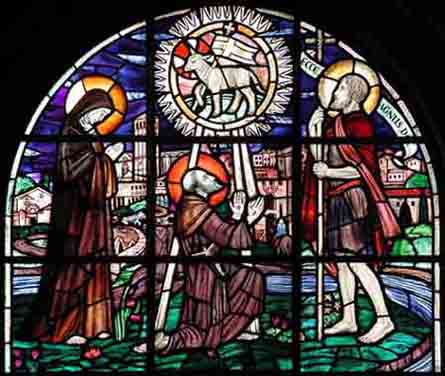
- Les Vitraux II, stained glass Agnus Dei window with John the Baptist and a lamb.
- Jesus the Lamb of God, All Saints Episcopal Church, San Francisco, CA.
- Memorah and Lamb of God Windows at Immanuel Seymor
- The Lamb of God window, beside the Sacred Heart Altar, Our Lady of Mount Carmel, Munich Studios stained glass, Wyandotte, Michigan
- Curtis Graphics, Lamb of God window
- Lamb on sacrificial altar window, unknown location.
- Lamb bleeding into the Holy Chalice, carrying the vexillum, Stained glass showing Lamb of God with vexillum and chalice, from chapel that used to be part of a convent (now a Baptist church and school complex) in El Cajon, California
- Stained Glass Agnus Dei - found in the Cathedral of Florence (Basilica di Santa Maria del Fiore), Italy
- Lamb with Cross Stained Glass Duomo Basilica Cathedral, Church Florence Italy
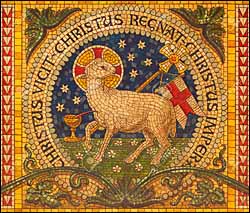 Mosaic
- Mosaic of Lamb of God altar of little chapel Capella Pinardi, Turin, Italy.
- San Vitale, Ravenna (begun 532, consecrated 547A.D), Agnus Dei (Lamb of God) Detail of Central Medallion, large photo, detailed image.
- Ontario, Canada, church doorway, Behold the Lamb of God, mosaic with gilded sun above Lamb.
-
Floor of Nativity of Mary Blessed Virgin Catholic Church, Schulenburg, Texas, Lamb of God.
- Mosaic vault showing the Lamb of God, the Patriarchs and the Prophets, above the Main Altar of the Florence Baptistery, Italy. 13th and 14th centuries.
Miscellaneous
- Tile Agnus Dei, at St. Mary's Episcopal Cathedral, Edinburgh.
- Reliquary
Casket with the Lamb of God and a
Personification of the Church, French (Limoges)
About 1185-95, Champlevé enamel on copper, Width 15.4 cm x height 14.5 cm x depth 6.9 cm
Private collection - Lamb with Vexillum (flag-like object used as a military standard by units in the Ancient Roman army)
Iconography of the Agnus Dei
Copyright © 2026, Ralph F. Wilson. <pastor joyfulheart.com> All rights reserved. A single copy of this article is free. Do not put this on a website. See legal, copyright, and reprint information.
 To be notified about future articles, stories, and Bible studies, why don't you subscribe to our free newsletter, The Joyful Heart, by placing your e-mail address in the box below. We respect your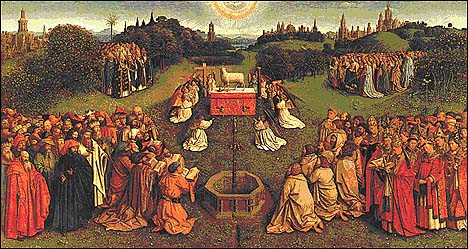


_(4)_Agnus_Dei.jpg)