


|
Old Testament
New Testament
Gospels
Acts
Paul's Letters
General Letters
Revelation
Topical Studies
Beginning the Journey (for new Christians). en Español

|
Old Testament
New Testament
Gospels
Acts
Paul's Letters
General Letters
Revelation
Topical Studies

|
Home
Bible Studies
Articles
Books
Podcasts
Search
Menu
Donate
About Us
Contact Us
FAQ
Sitemap


Free
E-mail Bible Study
 Experiencing the Psalms
Home | Bible Studies | Articles | Books | Podcasts | Search | Menu | Donate | About Us | FAQ | Contact Us
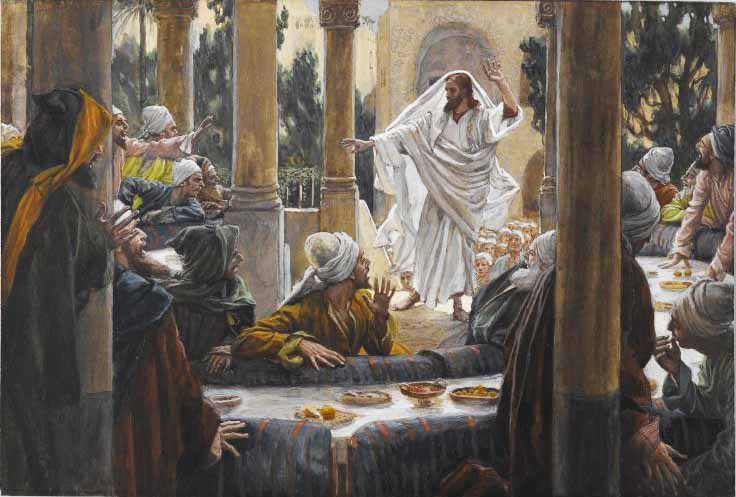 James Tissot, detail of "Curses against the Pharisees" (1886-96), watercolor, Brooklyn Museum, New York. Full image. |
Kingdom of Heaven vs. Kingdom of God
One question I often hear revolves around the different terminology used in Matthew, "kingdom of heaven," compared to "kingdom of God" used in Mark and Luke.
The reason is pretty simple. Matthew wrote primarily for a Jewish audience, while Mark and Luke wrote for a wider audience. Because of the Jews'zeal to keep the Second Commandment, "Thou shalt not take the name of the LORD thy God in vain" (Exodus 20:7a), they substituted other words, so they wouldn't have to speak God's name or any of his titles. Thus, we see uses such as, "Father, I have sinned against heaven and against you" (Luke 15:18b). Nevertheless, we still see a few occurrences of "kingdom of God" in Matthew's Gospel.3
"Kingdom of God" and "kingdom of heaven" are interchangeable terms. In Matthew we read:
"I tell you the truth, it is hard for a rich man to enter the kingdom of heaven. 24 Again I tell you, it is easier for a camel to go through the eye of a needle than for a rich man to enter the kingdom of God." (Matthew 19:23-24)
What Does "Kingdom" Mean?
Now let's examine the word "kingdom." Does it primarily mean:
- Reign ("abstract"), kingly rule, or
- Realm ("concrete"), territory controlled by a monarch?
In Hebrew, the noun malkût, "sovereign power," is formed from the verb, mālak, "to reign," that is, "to be and exercise functions of a monarch."4 The Greek noun basileia also has the basic idea of "kingly rule."5 New Testament scholar Chrys Caragounis observes, "The primary meaning ... is abstract and dynamic, that is, ‘sovereignty'or ‘royal rule'.... The sense of realm -- a territorial kingdom -- is secondary."6 So Jesus is announcing the coming of the "royal rule" of God.
Old Testament Background
A survey of the Old Testament finds that the phrase "kingdom of God" does not appear in the canonical books, and only once in the Apocrypha (Wisdom 10:10). The idea, however, is very much present.
The Old Testament teaches clearly that Yahweh is the true King of Israel.7 The giving of the law at Mt. Sinai has clear parallels to a Suzerain-Vassal covenant, by which a powerful monarch sets up a treaty with a less powerful nation, confirmed by written covenants as well as sacrifices, blessings, cursings, etc.8 If you think about it, the tabernacle in the wilderness is the portable home of Yahweh in the midst of his people. The courtyard defines the royal precincts, the tent is his abode, and the mercy seat of the Ark of the Covenant is his throne.
In the early days, Yahweh is King and the prophets serve as his spokesmen. However, towards the end of Samuel's prophetic career, the people demand "a king to lead us, such as all the other nations have" (1 Samuel 8:5).
"And the LORD told [Samuel]: ‘Listen to all that the people are saying to you; it is not you they have rejected, but they have rejected me as their king.... Now listen to them; but warn them solemnly and let them know what the king who will reign over them will do." (1 Samuel 8:7, 9)
As the kingdom was established, first under Saul and later under David, "the king was understood to reign as Yahweh's representative and under Yahweh's suzerainty."9 The prophet at the court (Nathan, Gad, Elijah) serves as God's spokesman to the king.
King David is a man after God's own heart (Acts 13:22) and God makes special promises to him of an everlasting kingdom:
"The LORD declares to you that the LORD himself will establish a house for you: When your days are over and you rest with your fathers, I will raise up your offspring to succeed you, who will come from your own body, and I will establish his kingdom. He is the one who will build a house for my Name, and I will establish the throne of his kingdom forever. I will be his father, and he will be my son. When he does wrong, I will punish him with the rod of men, with floggings inflicted by men. But my love will never be taken away from him, as I took it away from Saul, whom I removed from before you. Your house and your kingdom will endure forever before me; your throne will be established forever." (2 Samuel 7:11-16)
But David's descendents were disobedient. After Solomon, the kingdom split into the northern kingdom (Israel) and the southern kingdom (Judah). First, Israel was exiled by the Assyrians (722 BC, 2 Kings 17:6). Then Judah was exiled by the Babylonians (582 BC, 2 Kings 25:11). Though some of David's descendents ruled, such as Zerubbabel, there was no king upon the throne of Judah. Psalmists bemoaned this tragedy and called upon God to fulfill his promise to David (Psalm 89:35-52).
The Son of Man in Daniel
But out of the midst of the exile, the Prophet Daniel brings a word of hope.10 In Daniel 7 he describes the various nations that arise to challenge God's rule. Finally, a figure emerges who is to restore the kingdom -- not just the Jewish kingdom, but a universal kingdom.
"In my vision at night I looked, and there before me was one like a son of man, coming with the clouds of heaven. He approached the Ancient of Days and was led into his presence. He was given authority, glory and sovereign power; all peoples, nations and men of every language worshiped him. His dominion is an everlasting dominion that will not pass away, and his kingdom is one that will never be destroyed." (Daniel 7:13-14)
You will recall that Jesus seldom used either the title "Messiah" or "Son of God." Instead, his preferred title was "Son of Man" -- this very Son of Man identified in Daniel's prophecy. Son of Man is surely a messianic title, but one that wasn't widely understood as such, and thus it didn't have the political implications of claiming to be the Messiah. However, at Jesus' trial before the Sanhedrin, the high priest asks him if he is "the Christ, the Son of God." Jesus answers in the affirmative, but then clearly identifies himself with the Son of Man of Daniel 7:
"'Yes, it is as you say,'Jesus replied. ‘But I say to all of you: In the future you will see the Son of Man sitting at the right hand of the Mighty One and coming on the clouds of heaven.'" (Matthew 26:64)
Jewish Expectancy in Jesus' Day
Between the Old and New Testaments, there is no lack of Jewish religious literature. Much of it focuses on the restoration of the Davidic Kingdom. Some is apocalyptic literature, that is, writings foretelling an apocalypse, an imminent cosmic cataclysm in which God will destroy the ruling powers of evil and raise the righteous to life in a messianic kingdom.11
Apocalyptic writings in the period between the testaments are known as Old Testament Pseudepigrapha. These flourished between 200 BC and 150 AD, often written under pseudonyms. Some that have been found include: 1 Enoch (from 300 BC to the first century AD), the Sibylline Oracles (second to fifth century AD), Second Apocalypse of Baruch (late first century or early second century AD), and 4 Ezra (or 2 Esdras in the Apocrypha). Such literature tends to teach that:
- God will come in judgment at the end of the age to punish the wicked and reward the just, and God will reign through his Messiah.
- The kingdom and Messiah will be transcendental, that is, heavenly realities that will deliver God's people from centuries-long Gentile rule over Palestine.
Though such writings weren't read by the common person in Jesus' day, they reflect the belief of the times and the fervent expectancy that existed throughout Palestine. Such an expectancy explains the crowd that John the Baptist attracted. So when John and Jesus preached that "the kingdom of God is at hand," the people immediately thought of the promised Messiah who would deliver Israel from its oppressors and set up the Davidic Kingdom with its throne in Jerusalem.
Kingdom of God in John's Gospel and Paul's Epistles
Though "kingdom of heaven" and "kingdom of God" appear frequently in the Synoptic Gospels, John's Gospel has just two occurrences.
"I tell you the truth, no one can see the kingdom of God unless he is born again." (John 3:3)
"I tell you the truth, no one can enter the kingdom of God unless he is born of water and the Spirit." (John 3:5)
Why so few references? John is writing his Gospel to the Gentile Hellenistic world that surrounds his residence in Ephesus. The phrase "Kingdom of God" has little meaning to non-Jews. Instead, John uses the phrase, "eternal life" 17 times or simply "life" 19 times. The Synoptics also occasionally use the phrase "life" as an equivalent to "kingdom of God,"12 but the word "life" is more intelligible to Gentile ears.
The Apostle Paul uses "kingdom of God" only sparingly13 for the same reason: he is writing primarily to Gentiles. Instead of stressing kingship, Paul uses the concept of Christ as Lord. A messianic king could have been misunderstood as a rival king to Caesar. Again, Son of Man is a Jewish concept that has little meaning to Gentiles.14 Paul uses the Jewish term "saved/salvation" as his characteristic equivalent to the Jewish idea of "entering the kingdom of God."15 The concept of "salvation" is more comprehensible to non-Jewish ears.
What Is the Kingdom of God?
It is in the Synoptic Gospels (Matthew, Mark, and Luke) that we have the bulk of Jesus' teachings on the Kingdom. To understand what Jesus meant by "kingdom of God," we need to be able to answer three questions. What is its essence? How is it related to Jesus' person and work? And when does it come?16 These aren't easy questions to answer.
Over the last 150 years, the nature and coming of the Kingdom have been a matter of intense debate. Here are the various interpretations with the names of their chief scholarly proponents:
- Ecclesiastical. The Kingdom is the Church was the prevailing view from the time of St. Augustine through the Reformers. Now, I agree that the Church is the people of the Kingdom, but the Church is not identical to the Kingdom itself.
- Personal. The Kingdom is the experience of God in a person's individual soul. It is spiritual and non-eschatological, and involves the Fatherhood of God, the brotherhood of man, the infinite value of the individual soul, and the ethic of love (Adolf von Harnack, Wilhelm Herrmann).
- Social. The Kingdom is a present social order based on love and solidarity, epitomized in the Social Gospel movement (Walter Rauschenbusch).
- Futuristic. The Kingdom is entirely eschatological, in that it comes at the Eschaton, the end of time. It is also apocalyptic in the sense that it breaks in suddenly upon the present world (Johannes Weiss, Gustaf Dalman, Albert Schweitzer). C.C. Caragounis sees Jesus' miracles as the preliminaries, not the kingdom of God itself, which comes at the end of the Age.
- Present. This is known as "realized eschatology," which holds that the Kingdom is a present reality in the person of Jesus, that all the prophets had hoped for has been realized in history (C.H. Dodd).
- Present and Future. The Kingdom is present in the person and ministry of Jesus, but is consummated in the future at Christ's return, thus it is both present and future (Werner Kümmel, Joachim Jeremias, G.R. Beasley-Murray, George E. Ladd).17
The Kingdom as Present and Future
Years ago, I studied under George Eldon Ladd, one of the proponents of the Present and Future Kingdom theory. As I've read the Gospels since and studied in depth Jesus' teachings on the Kingdom, I remain convinced that the Kingdom Jesus proclaimed is indeed both present in his person and will be fully consummated upon his return in glory. I will reinforce this in the lessons to follow. But for now, let us consider two passages that are at the crux of the issue.
Luke 11:20 || Matthew 12:28 -- "The kingdom has come to you"
In the first passage, Jesus has been accused by the Pharisees18 or teachers of the law19 of driving out demons by demonic power. Jesus challenges this:
"If I drive out demons by the finger of God, then the kingdom of God has come to you." (Luke 11:20)
"If I drive out demons by the Spirit of God, then the kingdom of God has come upon you." (Matthew 12:28)
At issue is the translation of the phrase "has come to/upon you" (NIV, NRSV), "is come upon/unto you" (KJV). The verb is phthanō, "to get to or reach a position, have just arrived," then simply "arrive, reach," here, with the preposition epi, "come upon someone, overtake."20
The verb is in the Aorist tense, which indicates an action that takes place at a particular point in time. Nearly always, this refers to an action in the past, which would indicate that the Kingdom had already come by the time Jesus cast out demons. This would support the view that the Kingdom was present.
However, Caragounis argues for a rare idiom where "the aorist tense is sometimes used to emphasize the certainty and immediacy of an action that properly belongs in the future by describing it as though it had already transpired."21 Frankly, I don't think he makes his case. The most natural way to translate this Aorist verb is as historical, or perhaps ingressive or inceptive, where an action "may be contemplated in its beginning."22 So this verse indicates that the Kingdom is indeed already present in Jesus while he is casting out demons, "the kingdom of God has come to you."
Luke 17:21 -- "The kingdom of God is within you"
The other classic verse used to argue that the kingdom is present in Jesus' life and ministry occurs a few chapters later. The Pharisees are asking Jesus for a timetable of when the Kingdom of God will come. Jesus replies:
"The kingdom of God does not come with your careful observation, nor will people say, ‘Here it is,'or ‘There it is,'because the kingdom of God is within (entos) you." (Luke 17:20b-21)
At issue here is the translation of the preposition entos. The word means, "pertaining to a specific area inside something, inside, within, within the limits of." In some English Bibles, entos is translated "within" (NIV, KJV), but based on the context, many scholars believe it must be translated as "among" (NIV marg., NRSV, NJB) or "in your midst" (NASB).23 Here are the arguments, which are pretty technical:
Within, inside you. The most common use of entos is "within, in." The standard Greek Lexicon by Liddell-Scott doesn't recognize entos as meaning "among." Caragounis contends that the sense "among" has been based on a few, sometimes obscure, instances in Aquila and Symmachus, and cites the third century Gnostic Gospel of Thomas for support of his interpretation.24 When Luke means "among," he contends, Luke writes en mesō. And, of course, the truth that God is within you is certainly supported in the New Testament, that the Holy Spirit lives within us.25
Among you, in your midst. But is Jesus telling the Pharisees that the Kingdom (via the Holy Spirit) is within them? Not likely; the opposite must be true. Moreover, "nowhere else is the kingdom regarded as something internal."26 Manson says:
"The Kingdom of God is not here under discussion as a state of mind or a disposition in men. It is thought of as something which is to come. It is a fact of history, not a psychology. Moreover, Jesus speaks elsewhere of men entering the Kingdom, not of the Kingdom entering men. The Kingdom is a state of affairs, not a state of mind.... The whole weight of the teaching of Jesus elsewhere seems to be in favor of saying, ‘Lo, the Kingdom of God is among you.'"27
I agree. Marshall says, "Jesus is speaking of the presence of the kingdom of God among men, possibly as something within their grasp if they will only take hold of it."28 The only translation that makes sense is, "The kingdom of God is among you," that is, in the person and ministry of Jesus himself.29
Now and at the End
In a number of passages in the Gospels, you can clearly see the tension between the Kingdom present now and the final consummation of the Kingdom at Christ's return. For example:
|
Now |
End of the Age |
Scripture |
|
This age30 |
The age to come |
Mark 10:30; Matthew 12:32 |
|
Last Supper |
Feast in the Kingdom |
Matthew 26:29; Mark 14:25; Luke 22:18; 1 Corinthians 11:26. |
|
The Centurion's faith |
Sitting down with Abraham, Isaac, and Jacob in the Kingdom of heaven |
Matthew 8:5-13 |
|
Mustard seed |
Full-grown tree |
Matthew 13:31-32 |
|
Yeast |
Leavened bread |
Matthew 13:33 |
|
Weeds sprouted |
Weeds removed at harvest |
Matthew 13:24-29 |
|
Talents/pounds distributed |
Master returns for an accounting |
Matthew 25:14-30; Luke 19:12-27 |
|
Virgins get oil for lamps |
Bridegroom comes |
Matthew 25:1-13 |
The Kingdom, the Son of Man, and the Cross
What at first glance doesn't seem to fit Jesus' teaching on the Kingdom of God is the cross. The disciples expected Jesus to usher in the Davidic Kingdom immediately. Cleopas tells Jesus on the road to Emmaus: "We had hoped that he was the one who was going to redeem Israel" (Luke 24:21a).
The cross seemed to the disciples as a huge obstacle to the Kingdom coming. But Jesus saw the cross as essential, and as a part of the unfolding of the Kingdom itself. Ladd notes, "The Gospels indicate that in some unexplained way, Jesus' death is essential to the coming of the kingdom."31
Jesus predicts his crucifixion at least three times, each time telling his disciples that this would happen to "the Son of Man,"32 that is, to the heavenly messianic figure whose kingdom would have no end (Daniel 7:13-14).
Jesus explains that the "Son of Man" came "to give his life as a ransom for many" (Mark 10:45). Neither Jesus' disciples nor the scripture scholars in Jerusalem can understand how and why the Son of Man "must suffer many things" (Mark 8:31). Nor does anyone except Jesus understand that the Suffering Servant of Isaiah is the same figure as the Son of Man, that:
"The righteous one, my servant, shall make
many righteous,
and he shall bear their iniquities." (Isaiah 53:11)
Even in Jesus' last hours we see three clear indications of the Kingdom:
-
The cup of wine at the Last Supper was emblematic of "my blood of the covenant which is poured out for many for the forgiveness of sins" (Matthew 26:28; cf. 1 Corinthians 11:25). The first covenant on Sinai was in the context of the kingdom of the Suzerain who covenanted with the vassal nation of Israel.33 This covenant, too, was about a kingdom. Jesus said he would not drink wine again, "until that day when I drink it new with you in my Father's kingdom" (Matthew 26:28; cf. 1 Corinthians 11:26).
-
Before Pilate, Jesus acknowledges his Kingdom, explaining: "My kingdom is not from this world. If my kingdom were from this world, my followers would be fighting to keep me from being handed over to the Jews. But as it is, my kingdom is not from here" (John 18:36). As he was condemned, the Kingdom was ever before him.
-
The thief on the cross shows amazing insight when he says, "Jesus, remember me when you come into your kingdom," and, without skipping a beat, Jesus replies, "Truly I tell you, today you will be with me in Paradise" (Luke 23:42-43). The cross was not an obstacle to the Kingdom; it was an open door to the Kingdom through which the thief walked, followed much later by you and me.
The Hope of the Kingdom of God
The Kingdom of God is a mystery until Jesus explains it to us. But as we study it in the lessons to follow, we'll find that the Kingdom of God is the Reign of God, which we enter into by faith in Jesus. Yes, the signs and presence of the Kingdom are evident in Jesus' life and ministry, and in the ministry of his disciples then (Luke 10:9) and now. However, we await the final consummation of the Kingdom when Christ the Son of Man shall return to receive his Kingdom, the vision that Daniel saw so long ago:
 A book of the compiled lessons is available in both e-book and paperback formats. |
"In my vision at night I looked,
and there before me was one like a son of
man,
coming with the clouds of heaven.
He approached the Ancient of Days
and was led into his presence.
He was given authority, glory and sovereign power;
all peoples, nations and men of every language worshiped him.
His dominion is an everlasting dominion that will not pass away,
and his kingdom is one that will never be destroyed." (Daniel 7:13-14)
Come soon, Lord Jesus!
1. Matthew 3:2.
2. Mark 1:15 || Matthew 4:17.
3. "Kingdom of God"is used in Matthew 6:33; 12:28; 19:24; 21:31; and 21:43.
4. Robert D. Culver, mālak, TWOT #1199. "Royalty, royal power, reign, kingdom"(BDB p. 574).
5. "If, as the linguistic usage has shown, the kingdom of God implies the state of kingly rule, this emerges logically in the description of this state. The predominant statement is that the kingdom of God is near, that it has drawn near, that it has attained to us, that it comes, that it will appear, that it is to come"(Karl Ludwig Schmidt, basileia, TDNT 1:584).
6. Chrys C. Caragounis, "Kingdom of God/Heaven,"DJG pp. 417-430, especially p. 417. "The noun malkût is one of the few older Hebrew abstract terms and denotes ‘kingdom'or ‘kingship.'”Gerhard von Rad, basileus, TDNT 1:570.
7. Exodus 19:5-6; Numbers 23:21; 1 Samuel 8:7; 12:12; Psalm 24:8-10; 29:10; 74:12; Isaiah 6:5; 33:22; Zephaniah 3:15; Zechariah 14:16-17.
8. J.A. Thompson, The Ancient Near Eastern Treaties and the Old Testament (London: The Tyndale Press, 1964).
9. Caragounis, DJG, p. 418.
10. Though many scholars who deny that prophecy can be predictive date Daniel as late, evangelical scholar Joyce G. Baldwin makes an excellent case for a late sixth- or early fifth-century date for the book in Daniel: An Introduction and Commentary (IVP, 1978).
11. In the Bible, Daniel, Ezekiel, and Revelation all contain highly symbolic imagery that is characteristic of this type of apocalyptic literature.
12. Mark 9:43-47 and parallels; 10:17-30 and parallels; Matthew 25:31-46.
13. 1 Corinthians 4:20; 6:9-10; 15:50; Colossians 4:11; 1 Thessalonians 2:12; 2 Thessalonians 1:5; Romans 14:17; Galatians 5:21.
14. Ladd, "Kingdom of God,"ISBE 3:29.
15. Compare "enter the kingdom of God"(Mark 10:23-24) with "Who then can be saved?"(Mark 10:26).
16. Caragounis, DJG, p. 420.
17. In addition are views that the kingdom of God is "a mythical symbol"(Norman Perrin) and existential, (Rudolf Bultmann), that the kingdom of God is ever coming and thus a continual decision. The summary above is based on a discussion by Caragounis, DJG, pp. 420-422; and Ladd, "Kingdom of God,"ISBE 3:24-25.
18. Matthew 12:24.
19. Mark 3:22.
20. Phthanō, BDAG 105, 2.
21. Caragounis (DJG, p. 430) cites his article, "Kingdom of God, Son of Man and Jesus' Self-Understanding,"Tyndale Bulletin 40 (1989) 3-23. He would be referring to the future aorist. Blass, Debrunner, and Funk (Grammar, §332(1), p. 171) explain that the complexive (constative) aorist can be used "for linear actions which (having been completed) are regarded as a whole."Dana and Mantey (Grammar, §180(3), p. 197) explain that the "cumulative aorist"is employed "when it is wished to view an event in its entirety, but to regard it from the viewpoint of its existing results."See also Nigel Turner, A Grammar of New Testament Greek: Vol 3. Syntax (series by James Hope Moulton; Edinburgh, T & T Clark, 1963), §3b3, p. 72.
22. Dana and Mantey, Grammar, §180(2), p. 196.
23. So entos, BDAG 340, 1.
24. "Rather, the (Father's) kingdom is within you and it is outside you"(Gospel of Thomas 3; Papyrus Oxyrhynchus (P.Oxy) IV 654, 16).
25. John 14:17; Romans 8:9, 11; 1 Corinthians 6:19; Ephesians 2:22; 3:17; 2 Timothy 1:14; 1 John 2:27; 4:13; etc.
26. Marshall, Luke, p. 655.
27. T.W. Manson, The Sayings of Jesus (Eerdmans, reprint of SCM Press, 1957 edition), pp. 303-304.
28. Marshall, Luke, p. 655.
29. Manson (p. 304) believes that the saying responds to the Pharisees'question of "When?"and means that "the question cannot be answered, since the answer is known to God alone."He would paraphrase it: "It comes suddenly and unexpectedly. One moment the world is just its normal self: then Lo! the kingdom of God is among you."I don't find Manson's interpretation here convincing. Rather Green (Luke, p. 630) has it right: "Jesus reprimands the Pharisees in their kingdom-seeking for looking for the wrong thing and in the wrong way, and asserts that the kingdom is already operative, if only they would open their eyes to it. The kingdom of God is closely related to the person and activity of Jesus (cf. Luke 11:20); failing to understand this, the Pharisees do not recognize (and cannot respond to) God's new world order.”
30. Aiōn, "a segment of time as a particular unit of history, age."consisting of "the present age"(nearing its end) and "The age to come,"the Messianic period (BDAG 32, 2a).
31. Ladd, "Kingdom of God,"TDNT 3:28.
32. Luke 9:31 || Matthew 16:21; 17:22-23; 20:18-19; 26:2 and parallels.
33. See above in this Introduction on the "Old Testament Background.”
Free
E-mail Bible Study
Experiencing the Psalms
Home | Bible Studies | Articles | Books | Podcasts | Search | Menu | Donate | About Us | FAQ | Contact Us
Copyright © 2026, Ralph F. Wilson. <pastor joyfulheart.com> All rights reserved. A single copy of this article is free. Do not put this on a website. See legal, copyright, and reprint information.
 To be notified about future articles, stories, and Bible studies, why don't you subscribe to our free newsletter, The Joyful Heart, by placing your e-mail address in the box below. We respect your