|
Old Testament
New Testament
Gospels
Acts
Paul's Letters
General Letters
Revelation
Topical Studies
Beginning the Journey (for new Christians). en Español

|
Old Testament
New Testament
Gospels
Acts
Paul's Letters
General Letters
Revelation
Topical Studies

|
Home
Bible Studies
Articles
Books
Podcasts
Search
Menu
Donate
About Us
Contact Us
FAQ
Sitemap


Free
E-mail Bible Study
 Experiencing the Psalms
Home | Bible Studies | Articles | Books | Podcasts | Search | Menu | Donate | About Us | FAQ | Contact Us
 "Gideon and His 300" (1907), Bible card, "Coprighted 1907 by Providence Lithograph Co." Unknown artist. Larger image. |
300 Men, Trumpets, Jars and Torches (7:15-20)
God has prepared and encouraged Gideon. Now he awakens his remaining 300 men with similar words to what God used to awaken him: "Get up! The LORD has given the Midianite camp into your hands" (see 7:9).
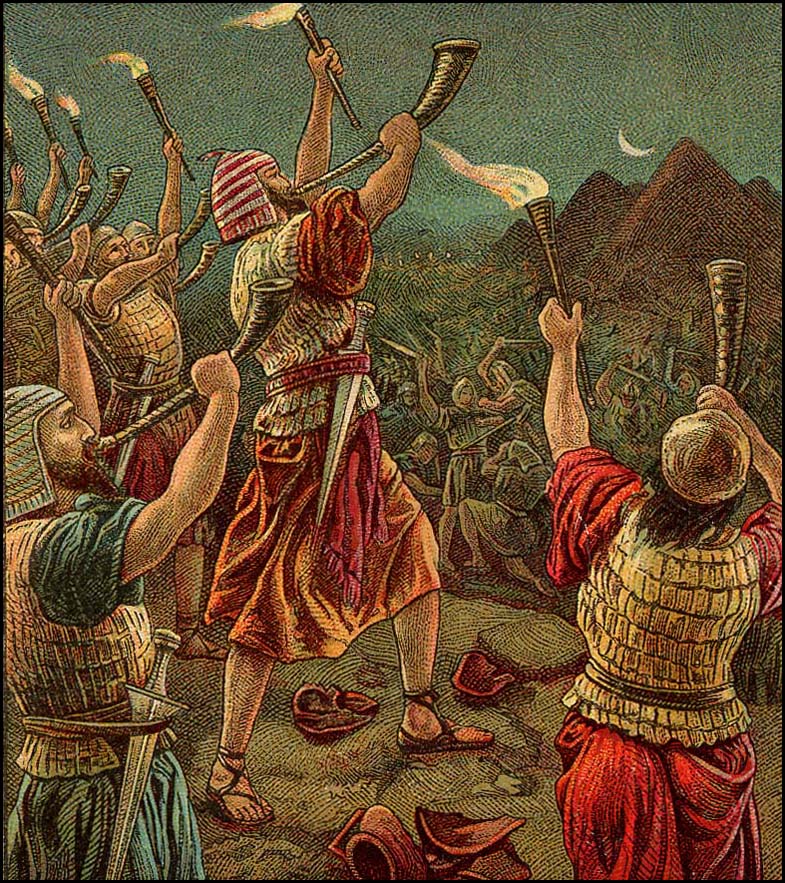
"When Gideon heard the dream and its interpretation, he worshiped God. He returned to the camp of Israel and called out, 'Get up! The LORD has given the Midianite camp into your hands.' Dividing the three hundred men into three companies, he placed trumpets and empty jars in the hands of all of them, with torches inside.
'Watch me,' he told them. 'Follow my lead. When I get to the edge of the camp, do exactly as I do. When I and all who are with me blow our trumpets, then from all around the camp blow yours and shout, "For the LORD and for Gideon." '
Gideon and the hundred men with him reached the edge of the camp at the beginning of the middle watch, just after they had changed the guard. They blew their trumpets and broke the jars that were in their hands. The three companies blew the trumpets and smashed the jars. Grasping the torches in their left hands and holding in their right hands the trumpets they were to blow, they shouted, 'A sword for the LORD and for Gideon!' " (7:15-20)
Privately, Gideon has needed reassurance, but publicly, in front of his men, he exudes a positive, confident leadership -- "Watch me. Follow my lead. Do exactly as I do." Oh, that Christian leaders today could so live that they could say this, as the Apostle Paul wrote, "Follow my example, as I follow the example of Christ" (1 Corinthians 11:1). Instead we are so apologetic about our weaknesses that we don't project confident leadership. Somehow we need to learn how to balance vulnerability with effective leadership.
Gideon's strategy involves several elements:
- Surround the Midianite camp with a line of men a few hundred feet apart. This way the enemy will feel like they are being attacked from all sides.
- Attack late at night to surprise and confuse the enemy. The beginning of the middle watch would be about 10 pm.1
- Sound trumpets (shofars) from 300 different directions. Trumpets were used in battle to sound the charge or retreat, much as bugles were used in the American Civil War. Usually one trumpet would be sounded to direct each company of soldiers. When the enemy hears 300 trumpets they imagine that a huge army is attacking them.
- Break pottery jars. The jars serve two purposes: (1) to hide the light of the torches until the right time and (2) to create a great deal of noise upon shattering in order to confuse the enemy.2
- Raise torches. Torchlights suddenly appearing all around the Midianite camp underscore the impression of being surrounded and induce panic.
- Shout a battle cry, "A sword for the LORD and for Gideon." 300 men shouting a battle cry from diverse directions adds to the fear and panic of the enemy.
Can you imagine the faith, the sheer nerve -- Yiddish chutzpah -- it requires of Gideon and his 300 courageous men to plan to rout an army of 135,000 in this fashion? Gideon is either very crazy or else very sure that it is God's voice he is hearing, being careful to obey God in every respect.
A Rout of the Midianite Army (7:21-23)
Here's how the strategy unfolded:
"While each man held his position around the camp, all the Midianites ran, crying out as they fled. When the three hundred trumpets sounded, the LORD caused the men throughout the camp to turn on each other with their swords. The army fled to Beth Shittah toward Zererah as far as the border of Abel Meholah near Tabbath. Israelites from Naphtali, Asher and all Manasseh were called out, and they pursued the Midianites." (7:21-23)
The Midianite army panics and, unable to see in the dark and running into each other, begin to strike each other down with their swords. Many are killed by their comrades right in the camp. Those fortunate enough to escape this slaughter flee as fast as they can go. Now Gideon calls upon fighters from the tribes of Naphtali, Asher, and Manasseh to help him capture and destroy the remaining Midianites.
Q1. (Judges 7:16-22) Why does Gideon divide his army into three companies? What is the strategy with the trumpets, the empty jars, and the torches? Why did this strategy work?https://www.joyfulheart.com/forums/index.php?showtopic=29
 Pursuit of the Midianites. Larger map. |
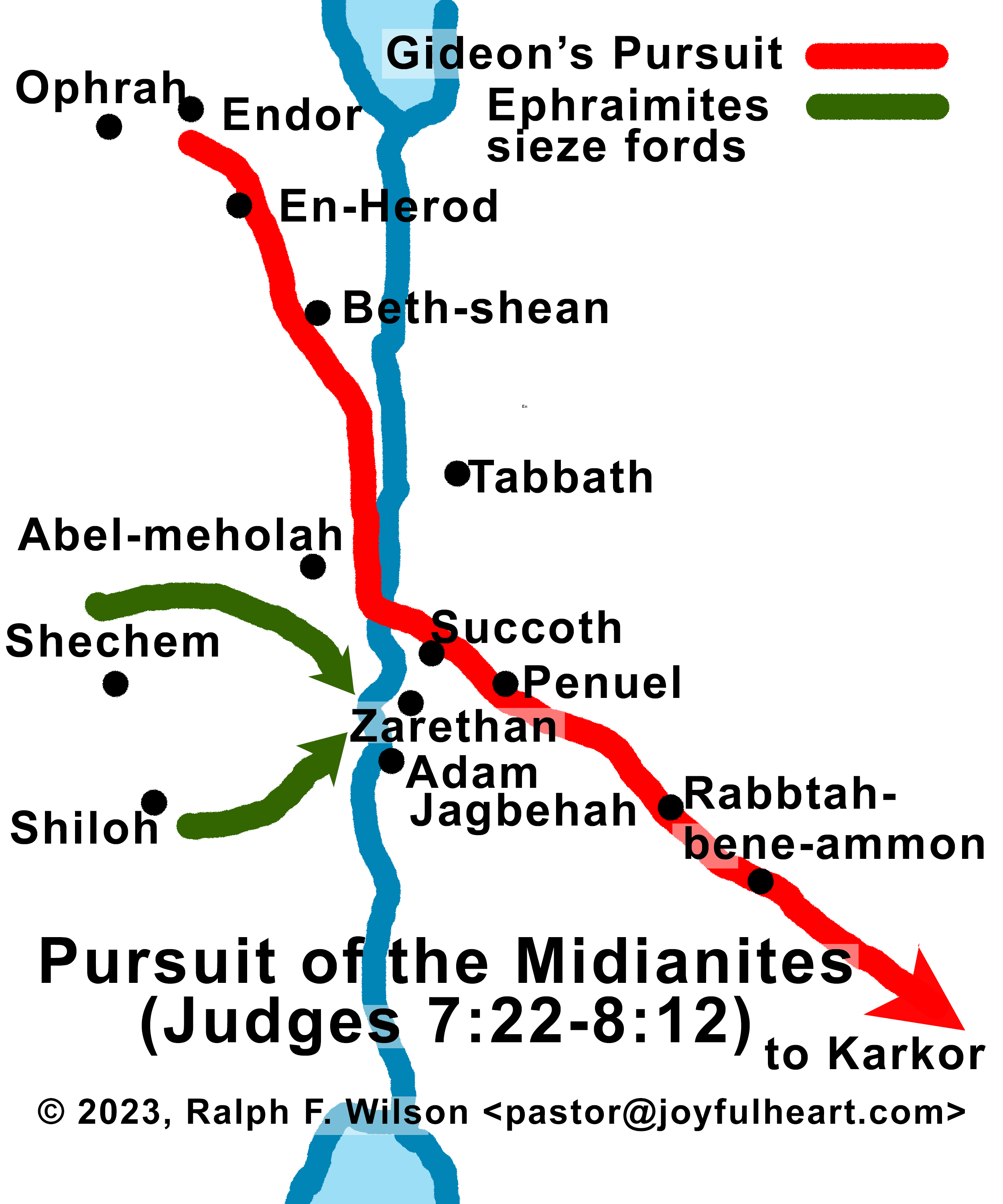
A map shows the route that Gideon follows in pursuit of the remnants of the fleeing Midianite army. The Midianites run towards the Jordan River, desperately trying to find a place to cross and escape. Finally, some are able to ford the river near Succoth, and flee along the Jabbock River, then south across the desert to Jogbehah, Rabbah and on to Karkor.
Calling upon Ephraim for Assistance (7:24-25)
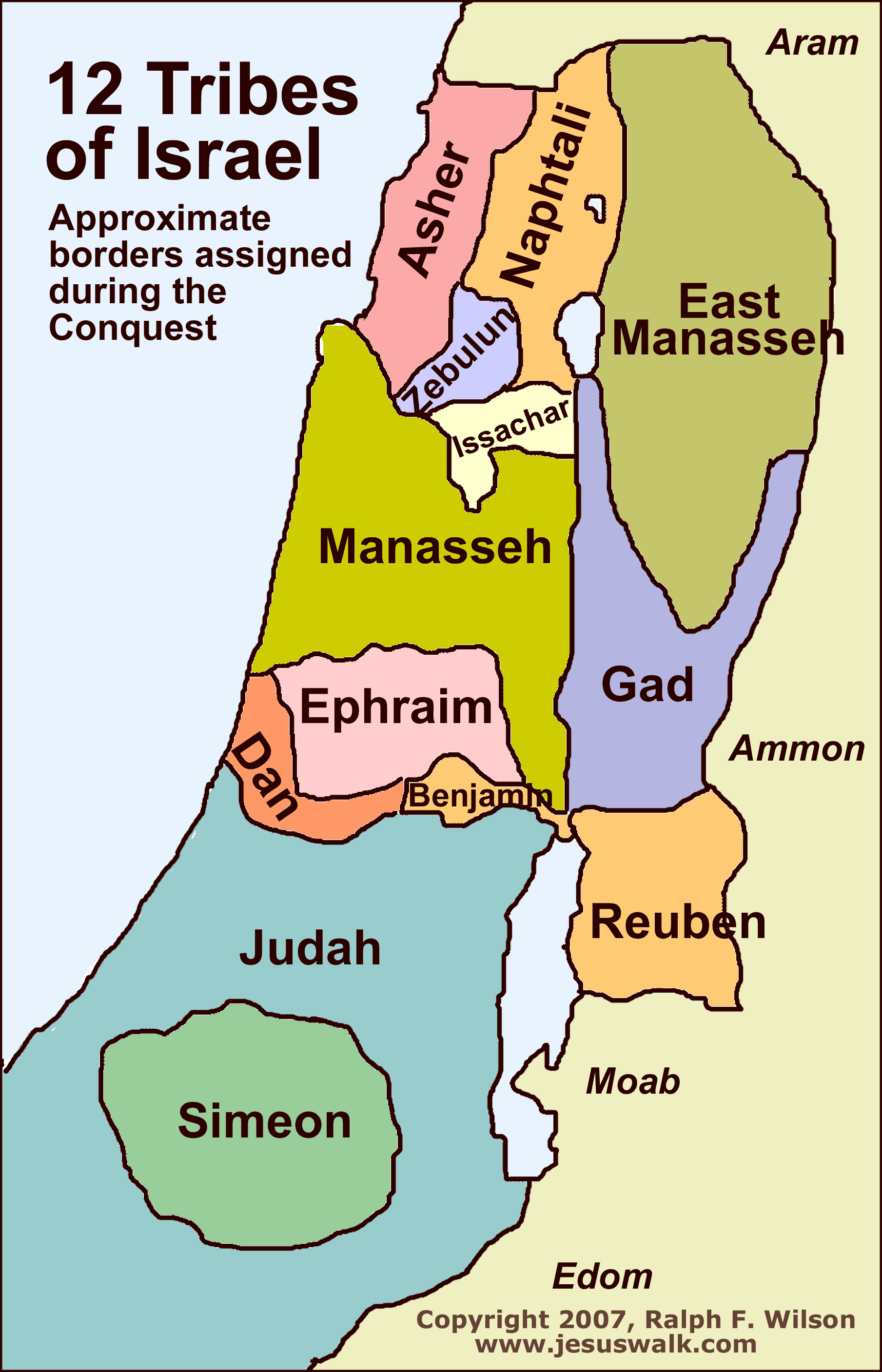
Naphtali, Asher, and Manasseh cut off the Midianites' escape to the north and west. Now Gideon needs assistance from the large and powerful tribe of Ephraim to the south. Prior to this he has not called upon the Ephraimites when raising his army.
"Gideon sent messengers throughout the hill country of Ephraim, saying, 'Come down against the Midianites and seize the waters of the Jordan ahead of them as far as Beth Barah.' So all the men of Ephraim were called out and they took the waters of the Jordan as far as Beth Barah. They also captured two of the Midianite leaders, Oreb and Zeeb. They killed Oreb at the rock of Oreb, and Zeeb at the winepress of Zeeb. They pursued the Midianites and brought the heads of Oreb and Zeeb to Gideon, who was by the Jordan." (7:24-25)
Dispute with the Ephraimites (8:1-3)
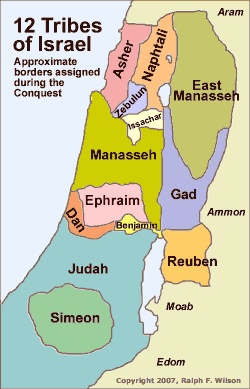 12 Tribes of Israel. Larger map. |
The Ephraimites are able to capture some of the chief leaders. Now they complain loudly to Gideon -- who was still in hot pursuit of remnants of the Midianite army. Why did Gideon not call them earlier? they grumble. They are jealous of the spoils of victory.
"Now the Ephraimites asked Gideon, 'Why have you treated us like this? Why didn't you call us when you went to fight Midian?' And they criticized him sharply. But he answered them, 'What have I accomplished compared to you? Aren't the gleanings of Ephraim's grapes better than the full grape harvest of Abiezer? God gave Oreb and Zeeb, the Midianite leaders, into your hands. What was I able to do compared to you?' At this, their resentment against him subsided." (8:1-3)
Why doesn't Gideon call upon the tribe of Ephraim before this? Perhaps he is afraid that because of their size and prominence they will try to take over. We don't know. We do know, however, that when the Spirit of the Lord came upon Gideon (6:35-35), he called on his own tribe of Manasseh and the tribes of Asher, Zebulun, and Naphtali, not Ephraim. God was in it.
But notice how gracious Gideon is. Instead of pointing defensively to his considerable achievements in the battle, he refuses to be drawn into an argument that will delay him from pursuing the remnants of the fleeing Midianite army. Instead, he humbly compliments them on their achievement -- capturing the leaders, Oreb and Zeeb -- and minimizes his own.
He says, "Aren't the gleanings of Ephraim's grapes better than the full grape harvest of Abiezer?" By this he means that his own clan, Abiezer, in the midst of the battle (full grape harvest) didn't accomplish as much as Ephraim's small mop-up operation (gleanings). Gleanings, as he puts it, are the remaining grapes in the vineyard after the harvest has already taken place. Gideon shows great wisdom and restraint here.
| Q2. (Judges 7:24-8:3) What does Gideon ask the
Ephraimites to do? Why are they so angry? What do you learn from Gideon's
approach to the Ephraimites' arrogance? https://www.joyfulheart.com/forums/index.php?showtopic=30
|
Allies Refuse Aid (8:4-9)
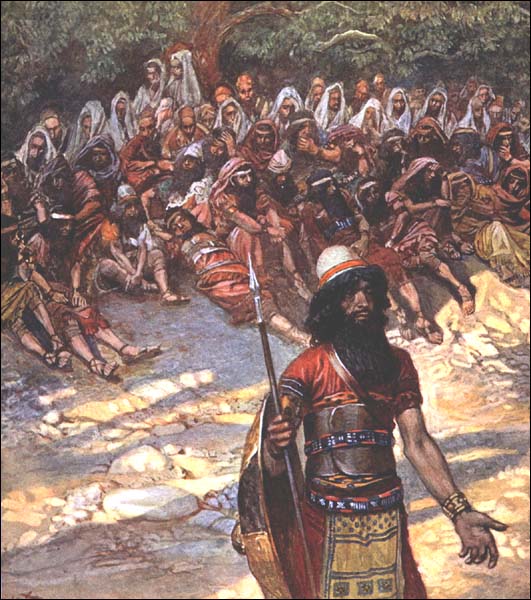 Gideon asks bread of the men of Succoth, unknown illustrator. Larger image. |
"Gideon and his three hundred men, exhausted yet keeping up the pursuit, came to the Jordan and crossed it. He said to the men of Succoth, 'Give my troops some bread; they are worn out, and I am still pursuing Zebah and Zalmunna, the kings of Midian.''
But the officials of Succoth said, 'Do you already have the hands of Zebah and Zalmunna in your possession? Why should we give bread to your troops?'
Then Gideon replied, 'Just for that, when the LORD has given Zebah and Zalmunna into my hand, I will tear your flesh with desert thorns and briers.'
From there he went up to Peniel and made the same request of them, but they answered as the men of Succoth had. So he said to the men of Peniel, 'When I return in triumph, I will tear down this tower.' " (8:4-9)
Succoth and Peniel are Israelite cities, the eastern portion of land assigned to the tribes of Gad and Manasseh. Rather than helping their brothers fight the common enemy as is their covenant responsibility as fellow Israelites, they are withholding aid until they make sure that the Midianites are thoroughly trounced. They are taking no chances with the Midianites. But in doing so they are committing a terrible breach of hospitality to their own kinsmen and a grave sin against the God of the Covenant.
Gideon promises to punish them, and, by the standards of the time, they certainly deserve it. But now we begin to see a darker and vindictive side to Gideon, a characteristic that becomes full blown terror in his son Abimelech (Judges 9). "Tear" in 8:7 is the Hebrew word dish, "tread, thresh."3 He will punish them like the oxen that trample the grain on the threshing floor.
Capturing Zebah and Zalmunna, Kings of Midian (8:10-12)
However, he lets nothing deter him from his single focus -- destroy the remnants of the Midianite army. That he must do in order to protect his people from future incursions.
"Now Zebah and Zalmunna were in Karkor with a force of about fifteen thousand men, all that were left of the armies of the eastern peoples; a hundred and twenty thousand swordsmen had fallen. Gideon went up by the route of the nomads east of Nobah and Jogbehah and fell upon the unsuspecting army. Zebah and Zalmunna, the two kings of Midian, fled, but he pursued them and captured them, routing their entire army." (8:10-12)
We don't know exactly where Karkor is4, but it was apparently on a caravan route, "the route of the nomads" in Trans-Jordan -- a long way from Gideon's home.
The word "unsuspecting" (NIV), "secure" (KJV), or "off its guard" (NRSV) is the Hebrew noun bēṭah, "safety, security, carelessness," in this case, a sense of false security.5 They don't imagine that they were in any danger from Gideon's army in this remote location and probably fail to post a guard at night. We are not told the details of this attack, only that Gideon's small band of 300 men "fell upon" (NIV) or "smote" (KJV) the remaining Midianite army of 15,000 men. The Hebrew verb is nākâ, "strike, strke dead, attack, destroy." It includes both those who are wounded as well as killed.6 Gideon, in the language of the KJV, "discomfited the host," translating the verb ḥārad, "make afraid, startle" or "threw the army into terror,"7 "routed" (NIV). His men may not have killed many Midianites in this battle, but they ran off in terror. Gideon's men pursued them until they had captured Zebah and Zalmunna, two leading Midianite kings.
Q3. (Judges 8:10-12) Why must Gideon vanquish the Midianite force of 15,000 men in Karkor? What danger do we face when we deal with problems only half-way?https://www.joyfulheart.com/forums/index.php?showtopic=31
Punishing the Uncooperative Allies (8:13-17)
At this juncture the darker, punitive side of Gideon reappears. Now that he has won the key victory he can afford to deal with the two Israelite towns that had spurned his requests for food during the pursuit.
"Gideon son of Joash then returned from the battle by the Pass of Heres. He caught a young man of Succoth and questioned him, and the young man wrote down for him the names of the seventy-seven officials of Succoth, the elders of the town. Then Gideon came and said to the men of Succoth, 'Here are Zebah and Zalmunna, about whom you taunted me by saying, "Do you already have the hands of Zebah and Zalmunna in your possession? Why should we give bread to your exhausted men?"' He took the elders of the town and taught the men of Succoth a lesson by punishing them with desert thorns and briers. He also pulled down the tower of Peniel and killed the men of the town." (8:13-17)
Gideon's punishment for the town of Peniel is to destroy the tower that protects the citizens of Peniel during siege and to kill the men. Pretty harsh! At Succoth he obtains the names of the elders of the town who are responsible for the decision to deny his army food. Though we aren't told exactly how he punished them, apparently he whips them with thorns and briars until they are bloody. The author says he "taught" them, in the way that a spanking might teach a child. Cundall sees it as "a form of torture which almost certainly ended in their death."8
Q4. (Judges 8:4-17) Why do the cities of Succoth and Peniel refuse aid to Gideon's army?Why does Gideon punish these cities later? What is their sin? Is Gideon just? Can you think of a circumstance when a Christian might be guilty of the sin of Succoth and Peniel?https://www.joyfulheart.com/forums/index.php?showtopic=32
Slaying Zebah and Zalmunna (8:18-21)
Next, Gideon deals with the captured kings of the Midianites.
"Then he asked Zebah and Zalmunna, 'What kind of men did you kill at Tabor?'
'Men like you,' they answered, 'each one with the bearing of a prince.'
Gideon replied, 'Those were my brothers, the sons of my own mother. As surely as the LORD lives, if you had spared their lives, I would not kill you.' Turning to Jether, his oldest son, he said, 'Kill them!' But Jether did not draw his sword, because he was only a boy and was afraid.
Zebah and Zalmunna said, 'Come, do it yourself. "As is the man, so is his strength."' So Gideon stepped forward and killed them, and took the ornaments off their camels' necks." (18:18-21)
Zebah and Zalmunna try to answer Gideon's questions wisely, describing the men they killed as having "the bearing of a prince." Apparently these kings had executed Gideon's own brothers at Mt. Tabor in an incident we aren't told about. According to the standards of the time, Gideon has a family obligation to exact vengeance for his brothers' unjust deaths. (See Numbers 35:9-34, especially verse 19; 1 Samuel 15:33; Romans 12:19). We cannot fault him for this, though we can tremble at the anger that motivates this primitive justice.
He directs his son Jether to kill the men. For Jether it would be considered an honor to slay such important men and for the Midianite kings a disgrace to be slain by a boy. But Jether can't do it, so Gideon kills them himself. Then he takes from their camels the spoils of war. We view conquering Gideon full of vindictive anger, not nearly so attractive as the humble, obedient man we saw a few days before.
Q5. (Judges 8:18-21) Why does Gideon slay Zebah and Zalmunna? Is he unjust or fulfilling his just obligation? (Numbers 35:16) Why does Romans 12:19 prohibit Christians from taking vengeance?https://www.joyfulheart.com/forums/index.php?showtopic=33
Lessons for Disciples
What in the world are disciples of Jesus to learn from this bloodbath? We certainly aren't to emulate Gideon's angry retribution to his enemies, though we must judge Gideon by his own light and cultural standards, not by the light of Jesus' teaching which comes twelve hundred years later. What are the lessons here? I see several:
- Great courage and faith to carry out God's battle plan with a skeleton force of only 300 men.
- Follow-through and persistence to pursue the enemy until he is completely defeated.
- Single-minded focus to concentrate on the most important task and not be distracted.
- Wisdom and restraint to choose his battles carefully and not challenge the Ephraimites' arrogant complaints.
- A concern for justice for his brothers' unjust execution by the Midianites.
- Terrible anger that results in a harsh punishment which may have exceeded the provocation.
 Available in book formats. |
Gideon is a common man who, over the period of just a few weeks, has risen to greatness. We have much to learn from him. Yet some of the lessons that Christians must draw are the need for restraint and mercy in the face of our own anger. Why is it that great men and women of God come with flaws? Are we to give in to disillusionment? No, but we must accept the reality that all of us are vulnerable to temptation and sin. And we must be willing to show mercy with regard to others' weaknesses if we desire mercy ourselves -- a difficult, but important lesson.
Prayer
Father, thank you for Gideon's boldness and strength. Help me to have his single-minded focus to do what you have shown me I must do. Help me not to be deterred by problems to the left and right, but to accomplish your will. Most of all I pray for humility -- humility that will temper my own struggle with anger and humble mercy when others around me sin. Have mercy on us, heavenly Father. Thank you for your costly mercy toward me in Jesus Christ, in whose name I pray. Amen.
Key Verse
"'Watch me,' he told them. 'Follow my lead. When I get to the edge of the camp, do exactly as I do. When I and all who are with me blow our trumpets, then from all around the camp blow yours and shout, "For the LORD and for Gideon."'" (Judges 7:17-18)
References
Common Abbreviations of References
- Cundall, Judges, p. 113. The 10 pm figure is based on the assumption that the hours of darkness were divided into three rather than four watches.
- "Jar" (NIV, NRSV) or "pitcher" (KJV) is the Hebrew noun kad, a jar used for domestic purposes. TWOT #953a. Such jars carried water or other provisions such as meal (1 Kings 17:12, 14, 16). BDB 461.
- Harold G. Stigers, TWOT #419. Brown, Judges, p. 200.
- Barry Hovey, "Karkor," ISBE, 2:3, says it cannot be identified with Qarqar, which is 250 miles from Jogbehah. Cundall, p. 117 places it in the Wadi Sirhan, well to the east of the Dead Sea. Harry O. Thompson, "Karkor," ABD 4:6, discusses the various possibilities and sees the best possibility as Nowakis and Jebeiha, in the neighborhood called Karkagheich, on the left side of the road from Salt to Amman, 1.5 hours NW of Amman.
- John N. Oswalt, bāṭaḥ, TWOT #233a.
- Marvin R. Wilson, nākâ, TWOT #1364.
- Andrew Bowling, ḥārad, TWOT #735.
- Cundall, Judges, p. 118.
Copyright © 2026, Ralph F. Wilson. <pastor joyfulheart.com> All rights reserved. A single copy of this article is free. Do not put this on a website. See legal, copyright, and reprint information.
 To be notified about future articles, stories, and Bible studies, why don't you subscribe to our free newsletter, The Joyful Heart, by placing your e-mail address in the box below. We respect your