Free E-Mail
Bible Studies
 Apostle Peter
Beginning the Journey (for new Christians). en Español
Old Testament
Abraham
Jacob
Moses
Joshua
Gideon
David, Life of
Elijah
Psalms
Solomon
Songs of Ascent (Ps 120-135)
Isaiah
Advent/Messianic Scriptures
Daniel
Rebuild & Renew: Post-Exilic Books
Gospels
Christmas Incarnation
(Mt, Lk)
Sermon on the Mount
(Mt 5-7)
Mark
Luke's
Gospel
John's Gospel
7 Last Words of Christ
Parables
Jesus and the Kingdom
Resurrection
Apostle Peter
Acts
The Early Church
(Acts 1-12)
Apostle Paul
(Acts 12-28)
Paul's Epistles
Christ Powered Life (Rom 5-8)
1 Corinthians
2 Corinthians
Galatians
Ephesians
Vision for Church
(Eph)
Philippians
Colossians,
Philemon
1
& 2 Thessalonians
1 & 2 Timothy,
Titus
General Epistles
Hebrews
James
1 Peter
2 Peter, Jude
1, 2, and 3 John
Revelation
Revelation
Conquering Lamb of Revelation
Topical
Glorious Kingdom, The
Grace
Great Prayers
Holy Spirit, Disciple's Guide
Humility
Lamb of God
Listening for God's Voice
Lord's Supper
Names of God
Names of Jesus
Christian Art
About Us
Podcasts
Contact Us
Dr. Wilson's Books
Donations
Watercolors
Sitemap

 Apostle Peter: Disciple Lessons from the Rock
Paul met with some form the circumcision controversy in city after city where he established churches. As a Jerusalem-trained rabbi, Paul would be asked to speak in synagogues of the Jewish Diaspora. From his extensive command of the Old Testament Scriptures (there were no New Testament Scriptures yet), he would prove that Jesus is the promised Messiah. Though he would eventually be ejected from the synagogue, his followers would include some Jews and larger group of "God-fearers," Gentiles who were attracted by the moral tone of Judaism, but who had not submitted to circumcision so as to become full converts to Judaism.
But again and again, his churches were troubled by Jewish-Christians who couldn't seem to let go of circumcision. After Paul had left the Galatian churches, a small group of Judaizers had gained dominance and were in the process of convincing the Gentile Christians to be circumcised -- thus perverting the gospel of Christ (1:7).
Paul's dilemma was that he would assert his Jewish credentials and the Jewish Christians would assert theirs -- and the Gentile Christians would see this as an argument between Jews. Moreover, Paul was hundreds of miles distant, but the Judaizers were right in the community! Guess who wins that argument?
So to convince his spiritual children among the Galatians that he should be believed, Paul goes beyond comparing Jewish credentials -- or even credentials from the Jerusalem church. He asserts something that his opponents cannot: that Jesus had appeared to him personally, appointed him as an apostle, and given him a personal revelation. His gospel wasn't derived primarily from the Old Testament, or from the teachings of the apostles and elders in Jerusalem. He received it directly from Christ.
Revelation from Jesus Christ (1:11-12)
And so Paul begins relating his amazing story.
"11 I want you to know, brothers, that the gospel I preached is not something that man made up. 12 I did not receive it from any man, nor was I taught it; rather, I received it by revelation from Jesus Christ." (1:11-12)
These two verses constitute the thesis that Paul supports in 1:13 to 2:10. The phrase translated variously "something that man made up" (NIV) or "of human origin" (NRSV), is literally "after man" (KJV), using the preposition kata, "according to, in accordance with, in conformity with."[30] He didn't model his preaching after anyone's teaching. He neither received[31] it from some prior apostle nor was he taught it. Rather it came by revelation through the personal agency of[32] Jesus Christ himself.
The noun "revelation" is apokalypsis, literally, "uncovering," here, "making fully known, revelation, disclosure."[33] Paul uses this word group several times in Galatians:
"I did not receive [the gospel] from any man, nor was I taught it; rather, I received it by revelation from Jesus Christ." (1:12)
"But ... God ... was pleased to reveal his Son in me so that I might preach him among the Gentiles...." (1:15-16)
"I went [to Jerusalem] in response to a revelation and set before them the gospel that I preach among the Gentiles." (2:2a)
"Before this faith came, we were held prisoners by the law, locked up until faith should be revealed." (3:23)
Authoritative Sources
All this may seem pretty remote to you until you realize that finding an authoritative and accurate source is the foundation of not only careful history, but also modern-day reporting and research.
Judaism is full of references to authorities. The Mishnah, for example, includes thousands of references to the sayings of the ancient rabbis to support some position or another. But Christian teaching is based on these sources:
- The revelation of the Old Testament Scriptures.
- The authoritative revelation of Jesus, the Son of God. Jesus' teachings to the eleven disciples,who were witnesses to his ministry, were transmitted to the church in the gospels and in the epistles.
- The independent revelation to the Apostle Paul.
The Roman Catholic tradition places the authority of Scripture alongside the authority of church tradition; Protestants usually go back to the Scripture itself to support their doctrines. Members of the LDS Church look to a supposed special revelation to Joseph Smith, whom they believe to be a prophet. Some groups emphasize the special insights (sometimes called "revelations") of their founders, which they quote extensively in their literature. Do you believe something because Evangelist X teaches it, or Pastor Y? What is the authority on which you base of your Christian beliefs? How reliable is this authority? What Paul is saying here is tremendously important to our belief system!
Q1. (Galatians 1:11-12) What is the source of Paul's
gospel? How do we know that it is a true revelation? How does it conform to our
other foundational sources of Christian teaching? What is the danger of taking
the teaching of contemporary leaders as our doctrinal basis without checking it
with the Scripture?
https://www.joyfulheart.com/forums/index.php?showtopic=1122
Zeal as a Rabbinical Student (1:13-14)
Now Paul begins a brief biographical account of his background and conversion. We know that as a young man Paul had been a student of Rabbi Gamaliel in Jerusalem (Acts 22:3); he had thoroughly learned the traditional interpretation of Scriptures through this discipline. Paul (who was from Tarsus in Cilicia), was part of the early persecution against the Christians:
"Opposition arose, however, from members of the Synagogue of the Freedmen (as it was called) -- Jews of Cyrene and Alexandria as well as the provinces of Cilicia and Asia." (Acts 6:9; cf. 9:29)
After the stoning of Stephen, we read:
"But Saul began to destroy[34] the church. Going from house to house, he dragged off men and women and put them in prison." (Acts 8:3)
As Paul recounts to the Galatians here:
"13 For you have heard of my previous way of life in Judaism, how intensely[35] I persecuted[36] the church of God and tried to destroy[37] it. 14 I was advancing in Judaism beyond many Jews of my own age and was extremely zealous for the traditions of my fathers." (1:13-14)
Paul shares this so the Galatians can see that his previous devotion to traditional Judaism had been thorough -- and to contrast it with his experience of Jesus Christ appearing to him! Jesus struck him to the ground outside of Damascus, where he had gone to arrest more Christians.
"'Saul, Saul, why do you persecute me?'
'Who are you, Lord?' Saul asked.
'I am Jesus, whom you are persecuting,' he replied. 'Now get up and
go into the city, and you will be told what you must do.'" (Acts 9:4-6)
Paul's Calling and Revelation (1:15-16)
Paul looked at this violent encounter as an act of God's grace, pure and simple.
"15 But when God, who set me apart from birth and called me by his grace, was pleased 16 to reveal his Son in me so that I might preach him among the Gentiles, I did not consult any man, 17 nor did I go up to Jerusalem to see those who were apostles before I was, but I went immediately into Arabia and later returned to Damascus." (1:15-17)
Notice the three verbs Paul uses to describe this:
"Set apart" (NIV, NRSV), "separated" (KJV) is aphorizō, "to select one person out of a group for a purpose, set apart, appoint."[38] This wasn't a spur-of-the-moment idea in God's mind; Paul had been born for this purpose.
"Called" is kaleō, "call." From the meanings 'summon' and 'invite' there develops the extended sense, "choose for receipt of a special benefit or experience, call."[39] God had something special in mind for Paul. Our understanding of a "call to the ministry" or "vocation" (from Latin vocare, "to call," from which we also get our word "vocal") comes from this idea.
"Reveal" is the verb apokalyptō, "to cause something to be fully known, reveal, disclose, bring to light, make fully known."[40] Notice the wording, "reveal in[41] me" referring to an inward experience. But it could be translated "in my case."[42]
Finally, Paul shares the purpose of this revelation:
"... so that I might preach[43] him among the Gentiles." (1:16b)
The mission to the Gentiles was different from anything encountered previously by the Christian church. And preparation for the primary missionary to the Gentiles needed to be unique as well. The original apostles knew how to proclaim the gospel effectively to the Jews, but they had little experience communicating it to Gentiles.
Some missionary friends of mine went to Bangladesh in the 1970s to reach out to Muslims. They had hoped to be mentored by a missionary couple that had been in the country for years. But unexpectedly that couple left before the mentoring could begin. It turned out that this "tragedy" was a God-send. Mentoring by this couple who had had little success reaching Muslims would have prevented my friends from learning from God and pioneering new and fruitful approaches that have since brought tens of thousands of Muslims into the Kingdom. God was preparing Paul for something new.
According to the account in Acts, this preaching began immediately -- though it was directed for now to the Jews living in Damascus.
"Saul spent several days with the disciples in Damascus. At once he began to preach[44] in the synagogues that Jesus is the Son of God.... Yet Saul grew more and more powerful and baffled the Jews living in Damascus by proving that Jesus is the Christ." (Acts 9:19-20, 22)
Immediately[45] after his conversion, he "baffled"[46] the Jews by "proving"[47] from the Scriptures that Jesus must be the Christ. During Paul's three-day blindness, we know that he had visions (Acts 9:12). No doubt he also had revelations from Jesus about how he fit into the Old Testament scriptures, perhaps much as Jesus had done with the disciples on the road to Emmaus after his resurrection (Luke 24:27). Without time to study with the disciples at Damascus, he was convincingly preaching Jesus as the Messiah.
Q2. (Galatians 1:13-16) What factors in Paul's background
made him an ideal apostle to the Gentiles? How did God use his being different
from others? To ponder: How has your unique background fitted you for ministry?
What uniqueness has God given you? What will it take to see that uniqueness as a
God-given strength rather than as an embarrassment?
https://www.joyfulheart.com/forums/index.php?showtopic=1123
Not Influenced by the Jerusalem Church (1:16c-17)
Paul has explained that he received a specific commission, call, and revelation. Now he denies that man had any substantive part in the formation of his understanding of the gospel -- a point which he will develop in detail over the next several verses. Speaking of the period right after his conversion, he asserts:
"16c I did not consult any man, 17 nor did I go up to Jerusalem to see those who were apostles before I was, but I went immediately into Arabia and later returned to Damascus." (1:16c-17)
"Consult" (NIV), "confer with" (NRSV, cf. KJV) is prosanatithēmi, "to take up a matter with, consult with someone,"[48] literally, "to lay upon oneself in addition, to betake oneself to another, to confer with."[49] The only other appearance in the New Testament is at a related passage a few verses later:
"Those men added nothing (prosanatithēmi) to my message." (2:6)
Nor did Paul stay in Damascus for long, but left for Arabia, then returned to Damascus, from which he fled due to a plot on his life. Arabia in that day included the territory west of Mesopotamia, east and south of Syria and Palestine, to the Isthmus of Suez.[50] The point is that he didn't go immediately to the seat of Christianity at that time -- Jerusalem.
Paul's Contact with the Jerusalem Church (1:18-21)
18 Then after three years, I went up to Jerusalem to get acquainted with Peter and stayed with him fifteen days. 19 I saw none of the other apostles -- only James, the Lord's brother. 20 I assure you before God that what I am writing you is no lie." (1:18-20)
His purpose of the trip was specific. Paul felt it was important to spend some time with Peter (NIV, his Greek nickname), that is, Cephas (NRSV, KJV, his Aramaic nickname).
"Get acquainted with" (NIV), "visit" (NRSV), "see" (KJV) is historeō, "visit" (for the purpose of coming to know someone or something)[51] "to gain knowledge by visiting," from histōr, "one who knows by inquiry."[52] In Acts 9:26 his purpose is described as trying to "associate with on intimate terms, join"[53] the disciples there. We know from Luke's account that he only obtained an audience with Peter through the intervention of Barnabas (Acts 9:26-27), since up to that time the apostles were afraid of him due to his former reputation. The other apostle Paul mentions is "James, the Lord's brother" (Matthew 13:55; 27:56; Galatians 2:12), who later becomes leader of the Church of Jerusalem, presides over the Jerusalem Council (Acts 15:13-20), and writes the Epistle of James in our New Testament.[54] James was known as "James the Just" for his careful keeping of the Mosaic law. James and Peter enter our story a bit later in 2:11-12, which we'll discuss in Lesson 3.
It's interesting that Paul had to underscore his account with this sentence:
"I assure you before God that what I am writing you is no lie." (1:20)
"Before God" is a solemn oath. Apparently, Paul's story had been questioned by his opponents who claimed that his gospel was derived from the Jerusalem church, not independently.
Paul's Time in Tarsus and Antioch (1:21)
"21 Later I went to Syria and Cilicia. 22 I was personally unknown to the churches of Judea that are in Christ. 23 They only heard the report: 'The man who formerly persecuted us is now preaching the faith he once tried to destroy.' 24 And they praised God because of me." (1:21-24)
We know from Luke that, when a plot by Grecian Jews against Paul's life was discovered in Jerusalem, he was taken to the port at Caesarea and sent by ship to his hometown of Tarsus in Cilicia (Acts 9:29-30). Later, Barnabas found him in Tarsus, and recruited him to help with the ministry to Gentile Christians in Antioch in Syria (Acts 11:25-26).
Here in Antioch, the gospel had reached the Gentiles. Prior to that, with a few exceptions, it had been contained pretty well within the Jewish world. Now, however, it had broken out into the vast Gentile world.
Paul and Barnabas Go to Jerusalem (2:1-2)
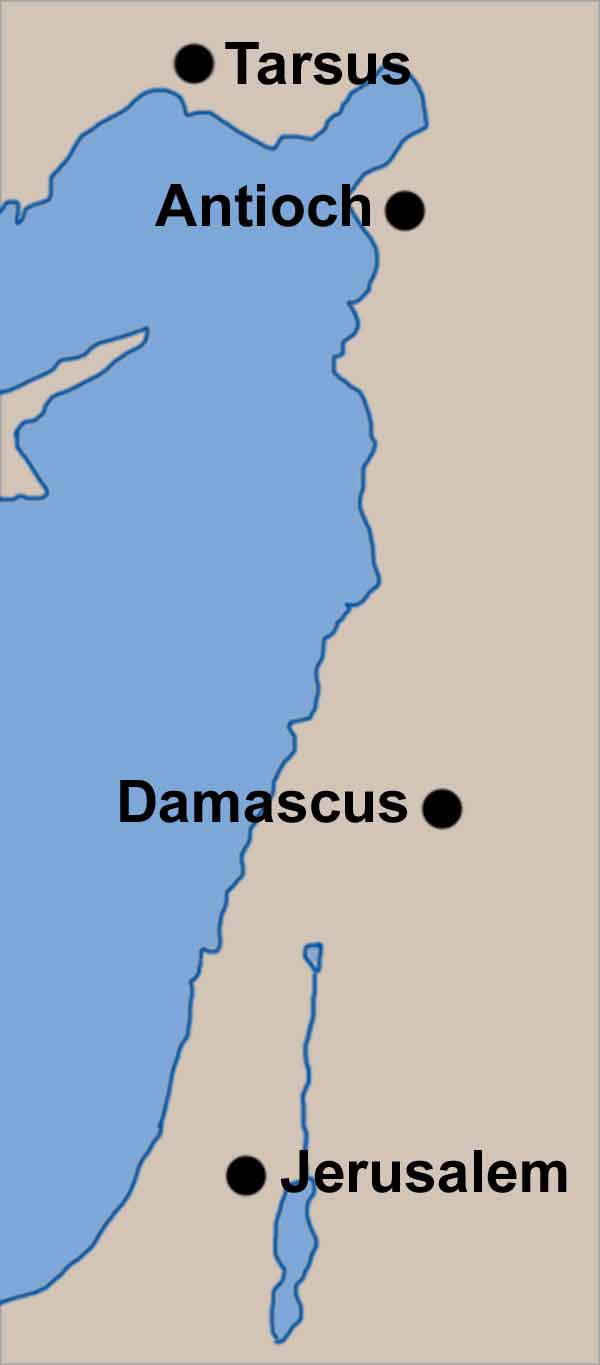 Map of Tarsus, Antioch, Damascus, and Jerusalem. Larger image. |
Paul is still answering his opponents' claim that his gospel derived from the Jerusalem church.
"Fourteen years later I went up again to Jerusalem, this time with Barnabas. I took Titus along also." (2:1)
Paul's various trips to Jerusalem are confusing, so follow closely. (See the Introduction and Appendix 2 for a detailed study of Paul's different trips to Jerusalem.) The primary purpose of this trip was famine relief, as we see in Luke's account.
"27 During this time some prophets came down from Jerusalem to Antioch. 28 One of them, named Agabus, stood up and through the Spirit predicted that a severe famine would spread over the entire Roman world. (This happened during the reign of Claudius.) 29 The disciples, each according to his ability, decided to provide help for the brothers living in Judea. 30 This they did, sending their gift to the elders by Barnabas and Saul.... When Barnabas and Saul had finished their mission, they returned from Jerusalem, taking with them John, also called Mark." (Acts 11:27-30; 12:25)
Since his first post-conversion trip to Jerusalem, Paul had spent years in Tarsus, and then further time in Antioch working alongside of Barnabas. This second trip was prompted "in response to a revelation" (2:2a) -- apparently in response to Agabus's prophecy of the coming famine. But Paul took the opportunity of this visit to discuss in depth the approach that he and Barnabas had developed to reach the Gentiles in Antioch.
"I went in response to a revelation and set before them the gospel that I preach (kēryssō) among the Gentiles. But I did this privately to those who seemed to be leaders, for fear that I was running or had run my race[55] in vain." (2:2)
This wasn't the public debate with the Judaizers that occurred during the Jerusalem Council (if you follow an early dating of Galatians), but a private meeting.[56] Was Paul really afraid that his presentation of the gospel wasn't correct? I don't think so. "For fear" (NIV) is probably over translated. The phrase is better rendered, "in order to make sure" in the NRSV.[57] Perhaps Paul called for this meeting because some were raising questions about uncircumcised believers in Antioch -- something we know happened later (Acts 15:1).
Paul is making the point that he didn't learn the gospel from the Jerusalem leaders, but "set before" (NIV), "laid before" (NRSV), "communicated" (KJV)[58] his "good news" to them for their consideration -- to see if they would call it into question. They did no such thing.
The Decision Concerning Titus (2:3)
The upshot of the meeting was entirely positive, so far as Paul was concerned. He reports,
"3 Yet not even Titus, who was with me, was compelled[59] to be circumcised, even though he was a Greek."4 [This matter arose] because some false brothers had infiltrated our ranks to spy on the freedom we have in Christ Jesus and to make us slaves. 5 We did not give in to them for a moment, so that the truth of the gospel might remain with you." (2:3-5)
The matter of circumcision arose regarding Titus, one of Paul's converts, presumably from Antioch (Titus 1:4), and a later co-worker. Bruce comments:
"Luther suggested that Paul regarded Titus as a test case: 'He took him along then in order to prove that grace was equally sufficient for both Gentiles and Jews, whether in circumcision or without circumcision.'"[60]
Apparently, Paul's enemies raised the issue of Titus' uncircumcision in a sneaky way,[61] trying to discredit Paul's ministry and restrict the liberty[62] Paul and Barnabas were exercising to reach the Gentiles without imposing the Mosaic law upon them. But the Jerusalem leaders hadn't required Titus to be circumcised, which seemed to support Paul's position.
Q3. (Galatians 2:1-3) Paul is arguing that the Jerusalem
leaders support his position on circumcision, rather than that of the Judaizers.
What is the significance of Paul's mention that Titus was not required to be
circumcised?
https://www.joyfulheart.com/forums/index.php?showtopic=1124
Paul Distances Himself from the Jerusalem Leaders (2:2, 6, 9)
It's interesting how Paul refers to the apostles in Jerusalem. Instead of warmly endorsing them as beloved apostles, he uses a kind of arm's-length expression in verse 2, 6, and 9.
"Those who seemed to be leaders...." (2:2)
"As for those who seemed to be important -- whatever they were makes no difference to me; God does not judge by external appearance...." (2:6)
"James, Peter and John, those reputed to be pillars[63]...." (2:9)
The verb in each instance is dokeō, "to consider as probable," then, "to appear to one's understanding, seem, be recognized as," here, "be influential, be recognized as being something, have a reputation."[64]
Paul is taking some pains to distance himself from acknowledging their actual authority, since his opponents in Galatia are claiming that their authority comes from the leaders in Jerusalem. Here Paul only grants that others considered them to be leaders.
James, Peter, and John Approve Paul's Message (2:6-10)
But while Paul doesn't acknowledge the leaders' authority over him, he reports that they approved of his message. Paul is trying to have it both ways: being independent of their message, but receiving approval of his revelation and ministry to the Gentiles. And he seems to have succeeded -- and least in relation to the Jerusalem church.
"6b Those men added nothing to my message. 7 On the contrary, they saw that I had been entrusted with the task of preaching the gospel to the Gentiles,[65] just as Peter had been to the Jews. 8 For God, who was at work in the ministry of Peter as an apostle[66] to the Jews, was also at work in my ministry as an apostle to the Gentiles.
9 James, Peter and John, those reputed to be pillars, gave me and Barnabas the right hand of fellowship when they recognized the grace given to me. They agreed that we should go to the Gentiles, and they to the Jews. 10 All they asked was that we should continue to remember the poor, the very thing I was eager to do." (2:6b-10)
According to Paul, this meeting provided the approval of the Jerusalem church leaders upon his and Barnabas's mission to the Gentiles. This approval contained several elements:
- Recognized theirs as a legitimate calling of God. The apostles saw them as "entrusted"[67] by God with a ministry to the Gentiles (2:7) and as recipients of God's "grace" in this mission (2:9).
- Recognized as equals in different fields. Paul portrays them as equal in apostleship but assigned to different fields -- Peter to the Jews and Paul to the Gentiles.
- Offered friendship and fellowship. To offer the "right hand of fellowship" is to pledge mutual friendship, a custom that is confirmed in both secular and Jewish writings.[68]
- Asked for relief for the poor. On this trip to Jerusalem, Paul and Barnabas had brought gifts from the church in Antioch (Acts 11:30; 12:25), and Paul continues this practice of helping the poor saints through offerings from churches in Macedonia and Greece later in his ministry.
 Available in paperback and e-book formats |
Q4. (Galatians 2:1-10) Why do you think Paul seems to
distance himself from the leaders of the Jerusalem church (2:2, 6, 9)? Why does
he at the same time write of their approval of his ministry? How does this
further his argument to the Galatians in this letter?
https://www.joyfulheart.com/forums/index.php?showtopic=1125
Prayer
Lord, thank you for saving Paul! And thank you for giving him the humility to both be taught by you -- and to stand up for it when he was challenged. Please give us the kind of strength and perseverance that we'll stand up for you, even when those around us criticize and ostracize us. Help us to be faithful to our calling. In Jesus' name, we pray. Amen.
Key Verse
"I want you to know, brothers, that the gospel I preached is not something that man made up. I did not receive it from any man, nor was I taught it; rather, I received it by revelation from Jesus Christ." (Galatians 1:11-12, NIV)
End Notes
[30] Kata, BDAG 513, 5bβ.
[31] "Receive" in 12a is paralambanō, "'receive,'used here in a kind of technical sense of a mental or spiritual heritage that one has received in the passing on of a tradition" (BDAG 768, 2bγ). For example, Paul employs the word as he passes on instructions about the Lord's Supper: "For I received from the Lord what I also passed on to you..."(1 Corinthians 11:23).
[32] The preposition "by" (NIV, KJV), "through" (NRSV) is dia, here "a marker of personal agency, through, by" (BDAG 225, 4bβ).
[33] Apokalypsis, BDAG 112, 1b.
[34] "Destroy" (NIV), "ravaging" (NRSV), "made havock of" (KJV) is lymainō, "to cause harm to, injure, damage, spoil, ruin, destroy" (BDAG 604), from lymē, "injury." The verb is in the imperfect tense, meaning a continuous, ongoing action in the past.
[35] "Intensely" (NIV), "violently" (NRSV), "beyond measure" (KJV) is hyperbolē (from which we get our English word), "state of exceeding to an extraordinary degree a point on a scale of extent (the context indicating whether in a good or a bad sense), excess, extraordinary quality/character" (BDAG 1032).
[36] "Persecuted" is diōkō, "to harass someone, especially because of beliefs, persecute" (BDAG 254, 2).
[37] "Tried to destroy" (NIV, cf. NRSV), "wasted" (KJV) is portheō, "to attack and cause complete destruction, pillage, make havoc of, destroy, annihilate." (BDAG 853). Like lymainō (Acts 8:3), portheō is in the imperfect tense where the idea of ongoing action is present. The church wasn't destroyed at one time (which would require the aorist tense), or completely (which might use the perfect tense). This construction probably should be seen as the tendential imperfect, sometimes called the conative imperfect, regarding an action that was attempted but not fully attained, reflected in the NIV and NRSV translations as "tried to destroy." Dana and Mantey, §177(1).
[38] Aphorizō, BDAG 158, 2. The same verb is used in Acts 13:2 where Paul and Barnabas are appointed to their missionary work in Antioch.
[39] Kaleō, BDAG 503, 4.
[40] Apokalyptō, BDAG 112, b.
[41] "In" is en, here as a "marker denoting the object to which something happens or in which something shows itself, or by which something is recognized, to, by, in connection with" (BDAG 329, 8).
[42] So Robertson, Word Pictures, and Lightfoot, Galatians.
[43] "Preach" (NIV, NRSV), "proclaim" (KJV) is euangelizō, from which we get our word "evangelize." The basic meaning is "bring good news, announce good news." Here and in verses 1:8a and 23 it has the specific meaning, "proclaim the divine message of salvation, proclaim the gospel, preach" (Euangelizō, BDAG 402, 2aα).
[44] Kēryssō, "to make public declarations, proclaim aloud" (BDAG 543, 2bβ).
[45] Eutheōs, "at once, immediately" (BDAG 405).
[46] "Baffled" (NIV), "confounded" (NRSV, KJV) is syncheō, literally, "pour together," then by figurative extension, "to cause dismay, confuse, confound, trouble, stir up... throw into consternation" (BDAG 953).
[47] "Proving" is symbibazō, "to present a logical conclusion, demonstrate, prove" (BDAG 957, 3).
[48] Prosanatithēmi, BDAG 876, 2.
[49] Robertson, Word Pictures.
[50] Arabia, BDAG 128.
[51] Historeō, BDAG 483.
[52] Robertson, Word Pictures.
[53] Kollaō, BDAG 556, 2bα.
[54] The other James was "James, son of Zebedee," was the brother of the Apostle John, and had been beheaded by Herod (Acts 12:1-2).
[55] "Run" is trechō, "run," then figuratively, "to make an effort to advance spiritually or intellectually, exert oneself." (BDAG 1015, 2).
[56] "Privately" (NIV, KJV), "in a private meeting" (NRSV) is kata idios, "pertaining to a particular individual, by oneself, privately" (BDAG 467, 5).
[57] "For fear" (NIV), "in order to make sure" (NRSV), "lest" (KJV) is two words: mē pōs, an idiom that means, "marker of a negative perspective expressing misgiving," frequently rendered "lest." Here, in introduction to an indirect question "(lest) perhaps" (BDAG 902, 2c).
[58] Anatithēmi, "to lay something before someone for consideration, communicate, refer, declare," with the connotation of request for a person's opinion (BDAG 73, 2).
[59] "Compelled" is anankazō, "to compel someone to act in a particular manner, compel, force" (BDAG 60, 1). From Sophocles down, "to necessitate, compel, drive to, constrain," whether by force, threats, etc., or by persuasion, entreaties, etc., or by other means (Thayer, 36).
[60] Bruce 107-108 citing Luther, Vorlesung, ad loc, cited by H. Schlier, Der Brief on der Galater (Göttingen, 1971), p. 65, n. 5.
[61] "Infiltrated" (NIV), "secretly brought in" (NRSV), "came in privily" (KJV) is pareisaktos, "pertaining to coming into a group in a surreptitious manner, secretly brought in, smuggled in, sneaked in" (BDAG 774). "Spy on/out" is kataskopeō, "spy out, lie in wait for" (BDAG 527). "To inspect, view closely, in order to spy out and plot against" (Thayer 337).
[62] "Freedom" (NIV, NRSV), "liberty" (KJV) is eleutheria, "the state of being free, freedom, liberty." Used especially of freedom which stands in contrast to constraint of the Mosaic law, looked upon as slavery (2:4; 5:1; BDAG 316).
[63] "Pillars" is stylos, "pillar, column," then figuratively, "a person or community recognized for spiritual leadership, pillar, support" (BDAG 949, 2).
[64] Dokeō, BDAG 255, 2aβ.
[65] "Gentiles" (NIV, NRSV), "heathen" (KJV) is ethnos, "people groups foreign to a specific people group (a nationalistic expression, also usual in Greek for foreigners), here specifically, "non-Israelite Christians, gentiles of Christian congregations composed of more than one nationality and not limited to people of Israel" (BDAG 276, 2b).
[66] "Apostle" (NIV, NRSV), "apostleship" (KJV) is apostolē, "office of a special emissary, apostleship, office of an apostle, assignment" (BDAG 122).
[67] "Entrusted" (NIV, NRSV), "committed" (KJV) is pisteuō, "trust, believe," here, "entrust something to someone." (BDAG 818).
[68] Dexios, "'give the right hand'as a sign of friendship and trust" (BDAG 217), "To pledge either a mutual friendship, or a compact, by joining the right hands:" Appears in 1 Maccabees 6:58; 11:50, 62, 66; 13:50; 2 Maccabees 11:26; 12:11; 13:22; Josephus, Antiquities of the Jews, 18, 9, 3).
Copyright © 2025, Ralph F. Wilson. <pastor joyfulheart.com> All rights reserved. A single copy of this article is free. Do not put this on a website. See legal, copyright, and reprint information.
 |

|

In-depth Bible study books
You can purchase one of Dr. Wilson's complete Bible studies in PDF, Kindle, or paperback format -- currently 48 books in the JesusWalk Bible Study Series.
Old Testament
- Abraham, Faith of
- Jacob, Life of
- Moses the Reluctant Leader
- Joshua
- Gideon
- David, Life of
- Elijah
- Psalms
- Solomon
- Songs of Ascent (Psalms 120-134)
- Isaiah
- 28 Advent Scriptures (Messianic)
- Daniel
- Rebuild & Renew: Post-Exilic Books
Gospels
- Christmas Incarnation (Mt, Lk)
- Sermon on the Mount (Mt 5-7)
- Luke's Gospel
- John's Gospel
- Seven Last Words of Christ
- Parables
- Jesus and the Kingdom of God
- Resurrection and Easter Faith
- Apostle Peter
Acts
Pauline Epistles
- Romans 5-8 (Christ-Powered Life)
- 1 Corinthians
- 2 Corinthians
- Galatians
- Ephesians
- Philippians
- Colossians, Philemon
- 1 & 2 Thessalonians
- 1 &2 Timothy, Titus
General Epistles
Revelation
Topical

 To be notified about future articles, stories, and Bible studies, why don't you subscribe to our free newsletter, The Joyful Heart, by placing your e-mail address in the box below. We respect your