Free E-Mail
Bible Studies
 Apostle Peter
Beginning the Journey (for new Christians). en Español
Old Testament
Abraham
Jacob
Moses
Joshua
Gideon
David, Life of
Elijah
Psalms
Solomon
Songs of Ascent (Ps 120-135)
Isaiah
Advent/Messianic Scriptures
Daniel
Rebuild & Renew: Post-Exilic Books
Gospels
Christmas Incarnation
(Mt, Lk)
Sermon on the Mount
(Mt 5-7)
Mark
Luke's
Gospel
John's Gospel
7 Last Words of Christ
Parables
Jesus and the Kingdom
Resurrection
Apostle Peter
Acts
The Early Church
(Acts 1-12)
Apostle Paul
(Acts 12-28)
Paul's Epistles
Christ Powered Life (Rom 5-8)
1 Corinthians
2 Corinthians
Galatians
Ephesians
Vision for Church
(Eph)
Philippians
Colossians,
Philemon
1
& 2 Thessalonians
1 & 2 Timothy,
Titus
General Epistles
Hebrews
James
1 Peter
2 Peter, Jude
1, 2, and 3 John
Revelation
Revelation
Conquering Lamb of Revelation
Topical
Glorious Kingdom, The
Grace
Great Prayers
Holy Spirit, Disciple's Guide
Humility
Lamb of God
Listening for God's Voice
Lord's Supper
Names of God
Names of Jesus
Christian Art
About Us
Podcasts
Contact Us
Dr. Wilson's Books
Donations
Watercolors
Sitemap

 Apostle Peter: Disciple Lessons from the Rock
|
|
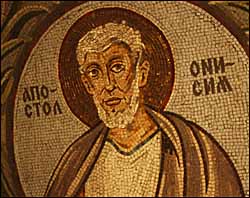
Introduction to Philemon
We won't spend much time on the letters date and place of writing. It has been generally acknowledged as having been written by St. Paul, and seems to have been written at the same time (about 60-62 AD) and from the same place (in prison in Rome) as Colossians.1 In fact, Tychicus who is carrying Paul's Letter to the Colossians to its destination, is also carrying this personal letter to Philemon, who probably lives in Colossae.
As the letter unfolds, we find that the purpose of the letter is to help reconcile Onesimus, a slave, to his master, Philemon. Since Paul bends over backwards not to tell Philemon what to do, it's difficult to learn conclusively what the difficulty is. But the two prevailing theories are:
- Runaway slave theory. Onesimus is a runaway slave who has found Paul in Rome, become a Christian, and whom Paul is sending back to his master Philemon.
- Mediation theory. Onesimus is a slave who has a dispute with his master Philemon, and has come to Paul to mediate in the dispute between master and slave.2
But the first option, that Onesimus is a runaway slave, seems to fit the facts the best, is the most popular interpretation, and is the one I am adopting in my exposition. The unanswered question is how does Onesimus hook up with Paul, who is in prison in Rome, since Colossae is nearly 1,000 miles east of Rome and many weeks journey away.
We could say more, but since this is a short letter, we'll just observe as we go through the verses. There are no chapter divisions in this letter.
Greetings (verses 1-3)
"1 Paul, a prisoner of Christ Jesus, and Timothy our brother,
to Philemon our dear friend and fellow worker, 2 to Apphia our sister, to Archippus our fellow soldier and to the church that meets in your home:
3 Grace to you and peace from God our Father and the Lord Jesus Christ." (1-3)
The first few verses follow much the same "epistle format" that we observed in Colossians. Notice that there are four actual addressees:
- Philemon, pastor of a house church, whom Paul recognizes as "a good friend and fellow worker." Philemon is not just a church member, but a leader -- and wealthy enough to own slaves. According to letters we have from this era, we recognize that Philemon is the primary addressee, since he appears first in the list.
- Apphia is likely to be Philemon's wife. If so, Paul's letter about a slave affects her household, too. But she may be a prominent member in the church. We don't know.
- Archippus may well be Philemon's son, though we don't know that either. He was in active ministry in the church, since he is addressed as "fellow soldier," a term Paul has only applied elsewhere to Epaphroditus, whom he calls "my brother, fellow worker and fellow soldier" (Philippians 2:25). Note that at the end of Colossians, Paul exhorts Archippus by name: "Tell Archippus: 'See to it that you complete the work you have received in the Lord'" (Colossians 4:17).
- The church that meets in your home.
Encouragement to Philemon (verses 4-7)
First, Paul writes words of encouragement to Philemon. Some see this rather cynically as "buttering him up" before he makes an appeal for Onesimus. But I don't think that's necessary. Paul is gracious in his letters, and such graciousness early in a letter is part of letter-writing etiquette in the first century.
"4 I always thank my God as I remember you in my prayers, 5 because I hear about your faith in the Lord Jesus and your love for all the saints. 6 I pray that you may be active in sharing your faith, so that you will have a full understanding of every good thing we have in Christ. 7 Your love has given me great joy and encouragement, because you, brother, have refreshed the hearts of the saints." (Philemon 4-7)
As in the beginning of Colossians, Paul enumerates the reasons that he thanks God for him in his prayers:
- Faith in the Lord Jesus, and
- Love for all the saints. In fact, Philemon has gone overboard in his hospitality, giving Paul "great joy and encouragement" and because he has "refreshed3 the hearts of the saints," that is, opened his home to passing Christian workers and provided generously for their needs and their comfort.
Paul's Prayer for Philemon (verse 6)
Notice Paul's brief prayer for Philemon:
"I pray that you may be active4 in sharing your faith, so that you will have a full understanding of every good thing we have in Christ." (verse 6)
This is a difficult sentence to translate exactly. However, "sharing" (NIV), "communication of" (KJV) is koinōnia, "participation, sharing in something." 5 But "sharing your faith" isn't the same as our present-day evangelical idiom for evangelizing a person or giving our testimony of how Christ helped us. Verse 6 is difficult to interpret precisely, but Moo paraphrases it thus:
"Philemon, I am praying that the mutual participation that arises from your faith in Christ might become effective in leading you to understand and put into practice all the good that God wills for us and that is found in our community; and do all this for the sake of Christ."
Paul's Appeal on Behalf of Onesimus (verses 8-13)
Now we come to the core of Paul's appeal on behalf of Onesimus.
"8 Therefore, although in Christ I could be bold and order you to do what you ought to do, 9 yet I appeal to you on the basis of love. I then, as Paul -- an old man and now also a prisoner of Christ Jesus -- 10 I appeal to you for my son Onesimus, who became my son while I was in chains. 11 Formerly he was useless to you, but now he has become useful both to you and to me. 12 I am sending him -- who is my very heart -- back to you. 13 I would have liked to keep him with me so that he could take your place in helping me while I am in chains for the gospel." (Philemon 8-13)
|
Q1. (Philemon 12) Why
does Paul send Onesimus back to Philemon where he can lose his
freedom again? Why is it necessary for Paul to do this? Why is it
necessary for Onesimus to do this?
|
Paul works up to his appeal -- which he never quite spells out in detail -- with various inducements to Philemon. He wants Philemon to act without being forced to -- exactly. Paul appeals:
- On the basis of apostolic authority. Paul could "be bold and order6 you" (verse 8) -- but doesn't. He only suggests that he could, if he wanted to.
- On the basis of love (verse 9a). Paul has recalled instances of Philemon's love that have reached Paul's ears, so he appeals to Philemon as one would to a brother who is rich in love.
- On the basis of respect for Paul's age (verse 9b). In our culture, age is looked down upon. But in Paul's world, age was considered worthy of great respect. The old were deemed to be wise.
- On the basis of honoring Paul's sufferings. In verses 9c and 13b, Paul reminds Philemon that he is suffering in prison for the sake of the gospel even as he writes this appeal.
- On the basis of Paul's spiritual fatherhood of Onesimus (verse 10). Paul apparently led Onesimus to Christ while they were together. He "became my son while I was in chains," says Paul.
- On the basis of Onesimus's usefulness to Paul's (verse 11). Onesimus was useful to Paul and served him while in prison, probably by attending to his personal needs, perhaps shopping, carrying messages, etc. I need him, Paul says, "while I am in chains for the gospel" (verse 13b). Don't miss the play on words here. "Onesimus" means in Greek, "profitable, helpful," from onēsis, "profit," and therefore is a common name given slaves.7 Previously, when Onesimus had been a slave in Philemon's household, as yet not a Christian, he was pretty worthless. The word is achrēstos, "pertaining to not serving any beneficial purpose, useless, worthless." 8 But now Onesimus ("profitable one") is euchrēstos, "pertaining to being helpful or beneficial, useful, serviceable," 9 that is, he now is fulfilling his name, which means "profitable, helpful one."
- On the basis of Paul's affection for Onesimus. Paul says that Onesimus "is my very heart" (verse 12), "he is very dear to me" (verse 16).
- On the basis of Philemon's debt to Paul. Paul says, "I would have liked to keep him with me so that he could take your place in helping me while I am in chains for the gospel" (verse 13). Later he notes, "not to mention that you owe me your very self" (verse 19b). Paul was the one who had led Philemon to the Lord.
It is a very strong appeal. How can Philemon resist?
Respect for Philemon's Will (verse 14)
Paul makes a strong appeal indeed, but he seeks Philemon's action out of his own free will rather than in response to an apostolic command. God always seeks our heart rather than merely our robotic response.
"But I did not want to do anything without your consent, so that any favor you do will be spontaneous and not forced." (verse 14)
Does Paul go over the top in supporting his plea. He's near the edge, perhaps, but yet he seeks Philemon's heart decision. That's why he doesn't go farther and command Philemon.
|
Q2. (Philemon 14) Why
doesn't Paul come right out and command Philemon? Is this out of
respect for his personhood or to build moral character in him -- or
what?
|
A New Relationship (verses 15-16)
Paul is now reasoning with Philemon, reflecting with him on the wonder of Christian fellowship.
"15 Perhaps the reason he was separated from you for a little while was that you might have him back for good -- 16 no longer as a slave, but better than a slave, as a dear brother. He is very dear to me but even dearer to you, both as a man and as a brother in the Lord." (verses 15-16)
Previously, when Onesimus had been a house slave, he had been unconverted, and by all accounts pretty worthless. Perhaps he had even stolen from Philemon as he had run away (verse 18). But his running away was ultimately for the best. Probably Philemon had prayed for his salvation, as he would have for each member of his household. Now God has answered his prayers. Strange, how God can turn what is intended as evil against us into good (Genesis 50:20; Romans 8:28).
Now that he has become a Christian, Onesimus is more than a slave. He is a brother. Once he was considered a person of a lower class, and perhaps looked down on as a poor slave at that. Now he can be considered as one who is truly "dear." The word is agapētos, pertaining to one who is dearly loved, dear, beloved, prized, valued." 10
I am sure that Philemon is struggling with this. He has resented Onesimus for months, perhaps years, for running away and depriving him of the labor that he legally has a right to in that culture. And now Paul says that Onesimus is to be considered as one who is "beloved," a brother. Hmmm. Sometimes God needs to stretch us so we can see beyond our prejudices.
The Appeal: Welcome Him (verses 17-21)
After all this introduction, Paul comes to his point. He asks that Philemon "welcome" Onesimus.
17 So if you consider me a partner, welcome him as you would welcome me. 18 If he has done you any wrong or owes you anything, charge it to me. 19 I, Paul, am writing this with my own hand. I will pay it back -- not to mention that you owe me your very self. 20 I do wish, brother, that I may have some benefit from you in the Lord; refresh my heart in Christ. 21 Confident of your obedience, I write to you, knowing that you will do even more than I ask.
"Welcome" (NIV, NRSV), "receive" (KJV) is proslambanō, literally, "take besides, take in addition." The connotation of the word here is "to extend a welcome, receive in(to) one's home or circle of acquaintances." 11 We see this usage several times in the New Testament (Romans 14:1, 3; 15:7; Acts 28:2) as a synonym of dechomai, "welcome," which we saw in Colossians 4:10 regarding John Mark. If Onesimus was indeed an escaped slave, Philemon had the legal right as a slave owner to punish Onesimus physically with a severe lashing -- even if it ended in death. Slaves had no legal rights under Roman law. If he didn't want Onesimus in his household service any longer he could sell him, be rid of him, and regain some of his losses. But Paul appeals to him to "welcome him as you would welcome me" (verse 17b).
Moreover, Paul vouches for Onesimus to the extent that he offers to pay Philemon for any debt that Onesimus might have occurred, either through loss of labor or for anything he might have stolen to finance his escape. The verb is apotinō, a technical term that means, "make compensation, pay damages"12
Paul adds in verse 20a, "I do wish, brother, that I may have some benefit (oninēmi) from you in the Lord." "Benefit" (NIV, NRSV), "joy" is oninēmi, a play on words with the name Onesimus. He is asking Philemon to ease his heart13 with regard to his concern for Onesimus's future, to "refresh14 my heart" (verse 20b).
Finally, Paul speaks of his assurance of Philemon's obedience (hypakoē). The word means, "state of being in compliance, obedience" (one listens and follows instructions).15 Paul hasn't commanded Philemon, but he fully anticipates that Philemon will comply with his appeal.
A Gospel Partner (verse 17)
Notice how Paul begins his appeal: "So if you consider me a partner..." (verse 17). The word is koinōnos, "one who takes part in something with someone, companion, partner, sharer"16 (closely related to the word koinōnia, "communion, sharing"). What does it mean to be a partner with Paul? It means that you share the same values, the same mission, and probably, that you have helped him financially in his work. As a partner, you take risks to achieve the mission, as well as receive in its rewards when the project bears fruit. The Philippian church, because of their financial contributions, had become partners or sharers in Paul's work (Philippians 1:5). To what degree are you a partner in the gospel? To what degree as a partner will you receive its rewards?
Prepare a Guest Room (verse 22)
Paul is now concluding his letter.
"And one thing more: Prepare a guest room17 for me, because I hope to be restored to you in answer to your prayers." (verse 22)
It would be common in a letter to mention the hope of visiting soon. However, his phrase, "and one thing more...." suggests that this sentence is actually part of his appeal. Paul's hopeful visit is in itself an inducement for Philemon to welcome Onesimus back.
Paul is serious, however. He is expecting to be released from confinement in Rome, "restored" (NIV, NRSV) or "given" (KJV). The word is charizomai, "give graciously... give or grant someone something," 18 here, in answer to prayer.
Personal Greetings (verses 23-24)
"23 Epaphras, my fellow prisoner in Christ Jesus, sends you greetings. 24 And so do Mark, Aristarchus, Demas and Luke, my fellow workers." (verses 23-24)
We've commented on each of these "fellow workers" in lesson 8 above (Colossians 4:10, 12, 14). The Letter to Philemon seems to have been written at the same time as Colossians.
What Happened to Onesimus?
What happened as result of Paul's appeal for Onesimus? Did Philemon welcome him? Did he free him? Did he receive him as a Christian brother? Did he forgive him his theft and the loss of service?
We don't know the details from Scripture. But I would guess that the very existence of this short Letter to Philemon in the canon of scripture tells us that Philemon did indeed welcome Onesimus.
We do know than a man named Onesimus was bishop of Ephesus in the early second century, some 40 to 50 years later.19 If Onesimus was but a young man in his latter teens or early twenties when Paul wrote the letter, it is possible that could have been a bishop at age 70. Perhaps this is the same Onesimus, the "unprofitable" slave whom Paul led to Christ and Philemon pardoned.20
What Do We Learn from this Letter?
Why is Philemon included among Paul's authentic letters, preserved for us down to this day? What are we to learn from it? Though it is not a didactic or teaching letter, there are several lessons found within it by implication:
1. We are not to command our equals to do the right thing. Paul appeals to Philemon to welcome Onesimus, but does not command him. In fact, he bends over backwards not to command him, even though he has the right (verses 8-9). With our children, it is appropriate to require right action. But with a grownup, we should appeal to their sense of right and wrong. People must make their own moral decisions.
2. Recompense is appropriate when we do wrong. Paul could not remove Onesimus's obligation to return to his master. He could appeal on his behalf. But Onesimus, even after his conversion and forgiveness by God, needed to do right by his master. This is found in steps 8 and 9 of the 12-Step Program of Alcoholics Anonymous:
-
#8. Made a list of all persons we had harmed, and became willing to make amends to them all.
-
#9. Made direct amends to such people wherever possible, except when to do so would injure them or others.
3. Sinners can change. Sometimes we do terrible things. But through God's grace we can change. Onesimus probably stole and ran away from his master. And, even though we believe slavery to be fundamentally wrong, in Paul's day, arbitrarily breaking that bond of slavery illegally was considered wrong. But in spite of Onesimus's sins, God got hold of him -- in faraway Rome. And God changed him.
4. Christ changes relationships. Though people have different stations in life, Christ alters these relationships forever. As Paul wrote in Colossians:
"Here there is no Greek or Jew, circumcised or uncircumcised, barbarian, Scythian, slave or free, but Christ is all, and is in all." (Colossians 3:11)
Even though Onesimus might be a slave in this life, now he is a brother in Christ. We are not to look down on people because of their social standing. To do so is a sin. We are all equal before God -- and in Christ we are one!
5. We owe a debt to our spiritual fathers and mothers. When we become Christians, we now have a new kind of family. We have fathers and mothers in the Lord, and we owe them. In the case of our letter, Philemon was lost until Paul introduced him personally to Jesus Christ. As a result, Paul has a call on him: "Not to mention that you owe me your very self" (verse 19b).
6. Vouching for a brother or sister is a way of helping them to a new life. Vouching for someone is dangerous. We're advised in Proverbs not to be "surety" or "put up security" for either friends or strangers (Proverbs 6:1; 11:15). It's a bad business practice, because people, even friends, often disappoint us. But here we see Paul risking at least his capital of "good will" to help open up a new life for his friend and son in the Lord, Onesimus. We must be careful when we vouch for others. But sometimes it is the way that God can use us to bring reconciliation and restoration to those who don't deserve it. Christ vouches for us before God's throne, and has given every shred of his wealth to redeem us (1 John 2:1)!
|
Q3. (Philemon 18-19)
Paul vouches for Onesimus and puts up his money (at least in theory)
to cover Onesimus's debts to Philemon? Is this wise in all cases?
Why does Paul do it here? How does Christ vouch for us? When should
we vouch for our Christian brothers and sisters?
|
Martin Luther liked this short book. "This epistle," he wrote, "shows a right noble lovely example of Christian love.... Even as Christ did for us with God the Father, thus also does St. Paul for Onesimus with Philemon... We are all his Onesimi, to my thinking." 21
Grace (verse 25)
"The grace of the Lord Jesus Christ be with your spirit." (verse 25)
A "grace wish" was a common way to end a letter in the Greek culture. But when Paul qualifies it with "the grace of the Lord Jesus Christ," he elevates grace to an entirely new level. He speaks of the grace of Jesus in his official title and in all his glory. He is speaking of the unmerited favor of God poured out to us through the suffering, death, and resurrection of Jesus Christ.
 A book of the compiled lessons is available in both e-book and paperback formats. |
Dear friends, Philemon needed God's grace to cope with the emotions that crowded up in him as he considered his runaway slave Onesimus, now before him. And we need grace too, as we consider where we came from, what we are facing, and where we are going. Thank God for grace!
Paul's final greeting is a fitting way to conclude these lessons on Colossians and Philemon: "May the grace of the Lord Jesus Christ be with your spirit!" Amen.
Prayer
Father, thank you for the times you've helped us to forgive and move on when our hearts have been clouded with hurt and anger. Thank you for the grace you gave Philemon to make the decision that he must make. Help us, too. In Jesus' name, we pray. Amen.
References
1. For details, see the Introduction to Colossians above.
2. For more on theories of the purpose of the letter, see Moo, Colossians and Philemon, pp. 364-369.
3. "Refreshed" is anapauō, "cause to rest, give (someone) rest, refresh, revive" (BDAG 69, 1).
4. "Active" (NIV), "effective" (NRSV), "effectual" (KJV) is energēs, "pertaining to practical expression of capability, effective, active, powerful" (BDAG 335).
5. Koinōnia, BDAG 553, 4. Danker translates this clause as a prayer "that your participation in the faith may be made known through your deeds."
6. "Order" (NIV, NRSV), "enjoin" (KJV) is epitassō, "to command with authority, order, command someone" (BDAG 383).
7. Lightfoot, Colossians and Philemon, p. 310.
8. Achrēstos, BDAG 160.
9. Euchrēstos, BDAG 413.
10. Agapētos, BDAG 7, 2.
11. Proslambanō, BDAG 883, 4.
12. Apotinō, BDAG 124.
13. "Refresh my bowels" (KJV) may seem a bit crude, until you understand that "bowels" (splanchnon) is used to refer to ones inner feelings, one's "heart" (BDAG 938, 2).
14. "Refresh" is anapauō, "to cause someone to gain relief from toil," here "cause to rest, give someone rest, refresh, revive" (BDAG 69, 1).
15. Hypakoē, BDAG 1028, 1b.
16. Koinōnos, BDAG 553, 1d.
17. Xenia, "hospitality, entertainment" shown a guest, less frequently the place where the guest is lodged, "guest room" (BDAG 683).
18. Charizomai, BDAG 1078, 1. We get our word "charismatic" or "gifted" from this word.
19. Ignatius of Antioch (c. 110 AD), Letter to the Ephesians 1. In the Constitutions of the Holy Apostles (fourth century), Onesimus is mentioned as a freed slave in sec. 82 and bishop of Berea in Macedonia in sec. 46.
20. Onesimus was a common name, especially of slaves. Several traditions exist that have been conflated with the Biblical Onesimus. Eastern Orthodox tradition venerates St. Onesimus. The questionable History of the 70 Apostles by Dorotheus, Bishop of Tyre states that Onesimus died in Potiole at the hands of the Roman ruler Tertillus. Another account (without attribution) indicates: "In the year 109, St. Onesimus was arrested and brought to trial before the Eparch Tertillus, during the reign of the Emperor Trajan. He held the saint in prison for eighteen days, and then sent him to prison in the city of Puteoli. After a while, the eparch sent for St Onesimus and had him stoned and beheaded for still maintaining his faith in Christ. A certain illustrious woman took the body of the martyr and placed it in a silver coffin." Another tradition sees Onesimus as Bishop of Byzantium 54 to 68 AD. See Lightfoot, Colossians and Philemon, p. 316.
21. Cited by Lightfoot, Colossians and Philemon, pp. 317-318.
Copyright © 2025, Ralph F. Wilson. <pastor joyfulheart.com> All rights reserved. A single copy of this article is free. Do not put this on a website. See legal, copyright, and reprint information.
 |

|

In-depth Bible study books
You can purchase one of Dr. Wilson's complete Bible studies in PDF, Kindle, or paperback format -- currently 48 books in the JesusWalk Bible Study Series.
Old Testament
- Abraham, Faith of
- Jacob, Life of
- Moses the Reluctant Leader
- Joshua
- Gideon
- David, Life of
- Elijah
- Psalms
- Solomon
- Songs of Ascent (Psalms 120-134)
- Isaiah
- 28 Advent Scriptures (Messianic)
- Daniel
- Rebuild & Renew: Post-Exilic Books
Gospels
- Christmas Incarnation (Mt, Lk)
- Sermon on the Mount (Mt 5-7)
- Luke's Gospel
- John's Gospel
- Seven Last Words of Christ
- Parables
- Jesus and the Kingdom of God
- Resurrection and Easter Faith
- Apostle Peter
Acts
Pauline Epistles
- Romans 5-8 (Christ-Powered Life)
- 1 Corinthians
- 2 Corinthians
- Galatians
- Ephesians
- Philippians
- Colossians, Philemon
- 1 & 2 Thessalonians
- 1 &2 Timothy, Titus
General Epistles
Revelation
Topical

 To be notified about future articles, stories, and Bible studies, why don't you subscribe to our free newsletter, The Joyful Heart, by placing your e-mail address in the box below. We respect your