Free E-Mail
Bible Studies
 King
Solomon
King
SolomonBeginning the Journey (for new Christians). en Español
Old Testament
Abraham
Jacob
Moses
Joshua
Gideon
David, Life of
Elijah
Psalms
Solomon
Songs of Ascent
(Ps 120-135)
Isaiah
Advent/Messianic Scriptures
Daniel
Rebuild & Renew: Post-Exilic Books
Gospels
Christmas Incarnation
(Mt, Lk)
Sermon on the Mount
(Mt 5-7)
Mark
Luke's
Gospel
John's Gospel
7 Last Words of Christ
Parables
Jesus and the Kingdom
Resurrection
Acts
The Early Church
(Acts 1-12)
Apostle Paul
(Acts 12-28)
Paul's Epistles
Christ Powered Life (Rom 5-8)
1 Corinthians
2 Corinthians
Galatians
Ephesians
Vision for Church
(Eph)
Philippians
Colossians,
Philemon
1
& 2 Thessalonians
1 & 2 Timothy,
Titus
General Epistles
Hebrews
James
1 Peter
2 Peter, Jude
1, 2, and 3 John
Revelation
Revelation
Conquering Lamb of Revelation
Topical
Glorious Kingdom, The
Grace
Great Prayers
Holy Spirit, Disciple's Guide
Lamb of God
Listening for God's Voice
Lord's Supper
Names of God
Names of Jesus
Christian Art
About Us
Speaking
Contact Us
Dr. Wilson's Books
Donations
Watercolors
Sitemap

2. Joseph, the Stand-In Father (Matthew 1:18-25)
by Dr. Ralph F. WilsonAudio (27:44) | YouTube (22:44)
 King Solomon: Wisdom, Wealth, Weakness
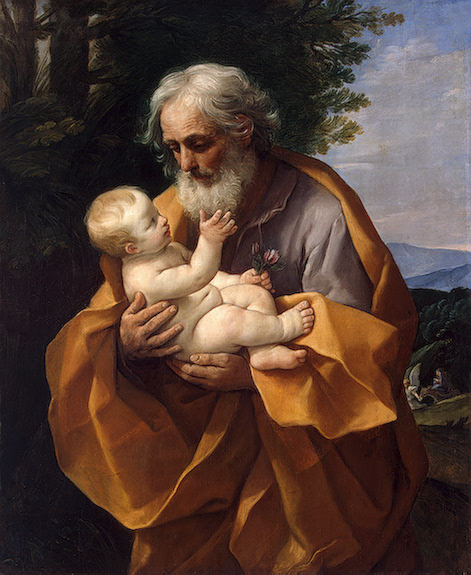 Guido Reni, "St. Joseph with Infant Christ in his Arms" (1620s), oil on canvass 126x101 cm, Hermitage Museum, St. Petersburg. Larger image. |
"18This is how the birth of Jesus Christ came about: His mother Mary was pledged to be married to Joseph, but before they came together, she was found to be with child through the Holy Spirit. 19Because Joseph her husband was a righteous man and did not want to expose her to public disgrace, he had in mind to divorce her quietly.
20But after he had considered this, an angel of the Lord appeared to him in a dream and said, 'Joseph son of David, do not be afraid to take Mary home as your wife, because what is conceived in her is from the Holy Spirit. 21She will give birth to a son, and you are to give him the name Jesus, because he will save his people from their sins.'
22All this took place to fulfill what the Lord had said through the prophet: 23'The virgin will be with child and will give birth to a son, and they will call him Immanuel' -- which means, 'God with us.'
24When Joseph woke up, he did what the angel of the Lord had commanded him and took Mary home as his wife. 25But he had no union with her until she gave birth to a son. And he gave him the name Jesus." (Matthew 1:18-25)
The Gospel of Matthew begins with a detailed genealogy, beginning with Abraham, tracing through David, Israel's greatest king, and ending with:
"Joseph, the husband of Mary, of whom was born Jesus, who is called Christ" (1:16).
The genealogy traces Jesus' lineage back to David, placing him in line for the ultimate Kingship -- Messiah, the anointed One, the heir to David's kingdom, who would rule over the Kingdom of God forever. But it's not that simple is it? Not nearly, since Jesus is born of a virgin mother, not of Joseph's seed at all. Therefore, was Jesus really a descendent of David after all?
Matthew begins with a genealogy of the Messiah, of who begat whom, but now he must explain why it is relevant. This conception, this birth, bears some explanation.
It's pretty clear from what is not said in Matthew that his readers were familiar with the story of the virgin birth that Luke recounts, which had been told from Mary's point of view (Luke 1:26-38) and which we considered in a previous chapter. Matthew's account, on the other hand, is told from Joseph's perspective.
Matthew begins simply:
"This is how the birth of Jesus Christ came about: His mother Mary was pledged to be married to Joseph, but before they came together, she was found to be with child through the Holy Spirit." (1:18)
Notice that he just states simply the facts of what his readers already knew, without embellishment:
- Mary and Joseph were betrothed.1
- They had not "come together," that is, had sex with each other.2
- But Mary had begun to "show," she was pregnant.
- The conception was from3 the Holy Spirit, not man.
We knew these things and so did Joseph -- except for point 4. In Matthew's account we learn how Joseph came to understand. The story is familiar to us, but let's examine it in detail so that we might begin to understand the stand-in father that the Heavenly Father chose to raise His Son.
Joseph's Name
Joseph's name was a proud name, recalling the ancient Jewish name of one of the twelve patriarchs, Joseph the son of Jacob who was sold by his brothers into Egypt and who later became second to Pharaoh in power over all Egypt, saving his family from famine (Genesis 30-50). His name means "to add."
Joseph the Husband
Joseph was no doubt older than Mary. While girls were married by 13 or 14 -- old enough at that age to bear children -- husbands on the other hand needed to be established enough to support a wife before they could enter into marriage. They were legally obligated to provide with food, clothing, and shelter.
But they didn't have to do it all by themselves. In the West, newly married couples get their own apartment and live independently, but not in Palestine. In first century Galilee, however, Joseph would take Mary home to the house in which he lived with his parents, and perhaps grandparents, as well as brothers and sisters who might be at home. Only as his own family grew, would Joseph and his family likely get their own house. This may sound very crowded and non-private to you, but it had its advantages. Instead of a young couple out on their own, in a large household, each member contributed to the economy of the family by their own work, making enough for the whole to subsist on. A couple cut off from the economy of the extended family would have to fend for themselves, as Mary and Joseph had to do in Bethlehem. Those were mighty lean times.
Joseph the Carpenter
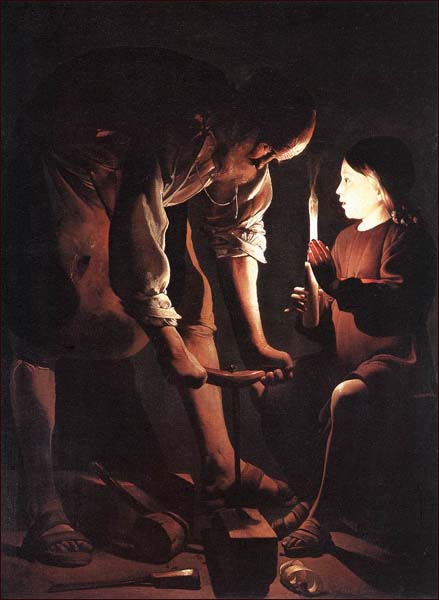 Georges de la Tour (French painter, 1593-1652), "Christ in the Carpenter's Shop" (1645), Oil on canvas, 137 x 101 cm, Musée du Louvre, Paris. Larger image. |
We know from later in Matthew's gospel that Joseph was a carpenter4 by trade (Matthew 13:55). But the town of Nazareth was small enough that carpentry wouldn't have been all he did. Carpenters and other tradesmen would also keep a garden and a couple of animals for food and perhaps do some subsistence farming to eke out a living in this agrarian society of rural Galilee. But when townspeople needed some carpentry done that was beyond their own skills and tools, Joseph would be the one they came to.
As a rule the common man built his own house, probably with the help of family and neighbors. A family might have a knife and hammer of some kind. But a carpenter would possess both specialized tools, some fairly expensive, and the skills to use them -- saws, axes, awls, drills, plumb lines, chisels, and planes, some of which have been recovered by archeologists.5
With these tools, a skilled carpenter might fashion doors, beams, and perhaps gates. He would make plows and yokes and other wood implements. There was no local Nazareth Furniture Store; all furniture would be made by hand. Each town had a rich family or two. They would be wanting some nice things made and their money would help the economy of the carpenter's family.
But carpentry didn't make Joseph wealthy -- not by any means. The offering Mary and Joseph brought to the temple on the occasion of Mary's purification from childbirth was the offering of a poor man, a pair of doves or pigeons (Luke 2:24; Leviticus 12:8).
Carpentry was Joseph's world, and the world that Jesus grew up in. He played in the wood shavings on the floor of his father's shop. Carpentry was Joseph's trade and the trade he taught his son. Jesus learned from Joseph to saw and plane, drill and smooth. He watched his father -- the local contractor -- make business contracts and deal with customers. Jesus saw it all.
| Q1. What would Jesus have learned as the son of a
carpenter? What experiences would this have exposed him to? https://www.joyfulheart.com/forums/index.php?showtopic=714
|
Mary's Predicament, Joseph's Dilemma
But we're getting ahead of ourselves. Right now Joseph was faced with the pregnancy of his betrothed. You can bet that tongues in this small town were wagging furiously with the news. Mary is pregnant! Couldn't Joseph and Mary wait? They know better!
Joseph has been deeply embarrassed by the whole incident. But he alone knows that he is not the father. He supposes that Mary, who as a betrothed woman and legally his wife, has had an affair with someone or another. Unless she had been raped, but she had said nothing of the sort! The only conclusion he can reach is that she has been unfaithful. His betrothed is an adulteress!
Mary's pregnancy had placed her at considerable risk in this society:
- Husband. Her betrothed husband would reject her. Her pregnancy would embarrass him and reflect on his character. She couldn't expect him to understand or accept her condition.
- Penalty. At worst she could be stoned. The law provided in cases like this for possible stoning (Deuteronomy 22:13-30), especially if the man and married woman are caught in the act of adultery. Stoning for adultery still took place in first century Palestine.6
- Shunning. At best, her family would allow her to live at home, though her supposed adultery would hurt their standing in the community. She and her bastard child would be shunned.
- Remarriage. No upstanding man would ever marry her, since the stigma of her supposed adultery would remain with her and taint the reputation of any husband.
- No where to go. She couldn't go to the city and be lost in its anonymity. Single women just didn't live alone. This was a family-centered culture where a woman's work centered around home and family. There was no work for single women, except perhaps as a housekeeper in a wealthy home -- or prostitution.
Mary's prospects were grim. She had agreed to the pregnancy. She had said to the angel, "Behold, I am the handmaid of the Lord. May it be to me according to your word" (Luke 1:38), but now the cost of this decision had become painfully apparent. However, the grace of God now comes into play.
Joseph, the Righteous Man (1:19)
We begin to see the character of the man to whom she was betrothed:
"Because Joseph her husband was a righteous man and did not want to expose her to public disgrace, he had in mind to divorce her quietly." (1:19)
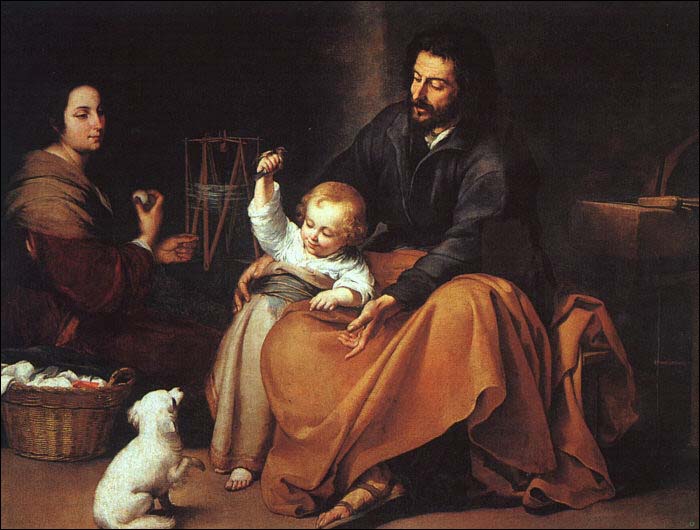 Bartolomé Esteban Murillo (Spanish painter, 1617-1682), detail from "The Holy Family with a Small Bird" (c. 1650), Museo del Prado, Madrid. Full image. |
Matthew says that he was "a righteous man." "Righteous" (NIV, NRSV) or "just" (KJV) is dikaios, "pertaining to being in accordance with high standards of rectitude, upright, just, fair," here probably, "interested in doing the right thing, honorable, just, good."7
"Righteous" meant that Joseph carefully observed the law and valued his own reputation. According to the customs of that time, adultery would make her unmarriageable to either her betrothed husband or a paramour, if one had been discovered. By marrying her, Joseph would compromise himself in the eyes of the law. But his righteousness went deeper than a mere external righteousness before Jewish law. He was honorable and wanted to do the right thing.
The wrong thing, he decided, was to demand prosecuting her for adultery. "Expose to public disgrace" (NIV, NRSV) or "make a public example" (KJV) is deigmatizō, "expose, make an example of, disgrace."8 He couldn't marry her, of course, since he knew that her baby was not his. But instead of a messy public trial, he had decided to divorce9 her quietly.10 He would simply write out a certificate of divorce and present it to her in the presence of two witnesses, as required by law.11 And to avoid the accusation of adultery as the reason for the divorce, Joseph could have offered less serious grounds, acknowledged by Pharisees of the school of Hillel. Brown suggests that "to divorce quietly" may mean to divorce leniently.12
And so Joseph decided to divorce Mary, but to do it in such a way as to protect her as much as he could, given the situation. We see in Joseph a gentleness and maturity. A righteous man, but not a man full of himself. Joseph was a man seeking to do the right thing.
| Q2. (Matthew 1:19) What were Mary's options
being pregnant and carrying a baby not her husband's? What
kind of character did Joseph exhibit by deciding to divorce
Mary quietly and leniently? https://www.joyfulheart.com/forums/index.php?showtopic=715
|
The Angel's Revelation in a Dream (1:20-21)
God changed Joseph's mind:
"But after he had considered this, an angel of the Lord appeared to him in a dream and said, 'Joseph son of David, do not be afraid to take Mary home as your wife, because what is conceived in her is from the Holy Spirit. She will give birth to a son, and you are to give him the name Jesus, because he will save his people from their sins.'" (1:20-21)
The three times we have a record of God speaking to Joseph, it is through an "angel of the Lord" appearing to him in a dream. Each time when he wakes up, he immediately obeys the messenger (1:20; 2:13, 19). The form of address, "Son of David," emphasizes Joseph's honored position as a direct descendent of David, Israel's greatest king, and from whose descendents the Messiah should come.
The message was, "do not be afraid to take Mary home as your wife." Of course, according to Jewish law she was already his wife. But the messenger assures Joseph that it is right and just for him to proceed with the relationship.13 Her pregnancy14 is not adulterous, but "from the Holy Spirit."
The Name "Jesus" (1:21)
Next, the angel tells Joseph the name to be given to the child -- Jesus. "Jesus" (Greek Iēsous) was not an uncommon name at this time, since the Hebrew name Yēshūa‘ is a shortened form of Joshua (Yehôshűa‘), who was one of Israel's most celebrated heroes. But the significance of God's insistence that he be named Jesus is not to honor a national hero, but because of the meaning of the name: "Yahweh saves."15
"... You are to give him the name Jesus, because he will save his people from their sins" (1:21)
Jesus' name from the time he was a baby was to indicate his mission. Both Mary and Joseph were given this name by the angel so neither would ever forget who he was -- Yahweh's salvation embodied in human form. As a little baby, "Yahweh saves" might have been born and raised in the humblest of circumstances, but that never diminished who he was. His destiny was to save. The Greek verb sōzō means "to preserve or rescue from natural dangers and afflictions, save, keep from harm, preserve, rescue," here, "to save/preserve from eternal death, bring Messianic salvation."16
Seeing the Messiah as Savior was the popular Jewish understanding of the Messiah's role at the time. But the angel made it clear to Joseph that this salvation would not be political or military. Jesus' mission was not to overthrow the Roman oppressors and reinstate the Jewish kingdom. His mission was to save his people from a far more insidious enemy -- sin. Jesus came to destroy the power of sin.
| Q3. (Matthew 1:21) What is the significance
of the name Jesus? Why do you think the angel gave the name
to both Mary (Luke 1:31) and Joseph independently? https://www.joyfulheart.com/forums/index.php?showtopic=716
|
Joseph Shall Adopt the Child (1:21)
Before we leave it, let's take one final look at this command:
"... You are to give him the name Jesus" (1:21)
Joseph is commanded to personally name17 the child. This is deeply significant. It means that Joseph, in naming the child, acknowledges him as his own son and thus becomes the legal father of the child according to Semitic law. As a result of this legal adoption, Joseph's ancestry as a descendent of David transfers also to his legal son.18 Biologically, Jesus is begotten by the Holy Spirit and is thus the "Son of God" (Luke 1:32a), but legally he is the son of Joseph and heir to the promises of David, Joseph's ancestor.
The angel Gabriel had promised Mary, "The Lord God will give him the throne of his father David" (Luke 1:32b). In Joseph naming the boy, and therefore adopting him, David becomes Jesus' earthly ancestor.
The Virgin Will Conceive (1:22-23)
The angel's message is complete. Now Matthew explains all this in terms of an ancient prophetic word:
"All this took place to fulfill what the Lord had said through the prophet: The virgin will be with child and will give birth to a son, and they will call him Immanuel' -- which means, 'God with us.'" (1:22-23)
Matthew is quoting Isaiah 7:14 because he sees in it a prefiguring of the Virgin Birth of Jesus.
In its original setting, Isaiah is exhorting Ahaz King of Judah (the southern kingdom), who faces the daunting threat of a siege of Jerusalem by the armies of Israel (the northern kingdom) and its ally Aram-Damascus, a petty Syrian kingdom. Isaiah tells Ahaz not to fear, but to stand firm in faith. As a sign, the Lord says that a virgin will conceive and bear a child to be called Immanuel as a reminder that God is with his people in times of trouble. In the time it will take this baby to become just a young child, the King of Assyria will have destroyed Judah's enemies.
Some believe that the reference is to some child born in Isaiah's day.19 Others see in it a brief prophetic insight, a glimpse far into the future of a child who will be born to a virgin and bring God's very presence to deliver his people.20 Clearly, Matthew sees the virgin conception and the name Immanuel as having a fuller meaning in Christ. The word "fulfill" (plēroō) means "to make full, fill(full)," then "to bring to completion, complete, finish" and as here "to bring to a designed end, fulfill" a prophecy.21
Prophecy in the Old Testament takes several shapes, including:
- Exhortation, a directive word from God to a particular person or people at a particular time. For example, the Prophet Nathan confronts David with his adultery: "Thou art the man!" (2 Samuel 12).
- Prediction, a clear foretelling of the future for a person or nation. For example, the Prophet Isaiah foresees the Suffering Servant in Isaiah 53 and declares his atonement for our sins.
- Acted prophecy, such as Hosea marrying a prostitute to illustrate Israel's unfaithfulness (Hosea 1:2).
- Foreshadowing, where a contemporary prophetic event or insight foreshadows a distant one, so there is a double fulfillment -- a present-time fulfillment (the type) and a future completion (the antitype) which brings the prophecy to fullness or completion.
I see Isaiah's words in Isaiah 7:14 as the latter kind of prophetic word. The initial fulfillment presumably took place in the prophet's time, while the ultimate fulfillment and completion of this word is found in Christ.
| Q4. (Matthew 1:23) How did the prophetic
concept of the virgin conception and the name "Immanuel" find
their fullness in the birth of Jesus to Mary? https://www.joyfulheart.com/forums/index.php?showtopic=717
|
Emmanuel, God with Us (1:23)
"Emmanuel" or "Immanuel" (depending upon how one spells it) is a transliteration of the Hebrew name in Isaiah 7:14, literally "with us is God,"22 originally symbolizing the presence of God (’el) to deliver his people from the Assyrian army that threatened their very existence in Isaiah's day. Though to our knowledge, the name Immanuel was never given to Jesus, it certainly applied to him, since "God with us" is a perfect way to describe the birth of the God-Man, Jesus Christ, who is fully man and fully God.
Joseph's Obedience (1:24-25)
24When Joseph woke up, he did what the angel of the Lord had commanded him and took Mary home as his wife. 25But he had no union with her until she gave birth to a son. And he gave him the name Jesus." (Matthew 1:24-25)
As soon as he woke up,23 Joseph obeyed. He accepted Mary as his wife, and took her home, but didn't have sex24 with her until Jesus was born.
Did he have normal marital relations with her after Jesus' birth? Protestants see verse 25 as evidence that Mary and Joseph lived together as husband and wife after Jesus' birth and bore additional children together, since there is no suggestion that Jesus' brothers and sisters (Matthew 12:46-50; 13:55-56) were not also children of Mary and Joseph. While the Greek conjunction heōs, "until" doesn't demand that they later had marital relations, that is certainly the implication.25 Catholics, on the other hand, believe that these children were Joseph's by a previous marriage and that the Virgin Mary was a perpetual virgin.
| Q5. (1:24-25) What does Joseph accepting
Mary as his wife say about his character? What is the
significance for prophetic fulfillment of Jesus as a Son of
David that Joseph "named" the child "Jesus"? https://www.joyfulheart.com/forums/index.php?showtopic=718
|
Joseph's Protection of Jesus
The final things we learn about Joseph happen a few years after Jesus' birth, but let's consider them briefly. First, after the wise men came to worship Jesus -- and had tipped off King Herod as to the presence of a possible rival heir to the throne -- an angel commanded Joseph to flee (2:13-15). Joseph obeyed immediately and left in the middle of the night for Egypt. It was a good thing he did. Within a short time, Herod's soldiers slaughtered all the male babies in Bethlehem.
After Herod's death -- when he perceived that the threat was over --Joseph brought Mary and the Child back to Israel, returning to Nazareth (2:19-23). Even then, he is careful not to return to Bethlehem, since Herod's brutal son Archelaus now reigned in the territory of Judah.26 So he brought his family back to Nazareth, in spite of what scandal still might remain there. In Nazareth, the family now lived. It was here that Jesus was raised, and learned the trade of carpentry from his father.
The scripture tells us nothing of Joseph's death, though presumably he was not living during the time of Jesus' ministry, or Jesus would not have felt the need to entrust his mother Mary's care to the beloved disciple (John 19:26-27).
What we learn from the Scripture about Joseph is that God chose to father his Jesus a man who was devout, full of faith, obedient to God, just, merciful, and one who loved and carefully guarded both Mary and the Child Jesus.
Prayer
Father, thank you for Joseph who proved worthy of your trust to raise Jesus. Help us to be as believing, as faithful, as zealous as he was to take on the various tasks that you assign to us. In Jesus' name, we pray. Amen.
Key Verses
"Because Joseph her husband was a righteous man and did not want to expose her to public disgrace, he had in mind to divorce her quietly." (Matthew 1:19)
"When Joseph woke up, he did what the angel of the Lord had commanded him and took Mary home as his wife." (Matthew 1:24)
References
- "Pledged to be married" (NIV), "engaged" (NRSV), and "espoused" (KJV) translate the verb mnēsteuō, "woo and win, betroth," passive, "be betrothed, become engaged" (BDAG 656).
- "Came together" (NIV, KJV) or "lived together" (NRSV) is sunerchomai, here "'to unite in an intimate relationship, come together' in a sexual context" (BDAG 969-970).
- In 1:18 the Holy Spirit's agency is indicated by the preposition ek, here, a "marker denoting origin, cause, motive, reason, 'from, of.'" (BDAG 295-298, 3.a.)
- Greek tektōn, "one who constructs, builder, carpenter" (BDAG 995).
- R.K. Harrison, "Tools," ISBE 4:874-876.
- Raymond E. Brown, The Gospel According to John I-XII (Anchor Bible; Doubleday, 1966), 333, citing J. Blinzer, "Die Strafe für Ehebruch in Bible and Halacha zur Auslegung von Joh. viii 5," NTS 4 (1957-58), 32-47.
- Dikaios, BDAG 296-297, 1.a.α.
- Deigmatizō, BDAG 214.
- "Divorce" (NIV), "dismiss" (NRSV), and "put away" (KJV) is apoluō, which is a technical term for "to grant acquittal, set free, release, pardon." Here it means, "to dissolve a marriage relationship, to divorce one's wife or betrothed" (BDAG 118, 5).
- "Quietly" (NIV) is lathra, "(to do something) without others being aware, secretly" (BDAG 581).
- Brown, Birth, p. 128, citing Strack and Billerback, I, 304-305.
- Brown, Birth, p. 128.
- "Take home" (NIV) or "take" (NRSV, KJV) is paralambanō, "to take into close association, take (to oneself), take with/along." Here of one's wife, "take (her) into one's home," here and in 1:24. (BDAG 767)
- "Conceived" is gennaō, "beget" by procreation (BDAG 193-194).
- The original meaning is "Yahweh helps," or in popular etymology connected with the root ysh‘, "to save," and the noun yeshű‘â, "salvation" (Brown, Birth, p. 131).
- Sōzō, BDAG 982-983.
- The verb is kaleō, "call," here with the meaning "name, provide with a name" (BDAG 502-504, 1.c.).
- See the discussion in Brown, Birth, p. 139.
- John N. Oswalt, The Book of Isaiah, Chapters 1-39 (New International Commentary on the Old Testament; Eerdmans, 1986), p. 209-213. Oswalt sees Isaiah's son Maher-shalal-hash-baz (Isaiah 8:3) as the immediate fulfillment, but with 7:14 pointing to "the ultimate Immanuel" (p. 213).
- For example, Edward J. Young, The Book of Isaiah (Eerdmans, 1965), vol. 1, pp. 283-294. He quotes the classic work of J. Gresham Machen, The Virgin Birth of Christ (1930), who paraphrases the thought: "I see a wonderful child, the prophet on this interpretation would say, a wonderful child whose birth shall bring salvation to his people; and before such a period of time shall elapse as would lie between the conception of the child in his mother's womb and his coming to years of discretion, the land of Israel and of Syria shall be forsaken." Young comments, "In vision Isaiah was allowed to see the virgin, and it is the announcement of what he is permitted to see in vision that he declared unto Ahaz and the nation" (p. 286).
- Plēroō, BDAG 827-829, 4.a.
- BDB 769.
- "Woke up" (NIV) or literally "being raised" (KJV), is the Aorist passive of egeirō, "wake, arouse," or passive, "wake up, awaken." (BDAG 271-272, 1, 2.). The word also is used in a command to the dreaming Joseph in 2:13.
- "Had no union" (NIV), "had no marital relations" (NRSV) or "knew" (KJV) is ginōskō, "know," here a euphemism for "to have sexual intercourse with," both here and in Luke 1:34 (BDAG 199-200, 5.).
- "Until" is heōs,
"to denote the end of a period of time,
till, until." 1.b.β, Aleph). It is used both here and in 2:15
where it refers to the period of time that the Holy Family
lived as expatriates in Egypt.
Catholic New Testament scholar Raymond E. Brown (Birth, p. 132), in protecting the doctrine of the Perpetual Virginity of Mary, notes that in English when something is negated until a particular time, something happening after that time is usually assumed. However, he cites K. Beyer (Semitische Syntax im Neuen Testament (Göttigen: Vandenhoeck, 1962), I, 132) to the effect that in Greek and Semitic such a negation often has no implication about what happened afterwards. Note this argument only provides the possibility that heōs ("until") doesn't imply that Mary and Joseph engaged in marital relations later; it doesn't prove the point. Although Brown asserts, "The immediate context favors a lack of future implication here," in the light of Matthew 12:46-50; 13:55-56, I don't agree. If Matthew had intended to teach Mary's perpetual virginity, he would have said something like, "Though Joseph took Mary home as his wife, he never had sex with her." Instead, he uses heōs ("until") with a specified time period, "until she gave birth to a son." Brown concludes, "In my judgment the question of Mary's remaining a virgin for the rest of her life belongs to post-biblical theology." - Herod the Great's death is probably to be dated as March/April 4 B.C. (Brown, Birth, p. 166.) Succeeded in Judea by his son Archelaus who was technically an ethnarch in Judea. He was known for his brutality and dictatorial ways, so much so that the Jews sent a deputation to Rome seeking his removal. He was deposed by Rome in 6 AD But Joseph could take no chances with a ruler with such a savage reputation. Joseph was a known and marked man. If someone recognized him in Bethlehem, the child might well have been killed by the son Archelaus. So instead Joseph led his family to Nazareth. In spite of the scandal of Mary's pregnancy there, he would not be identified with the wisemen's visit to Bethlehem. The Child would be safe.
Copyright © 2024, Ralph F. Wilson. <pastor joyfulheart.com> All rights reserved. A single copy of this article is free. Do not put this on a website. See legal, copyright, and reprint information.
 |
|
In-depth Bible study books
You can purchase one of Dr. Wilson's complete Bible studies in PDF, Kindle, or paperback format -- currently 48 books in the JesusWalk Bible Study Series.
Old Testament
- Abraham, Faith of
- Jacob, Life of
- Moses the Reluctant Leader
- Joshua
- Gideon
- David, Life of
- Elijah
- Psalms
- Solomon
- Songs of Ascent (Psalms 120-134)
- Isaiah
- 28 Advent Scriptures (Messianic)
- Daniel
- Rebuild & Renew: Post-Exilic Books
Gospels
- Christmas Incarnation (Mt, Lk)
- Sermon on the Mount (Mt 5-7)
- Luke's Gospel
- John's Gospel
- Seven Last Words of Christ
- Parables
- Jesus and the Kingdom of God
- Resurrection and Easter Faith
Acts
Pauline Epistles
- Romans 5-8 (Christ-Powered Life)
- 1 Corinthians
- 2 Corinthians
- Galatians
- Ephesians
- Philippians
- Colossians, Philemon
- 1 & 2 Thessalonians
- 1 &2 Timothy, Titus
General Epistles
Revelation
Topical

 To be notified about future articles, stories, and Bible studies, why don't you subscribe to our free newsletter, The Joyful Heart, by placing your e-mail address in the box below. We respect your