Free E-Mail
Bible Studies
 Apostle Peter
Beginning the Journey (for new Christians). en Español
Old Testament
Abraham
Jacob
Moses
Joshua
Gideon
David, Life of
Elijah
Psalms
Solomon
Songs of Ascent (Ps 120-135)
Isaiah
Advent/Messianic Scriptures
Daniel
Rebuild & Renew: Post-Exilic Books
Gospels
Christmas Incarnation
(Mt, Lk)
Sermon on the Mount
(Mt 5-7)
Mark
Luke's
Gospel
John's Gospel
7 Last Words of Christ
Parables
Jesus and the Kingdom
Resurrection
Apostle Peter
Acts
The Early Church
(Acts 1-12)
Apostle Paul
(Acts 12-28)
Paul's Epistles
Christ Powered Life (Rom 5-8)
1 Corinthians
2 Corinthians
Galatians
Ephesians
Vision for Church
(Eph)
Philippians
Colossians,
Philemon
1
& 2 Thessalonians
1 & 2 Timothy,
Titus
General Epistles
Hebrews
James
1 Peter
2 Peter, Jude
1, 2, and 3 John
Revelation
Revelation
Conquering Lamb of Revelation
Topical
Glorious Kingdom, The
Grace
Great Prayers
Holy Spirit, Disciple's Guide
Humility
Lamb of God
Listening for God's Voice
Lord's Supper
Names of God
Names of Jesus
Christian Art
About Us
Podcasts
Contact Us
Dr. Wilson's Books
Donations
Watercolors
Sitemap

4. Fellowship - Connecting to a Community of Christiansby Dr. Ralph F. Wilson |


 Apostle Peter: Disciple Lessons from the Rock
 Some people try to live a Christian life by themselves, away
from any regular Christian friends or a church. It does not work very well -- either
for their own growth or to accomplish Jesus' mission here on earth.
Some people try to live a Christian life by themselves, away
from any regular Christian friends or a church. It does not work very well -- either
for their own growth or to accomplish Jesus' mission here on earth.
Love Can't Operate in a Vacuum
The reason we can't practice authentic Christianity without Christian fellowship is because love is at the very root of God's character.
"God is love. Whoever lives in love lives in God, and God in him." (1 John 4:16)
Love requires someone to love. Love seeks out someone to love and bless. Love is never solitary. It requires community to operate. Jesus believed in this so much that he made this audacious statement:
"A new command I give you: Love one another. As I have loved you, so you must love one another. By this all men will know that you are my disciples, if you love one another." (John 13:34-35)
We start out selfish on our own, but when we are with others, we learn to care for their needs. Have you ever seen how a young man settles down when he gets married? Have you ever seen a young woman begin to mature when she becomes a mother? Why does this happen? Because marriage and family require people to put others' needs first. They require people to learn to love.
The Bible describes the communities of Christians in four ways: as a family, as a body, as a flock, and as the church.
1. We Are Part of a Family
First, let's look at the idea of Christians as a family. Look at these verses:
"Let us do good to all people, especially to those who belong to the family of believers." (Galatians 6:10)
"Finally, all of you, live in harmony with one another; be sympathetic, love as brothers, be compassionate and humble." (1 Peter 3:8)
Family members care for each other, help each other, support each other -- and forgive each other when they have an argument. We are family, sons and daughters of the same Father.
2. We Are Part of a Body
Christians are also described as part of a body.
"The body is a unit, though it is made up of many parts; and though all its parts are many, they form one body. So it is with Christ." (1 Corinthians 12:12)
"From him the whole body, joined and held together by every supporting ligament, grows and builds itself up in love, as each part does its work." (Ephesians 4:16)
Parts of a body aren't independent, but interdependent. Each part has a vital responsibility -- as a finger, or an eye, or a knee, for example -- to help the whole body function well. A toe can't isolate itself from the body and survive.
3. We Are Part of a Flock
Christians are also described as part of a flock under the care of a shepherd. The shepherd is not passive. Rather, he is active in finding food for the flock, taking them to streams where they can drink, binding up the wounds of those who are injured, and protecting the flock against predators. Sometimes the shepherd must defend the sheep at the risk of his life. Jesus said:
"I am the good shepherd. The good shepherd lays down his life for the sheep." (John 10:11)
This idea of a shepherd is carried over to the church that Jesus founded. The word "pastor" literally means "shepherd." Each grouping of Christians has a pastor or shepherd who is responsible for the "flock" or that grouping of Christ-followers. The Apostle Paul exhorted some leaders:
"Keep watch over yourselves and all the flock of which the Holy Spirit has made you overseers. Be shepherds of the church of God, which he bought with his own blood." (Acts 20:28)
Sometimes these Christian leaders are called elders, priests, ministers, bishops, or overseers. Do not let the terminology confuse you. Just understand the concept of shepherds caring for the sheep -- God's people.
4. We Are Part of the Church
The "church" is very much Jesus' idea -- but Jesus' concept of church may be quite a bit different than many "churches" that you may see around you. Let me clarify.
Jesus said: "I will build my church" (Matthew 16:18). The Bible word "church" means, literally, "the called-out ones," those who have been called by God and gathered together out of the world.
Notice carefully that the word "church" does not mean a building! A church is primarily a gathering of people, not a physical structure. In fact, for the first few centuries after Christ, there were no church buildings. People met for worship in homes.
Since the primary concept of the church is people, you don't "go to church." Rather you gather with the church. In fact, it is extremely important for you to gather regularly with a church, a congregation, or group of Christians near you. It is vital for your health and growth. The Bible says:
"Let us not give up meeting together, as some are in the habit of doing, but let us encourage one another -- and all the more as you see the Day approaching." (Hebrews 10:25)
Large, Small, and Pairs
Let's look at the value of various groupings of God's people:
Larger gatherings. In our day, churches range in size from 25 to 5,000 and even more. Size has nothing to do with spiritual quality -- bigger is not necessarily better. In larger gatherings you worship with other Christians and hear teaching and preaching that can help you grow in Christ.
Small groups. Smaller gatherings are important for you also, because here you get to know your Christian brothers and sisters well. In small groups they can get to know you, love you, and care for you -- and vice versa. This is where the best Christian fellowship takes place. These small groups are sometimes called by different names -- "life groups," "care groups," etc. You need to be part of one of these. Ask your mentor or the pastor of your church how to get involved in a small group.
Pairs. Another important way to grow is to spend time on a regular basis with one or two Christian friends. I hope that you are following my instructions and are doing this Beginning the Journey study with a mentor. If not, you need to find a person with whom you can study. Having a close Christian friend gives you someone to be accountable to -- in a good way. Accountability keeps you on track and growing.
How Do You Find a Church?
The best way to find a church is to ask your mentor or Christian friend what church he or she attends and go along. Going with a friend makes it easier to get acquainted with other Christians and learn about Christian worship and life in a church.
Sometimes, however, finding the right church for you can be difficult. For one reason or another, a church may not "feel right" to you. If that is the case, try attending another church in your community, if one is available.
But no church is perfect. That is because churches are made up of human beings (just like you). Whatever church you attend, you will probably see some flaws. Do not focus on the flaws. Focus on God -- how you can worship him in that service and what you can learn from him through the preaching or teaching.
What to Look For
Churches come in all shapes and sizes. There are different denominations or families of churches that come from different historical traditions. Do not chose a church by its name. Instead, look for a church:
- That teaches or preaches from the Bible. Avoid churches where the sermon or message is mainly the preacher's own thoughts and theories. You will grow from Bible teaching, not just clever sermons.
- Where people love one another. Remember, Jesus said that love is the sign that they are his true disciples (John 13:34-35).
- That is not proud and exclusive. Some offshoots of Christianity, called sects, act as if all other churches are wrong and only they have the truth. Avoid these churches. They have some truth, but their exclusive attitude leads to serious problems and distortions of Jesus' teachings.
Benefits of Being Part of a Church
There are many benefits and blessings of being part of a church. Jesus intended it this way.
Role models. You can find people who are mature in the Christian faith from whom you can learn and who you can model your life after. These are like fathers and mothers for us in the faith.
Specialized ministries. In a church you will find people who have received special spiritual gifts from God that will help build you up in the faith. You will meet people with gifts of teaching, evangelism, faith, showing mercy, exhortation, encouragement, prayer, artistic gifts such as music and art, and many others. A church is designed to offer a rich environment of spiritually gifted people who together produce a healthy Christian community.
Protection. A church provides spiritual protection for you. The role of a pastor or shepherd is to watch out for you and other members of the flock (Galatians 6:1).
Healing. A church is designed to be a place where hurting, wounded people can find love and healing. The love that produces healing flows best in smaller groups, so be sure to become part of such a group.
Encouragement. Face it. Sometimes we get discouraged. Having brothers and sisters nearby can help us. The Bible says, "Encourage one another and build each other up" (1 Thessalonians 5:11). "Carry each other's burdens, and in this way you will fulfill the law of Christ" (Galatians 6:2).
Growth. If you are part of a healthy church, you will find yourself growing and becoming more mature in your faith.
You Have a Lot to Offer, Too
Perhaps you have been thinking about what you can receive from a church. That is good. But also realize that you have a lot to offer a Christian community. Just like having a baby energizes a human family, so having new Christians energizes a church. People praise God for what Jesus has done in your life.
God has given you spiritual gifts to help others in the Christian community. Though you may not realize yet what these gifts are, your presence and faithfulness will help build up the church and make everyone else stronger.
Be Faithful
As we have learned, Jesus started the Christian faith on the principle of a loving community of disciples. To be his followers, we need to become a part of a community of believers. That is our responsibility. I have two recommendations:
- Become part of a small group. Being in a group of 6 to 12 people every week or two will help you a great deal. It is well worth your time!
- Join a church in your community. Church membership may seem a little scary, but don't quit. Becoming a formal member of a church is an important step for your spiritual growth. It usually involves some classes and baptism. Just like marriage signals commitment and causes growth and fulfillment, so joining a church signals commitment and produces growth and fulfillment.
Don't Be a "Church-Hopper"
You will find some people who are "church-hoppers." Like grasshoppers or crickets, they jump from church to church, never staying long, but hopping to another church. They look for perfection, but never find it. So they hop off again. These immature people are afflicted with three problems:
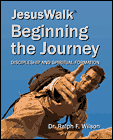 Printed books, e-books, and a DVD set are available |
- Selfishness. They are more concerned with what they can get, than what they can give. People who hop from one church to another never stay long enough to use their spiritual gifts to build others up. Selfishness is the opposite of love.
- Lack of realism. They expect churches to be perfect, and when they find a church's flaws, they're gone. They're like dreamy-eyed young married couples who expect marriage to be perfect. Hopefully, they grow up and begin to work at making the best of their relationship.
- Unfaithfulness. They lack commitment or faithfulness. One of the qualities Jesus seeks to produce in his followers is faithfulness or reliability -- steadfastness. Commitment causes growth in us and health in a church body.
When Jesus founded the Christian faith, he founded it on love -- love for God and love for one another. He knew that Christian fellowship was the network through which this love would flow. That is why it is important to become part of a Christian fellowship ourselves.
Prayer
Lord, thank you for the people who have followed Jesus before me. I have learned so much from them. I pray that you will help each person studying this lesson to find a place where he or she can be part of a fellowship of Christian brothers and sisters. Guide them, help them, so that they can grow strong in Jesus. In his name, I pray. Amen.
Memory Verse
"A new command I give you: Love one another. As I have loved you, so you must love one another. By this all men will know that you are my disciples, if you love one another." (John 13:34-35, NIV)
Questions and Discussion Points
- Read aloud five times the new memory verse (John 13:34-35) and copy it onto a card.
- Discuss. Why does God's nature of love require that Jesus' followers be part of a community?
- Discuss. What are four communities that Christian gatherings are
compared to in the Bible?
________________ (Hint: A group consisting of blood relatives.)
________________ (Hint: The flesh and blood part of you.)
________________ (Hint: A group of wooly animals.)
________________ (Hint: The word literally means "the called-out ones.")
What unique truths about the church does each of these analogies teach us? - Discuss. What benefits do you receive by being part of a church?
- Discuss. Why are small groups important for your spiritual growth?
- Discuss. What is wrong with "church hopping," going from one church to another without settling down?
- Discuss. Why aren't any churches perfect? If this is so, according to John 13:34-35, why is loving one another a true sign of being authentic disciples of Jesus?
- Attend church with your mentor, if you haven't already done so. Discuss what impressions you had of the people in this church.
- What kinds of responsibilities has your mentor had in a church or small group? How has a church or small group helped your mentor?
- Baptism. Have you arranged to be baptized yet? If not, what is keeping you from moving forward with this?
- Discuss. Last lesson we talked about resisting temptation. How is that going?
- Assignment for mentor: Introduce your new Christian friend to several of your believer friends. You are the bridge for your Christian friend to the Christian community.
- Assignment for new Christian: Have coffee or a meal with some of your mentor's friends from his or her church or small group. If you go to a restaurant or coffee shop, ask your mentor to pay the bill. ☺
- Review your memory verses from Lesson 1 (Ephesians 2:8-9), Lesson 2 (John 8:31-32), and Lesson 3 (1 John 1:9). Can you say them more accurately than your mentor can? (Hey, mentor! You need to learn these, too.)
- Pray together about you finding a regular church or small group to help you grow strong as Jesus' disciple. Also pray about any problems that you are experiencing.
- Ask your mentor if he or she has any problems that you can pray for. If you feel comfortable, pray for your mentor's need right now. Praying for each other is one way we show our love for each other.
- Appointment. Set a time and place to meet and go through next week's lesson.
JesusWalk: Beginning the Journey
New Christian, New Believer Discipleship Training
and Spiritual Formation
Copyright © 2025, Ralph F. Wilson. <pastor joyfulheart.com> All rights reserved. A single copy of this article is free. Do not put this on a website. See legal, copyright, and reprint information.
 |
|

In-depth Bible study books
You can purchase one of Dr. Wilson's complete Bible studies in PDF, Kindle, or paperback format -- currently 48 books in the JesusWalk Bible Study Series.
Old Testament
- Abraham, Faith of
- Jacob, Life of
- Moses the Reluctant Leader
- Joshua
- Gideon
- David, Life of
- Elijah
- Psalms
- Solomon
- Songs of Ascent (Psalms 120-134)
- Isaiah
- 28 Advent Scriptures (Messianic)
- Daniel
- Rebuild & Renew: Post-Exilic Books
Gospels
- Christmas Incarnation (Mt, Lk)
- Sermon on the Mount (Mt 5-7)
- Luke's Gospel
- John's Gospel
- Seven Last Words of Christ
- Parables
- Jesus and the Kingdom of God
- Resurrection and Easter Faith
- Apostle Peter
Acts
Pauline Epistles
- Romans 5-8 (Christ-Powered Life)
- 1 Corinthians
- 2 Corinthians
- Galatians
- Ephesians
- Philippians
- Colossians, Philemon
- 1 & 2 Thessalonians
- 1 &2 Timothy, Titus
General Epistles
Revelation
Topical

 To be notified about future articles, stories, and Bible studies, why don't you subscribe to our free newsletter, The Joyful Heart, by placing your e-mail address in the box below. We respect your