Free E-Mail
Bible Studies
 Apostle Peter
Beginning the Journey (for new Christians). en Español
Old Testament
Abraham
Jacob
Moses
Joshua
Gideon
David, Life of
Elijah
Psalms
Solomon
Songs of Ascent (Ps 120-135)
Isaiah
Advent/Messianic Scriptures
Daniel
Rebuild & Renew: Post-Exilic Books
Gospels
Christmas Incarnation
(Mt, Lk)
Sermon on the Mount
(Mt 5-7)
Mark
Luke's
Gospel
John's Gospel
7 Last Words of Christ
Parables
Jesus and the Kingdom
Resurrection
Apostle Peter
Acts
The Early Church
(Acts 1-12)
Apostle Paul
(Acts 12-28)
Paul's Epistles
Christ Powered Life (Rom 5-8)
1 Corinthians
2 Corinthians
Galatians
Ephesians
Vision for Church
(Eph)
Philippians
Colossians,
Philemon
1
& 2 Thessalonians
1 & 2 Timothy,
Titus
General Epistles
Hebrews
James
1 Peter
2 Peter, Jude
1, 2, and 3 John
Revelation
Revelation
Conquering Lamb of Revelation
Topical
Glorious Kingdom, The
Grace
Great Prayers
Holy Spirit, Disciple's Guide
Humility
Lamb of God
Listening for God's Voice
Lord's Supper
Names of God
Names of Jesus
Christian Art
About Us
Podcasts
Contact Us
Dr. Wilson's Books
Donations
Watercolors
Sitemap
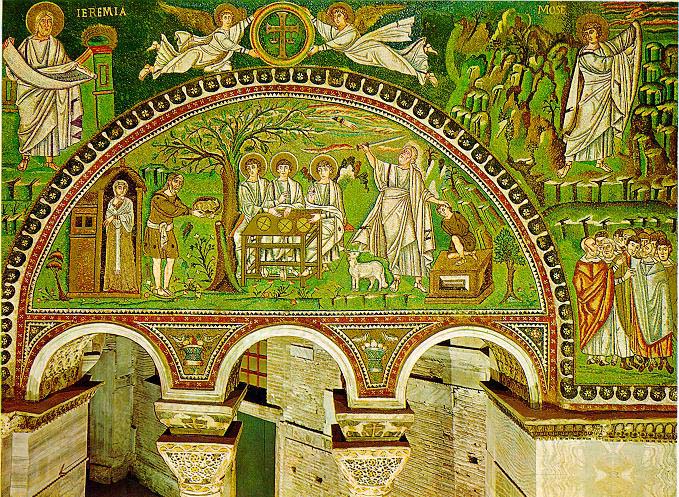 Abraham and Sarah entertain the three angels. Detail from a mosaic above the arches on the north wall of Church of St. Vitale, Ravenna, Italy (526-548 AD). Larger image. |
The account of Abraham entertaining the three angels -- one of whom turns out to be an appearance of Yahweh himself -- is only half of the story. It becomes apparent in chapter 19 that the two angels are on their way to destroy Sodom. Apparently they stop at Abraham's tent mainly to involve him in intercession in this struggle between judgment and mercy. Only by seeing the bigger picture first, can we begin to understand what chapter 18 is really about.
Abraham at Mamre (18:1)
"The Lord appeared to Abraham near the great trees of Mamre while he was sitting at the entrance to his tent in the heat of the day." (18:1)
Abraham is camped at the "Great Trees of Mamre" near Hebron, where he has lived in the past (13:8; 14:13) and where he and Sarah are eventually buried (chapter 23). Here is another appearance of Yahweh (the Hebrew verb is rā’eh). God has appeared to Abraham at least three times so far -- in Haran or Ur when he is called (12:7), cutting the covenant (as a burning torch and smoking firepot (chapter 15), and at the covenant of circumcision (17:1).
Abraham Shows Hospitality to the Three "Men" (18:2-8)
At the beginning of this encounter, I'm not convinced that Abraham recognizes these men as supernatural beings. Yes, Abraham calls the leader "my lord" (’adôn, "lord" or "father."), but this word is commonly used of human beings -- as a term of respect for a husband (18:12), a master (chapter 24), a Pharaoh (40:1), a patron (Ruth 2:13).[1] In the KJV, "Lord" is capitalized signifying divinity, but there are no capital letters in the original Hebrew.
We see in Abraham an amazing example of scrupulous and eager Near Eastern hospitality. This is the way sojourners were to be treated in Abraham's culture.
"Abraham looked up and saw three men standing nearby. When he saw them, he hurried from the entrance of his tent to meet them and bowed low to the ground.
He said, 'If I have found favor in your eyes, my lord, do not pass your servant by. Let a little water be brought, and then you may all wash your feet and rest under this tree. Let me get you something to eat, so you can be refreshed and then go on your way -- now that you have come to your servant.'
'Very well,' they answered, 'do as you say.'
So Abraham hurried into the tent to Sarah. 'Quick,' he said, 'get three seahs of fine flour and knead it and bake some bread.'
Then he ran to the herd and selected a choice, tender calf and gave it to a servant, who hurried to prepare it. He then brought some curds and milk and the calf that had been prepared, and set these before them. While they ate, he stood near them under a tree." (18:2-8)
Several words seem to characterize Abraham as a conscientious host. "Hurried" occurs in verses 6 and 7. The word "quick" is repeated three times in verses 6 and 7. "Ran" is found in verse 7. Picture this still-fit, 99-year-old man running out from the main encampment to where his herds are being pastured, arriving breathless. He personally picks out his finest young, tender calf and gives orders to butcher and prepare it. Then he returns to entertain his guests while the meal is being prepared. His haste is evidence of his desire for his guests' comfort and honor.
Consider how much trouble it would be -- and how long it would take -- to butcher a calf and make leavened bread. We're not exactly sure how much flour is in three seahs, but it may be 20 dry quarts per seah or more.[2] I used to make bread allowing 4 to 5 cups of flour (about one dry quart) for two loaves of bread. Can you imagine how much bread you can make with three seahs (or about 60 quarts) of flour? This is an extravagant meal to honor these three guests.
A Promise that Sarah Will Bear a Son (18:9-10a)
As they eat, they converse with Abraham.
"Where is your wife Sarah?" they asked him.
"There, in the tent," he said.
Then he said, "I will surely return to you about this time next year, and Sarah your wife will have a son." (18:9-10a)
In verse 10a, the NIV identifies the speaker as Yahweh, "the Lord," though his identity isn't clarified until verse 13. It is possible that the guests have supernatural knowledge of Sarah's name, though it may have come up in the conversation.
At some point in the conversation, the leader of the group says, "I will surely return to you about this time next year, and Sarah your wife will have a son" (18:10a).
Sarah Laughs (18:10a-15)
During the recent covenant of circumcision, God reveals to Abraham that Sarah would bear a son (17:16, 21), but obviously Abraham hasn't shared it with Sarah yet.
"Now Sarah was listening at the entrance to the tent, which was behind him. Abraham and Sarah were already old and well advanced in years, and Sarah was past the age of childbearing. So Sarah laughed to herself as she thought, 'After I am worn out and my master is old, will I now have this pleasure?'
Then the LORD said to Abraham, 'Why did Sarah laugh and say, "Will I really have a child, now that I am old?" Is anything too hard for the LORD? I will return to you at the appointed time next year and Sarah will have a son.'
Sarah was afraid, so she lied and said, 'I did not laugh.'
But he said, 'Yes, you did laugh.'" (18:10a-15)
As I picture the scene, the men are eating under the great trees talking. When they ask where Sarah is, Abraham points behind him to the tent where Sarah sits -- perhaps seen, perhaps unseen -- at the doorway. As the story unfolds, the narrator reminds us of Abraham's and Sarah's great age and that Sarah is well past menopause, literally, "It had ceased to be with Sarah after the manner of women" (18:11, NRSV, KJV).
Sarah ponders what she just heard and considers that she is "worn out" (NIV) or "grown old" (NRSV).[3] She wonders whether she will have "pleasure" at her age. The Hebrew noun ‘ednâ, can refer to the pleasure of being a mother, but the word "has strong connotations of sensual and sexual pleasure."[4]
Sarah laughs "to herself."[5] No one can hear her inner laughter except the LORD, whose word "… is able to judge the thoughts and intentions of the heart" (Hebrews 4:12), who "knows the secrets of the heart" (Psalm 44:21), and "who searches hearts and minds" (Revelation 2:23). Her inner unbelief is no secret to the LORD. Abraham, too, had laughed when God had first told him (17:17).
Is Anything Too Hard for the LORD? (18:14)
Notice that "LORD" in small caps in verse 13 identifies Yahweh as the speaker. He asks, "Is anything too hard for the LORD?" a question that echoes down the ages through the Old and New Testaments and up to our own day. Consider with me the implications of our omnipotent Lord:
"Was my arm too short to ransom you? Do I lack the strength to rescue you?" (Isaiah 50:2)
"Ah, Sovereign Lord [literally, "Lord Yahweh"], you have made the heavens and the earth by your great power and outstretched arm. Nothing is too hard for you." (Jeremiah 32:17)
On the impossibility of a rich person being saved, "With man this is impossible, but with God all things are possible." (Matthew 19:26, also Luke 18:27)
The angel Gabriel revealing aged Anna's pregnancy to Mary at the Annunciation, "For nothing is impossible with God." (Luke 1:37)
Refusing to Believe a Miracle
When I pastored a congregation in the San Fernando Valley in the 1980s, our organist Chris, a woman in her mid-thirties, was diagnosed with lung cancer and now faced her ninth operation for cancer. She declined the surgery and opted instead for chemotherapy. One Sunday morning that spring, God put it on my heart in the middle of a worship service to ask several women to gather around her as she sat at the organ and to lay their hands on her as I prayed from the pulpit. After the service, Chris told me that she had felt a strange warmth in her body. One of the ladies who prayed for her had a strong sensation of heat in her arm as she laid her hands on Chris.
A few weeks later I asked Chris how things were going. "Before," she said, "the chemotherapy made me very weak, but now I even have the energy to go swimming in the pool at my apartment" -- while still undergoing chemotherapy! At the end of this regimen, the doctors took another series of x-rays. She expected to receive the results on Tuesday, but nothing. Wednesday, nothing. Finally on Thursday her doctor told her that her x-rays had been examined by a number of doctors, and where there had been a tumor, there was now nothing at all. Chris announced this healing to our congregation on the following Sunday morning -- Easter Sunday. What a Resurrection Celebration we had that day! I kept in touch with Chris for a number of years after that -- she had no recurrence of the cancer. Praise God for a miracle!
But when I shared the story with another pastor, he refused to accept that this could have been a miracle. "It must have been the chemo," he kept insisting against all of my protests. He just did not believe that God could or would do such a miracle in our day.
His unbelief, though entrenched, is no worse that the unbelief that lurks in many of us. We say that we believe in a God who can do anything, but our fears and actions tell the real story. We, too, need to ponder Yahweh's question to Sarah, "Is anything too hard for the LORD?"
Faith in the God of the Impossible
But this faith in the God of the impossible was growing in Abraham. Paul recounts Abraham's faith response to learning that Sarah would become pregnant:
"Without weakening in his faith, he faced the fact that his body was as good as dead -- since he was about a hundred years old -- and that Sarah's womb was also dead. Yet he did not waver through unbelief regarding the promise of God, but was strengthened in his faith and gave glory to God, being fully persuaded that God had power to do what he had promised. This is why 'it was credited to him as righteousness.'" (Romans 4:19-22)
|
Q1. (18:14) How can we tell if we really believe in God's present
willingness to do miracles in our day? Is there any indication in Scripture that
God will
stop doing miracles? Is there any indication that God continues to do
miracles? How can we regain an active faith in the God of miracles?
|
God's Choice of Abraham (18:16-19)
As Abraham walks with these "men" on their way for a bit, we catch a piece of the conversation:
"When the men got up to leave, they looked down toward Sodom, and Abraham walked along with them to see them on their way. Then the LORD said, 'Shall I hide from Abraham what I am about to do? Abraham will surely become a great and powerful nation, and all nations on earth will be blessed through him. For I have chosen him, so that he will direct his children and his household after him to keep the way of the LORD by doing what is right and just, so that the LORD will bring about for Abraham what he has promised him.'" (18:16-19)
Yahweh wonders out loud -- for Abraham's benefit -- whether he should tell Abraham what he has planned for Sodom and Gomorrah. He decides not to "hide"[6] this from Abraham. "Surely the Sovereign LORD does nothing without revealing his plan to his servants the prophets" (Amos 3:7). Abraham, the Friend of God (Isaiah 41:8; James 2:23), is one of these prophets (20:7).
Why did God choose Abraham? "So that he will direct his children and his household after him to keep the way of the LORD by doing what is right and just" (18:19). The operative word describing Abraham is "direct" (NIV), "command" (KJV), or "charge" (NRSV).[7]
We have seen from the inner family politics, Abraham doesn't always get his way in the family. Sarah's voice has lots of influence (16:5-6; 21:9-12). But, on her part, Sarah respects her husband -- most of the time -- and in 18:12 calls him "master" (NIV), "lord" (KJV, see 1 Peter 3:6), or "husband" (NRSV). The Hebrew noun is ’ādōn -- the same word of respect and honor that Abraham uses to refer to the leader of the three visitors he is entertaining (18:3). Abraham is not a dictator. But he does set the tone and direction for his family and his household of righteous living towards God and justice towards others.
| Q2. (18:16-19) How can fathers and husbands strike the right balance
-- of being godly, caring leaders without being dictators? How can mothers
and wives strike the right balance -- of being submissive and at the same
time being open about their needs and desires? (I know of no Christian
cookie-cutter answer to this. It must be conscientiously worked out within
the crucible of marriage.) https://www.joyfulheart.com/forums/index.php?act=ST&f=58&t=250
|
Keeping the Way of the Lord (18:19)
Three elements describe Abraham's lifestyle:
- "Keeping the way of the LORD." "Way" is the Hebrew noun derek, "way, road, journey." It refers to a path worn by constant walking or to a major highway. Metaphorically, derek often refers to the actions and behavior of men, who either follow the way of the righteous or the way of the wicked (Psalm 1:6). Isaiah reminds us that God's ways are much higher than man's ways (Isaiah 55:7-9).[8] Keeping the way of the Lord consists "doing what is right and just."
- "Doing what is right" (NIV), "justice" (KJV), and "righteousness" (NRSV) is the Hebrew noun sedāqā, "justice, righteousness," from a root that "connotes conformity to an ethical or moral standard," which, in the Old Testament, is the standard of the nature and will of God. Judges are to deliver and decide according to the truth without partiality (Leviticus 19:15), weights and measures are to be honest (Leviticus 19:36). Commercial fraud and deception are not allowed.[9] Abraham uses the word in verse 25 to appeal to God's own character of righteousness.
- "Doing what is … just" (NIV), "judgment" (KJV), and "justice" (NRSV) is the Hebrew noun mishpāt, "judgment, justice." The primary sense of this root is to exercise the processes of government. Mishpāt can be translated different ways, depending upon the context. Here it is "justice, that is, rightness rooted in God's character" as an attribute of man in general and the judicial process among men.[10]
| Q3. (18:19) In your own words, describe what a lifestyle of "keeping
the way of the LORD by doing what is right and just"
looks like in the twenty-first century. In what ways is this difficult? In
what ways is this easy? What are the special challenges? https://www.joyfulheart.com/forums/index.php?act=ST&f=58&t=251
|
"Chosen" (NIV, NRSV) or "know" (KJV) in verse 19 is the Hebrew verb yāda‘, "know," probably in the sense of foreknowledge. Here's a chicken-and-egg theological question: Does God choose Abraham because he knows he will direct his family in a godly way in the future? Or does he choose him because Yahweh knows that he will mold Abraham to be a godly man and leader of his family? Ah, the wonders of election vs. foreknowledge, predestination vs. free will.
The Sins of Sodom and Gomorrah (18:20-21)
"Then the Lord said, 'The outcry against Sodom and Gomorrah is so great and their sin so grievous that I will go down and see if what they have done is as bad as the outcry that has reached me. If not, I will know.'" (18:20-21)
"Outcry against" (NIV, NRSV) or "cry of" (KJV) is the Hebrew noun za‘ārā, "cry, outcry." The basic meaning of this root is "to cry for help in time of distress."[11] A similar outcry of the oppressed for justice is heard throughout the Old Testament (Genesis 4:10; Exodus 2:23-24; 3:7, 9; 22:23, 27; Deuteronomy 24:15; Job 31:38-39; 34:28; Psalm 9:12; 10:17; 22:24; 34:6; 102:17; Isaiah 5:7; James 5:4).
In chapter 15 God tells Abraham that "the sin of the Amorites has not yet reached its full measure" (15:16), so he isn't ready to punish the Amorites at this time. But here, the sins of Sodom have indeed reached the point where God is ready punish their sins. Throughout the ages God has shown mercy to peoples that have sinned (Exodus 34:6-7; Lamentations 3:22; Jonah 4:2; Romans 2:4; 3:25; 9:22; 1 Timothy 1:16). If God destroyed us for one sin, who would remain? God is merciful, giving us a chance to repent. But Sodom's days are numbered. Since God is righteous, there is a time that judgment must fall. And that time has come.
Will Not the Judge of All the Earth Do Right? (18:22-25)
Now we see a most amazing, bold, audacious appeal from Abraham to Yahweh.
"The men turned away and went toward Sodom, but Abraham remained standing before the Lord. Then Abraham approached him and said: "Will you sweep away the righteous with the wicked? What if there are fifty righteous people in the city? Will you really sweep it away and not spare the place for the sake of the fifty righteous people in it? Far be it from you to do such a thing -- to kill the righteous with the wicked, treating the righteous and the wicked alike. Far be it from you! Will not the Judge of all the earth do right?"
God has just spoken about Abraham's destiny to raise up his family in "doing what is right and just (mishpāt)" (18:19). Now Abraham demands righteousness of God: "Will not the Judge (shāpat) of all the Earth do right (mishpāt)?" The term "Judge" is shāpat, "judge, govern, act as ruler," is from the same word group as mishpāt, "judgment, justice" in verse 18. How can God destroy a city that has 50 righteous residents? It would be wrong "to kill the righteous with the wicked," Abraham asks. If God expects justice of Abraham, surely he himself must be just, Abraham argues.
Abraham's name for God -- "The Judge of All the Earth" -- is another indication of Abraham's monotheism and very high view of God's righteousness. The gods in the Mesopotamian pantheon were not known for their righteousness, but for their capriciousness and sins. On the contrary, Yahweh is the righteous and holy God! He can be trusted to do what is right. Abraham is sure of it.
Abraham's motive in this appeal, of course, is to save his nephew Lot from destruction along with Sodom. This is the second time Abraham has risked himself to rescue Lot. Now he comes before the LORD himself with incredible nerve and chutzpah!
Abraham Intercedes for Sodom (18:26-33)
Over the course of the next few minutes, Abraham boldly bargains God down from 50 to 10 righteous people that would prevent God from destroying Sodom, and the Lord agrees. Abraham dares not go lower.
"The Lord said, 'If I find fifty righteous people in the city of Sodom, I will spare the whole place for their sake.'
Then Abraham spoke up again: 'Now that I have been so bold as to speak to the Lord, though I am nothing but dust and ashes, what if the number of the righteous is five less than fifty? Will you destroy the whole city because of five people?'
'If I find forty-five there,' he said, 'I will not destroy it.'
Once again he spoke to him, 'What if only forty are found there?'
He said, 'For the sake of forty, I will not do it.'
Then he said, 'May the Lord not be angry, but let me speak. What if only thirty can be found there?'
He answered, 'I will not do it if I find thirty there.'
Abraham said, 'Now that I have been so bold as to speak to the Lord, what if only twenty can be found there?'
He said, 'For the sake of twenty, I will not destroy it.'
Then he said, 'May the Lord not be angry, but let me speak just once more. What if only ten can be found there?'
He answered, 'For the sake of ten, I will not destroy it.'
When the Lord had finished speaking with Abraham, he left, and Abraham returned home." (18:26-33)
The Purpose of Prayer
Through his prayer, Abraham has prevailed upon the Lord to change his mind -- at least to modify his judgment. The audacious assumption that underlies prayer is that we can influence God to change his mind. Of course, God will never act against his own character and word. But, as our saying goes: "There is more than one way to skin a cat." God can work out his will and purpose in many ways.
Was God upset with Abraham's boldness? No. I think God had set Abraham up for this very act of intercession by revealing to Abraham his intentions. Abraham was under no illusions. He knew how bad Sodom really was (13:13). He knew how truly wicked the city and its leaders were, evidenced by the way he had refused to accept anything from the king of Sodom (14:21-24). He knew that when the Lord observed the sins of the city, he would destroy it. And therefore Abraham felt an obligation to protect his own family from that destruction.
I believe God intended to teach Abraham -- and us -- several lessons about intercession, that is, praying to God on behalf of someone else. I see three lessons here:
- Boldness or confidence before God is necessary to ask God to change his mind or his action. See Ephesians 2:18; 3:12; Hebrews 4:16; 10:19.
- Yahweh's character and word are the basis of the appeal. You can see this some of the great prayers of intercession in the Bible: Exodus 32:9-14; 33:12-17; Numbers 16:20-22; 1 Samuel 7:5-14; 2 Samuel 24:17; 1 Kings 17:20-23; 2 Kings 19:1-37; Ezra 9:5-15; Nehemiah 1:4-9; Daniel 9:4-19; Amos 7:2-6.
- Persistence in prayer until the answer was given is required. See Luke 11:5-13; 18:1-8.
I've wondered why God sometimes waits to do what is in his will to do until we pray. I believe the answer is found in God's desire to train us to take over the family business, that is, to understand how he thinks, what he desires, and how he works. He teaches this to us as we learn to pray according to his will.
| Q4. On what ground does Abraham so boldly address God? Do you think
God desires us to do the same? Why or why not? Why do you think Abraham's
intercession pleased God? What will it take for us to please him in our
prayers? https://www.joyfulheart.com/forums/index.php?act=ST&f=58&t=252
|
I invite you to seek this awesome God in bold, persistent, prevailing prayer, based on his promises and character. Indeed, this is the will of God in Christ Jesus for you! (1 Thessalonians 5:18).
 Available in PDF and Kindle formats. |
When I think about Abraham interceding for sinful Sodom -- especially for his nephew Lot -- I think of Christ's constant intercession for his people before the Father. We read that he is our "Advocate with the Father, Jesus Christ the Righteous" (1 John 2:1, NRSV, KJV). He is the "one Mediator between God and men, the man Christ Jesus (1 Timothy 2:5). He is "at the right hand of God and is also interceding for us" (Romans 8:34). And he is able to save us to the uttermost "seeing that he ever lives to make intercession for [us]" (Hebrews 7:25).
Perhaps the extent of our sins is not as great as those of Sodom, but certainly our sinfulness before God is just as repugnant. Thank God that there is One who intercedes for us, who has brought us to repentance, and has made a way for us to be forgiven. Amen.
Prayer
Father, as I meditate on this encounter between Abraham and you I am awed at your patience, your love, your gentleness, your ability to bring out faith in Abraham. Please be patient in your work with me, too, that I might become all you want me to be. Teach me to talk to you as Abraham did. In Jesus' name, I pray. Amen.
Key Verses
"Is anything too hard for the Lord?" (Genesis 18:14a)
"For I have chosen him, so that he will direct his children and his household after him to keep the way of the Lord by doing what is right and just, so that the Lord will bring about for Abraham what he has promised him." (Genesis 18:19)
References
Common Abbreviations https://www.jesuswalk.com/abraham/refs.htm
- Robert L. Alden, TWOT #27b.
- Probably 1/3 of an ephah (2 Kings 7:1, 18). From a description of the trench dug around the altar when Elijah challenged the prophets of Baal ("he dug a trench around it large enough to hold two seahs of seed," 1 Kings 18:32), this seems like a great deal. Estimates vary from 20 dry quarts or 22 liters (NIV footnote) to 41 dry quarts or 45 liters. So far no jars have been found with enough pieces to reconstruct the jar and measure the capacity, though some jar handles have been found stamped btmlk, "bath of the royal standard" (Jack B. Scott, TWOT #82). See also 1 Samuel 25:18; 2 Kings 7:1, 16, 18 (TWOT #1452).
- Walter C. Kaiser, TWOT #246. The Hebrew verb bālā is used of clothes that wear out from long use (Deuteronomy 8:4; 29:4; Nehemiah 9:21; Joshua 9:13).
- Hamilton, Genesis 2:5.
- Leonard J. Coppes, TWOT #2066a. the Hebrew noun qereb, "inner part," used sometimes of inward attitudes and thoughts of the inner being of a person.
- "Hide" is the Hebrew verb kāsā, "cover, conceal, hide."
- The Hebrew verb sāwā is used of the instruction of father to a son (1 Samuel 17:20), a farmer to laborers (Ruth 2:9), and a king to his servants (2 Samuel 21:14) (John E. Hartley, TWOT #1887).
- Herbert Wolf, TWOT #453a.
- Harold G. Stigers, TWOT #1879b.
- Robert D. Culver, TWOT #2443c.
- Leon J. Wood, TWOT #570a. The roots zā‘aq and sā‘aq are very similar, both signifying the same sense of a cry for help out of a situation of distress.
Copyright © 2025, Ralph F. Wilson. <pastor joyfulheart.com> All rights reserved. A single copy of this article is free. Do not put this on a website. See legal, copyright, and reprint information.
 |

|
In-depth Bible study books
You can purchase one of Dr. Wilson's complete Bible studies in PDF, Kindle, or paperback format -- currently 48 books in the JesusWalk Bible Study Series.
Old Testament
- Abraham, Faith of
- Jacob, Life of
- Moses the Reluctant Leader
- Joshua
- Gideon
- David, Life of
- Elijah
- Psalms
- Solomon
- Songs of Ascent (Psalms 120-134)
- Isaiah
- 28 Advent Scriptures (Messianic)
- Daniel
- Rebuild & Renew: Post-Exilic Books
Gospels
- Christmas Incarnation (Mt, Lk)
- Sermon on the Mount (Mt 5-7)
- Luke's Gospel
- John's Gospel
- Seven Last Words of Christ
- Parables
- Jesus and the Kingdom of God
- Resurrection and Easter Faith
- Apostle Peter
Acts
Pauline Epistles
- Romans 5-8 (Christ-Powered Life)
- 1 Corinthians
- 2 Corinthians
- Galatians
- Ephesians
- Philippians
- Colossians, Philemon
- 1 & 2 Thessalonians
- 1 &2 Timothy, Titus
General Epistles
Revelation
Topical

 To be notified about future articles, stories, and Bible studies, why don't you subscribe to our free newsletter, The Joyful Heart, by placing your e-mail address in the box below. We respect your