Free E-Mail
Bible Studies
 Apostle Peter
Beginning the Journey (for new Christians). en Español
Old Testament
Abraham
Jacob
Moses
Joshua
Gideon
David, Life of
Elijah
Psalms
Solomon
Songs of Ascent (Ps 120-135)
Isaiah
Advent/Messianic Scriptures
Daniel
Rebuild & Renew: Post-Exilic Books
Gospels
Christmas Incarnation
(Mt, Lk)
Sermon on the Mount
(Mt 5-7)
Mark
Luke's
Gospel
John's Gospel
7 Last Words of Christ
Parables
Jesus and the Kingdom
Resurrection
Apostle Peter
Acts
The Early Church
(Acts 1-12)
Apostle Paul
(Acts 12-28)
Paul's Epistles
Christ Powered Life (Rom 5-8)
1 Corinthians
2 Corinthians
Galatians
Ephesians
Vision for Church
(Eph)
Philippians
Colossians,
Philemon
1
& 2 Thessalonians
1 & 2 Timothy,
Titus
General Epistles
Hebrews
James
1 Peter
2 Peter, Jude
1, 2, and 3 John
Revelation
Revelation
Conquering Lamb of Revelation
Topical
Glorious Kingdom, The
Grace
Great Prayers
Holy Spirit, Disciple's Guide
Humility
Lamb of God
Listening for God's Voice
Lord's Supper
Names of God
Names of Jesus
Christian Art
About Us
Podcasts
Contact Us
Dr. Wilson's Books
Donations
Watercolors
Sitemap

3. The Living Word of Scripture (2 Peter 1:12-21)
by Dr. Ralph F. WilsonPrint this Page
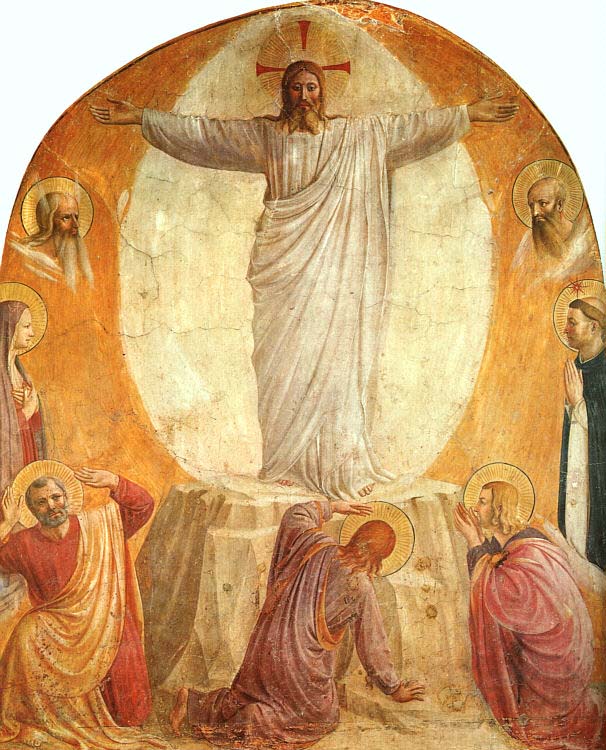 "Transfiguration of Christ" (ca. 1441), by Florentine painter and Dominican friar Fra Angelico(ca. 1400-1455), Fresco, 181 x 152 cm, Museo di San Marco, Cell 6, Florence, Italy. Peter seems to be crouching at the bottom left. Larger image. |
What we know and believe has a decisive effect on our lives. Peter is not just writing a nice letter to some churches in this epistle. He is battling to keep their minds focused on truth, rather than distracted, and ultimately ruined, by false teachers who are attempting to substitute their errors for truth. In this passage, Peter makes three main points with profound implications:
- Peter reminds them of what he and the other apostles have already taught them. Repetition is important for stability.
- Peter's authority, ultimately, comes from God himself speaking and authenticating Jesus' life and ministry.
- The authority of Scripture is based on God himself speaking through the prophets.
You may yawn, and say, "Ho-hum," but Peter's subject here is intensely relevant, at the forefront of the battle for people's minds today. Let me explain….
Recalling Truth to Mind (1:12-15)
Peter has been talking about adding building blocks of Christian character to the faith that God has given each believer. Virtue is essential to a productive Christian life. Now he makes a transition:
"So I will always remind you of these things, even though you know them and are firmly established in the truth you now have. I think it is right to refresh your memory as long as I live in the tent of this body, because I know that I will soon put it aside, as our Lord Jesus Christ has made clear to me. And I will make every effort to see that after my departure you will always be able to remember these things." (1:12-15)
We live in a culture where we feel compelled to be constantly innovative -- a new concept, a new twist, a new package. But Peter understands the importance of repetition and reminder[1] in teaching. Of going back to the things we know and reinforcing them so they don't slip. A. Katherine Hankey wrote in 1866:
"I love to tell the story, for those who know it best
Seem hungering and thirsting to hear it like the rest.
And when, in scenes of glory, I sing the new, new song,
’Twill be the old, old story that I have loved so long.
I love to tell the story, ’twill be my theme in glory,
To tell the old, old story of Jesus and His love."
In verse 13, Peter talks about memory with the words "refresh" (NIV, NRSV) or "stir you up" (KJV), translating the Greek verb diegeirō, "wake up, arouse."[2]
I often find myself in need of renewal, of spiritual arousal, of waking up where I have dozed off spiritually. I need to do again the things I know to do but where I have slacked off. I need to go back to the basics in my life. This is what Peter is saying. "You know them and are firmly established,"[3] he acknowledges, but he makes no apology about reviewing the basic truths of the faith. This is an important lesson for us a spiritual beings, as disciples, as parents, and as Christian leaders.
Earthly Life as a Tent (1:13-15)
Peter is an old man by now -- it's the early 60s AD. His early career as a fisherman has been replaced by a long and successful stint as an itinerant preacher and teacher and apostle to the Church. He is now in Rome facing likely martyrdom at the hands of an increasingly dangerous and erratic Emperor Nero. He speaks casually of the transitoriness of life:
"I think it is right to refresh your memory as long as I live in the tent of this body, because I know that I will soon put it aside, as our Lord Jesus Christ has made clear to me." (1:13-14)
As I write this, millions are camping during a three-day holiday weekend. On Fridays campgrounds fill up with tenters and RVs, but by Monday noon they'll be empty again, except for overflowing trash barrels. The tents go up quickly, and just as quickly are struck and put away.
The body is like a tent,[4] says Peter. "The tent of this body … will soon be put aside."
My grandmother was born at the height of the Victorian era. In her day, death was openly talked about, while sex was hush-hush. Our society has it reversed. We just don't talk about death. We often refuse to discuss our own mortality and transitoriness -- though we think about it. Being open in our churches and small groups about death is healthy, not morbid. It helps focus our minds and our efforts.
Peter speaks of his coming death as something "our Lord Jesus Christ has made clear to me" (1:14). He is probably referring Jesus' prophecy after his resurrection, when he restored Peter to his call and ministry.
"'I tell you the truth, when you were younger you dressed yourself and went where you wanted; but when you are old you will stretch out your hands, and someone else will dress you and lead you where you do not want to go.' Jesus said this to indicate the kind of death by which Peter would glorify God. Then he said to him, 'Follow me!'" (John 21:18-19)
Peter has an intriguing way of referring to his death. In verse 15 he calls it "my departure," literally, exodus. This is not a common word for death, used by itself. He is probably comparing his own death to the exodus of the people of Israel from Egypt on their way to the Promised Land. (See also Luke 9:31, where Jesus uses this concept at his Transfiguration.)
|
Q1. (2 Peter 1:13-15) Why does our culture avoid talking about death? How
is describing your earthly body as a "tent" freeing and motivating? What is the
significance of Peter referring to his death as a "departure" or "exodus"?
|
Preserving Peter's Legacy of Teaching (1:15)
Well aware of his own impending death, Peter has taken steps to put his teachings in such a form that the truth of Jesus' life doesn't die with him.
"And I will make every effort to see that after my departure you will always be able to remember these things." (1:15)
How did Peter preserve his legacy of teaching? Probably through the Gospel of Mark. According to the Anti-Marcionite Prologue to Mark and Luke (ca. 160 to 180 AD), Mark is said to be "the interpreter of Peter. After the death of Peter himself he wrote down this same gospel in the regions of Italy."[5] Peter is probably referring here to a plan with his disciple Mark to write down his preaching about Jesus -- forming the basis of the Gospel of Mark.
Eyewitnesses of His Majesty (1:16)
Now, in the face of criticism from false teachers, who state that the Christian message is a human invention, Peter defends his preaching about Jesus:
"We did not follow cleverly invented stories (mythos) when we told you about the power and coming of our Lord Jesus Christ, but we were eyewitnesses of his majesty." (1:16)
"Stories" (NIV), "fables" (KJV), or "myths" (NRSV) is the Greek noun mythos, from which we get the English word "myth." Originally mythos referred to "speech, conversation" and also to "narrative" or "story" without any distinction of whether it was fact or fiction. Later it referred to fictional narrative as opposed to logos, the truth of history. In our passage we see this sense, where mythos means "tale, story, legend, myth."[6] There's a similar accusation in 2 Clement 13:3: "They [opponents of Christianity] turn to blasphemy, saying that it is a myth (mythos) and a delusion."[7]
What in particular did the false teachers ridicule? They scoffed that Christians' claim that Jesus would actually return in the Second Coming -- at "the power and coming of our Lord Jesus Christ" (1:16). Peter responds to their criticisms in 3:1-13.
Notice how Peter deals here with their ridicule: he claims to be an eyewitness.[8] He speaks of the Transfiguration as being of the very same type of majesty and glory that will surround Jesus at his return. "Majesty" is the Greek noun megaleiotēs, "quality or state of being foremost in esteem, grandeur, sublimity, majesty."[9] It is used twice elsewhere in the New Testament (Luke 9:43; Acts 19:27), as here, to refer to divine majesty.
Recalling Jesus' Transfiguration (1:17-18)
Now Peter recalls the Transfiguration that is declared in each of the Synoptic Gospels (Matthew 17:1-8 || Mark 9:2-8 || Luke 9:28-36).
"For he received honor and glory from God the Father when the voice came to him from the Majestic Glory, saying, "This is my Son, whom I love; with him I am well pleased." We ourselves heard this voice that came from heaven when we were with him on the sacred mountain." (1:17-18)
In this event Jesus is revealed with all the glory of God himself and is attested as the Beloved Son by God's own voice. The term Majestic Glory[10] refers to the Shekinah glory of God -- Jesus' face and clothing shone as bright as lightning, with transcendent glory (see Exodus 34:29-35). The voice of God heard on Mt. Sinai (Exodus 19:19; Deuteronomy 4:11-12; 5:22) thunders approval of the Son. And a bright cloud envelops them, reminiscent of the cloud of God's glory resting on Mt. Sinai, hovering over the temple by day and night, and filling the tabernacle and later the temple with power so great that the priests could not stand in order to minister (Exodus 40:34-35; 1 Kings 8:10-11; see also Leviticus 9:6, 23; Ezekiel 43:2-4; 44:4).
Peter says that the Transfiguration was no myth or fable, but an actual event that he witnessed with his own eyes.
Demythologizing the Scripture
You may think that calling Christianity a myth is a dead issue, but I assure you it is not.
When I was in college in the 1960s, German New Testament scholar Rudolf Bultmann (1884-1976) was influential among liberal professors and pastors. I remember a sermon in the church our family attended based on John A.T. Robinson's book Honest to God (John Knox Press, 1963, reprinted 2003) that called on members of our church to "demythologize" scripture. Our pastor at that time told us that the Virgin Birth was a myth. The book questioned the Resurrection, as well as every basic doctrine of the Christian faith. The religion faculty of the church-related college I attended taught this approach as truth.
Today, this movement of unbelief within the Christian church has captured whole denominations. Peter, I am sure, would call them "false teachers." A recent voice leading this movement comes from Episcopalian Bishop John Shelby Spong, author of A New Christianity for a New World: Why Traditional Faith is Dying & How a New Faith is Being Born (HarperSanFrancisco, 2002) and Why Christianity Must Change or Die (HarperSanFrancisco, 1999). The Jesus Seminar of the 1990s, based on form criticism and an assumption that miracles didn't really happen, rated every passage in the Gospels as to its degree of their possible authenticity. Only a small percentage survived as "probable." In our day there is a strong movement to separate the Christ figure (myth) from the Jesus of history (fact).
Lest you think that treating Jesus and his teachings as a myth is a problem only in certain liberal churches, be aware that a large percentage of American Christians probably view Satan as a myth of evil, rather than a real spiritual person who seeks their destruction. Many see the Second Coming of Christ as a myth, just as did Peter's opponents. What has changed in 2,000 years?
Peter says, "I saw it with my own eyes. It is undeniable!" False teachers of his day and ours smile patronizingly and mutter, "Foolishness!"
Scripture as a Light in a Dark Place (1:19)
The battleground in Peter's day and ours centers on our own worldview and understanding of the authority of Scripture. Peter has spoken of his own eyewitness experience. Now he marshals to his argument the authority of the Old Testament prophets who predicted the coming of the Messiah.
"And we have the word of the prophets made more certain, and you will do well to pay attention to it, as to a light shining in a dark place, until the day dawns and the morning star rises in your hearts." (1:19)
"Morning star" (NIV, NRSV) or "day star" (KJV) is the Greek noun phōsphoros (from which we get our English word), probably "the morning star, the planet Venus."[11] Verse 19b talks about the prophetic scriptures as "a light shining in a dark place." That's clear enough. But what does the next phrase mean: "... until the day dawns and the morning star rises in your hearts." Several possibilities have been suggested:
- A Gnostic interpretation that the new convert is in darkness, but will come to "knowledge" and enlightenment. This doesn't fit the date and general approach of 2 Peter.
- The "dawning" and "morning star" both refer to the Second Coming of Christ himself (Numbers 24:17; Malachi 4:2; Luke 1:78; Revelation 2:28; 22:16), known as "the parousia." But how is this event supposed to happen "in your hearts"?
- Perhaps it means, "Take heed to the prophetic scriptures until the full light of the Messianic dawn when Jesus returns. Again, how is this supposed to happen "in your hearts"?
- Or "Our inner transformation, deepened continually by the Spirit as we study the Scriptures (2 Corinthians 3:18), will be completed on the great day when we shall see him as he is, and be made like him (1 John 3:2)."[12]
I'm not sure which of these best represents Peter's thought. But certainly he is calling his readers to recognize the spiritual darkness around us and the illumination of scripture. We are to "pay attention" (NIV), "take heed" (NIV), and "be attentive" (NRSV) to it.[13]
|
Q2. (2 Peter 1:19). In what ways do the Scriptures of the Old and New
Testaments act for you as "a light shining in a dark place"? What does the
darkness represent? What does the light represent?
|
No Private Interpretation (1:20)
As Peter explains the importance of paying attention to the prophets of the Old Testament, we catch a fascinating glimpse of how that Scripture came to be:
"Above all, you must understand that no prophecy of Scripture came about by the prophet's own interpretation. For prophecy never had its origin in the will of man, but men spoke from God as they were carried along by the Holy Spirit." (1:20-21)
"Interpretation" is the Greek noun epilusis, "a setting free from something," then "the act or process of explaining, explanation, interpretation."[14] The statement about "private interpretation"[15] has been taken two ways:
- No prophecy arises from the prophet's own interpretation -- prophecy is given by God.
- No prophecy is to be understood by private interpretation -- the Church is to be the interpreter.
But Green sees grammatical problems with these views. Instead, he sees that the thrust of Peter's thought is about how God speaks to authenticate the word of his servants. He argues that:
- We can rely on the apostles' teaching because they witnessed God's voice speaking at the transfiguration.
- We can rely on the prophets' message because, behind these human authors, God spoke.
God Moved on Human Prophets (1:21)
Peter is really talking about the divine origin of scripture, not its interpretation.
"Above all, you must understand that no prophecy of Scripture came about by the prophet's own interpretation. For prophecy never had its origin in the will of man, but men spoke from God as they were carried along by the Holy Spirit." (1:20-21)
"Scripture" is the Greek noun graphē (from which we get our English word "graphic"), a general word for "a brief piece of writing." However, where graphē is used in the New Testament, it always refers to the sacred Scripture of the Old Testament. Later, the word also began to be used of the Gospels of the New Testament. (Note, however, that in 2 Peter 3:16, Paul's epistles are compared to "the other Scriptures").
This isn't just a "male" thing. In the phrase "men spoke from God," the word for "man" is the Greek noun anthropos, the generic word for human being, including both male and female human beings.[16] The prophetic gift of the Holy Spirit isn't limited to males (1 Corinthians 11:4-5).
But the word that best helps us understand what Scripture is all about is the Greek verb phero. It is translated "carried along" (NIV) or "moved" (KJV, NRSV). The basic meaning is "to bear or carry." Here it means, "be moved, be driven, let oneself be moved."[17] The word almost comes to mean "inspiration," where God breathes out the Word.[18] This is a fascinating maritime metaphor, used of a ship carried along by the wind (see Acts 27:15, 17). "The prophets raised their sails, so to speak -- they were obedient and receptive -- and the Holy Spirit filled them and carried their craft along in the direction he wished."[19]
Notice what is going on here. Human beings speak, but God does the moving. Scripture uses human language with all its cultural limitations, but God moves people to speak for him. This isn't a dictation model of inspiration, nor does the message originate with the prophet. It is God himself speaking authoritatively through human instruments. While we recognize that not all prophecy is authoritative Scripture, God can still speak today through the spiritual gift of prophecy (1 Corinthians 14).
|
Q3. (2 Peter 1:20-21) How can a person be speaking and God be speaking,
too? How does the image of a ship being moved by the wind help you understand
this? (Greek
pneuma means "spirit" and "wind.")
|
If this is true, that Scripture is God himself speaking through the authors -- and we Christians believe that it is true -- then the implications are huge!
Scripture Is "God Breathed"
A similar view of inspiration is found in 2 Timothy:
"All Scripture is God-breathed and is useful for teaching, rebuking, correcting and training in righteousness, so that the man (anthropos) of God may be thoroughly equipped for every good work." (2 Timothy 3:16-17)
"God-breathed" (NIV), "given by inspiration of God" (KJV), and "inspired by God" (NRSV) is the Greek compound adjective theopneustos, formed from the word theos, "God" and pneō, "blow, breathe, exhale." Under the influence of the Latin Vulgate rendering inspirata, the word "inspired" is a common English translation. But the basic idea is "rooted in the idea of the creative breath of God."[20]
|
Q4. (2 Timothy 3:16) If Scripture is "breathed" by God, how can it help us
draw close to God? Why do you think God's Spirit (pneuma, "breath, wind")
is so important in helping us understand Scripture?
|
 Available in paperback, kindle, or ebook formats. |
Summing Up
This may seem like a long explanation of a short passage, but it is a very important passage in light of today's false teachers who seek to explain away Jesus' divinity and supernatural character. But on the other hand, what a wonderful assurance we have of God's profound work in causing Scripture to be written -- moving upon saints by his Holy Spirit, breathing the words into being that they might be penned by people God had chosen as his spokespersons.
Prayer
Father, thank you for protecting and preserving your words and your Word so that we can let it refresh and enlighten our souls today. Use your Word to both transform our lives as well as to teach the truth of Jesus' life and message to our generation. Please prevent us from taking the Scripture for granted, but help us to understand -- and appropriate -- the spiritual power in your Word. In Jesus' name, we pray. Amen.
Key Verse
"For prophecy never had its origin in the will of man, but men spoke from God as they were carried along by the Holy Spirit." (2 Peter 1:21)
References
Standard References https://www.jesuswalk.com/1peter/refs.htm
- "Remind" (NIV, cf. NRSV) or "put ... in remembrance" (KJV) is the Greek verb hupomimnēskō, "to put another in mind of something, remind" (BDAG 1039).
- BDAG 243. "Memory" (NIV, NRSV) and "remembrance" (KJV) is the Greek noun hupomnēsis, "the act of calling to someone's mind, reminding," here and in 3:1 (BDAG 1039).
- "Firmly established" (NIV) is the Greek verb stērizō. It originally spoke of setting up or supporting something firmly. Here it is used figuratively, "to cause to be inwardly firm or committed, confirm, establish, strengthen" (BDAG 945).
- "Tent" (NIV) or "tabernacle" (KJV) in verses 13 and 14 is the Greek noun skēnōma, generally, "lodging, dwelling," in the New Testament figuratively "habitation" (BDAG 929). The root word is skēnē, "tent, hut, temporary dwelling, tabernacle." "Put aside" (NIV) or "put off" (KJV), with reference to this tent of our body, is the Greek verb apothesis, "removal, getting rid of" (BDAG 110).
- Cited by William L. Lane, Commentary on the Gospel of Mark (New International Commentary of the New Testament; Eerdmans, 1974), p. 9. Mark's Gospel is probably to be dated in between 65 and 70 AD. Papias writes early in the Second Century AD, "Mark having become the interpreter of Peter, wrote down accurately, though not in order, whatsoever he remembered of the things said or done by Christ…." (Recorded in Eusebius, Church History, iii.39.15 and v.8.3). Clement wrote, "As Peter had preached the Word publicly at Rome, and declared the Gospel by the Spirit, many who were present requested that Mark, who had followed him for a long time and remembered his sayings, should write them out. And having composed the Gospel he gave it to those who had requested it" (Eusebius, Church History, vi.14.5-7). Irenaeus also confirmed this (Irenaeus, Against Heresies, iii.10.5).
- BDAG 660. "Cleverly invented" (NIV) or "cunningly devised" (KJV) is the Greek verb sophizō. The verb can be used in a positive sense, "to make wise, teach" and "to be skilled in formulating something in an artful manner." But often it is used with the implication of self-serving cleverness as here, "reason out, concoct ingeniously / slyly or devise craftily" (BDAG 935).
- 2 Clement 13:3 (Roberts-Donaldson English Translation).
- "Eyewitnesses" is the Greek noun epoptēs, "to have first-hand acquaintance with something with implication of special privilege, eyewitness" (BDAG 387-388). This is also a technical term of the mystery religions, to designate those who have been initiated into the highest grade of the mysteries, however, there is no indication that Peter is using it in this sense.
- BDAG 622.
- "Majestic" (NIV, NRSV) or "excellent" (KJV) is the Greek adjective megaloprepēs, "magnificent, sublime, majestic, impressive" (BDAG 622-623). "Well pleased" is the Greek verb eudokeō, "to take pleasure or find satisfaction in something, be well pleased, take delight" (BDAG 404).
- BDAG 1073.
- Green 98-99. "Made more sure" (NIV), "more sure" (KJV), or "more fully confirmed" (NRSV) is the Greek adjective bebaios, "of something that can be relied on not to cause disappointment, reliable." We saw this word in 2 Peter 1:10. There it could have the same meaning or mean "in force, valid" (BDAG 172).
- The Greek verb prosechō means "to pay close attention to something, pay attention to, give heed to follow" (BDAG 879-880).
- BDAG 375. The word epilusis doesn't occur again in the New Testament, but the verb occurs in Mark 4:34 and Acts 19:39 and means "to unravel a problem" (Green 100).
- "Private" (KJV), "the prophet's own" (NIV), or "one's own" (NRSV) is the Greek adjective idios, "pertaining to belonging or being related to oneself, one's own" (BDAG 466-467).
- BDAG 81-82
- BDAG 1051-1052.
- Green (p. 101) notes that J.P. Jacobszoon of Leyden translated it as "inspiration" as early as 1599.
- Green 102.
- B.B. Warfield, Inspiration and Authority (1927), p. 275, cited by George W. Knight III, Commentary on the Pastoral Epistles (New International Greek Testament Commentary; Eerdmans, 1992), p. 446.
Copyright © 2025, Ralph F. Wilson. <pastor joyfulheart.com> All rights reserved. A single copy of this article is free. Do not put this on a website. See legal, copyright, and reprint information.
 |
|
In-depth Bible study books
You can purchase one of Dr. Wilson's complete Bible studies in PDF, Kindle, or paperback format -- currently 48 books in the JesusWalk Bible Study Series.
Old Testament
- Abraham, Faith of
- Jacob, Life of
- Moses the Reluctant Leader
- Joshua
- Gideon
- David, Life of
- Elijah
- Psalms
- Solomon
- Songs of Ascent (Psalms 120-134)
- Isaiah
- 28 Advent Scriptures (Messianic)
- Daniel
- Rebuild & Renew: Post-Exilic Books
Gospels
- Christmas Incarnation (Mt, Lk)
- Sermon on the Mount (Mt 5-7)
- Luke's Gospel
- John's Gospel
- Seven Last Words of Christ
- Parables
- Jesus and the Kingdom of God
- Resurrection and Easter Faith
- Apostle Peter
Acts
Pauline Epistles
- Romans 5-8 (Christ-Powered Life)
- 1 Corinthians
- 2 Corinthians
- Galatians
- Ephesians
- Philippians
- Colossians, Philemon
- 1 & 2 Thessalonians
- 1 &2 Timothy, Titus
General Epistles
Revelation
Topical

 To be notified about future articles, stories, and Bible studies, why don't you subscribe to our free newsletter, The Joyful Heart, by placing your e-mail address in the box below. We respect your