Free E-Mail
Bible Studies
 Apostle Peter
Beginning the Journey (for new Christians). en Español
Old Testament
Abraham
Jacob
Moses
Joshua
Gideon
David, Life of
Elijah
Psalms
Solomon
Songs of Ascent (Ps 120-135)
Isaiah
Advent/Messianic Scriptures
Daniel
Rebuild & Renew: Post-Exilic Books
Gospels
Christmas Incarnation
(Mt, Lk)
Sermon on the Mount
(Mt 5-7)
Mark
Luke's
Gospel
John's Gospel
7 Last Words of Christ
Parables
Jesus and the Kingdom
Resurrection
Apostle Peter
Acts
The Early Church
(Acts 1-12)
Apostle Paul
(Acts 12-28)
Paul's Epistles
Christ Powered Life (Rom 5-8)
1 Corinthians
2 Corinthians
Galatians
Ephesians
Vision for Church
(Eph)
Philippians
Colossians,
Philemon
1
& 2 Thessalonians
1 & 2 Timothy,
Titus
General Epistles
Hebrews
James
1 Peter
2 Peter, Jude
1, 2, and 3 John
Revelation
Revelation
Conquering Lamb of Revelation
Topical
Glorious Kingdom, The
Grace
Great Prayers
Holy Spirit, Disciple's Guide
Humility
Lamb of God
Listening for God's Voice
Lord's Supper
Names of God
Names of Jesus
Christian Art
About Us
Podcasts
Contact Us
Dr. Wilson's Books
Donations
Watercolors
Sitemap

 Apostle Peter: Disciple Lessons from the Rock
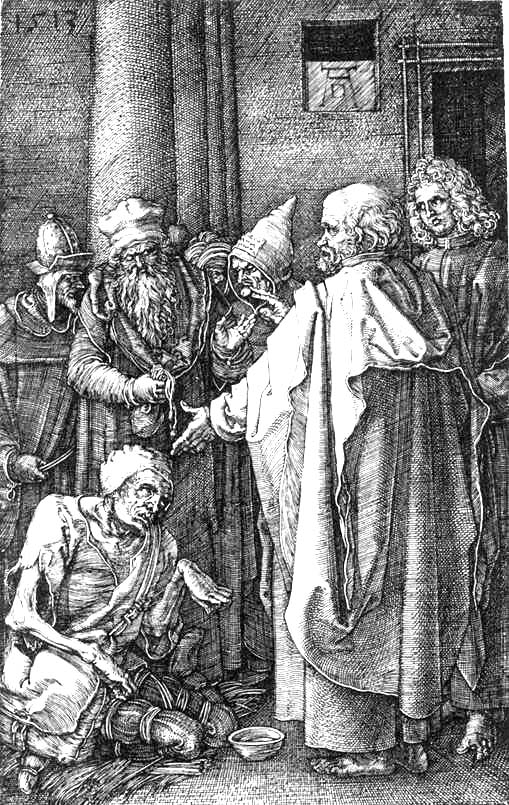
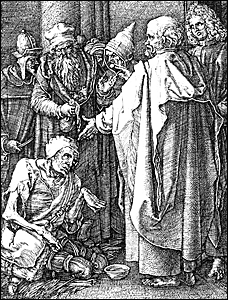 Peter using his spiritual gifts. Detail of Albrecht Dürer (1471-1528), 'St Peter and St John Healing the Cripple' (1513), engraving, 118 x 74 mm, Metropolitan Museum of Art, New York. Larger image. |
Christians are sinners, but this is nothing to brag about. I've heard people recite as their spiritual mantra, "I'm just a sinner, saved by grace." True. But if you haven't turned away from sin with hearty repentance, then you are rebellious.
Shame on us, if we sin knowingly and shamelessly. Peter tells us in this passage that there's no excuse for Christians to live like pagans. Rather we Christians have come from a place of sin (past tense) and should be grateful to God for deliverance. We may struggle as God purifies our thoughts, hearts, and motives. But we must abstain fully from acts of sin that characterized our life before Christ.
Done with Sinning (4:1)
"Therefore, since Christ suffered in his body, arm yourselves also with the same attitude, because he who has suffered in his body is done with sin. As a result, he does not live the rest of his earthly life for evil human desires, but rather for the will of God." (4:1-2)
If you saw Mel Gibson's movie "The Passion of the Christ" (2004) -- or read the Gospel passages on which the movie is based -- then you know that Jesus suffered for sins, your sins. "Suffered" is the Greek verb paschō, "suffer, endure."[199]
But this passage raises an interesting question. What was Jesus' attitude as he suffered on the cross? "Attitude" (NIV), "mind" (KJV), or "intention" (NRSV) is the Greek noun ennoia, "the content of mental processing, thought, knowledge, insight."[200] Specifically, what was Jesus' thought about sin -- since sin is the focus of this passage -- as he bore the scourging he received? What was his attitude about sin as they drove the nails into his hands? As he hung on the cross for six hours, finally succumbing to his wounds? What was his insight toward sin? What was his understanding of God's desire for you and me to be free from sin's pollution and degradation in our lives?
In Lesson 7 we learned that Jesus "died for sins once for all, the righteous for the unrighteous, to bring you to God" (3:18). He was done with sin. He paid an awful price to set us free from it and now he no longer has anything to do with it. That's his attitude.
Peter says to "arm yourselves" with this attitude. The Greek verb is hoplizō, "equip, arm," from hoplon, "tool, weapon, implement."[201] The insight that Jesus died a horrible death because of our sin ought to be a sword in our hand to defend us from sin returning to harass and defeat us. Just as Jesus died for sins "once for all," so we are to be "done" with sin ourselves. "Done" (NIV), "ceased" (KJV), or "finished" (NRSV) is the Greek verb pauō, "to cease doing something, stop (oneself), cease."[202]
Living for the Will of God (4:2)
Peter is saying, if we have suffered for what is right (3:13), then we, too, have a stake in this suffering. Too much stake to go back to our old sinful ways. "As a result," Peter says, "he does not live the rest of his earthly life for evil human desires,[203] but rather for the will of God" (4:2).
Instead of living in order to fulfill our petty desires and lusts, we live with a higher purpose -- to live the rest of our earthly lives ... for the will of God." That is God's desire for us, his plan for us, to learn to pattern our lives and our lifestyles after his will. It is not boring and old fashioned, but a challenge, an adventure, and the only way our lives can really be fulfilled.
Q1. (4:1-2) When the scripture says "arm yourselves with
the same attitude" as Christ had, how should this attitude help keep you from
sin? What attitude are we talking about?
https://www.joyfulheart.com/forums/topic/177-q1-done-with-sinning/
A Catalog of Vices (4:3)
But Peter is not finished talking about sin. There was sin among people in the church. We may think that we live in a decadent society -- and we do, increasingly. But life in the cities of the Roman provinces was worse -- sin, unrestrained by any belief in a righteous God. The gods of Greece and Rome themselves were lustful, fornicating, raping, sinning, hating, and taking revenge upon one another. So Peter spells it out rather clearly.
"For you have spent enough time in the past doing what pagans choose to do -- living in debauchery, lust, drunkenness, orgies, carousing and detestable idolatry." (4:3)
Let's examine each of these words with some accuracy so we know what he was referring to:
"Debauchery" (NIV) or "lasciviousness" (KJV, NRSV) is the Greek noun aselgeia, "lack of self-constraint which involves one in conduct that violates all bounds of what is socially acceptable, self-abandonment." The word is used especially of sexual excesses.[204] Our society glorifies debauchery in countless films and romance novels. Without exercising self-control, we'll never see the will of God worked out in our lives.
"Lust" (NIV, KJV) or "passions" (NRSV) is the Greek noun epithymia used in verse 1 -- "desire for something forbidden."[205] God has built sexual desire into humans. But we are to restrict that desire to the one we marry. In that context it is a legitimate and godly desire and joy. But we are not to live in unrestrained lust for any member of the opposite sex (or same sex) that strikes our fancy. We can't do that and fulfill the will of God.
"Drunkenness" (NIV, NRSV) or "excess of wine" (KJV) is the Greek noun oinophlygia, "drunkenness," from oinos, "wine."[206] When we seek to intoxicate or drug ourselves in order to escape our lives or so we don't have to face our problems, we sin and fail to let the will of God be worked out in our lives.
"Orgies" (NIV), "revels" (NRSV, KJV) is the Greek noun kōmos, "excessive feasting, carousing, revelry."[207] "Party hearty" is the watchword of an entire generation. Jesus enjoyed parties and dinners. He was not an ascetic like John the Baptist. But partying for the excesses keeps the will of God from being fulfilled in us.
"Carousing" (NIV, NRSV) or "banquetings" (KJV) is the Greek noun potos, "drinking party," probably here "carousal."[208] How many times have you heard a young person brag to another about going out to get drunk? For some people, that's their understanding of a good time. But the will of God gets left behind.
"Idolatry" is the Greek noun eidōlatria, a derogatory term, "image worship, idolatry," from eidos, "image."[209] In Peter's day, every Greek and Roman city had its own patron gods. Sacrifices were made to these gods and much of the city life was bound up in this idol worship. Many Christians, too, were entangled in it. They had been raised in idolatry, but even after becoming Christians there was the temptation to just "go with the flow," and not make others angry by refusing to take part in idol worship.
Today we understand idolatry in a figurative sense -- anything that takes the place of God in our lives. Money, power, the weekend get-a-way, a fast car. Whatever it is, it must take second place to God, for Jesus taught us very clearly,
"No one can serve two masters. Either he will hate the one and love the other, or he will be devoted to the one and despise the other. You cannot serve both God and Money." (Matthew 6:24)
In Paul's letters, idolatry is identified with greed or covetousness (1 Corinthians 5:10-11; Ephesians 5:5; Colossians 3:5). If you consider our culture and the advertising that drives it, you can see how difficult it is to keep possessions in their proper place.
Going Along with the Crowd (4:4)
"They think it strange that you do not plunge with them into the same flood of dissipation, and they heap abuse on you." (4:4)
"Dissipation" (NIV, NRSV) or "riot" (KJV) is the Greek noun asōtia, "reckless abandon, debauchery, dissipation, profligacy, especially exhibited in convivial gatherings."[210] In this verse it is described as a "flood of dissipation" (NIV) or "excesses" (KJV), literally, "pouring out," then "wide stream."[211] If you've been a Christian for very long, you've no doubt observed that if you don't go along[212] with others' deceptions or sins, you are picked on as "holier than thou," as a "goody-goody." People take your non-participation in their sins as you judging them. So they try to shame you into sinning with them. If you give in, they hold it up as proof that you aren't any better than they are.
Incidentally, if you do fall into sin around non-Christians, ask their apology for what you did and acknowledge that it was wrong, that it doesn't represent very well the Christ you are trying to serve. Don't say tritely, "I'm just a sinner, but I'm forgiven." Show remorse. They may disparage you, but they will respect your desire to be a consistent follower of Jesus.
Q2. (4:3-4) Why do non-Christians try to get you to sin
with them? Why are we tempted to do so? How can we resist this temptation?
https://www.joyfulheart.com/forums/topic/178-q2-resisting-temptations-to-sin/
Giving Account before God (4:5)
The awesome truth is that those who live in sin will meet terrible judgment unless they repent and turn to Christ. That's why your lifestyle around them is so important. Someone said well, "The only Bible they'll read is you."
"But they will have to give account to him who is ready to judge the living[213] and the dead." (4:5)
The lie, of course, is that we can get away with our sins. To attract people to spend the weekend in Las Vegas, Nevada, the city discarded its once family-friendly advertising campaign and adopted the slogan: "What happens in Vegas, stays in Vegas." In other words, whatever foolish or degraded thing you do here, no one will ever know about.
But The Bible is quite clear that we will have to give an accounting to God. "Account" is the Greek noun logos which has a variety of meanings, depending upon context. Here it means "computation, reckoning. A formal accounting, especially of one's actions, and frequently with figurative extension of commercial terminology, account, accounts, reckoning."[214]
In our secular society, judgment isn't a very popular topic. These days, people want a God who will love and forgive them when they feel guilty, but resist a God that has rules and who is "judgmental." Dear friends, judgment is an essential part of the Gospel of Jesus Christ -- not a peripheral issue that can be ignored or glossed over. Nor is it the invention of some angry fundamentalists, but of Jesus himself. Consider the following verses:
"Jesus went into Galilee, proclaiming the good news of God. 'The time has come,' he said. 'The kingdom of God is near. Repent and believe the good news!'" (Mark 1:14-15)
"I have not come to call the righteous, but sinners to repentance." (Luke 5:32)
"There is a judge for the one who rejects me and does not accept my words; that very word which I spoke will condemn him at the last day." (John 12:48)
"For the Son of Man is going to come in his Father's glory with his angels, and then he will reward each person according to what he has done." (Matthew 16:27)
"Repent and be baptized, every one of you, in the name of Jesus Christ for the forgiveness of your sins. And you will receive the gift of the Holy Spirit." (Acts 2:38)
"But because of your stubbornness and your unrepentant heart, you are storing up wrath against yourself for the day of God's wrath, when his righteous judgment will be revealed." (Romans 2:5)
"For we must all appear before the judgment seat of Christ, that each one may receive what is due him for the things done while in the body, whether good or bad." (2 Corinthians 5:10)
"Man is destined to die once, and after that to face judgment." (Hebrews 9:27)
This is just a scattering of verses; there are literally dozens. You cannot remove the concept of future judgment from the New Testament without grossly distorting the Christian message. Thankfully, through God's love, those who put their trust in Jesus Christ receive forgiveness from their sins and escape being judged for them. That, too, is the Gospel.
Preaching to the Dead (4:6)
"For this is the reason the gospel was preached even to those who are now dead, so that they might be judged according to men in regard to the body, but live according to God in regard to the spirit." (4:6)
This is a difficult verse to understand. Some believe that Peter is referring back to "preaching to the spirits in prison" in 3:19-20. Rather than spending a lot of time in speculation about an obscure verse, let me give you what I think is the sense of it and move on -- "It is because of the coming final judgment that the gospel was preached, even to those who believed in Christ and then later died."[215]
Self-Control in Preparation for Christ's Coming (4:7)
In light of the coming judgment, Peter continues to exhort his readers with all seriousness.
"The end of all things is near. Therefore be clear minded and self-controlled so that you can pray." (4:7)
"Is near" (NIV, NRSV), "at hand" (KJV) is the Greek verb engizō, to draw near in a temporal sense, draw near, come near, approach."[216] Peter, Paul, and the other apostles expected the coming of Christ in their generation -- and rightly so. We, too, are to watch and be ready and have an attitude of expectation, rather than fall into the error that Christ isn't coming after all, or if he is, not any time soon. People were like that in Peter's time:
"In the last days scoffers will come, scoffing and following their own evil desires. They will say, 'Where is this "coming" he promised? Ever since our fathers died, everything goes on as it has since the beginning of creation.'" (2 Peter 3:3-4)
But Peter warned them:
"The Lord is not slow in keeping his promise, as some understand slowness. He is patient with you, not wanting anyone to perish, but everyone to come to repentance. But the day of the Lord will come like a thief...." (2 Peter 3:9-10)
So our attitude should be one of alertness. Peter uses two words in our passage to describe this:
"Clear minded" (NIV), "serious" (NRSV), "sober" (KJV) is the Greek verb sōphroneō, which first means "of sound mind" in a mental health sense. Then it means "to be prudent, with focus on self-control, be reasonable, sensible, serious, keep one's head."[217]
"Self-controlled" (NIV), "discipline yourselves" (NRSV), "watch" (KJV) is the Greek verb nēphō, "be well-balanced, self-controlled." The word originally meant to be sober, not drunk. In the New Testament the word is used figuratively: "to be free from every form of mental and spiritual 'drunkenness,' from excess, passion, rashness, confusion, etc."[218]
Peter is passing on to us the same teaching that Jesus had taught him years before:
"Therefore keep watch, because you do not know on what day your Lord will come." (Matthew 24:42)
Q3. (4:5-7) Why don't non-Christians like the idea of
giving an account of their actions? Why don't we Christians like it? What should
the realization that we must give an account of our actions inspire in us? With
what attitude should we live as a result?
https://www.joyfulheart.com/forums/topic/179-q3-giving-an-account/
Love and Hospitality (4:8-9)
"Above all, love each other deeply, because love covers over a multitude of sins. Offer hospitality to one another without grumbling." (4:8-9)
Not only are we Christians to love (agapē) each other, but we are to love "deeply" (NIV); love should be "fervent" (KJV), "constant" (NRSV). The Greek adverb is ektenēs, "pertaining to being persevering, with implication that one does not waver in one's display of interest or devotion, eager, earnest."[219]
Think about your church. One of the reasons for pettiness and bickering is that our love isn't constant and persevering. Our love lacks depth. If we will love our Christian brothers and sisters as we should, then our love for them will "cover up, remove from sight"[220] many, many sins.
Instead of loving our brothers and sisters -- warts and all -- many have gone on a quest for the perfect church and when they realized that all churches have immature people in them, dropped out of church altogether.
Dear friends, it is God's plan that we grow to spiritual maturity amidst immature people so that our love will be perfected. While it might be possible to be a believer and be separated from the church, it is not possible to grow into maturity in Christ and use your spiritual gifts to build up the Body of Christ when you are severed from that Body.
Love deeply, fervently, without quitting, the Apostle Peter tells us, because our love must cover a multitude of sins. As an example of that love, Peter admonishes us, instead of complaining about the imposition of visiting Christians, we are to be "hospitable" to each other, literally, show "love of strangers."
Gifts Meant for Sharing (4:10)
This passage concludes with an exhortation about spiritual gifts. They are not meant to be used selfishly or be hidden away (Matthew 25:24-30), but used to serve others.
"Each one should use whatever gift he has received to serve others, faithfully administering God's grace in its various forms." (4:10)
Let's examine this passage. "Gift" is the Greek noun charisma, "that which is freely and graciously given, favor bestowed, gift."[221] Notice that Peter doesn't include any distinction between spiritual gifts and natural talents or abilities. If we find a "gifted" musician, we don't question the source of the gift -- obviously the musical gift is from God. Whether it is "spiritual" or not depends upon how it is used. If it is used to earn a living it is no less from God, than if it were used on the worship team in a church to build up the Body. But it becomes a "spiritual gift" when it is yielded to the Holy Spirit to be used for God's glory and to serve others in the Body of Christ.
Christians are exhorted in this passage to consider every gift from God as a trust to be used to serve others. Look at two keywords in verse 10.
"Serve" (NIV, NRSV) or "minister" is the Greek verb diakoneō, "perform duties, render assistance, serve."[222] This verb can indicate menial tasks, such as waiting on someone at the table or more exalted tasks, such as serving God himself. If we have gifts from God, then we are obligated to use them to serve others.
"Stewards" (KJV, NRSV) or "faithfully administering" (NIV) is the Greek noun oikonomos, "manager of a household or estate, (house) steward, manager."[223] A steward works for the master or house owner, and is responsible to see that the needs of all the members of the household are met (see Luke 12:42-46). The steward is held responsible by the master to fulfill the responsibilities completely and thoroughly.
When God gives us gifts -- spiritual or natural -- we are to see ourselves as: (1) servants of others and (2) stewards of God's property.
Our gifts are referred to in two ways:
- "Manifold" and "various" is the Greek poikilos, "pertaining to existence in various kinds or modes, diversified, manifold."[224] When people count up spiritual gifts, some come up with 9, others 19, others 27, etc. But when you multiply the number of spiritual gifts times the varieties of talents, personalities, temperaments, passions, visions, and personalities, God's packages of gifts in each person are truly unique, wonderful, and unpredictable, since they are empowered by the Holy Spirit.
- "Grace of God," that is, gifts that God bestows upon us without any thought to us deserving them or earning them. We shouldn't ever get puffed up because God has chosen to use us in a certain way. It is all God. It is all grace. It is all a gift -- not for us to keep, but for us to share.
Use Your Gifts to the Uttermost (4:11)
Now we look at some specific gifts:
"If anyone speaks, he should do it as one speaking the very words of God. If anyone serves, he should do it with the strength God provides, so that in all things God may be praised through Jesus Christ. To him be the glory and the power for ever and ever. Amen." (4:11)
Peter mentions two kinds of gifts in verse 11, gifts of speaking (Greek laleō) and gifts of serving (diakoneō). There's nothing especially memorable about the Greek words -- they are used very, very commonly. But it's the manner in which we exercise God's gifts of speaking and service that is remarkable.
- Speaking ... as one speaking the very words of God.[225]
- Serving ... with the strength God provides.
Notice that in both cases, while God provides the substance, we must provide the willingness to be available and obedient. We are spokesmen for God, not for ourselves. We are serving on behalf of God. It doesn't come from us, but from God, and we are to minister the gifts with this clear recognition. The glory is to go to God and not to us.
Many years ago when I was still in college, a young woman spoke some words to my friend and me that I believe were prophetic. "You will speak for me before many people," she said. "When people praise you, never take the glory for yourself. Remember that it is I who give this through you. Always pass that glory on to me."
Peter gives an identical instruction in a doxology that closes this section:
"So that in all things God may be praised through Jesus Christ. To him be the glory and the power for ever and ever. Amen." (4:11b)
Q4. (4:10-11) If people are always promoting themselves
and pointing to how God is using them, what does that say about them? Their
sense of self-worth? Their maturity? Their realism? Their humility? What
spiritual gifts has God given you, and how are you using them to his glory?
https://www.joyfulheart.com/forums/topic/180-q4-pride-and-spiritual-gifts/
 In book form as PDF, Kindle, and paperback |
Prayer
Lord, when I consider where my brothers and sisters and I have come from, I realize how unworthy any of us is of glory. Rather I give you praise and thanks and glory. You have been so merciful to me. And so gracious, to use me and speak through me and show love through me. Let me be a clean, dedicated vessel available for your service whenever you choose to use me. And Lord, let that which comes through me come with a purity of message that marks it as from God. In Jesus' name, I pray. Amen.
Key Verse
"Each one should use whatever gift he has received to serve others, faithfully administering God's grace in its various forms." (1 Peter 4:10)
End Notes
[199] Paschō, BDAG 785-786.
[200] Ennoia, BDAG 337.
[201] Hoplizō, BDAG 575; A. Oepke, hoplon, TDNT 5:292-315.
[202] Pauō, BDAG 790.
[203] "Evil human desires" (NIV) or "lusts" (KJV) is the Greek noun epithymia, which means "desire, longing," especially, "a desire for something forbidden or simply inordinate craving, lust" (BDAG 372).
[204] Aselgeia, BDAG 141.
[205] Epithymia, BDAG 372.
[206] Oinophlygia, BDAG 701.
[207] Kōmos, BDAG 580.
[208] Potos, BDAG 857.
[209] Eidōlatria, BDAG 148.
[210] Asōtia, BDAG 280.
[211] Greek anachusis, BDAG 75.
[212] In verse 4, the KJV translates the verb syntrechō, rather accurately as "run ... with them." Here it means figuratively "to be in league with, go with," in imagery of close association in some activity. (BDAG 976; "plunge with" (NIV), "join" (NRSV)).
[213] The KJV phrase "the quick and the dead" is rendered in modern translations as "the living and the dead." "Quick" (KJV) is an archaic word meaning "not dead, alive." However, this root still appears in the English verb "to quicken," "to reach the stage of gestation at which fetal motion is felt."
[214] Logos, BDAG 600-601. Also found in this sense in Matthew 12:36; Luke 16:2; Acts 19:40; Romans 14:12; and Hebrews 13:17.
[215] Grudem 170-172; Kelly 172-176.
[216] Engizō, BDAG 270.
[217] Sōphroneō, BDAG 986.
[218] Nēphō, BDAG 672.
[219] Ektenēs, BDAG 310.
[220] Greek verb is kalyptō, "cover," here "to cause something not to be known, hide, conceal, keep secret" (BDAG 505).
[221] Charisma, BDAG 1081.
[222] Diakoneō, BDAG 229-230.
[223] Oikonomos, BDAG 698.
[224] Poikilos, BDAG 842.
[225] "The very words" (NIV, NRSV) and "oracles" (KJV) is the Greek noun logia, "a saying" (BDAG 598). In this case our words need to be "sayings of God," not just our opinions.
Copyright © 2025, Ralph F. Wilson. <pastor joyfulheart.com> All rights reserved. A single copy of this article is free. Do not put this on a website. See legal, copyright, and reprint information.
 |

|

In-depth Bible study books
You can purchase one of Dr. Wilson's complete Bible studies in PDF, Kindle, or paperback format -- currently 48 books in the JesusWalk Bible Study Series.
Old Testament
- Abraham, Faith of
- Jacob, Life of
- Moses the Reluctant Leader
- Joshua
- Gideon
- David, Life of
- Elijah
- Psalms
- Solomon
- Songs of Ascent (Psalms 120-134)
- Isaiah
- 28 Advent Scriptures (Messianic)
- Daniel
- Rebuild & Renew: Post-Exilic Books
Gospels
- Christmas Incarnation (Mt, Lk)
- Sermon on the Mount (Mt 5-7)
- Luke's Gospel
- John's Gospel
- Seven Last Words of Christ
- Parables
- Jesus and the Kingdom of God
- Resurrection and Easter Faith
- Apostle Peter
Acts
Pauline Epistles
- Romans 5-8 (Christ-Powered Life)
- 1 Corinthians
- 2 Corinthians
- Galatians
- Ephesians
- Philippians
- Colossians, Philemon
- 1 & 2 Thessalonians
- 1 &2 Timothy, Titus
General Epistles
Revelation
Topical

 To be notified about future articles, stories, and Bible studies, why don't you subscribe to our free newsletter, The Joyful Heart, by placing your e-mail address in the box below. We respect your