|
Old Testament
New Testament
Gospels
Acts
Paul's Letters
General Letters
Revelation
Topical Studies
Beginning the Journey (for new Christians). en Español

|
Old Testament
New Testament
Gospels
Acts
Paul's Letters
General Letters
Revelation
Topical Studies

|
Home
Bible Studies
Articles
Books
Podcasts
Search
Menu
Donate
About Us
Contact Us
FAQ
Sitemap


 Hebrews: Discipleship Lessons
Before we begin our verse-by-verse study of 1 Peter, let's spend a few minutes getting acquainted with this epistle or letter.
Recipients
1 Peter begins:
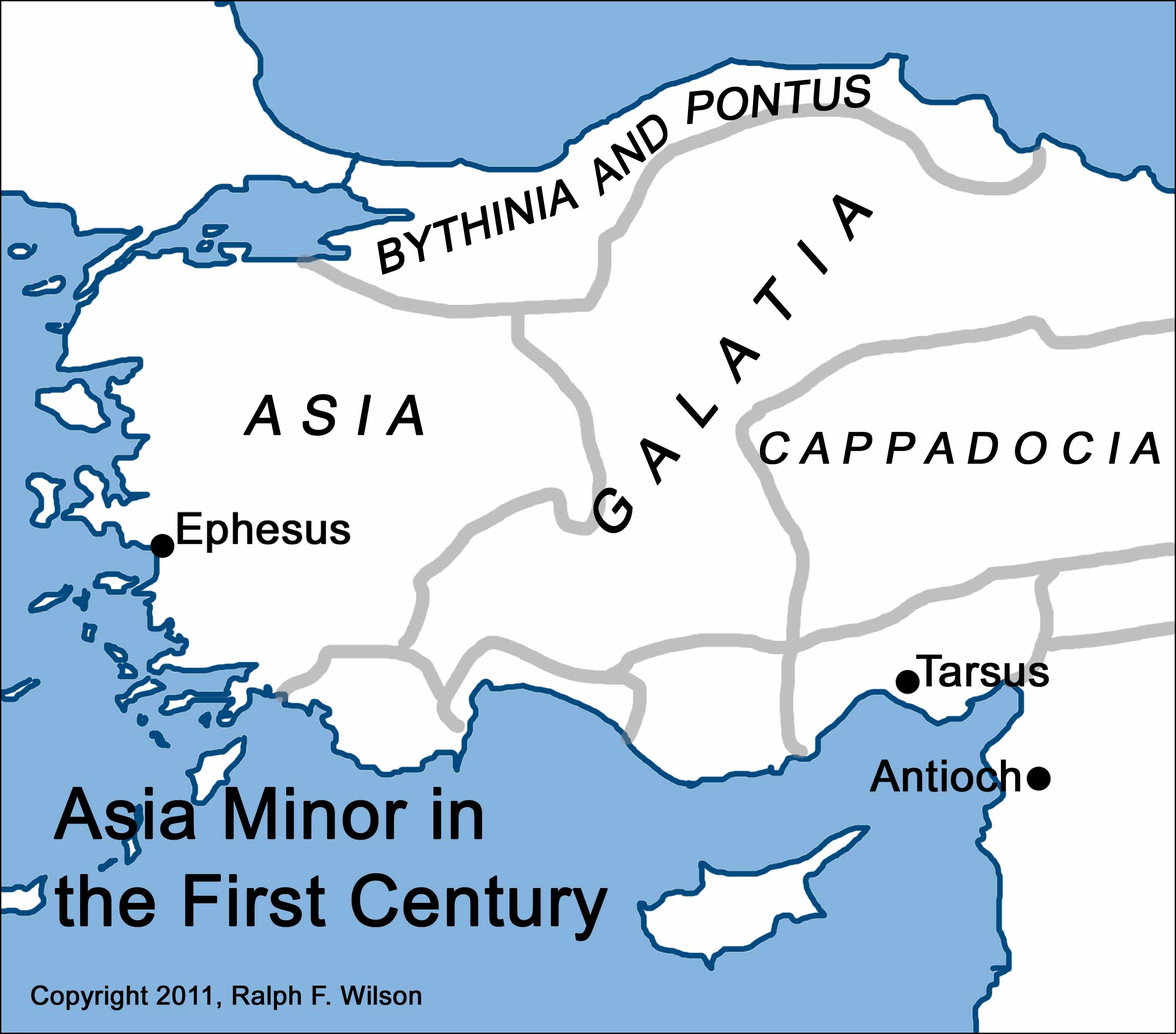
"Peter, an apostle of Jesus Christ, to the strangers scattered throughout Pontus, Galatia, Cappadocia, Asia, and Bithynia...." (1 Peter 1:1)
 Asia Minor in the First Century. Larger map. |
If you look at a First Century map of the Roman Empire you'll see that these are Roman provinces located in the northeast part of Asia Minor -- present-day Turkey. Paul had traveled in this area several times and established a number of churches. Now Peter addresses these Pauline churches.
The letter's recipients are further described as "strangers" (NIV, KJV), rendered rather accurately by the NRSV as "exiles of the Dispersion." The Jews who had moved away from Palestine into the cities of the Roman Empire were called the Diaspora, the Dispersion. But Peter doesn't seem to be referring here to Jews, but rather clearly to Christians, "who have been chosen ... for obedience to Jesus Christ...." (1:2). It seems that the concept of the Diaspora has now been appropriated by the Christian community to refer not to the Jewish Diaspora, but Christians who are scattered throughout the empire (see also James 1:1).
Author
The author clearly identifies himself as Peter, an apostle of Jesus Christ" -- an obvious reference to Simon Peter, a son of Jonah, and a leader of the first generation church.
The early church accepted this epistle as Peter's work without question -- which, in itself, is a bit surprising. The church of the first few centuries was inundated with letters and gospels purporting to be written by Peter. The church didn't have much trouble separating this letter from the host of pseudepigraphs -- writings in the name of a great church leader. The letter was widely quoted or alluded to by early Christian writings by Clement of Rome (ca. 96 AD), Ignatius, Barnabas, Hermas, and Polycarp (baptized 69 AD). It was specifically identified as Peter's work by early Church Fathers such as Papias, Irenaeus, Clement of Alexandria, Tertullian, and many others.
In modern times, when some scholars have disputed the authorship of nearly every New Testament book, 1 Peter has not escaped. Some reject Peter's authorship on these grounds:
- Its elegant Greek doesn't seem to reflect the language skills of a rough Galilean fisherman.
- The author is self-effacing and does not brag of his prominence.
- It shows some literary and theological dependence on Paul's epistles.
- Its historical period seems later than Nero's persecution.
- Some of the vocabulary of the letter also appears in the pagan mystery religions.
- It is classified by many as a baptismal sermon.
I don't see any of these as compelling arguments against St. Peter's authorship. Indeed, if the Apostle Peter didn't write this letter, then the author is someone taking a pseudonym, claiming to be Peter. The early church, which was quite familiar with this practice, wouldn't have taken such a document as authoritative -- but they obviously ascribed this letter to the apostle. Thus I feel confident in identifying the author as the Apostle Peter himself. Of course, Peter may have dictated the letter to a secretary who rendered it into excellent Greek.
Perhaps Silvanus could have served in this role, since Peter concludes his letter by saying, "With the help of Silvanus, whom I regard as a faithful brother, I have written to you briefly..." (5:12). This may be the Silvanus (sometimes referred to as "Silas") who was an associate of Paul (2 Corinthians 1:19; 1 Thessalonians 1:1; 2 Thessalonians 1:1) -- we just don't know for sure.
Persecutions and the Epistle's Date
It is difficult to affix a date independently of who is the author. Other than local persecutions, the first State-instigated persecution took place in 64 AD when Nero blamed Christians for the destruction of Rome by fire. Roman historian Tacitus tells us that Christians were persecuted by Nero with public approval for "hatred of the human race."[1] Early Christian tradition attests that both Peter and Paul lost their lives under Nero.[2] Other persecutions took place under Domitian in 95 AD. In 110 or 111 AD, Pliny asks Emperor Trajan for guidance as to what extent he should punish those who have been identified as Christians.[3]
None of these occasional historical references demands a date later that the 60s. So if we assume, as I do, that Peter is the author, we should probably date this letter near the end of Peter's life in 63-64 AD.
The author indicates that he is writing from the church that is in "Babylon" (5:13). Most likely, Babylon is used to designate the city of Rome, in the same way that it is used in Revelation 17-18.
Significance and Theology
Though it is only five chapters long, 1 Peter is an important Letter for us to study, since it contains a number of themes that Christian disciples must master if we would serve Jesus faithfully in our own day. Some of the main themes include hard lessons that you may have struggled with:
-
Appreciating our salvation rather than taking it for granted
In book form as PDF, Kindle, and paperback - Learning obedience and submission even though it's tough
- Practicing holiness without developing a sanctimonious smirk
- Living in the world without being tainted by it
- Emulating Christ's sacrificial lifestyle so it becomes our own
- Growing through our sufferings rather than being defeated by them
- Being faithful in our relationships with family, employers, and employees
- Grasping our true identity as God's people
- Preparing for judgment without being driven by fear
- Developing the character of leaders of which God can be proud
Though 1 Peter teaches us a lot about what God is like, it is also an intensely practical book that teaches us to grow and change in positive ways.
End Notes
[1] Tacitus, Annals, xv.44.
[2] 1 Clement 5.
[3] Epistle to Trajan, xcvi, xcvii.
Copyright © 2026, Ralph F. Wilson. <pastor joyfulheart.com> All rights reserved. A single copy of this article is free. Do not put this on a website. See legal, copyright, and reprint information.
 To be notified about future articles, stories, and Bible studies, why don't you subscribe to our free newsletter, The Joyful Heart, by placing your e-mail address in the box below. We respect your