


|
Old Testament
New Testament
Gospels
Acts
Paul's Letters
General Letters
Revelation
Topical Studies
Beginning the Journey (for new Christians). en Español

|
Old Testament
New Testament
Gospels
Acts
Paul's Letters
General Letters
Revelation
Topical Studies

|
Home
Bible Studies
Articles
Books
Podcasts
Search
Menu
Donate
About Us
Contact Us
FAQ
Sitemap


Free
E-mail Bible Study
 Names and Titles of God
Home | Bible Studies | Articles | Books | Podcasts | Search | Menu | Donate | About Us | FAQ | Contact Us
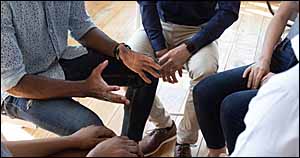 Discipleship group. Image: unknown |
We have explored Biblical models for the discipleship in Jesus' and Paul's ministry. We have examined spiritual disciplines and other elements of discipleship.
Now, employing the principles and biblical models we've seen, we'll focus on implementing some of them -- in your own life as a disciple and in your own personal ministry of discipling others.
I can only offer some tips -- whole books have been written here by insightful experts. But I will share some suggestions that I hope will strengthen you and your ministry.
7.1 Discipling Yourself
We begin by discipling ourselves. Perhaps "discipling yourself" sounds like an oxymoron, but you know what I mean. Discipling yourself means to deliberately present yourself afresh before the Lord to follow Jesus, to adopt his way of life, and include spiritual disciplines you practice that help you follow him faithfully. In Jesus' words, you are taking his "yoke" upon you (Matthew 12:28; Lesson 1.4.3).
Weak Influence without Current Growth
When you stop pressing in to follow Jesus, your influence begins to wane. People sense it, even though they might not know what is wrong. Families can tell when a parent is no longer really excited about the Lord, but just going through the motions. You, my friend, must keep growing by discipling yourself, if you want to have a positive influence on those around you.
At a Sunday morning service, I asked one of my discipleship group members how he was doing. His head dropped. "I'm slacking off on my spiritual disciplines," he said. "I'm not attending the discipleship group. I'm stuck." Sin had snagged him briefly. That's not uncommon -- for me, for you. We are human, after all. We sometimes coast, drift, get lazy. It's a reality. Sometimes trigger events occur that cause us to doubt and fear. Our faith is often under attack; we are engaged in a spiritual war with the enemy of our souls. I call you now to renew your life in the Lord.278
Never Been "Discipled"
Perhaps you've been a Christian for a long time, but have never been "discipled" by someone else. The very idea of discipleship may be foreign to your particular denomination or circle of churches. You want to walk in the way of a disciple, but much of this is new to you.
Here are some basic steps that will help you on your way to becoming a well-trained disciple. Or to get back on track if you've gotten derailed somewhere along the line.
All these elements are essential to spiritual maturity. If you omit any of them, you risk being lopsided. I've included a theme verse for each of the steps.
1. Surrender
It is no light thing to undertake to be a true follower, pleasing to Jesus. Re-surrender your life to him. If you are aware of sins in your life, confess and repent of them, and ask for Christ's forgiveness. Seek his help and guidance in your journey as a disciple. Any growth that happens in your life will come through the Jesus' Spirit working in you. As you give permission, the Holy Spirit will be able to mold and change you much more easily than if you resist.
"Therefore, I urge you, brothers, in view of God's mercy, to offer your bodies as living sacrifices, holy and pleasing to God -- this is your spiritual act of worship. Do not conform any longer to the pattern of this world, but be transformed by the renewing of your mind. Then you will be able to test and approve what God's will is -- his good, pleasing and perfect will." (Romans 12:1-2)
2. Mentor or Accountability Partner.
Second, you need a mentor or accountability partner of some kind who can give you honest feedback and occasional direction.
"Remember your leaders, who spoke the word of God to you. Consider the outcome of their way of life and imitate their faith." (Hebrews 13:7)
If you are a younger believer, find a person in your church of your same gender whom you recognize as spiritually mature and seems to take the Bible seriously. Even if the person is not in your town or village, find someone who has been walking with the Lord for a while.
Explain to them:
"I am trying to grow as a Christian disciple and I realize the need to draw on the wisdom of a person farther along in the faith than I am. Could I meet with you occasionally for an hour or so to discuss spiritual things and get your feedback?"
Bold, I know. But if they agree, arrange to meet with them and see where it goes from there. If this doesn't seem like the right person, seek another.
Even if you are a mature Christian, you'll still want to be growing. Select a peer with whom you can share spiritual things. Sharing helps you grow. Persistent habits are hard to break on your own. New spiritual disciplines are more difficult to establish when you aren't accountable to anyone. If you are a leader, your pastor might be that person. If your church has some kind of small group or discipleship group, by all means seek to be part of that!
If you are a pastor, you too will grow better as a disciple if you have a mentor -- or someone who can see you accurately and encourage you in Christ. You might find a fellow pastor in your city or village whom you can trust to share your struggles with and whom you respect enough to be able to receive a rebuke when needed. The pastor doesn't have to be of your denomination; sometimes it's better if they aren't. In some circles, this kind of person is called a spiritual director. Whoever it is, pray to God and he will help you find someone.
When you are a pastor and have an "image" to maintain, honest sharing can be difficult. I understand. But this is the path to growth and freedom for you. You won't be able to lead your people to growth, if you aren't growing yourself. You'll be a better disciple and a better pastor/leader as a result of reaching out to someone to walk the road with you.
3. Quiet Time
Make a regular appointment with the Lord, as we outlined in Lesson 5.3. Find a time and location for your appointment where you are not likely to be disturbed.
"Very early in the morning, while it was still dark, Jesus got up, left the house and went off to a solitary place, where he prayed." (Mark 1:35)
Morning is best, since you can lay out the coming day before the Lord. But some people just aren't "morning people." Any time is okay. Make this appointment for enough time. For a young believer getting started, I suggest a minimum of five minutes. But if you are serious about growing as a disciple; why don't you begin with ten or even fifteen minutes.
4. Spiritual Disciplines
In Lesson 5 and Lesson 6 we examined a whole array of spiritual disciplines that help a person be exposed to God's presence. Begin to build out a trellis or rule of life (Lesson 6.4) that fits your personality and the time you have available. Start small. Seriously! Don't load a huge yoke on your shoulders in order to get spiritual quickly, and then feel guilty if you can do it all. You can always add or modify, or prune your trellis if it becomes burdensome. Don't let yourself be driven to spirituality by a sense of duty. Relax. This is all about enjoying Jesus and basking in his presence.
In your daily Quiet Time, I recommend that you begin with prayer, a Scripture reading plan to get you through the Bible in a year or two, and a time of praise. God will guide you about adding other disciplines.
5. Listening for God's Voice.
An essential disciple skill is learning to discern God's voice when he communicates with you.
"My sheep listen to279 my voice; I know them, and they follow280 me." (John 10:27, NIV)
I recommend taking my free e-mail Bible study Listening for God's Voice (www.jesuswalk.com/voice/), which will help you get started. Notice that I call this a skill. All true believers have received the Holy Spirit who communicates God's messages to us. If you have a prophetic gift, you'll hear more and use those messages for others. But at the very least, you need to be able to discern and act on God's voice yourself. This is vital for disciples!
6. Community.
Find a Christian community and become an active part of it. If you want to grow, you need spiritual gifts that God has given through others. When you are cut off from a Christian community, you won't be able to receive some of these nor will you be able to use your spiritual gifts to build up others in turn.
"Let us not give up meeting together, as some are in the habit of doing, but let us encourage one another - and all the more as you see the Day approaching." (Hebrews 10:25)
7. Minister to others regularly and generously
Since the essence of Christianity consists of love, we cannot be selfish and hoard our time and resources. Rather, we should look for ways to serve that are congruent with our spiritual gifts (as we currently understand them). Part of this is giving of our resources to help Christ's mission and aid those in need.
"For we are God's workmanship,281 created in Christ Jesus to do good works, which God prepared in advance for us to do." (Ephesians 2:10)
I've given you some steps that will get you going. Ask your pastor to assist you. Remember, if you skip any of these steps, you won't mature properly. God will guide you the rest of the way as you seek him.
Q31. In what ways is God nudging you to deepen your walk with him? Where are you weak that needs strengthening?
7.2 Discipling Individuals
 Annie Vallotton, 'Help those who have all kinds of troubles' (2 Corinthians 1:4). © American Bible Society. |
After ordering your own steps as a disciple of Jesus, the next step is to help someone else. Only don't wait until you are perfect or you'll never begin.
It's usually best to start with an individual. Paul worked this way extensively. In Lesson 3.5, we studied imitation.
"Be imitators of me, as I am of Christ." (1 Corinthians 11:1, ESV)
The Greek noun comes from a verb that means to "imitate, represent, portray."282 A young believer begins to mimic or imitate us as a model of how a disciple lives. And in our disciple's presence, we mimic or imitate Christ. We are an intermediary between the new disciple and Jesus. A temporary intermediary, yes, but an important one.
God has many ways to connect us with needy people. But here are some possible steps in the process of discipling an individual.
Prayer and Observation
Begin with your own prayer to God: "Lord, is there a person you want me to encourage in You? Show me. Guide me." Then observe what happens.
You may find yourself drawn to a person in your church, at your work, or in your community. Or perhaps you'll find someone who seems drawn to you. Perhaps a person in your church has just come to Christ or made a significant step forward. Your pastor might ask you to encourage him or her in spiritual growth.
When a crisis comes -- illness, injury, death, divorce, family problems, job loss -- even "closed" people can be open to growth in Christ. Their defenses against God's work in them have been shaken. Someone might come alongside them and find them wide open to Christ and spiritual growth.
If you are older, perhaps you feel that younger people wouldn't be interested in your spiritual friendship. You might be surprised how many younger people are seeking the wisdom and care of someone older. At this stage of your life, you have more to offer than when you were young and stupid. God has invested greatly in you. Now may be a time when you can give back.
Approaching a Possible Learner
Open up a conversation about spiritual things. If they seem interested, you might say something like, "If you like, we could get together and talk about how to live out our Christian faith." Offer an invitation to meet. If they seem open, set a time and a place. "Starbucks on Tuesday about 4:30 pm would work for me. How about you?"
I discourage a discipling relationship with a person of the opposite sex, unless it's your spouse. We humans are sexual beings. We are prone to getting our motives and attractions mixed up, which can get us into trouble. Best to stick with the same sex for the intimate relationship of discipling.
Get Together
Pray before the meeting. "Lord, is there a Scripture on my heart right now that I could share with them?" Sometimes it will be patently obvious that God has been preparing you and them for just this meeting. Or perhaps not.
Spend some time getting acquainted at the coffee shop or wherever you've decided to meet. Ask gentle questions to learn about them. Share a bit about yourself and your spiritual struggles, but don't monopolize the time. Focus on drawing them out.
You may find them closed and unresponsive. Okay. You tried. But you may find them open and hungry for God, needing a friend who cares about what is going on with them.
Your role may be just to listen or be a one-off encourager. That's fine. If the meeting seems to have gone well, you might ask, "Should we get together again? Perhaps in a couple of weeks?" Try to discern if a positive answer is just them being polite or if there is real interest. If so, that may help confirm that God is putting something together.
Next Steps
Bathe this in prayer. If your meetings continue, you might want to introduce some kind of informal curriculum. "Next time we get together, let's look at a chapter in Mark's Gospel" or "John's Gospel" or something like that.
What might you study? (see Lesson 4.2). For brand new believers, you could start with my JesusWalk: Beginning the Journey,283 a 12-lesson video series that provides talking points for mentors and detailed instructions for meetings. For Christians who have been walking with the Lord for a while, I would recommend using as a guide Appendix 1 in Leroy Eims' The Lost Art of Disciple Making (NavPress, 1978, still in print).
Navigators' discipleship resources are very usable for both one-on-one discipling and small groups.284 You'll find over 50 of my studies in the JesusWalk Bible Study Series that can be used to study with another person or group (www.jesuswalk.com/). And I'm just scratching the surface of the wealth of resources available.
I recognize, however, that how I approach this is conditioned by my personality and my experiences. What works for me, might not work for you. There are many approaches. Read Appendix 2. Various Approaches to Discipling. Perhaps you'll find one or more tips or ideas that fit your own personality and circumstances.
Involve Your Disciple in a Christian Community
A vital step for any discipler is to help your disciple become a part of a Christian community. It is quite natural to invite the person to your church and ask them to find you and sit with you. Introduce them to others.
Unless your disciple becomes part of a Christian community, their connection to Christ and his work is you alone -- a very thin string on which to hang their spiritual future. When they become incorporated into a Christian fellowship, there are many relationships, new spiritual gifts to draw from, and a strong bond for the future.
Ending a Discipling Relationship
Remember our role? Models to be imitated.
"Be imitators of me, as I am of Christ." (1 Corinthians 11:1, ESV)
It is a big responsibility, but it is normal, like a young child being dependent upon his parents. But the goal of parenthood is to help the child become independent of you. Your goal as a discipler is to gradually take their hand from yours, and place it in the hand of Jesus, so that instead of following you whom they can see, they gradually begin to follow Jesus who is unseen. It is a process.
At some point, all mentoring and discipling relationships come to an end. They become obsolete. The goal is for our disciples to outgrow us and move on. It can be painful. You might feel rejected, not needed. Grow up! Like a father or mother, there is pain when the children leaving the nest, but they must.
Emotionally immature parents cling to their adult children, keep them dependent, or try to continue to control them. This is what cult leaders do. It is both psychologically sick and dangerous for both you and your disciple. You are God's servant, God's co-worker in helping them grow. But God is the senior partner. Trust your disciple into his hands. He is faithful! We need to let them go. God is their Father.
Q32. Are there any individuals around you that God seems to be prompting you to get together with to help them on their Christian walk? What fears do you have about doing this? What resources do you have available in your church or larger Christian community that can assist you?
7.3 Discipling in a Small Group or Class
In Lesson 2 we examined Jesus discipling a group of twelve, plus some others. Of course, he lives with the Twelve day in and day out for several years. In a church setting, we can seldom do that. But with weekly meetings and some social get-togethers, we can take advantage of some of the strengths in discipling in a group. Scale and time, of course, are factors. Individual discipling is wonderful; it can be tailored to a person's individual needs. But discipling a small group can produce even a stronger effect. Let me explain.
1. Groups Affect Values and Behavior
Church Growth consultant Carl F. George taught me the importance of small groups in discipleship.285 He explains, "The groups we join affect our values and behavior." The field of social psychology studies how groups work, both healthy groups and unhealthy ones.286 Groups are powerful. Studies have found several important truths about how human groups function.
a. Groups produce conformity. The human impulse to conform is powerful. Positively, a group can support good behaviors. Alcoholics Anonymous is an example of how the group helps reinforce values and behaviors in a way that can help extract a person from destructive habits.287
b. Groups police behavior through the threat of ostracization, helping keep participants in line with the norms of the group. Though this may sound negative, it has been found successful in reforming bullies, protecting less assertive members, and encouraging cooperation.288
c. Groups normalize behaviors. We tend to behave like others around us. If a group says a behavior is okay, we are likely to believe that it is normal. Note that conformity and normalization are slightly different. Conformity is about behavior; normalization is about perceived rightness or wrongness.289 If the norms of a group are corrupt, such as those of a street gang, you begin to approve of corrupt behavior. But if the norms of the group are good and loving and selfless, you will gradually approve of those behaviors for yourself. Your values will change.
d. Groups intensify attitudes. When our opinions are reinforced by others, being part of a group makes us more certain our opinions are right, and less prone to succumb to counterarguments. Social psychologists call this phenomenon group polarization.290
If you're like me, you can see the sinister potentials of "group think," and want to shun all this. And in the hands of a manipulative leader, groups can become dangerous and manipulative cults. However, rejecting groups because of possible dysfunctions is useless. Group behavior is merely descriptive of how humans typically respond to groups -- for better or for worse.
One response to this might be to isolate yourself, become a loner, and avoid all groups. But that isn't what Jesus did. He formed a group of disciples so that the power of group dynamics could assist him in the discipling process. If we ignore these dynamics, we become less effective as disciplers.
Whatever discipling approach you find best for you, realize that early on in the process you must introduce your disciple to some kind of Christian group or church. Being part of a Christian community is key to your disciple's spiritual maturity.
Q33. What are some of the ways small group ministry can be more powerful than individual discipling?
2. Differences between a Discipleship Group and Other Small Groups
What's the difference between a discipleship group and other kinds of small groups? The short answer is that discipleship groups focus on maturing disciples rapidly.
Discipleship typically has two periods:
1. Rapid maturity. Discipleship groups can help new or unformed believers to grow rapidly into becoming active, mature disciples of Christ. This happens best in a group designed for it.
2. Maintaining and developing. After some growth in discipleship, disciples need to be part of some kind of small group that maintains, stimulates, and grows that faith, and encourages ministry and use of spiritual gifts. Both types of groups are legitimate; they just serve slightly different purposes.
We need some perspective. Since the mid-twentieth century the church has focused on what we call discipleship. But the Church has been producing mature disciples from novices and catechumens for many centuries, albeit not always with great efficiency.
Also, realize that group names vary from one church to another, one denomination to another. The exact definition of a "life group" or "connect group" or any of a hundred names is locally defined. There is no single authoritative definition.
Nevertheless, a Bible study group typically focuses on studying the Bible. As size increases, it tends to become a lecture format. Small groups will have more interaction, accountability, and sharing.
A discipleship group -- whatever name you give it -- is a group designed to form disciples of Jesus. This can't be accomplished efficiently with a lecture or leader-focused format. Typically, a discipleship group includes sharing of lives, accountability, and encouragement of spiritual practices such as a quiet time, and group prayer.
While they may or may not be called "Bible studies," most discipleship groups contain a Scripture component. The Word of God is an essential food for growth in Christ's image. "Grist for the mill," so to speak.291
Discipleship groups that don't have a strong Bible component might be emotionally safe groups to share and support one another, but not necessarily to build strong disciples of Jesus. Alcoholics Anonymous groups are strong on fearless sharing and accountability, but their purpose is to help men and women get free from addiction to alcohol and drugs. Sharing and honestly alone don't produce disciples of Jesus. Jesus is always teaching his disciples along with group interaction.
Modifying Bible Studies to Form Disciples
Some Bible studies, on the other hand, have done a spectacular job in changing lives to be like Jesus. What makes the difference? In addition to Bible study, these group structures often include:
- Discussion. Provide challenging questions that force people to grapple with the real issues.
- Application. Challenge one another to make the changes in our lives that Scripture dictates.
- Disciplines. Encourage and provide feedback about taking steps to adopt spiritual disciplines that deepen spiritual life.
- Sharing. Add a more intimate sense of community -- caring and sharing.
- Prayer. Institute prayer by group members for one another and the needs around us and of the world.
If you are a teacher, don't stop teaching in your Bible study. But shift the structure of the Bible study to include relational elements. Larger groups sometimes break into smaller sharing groups during the session for discussion, sharing, and prayer.
Not everyone in the group will accept changes to their rigid traditions, but as you are able to make these changes, your Bible study will be much more effective in maturing disciples of Jesus.
3. Structure for Discipleship Groups
There are many ways to lead an effective discipleship group.
A Variety of Discipleship Groups
What works for you largely depends upon how God has gifted you as a leader. My primary gift is teaching. Yours might be hospitality or serving or encouragement or whatever. God has wired us all differently, so strict uniformity in group structure might be counter-productive. Your group will be different from mine -- and that's quite okay!
If your group is newly formed, it will be different than a group that has met together for years. Some groups are designed for only 6 to 8 weeks. Other groups might be designed for men or women. Our high school ministry has discipleship groups of four or five people currently led by adults. Each will have its own particular flavor.
In addition to discipleship groups, God uses small groups for evangelism, support, help with addictions, as well as interest groups such as Christian motorcycle clubs. That's great! Our focus here, however, is groups designed for discipleship.
Please read Appendix 2. Various Approaches to Discipling. If you look carefully, you'll see lots of adaptation, depending upon the leader and the group. I hope you find it both encouraging and enlightening, filled with tips that might resonate with your situation.
Structure of My Discipleship Groups
Let me share how I conduct the two men's discipleship groups I currently lead, made up of middle-aged to older men who have been walking with the Lord for a while. This is not the "perfect" model, but may offer some ideas for you and your situation.
Weekly meetings. Let me describe each of the groups. The first meets on Tuesday mornings. It began as a church small-group men's Bible study that met for years at a Denny's restaurant. Since Covid, we moved to Zoom and stayed with it for convenience. Though now we all go to different churches, we get together for lunch every two or three months. The group consists of six of us. We'll typically have five attendees each week.
The second discipleship group of men from my church meets on Tuesday evenings. We used to meet in a Panera Bread restaurant but, with Covid we moved to Zoom, and stayed there, since participants live miles apart. The group has eight on the roster, but typically, we'll have five attendees on a given evening. We're always on the lookout for men to invite who are new to our church who need a challenge.
We do a "check in" occasionally concerning spiritual practices and daily time with Jesus. I generally e-mail a reminder to participants a day before the meeting.
The groups have three parts
1. Sharing (about 35% of the overall time). We begin with sharing what's been going on in our lives. Sometimes I'll ask, "Where have you seen God lately?" to help train people's perception of God working in their lives. When someone is going through a crisis, the level deepens rapidly. We'll listen and then pray about it before going on. People are not forced, but share as they gain trust in the group and in the confidentiality of what they share. The sharing time is also designed to build friendships so we can support each other.
2. Bible study (about 40% of the time) I'll lead the study of a chapter or two (sometimes less) from the part of the Bible we are exploring.
My approach is to give a bit of context and background. One of the participants reads the passage. Then I ask questions that force group members to grapple with the main points of the passage. I try not to answer my own questions, unless no one is even close. This Socratic method of teaching helps people engage deeply in the text. If I were to merely tell them what it said, it wouldn't long be remembered. But a passage they think about and talk about will help change their lives. Educators call this "engaging the learner."
I am convinced that encountering God's Word changes us; without making Scripture central to the discipleship group leaves a key element necessary to grow in a rounded way. That my primary spiritual gift is teaching helps explain why Bible study is central.
3. Group prayer (about 25% of the time). I'll typically ask: "What needs prayer in your world?" Participants share needs. Sometimes political concerns are brought up. I do my best to keep the discussion apolitical, rather than encourage political party talking points from the left or the right. We try to pray for issues generally without telling God what our opinion is about what he should do. We have a kind of conversational prayer in which everybody participates to the degree they are comfortable.
Other elements:
Discipleship challenges. Occasionally, I'll bring up spiritual disciplines and have people talk about what their Quiet Time looks like. As a group we provide reinforcement for consistency in practicing a personal rule of life. One of the groups takes time to go over the church's monthly Scripture memory verse.
Get together outside the group. Ken Braddy makes the point that in healthy small groups, members also get together outside of group meeting times. He argues that it (1) builds trust to deepen spiritual growth, (2) creates space for real-life ministry, and (3) strengthens the church's witness when the community sees what the love of Christ looks like in everyday life.292 One of my groups gets together for lunch every two or three months. The other group sees each other regularly at church, as well as at men's ministry events such as pickle ball and cornhole tournaments, game nights, and quarterly men's breakfasts.
4. Ideal Group Size
What is the best size for a discipleship group?
Jesus discipled twelve men, plus some others. Is twelve the ideal size for a discipleship group? I don't think so. First, Jesus is trying to make the point that the twelve apostles are the basis of a New Israel, with its own twelve tribes (Revelation 21:12-14; Luke 22:28-30). Second, Jesus isn't leading a weekly meeting of 45 minutes to an hour and a half. He lives with these men day and night for three years -- plenty of time to draw them out in discussion and personal ministry. So unless you plan to live with your disciples or have a teacher-centered group, twelve is probably not ideal.293
Bigger is not better when it comes to growing disciples! Seeing your group grow is exciting and helps stroke your ego. But after a certain point, the group becomes less effective as a discipling group, and moves in the direction of a teacher/audience type group. Large churches know this. Most work very hard (with varying effectiveness) in getting members involved in some kind of small group, because that is where the most effective growth takes place.
What is ideal for a discipling group? Three to eight is perhaps best.294 There is no right answer. In my experience, three is too small because if one person doesn't show up, you revert to a teacher-student model. Studies of small group dynamics indicate that by the time you get beyond twelve people, shy people have already stopped sharing.
I've found that six to eight total is a sweet-spot for my style -- large enough to have a good discussion, but small enough that I can "read" the faces to know who is hurting, who wants to add something, who is trying to hide, etc. On any given week, two or three will likely be missing.
5. Closed or Open Group?
Disciple groups require some kind of commitment. They need to be closed groups, not ones where attendance is casual. Trust in confidentiality needs a closed group. However, groups could be willing to grow if a person wants to be part and will commit to the group norms. If a group gets too big this way, then split it.
6. Relationship to Church
You can't make well-rounded disciples without encouraging them to join a Christian community! A Christian community is vital to both evangelism and then discipling the new believers to become mature Christ-followers.
Since Covid -- and perhaps before -- some Christians have developed the bad habit of not attending church. Watching church on TV or YouTube is not a substitute for face-to-face involvement in the life of a community. It's better than nothing if you are bedridden, but not enough for disciples to mature and grow properly.
Some say, the Christian churches in my town are all too liberal, or too political, or too fundamentalist, or too something -- so I don't go any more. I understand your discouragement, but don't let Satan use this to neutralize your evangelistic and discipleship ministry.
If you must, find some other unchurched people and begin to meet together weekly, at least until you can find a faithful church. No, don't meet out of mutual anger and spite at other churches' unfaithfulness. A gathering of the disaffected or proud puritans will be dysfunctional almost by definition! Meet together to worship the risen Christ and to "encourage one another -- and all the more as you see the Day approaching" (Hebrews 10:25).
If you are in a church, seek your pastor's permission to start your own discipleship group. John Wesley (1703-1791) started "class meetings" and "band meetings" to provide support for people while they attended existing Anglican congregations on Sundays. Wesley's classes and societies revolutionized the Christian faith in England.
New disciples need healthy fellowship in order to mature properly. "Healthy" doesn't have to be "perfect." There is no perfect Christian community. And if there is, once you join it, it will cease to be perfect. (Smile.) Imperfect families with some degree of dysfunction can still produce good children. "I won't accept any dysfunction." Good luck with that.
Q34. What differences do you see between "standard" small groups and the kind of discipleship groups we are talking about?
Q35. After reading the above and Appendix 2. Various Approaches to Discipling, what approaches or techniques do you think you might add to your ministry of growing disciples?
7.4 Discipling as Pastor
We've looked at discipling yourself, discipling and individual, and discipling in small groups. How do you get to a point where your church becomes serious about discipleship and living as true disciples? How do you take an average congregation and move it to the point that a large percentage are following Jesus closely in their everyday lives?
Two things I am convinced of. First, you as pastor must make a fresh personal surrender to follow Jesus day by day as his disciple. Not to be a churchman. Not to be a professional Christian. But to simply be a follower of Jesus -- he and you walking, talking, and working together. Unless you are growing in Christ yourself, you won't be able to lead others in growth.
Second, if you are not already doing so, you as a pastor need to be discipling others personally -- either individually or in a small group. If you are not doing this in person, you'll never be able to lead a culture change that makes discipleship your church's central focus. It begins with you!
Having said that, I want to humbly suggest that I am not the person to write a book about changing the culture of a church to one of discipleship. I've made some steps as a pastor myself. And I have watched my current pastor successfully lead a church into discipleship, but I haven't led that effort successfully myself. Fortunately, others have gone before us.
Over the past couple of decades, many authors have shared their church's journey to discipleship. Instead of me trying to synthesize these ideas developed by others, let me point you to some helpful authors and books.
Breen. Mike Breen, Building a Discipling Culture (third edition; 3DM International, 2017). This British author describes moving away from discipleship as a program to a culture that permeates every aspect of church life. Focuses on changing language, rhythms, and systems to foster natural, everyday discipleship.
Coleman. Robert E. Coleman, The Master Plan of Evangelism (second edition, original published 1963; Revell, 2010). This classic book analyzes how Jesus focuses on investing in a few to reach the masses, emphasizing principles like selection, association, and delegation.
Gallaty and Swain. Robby Gallaty and Chris Swain, Replicate: How to Create a Culture of Disciple-Making Right Where You Are (Moody Publishers, 2020). Practical guide on how to shift a church toward a disciple making movement, offering specific steps on how to get leadership and the congregation on board with a relational approach.
Guindon. Brandon Guindon, Disciple-Making Culture: Cultivate Thriving Disciple-Makers Throughout Your Church (HIM Publications, 2022). A guide for leaders looking to cultivate a healthy, reproducible culture of discipleship, focusing on how to train others and move from attending to making disciples.
Hull. Bill Hull, The Complete Book on Discipleship: On Being and Making Followers of Christ (NavPress, 2006). Comprehensive, textbook-style resource combining research and practical experience. Helps develop a theological and practical foundation for discipleship.
Marshall and Payne. Colin Marshall and Tony Payne, The Trellis and the Vine: The Ministry Mind-Shift that Changes Everything (third edition, original published 2009; Matthias Media, 2023). Australian authors provide a framework for shifting from a "trellis" (structural/program-driven) ministry to a "vine" (person-driven/disciple-making) ministry, encouraging leaders to invest in people rather than just maintaining structure.
Ogden. Greg Ogden, Transforming Discipleship: Making Disciples A Few at a Time (IVP, 2003). Addresses the "low estate" of discipleship and argues for the necessity of intimate, small-group (triad or quad) structures as the most effective, biblical method for truly transforming lives.
Pope. Randy Pope, Insourcing: Bringing Discipleship Back to the Local Church (Zondervan, 2013). Advocates for "life-on-life" missional discipleship, focusing on personal, relational, and intentional accountability, rather than reliance on church programs for spiritual growth.
Putman, Harrington, and Coleman. Jim Putman, Bobby Harrington, and Robert Coleman, DiscipleShift: Five Steps That Help Your Church to Make Disciples Who Make Disciples (Zondervan, 2013). American authors outline five key shifts necessary for churches to transition from attracting crowds to building a disciple making culture -- moving from (1) reaching to making, (2) informing to equipping, (3) program to purpose, (4) activity to relationship, and (5) accumulating to deploying.
Of course, books cost money -- even used copies of the books above. Discpleship.org offers books for sale and an annual conference -- the National Disciple Making Forum. But they also offer a multitude of free resources, such as free e-books and a blog. And, if you'd like to learn more, you can also find a multitude of interviews and talks on YouTube as you search on each of the authors listed above.
Pastors, I hand you over to these more experienced brothers for the next phase of your discipleship leadership journey, that of changing a church culture to focus on discipleship.
Epilogue
My friend, you've learned a lot. Now, what are you going to do about it?
First, I pray that you will deepen your own level of following Jesus and listening for his voice. You know what to do and how to do it. Will you? What concrete steps have you taken over the course of this study? What steps must you take now to be the disciple Jesus calls you to be?
But there is a second challenge -- bringing others with you on your walk with Jesus. Now, next month, and going forward, I call you to seek God for how you can fulfill your own role in making disciples.
Helping one single person to begin to follow after Jesus as his disciple is huge! Over your lifetime, you may be key to helping several individuals learn what it means to be a disciple. Perhaps you'll lead a small group of sincere men or women that helps them walk as disciples of Jesus. Perhaps you are a leader or pastor. Your challenge is to lead your congregation from church-as-usual to a culture of discipleship, advocating sincere personal following of Jesus as a way of life.
But I'm an evangelist. I'm only a layman, you say. I'm not a teacher or discipler. Perhaps, but you can put your arm around the shoulders of an eager believer who wants to learn more about Jesus. And you can encourage them to walk a stretch of the road with you. And at the end of that stretch, they will be strengthened, more mature, and ready to take the next leg with Jesus himself. You can do this!
Feel overwhelmed? At its root, the journey begins rather simply. Two thousand years ago, Jesus walked along the rocky shore of Galilee, with the gentle sound of its waters lapping at the edge. He saw two men, brothers, Peter and Andrew throwing out a net to catch some fish.
"'Come, follow me,' Jesus said, 'and I will make you fishers of men.' At once they left their nets and followed him." (Mark 1:17-18)
Dear friend, following Jesus is your path too. But to follow him fully, you must leave something behind. Will you do that? Will you follow him and tie your life's journey to his.
Now we conclude this overview of discipleship. We have defined what discipleship is and examined how both Jesus and Paul discipled men and women. We have explored elements of discipleship training, particularly spiritual disciplines or practices that can help transform one's life. Finally, we've looked briefly at the process of making disciples individually and through small groups.
 Available in book formats: paperback, Kindle, PDF |
My prayer is that as a result of this study, you will be prompted by the Spirit to grow deeper as a disciple, and disciple others so they join you on life's greatest journey, the walk with Jesus.
Prayer
Father, after all is said and done, we come to You to direct us. I pray that You will inspire and empower Your people to be disciples and become disciplers of others. That they might bear much fruit and so glorify You. In Jesus' name, I pray. Amen.
Endnotes
[278] Read my article, "Press On, Press In to Know the Lord (Hosea 6:3)," The Joyful Heart, February 17, 2026 to help get you back on track.
[279] "Listen to" (NIV), "hear" (ESV, NRSV, KJV) is akouō, "hear, listen to" (BDAG 37, 1c).
[280] "Follow" is akolutheō, "to follow someone as a disciple, be a disciple, follow" (BDAG 36, 3).
[281] "Workmanship" (NIV, ESV, KJV), "what he has made" (NRSV) is poiēma, "that which is made, work, creation" (BDAG 842).
[282] "Imitators" (ESV, NRSV), "imitate" (NIV), "be followers" (KJV) is mimētēs, "imitator," from the verb mimeomai, "to imitate" (BDAG 652, a; Liddell-Scott 1134).
[283] Ralph F. Wilson, JesusWalk: Beginning the Journey (JesusWalk Publications, 2009; https://www.jesuswalk.com/beginning/)
[284] Navigators discipleship resources (www.navigators.org/topic/discipleship/).
[285] Carl F. George is the author of many books, including, Nine Keys to Effective Small Group Leadership (Center for the Development of Leadership for Ministry, 2007).
[286] "Why Do People Act Differently in Groups Than They Do Alone?" Walden University. Unattributed article designed to encourage online enrollment in the University's social psychology classes.
[287] The Solomon Acsh conformity experiments demonstrated that group conformity can be so powerful, that it can overwhelm our better judgment. But healthy groups can help individuals tremendously. See Wikipedia article, "Acsh conformity experiments."
[288] Matthew Feinberg, Robb Willer, and Michael Schultz, "Gossip and Ostracism Promote Cooperation in Groups," Psychological Science, March 2014 (Vol 25, Issue 3), pp. 656-664.
[289] To "normalize" is "to make (something) conform to or reduce (something) to a norm or standard" (Merriam-Webster Dictionary.
[290] Article, "Group polarization," Wikipedia.
[291] "Grist" is another word for grain, thus "grist for the mill," means grain or corn to be milled into flour.
[292] Ken Braddy, "Beyond Bible Study: Why Group Members Must Connect Between Gatherings," KenBraddy.com newsletter, February 2026.
[293] Ken Braddy, who comes from an adult Sunday school perspective, sees the ideal as 8 to 12. He says, "At this size, people can be discipled. They can be discipled in a way similar to the way Jesus discipled his group. People can be known. People can be developed. People can be encouraged and trained to do ministry. People are missed and followed up with at this size.... So my final answer is: a group of 12, plus or minus 4."Ken Braddy, "What's the right group size?" KenBraddy.com, January 4, 2018.
[294] Pattern Platform sees 3-8 (Pattern Platform, "What's the Best Size for a Small Group?" Blog patternplatform.app, October 2, 2025 (author not stated). Greg Ogden sees three or four as the ideal size (Greg Ogden, Discipleship Essentials: A Guide to Building Your Life in Christ (IVP Connect, 2007)).
Copyright © 2026, Ralph F. Wilson. <pastor joyfulheart.com> All rights reserved. A single copy of this article is free. Do not put this on a website. See legal, copyright, and reprint information.