


|
Old Testament
New Testament
Gospels
Acts
Paul's Letters
General Letters
Revelation
Topical Studies
Beginning the Journey (for new Christians). en Español

|
Old Testament
New Testament
Gospels
Acts
Paul's Letters
General Letters
Revelation
Topical Studies

|
Home
Bible Studies
Articles
Books
Podcasts
Search
Menu
Donate
About Us
Contact Us
FAQ
Sitemap


Free
E-mail Bible Study
 Names and Titles of God
Home | Bible Studies | Articles | Books | Podcasts | Search | Menu | Donate | About Us | FAQ | Contact Us
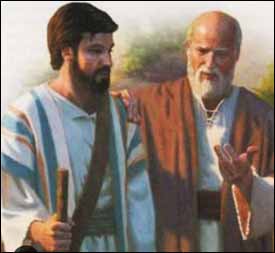 Paul and Timothy, unknown artist. |
Though Paul never meets Jesus in the flesh nor is discipled in the same manner as the Twelve, he becomes one of the most effective disciplers of the first century. We have lots we can learn from him.
We've examined Jesus' disciple making in some detail, partly since we have so much narrative material in the Gospels to draw from. With Paul, too, we have an abundance of material -- both the narrative of the Book of Acts and clues scattered throughout his numerous letters.
Let me highlight several avenues of insight into Paul's ministry of making disciples.
- Paul's goal -- maturity in Christ.
- Paul's teaching on spiritual formation.
- Paul's methods: correct, rebuke, exhort.
- Paul's portraits of a disciple maker.
- Paul uses his personal example.
- Paul prays for his disciples.
- Paul mentors co-workers.
- Paul extends his influence through letters.
We begin with Paul's goal, then explore some of his disciple making strategies.
3.1 Paul's Goal: Maturity in Christ (Colossians 1:27-29)
Paul gives us his disciple making goal at the beginning of Colossians.
"27 To [the saints] God has chosen to make known among the Gentiles the glorious riches of this mystery, which is Christ in you, the hope of glory.
28 We proclaim him, admonishing and teaching everyone with all wisdom, so that we may present everyone perfect in Christ. 29 To this end I labor, struggling with all his energy, which so powerfully works in me. (Colossians 1:27-29)
Let's pause here for a few minutes to absorb just what Paul is saying.
Christ in You, the Hope of Glory (Colossians 1:27b)
I'm particularly interested in the latter part of verse 27:
"Christ in you, the hope of glory." (Colossians 1:27b)
Who is Christ in? The context indicates that the object is the Gentiles, in particular, the Gentiles in the Colossian church. However, the statement's truth can also apply to individual believers throughout time -- Christ in you personally, the hope of glory.
In what sense does Christ in us constitute our "hope of glory"? What does this mean?
Glory (kābôd)
"Glory" first appears in the Old Testament in the word kābôd, a word meaning "weightiness, honor," associated with the brilliant light and overwhelming splendor of God's presence "like a consuming fire" (Exodus 24:17). When Moses speaks to God, his face retains the afterglow of God's glory (Exodus 34:33-35). Angels of God wear brilliant white clothing with an appearance like lightning (Matthew 28:3). God "lives in unapproachable light" (1 Timothy 6:15-16).
The New Testament indicates that we disciples are to experience God's glory -- his amazing, transforming presence and fullness -- now in this life and in the life to come. The truly amazing thing to me is that Christ in me is the hope of my own experience of and participation in God's glory in the present time. Elsewhere, Paul says,
"And we all, with unveiled face, beholding the glory of the Lord, are being transformed95 into the same image from one degree of glory to another. For this comes from the Lord who is the Spirit." (2 Corinthians 3:18, ESV)
Yes, we experience Christ's glory now, but in a real sense, it is the presence of Christ in us that is our guarantee of future glory with him.96 We'll consider this passage further in Section 3.2.5 below as we discuss sanctification.
Present Everyone Perfect in Christ (Colossians 1:28)
Paul explains, "Christ in you, the hope of glory." Then he continues.
"We proclaim him, admonishing and teaching everyone with all wisdom, so that we may present everyone perfect in Christ." (Colossians 1:28)
Paul's purpose is to bring those disciples under his care to maturity in Christ. The word translated "perfect" (NIV, KJV), "mature" (ESV, NRSV) is teleios. The word can mean, "perfect, pertaining to meeting the highest standard," or "pertaining to being mature, full-grown, mature, adult" or "pertaining to being fully developed in a moral sense."97 We don't achieve complete perfection in this life; Paul's goal is maturity in Christ!
Paul is frustrated by divisions in the Corinthian church (1 Corinthians 3:1).
"Brothers, I could not address you as spiritual but as worldly98 -- mere infants in Christ." (NIV)
Nevertheless, we can come to a level of relative maturity in Christ. That is Paul's goal.
"... So that we may present everyone perfect in Christ." (Colossians 1:28b)
When Paul presents99 his converts and disciples to God as the fruit of his labor, he wants to be proud of them.
Paul's Methods of Bringing Spiritual Maturity (Colossians 1:28-29)
Verse 28 not only states Paul's final purpose. It also lays out his methods of achieving maturity:
"We proclaim him, admonishing and teaching everyone with all wisdom, so that we may present everyone perfect in Christ." (Colossians 1:28)
He mentions three methods:
"Proclaim" (NIV, NRSV), "preach" (KJV) is katangellō, "to make known in public, with implication of broad dissemination, proclaim, announce."100 This probably refers to Paul's public ministry, heralding the Christ to those who haven't heard the news.
"Admonishing" (NIV), "warning" (KJV, NRSV) is noutheteō, "to counsel about avoidance or cessation of an improper course of conduct, admonish, warn, instruct."101 This method of perfecting the saints is more private -- done either with a smaller group of believers or one-on-one.
"Teaching" is didaskō, "to provide instruction in a formal or informal setting."102 This is the everyday instruction that would go on with individuals, families, and in the meetings of the believers. Notice the qualifier, "with all wisdom." Paul's teaching -- and ours -- must be carefully suited to the needs and spiritual level of those we instruct.
Finally, verse 29 details the work involved in bringing the saints to maturity in Christ.
"To this end I labor, struggling with all his energy, which so powerfully works in me." (Colossians 1:29)
The phrases "labor, struggling" (NIV) "toil and struggle" (NRSV, ESV), "labor, striving" (KJV) translate a pair of words:
-
Kopiaō means to "to exert oneself physically, mentally, or spiritually, work hard, toil, strive, struggle."103
-
Agōnizomai, literally and figuratively, "engage in a contest." Then generally, "to fight, struggle."104 The Greeks and Romans were big on athletic contests, so agōnizomai could refer to wrestling, or some other sport. (For more, see Lesson 5.1 on 1 Timothy 4:7-8.)
Bringing people to maturity for disciplers -- or as pastors and teachers -- is hard work. In the next verse, Paul uses this word agōnizomai to talk about wrestling in prayer for the believers.
"I want you to know how much I am struggling for you...." (Colossians 2:1; cf. 4:12)
Paul labors at it constantly, as must we. But he doesn't do it alone. He relies on the Holy Spirit -- "all his energy, which so powerfully works in me" (Colossians 1:29b).
Q15. (Colossians 1:27-29) What does relative maturity in Christ look like? What English verbs in verse 28 describe Paul's activity to bring maturity in his disciples?
3.2 Paul's Teaching on Spiritual Formation (morphoō)
We humans start with a character and thought patterns that are far removed from what God is thinking, purposing, and planning for his world.
"'For my thoughts are not your thoughts,
neither are your ways my ways,'
declares the LORD.
'As the heavens are higher than the earth,
so are my ways higher than your ways
and my thoughts than your thoughts.'" (Isaiah 55:8-9)
Without change, we'll never understand God and his ways.
One of Paul's emphases is on the process of spiritual formation, helping people to become like Jesus, being formed to be like him. We'll examine several related verses, each of which has a key verb constructed from the root word, morphoō, "to form, shape."105 We need to be "formed" or "morphed" so that we become like Christ and think like he does.
1. Christ Formed in You (Galatians 4:19)
Becoming like Christ is Paul's goal for every believer. In Galatians 4:19, Paul bemoans the lack of progress he sees in some believers who have turned to legalism.
"My dear children, for whom I am again in the pains of childbirth until Christ is formed (morphoō) in you...." (Galatians 4:19)
Of course, Christ's Spirit is in us, fused with our spirit when we are born again (1 Corinthians 6:17; 2 Corinthians 5:17). But spiritual formation involves changes in our character, our values, our actions, our mind, our reactions, our way of thinking.
2. Be Transformed by the Renewing of Your Mind (Romans 12:2a)
The next verse in this series is from Romans, where Paul is exhorting these believers whom he has not yet seen.
"Do not conform any longer to the pattern of this world, but be transformed (metamorphoō) by the renewing of your mind." (Romans 12:2a, NIV)
The pull or pattern106 of the world is powerful. The word translated "conform" means "to form according to a pattern or mold," then, "to form or model after something."107 The world molds our thinking and value system and demands conformity to it. J.B. Phillips paraphrases this verse:
"Don't let the world around you squeeze you into its own mold, but let God re-mold your minds from within...." (Romans 12:2a)108
When we turn to Christ, our mind or way of thinking and evaluating needs to be changed at a very basic level, as Christ-values and Spirit-leadership begin to take hold. The verb here is metamorphoō, "be changed, be transformed."109 Our English word "metamorphosis" is used to describe the radical change from caterpillars to butterflies and tadpoles to frogs. This verb is formed from the preposition meta-, "transfer, transmutation" and verb morphoō, "to change, form," from which we get our relatively new (1987) English word "to morph" -- "to change the form or character of, transform."110
Paul describes this process of change as "the renewing111 of the mind." The ancients didn't think in terms of "brain," but the mind as the sum total of our whole mental and moral state of being.112 Douglas Moo describes the renewal process as a "re-programming of the mind,"113 a whole new way of thinking.
3. Conformed to the Image of His Son (Romans 8:29a)
Paul talks about this transformation of our character in cosmic terms of God's plan for us before the beginning of time.114
"For those God foreknew he also predestined to be conformed (summorphos) to the image of his Son...." (Romans 8:29a, ESV)
Here "conformed" is summorphos, "pertaining to having a similar form, nature, or style,"115 from sun-, "together"116 + morphoō, "to form, shape." Complete conformity to Christ is God's goal for us.117
4. Transformed by Beholding Christ (2 Corinthians 3:18)
The final passage with the idea of spiritual transformation comes from Paul's Second Letter to the Corinthian church. He is talking about the glory of what Christ has done, referring to Moses' face glowing from being in Yahweh's presence (Exodus 34:29-35).
"And we all, with unveiled face, beholding the glory of the Lord, are being transformed (metamorphoō) into the same image118 from one degree of glory to another. For this comes from the Lord who is the Spirit." (2 Corinthians 3:18, ESV)
The verb here is metamorphoō, "be changed, be transformed,"119 that we saw in Romans 12:2 above.
No one claims that this process of transformation is easy. Change is hard and sometimes painful. But all along we get to look to Jesus and his glory -- always a joyful task. Transformation comes not primarily from will-power and hard work, but from looking to Jesus and trusting in his Holy Spirit's power to change us.
5. Sanctification and Spiritual Formation
If you have read this far and suspect that spiritual formation is similar to what theologians call "sanctification," you are correct. Discipleship, spiritual formation, and sanctification are just three ways of describing the same process.
- Discipleship carries the idea of learning Jesus' ways through following him and emulating him as a pupil would a teacher, with focus on the disciple relationship.
- Spiritual formation carries the idea of our character being formed in Christ's image, with a focus on the process of formation or change.
- Sanctification is "a progressive work of God and man that makes us more and more free from sin and like Christ in our actual lives,"120 with focus on the theological realities.
Our study wouldn't be complete without a brief look at the theology of what is happening in sanctification.
The Greek word translated "sanctify" is hagiazō, "to make holy, sanctify." Regarding people, it means "to include a person in the inner circle of what is holy, in both cultic and moral associations of the word, consecrate, dedicate, sanctify."121
Three Phases of Sanctification
It is helpful to consider sanctification in three phases:
1. Sanctification begins at the new birth (or regeneration). Paul says,
"... He saved us through the washing of rebirth and renewal by the Holy Spirit, whom he poured out on us generously through Jesus Christ our Savior." (Titus 3:5--6)
There is some moral change in us, since John tells us that we can't continue to sin as a habit or pattern of life because his seed is in us (1 John 3:9). The essential change has been made. We now belong to God. Thus, we must consider ourselves dead to our old life of sin and now alive to God in Christ (Romans 6:11, 14). In the New Testament, the references to "sanctify" are usually to what Christ has already done through his atonement (Acts 20:32; 26:18; Romans 15:16; 1 Corinthians 1:2; 6:11; Ephesians 5:26; Hebrews 2:11; 9:13; 10:10, 14, 29; 13:12).
2. Sanctification continues throughout our lives. Here is where the verses we have just looked at fit in -- and many others.
"... Christ is formed in you." (Galatians 4:19)
"Be transformed by the renewing of your mind." (Romans 12:2a)
"We ... are being transformed into the same image from one degree of glory to another." (2 Corinthians 3:18)
Throughout our lives, God is working on our character and behavior, so that we become like Christ more and more. He gradually purifies us of bad thoughts and habits, changes our thinking, and -- even while we are yet imperfect -- uses us as partners in his Kingdom work. Occasionally, the verb hagiazō is used to refer to this ongoing process of sanctification (John 17:17, 19; 1 Thessalonians 5:23). Christ has made us holy by his atonement for our sins. Now we are working out that holiness in our lives and behavior.
"12b Continue to work out122 your salvation with fear and trembling, 13 for it is God who works in you to will and to act according to his good purpose." (Philippians 2:12b-13)
Our degree of personal holiness will gradually increase as we follow Jesus, and are thus being delivered or saved from sin's power. But in no way are we saved from hell by how good we have become. Rather, we are saved eternally by God's grace (Ephesians 2:8-10).
3. Sanctification of our souls is completed at death and our final resurrection (Hebrews 12:23; Revelation 21:27; Philippians 3:20-21; 1 Corinthians 15:23, 49).
Another way to see this is in three phases of God's work in us:
- Justification, made holy in God's sight at the new birth.
- Sanctification, being gradually formed into his image through our lives.
- Glorification, sharing in his glory in heaven and at the resurrection.
This has been a too-brief glance at the doctrine of sanctification; whole books have been written on the subject. Our task, however, is to focus on what we can do to advance the process of sanctification by drawing close to Christ, following him, and letting him work on us. So we'll continue to consider Paul's approach to that process.
Q16. (Romans 12:2; Romans 8:29; 2 Corinthians 3:18) Which model of spiritual transformation most resonates with you? Renewing of the mind? Conforming to his image? Transformed by beholding Christ? What is the difference between the new birth and the process of sanctification?
3.3 Paul's Intensity: Correct, Rebuke, Exhort (2 Timothy 4:2)
Paul writes to his protégé Timothy who is serving as pastor of the church at Ephesus about tools used in forming disciples.
"Preach the Word; be prepared in season and out of season; correct, rebuke and encourage -- with great patience and careful instruction." (2 Timothy 4:2)
"Preach" (NIV, KJV), "proclaim" (NRSV) is kēryssō, "to make public declarations, proclaim aloud."123 Declaring the gospel publicly is vital to bring people the truth of salvation.
"How then shall they call on him in whom they have not believed? and how shall they believe in him of whom they have not heard? and how shall they hear without a preacher? And how shall they preach, except they be sent? as it is written, How beautiful are the feet of them that preach the gospel124 of peace, and bring glad tidings of good things!" (Romans 10:14-15)
Preaching doesn't need to be formal oratory. It can include the idea of teaching, too, as the end of 2 Timothy 4:2 two indicates "with ... careful instruction."125
Be Prepared
The next phrase of our passage is translated variously:
"Be prepared
in season and out of season." (NIV)
"Be instant in season, out of season." (KJV)
"Be persistent whether the time is favorable or unfavorable." (NRSV)
The verb is ephistēmi, "to be present in readiness to discharge a task, fix one's mind on, be attentive to."126 Timothy is to declare God's word both when it is convenient and inconvenient, in season and out of season.127 Be ready! Paul isn't referring to the hours of preparation it takes to create a finely crafted sermon (as important as that can be). We must be ready to share, ready to declare, ready to spend time with our disciples in an emergency when the opportunity presents itself -- whether it fits into our schedule or not.
Convince, Rebuke, Exhort
"Preach the Word; be prepared in season and out of season; correct, rebuke and encourage -- with great patience and careful instruction." (2 Timothy 4:2)
Paul outlines three functions of discipling, which may be familiar from Lesson 2.5.
1. "Correct" (NIV), "convince" (NRSV), "reprove" (KJV, ESV) is elenchō, "to express strong disapproval of someone's action, reprove, correct." It also can mean, "to bring a person to the point of recognizing wrongdoing, convict, convince."128 We live in a tolerant time in which talking about sin is considered "judgmental." No matter. Correcting is part of our task. We must be winsome, but we must declare truth, even when truth may be difficult for some to receive.
2. "Rebuke" is epitimaō, "to express strong disapproval of someone, rebuke, reprove, censure," also "speak seriously, warn in order to prevent an action or bring one to an end."129 Paul sees this as the important task of an elder.
"[The elder] must hold firmly to the trustworthy message as it has been taught, so that he can encourage others by sound doctrine and refute[130] those who oppose it." (Titus 1:9)
3. "Encourage" (NIV, NRSV), "exhort" (KJV, ESV) is parakaleō, "to urge strongly, appeal to, urge, exhort, encourage," as well as "to instill someone with courage or cheer, comfort, encourage, cheer up."131
Then Paul provides a caution to this intensity: "... with great patience and careful instruction." "Patience" (NIV, ESV, NRSV), "longsuffering" (KJV) is makrothymia, "the state of being able to bear up under provocation, forbearance, patience."132 And not just patience, but "great patience" (NIV), "complete patience" (ESV), "utmost patience" (NRSV), "all longsuffering."133
Discipling requires patience, just as parenting does. It requires a clear vision of the task and the endurance to continue when children and immature people aren't as responsive as we'd like.
Q17. (2 Timothy 4:2) Paul outlines an intense style of discipling individuals. Why is it so difficult for you to correct another disciple? How can you be faithful to bring correction, but in a way that fits your own personality? What happens to disciples if their disciplers don't correct them?
3.4 Paul's Portraits of a Disciple Maker (1 Thessalonians 2:7-13)
In Paul's first letter to the church at Thessalonica, we get a glimpse of his hands-on discipling style. There is lots to learn from this passage, but I want to emphasize five aspects of the approach Paul employs with the young congregation at Thessalonica.
1. Motherly gentleness (vs. 7)
First, Paul uses the analogy of a mother to describe his ministry.
"We were gentle among you, like a mother caring for her little children." (1 Thessalonians 2:7)
He highlights the nurturing qualities that are especially found in mothers,134 -- (1) gentleness, kindness135 and (2) deep caring, cherishing, providing comfort.136
Gentleness is especially important when helping people back to Christ who have fallen into sin.
"Brothers, if anyone is caught in any transgression, you who are spiritual should restore137 him in a spirit of gentleness. Keep watch on yourself, lest you too be tempted." (Galatians 6:1)
2. Sharing his life openly (vs. 8)
"We loved you so much that we were delighted to share138 with you not only the gospel of God but our lives as well, because you had become so dear to us." (1 Thessalonians 2:8)
The Greek word suggests that Paul is giving a part of himself to them by means of time investment. You'll recall Jesus spending time with his disciples (Lesson 2.2). Disciples are not best made through arms-length teaching, but by sharing life-to-life. Paul lets them see who he is. He is vulnerable and accessible. This is how Jesus does it. And this is how mothers raise their sons and daughters.
3. Example of an upright life (vs. 10)
Paul is discipling people from a pagan culture, with morals and values very far from those of Jesus. He teaches the lifestyle of a redeemed person not only with words, but with the example of his life. (More on this shortly, in Section 3.5 below)
"You are witnesses, and so is God, of how holy,139 righteous140 and blameless141 we were among you who believed." (1 Thessalonians 2:10)
In Paul they can see what an upright life looks like. Of course, our disciples will surely see our inconsistencies, our warts, and our weaknesses. But they will also see a man, a woman committed to Jesus' standards of uprightness. People aren't surprised by imperfection, but they are seeking authenticity.
When we do sin -- before our disciples or before our children -- then we acknowledge the sin (confess) and ask forgiveness of those we have sinned against or disappointed. If we just bluster on through as if we had never sinned, people (and our children) will see us as hypocrites. If we are honest and transparent about it, they will see us as sincere, but imperfect, servants of Christ. And that will be enough to be effective disciple makers.
4. Fatherly encouragement (1 Thessalonians 2:11-12)
Paul has explored some of the nurturing qualities often associated with mothers. Now he moves to some of the qualities commonly associated with fathers.
"11 For you know that we dealt with142 each of you as a father deals with his own children, 12 encouraging, comforting and urging you to live lives worthy of God, who calls you into his kingdom and glory." (1 Thessalonians 2:11-12)
Good fathers help their children strive to be the very best they can be. They accomplish this in several ways:
a. Exhorting. The word Paul uses here (as in 2 Timothy 4:2 above) is parakaleō, which can carry a variety of nuances, depending upon the context -- "to urge strongly, appeal to, urge, exhort, encourage."143 With the other words in this sentence it probably carries the idea of "to exhort or urge." Whatever the exact sense here, it pictures a father who is actively engaged in molding his children's lives.
b. Encouraging or comforting is paramytheomai, "console, cheer up someone," especially in connection with death or other tragic events.144 If exhorting is a more forceful word, then encouraging or comforting is the other side. I can imagine a father (or mother) putting his arms around a small child who is hurt and confused, and comforting the child.
c. Urging or pleading. The third word is martyromai, "bear witness." The basic idea of the word is being a reliable witness in court. Here it has the sense, "to urge something as a matter of great importance, affirm, insist, implore."145 It carries the idea of speaking with all seriousness and urgency to a child.
The purpose of these disciple making behaviors is to mold men and women to be consistent followers of Jesus Christ, so that they live lives146 that are worthy or suitable147 to God's own kingdom and glory (verse 12) -- a high calling indeed.
We are called to God's own (heautou148) kingdom and glory. It is a privilege. It is incumbent upon us to conform to God's standards, not to our own or to those of the world.
5. Ministry of the Word (1 Thessalonians 2:13)
Our job is not just witnessing, but teaching the basics of the faith to young disciples. Paul finds the Thessalonians quite receptive to the Word.
"And we also thank God continually because, when you received149 the word of God, which you heard from us, you accepted150 it not as the word of men, but as it actually is, the word of God, which is at work in you who believe." (1 Thessalonians 2:13)
Scripture is the knowledge basis for forming disciples, but it must be combined with the personal example of living it out. (More in the use of Scripture in discipling in Lesson 7.3.2.)
Q18. (1 Thessalonians 2:7-13) Which of these motherly and fatherly qualities have you seen in someone who discipled you? In what ways is discipling like parenting? Why are both Scripture and personal example vital in growing disciples?
3.5 Paul Uses His Personal Example
As we saw in 1 Thessalonians 2:8-10 above, Paul alludes to sharing his life openly, allowing his disciples to observe him carefully as an example of how he lives out the Christian gospel. Children learn by example. Even adults learn better when they can see how something is done so they can emulate it. Let's explore this further.
Imitation (mimētēs)
Paul leads by example. 1 Corinthians 11:1 is variously translated:
"Follow my
example, as I follow the example of Christ." (NIV)
"Be imitators of me, as I am
of Christ." (ESV, NRSV)
"Be ye followers of me, even as I also am of Christ." (KJV)
The key word is the noun mimētēs, "imitator."151 Of course, this is the natural way children learn, by imitating their parents. Paul writes to the Ephesians,
"Be imitators of God, therefore, as dearly loved children." (Ephesians 5:1)
In a desire to be humble, we might shy away from telling people to imitate us. We know we're not perfect. But that is how children learn, from imperfect parents. They get the idea in spite of parental imperfections.
I think of the pastor who mentored me just after college, Philip Stanley. I could see his flaws, sometimes clearly, but I respected his experience, his love for Jesus, and his zeal to serve the Lord no matter the cost. He taught me much by his example.
Paul is quite deliberate here:
"15 Even though you have ten thousand guardians152 in Christ, you do not have many fathers, for in Christ Jesus I became your father through the gospel. 16 Therefore I urge you to imitate153 me." (1 Corinthians 4:15-16)
The writer of Hebrews sees the same role for leaders:
"Remember your leaders, who spoke the word of God to you. Consider the outcome of their way of life and imitate154 their faith." (Hebrews 13:7)
"We do not want you to become lazy, but to imitate155 those who through faith and patience inherit what has been promised." (Hebrews 6:12)
Patterns (typos)
Paul writes to the Philippian church:
"Join with others in following my example,156 brothers, and take note of those who live according to the pattern (typos) we gave you." (Philippians 3:17)
Here, he introduces a new word, "pattern" (NIV), "example" (ESV, NRSV), "ensample" (KJV). The Greek word is typos, originally "a mark made as the result of a blow or pressure, mark, trace." Here, "an archetype serving as a model, type, pattern" in the moral life, "example, pattern."157
To the Church at Thessalonica, Paul uses this same pair of words -- imitate and example -- variously translated into English.
"6 You became imitators (mimētēs) of us and of the Lord.... 7 And so you became a model (typos) to all the believers in Macedonia and Achaia." (1 Thessalonians 1:6--7)
Again, he writes to the Thessalonians about some who are idle:
"7 For you yourselves know how you ought to follow our example[158].... 9 We did this ... in order to make ourselves a model (typos) for you to follow." (2 Thessalonians 3:7, 9)
When pastors show that they aren't perfect, sometimes I hear people defend them saying: You shouldn't put the pastor on a pedestal. He or she is an imperfect person just like the rest of us. We shouldn't hold a pastor to a higher standard. Wrong! Pastors and church leaders are imperfect, but are to be examples (typos) to the flock.
"Set an example (typos) for the believers in speech, in life, in love, in faith and in purity." (1 Timothy 4:12)
"7 In everything, set them an example (typos) by doing what is good." (Titus 2:7)
"Being examples (typos) to the flock." (1 Peter 5:3b)
Paul's Template for Disciples (1 Timothy 3:1-7; Titus 1:5-9)
Leaders are to set the tone for what a disciple is. What should a disciple look like? Look at the qualifications for church leaders. In two passages (1 Timothy 3:1-7 and Titus 1:5-9) Paul gives us a portrait of a leader. I have combined the two passages to list some of the qualities Paul sees important:
- Above reproach, respectable, honorable, blameless, that is, free from scandal in the community
- Respectably married
- An effective parent
- Not overbearing
- Patient, not quick-tempered
- Temperate with alcoholic beverages
- Gentle rather than violent
- Not greedy or a lover of money
- Honest
- Hospitable
- Self-controlled, disciplined
- Upright, just
- Holy, seeking to please God
- Orthodox in beliefs
- Able to teach others
Perhaps "able to teach others" isn't needed in all disciples. But the rest of the qualities serve as a good template of what being formed in Christ looks like.
Allowing People to Know and Observe Him
It's not just what you say, but how you live that impresses people. And in the crowded city of Ephesus, people have watched the Apostle Paul carefully for three years. Now he is ready to leave.
He calls the Ephesian elders to him at Miletus so he can speak to them privately, just before his boat leaves the west coast of what today is part of Turkey. They are on the beach. Paul is speaking. I am impressed how he uses the words, "You know...." They do know his life intimately.
"18b 'You know how I lived the whole time I was with you, from the first day I came into the province of Asia. 19 I served the Lord with great humility and with tears, although I was severely tested by the plots of the Jews. 20 You know that I have not hesitated to preach anything that would be helpful to you but have taught you publicly and from house to house...." (Acts 20:18b-20)
He warns them of future problems that will occur in the church.
"34 You yourselves know that these hands of mine have supplied my own needs and the needs of my companions. 35 In everything I did, I showed you that by this kind of hard work we must help the weak, remembering the words the Lord Jesus himself said: 'It is more blessed to give than to receive.'
36 When he had said this, he knelt down with all of them and prayed." (Acts 20:34-36)
Q19. (1 Corinthians 11:1) Why are you hesitant to encourage others to use you as an example? Is it a difficulty in believing that God can use you in spite of your imperfections? Or is it an unresolved sin problem? Or something else? Is there a way to disciple a person without them using you as an example?
The Example of Your Manner of Living (Titus 2:7-8a)
In another portrait of a discipler, Paul exhorts his protégé Titus:
"7 Show yourself in all respects to be a model (typos) of good works, and in your teaching show integrity, dignity, 8 and sound speech that cannot be condemned." (Titus 2:7-8a, ESV)
Here is what a disciple maker should be doing to be a positive influence on those he or she is leading.
Good works. "Doing what is good" (NIV), "good works" (ESV, NRSV, KJV). This virtue of service to others is found throughout the Old and New Testaments, and especially in the Pastoral Epistles.159 We are created to do good works (Ephesians 2:10), that is, to carry out good and generous actions to help others. Greek and Roman cultures weren't known for caring for the poor and needy, but these acts of compassion became a hallmark of the Christian Church in its earliest days.
Integrity (NIV, ESV, NRSV). The Greek word is literally "uncorruptness" (KJV), not corrupted or compromised.160 It is tempting when church leaders are caught in a hard place to flip-flop, to tell people what they want to hear, like politicians. People aren't stupid. When they see this, they stop trusting their leaders. Trust is earned by consistency in what we say and do. Much better to be candid, to tell the truth in love, and to admit where we're wrong.
Dignity. The underlying Greek word has to do with evoking special respect. It is translated in various ways in English Bibles -- seriousness, dignity, gravity, irreproachable.161 Seriousness and gravity seem dark and unattractive to me. I think "dignity" (ESV) may convey the idea best. Dignity can gain respect by being friendly, cheerful, and humble. Radical, wild, unpredictable speech and behavior cause people to take us less seriously. If we expect people to follow our lead, our conduct needs to emulate that of Jesus.
Soundness of speech. Paul is talking about words or speech that are correct,162 not exaggerations or oratorical flourishes that make them not really true. Our words need to be accurate. Even if our hearers don't agree with us, they will respect our careful explanations and use of words.
3.6 Paul Prays for His Disciples
Just like Jesus (Lesson 2.3), one of Paul's discipling practices is ongoing earnest prayer for his disciples, as well as members of churches being formed.
In Paul's brief letter to the Colossian church, he mentions prayer in five verses. He has never met the Colossian believers, yet he is praying earnestly for the believers there. How much more must Paul be praying for the converts he is working with personally.
Here is how Paul prays for his disciples:
- Giving Thanks. "We always thank God, the Father of our Lord Jesus Christ, when we pray for you...." (Colossians 1:3)
- Asking for Spiritual Knowledge. "... From the day we heard, we have not ceased to pray for you, asking that you may be filled with the knowledge of his will in all spiritual wisdom and understanding...." (Colossians 1:9)
- Asking for prayers for himself. "Pray also for us, that God may open to us a door for the word, to declare the mystery of Christ, on account of which I am in prison." (Colossians 4:3)
- Struggling, wrestling in spiritual warfare. "For I want you to know how great a struggle I have for you and for those at Laodicea and for all who have not seen me face to face." (Colossians 2:1)
- Epaphras ... [is] always struggling on your behalf in his prayers, that you may stand mature and fully assured in all the will of God." (Colossians 4:12)
The word translated "struggling" (NIV, NRSV), "conflict" (KJV) is agōn from which we get our English word "agony." This Greek word was first used of the place where people assembled to watch athletic competitions in the games. Later, it was used by extension to refer to "a struggle against opposition, struggle, fight."163 Sometimes we are called to intercede in spiritual warfare for our disciples.
Prayer for his disciples is constant, part of Paul's core ministry strategy. Notice these phrases from the ESV translation:
"Praying at all times in the Spirit ... with all perseverance, making supplication" (Ephesians 6:18)
"We always thank God ... when we pray for you." (Colossians 1:3)
"We have not ceased to pray for you...." (Colossians 1:9)
"We pray most earnestly164 night and day...." (1 Thessalonians 3:10)
"Pray without ceasing...." (1 Thessalonians 5:17; more at Lesson 5.2.1)
"To this end we always pray for you...." (2 Thessalonians 1:11)
If we can learn something from Paul about disciple making, it must include developing a life of prayer for our disciples as we disciple them -- and after!
As a result of Paul's example, I've made a list of the men I am discipling and keep adding to it others to whom God directs me. I didn't always do this, but I've learned to enter into prayer for my disciples as a priority.
Q20. Why does Paul make prayer for his disciples such a priority? Why does he ask for prayer for himself? How would a better prayer foundation increase your ministry as a disciple and as a discipler?
3.7 Paul Mentors Co-Workers
Another characteristic of Paul's discipling ministry is involving younger believers with him as part of his team. Jesus disciples the Twelve and some others. Paul disciples young men by bringing them on his apostolic team and then mentoring them as he was mentored.
Paul Is Mentored by Barnabas
Paul is converted in Damascus after Jesus appears to him. Ananias reaches out to him. Then after Paul's conversion in Damascus and time in the desert, Paul comes to Jerusalem. Most Christians are frightened of him because of his reputation as a persecutor of the church. But Barnabas reaches out to him, accepts him, and introduces him to Peter and James (Acts 9:26-27; Galatians 1:18-20). When Barnabas is sent to Antioch to minister in the Gentile revival that has broken out, he recruits Paul to join him and they minister together. Later, they travel together on the First Missionary Journey. Barnabas seems to be in charge, but Paul is the chief spokesman (Acts 14:12). On his Second Missionary Journey, Paul travels with Silas as a peer, but now picks up a young man in Lystra to travel with them -- Timothy.
Timothy
Of all the people Paul mentors, we know the most about Timothy.165
Timothy is the child of a devout mother and grandmother, and is well versed in the Scriptures (2 Timothy 3:15). He is Paul's convert from his First Missionary Journey, his "true-born child in the faith" (1 Timothy 1:2), and is respected both in his own home church at Lystra as well as in nearby Iconium (Acts 16:2). Before the team leaves the region on Paul's Second Missionary Journey, the elders gather, lay hands on Timothy, and send him forth in prayer, accompanied by words of prophecy and the impartation of spiritual gifts (1 Timothy 1:8; 4:4).
Paul mentors him. Even during Timothy's solo mission to strengthen the church at Ephesus, Paul prods and pushes him toward maturity with a mixture of exhortation, rebuke, and encouragement. Here are a few of these exhortations from 1 and 2 Timothy:
"Set an example for the believers in speech, in life, in love, in faith and in purity." (1 Timothy 1:12b)
"Devote yourself to the public reading of Scripture, to preaching and to teaching." (1 Timothy 1:13)
"Do not neglect your gift...." (1 Timothy 1:14)
"Watch your life and doctrine closely...." (1 Timothy 1:16)
"You, man of God, flee from [the love of money], and pursue righteousness, godliness, faith, love, endurance and gentleness." (1 Timothy 6:11)
"Fight the good fight of the faith. Take hold of the eternal life to which you were called...." (1 Timothy 6:12)
"In the sight of God ... I charge you to keep this command without spot or blame...." (1 Timothy 6:13-14)
"Timothy, guard what has been entrusted to your care. Turn away from godless chatter...." (1 Timothy 6:20)
"Fan into flame the gift of God, which is in you through the laying on of my hands. For God did not give us a spirit of timidity, but a spirit of power, of love and of self-discipline." (2 Timothy 1:6-7)
"Do not be ashamed to testify about our Lord, or ashamed of me his prisoner. But join with me in suffering for the gospel, by the power of God." (2 Timothy 1:8)
"Be strong in the grace that is in Christ Jesus. And the things you have heard me say in the presence of many witnesses, entrust to reliable men who will also be qualified to teach others." (1 Timothy 2:1-2)
"Endure hardship with us like a good soldier of Christ Jesus." (1 Timothy 2:3)
"Do your best to present yourself to God as one approved, a workman who does not need to be ashamed and who correctly handles the word of truth." (2 Timothy 2:15)
"Avoid godless chatter, because those who indulge in it will become more and more ungodly." (2 Timothy 2:16)
"Flee the evil desires of youth, and pursue righteousness, faith, love and peace, along with those who call on the Lord out of a pure heart." (2 Timothy 2:22)
"Keep your head in all situations, endure hardship, do the work of an evangelist, discharge all the duties of your ministry." (2 Timothy 4:5)
As he matures, Timothy is trusted with a number of sensitive solo missions. Among these are:
- Visiting and strengthening the Macedonian churches (Acts 19:22), both at Philippi (Philippians 2:19) and Thessalonica (1 Thessalonians 3:1-3).
- Visiting Corinth to smooth over a difficult relationship between the church and Paul (1 Corinthians 4:17; 16:10).
- Visiting Ephesus, and serving for a time as pastor there (1 Timothy).
In short, he is an invaluable aide to Paul, gradually growing as an effective apostolic representative in his own right.
Travelling with Others
Paul's practice is to travel with at least one other person. Part of this was for safety and the reinforcement of a team. But I expect that Paul's travels with Timothy include discipling time.
Some pastors who never go to conferences or visit parishioners by themselves. They make it a practice to take one or more of their leaders whom they are developing. The time traveling, in a hotel, over meals, and discussing the content of the conference or visit are all useful in passing on values. Of course, this may mean added cost and there will be exceptions. But this might be looked at as "the cost of doing business" -- the Kingdom business of discipling.
If we can invite someone along with us on a ministry appointment or assignment, it can become part of our overall discipling strategy.
Paul and Other Workers
Paul doubtless mentors other converts and co-workers on his various missions, though we have few details. Some of Paul's more prominent associates are:
- Luke, "the beloved physician" (Colossians 4:14).
- John Mark, a nephew of Barnabas.
- Titus, a Gentile convert of Paul's in Antioch.
- Aquila and Priscilla, Jewish owners of a tent-making business.
According to Church tradition Justin the Martyr, Papias of Hierapolis, and Ignatius of Antioch are all disciples of the Apostle Paul. Many other associates are mentioned in his letters. We'll talk more about mentoring in Lesson 4.3.
3.8 Paul Extends His Influence through Letters
Finally, through his correspondence, Paul continues his relationships with churches and individuals after he is no longer present. He continues to exert a powerful influence on us in the twenty-first century, though none of us have had personal contact with him. We'll explore this remote ministry further in Lesson 4.3.
 Available in book formats: paperback, Kindle, PDF |
We've examined Jesus' disciple approach and Paul's. Though we've noted many similarities, there are also differences. It amuses me that effective disciplers come in all sorts of shapes and sizes -- and with a whole variety of spiritual gifts. The spiritual gift of teaching may be useful, but not essential. We need to be "able to teach" (1 Timothy 3:2; 2 Timothy 2:24; 2 Timothy 2:2), even if that is not our particular gifting. I can think of a powerful discipler who doesn't have the gift of teaching, but produces many disciples who are hungry for Jesus.
We aren't Jesus or Paul, but if we are willing to step up, God can use us to help others be formed in Christ and learn to be his disciples.
Prayer
Father, work in us those qualities of Your Spirit that enable us to help people to learn to follow you faithfully. Teach us patience. I know we'll need it, since people are what they are. And give us trust in You, as we serve as co-workers with Your Spirit to form Christ in them. In Jesus' name, we pray. Amen.
Endnotes
[95] "Transformed" is the verb metamorphoō, "to change inwardly in fundamental character or condition, be changed, be transformed" (BDAG 639, 2).
[96] Verses that relate to future glory: 2 Corinthians 4:17-18; Romans 8:17; Colossians 3:4; 1 Peter 1:7; 5:1, 10.
[97] Teleios, BDAG 996, 1-4. The word was also used as a technical term of the Greek mystery religions, to refer to one initiated into mystic rites.
[98] "Worldly" (NIV), "people of the flesh" (ESV, NRSV), "carnal" (KJV) is sarkinos, "pertaining to being material or belonging to the physical realm, material, physical, human, fleshly" (BDAG 914, 1). "Infants (ESV, NIV, NRSV), "babes" (KJV) is nēpios, "a very young child, infant, child," here figuratively (BDAG 671, 1bα).
[99] "Present" is paristēmi/paristanō, "to cause to be present in any way." BDAG sees the usage in verses 22 and 28 as almost equivalent to "make, render." However, I think the idea is closer to its use as a legal technical term, "bring before (a judge)" (BDAG 778, 1c, e).
[100] Katangellō, BDAG 515, 1b.
[101] Noutheteō, BDAG 679.
[102] Didaskō, BDAG 223, 2b.
[103] Kopiaō, BDAG 558, 2.
[104] Agōnizomai, BDAG 17, 2b.
[105] Morphoō, "to form, shape" (BDAG 659).
[106] "Pattern of this world" (NIV), "world" (ESV, NRSV, KJV) is aiōn, "an extended period of time," here, "a segment of time as a particular unit of history," here "the present age" (nearing its end), "this world," ... "As well as everything non-Christian, it includes the striving after worldly wisdom" (BDAG 32, 2a). "Demas, in love with this present world (aiōn), has deserted me and gone to Thessalonica" (2 Timothy 4:10).
[107] "Conform" (NIV), "be conformed" (ESV, NRSV, KJV) is the present middle or passive imperative of suschēmatizō, "to form according to a pattern or mold, form/model after something." Passive: "be formed like, be conformed to, be guided by" (BDAG 979) From sun- "together" or perhaps "completely" + schēmatizō, "assume a certain form, figure, posture, or position."'
[108] J.B. Phillips, The New Testament in Modern English (Macmillan, 1962). American spelling.
[109] Metamorphoō, BDAG 639-40.
[110] "Morph," Merriam-Webster.com.
[111] "Renewing/renewal" is anakainōsis, "renewal" of a person's spiritual rebirth (BDAG 64). From ana-, "repetition, renewal, anew, over again" + kainos, "new."
[112] "Mind" is nous, "the faculty of intellectual perception," here "way of thinking, mind, attitude" as the sum total of the whole mental and moral state of being (BDAG 680, 2a).
[113] Douglas J. Moo, The Letter to Romans (New International Commentary on the New Testament; Eerdmans, 2018), in loc.
[114] "Foreknew" is proginōskō, which means, "to know beforehand or in advance, have foreknowledge (of)" (BDAG 866, 1 and 2). Vincent argues, "It does not mean foreordain. It signifies prescience, not pre-election. 'It is God's being aware in His plan, by means of which, before the subjects are destined by Him to salvation, He knows whom He has to destine thereto' (Meyer)." (Vincent, Word Studies, in loc.). "Predestined" (NIV, NRSV) or "predestinate" (KJV) is prohorizō, "decide upon beforehand, predetermine" (BDAG 873).
[115] Summorphos, BDAG 958.
[116] Sun, Thayer 599, II, 2, in composition as compound words.
[117] "Image" is the noun eikon (from which we get our word "icon"), crafted object, "likeness, portrait," here, "that which represents something else in terms of basic form and features, form, appearance" (BDAG 282, 3).
[118] Eikon, "image, form, appearance" (BDAG 382, 3).
[119] "Transformed" (NIV, ESV, NRSV), "changed" (KJV) is metamorphoō, "to change inwardly in fundamental character or condition, be changed, be transformed." (BDAG 639-40, 2). We get our word "metamorphosis" from this Greek root.
[120] Wayne A. Grudem, Systematic Theology: An Introduction to Biblical Doctrine (Zondervan, 1994, 2000), chapter 38, p. 746.
[121] Hagiazō, BDAG 9-10. Related words are the adjective hagios, "holy, set apart," and the nouns hagiotēs, "personal holiness" and hagiosynē, "holiness generally or abstractly considered."
[122] There is a play on words here with "work out" in verse 12b and "work" twice in verse 13, both verbs from the root noun ergon, "work." "Work out" in verse 12b is katergazomai, "to cause a state or condition, bring about, produce, create" (BDAG 531, 2) from kata-, either intensive (Lat. perficere) or descensive (Lat. perpetrare) + ergazomai, "to work" (Thayer). The verb "works/to act" (twice in verse 13) is energeō (from which we get our were "energy"), "to bring something about through use of capability, work, produce, effect" (BDAG 335, 2), from en-, "motion into something" + ergeō/azomai, "to work."
[123] Kēryssō, BDAG 543, 2bβ.
[124] Euangelizō, "declare good news."
[125] "Careful instruction" (NIV), "teaching" (NRSV, ESV), "doctrine" (KJV) is didachē, "the activity of teaching, teaching, instruction" (BDAG 241, 1).
[126] Ephistēmi, BDAG 418, 5. Robertson (Word Pictures, in loc.) explains the basic meaning as: "'take a stand, stand upon it or up to it, carry on, stick to it.' The [Latin] Vulgate [translation] has insta," which influenced the King James translation "instant."
[127] "In season" (NIV, KJV), "whether the time is favorable" (NRSV) is eukairōs, "conveniently" (BDAG 407). "Out of season" (NIV, KJV), "whether the time is ... unfavorable" is akairōs, "untimely" (BDAG 34).
[128] Elenchō, BDAG 315, 3 and 2.
[129] Epitimaō, BDAG 384, 1. Originally it meant, "to award to honor or to blame," later "to blame, reprove." (Ethelbert Stauffer, epitimaō, ktl., TDNT 2:623-627).
[130] "Refute" (NIV, NRSV), "rebuke" (ESV), "convince" (KJV) is elenchō, "to scrutinize or examine carefully, bring to light, expose, set forth," or perhaps, "to express strong disapproval of someone's action, reprove, correct" (BDAG 315, 1, or perhaps 3).
[131] Parakaleō, BDAG 765, 2 and 4.
[132] Makrothymia, BDAG 612, 2a.
[133] These translate the very common adjective pan, a marker of the highest degree of something, here, "full, greatest, all" (BDAG 783, 3a).
[134] "Mother" (NIV), "nurse" (NRSV, KJV) is trophos, "nurse," possibly, "mother" (BDAG 1017).
[135] "Gentle" is ēpios. It has the root idea of "affable," then, "mild, gentle" (BDAG 279). When it's used of persons, it has the idea of "gentle, kind," as well as "soothing, assuaging" (Liddell-Scott).
[136] "Caring" (NIV), "tenderly caring" (NRSV), "cherisheth" (KJV) is thalpō. In Greek literature often in the sense, "make warm." Here it is figurative: "cherish, comfort" (BDAG 442).
[137] "Restore" is katartizō, "to cause to be in a condition to function well, put in order, restore," here, "restore to a former condition, put to rights" (BDAG 526, 1a).
[138] "Sharing" (NIV, NRSV), "to have imparted" (KJV) is metadidōmi, "to give (a part of), impart, share" (BDAG 638). This compound verb comes from meta-, "association, fellowship, participation with" + didōmi, "to give." (Thayer, meta-, III,1).
[139] "Holy" (NIV), "pure" (NRSV), "holily" (KJV) is hosiōs, "pertaining to a manner pleasing to God, devoutly." Used only here in the New Testament (BDAG 728).
[140] "Righteous" (NIV), "upright" (NRSV), "justly" (KJV) is dikaiōs, is from the realm of law, "just or right in a juridical sense." Here it pertains to quality of character, thought, or behavior, "correctly, justly, uprightly" (BDAG 256, 2).
[141] "Blameless" (NIV, NRSV), "unblameably" (KJV) is amemptōs, used especially in the Greco-Roman world of people of extraordinary civic consciousness, "blamelessly," so there is no cause for censure (BDAG 52; Thayer 32), literally, "without blame."
[142] "Dealt with" (NIV, NRSV) is added to make the sentence smoother in English. It isn't in the Greek text, though is implied.
[143] Parakaleō, BDAG 765, 2.
[144] Paramytheomai, BDAG 769.
[145] Martyromai, BDAG 619, 2.
[146] "To live lives" (NIV), "lead a life" (NRSV), "walk" (KJV, ESV) is peripateō, "walk," here, figuratively, "to conduct one's life, comport oneself, behave, live as habit of conduct" (BDAG 803, 2aα).
[147] "Worthy" is axiōs, "worthily, in a manner worthy of, suitably" (BDAG 94).
[148] Heautou is a reflexive pronoun, here it is a "marker of possession by the person spoken of or acting" (BDAG 269, 3).
[149] "Received" is paralambanō, "to gain control of or receive jurisdiction over, take over, receive," here referring to receiving and accepting a spiritual heritage (BDAG 768, 2bγ). "To receive something transmitted" with the mind (Thayer 484, 2b). This compound has such senses as "to take over," for example, to take over an intellectual position, and "to inherit," especially intellectual things, such as a student from a teacher. "It is important in philosophy, for most knowledge is handed down orally, and since it is practical, the teacher is an authoritative leader whose goal is the formation of character and who will still be respected even should the students strike out on their own (cf. Socrates)" (Gerhard Delling, lambanō, ktl., TDNT 4:5-15).
[150] "Accepted" (NIV, ESV, NRSV), "received" (KJV) is dechomai, "take, receive," here, "to indicate approval or conviction by accepting, be receptive of, be open to, approve, accept" (BDAG 221, 5).
[151] Mimētēs, BDAG 652, a.
[152] Paidagōgos, originally a slave whose duty it was to conduct a boy or youth to and from school and to superintend his conduct generally. When the boy came of age the paidagōgos was no longer needed. In Paul's letters, the word means "one who has responsibility for someone who needs guidance, guardian, leader guide" (BDAG 748).
[153] Mimētēs, "imitator," here, "use me as your model." (BDAG 652, a).
[154] "Imitate" (NIV, ESV, NRSV), "consider" (KJV) is the verb mimeomai, "to use as a model, imitate, emulate, follow" (BDAG 651).
[155] "Imitate" (NIV), "be imitators" (ESV, NRSV), "be followers" (KJV) uses the noun mimētēs, "imitator" (BDAG 652, a).
[156] Summimētēs, "one who joins others as an imitator, fellow-imitator" (BDAG 958).
[157] Typos, BDAG 1020, 6b.
[158] "Follow" (NIV, KJV), "imitate" (ESV, NRSV) in verses 7 and 9 is the verb mimeomai, "to use as a model, imitate, emulate, follow," from mimos, "imitator, mimic" (BDAG 651).
[159] 1 Timothy 2:10; 5:10, 25; 6:18; 2 Timothy 2:21; 3:17; Titus 1:16; 2:7, 14.
[160] "Integrity" (NIV, ESV, NRSV), "uncorruptness" (KJV) is aphthoria, "soundness," literally, "incorruption" (BDAG 156), from a- ("not") and phtheiro, "destroy," here, "cause deterioration of the inner life, ruin, corrupt" (Liddell-Scott 1054, 2). "Sincerity" (KJV) translates aphtharsia, "incorruptibility," a textual variant in the Textus Receptus. The presence of aphtharsia as a textual variant in verse 7 "is probably due to a misunderstanding of the rare word aphthoria ('soundness')" (BDAG 155; Metzger, Textual Commentary, p. 585).
[161] "Seriousness" (NIV), "dignity" (ESV), "gravity" (NRSV, KJV) is semnotēs, "a manner or mode of behavior that indicates one is above what is ordinary and therefore worthy of special respect," here, "dignity, seriousness, probity, holiness" = Latin gravitas (BDAG 919). From semnos, "pertaining to evoking special respect."
[162] "Sound speech" (hygiēs) is literally, "healthy, sound" words, here, "pertaining to being uncorrupted or correct" (BDAG 1023, 2).
[163] Agōn, BDAG 17, 2.
[164] "Most earnestly" (NIV, NRSV, ESV), "exceedingly" is the adverb hyperekperissou, "quite beyond all measure" (highest form of comparison imaginable) (BDAG 1033).
[165] Timothy is mentioned in Acts, Romans, 1 and 2 Corinthians, Philippians, Colossians, 1 and 2 Thessalonians, Philemon, and Hebrews, as well as two letters sent to him -- 1 and 2 Timothy.
Copyright © 2026, Ralph F. Wilson. <pastor joyfulheart.com> All rights reserved. A single copy of this article is free. Do not put this on a website. See legal, copyright, and reprint information.