


|
Old Testament
New Testament
Gospels
Acts
Paul's Letters
General Letters
Revelation
Topical Studies
Beginning the Journey (for new Christians). en Español

|
Old Testament
New Testament
Gospels
Acts
Paul's Letters
General Letters
Revelation
Topical Studies

|
Home
Bible Studies
Articles
Books
Podcasts
Search
Menu
Donate
About Us
Contact Us
FAQ
Sitemap


Free
E-mail Bible Study
 Names and Titles of God
Home | Bible Studies | Articles | Books | Podcasts | Search | Menu | Donate | About Us | FAQ | Contact Us
 Matthias Stom (Flemish painter, 1600-c. 1649),'Old Woman Praying,' oil on canvas; 30 5/8 x 25 1/8 in., Metropolitan Museum of Art, New York. Larger image. |

Jesus' lifestyle is characterized by a number of spiritual disciplines, spiritual practices, "acts of righteousness" (Matthew 6:1) -- ways he reaches out to his Father, that enable him to do what he does. A few obvious disciplines that Jesus practices in one period of his life or another include prayer, fasting, Scripture memorization, prayer before meals, and attending synagogue. We could surely add a number of others.191
5.1 The Role of Spiritual Disciplines
A "discipline" is defined as an "orderly or prescribed conduct or pattern of behavior."192 Spiritual disciplines are habits of devotion that have been practiced by God's people for thousands of years. These practices arise from a desire to draw closer to the Lord and create opportunities in our lives for the Holy Spirit to transform us. Over the centuries, devout disciples have sought to distill and define spiritual practices that help believers grow in godliness, in the image of Christ, and draw nearer to God.
We'll consider individual disciplines soon, but first we need to understand their value and how they function in spiritual growth. Here are ways writers have described them:
- Habits of the heart. "Spiritual disciplines develop habits of the heart." -- Bill Hull193
- Catalysts for transformation. Spiritual disciplines "set in motion a series of positive events that strengthen and transform our character." -- Bill Hull194
- Prybars to freedom from sin. "The practice of the spiritual disciplines [is] essential to the deliverance of human beings from the concrete power of sin." -- Dallas Willard195
- Exploration tools. "The classical Disciplines of the spiritual life call us to move beyond surface living into the depths. They invite us to explore the inner caverns of the spiritual realm." -- Richard J. Foster196
- Spaces to keep company with Jesus. "From its beginning, the church linked the desire for more of God to intentional practices, relationships, and experiences that gave people space in their lives to 'keep company' with Jesus." -- Adele Ahlbert Calhoun 197
Changed by Face-Time with Jesus (2 Corinthians 3:18)
In Lesson 3.2 we discussed Paul's use of the word "transform" (morphoō). One verse stands out to me.
"And we all, with unveiled face, beholding the glory of the Lord, are being transformed198 into the same image199 from one degree of glory to another. For this comes from the Lord who is the Spirit." (2 Corinthians 3:18, ESV)
As we spend time before God, beholding him, reading and meditating on his words, listening to him, talking to him, we grow more like him. The spiritual disciplines create intentional "spaces," deliberate opportunities for face-time with Jesus multiple times a day, as well as daily and at other intervals. The spiritual disciplines themselves don't change us; face-time with God does that. However, the spiritual disciplines provide the structure and opportunity for this face-time.
Eventually, I hope you'll adopt a group of spiritual disciplines that you practice regularly. These will form a structure through which face-time with Jesus takes place and spiritual growth occurs. This group of spiritual disciplines you practice are sometimes referred to as your personal "rule of life" or "trellis," terms that we'll explore further in Lesson 6.4.
Spiritual Disciplines as a Training Program (1 Timothy 4:8)
 2004 Olympic Games, Athens, Greece, 37 cent US Postage stamp. |
There are various ways to understand how spiritual disciplines transform us. However, the Bible gives an analogy that offers us insight -- spiritual disciplines are like a spiritual equivalent of a physical training regimen. To keep Timothy from distractions and dead-end trails, Paul uses an athletic analogy to encourage him to focus on training for godliness.
"Train yourself to be godly. For physical training is of some value, but godliness has value for all things, holding promise for both the present life and the life to come." (1 Timothy 4:7b--8)
"Train" (NIV, ESV, NRSV) or "exercise" (KJV) is gymnazō, "to train, undergo discipline"200 (from which we get our words "gym" and "gymnasium"). The root is gymnos, "naked," since Greek men used to exercise in the nude. The noun form, gymnasia, "training" appears in verse 8.
Paul commonly employs references to sports and games that were common in the Greek world.
- Finishing the race (Acts 20:24)
- Running and training to get the prize (1 Corinthians 9:24-27)
- Running a race in vain (Galatians 2:2)
- Pressing toward the goal (Philippians 3:13b-14)
- Competing according the rules (2 Timothy 2:5)
- Fighting the good fight, finishing the race (2 Timothy 4:7)
The writer of Hebrews adds:
- Running the race with perseverance (Hebrews 12:1)
In Greek and Roman worlds, training to excel in athletics was a big deal. Games were attended by huge crowds who idolized the athletes. In turn, the athletes would set aside time well before an event to prepare their bodies to excel.
A Personal Example
In 2019, I began CrossFit training in a gym owned by a member of my church, Dave Pabalate. I was really out of shape. After a few weeks of my under-used muscles complaining, I noticed that I had more energy. When I would go to the gym, I was able to gradually lift more weight, do more repetitions of each exercise, and not be completely exhausted by the end of the hour. Compared to the buff young men and women in the gym, I was still pathetic, but I was getting stronger. What I learned is: daily exercise strengthens muscles dramatically and affects overall well-being.
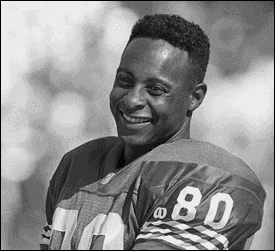 Jerry Rice, 49ers wide receiver. Image: 49ers.com |
Painted on the wall of the gym is a quotation about exercise and practice from American football legend Jerry Rice, the greatest wide receiver of all time:
"Today I will do what others won't, so tomorrow I can do what others can't."
Daily practice, daily exercise is powerful. The same is true of daily spiritual exercises.
Analogies illuminate certain truths, but can't be pushed too far. The danger of the physical exercise analogy is that we might think that the spiritual discipline itself strengthens us and gives us "spiritual muscles" in the form of increased faith and confidence in God.
Dallas Willard warns us:
"We must always remember that the path does not produce the change; it only puts us in the place where the change can occur."201
Contact with God transforms us, not the spiritual exercise itself.
Good Habits
When we first begin to practice a spiritual discipline, we may forget, fumble, or fail. New actions take a while to get established. But after we begin to practice a spiritual discipline for a while, it becomes a habit -- not a bad habit, but a good one! Spiritual disciplines are good habits that grow out of decisions to obey the Lord.
I've been playing the guitar for 60 years, but never really learned finger picking. Recently, I've been learning Travis picking from YouTube videos. The first few days, my thumb, index, and middle fingers just would not stay coordinated! But I kept at it in five- or ten-minute intervals. Eventually, my fingers started picking the correct strings without me thinking. Muscle memory was beginning to take hold. Habits are wonderful things. They take a while to get started, but when established, they help us live and minister with freedom and power.
Spiritual disciplines are habits or established patterns of opening up our hearts to Jesus.
Training for Godliness (1 Timothy 4:7-8)
Let's come back to our verse.
"Train yourself to be godly. For physical training is of some value, but godliness has value for all things, holding promise for both the present life and the life to come." (1 Timothy 4:7b--8)
We've talked about the importance of training, but what is the training designed to accomplish in us? Godliness (eusebeia).202 In the New Testament, the word is used in the sense of, "awesome respect accorded to God, devoutness, piety, godliness."203 The opposite of godliness (asebeia) is "godless, ungodliness, impiety."204
Q24. (1 Timothy 4:7-8) How do you become godly? On a scale of 1 to 10 (10 being high), how important are spiritual disciplines to Christian maturity? What happens to believers who have few spiritual disciplines in their lives?
Godliness and Lifestyle
Let's explore godliness further, since it is the goal of spiritual disciplines.
Paul has sent Timothy to the city of Ephesus where the spread of false doctrine is producing ungodliness, ungodly behavior, unrighteousness.205 There is true godliness and then there is a "form of godliness," a kind of outward religion and religious belief, but one that lacks its real essence and power (2 Timothy 3:5). Spiritual disciplines can and will lead us to godliness. But the Pharisees show us that spiritual disciplines (prayer, fasting, almsgiving) can just be a form of godliness to impress others. We want more than surface godliness; we want it to penetrate into our inner core.
A phrase that expresses the idea of godliness is the Old Testament expression "to fear the Lord." It is almost a synonym of "believer" under the Old Covenant. Someone who fears the Lord does not live in terror of God, but has a healthy respect for God and seeks in both heart and in action to "love God" and not be offensive to God.
Godly people live to please God. Ungodly people don't really consider or care what God thinks about their way of life. Hypocrites, like the Pharisees we mentioned, lead double lives - one for others to see, alongside a secret life that is unseen - except by God.
Examples of Godly Living
What does godliness look like in action? What are the qualities of a godly life? Spiritual fruit that comes from a pattern of yielding again and again to the Holy Spirit within us.
"The fruit of the Spirit is love, joy, peace, patience, kindness, goodness, faithfulness, gentleness and self-control." (Galatians 5:22-23)
Godliness comes from seeking to please God, from submitting as a way of life to the gentle leading of the Holy Spirit, as well as to his occasional rebuke. Do we sometimes fall short of these qualities? Oh, yes! But when we do, we repent, ask forgiveness, and get up to follow our Lord once again, washed in the forgiveness of God (1 John 1:7, 9).
Joy in Seeking God
As mentioned, a spiritual discipline is a spiritual practice designed to help us draw closer to God. Over the centuries, Christians have developed all sorts of spiritual practices. I don't mean to catalog all of them here, just give you an idea of a few helpful ways to connect with the Lord. Spiritual practices foster our spirituality, our seeking to know and experience God.206
The motive behind spiritual disciplines should be love for God. A 1980 praise chorus by Mimi Ribble reminds me of this:
"I will dance for you, sing for you,
Lift my hands in praise to you.
These are expressions of my love.
Worship you and magnify your name,
Seek your face and in your presence remain.
All of these things I do unto you.
These are expressions of my love."207
I love the gentle and joyful love for Jesus that permeates this song.
For this study, I'm grouping spiritual disciplines by typical frequency -- continual, daily, weekly, monthly, and annual -- though some seem to overlap my arbitrary categories.
5.2 Continual Practices
Let's begin with several practices you might engage in several times a day.
- Continual prayer and praise
- Spiritual awareness,
- Prayer before meals
- Making the sign of the cross
- Hours of prayer
1. Continual Prayer and Praise
As Paul talks about continual prayer, he describes a way of living, an attitude, an approach that is faith-filled and overflows with joy, thanks, and prayer.
"Be joyful always; pray continually;208 give thanks in all circumstances, for this is God's will for you in Christ Jesus." (1 Thessalonians 5:16-18)
I don't think he means non-stop muttering of prayers, so much as being constantly prayerful as a way of life. You can't be pessimistic while you are rejoicing and giving thanks. Paul encourages a continual prayerful, God-oriented attitude of living -- quick to rejoice, quick to pray, quick to give thanks, quick to look to God.209 Rejoicing indicates a spirit that is faith-filled. Practice these things!
2. Spiritual Awareness
People from many secular disciplines are trained in situational awareness (SA) -- law enforcement, military, aviation, to name a few. They are trained to look for and see things that would never register with the average person. The corresponding spiritual discipline is Spiritual Awareness. When we begin as newborn disciples, we are blind to what God is doing. Spiritual awareness is a skill or perhaps a sensitivity to God learned in cooperation with the Spirit.
Brother Lawrence (1614-1691) was a humble cook in a Paris monastery. As he went about his mundane labors, he sought to keep his mind on Jesus and developed a life habit of constantly turning his mind to God minute by minute. Recently, American pope Leo XIV shared how much Brother Lawrence's little book Practicing the Presence (written about 1695) influenced his own spirituality.210 This practice of constant awareness is celebrated in the African American spiritual, "I'm walkin' and a-talkin' with my mind stayed on Jesus" (based on Isaiah 26:3).
A more recent example of seeking to include God in one's constant thoughts is missionary Frank Laubach, whose delightful explorations in the Spirit are documented in Letters by a Modern Mystic (written 1930-1932; Mockingbird Press, 2022).
One way to train disciples in spiritual awareness is to ask the question:
"Where have you seen God lately?"
My pastor, Greg Krieger, constantly uses this question during Sunday morning services and in his discipleship groups to help people develop an awareness of God working around them. Jesus said,
"My Father is always at his work to this very day, and I, too, am working." (John 5:17)
Dave Pabalate, our worship pastor, gives a small black notebook to each of his disciples, with the instruction:
"If something happens that feels like a coincidence, or amazing, or like, 'What are the chances?' -- write it down."
His disciples then share what they wrote down the next time they get together. Awareness training.
Answering the question, "Where have you seen God lately?" helps train your eyes to see that God is behind many of the small "coincidences" of our lives. With trained eyes we become much more aware of God's presence. By the way, what has God been doing in your life lately? Where have you seen him at work around you?
3. Prayer before Meals
Prayer before meals goes way back to Judaism and was practiced by Jesus.
"Looking up to heaven, he gave thanks and broke the loaves." (Matthew 14:19; cf. 15:36)
"Jesus took bread, and after blessing it broke it." (Matthew 26:26-27)
"He took bread, gave thanks, broke it and began to give it to them." (Luke 24:30)
To this day, devout Jews utter an ancient prayer that blesses God and thanks him, the Hamotzi, the blessing over bread.
"Blessed are You, Lord our God, King of the universe, who brings forth bread from the earth."
Such blessings are said to go back to the early Second Temple period.211
Prayer prior to every meal keeps us mindful of God and thankful to him. It can also serve as a humble testimony of our faith when we eat with others, so long as we remember that this blessing is to God, not to impress onlookers (Matthew 6:1). If we are seeking to follow Jesus' example, we will pray before meals, thanking and blessing God.
4. Making the Sign of the Cross
Another continual practice, often exercised in liturgical traditions, is making the sign of the cross, sometimes called "signing" or "sealing." The practice goes back to at least the third century AD.212 Of course, signing can be done superstitiously or as a mindless reflex. But when you cross yourself mindfully and deliberately, it becomes a momentary spiritual discipline that can open your thoughts to Christ and his mighty power.
As a pastor, when I pray for individuals for healing, I often make a small sign of the cross on their forehead with anointing oil.213 I also make the sign of the cross during the benediction at the close of a service.
5. Hours of Prayer
In the Old Testament we read of prayer several times a day.
"Evening, morning and noon." (Psalm 55:17)
"Seven times a day." (Psalm 119:164)
"Three times a day." (Daniel 6:10)
I generally have my prayer time first thing in the morning. Recently, in light of these passages, I've been setting a reminder to pause briefly for prayer at noon and evening to call upon the Lord. Many families pray with their children at bedtime.
An ancient devotional practice of prayers many times a day, is known variously as the Divine Office, Daily Office, Divine Services, Liturgy of the Hours, etc. It was developed in monasteries and has been observed in some form or another by liturgical churches for many centuries. It consists of prayers and psalm reading or chanting at various hours throughout the day. It provides strong structure to one's devotional life, but requires a great deal of time and focus. More on this in Lesson 6.4.
Q25. Which continual spiritual disciplines are you doing now? What other continual disciplines do you find attracting you?
5.3 Daily Spiritual Practices (components of a Quiet Time)
 John William Waterhouse,The Missal, (1902), oil on canvas, private collection. |
As the core element of a rule of life, Christians throughout the ages have set aside time each day to focus on God, following Jesus' own practice:
"Very early in the morning, while it was still dark, Jesus got up, left the house and went off to a solitary place, where he prayed." (Mark 1:35)
Daily devotional practices have varied in both name and content from time to time, but the intent is the same -- to draw close to God daily.
- Lectio Divina (Divine Reading) has roots that go back to Origin, Ambrose, and Augustin, developed in the monastic movement. It has four steps or movements: read, meditate, pray, contemplate.214
- Prayer book or missal. Anglicans typically use the Book of Common Prayer215 to guide their prayers. Catholics often use a missal.216
- Morning Watch is a term popularized by Andrew Murray and the Keswick movement.
- Quiet Time is a term developed in the late 1900s by the Christian and Missionary Alliance, and popularized by Billy Graham, InterVarsity Christian Fellowship, Campus Crusade, and the Navigators.217
My own practice has been strongly influenced by the Quiet Time tradition.
As a pastor, it has been my observation that engaging in a daily Quiet Time is the single most significant catalyst for spiritual growth. Putting it simply, those who spend a deliberate time each day focused on God grow spiritually; those who don't won't see much growth or maturity in their faith.
One's daily devotional time is personal between you and God. There is no right or wrong way for everyone. I feel somewhat awkward about sharing my own personal practices, as if they were the norm. They are not. They structure how I approach the Lord at this point in my life. But I will share them, because, though I can't be there as a mentor to talk to you personally about your devotional life, I can share my own experience as a fellow Jesus-follower. Perhaps something of what I share may resonate with you.
Time constraints are very real. You can't do everything every day. Having said that, I recommend each of the following -- or some mix of them -- as part of your daily devotional practice to the degree possible within your schedule. Alternatively, most of these might fit well with special times on a weekly or monthly basis. I'm just grouping here what can fit into a daily time.
- Solitude
- Praise, Thanksgiving
- Bible reading
- Meditation on Scripture
- Journaling
- Prayer of Confession
- Prayer of Intercession
- Listening, Contemplation
Struggle with Your Quiet Time
Over the years, I've struggled with my Quiet Time at times -- and, if truth be told, so have you. Why? Three reasons -- the world, the flesh, and the devil. We get busy, we get lazy. The devil fights our Quiet Time constantly, because, as we meet daily with the Lord, we become strong and stronger. Satan hates that! This is not merely a battle with our will; it is primarily a spiritual battle, since a Quiet Time is so strategic to spiritual growth.
If you feel guilty about missing your quiet time, confess it and move on. We engage in this ongoing battle for the health of our souls. Fight the good fight of faith. Don't stay defeated. Tomorrow, meet with the Lord as scheduled.
Now let's look at several daily spiritual disciplines that can be profitable as part of a daily rule of life or Quiet Time.
1. Solitude
 Briton Rivière, 'The Temptation in the Wilderness' (1898), oil on canvas, 46 x 74 in., Guildhall Art Gallery, London. Larger image. |
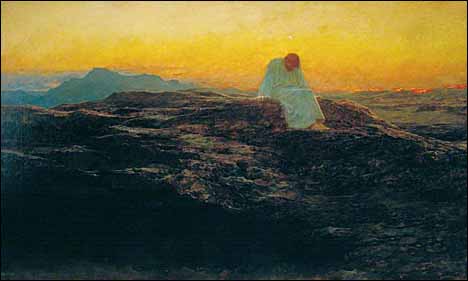
It is no coincidence that Jesus alludes to solitude in the Sermon on the Mount. Instead of praying before others to impress them, Jesus says,
"When you pray, go into your room,218 close the door and pray to your Father, who is unseen. Then your Father, who sees what is done in secret, will reward you." (Matthew 6:6)
Jesus' point here is secrecy, but it could just as well apply to solitude in prayer -- getting away to be alone, just you and God. As we saw in Lesson 2.3, Jesus practices solitude regularly.
"Very early in the morning, while it was still dark, Jesus got up, left the house and went off to a solitary place,219 where he prayed." (Mark 1:35)
Usually, the early morning is a time before family awakens and the bustle of the day begins. In our passage, Jesus leaves Peter's house early; later people search for him and eventually find him in prayer. If he hadn't got away, he would have been interrupted in his most important appointment of the day.
"Jesus often withdrew220 to lonely places and prayed." (Luke 5:16)
For Jesus, this is a habitual practice.221 The power of his word and healing are displayed in public, but the secret of his ministry is known only to his disciples, who see him creep off early into the hills to pray. It becomes a rhythm of his life: minister to the people and then withdraw to pray and talk to his Father.
One of the first steps in beginning a quiet time is to determine a time and a place where you will spend alone-time with God. Of course, the place need not be out in the hills. You can find solitude in your room -- even in a bathroom. Or in a public place, such as a library or park. So long as you aren't often interrupted by others, you can focus on God and the distractions around you will fade into the background. There is also solitude in walking and communing with God in your heart.
Solitude is important for both our mental and our spiritual health -- getting away where there is quiet. When we first seek to hear God's voice, quiet is important; later, as we learn to recognize his voice, the quiet isn't as necessary.
Of course, solitude need not be only a daily practice. (See Lesson 6.3.1.)
2. Praise, Thanksgiving
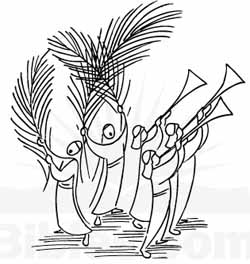 Annie Vallotton, 'Let us praise his glory' (Ephesians 1:14). © American Bible Society. |
Some authors refer to this as the spiritual discipline of "celebration,"222 but I think "praise" is a more precise term, since, in the Bible, "celebration" usually refers to a festival of some kind. (See Annual Spiritual Practices below, Sec. 5.5.2.)
Jesus begins the Lord's Prayer with a kind of praise or acknowledgement of God's holiness.
"Our Father in heaven,
hallowed be your name." (NIV)
"Hallowed" is the verb hagiazō, here, "to treat as holy, reverence." The New Living Translation renders it: "May your name be kept holy."223 This is reverence, a kind of praise. Many people begin their quiet time with the Lord's Prayer, which, in its present form, also concludes with praise.224
Sometimes, I'll begin my day with a song designed for tiny children. I sing it very slowly, prayerfully:
"Good morning, God,
This is Your day,
I am Your child,
Show me Your way."225
After that, I offer praise, probably because of David's exhortation:
"Enter his gates with thanksgiving
and his courts with praise." (Psalm 100:4a)
Praise and thanksgiving are closely related. Praise is acclaiming God's greatness, boasting in him, glorying in him. In Hebrew, the verb is hālal, from which we get our word "Hallelujah" (literally praise to Yah or Yahweh). Thanksgiving, on the other hand, acknowledges and celebrates all that he has done for us.
Sometimes I'll speak out to God something like, "I come before you today with praise, honor, glory and blessing. I magnify your name...." recalling praise in the heavenly throne room (Revelation 4). My new favorite praise passage are the words of David:
"Praise be to you, O Lord,
God of our father Israel,
from everlasting to everlasting.
Yours, O Lord, is the greatness and the power
and the glory and the majesty and the splendor,
for everything in heaven and earth is yours.
Yours, O Lord, is the kingdom;
you are exalted as head over all.
Wealth and honor come from you;
you are the ruler of all things.
In your hands are strength and power
to exalt and give strength to all.
Now, our God, we give you thanks,
and praise your glorious name." (1 Chronicles 29:10-13)226
Our English word "ascribe" means, "attribute something to someone," or, in this case, proclaim those things that are uniquely God's, his attributes.
"Ascribe227
to the Lord, O families of the peoples,
ascribe to the Lord glory and strength!
Ascribe to the Lord the glory due his name;
bring an offering, and come into his courts!" (Psalm 96:7-8)
Singing Praises
If we want to learn how to praise the Lord, the Book of Psalms gives lots of examples. Of course, the word "psalm" literally means "song." One way to bring praise to God is to sing praise songs to him. I look for songs and hymns that focus on God, such as, "How Great Thou Art."228
Years ago, encouraged by the example of my pastor, I added singing to my daily Quiet Time. My guitar hangs on the wall of my study with words to praise songs tucked under the strings. I'll take it down and sing three or four songs each morning. What a joy that is! I may begin to praise by rote, but after two or three songs, joy begins to break over me as I sense God's love and presence.
As a pastor, I often led songs at church. During the first song on a Sunday morning, the congregation often was distracted, not really into the worship. But by the third song you could sense them opening up their hearts to the Lord. It's the same with us in our quiet time. God's gift of music touches our spirit at a deep level and helps us open up and worship God from the heart.
If you don't play an instrument or sing, perhaps you could set up a playlist on your cell phone or on YouTube.
In Psalm 30, David exults:
"You have turned for me my mourning into
dancing;
you have loosed my sackcloth and clothed me with gladness,
that my glory may sing your praise and not be silent.
O Lord my God, I will give thanks to you forever!" (Psalm 30:11-12)
Thanksgiving
Another way to begin your time with God is to focus your thanks on him. Take thirty seconds or one minute to thank God for all the things you can think of that he is to you and has done for you. It prepares your heart to enter his presence.
There's a handy acronym to remind us of the various kinds of prayer: ACTS -- Adoration, Confession, Thanksgiving, and Supplication. In this acronym, praise = adoration. Thanksgiving is closely related.
3. Bible Reading
After you begin with praise, the order of elements of your Quiet Time isn't as important. Some read the Bible, then close in prayer. Others will pray and then close with Bible reading and meditation. Your choice. Either works fine!
My own practice is to begin my time with praise. Then wait upon God for instruction. That comes primarily from his Word, the Holy Scriptures. I spend several minutes reading the Bible.
Devotional books are good. But if that's the main way you take in Scripture, you might experience spiritual malnutrition. If you want to really grow, I suggest reading at least one chapter in the Bible each day. My practice -- which I realize you may not have time to do -- is to read a chapter of the Old Testament, a chapter from the New Testament, and a psalm each day. There are many good Bible reading programs -- that's just a simple one.
I've been reading a psalm each day for many years. However, familiarity sometimes finds me skimming rather than reading thoughtfully. To counter that, sometimes I try different translations.
One day I found a psalter designed for singing, actually, chanting the psalms. That led me to learn the basics of Gregorian chant on YouTube.229 Now I chant a psalm each day instead of reading it. I find that it brings me joy and I concentrate more on the meaning of the words.
I share these personal experiences to illustrate that, over time, your Quiet Time will take on its own particular character as you seek out the disciplines that most help you draw close to God. Don't be afraid to experiment. If your current routine is getting dull, change it up -- even if it is for a week or two. There are no rules here, only a desire to maintain and grow a relationship with God.
4. Meditation on Scripture
Reading Scripture is important; it exposes you to God's Word. But if you don't take time to meditate or think about it, at least briefly, you lose nearly all the value.
Christian meditation is different than sitting cross-legged and humming. Christian meditation is the practice of taking time to think about God, "a long, ardent gaze at God, his work, and his Word...."230
"... I remember you upon my bed,
and meditate231
on you in the watches of the night." (Psalm 63:6, ESV)
"My eyes are awake before the watches of the
night,
that I may meditate232
on your promise."
(Psalm 119:148, ESV; also vss. 15, 23, 27, 78, 148.)
"His delight is in the law of the Lord,
and on his law he
meditates day and night." (Psalm 1:2, NIV)
The Willow Creek Association commissioned researchers to find out how effective churches were at encouraging spiritual growth. Out of thousands of surveys across many churches one conclusion stood out:
"Nothing has greater impact on spiritual growth than reflection on Scripture."233
Reflection, of course, is thinking about the Scripture after reading it. It powerfully stimulates your growth in the Lord.
How do you reflect or meditate on Scripture? After reading a passage, find a verse or word that particularly speaks to you. Begin to break down what is being said. Analysis doesn't have to be dry; analysis can be a form of meditation.
Here are just a few approaches.
- Word meanings. If you have access to Greek or Hebrew language tools, you could look up keywords to plumb the depths of their meaning.234
- Paraphrasing. Try to paraphrase the verse or verses in your own words. Writing it forces you to understand the nuances of the verse.
- Outlining. If it is a longer passage, try outlining its main ideas.
- Questions. List the questions that require an answer to understand the passage.
- Praying Scripture. Pray through a verse, applying each command or promise to yourself and asking God to help you in it.
- Memorization. The spiritual discipline of Bible memorization will help you gain new insights as you say the verse over and over again to learn it (see Lesson 6.2.2).
These are only suggestions. But as you begin to meditate on Scripture, you'll find God will begin to change you!
You can find many Bible studies (including the more than 50 free e-mail studies in my JesusWalk Bible Study Series, www.jesuswalk.com) that will help you explore Scripture more deeply. Probing Discussion Questions are a feature of my studies and are designed to provoke thought and meditation on the passage, so that you end up understanding the main points. I encourage people to write their answer to each Discussion Question in an informal Bible study journal.
5. Journaling
Journaling is really one form of meditation. Journals can help you record thoughts like a spiritual diary and explore how God is leading and speaking to you. But a journal can also be used to write down what you are learning in Scripture. Writing has two benefits:
- You memorialize in writing what you are learning for future study.
- A point makes a greater impression on you if you write it down, than if you don't. Otherwise, it is often in-one-ear-out-the-other.
We learn best what we process through our own thinking. That's the key to learning! Writing facilitates that learning.
Recently, in order to stop me from skimming the Bible text and to become more mindful, I've determined to not leave my Bible reading/meditation time without writing down at least one sentence about what made the greatest impression on me from the chapters I read. Anticipating this, I now read more carefully.
6. Prayer of Confession
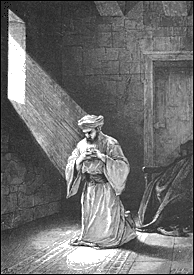 Alexandre Bida (French painter, 1813-1895), 'The Prayer in Secret,' (Matthew 6:6) engraving, in Edward Eggleston, Christ in Art (New York: Fords, Howard, & Hulbert, 1874). |
In the prayer acronym ACTS. "C" stands for confession.
The prayer of confession is designed to help us recognize sin in our lives, name it, confess it, and forsake it. Confession is an important part of repentance.
The Apostle John teaches us:
"8 If we claim to be without sin, we deceive ourselves and the truth is not in us. 9 If we confess our sins, he is faithful and just and will forgive us our sins and purify us from all unrighteousness." (1 John 1:8-9)
When we get spiritually sloppy, we tend to excuse minor (and sometimes major) sins or take them for granted. It is one thing to be unaware of sin. But when God makes us aware, we must bring the sins before God with confession and ask forgiveness.
Part of my own daily prayer routine is to confess and ask for cleansing of any sin that comes to mind, and then to pray a portion of the Lord's Prayer, asking for strength to resist sin this coming day:
"... Lead me not into temptation,
But deliver me from evil!" (Matthew 6:13)
My childhood pastor used to say, "Keep short accounts with God!" Don't let sin continue without repentance and confession.
"He who conceals his sins does not prosper,
but whoever confesses and renounces them finds mercy." (Proverbs 28:13)
7. Prayer of Intercession
After confessing my sins and asking for forgiveness, I go over my day with God -- the people I expect to meet, the things I have to do. I ask God to help me show them Christ's love and patience. I ask for wisdom and guidance.
Then I turn to intercession. In the ACTS acronym this is the "S" -- Supplication. Fifteen years ago, God dealt with me about intercessory prayer. Up until then, I hadn't taken it as seriously, but when I was called as the interim pastor of a rather dysfunctional congregation, God challenged me to pray for each of the members every day! It was a small congregation, but it stretched me.
Previously my mind had tended to drift when praying more than a short time or I would just run out of energy for prayer. So I made two changes to my prayer time.
1. To pray aloud -- audibly. When others are around, I'll close the door, pray silently, or take a walk and pray. But praying aloud helps me focus on my prayers, not wander or drop off to sleep. I continue the practice to this day.
2. To use a prayer rope to keep me praying. Let me explain, or you might think I've "gone off the deep end."
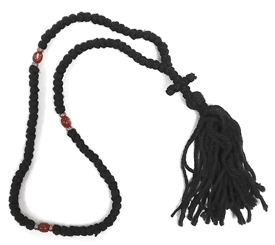 Orthodox prayer rope. |
I didn't grow up with this tradition, but I learned about a knotted prayer rope used by the Eastern Orthodox to pray the Jesus' Prayer (the same idea as the string of beads that Catholics use to pray the Rosary). I ordered a prayer rope handmade by sisters in an Orthodox convent in Bulgaria of actual black sheep's wool. Authentic!
The idea is that you move your thumb from one knot to the next as you move from one prayer to the next. I found it helpful to keep me praying for each of my church members, moving from one knot to another as I prayed for a different family. I used it for a year or two, but then I found I no longer needed it and put it aside. Nevertheless, this prayer rope helped me move me into interceding and praying seriously for others. It was a big help, a crutch that I needed for a time.
Prayer for Those Close to Us
Jesus prays for his disciples, sometimes battling the enemy in prayer for them.235 He intercedes for us now.236 Paul, too, makes a practice of praying for his disciples237 and asks them to pray for him.238 Sometimes, Paul does battle with the enemy, struggling, wrestling in intercessory prayer.239
From Jesus and Paul we learn to pray regularly for those God has given us some kind of responsibility for. I pray daily by name for:
- My wife, children, and grandchildren.
- Close relatives and their families.
- Church staff and leaders and their families.
- Men in my two Discipleship Groups and their families.
- Prayer for government officials (see below).
This can sometimes seem like reciting a list (and it is a mental list I go through), but as I call their names before God, I will pray for any of their special needs that God brings to mind. Yes, I must resist the temptation of just reciting names. But not to pray for them is worse -- much worse.
If you're just getting started in prayer, don't be overwhelmed by this. Start small in your intercessory prayers; let God grow this as he sees fit. If you are discipling a new believer, teach him to pray by being with you when you pray.
Prayer for Government
Paul teaches us to pray for government leaders.
"I urge, then, first of all, that requests, prayers, intercession and thanksgiving be made for everyone -- for kings and all those in authority, that we may live peaceful and quiet lives in all godliness and holiness." (1 Timothy 2:1--2)
I regularly pray for our president and vice president, by name, as well as key cabinet officers and advisors. From one administration to the next, I pray for them regardless of party affiliation. You can't sincerely pray for someone and continue to despise him or her. Prayer changes the heart to agape love.
Prayer for the Lost
Prayer and evangelism work hand-in-hand. Recently, I met a businessman at the local Chamber of Commerce mixer. He has an interest in Christianity and lots of zeal, but no personal commitment to follow Jesus. I got his card, put it on my desk, and try to pray for him often. In the next few days, I'll contact him again and see what God has been doing in his heart through my prayers.
Nineteenth century American evangelist D. L. Moody (1837-1899) had a prayer list of 100 non-Christian friends for whom he prayed daily. Before his death, 96 of them had come to Christ. At his funeral, the final four gave their hearts to the Lord. Intercessory prayer and evangelism go hand in hand.
Prayer can help soften hard hearts. C. Peter Wagner recalls the city of Resistencia in northern Argentina that was resistant to the revival that was sweeping Argentina at that time. Of the 400,000 residents, fewer than 6,000 were evangelical believers. But receptivity came when the believers there were taught intercessory prayer, what Wager calls "strategic-level spiritual warfare." After a year of prayer, they held the meetings in the city and the evangelical population swelled to 100,000.240
Prayer for Revival
I see America slipping faster and faster into agnosticism and ruin. Marrying religion to politics is hastening the slide. We must pray earnestly for a mighty Holy Spirit revival to bring our nation back to Christ.
Read the history of revivals. When God is moving, people can be struck with conviction without even entering a church building. Revival is usually sparked by earnest prayer on the part of even a small group of committed believers. I saw God work powerfully through the Jesus Movement when I was a youth pastor in Southern California. Holy Spirit revivals are sometimes messy, but can bring a wave of people into the kingdom far beyond what can be brought by evangelistic outreaches at other times. Pray for revival.
8. Listening, Contemplation
So far, I've talked about singing, speaking, and praying. But prayer is a conversation with God that requires us to listen, to spend some time in stillness, listening for his voice if he chooses to speak to us. Sometimes, especially in Roman Catholic spirituality, a related practice is called the spiritual discipline of contemplation, or contemplative prayer.
I can't stress enough the vital importance of learning to recognize God's voice and then being obedient to what he shows us. This is an essential discipleship skill. For more on this, see my book Listening for God's Voice (JesusWalk Publications, 2018) and the related free e-mail Bible study (www.jesuswalk.com/voice/).
Length of Your Quiet Time
I've spent some time talking about spiritual disciplines that you can practice daily in your Quiet Time. Don't be overwhelmed by all this. Do what you have time for. I am retired so I have more time than I used to.
Instead of seeing your Quiet Time as a burden, look at each spiritual discipline or practice as another window that opens up a space for you to encounter God. As you are able, throw open your windows and enjoy the full breeze of the Spirit each day.
If you don't have as much time as you'd like, I understand. You could set your alarm clock a few minutes earlier or set aside some time during the weekend. There are no rules, no absolutes. Except one: If you'll take time daily to meet with God, he will absolutely help you grow closer to him as a maturing disciple!
As a pastor, I've witnessed again and again that setting aside a daily time with God is a life-changing practice that revolutionizes one's spiritual life and growth.
Q26. Do you currently have a daily time and place for a regular appointment with God? If so, what does your daily Quiet Time look like at present? How might you enrich your Quiet Time without it becoming burdensome?
 Available in book formats: paperback, Kindle, PDF |
We've looked at how continual and daily spiritual practices contribute to Christian growth. In the next lesson, we'll continue our study of spiritual disciplines with weekly, monthly, and annual practices, as well as how to deal with the temptations that we experience when practicing disciplines.
Prayer
Father, increase in our hearts the desire to know You. Establish us each day in ways we can behold Your face and be bathed in Your presence. We want to know You more, know You more intimately than we do now. Meet with us, O Lord, as we humbly reach out to You with disciplines designed to open us to You. In Jesus' name, we pray. Amen
Endnotes
[191] Leslie Hardin points out nine elements of Jesus' spirituality: (1) prayer and solitude, (2) care for the oppressed, (3) resisting temptation, (4) corporate worship, (5) Scripture study, (6) meal sharing, (7) simplicity, (8) submission to the Father, and (9) evangelism and proclamation (Leslie Hardin, The Spirituality of Jesus: Nine Disciplines Christ Modeled for Us (Kregel, 2009)).
[192] Merriam-Webster.com, "discipline."
[193] Bill Hull, The Complete Book of Discipleship (NavPress, 2006), pp. 194-197.
[194] Ibid.
[195] Dallas Willard, The Spirit of the Disciplines (Harper and Row, 1988), p. 10.
[196] Foster, Celebration, p. 1.
[197] Calhoun, Handbook, p. 17.
[198] Metamorphoō, "be changed, be transformed" (BDAG 639-40).
[199] Eikon, "image, form, appearance" (BDAG 382, 3).
[200] Gymnazō, BDAG 208.
[201] Spirituality: Going Beyond the Limits," Christian Counseling Today, Vol. 4 No. 1, Winter 1996, p. 7. Interview
[202] The word "godliness" (eusebeia) comes from a Greek stem seb-, which meant originally "to step back from someone or something, to maintain a distance," then "to have awe at something, especially something lofty and sublime." This stem is combined with eu- ("abundance, fullness of") to form eusebeia (Werner Forester, sebomai, ktl., TDNT 7:168-196, especially p. 169. Walther Günther, "Godliness, Piety," in Colin Brown (editor), New International Dictionary of New Testament Theology (Zondervan, 1975-1978) 2:90-95).
[203] Eusebeia, BDAG 413.
[204] The noun asebeia is used "vertically as a lack of reverence for deity and hallowed institutions as displayed in sacrilegious words and deeds: impiety." The verb asebeō means "to violate the norms of a proper or professed relation to deity, act impiously." The adjective asebēs means, "pertaining to violating norms for a proper relation to deity, irreverent, impious, ungodly" (BDAG 141).
[205] Forester observes that eusebeia is "right conduct towards the gods," to be distinguished from dikaiosynē, "righteousness" (which is coupled with "godliness" in 1 Timothy 6:11) as "right conduct towards one's neighbor." Sophrosynē or egkrateia are seen as right conduct towards oneself (Werner Forester, sebomai, ktl., TDNT 7:176).
[206] Richard Foster, who refocused Evangelicals on the spiritual disciplines with his 1978 book Celebration of Discipline: The Path to Spiritual Growth (Harper & Row), sorts spiritual disciplines into three groups: inward disciplines, outward disciplines, and corporate disciplines. Adele Ahlberg Calhoun, in her comprehensive Spiritual Disciplines Handbook: Practices that Transform Us (InterVarsity Press, 2005), has seven groupings and dozens of disciplines, including for each practice a statement of desire, a definition, scriptural basis, what the practice includes, and the God-given fruit.
[207] "Expressions of My Love," by Mimi Ribble, ©1980 Zion Song Music.
[208] "Continually" (NIV), "without ceasing" (ESV, NRSV, KJV) "constantly" (NJB) is the adverb adialeiptōs, "constantly, unceasingly" (BDAG 20), "unremitting, incessant" (Liddell-Scott, p. 22), from a-, "not" + dialeimma, "interstice, gap, interval," leipō, "to lag."
[209] A similar exhortation involves, "... Praying at all times in the Spirit, with all prayer and supplication" (Ephesians 6:18a).
[210] Video: "Pope Leo Explains His Spirituality," Catholic News Service, YouTube, December 3, 2025 (www.youtube.com/watch?v=Bg66gtqZSbw).
[211] Mishnah Berakhot 6:1. The Protestant practice of blessing the food itself "to the nourishing and strengthening of our bodies" misunderstands the KJV translation "blessed" in Matthew 14:19 as blessing the food rather than blessing God (1 Timothy 4:4-5). Eulogeō, in Matthew 14:19 means, "give thanks and praise" (BDAG 408, 1).
[212] Hippolytus of Rome, Apostolic Tradition 8.8; 20.8; 22; 37.1 (about 215 AD). Tertullian, De Corona 3 (201 AD). More on this in, "Sign of the Cross," Wikipedia.
[213] James 5:14; Mark 6:13
[214] Article: "Lectio Divina," Wikipedia.
[215] Article: "Anglican Devotions," Wikipedia.
[216] Article, "Missal," Wikipedia.
[217] Article: "Quiet Time," Wikipedia.
[218] "Room" (NIV, ESV, NRSV), "closet" (KJV) is tameion, which means, "storeroom," then generally, a room in the interior of a house, "inner room" (BDAG 988, 2).
[219] "Solitary place" (NIV, KJV), "desolate" (ESV), "deserted" (NRSV). It is described by two Greek words: topos, "place" (from which we get our word "topography"), and erēmos, an adjective "pertaining to being in a state of isolation, isolated, desolate, deserted" of an area "unfrequented, abandoned, empty" (BDAG 391, 1a). The word can also be used of desert or wilderness, in contrast to cultivated and inhabited country.
[220] "Withdraw/withdrew" is hypochoreō, "to withdraw from a location, to go off, go away, retire" (BDAG 1043, 1).
[221] The Greek word pair translated "withdrew" in Luke 5:19 uses the imperfect tense which suggests continued action or established habit.
[222] Foster (Celebration, p. 164) uses the term to mean joyous praise, "the carefree spirit of joyous festivity." Calhoun (Handbook, pp. 27-29) uses the term for giving thanks, but has a separate spiritual discipline of "gratitude."
[223] Hagiazō, BDAG 10, 3. "To render or acknowledge to be venerable, to hallow" (Thayer 6, 1).
[224] The words, "for thine is the kingdom and the power and the glory of the Father and of the Son and of the Holy Spirit for ever. Amen" don't appear in some of the earliest manuscripts -- א B D Old Latin, f1 Tertullian Origin Cyprian. Metzger (p. 14) says, "an ascription, usually in a threefold form, was composed (perhaps on the basis of 1 Chr 29:11--13) in order to adapt the Prayer for liturgical use in the early church."
[225] I couldn't find any author for the song, though it is used by Bible Study Fellowship children's program. You can hear the tune on YouTube by searching the lyrics.
[226] See also Luke 2:14; 1 Chronicles 29:11-12; 1 Timothy 1:17; Revelation 5:12-13.
[227] "Ascribe" (NIV, ESV, NRSV), "give" (KJV) is the verb yāhab, "give, ascribe." We see it in Psalm 29:1; 96:7-8 = 2 Chronicles 16:28-29; Deuteronomy 32:3. "Ascribe" with the synonyms "attribute" or "credit" would suggest "inferring of cause, quality, authorship" (Webster). Hence the passages would demand everyone to acknowledge the Lord Yahweh as the great king and offer such ascription of glory and greatness as is commensurate with his majesty" (Paul R. Gilchrist, TWOT #849).
[228] "How Great Thou Art" is based on a Swedish hymn entitled "O Store Gud" (1885) by Swedish poet and minister Carl Boberg. The English version (1949) by English missionary Stuart K. Hine.
[229] I am currently using Psalm Tone V with the ESV translation as my text. Gregorian chants are a bit complex when you get started. I found a helpful YouTube video by Father Isaac J. Rehberg, "The Nine Psalm Tones in Plainchhant," YouTube, October 1, 2022. Father Rehberg is rector of All Saints Anglican Church of San Antonio, Texas.
[230] Calhoun, Handbook, p. 172.
[231] "Meditate," "think of" is hāgâ. If used of animals, it can mean, "coo, growl." It can also mean "plan, devise." Here it is "ponder (by talking to oneself)" (Holladay, p. 76; Herbert Wolf, TWOT #467).
[232] "Meditate" is śîḥâ, "meditation, prayer" (TWOT #2255b); "occupation, concern (of one's thoughts, mind)" (Holladay, p. 351).
[233] REVEAL Study, p. 19.
[234] A couple of online Bible study tools are the free versions of Bible Hub (biblehub.com) and Blue Letter Bible (blueletterbible.org).
[235] John 17; Luke 22:31-32.
[236] Romans 8:34; Hebrews 7:25; Isaiah 53:12.
[237] Ephesians 6:18; Colossians 1:3, 9; 1 Thessalonians 3:10; 5:17; 2 Thessalonians 1:11.
[238] Colossians 4:3; Philippians 1:19
[239] Galatians 4:19; Colossians 2:1; 4:12.
[240] Discussed several of C. Peter Wagner's books, including his biography, Wrestling with Alligators, Prophets, and Theologians (Regal, 2010), pp. 180-182.
[241] "Custom" is eiōtha, "to maintain a custom or tradition, be accustomed," the perfect form of the verb ethō, "that which is wont, usage, custom." (BDAG 295). The noun is ethos (from which we get our English word), "a usual or customary manner of behavior, habit," or group "custom."
Copyright © 2026, Ralph F. Wilson. <pastor joyfulheart.com> All rights reserved. A single copy of this article is free. Do not put this on a website. See legal, copyright, and reprint information.