


|
Old Testament
New Testament
Gospels
Acts
Paul's Letters
General Letters
Revelation
Topical Studies
Beginning the Journey (for new Christians). en Español

|
Old Testament
New Testament
Gospels
Acts
Paul's Letters
General Letters
Revelation
Topical Studies

|
Home
Bible Studies
Articles
Books
Podcasts
Search
Menu
Donate
About Us
Contact Us
FAQ
Sitemap

The Discipleship Process
Biblical Models for Spiritual Formation
a 169-page book
by Dr. Ralph F. Wilson
|
|
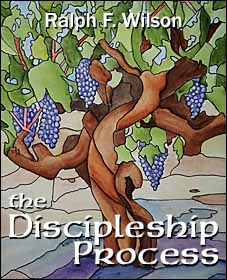
Jesus' characteristic call to disciples is "Follow me!" Discipleship or spiritual formation focuses on following the Lord and being transformed by him.
The book doesn't speak about changing a church culture. Rather, it focuses on understanding and applying Biblical models concerning disciple making -- first to readers themselves and then to the process of helping others be formed and live as authentic Jesus-followers.
The first chapter defines discipleship from Jesus' teaching. Chapters two and three take a close look at Jesus' and then Paul's discipling strategies. Chapter four examines the essence of what the gospel is, disciple training curricula, and the role of mentors. Chapters five and six explore spiritual disciplines that enable believers to grow in Christ. The final chapter explains how to put oneself on the path of a disciple, and then how to disciple individuals and small groups. A conversation between active disciplers in an appendix displays a variety of effective discipling styles.
Probing discussion questions focus on the central issues. Preachers and teachers appreciate the outlines, word definitions, Scripture cross-references, and footnotes that drastically reduce preparation time.
Jesus' Parable of the Vine and the Branches illustrates the process of discipleship and its purpose -- abiding in him so that we bear much fruit and glorify the Father.- What Is a Disciple?
- Jesus' Discipling Strategy
- Paul the Disciple Maker
- Elements of Discipleship Training
- Spiritual Disciplines (part 1)
- Spiritual Disciplines (part 2)
- Becoming Both Disciple and Disciple Maker
A detailed table of contents enables you to see the topics covered.
A free e-mail Bible study containing the same material is available at https://www.jesuswalk.com/discipleship/ If you are teaching a class you may duplicate free of charge Appendix 1. Participant Notes (PDF format)
Copyright © 2026, Ralph F. Wilson. <pastor joyfulheart.com> All rights reserved. A single copy of this article is free. Do not put this on a website. See legal, copyright, and reprint information.
 To be notified about future articles, stories, and Bible studies, why don't you subscribe to our free newsletter, The Joyful Heart, by placing your e-mail address in the box below. We respect your