


|
Old Testament
New Testament
Gospels
Acts
Paul's Letters
General Letters
Revelation
Topical Studies
Beginning the Journey (for new Christians). en Español

|
Old Testament
New Testament
Gospels
Acts
Paul's Letters
General Letters
Revelation
Topical Studies

|
Home
Bible Studies
Articles
Books
Podcasts
Search
Menu
Donate
About Us
Contact Us
FAQ
Sitemap


Free
E-mail Bible Study
 Names and Titles of God
Home | Bible Studies | Articles | Books | Podcasts | Search | Menu | Donate | About Us | FAQ | Contact Us
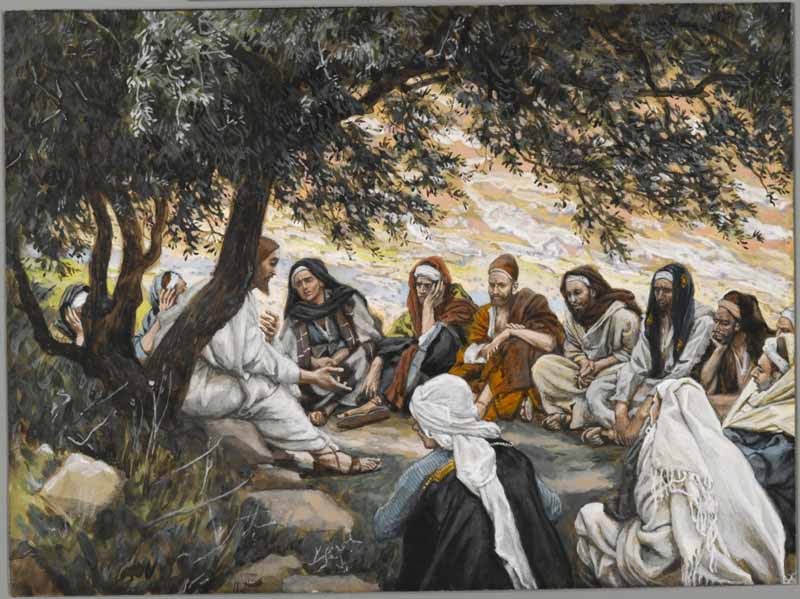
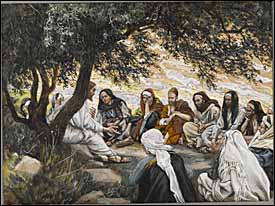 James J. Tissot, 'The Exhortation to the Apostles' (1886-94), gouache on gray wove paper, 6.5 x 8.75 in., Brooklyn Museum, New York. Larger image. |
We've been looking at what discipleship is. Now I want to move to the how of discipleship.
Who better to learn about how to disciple men and women than from the great Discipler himself, Jesus our Lord. In this lesson we'll examine how he trained his disciples. In Lesson 3, we'll focus on the Apostle Paul's approach to developing disciples.
We live twenty centuries and a world away from the culture of Jesus and Paul, so their exact methods may not fit, but the models are sound and can inform our discipling today.
I want to understand Jesus' strategies for developing disciples. A strategy is "a careful plan or method for achieving a particular goal usually over a long period of time."58
These are Jesus' discipling strategies that I see as central, though I'm sure you could come up with others. Note: they are not all distinct; some are closely related to others.
- Selection.
- Spending time.
- Prayer.
- Public and private teaching.
- Rebuke.
- Involvement in ministry.
- Community.
Let's consider them one by one.
2.1 Jesus Selects His Disciples Carefully
Jesus' discipleship training begins with a selection strategy. He teaches thousands, but invests most of his time training a much smaller following.
Circles of Intimacy and Investment
Jesus ministers to a wide range of group sizes. The larger groups hear him teach and watch him heal. But the smaller groups are more likely to have spent time with Jesus and his band of disciples -- at least for a while. The circles in Diagram 1 are represented by:
 Diagram 1. Jesus' Circles of Intimacy. Larger graphic. |

- Crowds
- The 120 (Acts 1:15)
- The Seventy (Luke 10:1)
- The Twelve
- The Inner Circle -- Peter James and John
- Personal ministry to individuals
More on this in Lesson 4.3.
Selecting the Twelve Apostles
Jesus ministers for some time before he selects the twelve apostles. He does not choose them lightly. Luke explains that this selection is preceded by a night of prayer.
"One of those days Jesus went out to a mountainside to pray, and spent the night praying to God. When morning came, he called his disciples to him and chose twelve of them, whom he also designated apostles." (Luke 6:12-13)
The twelve apostles are a special case in several ways, in the sense that they differ from the average disciple today.
1. Apostles. They are apostles, Greek apostlos, from the verb apostellō, "to send." They are people who will be dispatched for a specific purpose, "ambassador, delegate, messenger."59
2. Authority. Their privileges and responsibilities include "that they might be with him and that he might send them out to preach and to have authority to drive out demons" (Mark 3:14-15).
3. Symbolism. They are symbolic of the twelve tribes of Israel (Matthew 19:28;).
4. Foundational witnesses. They became the core of the early church by preaching, serving as witnesses to Christ's life and resurrection, and carriers of his authentic teaching. All but one died a martyr's death.
What was Jesus looking for in his disciples? Scripture is largely silent. Most of the Twelve were fishermen. One was a tax collector, another a zealot. I doubt that he selected them for their skill sets. I expect that he sought men who were honest, who would be loyal to him, who were willing to leave their past lives, and who were open to learning and adapting. They were like those described in the Parable of the Sower (that we'll examine shortly):
"... Those who, hearing the word, hold it fast in an honest and good heart, and bear fruit with patience." (Luke 8:15)
There is no rigorous testing, though they travel with Jesus before the apostles are actually selected. Jesus seeks his Father about whom to select. Nearly all are exceedingly fruitful; only one turned away. Tradition tells us that Thomas brought Christianity to India, Andrew to Scythia (Ukraine and Russia), Matthew to Ethiopia and Persia, etc.60
Selecting Disciples to Invest In
As mentors and disciplers, we, too, must decide with whom to spend time. You may feel led by the Lord to reach out and befriend various individuals and help them on their Christian journey. It can go the other way also. A few months ago, a man in the church where I am a member said to me, "I feel God drawing me to you." I invited him to be part of the small, weekly discipleship group that I lead and he has come ever since.
Pastors sometimes struggle with this. We don't want to play favorites. However, we know that spending an equal amount of time with everyone is neither wise nor possible. Some dysfunctional people will suck up all our time if we let them. Others love to talk, but have only a nominal interest in growing in Christ. Paul tells Timothy to select disciples based on a particular criterion:
"What you have heard from me in the presence of many witnesses entrust61 to faithful people,62 who will be able to teach63 others also." (2 Timothy 2:2)
The NIV's translation "qualified" (NIV) is better translated, "able" (ESV, NRSV, KJV) -- the kind of people who are able or competent64 to teach others. People who are likely to pass on what they have learned from us. Time is a limited commodity; we have only so much. While we'll work with some who are less promising, we are wise to invest the most time in those with potential to be fruitful in the future.
Faithfulness
One important quality we look for in disciples is faithfulness, or at least a growth toward faithfulness.
When I was a student at Fuller Seminary, Waldron Scott (1929-2016) spoke to our evangelism class. He had been a long-time staffer with the Navigators, an organization known for its emphasis on discipleship and Scripture memory. Scott had lots of personal experience discipling men. After class I asked him, "You must have lots of people coming to you, wanting you to disciple them. How do you decide with whom to invest your time?" I'll never forget his answer. "I give them several Bible verses to memorize and tell them to come back when they're done." That weeded people out fast!
Help Disciples Count the Cost
I have a background in marketing. Sell the product! But I've learned the hard way that we can over-sell people on following Jesus -- people who aren't really ready. Jesus doesn't do this. He talks to people up-front about the cost of following him. He doesn't sugarcoat the difficulties.
"57 As they were walking along the road, a man said to him, 'I will follow you wherever you go.'
58 Jesus replied, 'Foxes have holes and birds of the air have nests, but the Son of Man has no place to lay his head.'
59 He said to another man, 'Follow me.'
But the man replied, 'Lord, first let me go and bury my father.'
60 Jesus said to him, 'Let the dead bury their own dead, but you go and proclaim the kingdom of God.'
61 Still another said, 'I will follow you, Lord; but first let me go back and say good-by to my family.'
62 Jesus replied, 'No one who puts his hand to the plow and looks back is fit for service in the kingdom of God.'" (Luke 9:57-62)
In Lesson 1.2.2 we met a rich man, finely dressed, a ruler in the local sanhedrin, who comes to Jesus asking, "Good teacher, what must I do to inherit eternal life?" Jesus disputes his careless use of "good," then asks how well he obeys the Jewish law. I've scrupulously observed the law from my youth, he replies. Now Jesus comes to the rich man's real issue:
"22 When Jesus heard this, he said to him, 'You still lack one thing. Sell everything you have and give to the poor, and you will have treasure in heaven. Then come, follow me.' 23 When he heard this, he became very sad, because he was a man of great wealth." (Luke 18:22--23)
Jesus' disciples are aghast at Jesus' words. Why offend such a pious, devout, man, especially one so able to help meet the financial needs of the mission band?
Jesus knows that when anything captures our heart besides him, we can't be real disciples, only play-acting disciples. Jesus prophetically tells this particular rich man what he will need to give up in order to be able to follow him. The cost is too high and he goes away sadly. We might chase after a man with such financial and leadership potential. Jesus doesn't.
Good Soil (Matthew 13:3-9, 18-23)
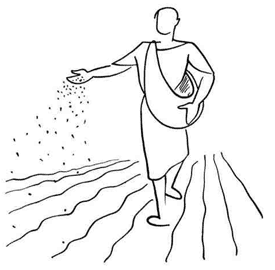 Annie Vallotton (1915-2013), 'The Sower,' illustration for the Good News Bible. ©American Bible Society. |
Jesus tells a troubling parable that we call the Parable of the Sower. A better name perhaps is the Parable of the Soils. Four soils represent different kinds of listeners. Some barely listen before they move on. Others are quick to listen, but don't last long. A third group is so ensnared by the thorns of life that they can't produce harvestable fruit. But some are like rich and productive soil, where a single seed will multiply to produce a plant that bears a total of 30, 60, or even 100 seeds.
"As for that in the good soil, they are those who, hearing the word, hold it fast in an honest and good heart, and bear fruit with patience." (Luke 8:15)
In this parable, Jesus is teaching the future sowers of the Kingdom (1) where to invest their time and (2) to help them avoid disillusionment when some would-be disciples become distracted. Yes, we are to rescue the floundering, but not let them take so much of our time that we don't invest time with the most promising people that God sends us.
Note: I say this from the point of view of discipling others. Another completely valid Christian focus is a ministry of mercy to the needy, such as conducted by Mother Teresa (1910-1997) to those dying on the streets of Calcutta. I don't mean to discount the importance of this type of ministry as an expression of Christ's love. Grace is like that; it is given by God without any regard to future return.
Q9. What happens when we invest time with needy people who don't seem to grow? What happens when we invest time with people who are hungry and eager to learn to follow Jesus? What will be warning signs? What will be signs of a person to spend time with?
2.2 Jesus Spends Time with His Disciples
Another vital strategy Jesus demonstrates in training his disciples is a personal touch. He spends time with them. A lot of time! These are not just "teachable moments." Rather, they are with him day and night. The Twelve -- with some others -- live and travel with him for several years (Acts 1:21-22; Luke 8:1-3).
Openness and Vulnerability
Jesus practices an openness with his disciples. He knows that allowing people close makes him susceptible to betrayal (John 2:24) -- and he is ultimately betrayed by a close disciple. Nevertheless, he allows his disciples see him as he is, close up and personal. He doesn't modify his teach to keep from offending them. Once, when many "disciples" deserted him for his talk about eating his flesh and drinking his blood (John 6:66). Jesus doesn't back off to be popular.
The most intimate scene in the Gospels is where Jesus enters the Garden of Gethsemane the night before he is crucified. He leaves most of the disciples near the entrance, but takes three with him -- Peter, James, and John -- who witness Jesus pleading with his Father, "remove this cup from me." They see his tears and sweat that drops off him like blood drops. They see his agony. And they hear his prayer, "Not my will, but Yours be done!"
Jesus trusts them with that degree of vulnerability so they can learn and grow -- and, in the future, lead others.
The Power of Openness
Some church traditions discourage pastors from maintaining close friendships with church members, since others in the congregation might resent it. Don't play favorites, they say. And when a pastor leaves a church, limit contact with former parishioners so the new pastor has a chance to gain their support. It makes some sense. But distance can prevent effective discipling.
Once, early in my ministry, I shared publicly that I struggled with prayer. After the service, one of the younger ladies severely reprimanded me for my failures. What I learned from this experience was not to share my weaknesses with people in my congregation. You give your enemies in a congregation fuel to attack you. But eventually I learned that being private doesn't necessarily protect you. Carnal people will attack you anyway, even if there is no cause.
Of course, when we pastors are betrayed and hurt, we tend to pull in and share less of ourselves. But a guarded style cripples the discipling process. Trust comes from time spent, authenticity, vulnerability, honesty, and love. Can we trust people to see the real us? If we want to influence others, we must let them see our lives, warts and all.
Greg Krieger, lead pastor of the church where I am a member, has set an example for me, one of open honesty about his weaknesses. He practices a very relational style of ministry. Greg jokes that Starbucks is his office. He has a real office, but he spends most of his time studying and meeting with others in a variety of coffee shops. He'll greet people who come in. He spends special time there with new believers and leaders. He shares his failures and struggles -- sometimes publicly. It is a style of discipling that centers on vulnerability and trust. Because of this openness, people trust him, confide in him, and want to be like him.
He is constantly forming small groups of men he is mentoring. These groups might last a few months, seldom longer. But over time, he touches the lives of many of the men in our church personally. To be open with others, it takes humility and a healthy sense of who he is in Christ. But it works. What I see as a result is a higher percent of men with active spiritual lives than any church I have ever seen. Men identify with him and begin to pattern their lives in the way that he is leading.
The pastor who shares no problems or weaknesses may think he projects an image of holiness. And some people are fooled into believing the public image. But a public image can be off-putting. People don't want to be judged. They need someone who understands their struggles. And when their leaders are open about their own struggles, disciples feel free to share -- and emulate those they trust.
"We do not have a high priest who is unable to sympathize with our weaknesses, but we have one who has been tempted in every way, just as we are -- yet was without sin." (Hebrews 4:15)
More on vulnerability and disciple making in Lesson 3.5.
Caveats
Be real. Be vulnerable. But I want to suggest a couple of exceptions. First, if you are harboring some big secret sin, don't dump it on your congregation. That will hurt them. Deal with it privately with another brother or sister and God. Then repent and seek to live a holy life before your people with God's help.
Second, in your openness, "be wise65 as serpents and innocent66 as doves" (Matthew 10:16, ESV). There are people with an evil heart who seek to destroy. Remember Jesus. He was open with his disciples, but careful with the crowds attracted by his miracles.
"24 Jesus would not entrust67 himself to them, for he knew all men. 25 He did not need man's testimony about man, for he knew what was in a man." (John 2:24-25)
Being with Jesus is Primary
Spending time with Jesus changed the men and women in his band. What a privilege they had!
"He appointed twelve -- designating them apostles -- that they might be with him...." (Mark 3:14a)
"Being with him" is vital. It also is a requirement for Judas's replacement just before Pentecost, since the Twelve form a body of eyewitnesses who know Jesus' teaching from long association.
"21 Therefore it is necessary to choose one of the men who have been with us the whole time the Lord Jesus went in and out among us ... for one of these must become a witness with us of his resurrection." (Acts 1:21, 22)
This close association marks Jesus' disciples. It marks Peter in the high priest's courtyard.
" 56 A servant girl saw him seated there in the firelight. She looked closely at him and said, 'This man was with him.' ....
58 A little later someone else saw him and said, 'You also are one of them.'
59 About an hour later another asserted, 'Certainly this fellow was with him, for he is a Galilean.'" (Luke 22:56, 58, 59)
The apostles haven't been trained by the temple rabbis, but by being with Rabbi Jesus.
"When [members of the Sanhedrin] saw the courage of Peter and John and realized that they were unschooled, ordinary men, they were astonished and they took note that these men had been with Jesus." (Acts 4:13)
Spending time with his disciples as also a key in Paul's ministry (Lesson 3.4.2).
Today we have something equivalent. We spend face-time with Jesus when spiritual disciplines open up windows to him. More on this when we discuss spiritual disciplines in Lesson 5 and Lesson 6.
Repetition
Related to the time the disciples spend with Jesus is the power of repetition. As Jesus preaches in synagogues and town squares and hillsides throughout Galilee and Judea, the disciples hear his parables and sayings and stories dozens and dozens of times. They talk about these teachings around campfires at night. In the process, they gradually internalize his values as well as his teachings.
Parents of young children rapidly lose count of the times they have to say simple things like, "Clean up your room" or "Don't speak with your mouth full." Repetition is how we learn, and that comes by disciplers spending time with their disciples.
We can crudely reproduce this by Scripture memorization. We say it until we know it and, in the process, it becomes part of us. (More in Lesson 6.2.2.)
Teachable Moments
In the course of "doing life together," Jesus takes advantage of teachable moments to instruct his disciples. If you think about it, this, too, is the way children learn from their parents. Parents seldom sit us down and give us "the talk." Rather, as things come up, they explain, they rebuke, they instruct. It is a slow process, but a natural part of life. Adult disciples can learn more quickly -- hopefully. In our day, a serious disciple can reach some level of maturity within a couple of years, but it doesn't happen overnight.
Sharing our life with peers is powerful when one encounters a teachable moment. You talk about it, reflect on it together or as a small group, and all learn together. I fondly remember lessons I learned in college with my Christian roommate Edson Lee. And other lessons on a trip with brothers to a conference half-way across the country when the car finally gave out 100 miles from home. Learning together is powerful.
Jesus Teaches by Example
Jesus' training strategy of spending time with disciples involves teaching by example. He preaches and heals the sick, and answers his disciples' questions about ministry. Then he sends them out to do what he did.
Jesus' teaching is not just knowledge about the kingdom -- it is that -- but also conformity to the values he lives before them. Following his washing the disciples' feet, Jesus says to them:
"15 I have set you an example68 that you should do as I have done for you. 16 I tell you the truth, no servant69 is greater than his master,70 nor is a messenger greater than the one who sent him. 17 Now that you know these things, you will be blessed if you do them." (John 13:15-17)
We'll see teaching by example again among Paul's discipling strategies (Lesson 3.5).
Goal: To Be Like the Teacher (Luke 6:40)
Jesus tells his disciples:
"A disciple71 is not above his teacher,72 but everyone when he is fully trained will be like his teacher." (Luke 6:40, ESV; cf. Matthew10:24-25)
"Fully trained" is a Greek word that means "to put into proper condition, make fit, sound, complete."73 We aren't complete until we are fully formed to be like our Master, our Rabbi Jesus.
Q10. Why was living with Jesus for three years essential to training the disciples? What was the value of constantly hearing him preach the same sermons and give the same teachings? What kinds of things are "better caught than taught"? Is face-time with a discipler less efficient than classroom time with an instructor? What assumptions lie behind your answer?
2.3 Jesus Teaches His Disciples to Pray
Jesus teaches many things by example, but let me pull out one of these for us to examine -- teaching his disciples to pray. He prays in their presence. They watch, ask questions, and learn. In addition, you see some formal instruction about prayer. Prayer is central to his life and ministry. Perhaps the most important thing he teaches his disciples is how to live a life of prayer.
Praying in Private
One of Peter's first revelations about Jesus' prayer priority is when Jesus stays in Peter's home in Capernaum. When Peter looks for him the next morning, Jesus has disappeared.
"And rising very early in the morning, while it was still dark, [Jesus] departed and went out to a desolate place, and there he prayed." (Mark 1:35)
Luke's Gospel displays for us the scope and pattern of Jesus' life of prayer.
- Prayer at his baptism (Luke 3:21).
- "Jesus often withdrew to lonely places and prayed" (Luke 5:16).
- All night prayer on a mountainside before choosing the apostles (Luke 6:12).
- Prayer on the mountain prior to his transfiguration (Luke 8:28-29).
- Jesus' teaching of "The Lord's Prayer" (Luke 11:1ff).
- Parables and teachings on praying persistently (Luke 11:5-10; 18:1-11).
- Seeing the temple as a "house of prayer" (Luke 19:46).
- Exhortation to pray to escape the terrible events of the end time and stand before the Son of Man (Luke 21:36).
- Prayer for Peter that his faith may not fail (Luke 22:32).
- Prayer in the Garden of Gethsemane, while sweating like drops of blood (Luke 22:40-46).
- Prayer from the cross (Luke 23:34, 46).
Types of Prayer
Looking at this another way, Jesus teaches and demonstrates many kinds of prayer.
- Prayer of submission (Luke 22:42).
- Praying simply, with the example of the Lord's Prayer (Matthew 6:7-13).
- Faith and prayer (Mark 11:22-24).
- Repentance, reconciliation, and forgiveness prior to prayer (Matthew 5:23-24; Mark 11:25).
- Prayer in private (Matthew 6:5-6).
- Fasting and prayer (Mark 9:29, some texts).
- Persistence in prayer (Luke 11:5-10; 18:1-11).
Jesus Prays for His Disciples
Jesus also prays for his disciples. In particular, he prays for his disciples when Satan has asked to sift Peter as wheat -- that is, the shaking involved with sifting wheat (Luke 22:31-32)
John's Gospel includes a lengthy prayer for protection of his disciples (John 17), sometimes called Jesus' "high priestly prayer." He is even praying for us now, interceding for us before the Father (Hebrews 7:25; Romans 8:34; Isaiah 53:12).
Q11. In your opinion, what are the two or three most important things Jesus teaches his disciples about praying? How closely is prayer correlated to fruit in your ministry? Can you teach your disciples how to pray today without showing them by example? How is your own prayer life doing?
2.4 Jesus Teaches Publicly and Privately
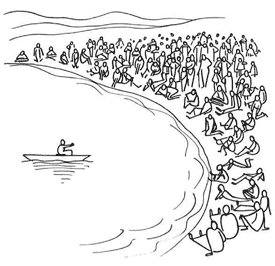 Annie Vallotton (1915-2013), 'Jesus Teaching the Crowds,' illustration for the Good News Bible. ©American Bible Society. |
While Jesus is with the Twelve, he teaches publicly, mainly through parables, and then explains and works through issues informally and privately with his close followers.
Public Teaching to Crowds
"Jesus went throughout Galilee, teaching74 in their synagogues, preaching75 the good news of the kingdom, and healing76 every disease and sickness among the people." (Matthew 4:23)
At times in his ministry, Jesus attracts huge crowds spread over the fields and hillsides, trying to hear him. They are attracted by his healings as well as by his teaching. Physicians of the day were ineffective with severe injuries and chronic diseases. So in any given town or region, a significant fraction of the population had some ailment. Most households would have elderly parents, uncles, or aunts, so when reports of the Healer comes, they flock to see him.
Introducing the Sermon on the Plain (Luke 6:20-49), Luke tells us,
"17 He went down with [the twelve apostles] and stood on a level place. A large crowd of his disciples was there and a great number of people from all over Judea, from Jerusalem, and from the coast of Tyre and Sidon.... 20 Looking at his disciples, he said: 'Blessed are you who are poor....'" (Luke 6:17, 20)
What follows we call the Sermon on the Plain (Luke 6:17-40), which is much like the Sermon on the Mount (Matthew 5-7). Another time, following the Feeding of the 5,000, he teaches in a synagogue what we call the Bread of Life Discourse (John 6:25-59). But much of his teaching is in parables about the Kingdom of God that he explains to his disciples later in private.
When Jesus teaches in the synagogues, there is little room for vast crowds. As in Nazareth, he perhaps starts with a Scripture text and then speaks about it (Luke 4). When he does heal in a synagogue service, he is severely criticized by the legalists for healing (acting as a physician) on the Sabbath.
But outdoors during the week, thousands might come to hear him. I get the feeling that usually the teaching comes first, followed by praying individually for all who are sick or infirm.
Jesus would teach publicly for some time, perhaps hours at a time. Compared to the rabbis, he doesn't cite other rabbis for his authority. He stands out, since he speaks authoritatively -- on his own authority and that of the Scriptures, which he quotes often. Even in the healing portion of his ministry, he is teaching by deed -- about God's compassion and that the Kingdom of God has truly come in their midst (Luke 11:20; 10:9-10).
Public Ministry Today
God uses gifted speakers and healers today to evangelize and teach the masses. God also uses Christian authors and online teachers such as myself. We use the gifts and opportunities God provides for us. And there is a big place for public preaching and teaching in the process of forming disciples. But sometimes we mistake crowds and numbers with making disciples like Jesus did. It is not.
In Jesus' ministry, public teaching is important. But Jesus' disciple-training process requires lots of private teaching with his disciples. Like an iceberg, perhaps 10% is seen above the water in public teaching and ministry, while 90% lies away from view.
We are in an era in America when megachurches are common; the largest churches are getting larger, and the smallest churches are getting smaller.77 Unless large churches are effective in involving their members in small groups, however, they are only marginally effective in producing the kinds of disciples Jesus is training. (More on this in Lesson 4.3.)
Private Teaching to Disciples
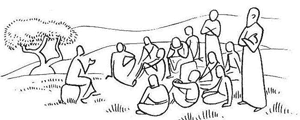 Annie Vallotton (1915-2013), 'Jesus Teaching His Disciples,' illustration for the Good News Bible. ©American Bible Society. |
Mark says concerning Jesus public teaching,
"He did not say anything to [the crowds] without using a parable. But when he was alone with his own disciples, he explained everything." (Mark 4:34)
In the private times, Jesus' disciples ask him questions about the meaning of the parables (Mark 4:10; 7:17) as well as other things they don't understand. These are a few of their questions:
"Do you know that the Pharisees were offended when they heard this saying?" (Matthew 15:12)
"Why could we not cast it out?" (Matthew 17:19)
"Tell us, when will these things be, and what will be the sign of your coming and of the end of the age?" (Matthew 24:3)
From Jesus' answers, they are forming a new world view.
Jesus Uses Questions
Sometimes Jesus will use questions to provoke thought and learning.
"Why do you call me good?" (Mark 10:18)
"Who do people say the Son of Man is?'" (Matthew 16:13)
"Who are my mother and my brothers?" (Mark 3:33)
"Whose portrait is this? And whose inscription?" (Mark 12:16)
"If then David calls him 'Lord,' how can he be his son?" (Matthew 22:45)
In small discipleship groups, I'll often explain the context and perhaps the meaning of key words in a Scripture passage, then ask a question. I'll remain silent, even if the pause continues. Pressure mounts. People are thinking. Eventually, someone will attempt an answer and we'll talk about it. Without personal engagement, disciples don't learn well and don't process the lessons. Jesus welcomes questions. (More on this in Lesson 7.3.2 "Bible study.")
The Scripture
Helping his disciples understand Scripture is one of Jesus' chief teaching themes. In the Sermon on the Mount, for example, Jesus balances the old interpretation ("You have heard it said") with his own ("but I say to you....").78 Jesus' teaching is full of quotes and allusions to the Old Testament.
After the resurrection, Jesus gives the disciples a comprehensive survey of how the Scriptures speak of him.
On the Road to Emmaus: "And beginning with Moses and all the Prophets, he interpreted to them in all the Scriptures the things concerning himself." (Luke 24:27)
In the Upper Room: "44 He said to them, 'This is what I told you while I was still with you: Everything must be fulfilled that is written about me in the Law of Moses, the Prophets and the Psalms.' 45 Then he opened their minds so they could understand the Scriptures." (Luke 24:44-45)
Withdrawing with the Disciples for Private Instruction
Jesus takes time to instruct his disciples privately, especially when pressure from Jesus' enemies is increasing along with danger of arrest. Instruction is important to him.
"After Jesus had finished instructing his twelve disciples, he went on from there to teach and preach in the towns of Galilee." (Matthew 11:1)
"Jesus did not want anyone to know where they were, because he was teaching his disciples." (Mark 9:30b-31a).
Jesus also takes the disciples aside for a debriefing and rest after their missions. (See Section 2.6 below; Mark 6:30--31; cf. Luke 9:10.) The words "take aside" and "withdraw" describe his actions to gain privacy for teaching.
"Now as Jesus was going up to Jerusalem, he took the twelve disciples aside79 and said to them...." (Matthew 20:17; cf. Mark 10:32)
"Jesus often withdrew80 to lonely places and prayed." (Luke 5:16)
"Jesus withdrew81 with his disciples to the lake." (Mark 3:7a)
There is a rhythm in Jesus' ministry -- public teaching and healing, followed by withdrawal or retreat for rest and to instruct his disciples privately.
Q12. How might pastors develop a rhythm of public and private ministry. What kinds of things are best taught publicly. What kinds of things are best taught privately? Why? How do you employ instruction as you train disciples?
2.5 Jesus Rebukes His Disciples
As you read the Gospels, you see Jesus rebuking his disciples, sometimes harshly.
"Jesus turned and said to Peter, 'Get behind me, Satan! You are a stumbling block to me; you do not have in mind the things of God, but the things of men.'" (Matthew 16:23)
The idea of rebuking seems somehow out of place -- especially coming from Jesus "meek and mild."82 But, dear friends, it is the way our parents molded our behavior from the time we were little children through our teenage years when we were learning to become independent and were often rebellious. Jesus uses rebuke to call out and shape the behavior of his disciples.
In Greek, the common word for rebuke is epitimaō, "rebuke, reprove, censure," also "speak seriously, warn" in order to prevent an action or bring one to an end. 83 Another word is elenchō, which has the root meaning "bring to light, expose." It means, "convict or convince someone of something, point something out to someone" and "reprove, correct."84
However, we often see Jesus using rebuke without either of these words being used. Observe a few incidents in Luke 9, where Jesus' disciples are trying to cast out a demon from a boy and aren't able. Jesus:
- Chides the generation for their unbelief (Luke 9:41)
- Rebukes an unclean spirit (Luke 9:42)
- Calls out pride in the disciples who argue about who is the greatest (Luke 9:46-48)
- Tells disciples to stop forbidding a non-disciple who is casting out demons (Luke 9:49-50)
- Rebukes James and John for wanting to call down fire on a Samaritan village that won't receive him (Luke 9:51-56).
These incidents are followed by a series of rather sharp corrections for excuses of people who say they want to follow Jesus -- but not yet (Luke 9:57-62).
Sometimes I have been too afraid of offending people by calling out their behavior. But if I would train disciples like Jesus, I need to be willing to use gentle rebuke, and even a direct one when necessary. Paul tells Timothy:
"Preach the word; be ready in season and out of season; reprove,85 rebuke,86 and exhort,87 with complete patience and teaching." (2 Timothy 4:2, ESV)
Rebuke needs to be part of the discipler's toolkit (1 Timothy 5:20; Titus 1:9, 13; Hebrews 12:5). Paul encourages Titus in this. To be silent is weakness. "Do not let anyone despise you." (Titus 2:15), but with your rebuke, remember gentleness, patience, and humility.88
Being willing to submit to another is an important ingredient in being a disciple. Perhaps we disciplers need to talk to our followers about the importance of rebuke so they understand and accept a rebuke in the spirit it is given. We must make sure that our motive is not frustration or anger, but love, or the rebuke can turn sour in the person we correct.
The Book of Proverbs has a lot to say about the value of a rebuke.
"My son, do not despise the Lord's discipline
and do not resent his rebuke,89
because the Lord disciplines those he loves,
as a father the son he delights in." (Proverbs 3:11-12; quoted in Hebrews
12:5-6)
"He who listens to a life-giving rebuke
will be at home among the wise." (Proverbs 15:31)
"A rebuke90
impresses a man of discernment
more than a hundred lashes a fool." (Proverbs 17:10)
"Flog a mocker, and the simple will learn
prudence;
rebuke a discerning man, and he will gain knowledge." (Proverbs 19:25)
"Like an earring of gold or an ornament of
fine gold
is a wise man's rebuke to a listening ear." (Proverbs 25:12)
"He who rebukes a man will in the end
gain more favor
than he who has a flattering tongue." (Proverbs 28:23)
To the angel of the church at Laodicea, Jesus says:
"Those whom I love I rebuke91 and discipline. So be earnest, and repent." (Revelation 3:19)
If part of being a Christian leader is loving our Christian brothers and sisters enough to rebuke them in Christ when appropriate, we must also be able to receive a rebuke graciously ourselves and learn from it, rather than bristle at it. Pride prevents us from receiving a rebuke; humility allows us to receive, learn, and grow. More on this in Lesson 3.3 (2 Timothy 4:2).
Q13. How important is rebuke in childrearing? What happens to children if parents fail to rebuke them? What is the value to us in being able to accept a rebuke? What is the relationship between submission and rebuke? How can a discipler teach by rebuking? What are the dangers of using rebuke?
2.6 Jesus Involves His Disciples in Ministry
To train his disciples, Jesus gives them increasing responsibilities in the day-to-day needs of the disciple band, caring for the crowds he attracting, and sending them on training missions. The disciples are Jesus' apprentices who receive hands-on training and experience.92 (See Lesson 1.2.1).
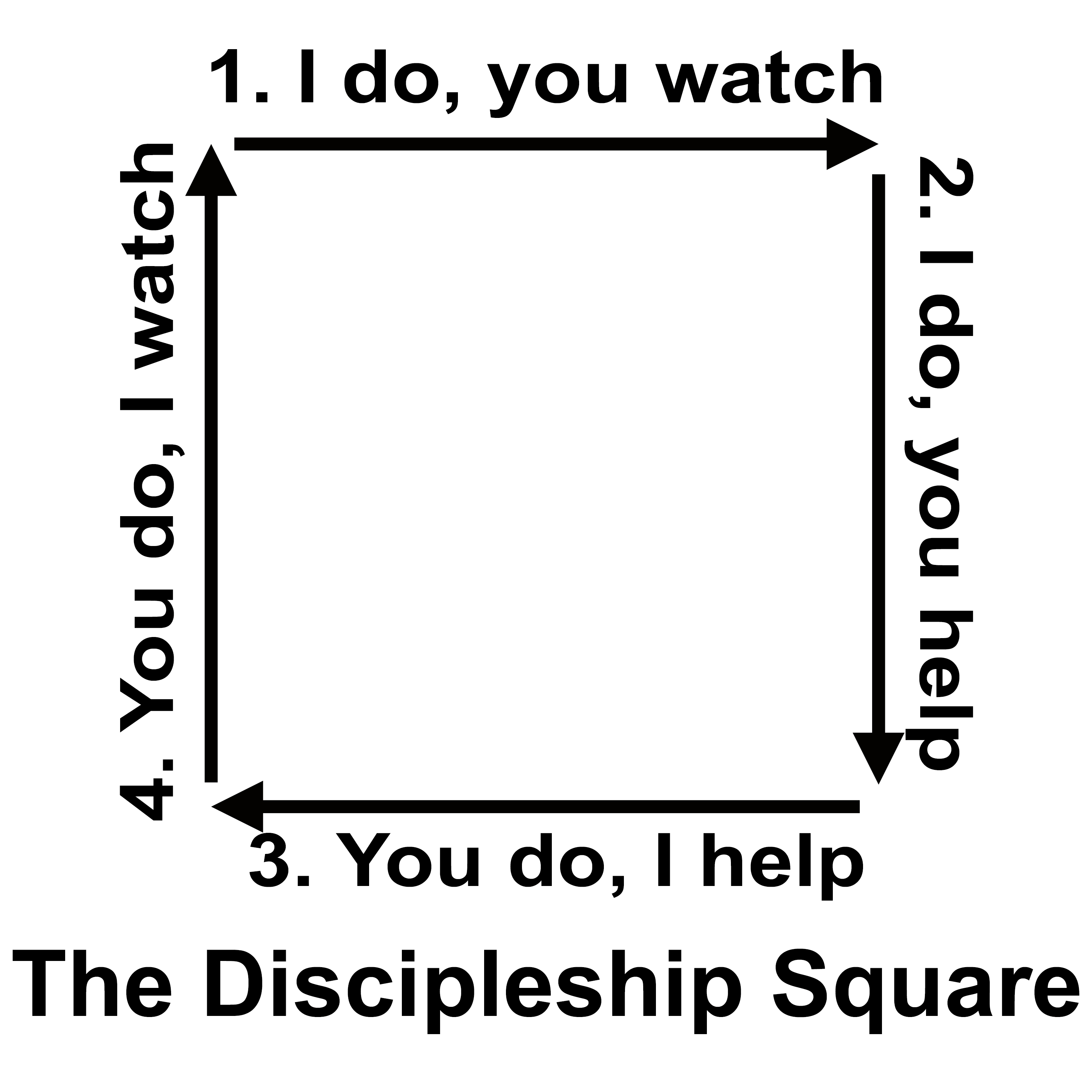
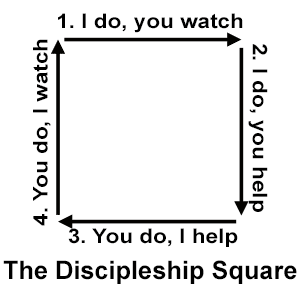 The Discipleship Square, from Mike Breen, Building a Discipling Culture (third edition; 3DM International, 2017). Larger graphic. |
We see this approach in many professions in our day -- especially in those that take some time to master. For example, police officers attend a police academy, then go out on patrol paired with a training officer, then go on patrol solo, but under the supervision of the watch commander. Doctors are trained academically, then trained in a hospital, graduate but become interns, then residents. Finally, they are ready to practice on their own. We could multiply examples. .
We see this same model with Jesus. He teaches the disciples. Then he gives them responsibilities under close supervision, debriefs and corrects them, then gives greater responsibilities. Mike Breen illustrates the four steps of this process in his Discipleship Square -- (1) I do, you watch; (2) I do, you help; (3) you do, I help; (4) You do, I watch.
Here are some examples of responsibilities Jesus gives his disciples that result in learning. Note that these responsibilities naturally produce "teachable moments" (see Section 2.2 above).
1. Managing logistics. Jesus uses his disciples to provide for the disciple band. We know Judas holds the money bag for the group's funds -- and steals from it (John 13:29). J The disciples are responsible to bring provisions for the crowd (Matthew 16:5-7) so Jesus involves in a miracle, as we'll see in a moment. Jesus tells Peter and John to prepare a place for the group's Passover celebration -- and so involves them in another miracle (Luke 22:8-13).
2. Crowd control. Since Jesus attracts increasing crowds, the disciples help keep order. Though we know that God can use his servants to heal on a large scale in meetings of tens of thousands, such as T. L. Osborne (1923-2013) and Tommy Hicks (1909-1973), Jesus' healing style is usually to minister individually to each person in need, even if it takes hours (Mark 1:32-34). During such times, the disciples would keep order. Sometimes they overdo it, as in the case of restricting little children from coming to Jesus (Mark 10:13--16).
3. Feeding the 5,000 is recorded in all four gospels.93 Since the disciples are handling logistics, they advise Jesus to send the people home, since there is no food for them in the area. Jesus says: "You feed them." Jaws drop. "What do you have?" Five loaves and two fish. "Bring them to me." He tells the disciples to have people sit in groups. Jesus prays, breaks bread, the disciples distribute it in baskets to the crowds. Then he has the disciples pick up all the remaining pieces of bread. There is a similar miracle of feeding the 4,000. Later, Jesus uses these experiences to teach them of God's abundant provision (Matthew 16:9).
4. Preaching and healing missions. When the Twelve have sufficient training, he sends them out two-by-two on missions to preach, heal, and cast out demons (Matthew 10; Mark 6:7--13; Luke 9:1--6). Later he sends out 70 or 72 disciples in pairs to the towns he will later visit himself (Luke 10:1-20). He sets specific restrictions on what they can bring with them so they will learn to rely on God for provision. Just before his crucifixion, he lifts these restrictions, though he reminds them of how God provided for them during the training missions (Luke 22:35--38). After they return from their mission, he debriefs the disciples and corrects some of their misconceptions (Luke 10:17-20).
5. Healing and exorcism. After having experienced God's power through them on the mission trips, the disciples now begin to anoint the sick with oil and pray for healing (Mark 6:12) and cast out demons (Mark 9:18). On one occasion, they aren't able to cast out a demon and ask Jesus why (Mark 9:28-29). Jesus explains. They seem to resent those outside their own band who are healing and casting out demons, but Jesus tells them not to fret (Luke 9:49-50).
Debriefing
As we noted above, part of assigning tasks is debriefing and correction. Jesus takes time to debrief his disciples after periods of ministry. Following their two-by-two mission, we read of the Twelve:
"30 The apostles gathered around Jesus and reported to him all they had done and taught. 31 Then, because so many people were coming and going that they did not even have a chance to eat, he said to them, 'Come with me by yourselves to a quiet place and get some rest.'" (Mark 6:30--31; cf. Luke 9:10)
When the Seventy (or seventy-two) return from their mission, they are full of excitement.
"The seventy-two returned with joy and said, 'Lord, even the demons submit to us in your name.'" (Luke 9:17)
Jesus comments, but redirects their understanding of priorities.
"However, do not rejoice that the spirits submit to you, but rejoice that your names are written in heaven." (Luke 9:20)
Nevertheless, Jesus is overwhelmed with joy at his disciples' reaction to Holy Spirit ministry:
"At that time Jesus, full of joy through the Holy Spirit, said, 'I praise you, Father, Lord of heaven and earth, because you have hidden these things from the wise and learned, and revealed them to little children. Yes, Father, for this was your good pleasure.'" (Luke 9:21)
Ministry assignments without debriefings miss out on the learning your disciples can gain through your mature insights into what is happening. Debriefing can also avoid having disciples learn bad habits. Train, do some projects together, then debrief. Rinse and repeat.
Ministry involvement provides many opportunities to learn. This coming week, our high school youth are going on a Spring break mission trip to Mexicali, through which they'll both experience the presence and power of God and learn through ministry to others.
2.7 Jesus Builds a Community of Disciples
Jesus disciples in a group setting. I am sure he does a lot of one-on-one personal ministry also. But even these encounters are often in the presence of others. Jesus' conversation with Nicodemus, for example, is reported by someone present, probably the Apostle John.
Jesus doesn't tell us the reasons for most of his strategies, so we must speculate. But I want to suggest several reasons why Jesus uses a strategy of discipling in a group and why it may be an important strategy for your ministry also.
1. Multiplication. Jesus has only so many hours in a day. Working primarily with a small group, he takes best advantage of the time he has. If he can accomplish the disciple training task in a small group, it takes less time than one-on-one ministry.
2. "Doing life together." The disciple band experiences various crises together -- teachable moments -- where the group can learn together. In Luke 9:46-48, for example, the disciples argue over which of them is the greatest; Jesus takes the opportunity to teach them that being great in his kingdom means being the least.
3. Love. The central theme of loving one another can't be taught in the abstract; it must be taught in the context of life. Jesus has many opportunities to teach love in the midst of the disciples' naturally-occurring group tensions and interactions (e.g., forgiving, Matthew 18:21-35; Luke 17:1-6)
4. Unity. Bringing people of diverse backgrounds together -- a tax collector, fishermen, and a zealot -- helps the disciples learn how to bring about and preserve unity.
5. Mutual support. Group members learn to support other members when they are struggling. This creates unity and bonding.
6. Inspiration. In a group setting we learn from one another. For example, Thomas says to the rest of the disciples, "Let us also go, that we may die with him" (John 11:16). His loyalty and courage to follow Jesus, even though he is fatalistic, inspires the rest to take courage also.
7. Movement. Being part of a committed group helps the disciples feel part of a larger movement of the kingdom of God than they might individually.
8. Leadership training. Being part of a group allows members to practice delegation, use their individual gifts and talents, and to receive and appreciate the gifts and talents of others.
9. Belonging. Being part of a healthy group creates a sense of belonging that combats isolation.
10. Accountability. Having responsibilities helps group members learn accountability.
By calling disciples to "follow me," Jesus invites them into a new kind of family with a shared mission that gives them a new sense of identity, belonging, and purpose that transcends their former lives. We'll see other advantages of discipling in a group setting in Lesson 7.3.1 when we examine insights from social psychology.
Q14. What strengths stand out to you of Jesus discipling in a group? What might be some of the drawbacks of this approach?
I've outlined a number of Jesus' discipling strategies; you can probably think of more. But those mentioned help us to begin to understand what he is doing.
How carefully did Jesus' apostles copy his discipling style? Unfortunately, the record is sparse. Peter and John work together in ministry on several occasions as peers, not as mentor/protégé. Early tradition tells of Mark assisting Peter and recording his words, but we aren't told much more.94 Earlier, Mark travels with Paul and Barnabas and then Barnabas in ministry. Other than that, Peter is depicted in Acts as traveling alone or with his wife. We don't have much from John's ministry to draw on, though as bishop in Ephesus he writes three epistles with a few personal references.
 Available in book formats: paperback, Kindle, PDF |
Paul is different. While he doesn't study under Jesus with the Twelve, he learns both the apostles' teaching and through personal revelation. In the next lesson we'll examine Paul's approach to discipling.
Prayer
Jesus, it must have been wonderful being one of the Twelve, spending day after day with You! Show me how to spend time with You each day. To get to know You through the Spirit. To learn from You. And, ultimately, to disciple others with some of the same strategies You used so long ago. In Your holy name, I pray. Amen.
Endnotes
[58] "Strategy," Merriam-Webster.com.
[59] Apostolos, BDAG 122, 2c. Sometimes these messengers have extraordinary status, especially of God's "messenger, envoy," including the Twelve and others who preached the gospel.
[60] Stories of the apostles' exploits (with the exception of Peter's and a few of John's) are not told in Scripture. But the early Church Fathers told their stories and the legends that grew up around them. See individual apostles' stories on Wikipedia. See also W. Brian Shelton, Quest for the Historical Apostles: Tracing Their Lives and Legacies (Baker Academic, 2018).
[61] "Entrust" (NIV, ESV, NRSV), "commit" (KJV) is paratithēmi, "place beside, place before," here, "to entrust for safekeeping, give over, entrust, commend" (BDAG 772, 3a).
[62] "Men" (ESV, NIV 1984, KJV), "people" (NRSV, NIV 2008) is the plural of anthropos, "'human being, man, person" a person of either sex, with focus on participation in the human race, "a human being" (BDAG 81, 1c). If Paul had intended to refer to males, he would have used the noun anēr, "man, male."
[63] "Teach" is didaskō, "provide instruction in a formal or informal setting, teach" (BDAG 241, 2b).
[64] "Able" (ESV, NRSV, KJV), "qualified" (NIV) is hikanos, "sufficient," here, "pertaining to meeting a standard, fit, appropriate, competent, qualified, able," with the connotation "worthy, good enough" (BDAG 472, 2; Thayer 300).
[65] "Wise" (ESV, NRSV, KJV), "shrewd" (NIV) is the adjective phronimos, "pertaining to understanding associated with insight and wisdom, sensible, thoughtful, prudent, wise" (BDAG 1066), from phronis, "prudence."
[66] "Innocent" is the adjective akeraios, literally, "unmixed," here, "pure, innocent" (BDAG 35).
[67] "Entrust" (NIV, NRSV, ESV), "commit" (KJV) is the imperfect active indicative of the common verb pisteuō, "to trust, believe," here, "entrust something to someone" (BDAG 818, 3).
[68] "Example" is hypodeigma, "an example of behavior used for purposes of moral instruction, example, model, pattern" (BDAG 1037).
[69] Doulos, "male slave" (BDAG 259, 1a).
[70] Kurios, "one who is in charge by virtue of possession, owner" (BDAG 577, 1).
[71] "Student" (NIV), "disciple" (ESV, NRSV, KJV) is mathētēs, "one who engages in learning through instruction from another, pupil, apprentice" (BDAG 609, 1).
[72] "Teacher" is didaskalos, "teacher," used in addressing Jesus (corresponding to the title "rabbi") (BDAG 241).
[73] "Fully trained" (NIV, ESV), "fully qualified" (NRSV), "perfect" (KJV) is karartizō, "to put into proper condition" (BDAG 526, 1b), properly, "to render artios," that is, "fit, sound, complete" (Thayer 336), from kata-, "in succession, in course, one part after another" + artizō, "get ready, prepare."
[74] "Teaching" is disaskō, "to provide instruction in a formal or informal setting, teach" (BDAG 241, 2a).
[75] "Preaching" (NIV, KJV), "proclaiming" (ESV, NRSV) is kēryssō, to make public declarations, proclaim aloud," originally, for an official herald to make an announcement (BDAG 543, 2bβ). The related noun is kerygma.
[76] "Healing" (NIV, ESV, KJV), "curing" (NRSV) is therapeuō, "heal, restore" (BDAG 453, 2).
[77] A 2025 National Survey of Religious Leaders found that the largest 9% of congregations contain about half of all churchgoers. Aaron Earls, "Most Pastors Lead a Small Congregation, but Most Churchgoers Attend a Larger Church," LifeWay Research, June 3, 2025.
[78] Matthew 5:21, 27, 31, 33, 38, 43.
[79] "Took aside" (NIV, ESV, NRSV), "took apart" (KJV) is two parts, (1) the prepositional phrase kat' idian, "by themselves, privately"; and (2) the verb paralambanō, "to take into close association, take (to oneself), take with/along," here for the purpose of private instruction (BDAG 757, 1).
[80] "Withdrew" translates the verb hypochōreō, used by the military to mean, "go back, retreat, withdraw," here, "to withdraw from a location, to go off, go away, retire" (BDAG 1043, 1).
[81] Anachōreō, "withdraw, retire, take refuge" (common in papyrii of obligations to the state) (BDAG 75, 3). Also in Matthew 12:15; 14:13.
[82] The phrase "meek and mild" comes from the title of a children's hymn by Charles Wesley in 1742 (Matthew 5:5; 11:29).
[83] Epitimaō, BAGD 303. It is a word of authority. Jesus rebukes evil spirits (Luke 9:41-43; Mark 3:12; 9:25), diseases (Luke 4:39), and the elemental forces of nature (Mark 4:39). It is also a word describing how Christian brothers are to relate to each other in a spirit of forgiveness: "So watch yourselves. If your brother sins, rebuke (epitimaō) him, and if he repents, forgive him" (Luke 17:3).
[84] Elenchō, BAGD 249, 2 and 3.
[85] Elenchō.
[86] Epitimaō.
[87] "Exhort" (ESV, KJV), "encourage" (NIV, NRSV) is parakaleō, to urge strongly, appeal to, urge, exhort, encourage" (BDAG 765, 2).
[88] Galatians 6:1-4; 2 Timothy 2:25; 4:2; 2 Thessalonians 3:15; 1 Peter 3:15.
[89] "Rebuke" is the Hiphil imperfect of yākaḥ, "to set someone right, reprove" (Holladay, p. 134). A related noun is tôkēḥâ, "reproof, rebuke, correction" (TWOT #865a). Another related noun is tôkaḥat, "argument, reproof." (TWOT #865b), "reproach, reprimand" (Holladay 387).
[90] "Rebuke" is gĕʿārâ (TWOT #370a), from gāʿar, "rebuke, reprove."
[91] "Rebuke" is elenchō, "to express strong disapproval of someone's action, reprove, correct" (BDAG 315, 3).
[92] Apprentice -- "one who is learning by practical experience under skilled workers a trade, art, or calling," Merriam-Webster.com.
[93] Matthew 14:13--21; Mark 6:31--44; Luke 9:12--17; John 6:1--14.
[94] Eusebius, Church History 3.39.15.
Copyright © 2026, Ralph F. Wilson. <pastor joyfulheart.com> All rights reserved. A single copy of this article is free. Do not put this on a website. See legal, copyright, and reprint information.