


|
Old Testament
New Testament
Gospels
Acts
Paul's Letters
General Letters
Revelation
Topical Studies
Beginning the Journey (for new Christians). en Español

|
Old Testament
New Testament
Gospels
Acts
Paul's Letters
General Letters
Revelation
Topical Studies

|
Home
Bible Studies
Articles
Books
Podcasts
Search
Menu
Donate
About Us
Contact Us
FAQ
Sitemap


Free
E-mail Bible Study
 Names and Titles of God
Home | Bible Studies | Articles | Books | Podcasts | Search | Menu | Donate | About Us | FAQ | Contact Us
 James J. Tissot, detail of 'Jesus Eats Breakfast with His Disciples' (1896-1904). Gouache on board. The Brooklyn Museum, New York. Full image. |
We've examined biblical models of how both Jesus and Paul formed disciples. Now our task is to apply these models to our contemporary situations in the twenty-first century. The models are sound, but they need to be adapted to our particular situations. The way you make disciples in Los Angeles will be different from the way you make disciples in Nairobi. Let's look at some of the elements we need to put in place.
- Discipleship gospel. Clarity on exactly what the gospel is.
- Disciple training curriculum. Approaches to content for teaching new disciples.
- Mentors and influencers. The role of mentors, authors, pastors, and others in forming disciples.
In following lessons, we'll examine the role of spiritual disciplines and working with individuals and small groups to make disciples.
4.1 Discipleship Gospel
One of the first elements we need in discipling men and women is to make sure we have an accurate understanding of the gospel, the Good News of Jesus Christ.
"The time is fulfilled, and the kingdom of God is at hand; repent and believe in the gospel." (Mark 1:15)
"Go into all the world and proclaim the gospel to the whole creation." (Mark 16:15, ESV)
Just what is the gospel in a nutshell?
The Preaching of the Apostles
Perhaps the most succinct but complete statement of the gospel content in the Bible is formulated by the Apostle Paul.
"3 For what I received I passed on to you as of first importance: that Christ died for our sins according to the Scriptures, 4 that he was buried, that he was raised on the third day according to the Scriptures, 5 and that he appeared to Peter, and then to the Twelve." (1 Corinthians 15:3-5)
How did the early church understand the gospel? We can distill sermons of Peter and Paul in the Book of Acts to determine what is the gospel (more on that in a moment).
The Apostles' Creed is a statement of the Christian faith from Rome written as early as perhaps 180 AD.166
In the next century, under the pressure of various heresies such as Arianism, the early church works hard to define with greater clarity what they all believe, especially with regard to the Trinity. The result is a statement of orthodox Christianity in the Nicene Creed (325 AD, revised in 381 AD). These creeds have served the Church well over the centuries. I fully affirm them, recommend them to you, and am blessed when I recite them.
Fast forward to the twentieth century, when New Testament scholar C. H. Dodd analyzes the preaching (kerygma) of the apostles in the Book of Acts. From the sermons of Peter and Paul, Dodd formulates the basic elements of their message.167 To that, Matthew Bates adds an eighth element.168 In brief, this is what the early apostles preached:
| Jesus the king: | |
| 1. Preexisted with the Father. | John 8:58; |
| 2. Took on human flesh, fulfilling God's promises to David. | John 1:1, 14; Mark 11:10; 10:47-48; 12:35-37. |
| 3. Died for sins in accordance with the Scriptures. | 1 Corinthians 15:3; Mark 10:45; Mark 14:24; Matthew 26:28; 1 Corinthians 11:25; Isaiah 53. |
| 4. Was buried. | Four gospels. 1 Corinthians 15:4 |
| 5. Was raised on the third day in accordance with the Scriptures. | 1 Corinthians 15:4; four gospels. |
| 6. Appeared to many. | 1 Corinthians 15:5-8 |
| 7. Is seated at the right hand of God as Lord.169 | Mark 10:35-40; 14:61-62; Matthew 19:28; 25:31-32; Daniel 7:13-14; Psalm 110 |
| 8. Will come again as judge. | Revelation 19:11-21; 1 Thessalonians 4:13-17; Matthew 25:31-32; Romans 2:16; 14:10; 2 Corinthians 5:10 |
All these elements can also be found in the Apostles' Creed!170 The problem with Dodd's formulation is its complexity, and it seems more doctrinal rather than actionable. However, having studied the apostolic preaching myself, I believe these eight indeed summarize the preaching of Peter and Paul in telling the story of Jesus.
The Plan of Salvation Is Part of the Gospel
We need to examine another wrinkle in our understanding of the gospel. In the twentieth century people developed several approaches to explain the gospel in simple terms. We'll call these abbreviated approaches the "Plan of Salvation."
You may have seen gospel presentations such as the Roman Road,171 Bill Bright's Four Spiritual Laws, and the Navigators' Bridge to Life. God has used these to bring hundreds of thousands of people to Christ. The purpose of the Plan of Salvation is to explain simply how one becomes a Christian, rather than complicate it with lots of theology. Essentially, the typical Plan of Salvation outline is:
- Problem: Man is sinful and lost.
- Solution: Jesus provides atonement and forgiveness of sins.
- Action: Ask Christ to be your Savior.
- Response: You will be born again, Christ will come in, etc.
There are numerous variations on this, but these are the basic points. The problem is that the Plan of Salvation is an important part of the gospel, not the whole gospel. Elements have been left out for simplicity, but with serious results.
The Gospel of the Kingdom
More recently, Bill Hull and Ben Sobels have helped us capsulize what they call "the discipleship gospel" or the "the Kingdom gospel."172 They see seven elements of the gospel, divided into four declarative elements and three imperative elements: These elements are derived from three passages of the New Testament that are specifically talking about the "gospel" -- Jesus' preaching in Mark 1:14-17 and Mark 8:27-31 and Paul's summary in 1 Corinthians 15:1-5 (that we saw above).
| Four declarative statements declare who Jesus is and what he has done. | |
| 1. God's kingdom is here. | Mark 1:15 |
| 2. Jesus is the Christ | Mark 8:29; 1 Corinthians 15:3 |
| 3. He died for our sins. | Mark 8:31; 1 Corinthians 15:4 |
| 4. He was resurrected on the third day. | Mark 8:31; 1 Corinthians 15:4 |
| Three imperative elements indicate what must be our response to the gospel. | |
| 5. Repent of sin | Mark 1:15 |
| 6. Believe the gospel | Mark 1:15 |
| 7. Follow Jesus | Mark 1:17 |
Hull and Sobels explain:
"While the imperative responses to the gospel are not the gospel proper in the purest sense, they are, in fact, essentially attached to it.... If people don't respond to the gospel in the way Jesus calls them to, they won't be saved.... We must not separate [the gospel from the imperative responses]. They are critically connected. Jesus didn't disconnect them and neither should we."173
I think Hull's and Sobels' seven elements to the gospel are quite useful in making disciples, though I don't want to quibble about which elements from Dodd's and Bates' lists should be added. The point of these approaches to defining the gospel is vital:
- The gospel is the story about Jesus, not about us. It is about who He is and what He did. It recounts Jesus' story, a narrative, rather than a series of theological propositions, making it easier to communicate.
- The gospel focuses on Jesus as our King to be obeyed, not only our Savior to be thanked.
- A gospel presentation concludes with a call to action that makes it clear that salvation is an entry to a life of following Jesus.
Of course, in every culture, we'll need to emphasize or further explain some element that might not be well understood by that culture. We may also need to use different terminology.174 But we need to explain the basic elements of the gospel and its response.
The Essential Response: Repent, Believe, Follow
Let's take a moment to examine the imperatives of the gospel as formulated by Hull and Sobel based on Mark 1:14, 16-17.
"14 Jesus went into Galilee, proclaiming the good news of God. 15 'The time has come,' he said. 'The kingdom of God is near. Repent and believe the good news!' ...
16 As Jesus walked beside the Sea of Galilee, he saw Simon and his brother Andrew casting a net into the lake, for they were fishermen. 17 'Come, follow me,' Jesus said, 'and I will make you fishers of men.' 18 At once they left their nets and followed him." (Mark 1:14-18)
1. Repent
Hull's and Sobels' first imperative is to repent. Repent is metanoeō, literally, "change one's mind," here, "feel remorse, repent, be converted."175
As mentioned above, too often in presenting the Plan of Salvation or during invitations at the conclusion of a service, we underemphasize the need for repentance -- changing one's mind and deliberately turning away from our old way to Jesus' way. I firmly believe that there is no salvation without repentance!
 Chair Illustration' from the '4 Spiritual Laws' by Bill Bright, © 1965-2013, CRU. Larger image. |

Repentance is often implied in gospel presentations. For example, Bill Bright's chair illustration in the Four Spiritual Laws, clearly illustrates the difference between self being on the throne of one's life and Christ being there.
The question asked for this illustration is: "Which circle would you like to represent your life?" The question requires choosing. But often, the implications of this aren't spelled out. Yes, the prayer includes making Jesus Savior and Lord of our lives, "taking control of the throne of my life," but the implications of Jesus being Lord aren't spelled out.
Repentance requires turning away from something and turning towards something. Away from sin and a self-centered lifestyle, and toward Jesus' path and a life of trusting and following him. If we want to produce disciples, then our gospel needs to include the necessity for repentance.
2. Believe
We considered in Lesson 1.2.3 what the New Testament means with the word "believe." In the Amplified Bible, "believe" includes the ideas of "adhere to, trust in, rely on, and have faith."176 Belief requires a full embrace of trusting Jesus.
3. Follow
As we saw in Lesson 1.2.2, following Jesus is the essential idea of being a disciple of Jesus. Going where he goes, doing what he does, adopting his worldview and lifestyle, etc. A Christian who doesn't follow Jesus is an utter contradiction.
The essence of the gospel is pretty clear. In order to produce true disciples, the gospel we declare needs to include Jesus' call to repent, believe, and follow him. One of the basics is to get the gospel foundation clear. On that, we can begin to build disciples.
Q21. (Mark 1:14-17; 8:27-31; 1 Corinthians 15:1-5) What essential elements might have been left out of Hull's and Sobel's "Discipleship Gospel"? What happens when someone isn't informed as they are led to Christ that they must follow him for the rest of their lives? How does that affect discipleship?
4.2 Discipleship Training Curricula
"Make disciples of all nations ... teaching them to obey everything I have commanded you." (Matthew 28:19)
If we are to teach people to obey "everything" Jesus taught that's pretty expansive. Let's consider what we should be teaching to train disciples. I see the task in two parts (with perhaps some steps in between):
- Training new believers to become disciples.
- Challenging current disciples to continue to grow as disciples.
The curriculum you adopt will depend on how mature your people are as disciples. Before we get to that, let's briefly consider what both Jesus and Paul taught their disciples.
Jesus' Disciple Training Curriculum
As we've discussed in Lesson 2, Jesus spends three years training his disciples, many of whom travel with him and hear his teachings numerous times in one village after another. We'll survey what Jesus teaches, but realize that Jesus' training purposes is unique -- first to train the Twelve, to be unique emissaries and foundational leaders. He also trains the 70 or more other people that are part of the band.
What does Jesus teach? In addition to more than 100 parables, metaphors, similes, and maxims to teach his disciples,177 some have counted 38 or 49 different commands he gives. A few years ago, after deduplicating the parallel accounts -- I counted approximately 78 distinct teachings that Jesus gave. Of course, John's Gospel concludes:
"Jesus did many other things as well. If every one of them were written down, I suppose that even the whole world would not have room for the books that would be written." (John 21:25)
Trying to organize all of Jesus' teaching can be a frustrating and rather artificial exercise. Realizing that, here is one very abbreviated way to categorize what Jesus taught his disciples:
- Who Jesus is -- Son of Man, Son of God, relation to the Father, Messiah, authority to forgive sins, etc. (Theology)
- Redemption and resurrection. The Messiah must be killed and rise on the third day. How the messianic prophecies of the Old Testament are fulfilled in Jesus. Jesus as a ransom, a sacrifice for our sins. (Theology)
- The new birth. The truth sets you free, we are called to repent, we are born spiritually by the Spirit, life is in the Son, etc. (Theology)
- Love and forgiveness. The first and second commands are to love God and to love your neighbor. This includes loving your enemies and laying down your life for your friends. Forgiveness is required. (Values)
- Humility is the antidote of our natural self-centeredness. (Values)
- Motive of the heart is central. We do not seek to impress others, but God. Sin flows from what is in the heart. We must not be judgmental; legalism deals with externals and is not central to our faith. Trusting God with our needs -- and our money -- is essential. (Values)
- Faith and prayer open us to receive from God. Seeking God and his kingdom in prayer is vital, along with obedience. Praying for the sick. (Practices)
- Commitment and persecution. Disciples must be ready to endure persecution, even death, a full commitment. We must be willing to give up everything to follow. (Values)
- Ministry to the lost. Jesus has compassion for lost people. We are to use the spiritual gifts he gives us to help them and establish them in the faith. Some training is by short missions two-by-two followed by a debriefing. (Values, practices)
- Promise of the Spirit. Jesus teaches his disciples to anticipate and wait for the power of the Holy Spirit who will dwell in them, teach, guide, and empower them. We learn to listen for God's voice through the Spirit. (Theology, practices)
- Judgment and reward. Jesus teaches that he is coming again following a time of great turmoil in the world. He will be the Judge on Judgment Day, and will reign in glory as Son of Man and Son of God. (Theology)
When you look at this list, you see that it is strong on theology, with some on values, heart attitudes, and morality, and some on skills and practices.178 Why is that?
God designed that his Messiah be born into a people and religious culture that had strong values and moral sense already established, a reverence for Scripture, a history of patriarchs and prophets, and revelation of many truths that underlie Christianity today. Yes, the morality was often external, legalism rather than heart submission, but it was there.
Devotional practices had some basis in Israel's history. Ministry skills were largely taught by Jesus' strong example of a devotional life and ministry to people. More on that later. Jesus taught what was necessary to help traditional Jews understand the kingdom he was bringing.
Paul's Disciple Training Curriculum
Paul's task is different. Though he encounters traditional Jews of the Diaspora in the synagogues he visits, within a few weeks he is usually ejected from the local synagogue. The congregations that result from his ministry became majority non-Jewish. Paul's discipleship task is different from Jesus' foundational role.
Disciple Lessons from Titus' Ministry in Crete
Recently, I spent a month studying Paul's short letter to Titus, a very productive time for me in better understanding the process of discipleship and spiritual formation.
Paul and Titus have evangelized the island of Crete together. Paul leaves to minister elsewhere, leaving Titus the task of establishing churches on the island. Paul's Letter to Titus is full of instructions on how to teach and disciple the people. These aren't primarily Jews who have centuries of living by the Ten Commandments and the Torah. These are raw pagans, steeped in idolatry -- and a pretty rough sort of people at that.
Paul gives a profile of a leader:
"[An elder] must hold firmly to the trustworthy message as it has been taught, so that he can encourage others by sound (hygiainō) doctrine and refute those who oppose it. For there are many rebellious people, mere talkers and deceivers, especially those of the circumcision group...." (Titus 1:9-10)
There are some Jewish people among the converts who are causing problems.179 But Jews are a tiny minority; most of the Cretans are pagan in origin.
"12 Even one of their own prophets has said, 'Cretans are always liars, evil brutes, lazy gluttons.' 13 This testimony is true. Therefore, rebuke them sharply, so that they will be sound (hygiainō) in the faith 14 and will pay no attention to Jewish myths or to the commands of those who reject the truth." (Titus 1:12-13)
Paul's comment isn't some kind of racial smear, but an evaluation from a world traveler who has worked in many locales.
Sound Doctrine on Crete (Titus 2:1-10)
Consider the phrase "sound doctrine" in Titus 1:9, 13 -- literally, "correct or uncorrupted or healthy teaching."180 "Sound doctrine" might sound to our ears like theology. But as the letter progresses, you find that what Paul means by "sound doctrine" is what we would call moral and character instruction.181
"1 You must teach what is in accord with sound doctrine. 2 Teach the older men to be temperate,182 worthy of respect,183 self-controlled,184 and sound in faith, in love and in endurance." (Titus 2:1-2)
The older men need to behave! Many have a drinking problem. They need to act in a way that others can respect. They need self-control. In addition, they need help in spiritual formation -- faith, love, patience, etc.
Older women have these and other needs:
"Likewise, teach the older women to be reverent in the way they live, not to be slanderers or addicted to much wine, but to teach what is good." (Titus 2:3)
As the older women are trained, they are to teach the women with young families.
"4 Then they can train185 the younger women to love their husbands and children, 5 to be self-controlled and pure, to be busy at home, to be kind, and to be subject to their husbands, so that no one will malign the word of God." (Titus 2:4-5)
The young husbands, too, need help with their behavior.
"Similarly, encourage the young men to be self-controlled." (Titus 2:6)
Titus has to spend a lot of time teaching basic morality.
Jesus can assume that his hearers accept basic moral tenets, even if they don't practice all of them. Rather than it being all new as on Crete, Jesus has to help his disciples unlearn wrong interpretations.
"You have heard that it was said ... but I tell you...." (Matthew 5:21-27-28)
Paul has to start teaching basic morality and good behavior from scratch, plus a theological understanding of Jesus.
A Culturally Sensitive Discipleship Curriculum
I say all this to point out that there is no single discipleship curriculum that fits all situations around the world. It has to be adapted to the culture or microculture of the converts. The discipler must see the culture with missionary eyes, then present the gospel and discipleship training in light of that culture's understandings and needs.
For example, the discipleship curriculum of Teen Challenge that works with recovering alcoholics and addicts is far different from the discipleship curriculum designed for students on a college campus or new converts in a Malaysian village. The basics remain, but the emphasis will vary greatly depending upon the needs in the culture and maturity of the converts.
When I pastored in Los Angeles in the 1970s and '80s, I researched ethnic communities in that sprawling metropolis for future church planting. School system data helped us pinpoint clusters of immigrants that spoke 52 different languages. Within a city you often have ethnic microcultures, sometimes living in ghettos. Consider also microcultures of the homeless and unemployed, the poor, middle class blue collar, middle class white collar, upper-middle class, etc. Young unmarried adults, young marrieds, middle aged with families, single parent homes, retirees, etc.
To build authentic disciples, we must carefully analyze the particular culture in which we are ministering and adapt as necessary. This is what Paul means when he says:
"I have become all things to all men so that by all possible means I might save some." (1 Corinthians 9:22)
The gospel does not change, but how we teach it and what we emphasize will vary from situation to situation. Whatever the culture, however, new disciples need training in:
- Values that underlie our Christ-like lifestyle. These include basic morality -- honesty, sexual purity, use of alcohol and drugs, love and forgiveness vs. hate and retaliation, etc.
- Doctrine, theology, an understanding of God, the Kingdom, Jesus' role, salvation -- these form a second bundle of teachings.
- Practices and behaviors. Developing a devotional life, learning to love and forgive, to pray, to minister to others. Many of these are "caught, not taught." New believers watch the discipler and learn to do as he or she does.
JesusWalk: Beginning the Journey
Here's one approach. Some time ago, God led me to develop a basic teaching curriculum for newly converted disciples. It is designed to be used by a lay mentor assigned by the pastor. It is video-based with talking points that help the mentor guide a conversation at weekly meetings with the new believer. In JesusWalk: Beginning the Journey (JesusWalk Publications, 2010) I integrate theology, values, as well as practices into most lessons. These are the twelve sessions:
- Rescue - grace and forgiveness (theology)
- Disciple - following Jesus daily (practice)
- Temptations - getting victory over sin (values, practice)
- Fellowship - connecting to a community of Christians (practice)
- Love - the core of Christianity (theology)
- Gospel - understanding Christ's story (theology)
- Holy Spirit - the power of God's presence (theology)
- Witness - sharing your faith (practice)
- Worship - communing with God (practice)
- Generosity and Service - love in action (practice)
- Bible - guidebook for living (theology)
- Lord - obedient servants of the King (practice)
It is designed to be useful across denominations and is most effective in a culture similar to mine. Your culture will have differences. This curriculum can and should be adapted to fit local needs.
Leroy Eims' Discipleship Curriculum
Writing for American evangelicals in the mid-twentieth century, Navigators leader Leroy Eims (1925-2004) in his classic book The Lost Art of Disciple Making (NavPress, 1978, still in print) has given us one of the most thorough training curricula I have seen. Appendix 1 outlines "Training Objectives for a Disciple" (pp. 159-180). He includes 30 topics, each spelled out in detail with clear training objectives and outcomes, various activities and recommendations for the discipler, a list of helpful books and materials, and several Scripture verses that underlie each topic.
|
|
|
While your training objectives will vary some from his, this 21-page appendix is well worth the price of the book! Again, Eims' curriculum is written for a particular culture, but can be adapted to yours.
Disciple Training vs. Pastoral Preaching
It is useful to differentiate between initial discipleship training that a new believer would receive and a long-term teaching and preaching strategy for a congregation. Initial teaching, what I refer to as a Discipleship Curriculum above, would include the topics you need to teach to bring a new disciple "up to speed," the basics of everything he or she needs to bypass typical blockages and move towards maturity.
But since most pastors have congregations made up of both new believers and established believers, they must consider a long-term approach to a congregation's week-in and week-out preaching and teaching. Sometimes we make the mistake of endless repetition of the basics without going deeper.
"Let us leave the elementary teachings about Christ and go on to maturity, not laying again the foundation...." (Hebrews 6:1a)
Some traditions see Sunday morning as a time to preach to the lost. As a result, the congregation becomes well acquainted with salvation, but weak on other essentials. Other congregations use a topical approach with a catchy series title to attract seekers. But sermons are sometimes shallow, since going deeper might alienate the seekers. Other times, pastors have personal hobby-horses that are constantly being flogged.
Pastors need to earnestly seek God so that, over time, they expose their congregations to the whole scope of Bible teaching. Yes, evangelism is a chief job of the church, but the chief job of the church's teaching is not evangelism, but preparing saints for the work of ministry (Ephesians 4:11-13). We must evangelize our communities, but we must also "teach them to obey everything he has commanded."
A strong emphasis on following Jesus as disciples needs to undergird a preaching plan and result in a gradual recognition by the congregation of the challenge of Jesus to follow him personally.
Q22. How would a discipleship curriculum differ for (1) new believers vs. (2) maturing believers? In your congregation's structure, where would new believers get basic discipleship training and mentoring?
4.3 Mentors and Influencers
We've considered what the essential gospel is and what a discipleship curriculum might look like. Now let's examine the role of mentors and leaders in building disciples.
God uses other believers to disciple and form us spiritually. Primarily, these are mentors in our family and church, but he also uses influencers we don't know well -- even people we have never met.
Mentors
A mentor is someone who teaches or gives help and advice to a less experienced and often younger person.186 The person on the receiving end of mentoring in a secular context might be referred to as a protégé,187 an apprentice, a learner, an intern, or a mentee. In spiritual settings, the appropriate word is often disciple.
Mentoring fits well with Jesus' approach to training his disciples. Of course, unlike mentors who guide and suggest, Jesus is Lord and Master over his disciples with authority to command them. Nevertheless, much of his training could be described as mentoring -- and that is the role played by most disciplers today.
Secular Mentoring
Mentoring is considered vital in management development circles. Styles of mentoring in a secular context may differ some from one company to another:
- Traditional face-to-face one-on-one mentoring.
- Distance or virtual mentoring, via phone or Zoom.
- Group mentoring, a single mentor with a cohort of mentees.
- Peer mentoring, people paired at similar levels or career stages.
- Reverse mentoring, younger employees paired with experienced employees to learn or grow in a specific field or discipline.
- Mosaic mentoring, seeing a mosaic or series of mentors through one's life or career.
You can imagine how some of these varieties could be adapted to church settings.
Spiritual Mentoring
Informal mentoring goes on all the time in healthy churches and has been a chief way of developing disciples from the earliest days.
"Remember your leaders, who spoke the word of God to you. Consider the outcome of their way of life and imitate their faith." (Hebrews 13:7)
Whether or not you are a church leader, there is nothing that will replace your life for Christ lived out among other people. No, you're not perfect, but your light shining will help a new generation understand what it means to be a disciple of Jesus. Mentoring is the way Jesus trained his disciples. There is no adequate substitute for it.
Remote Influencers
I am fascinated by the various levels of influence and their relationship to discipling. Leadership guru John Maxwell famously says:
"Leadership is influence -- nothing more, nothing less."188
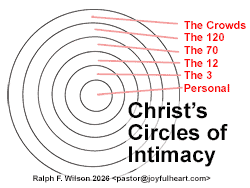 Diagram 1. Jesus' Circles of Intimacy. Larger graphic. |
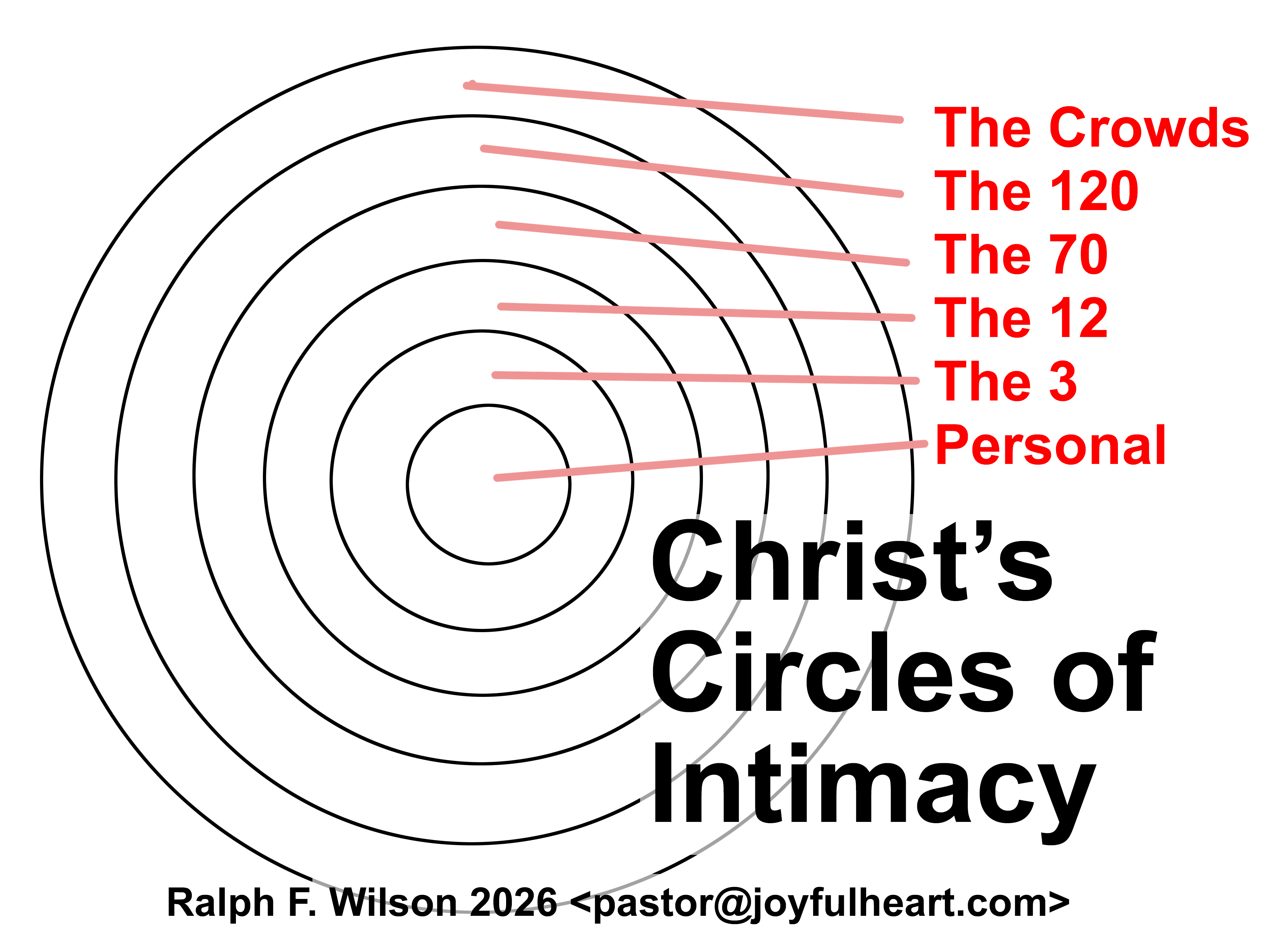
Group Sizes in Jesus' Ministry
How did Jesus influence people? Here are his circles of influence.
1. The Province of Judea. Jesus' reputation precedes him. Like John the Baptist before him, Jesus is a well-known and controversial figure in the Roman province of Judea (which included Galilee). He draws region-wide attention. His influence is so great that the region's Roman governor, regional king, and religious leaders all feel threatened. This region-wide influence isn't exerted primarily by personal contact, but by word-of-mouth that spreads Jesus' reputation far and wide.
2. The Crowds. On many occasions, Jesus draws crowds of thousands who come for healing, to see miracles, and to hear his teachings (Matthew 14:21; 15:38). In these gatherings, Jesus doesn't have much personal contact, except perhaps with those healed by the laying on of his hands before he moves on to the next person. Teaching is powerful and comes with a sense of authority, but no real personal relationships are formed. Many believe in his miracles, but not so much in his teachings, so Jesus doesn't open up fully to the crowds (John 2:23-24). When Jesus says difficult things, the crowds desert en masse (John 6:66). Jesus is influencing many people in the crowds, but the commitment level is often illusive.
3. The 120. After Jesus' resurrection about 120 of his core followers meet in Jerusalem for a sustained period (Acts 1:15). These include the band of disciples from around Jerusalem, plus some from Galilee who had come originally for Passover, but don't return because of Jesus' command to stay in Jerusalem (Luke 24:49). These 120 represent those who have been close to Jesus while he lived among them.
4. The 70 Disciples. On one occasion, Jesus sends out 70 (or 72) of his followers on mission-trips two-by-two (Luke 10:1-20). The group probably includes men like Joseph (called Barsabbas and Justus) and Matthias who are later candidates to take Judas' place as the twelfth apostle (Acts 1:23). Several women also travel with Jesus and help support him out of their wealth (Luke 8:1-3). He gives the disciples instructions when he sends them out and debriefs them when they return. There is, no doubt, some degree of personal relationship and mentoring going on here.
5. The Twelve Apostles. The Twelve are with Jesus a great deal and get to know him well. Jesus selects these twelve from among the larger group and designates them as apostles, "emissaries, sent ones" (Luke 6:12-13). They travel with him constantly (Luke 8:1). Occasionally, he'll take one aside for private instruction or direction (Mark 4:10-12, 33-34; 9:30-31; 16:20; etc.). In addition to intense personal mentoring, Jesus is teaching and explaining to them the parables he shares in public. They hear his teachings multiple times and internalize them.
6. The Inner Circle. An inner circle consists of Peter, James, and John who are especially close to Jesus. They enjoy special mentoring as well as special experiences with him at the Transfiguration and in the Garden of Gethsemane.
7. Individual Ministry. Jesus spends time with many persons in individual conversations and encounters. Once, for example, when Peter comes to him about the temple tax, he sends Peter on a project to catch a fish with a silver coin in its mouth -- and explains something about his own relationship to the Father. Of course, Jesus also spends time with inquirers. Several are highlighted in the Gospels -- Nicodemus (John 3), the Woman at the Well (John 4), the Rich Young Ruler (Mark 10:17-27), and Zacchaeus (Luke 19:1-10), to name a few.
In each of these circles of people, Jesus exercises spiritual influence. Reputation, teaching, and miracles influence the crowds, while those closest to him receive thoroughgoing mentoring.
Classification of Spiritual Influencers
We see various levels of influence today as well.
Some influence is non-face-to-face, remote influence. Authors of popular Internet blogs are known as "social media influencers." Advertisers recognize their effectiveness and offer them sponsorships, ads revenue, and products to review and endorse.
Celebrities have always had remote influence through fame from a hit record, a movie role, a well-known book, politics, or success in some other field. Their constant presence in the media, carefully cultivated by press agents, allows them to wield cultural influence whether or not they deliberately attempt to lead others.
As it relates to making disciples, I see four primary tiers of contemporary spiritual influence.
1. National and international influencers
National influencers are often best-selling authors or preachers with large television followings. Think of the impact of a writer like C.S. Lewis (1898-1963) who wrote Mere Christianity (1952) and other books. He has given generations of Christian believers a framework of thought, a way to understand and approach faith. Sometimes, the Holy Spirit will use a writer or television preacher to give us just the nugget of truth we need to unlock a whole new area of our lives.
Television and video personalities are pervasive, but their ministry is not personal. It may seem personal, if they are skilled video communicators, but their influence has nothing to do with real relationships. They may talk about their lives, but are quite selective in what they share.
People often feel that they "know" the celebrities they love. but they don't really "know" them personally. It is an illusion. Are they influential? Can they inspire? Oh, yes. God can use them powerfully. Can they teach? Yes, sometimes powerfully. But remote influencers are not enough for well-rounded discipling. Faith and values are caught, not just taught. And the life of a disciple is formed by emulating close-up examples.
2. Preachers and teachers of large churches
While numbers vary in different surveys, the largest churches contain a substantial number of churchgoers in the country.189 In large churches, services are programmed to the minute. Sermons are carefully prepared, often by teams. Senior pastors of these churches are skilled communicators. They influence through powerful preaching and teaching. They may mentor a staff, but probably most of these senior pastors are not really known by many congregants on a personal basis. In spite of that, hearers are often quite loyal to them and feel like "family."
3. Pastors and elders of small- to medium-size churches
Pastors of these smaller churches may not be such gifted communicators as in larger congregations, but they preach and teach weekly, sometimes more often. They influence through sermons and Bible studies, but also by personal relationships and pastoral care. These churches are small enough that people can meet with a pastor or be in a small class with a leader where they can interact. Pastors typically do informal mentoring in their congregation at key points in spiritual growth -- at least making sure that someone is helping them grow. They often mentor several of the leaders.
4. Disciplers, class teachers, small group leaders, and spiritual mentors
In the smaller church, it is much easier to know and be known. Smaller churches specialize in personal care and growth. Many members know their pastor well.
Larger churches excel in providing high quality praise bands, excellent communicators, and often helpful teaching. And teaching is important. But they struggle to get people involved in small groups and in one-on-one mentoring that will help them grow optimally as disciples. Here, smaller churches can excel, if they learn how to do this.
Again, budding disciples need personal examples, models whom they can emulate. People learn doctrine and values by teaching, but they learn faith and how to live by modeling individuals.
I come back to that verse in Hebrews:
"Remember your leaders, who spoke the word of God to you. Consider the outcome of their way of life and imitate their faith." (Hebrews 13:7)
Only when a mentor's way of life can be actually observed is he or she most effective in forming disciples by imitation.
You may think of your church as insignificant compared to some megachurch. But you are wrong. You are key in God's Kingdom. In a church of any size, if you spend time mentoring individuals, one by one or in small groups, you are on the front line of discipling. You are to be honored! This is where the rubber meets the road.
A Personal Observation
Though I have retired from the pastorate, I deliberately spend regular time with small groups of men teaching and mentoring, because I feel it is the best way to disciple others. However, I also experience a strange phenomenon, that through writing I have been able to influence -- sometimes powerfully through the Holy Spirit -- people I have never met, and will never meet this side of heaven. Some of my remote students credit me as their mentor. I am not their mentor in any real sense of the word. Mentoring is person-to-person. But I am awed by what God does!
Spiritual Development and Personal Contact
Personal contact is vital to normal development. Studies of children who are raised primarily in an orphanage rather than within a family find orphanage children to be smaller in height, weight, and head circumference. Behavioral development also seems to be slower. Lower IQ, fewer social skills, and an increased sense of insecurity have been reported among other things.190 Our heart goes out to those who are raised in difficult conditions.
But this illustrates how families and caring personal contact are vital in discipleship. Yes, national Christian leaders can powerfully influence people without personal contact. But I am convinced that you don't build strong, well-rounded, committed disciples without robust personal contact.
Personal contact was Jesus' way of training up men and women for the Kingdom. There is no substitute for personal disciplers, mentors -- call them what you will. If you are discipling men or women, you are my hero. You are indispensable to the Kingdom!
Q23. How is mentoring important to a new believer's spiritual formation? Name your three most important mentors in the Christian faith? If you were to be a mentor to a person who wants to grow in their Christian faith, describe the kind of person you might be the most likely to help?
 Available in book formats: paperback, Kindle, PDF |
We've examined several foundational elements involved in training disciples -- defining the gospel, developing a training curriculum, and mentoring. In the next lessons, we'll examine how spiritual disciplines help disciples grow in Christ.
Prayer
Father, we're beginning to take seriously this whole matter of viewing our lives and our churches in terms of training faithful disciples, close followers of Jesus. Teach us how to disciple others well. We pray this in Jesus' name and for the sake of his Kingdom. Amen.
Endnotes
[166] See Wikipedia article, "Apostles' Creed."
[167] C. H. Dodd, The Apostolic Preaching and Its Developments: Three Lectures (1937). Later, in book form: C. H. Dodd, The Apostolic Preaching and Its Developments (Harper and Row, 1964).
[168] Matthew W. Bates, Salvation by Allegiance Alone: Rethinking Faith, Works, and the Gospel of Jesus the King (Baker Academic, 2017) is a careful scholarly work. During the "lordship" controversy of the late 1980s, the late John MacArthur examined this in The Gospel According to Jesus: What Is Authentic Faith? (Zondervan, 1988, later expanded and revised), separating the "carnal Christian" from the true Christian, in that when a person is saved, he cannot merely receive the offer of eternal life, but must also surrender to Christ's lordship, which becomes evident in his obedient conduct.
[169] Bates (Allegiance, pp. 67-72) adds to Dodd's seven elements of apostolic preaching #7, "Is seated at the right hand of God as Lord," important since it speaks to Christ reigning now.
[170] Bates, Allegiance, p. 211.
[171] The Roman Road leads one to salvation using five verses from Romans in order: Romans 3:23; 5:8; 6:23; 8:1; 10:9.
[172] Bill Hull and Ben Sobels, The Discipleship Gospel: What Jesus Preached -- We Must Follow (Him Publications, 2018).
[173] Hull and Sobels, Discipleship Gospel, pp. 34-35
[174] For example, Jesus avoided the term "Messiah," but used "kingdom" terminology. Paul, on the other hand, spoke more of "Christ" than "king" or "kingdom," since in the cities of the Roman empire, "kingdom" might have been understood as language of rebellion.
[175] Metanoeō, BDAG 640, 2.
[176] John 6:29 in The Amplified Bible (Lockman Foundation, 1965, latest edition 2015).
[177] Ralph F. Wilson, Jesus' Parables for Disciples: Over 100 Stories, Analogies, and Figurative Sayings (JesusWalk Publications, 2023).
[178] This may be related to my own bias in compiling it.
[179] The "circumcision group" indicates that the converts in Crete included Jews -- probably because Paul's evangelism strategy typically began with teaching in synagogues, winning some Jews and Gentile "God-fearers" who attended the meetings. When Jews became believers in Jesus as the Messiah, some still insisted that circumcision was necessary for salvation, a problem that Paul had to deal with in many places (for example, Acts 15 and Galatians 2:11-21).
[180] Hygiainō, "healthy," here, figuratively, "to be sound or free from error, be correct" (BDAG 1023). The adjective is hygiēs, "healthy, sound," in Titus 2:8, "pertaining to being uncorrupted or correct" (BDAG 1023).
[181] Titus 1:9, 13; 2.1-2, cf. 2:8; 1 Timothy 1:10; 6:3; 2 Timothy 1:13; 4:3.
[182] Vēphalios, BDAG 672. Vēphalios can mean, by extension, pertaining to being restrained in conduct, self-controlled, level-headed." But since sōphrōn ("self-controlled") is used later in this sentence, here we should take vēphalios as having to do with consumption of alcoholic beverages -- beer and wine. Also, sound doctrine for older women includes the parallel idea of not being "addicted to much wine" (Titus 2:8). Temperance with alcohol is also a qualification for elders and deacons (1 Timothy 3:2-3, 8; Titus 1:7).
[183] "Worthy of respect" (NIV), "dignified" (ESV), "serious" (NRSV), "grave" (KJV) is semnos, "pertaining to evoking special respect," especially, "worthy of respect/honor, noble, dignified, serious" (BDAG 919, aα).
[184] "Self-controlled" (NIV, ESV), "prudent" (NRSV), "temperate" (KJV) is sōphrōn, "pertaining to being in control of oneself, prudent, thoughtful, self-controlled" (BDAG 987). Sōphrōn seems to be derived from saos/sōs, "safe, whole" (Thayer 613).
[185] "Train" (NIV, ESV), "encourage" (NRSV), "teach" (KJV) is not the normal word to teach or instruct (didaskō), but sōphronizō (from sōphrōn, "of sound mind") "to instruct in prudence or behavior that is becoming and shows good judgment, encourage, advise, urge" (BDAG 986). "To make someone a sōphrōn," i.e., "to bring him to reason," also, "to exhort, spur on" (Ulrich Luck, sophron, ktl., TDNT 7:1104).
[186] "Mentorship," Wikipedia. Merriam-Webster Dictionary notes the origin of the word with Mentor, a friend of Odysseus, entrusted with the education of Odysseus' son Telemachus.
[187] Protégé (male), protégée (female)
[188] John C. Maxwell, The 21 Irrefutable Laws of Leadership (Thomas Nelson, 1998), p. 17 (Law #2).
[189] Mark Wingfield, "Most American congregations are small, but most churchgoers attend large congregations," Baptist News Global, March 17, 2022, citing the National Congregations Study, Mark Chaves of the Sociology Dept. at Duke University, principal investigator. This study claims that the largest 9% of congregations contain about half of all churchgoers and that 91% of worshipers are in congregations of 360 people or over. Somewhat lower numbers are found in Christopher Watson, "Worship in the Average Church in America," Worship Leader Magazine, June 26, 2023.
[190] The St. Petersburg, USA Orphanage Research Team, "The Effects of Early Social-Emotional and Relationship Experience on the Development on the Development of Young Orphanage Children," Monographs of the Society for Research in Child Development (2008), Vol 73, No. 3, pp. vii-295.
Copyright © 2026, Ralph F. Wilson. <pastor joyfulheart.com> All rights reserved. A single copy of this article is free. Do not put this on a website. See legal, copyright, and reprint information.