


|
Old Testament
New Testament
Gospels
Acts
Paul's Letters
General Letters
Revelation
Topical Studies
Beginning the Journey (for new Christians). en Español

|
Old Testament
New Testament
Gospels
Acts
Paul's Letters
General Letters
Revelation
Topical Studies

|
Home
Bible Studies
Articles
Books
Podcasts
Search
Menu
Donate
About Us
Contact Us
FAQ
Sitemap


Free
E-mail Bible Study
 Names and Titles of God
Home | Bible Studies | Articles | Books | Podcasts | Search | Menu | Donate | About Us | FAQ | Contact Us
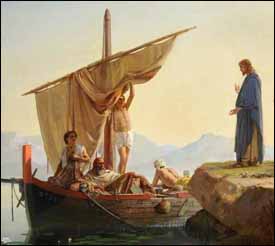 Edward Armitage, detail of 'Jesus Calling the Apostles James and John' (1869), oil on canvas, 28 x 42 in, Sheffield Galleries and Museums Trust, Sheffield, England. Full image. |

A disciple is one who closely follows his rabbi Jesus with a fervent desire to understand what he says, do what he does, and be what he is. A disciple is one in whom Christ is being formed.
To understand the discipling process, however, we need to look carefully at Jesus. What did he teach? What did he demand of his followers? How did he train them? Just what is a disciple?
This is not just an academic survey of the Bible. Every verse we'll examine requires both you and me to ask: How does this fit me? How is my walk as a disciple?
In succeeding lessons, we will examine the task of discipling others. We must start with what a real disciple looks like according to Jesus.
1.1 The Great Commission (Matthew 28:19-20)
Perhaps the best introduction to discipling is with Jesus' Great Commission, given to the apostles at the conclusion of Matthew's Gospel:
"19 Therefore go and make disciples of all nations, baptizing them in the name of the Father and of the Son and of the Holy Spirit, 20 and teaching them to obey everything I have commanded you. And, surely, I am with you always, to the very end of the age." (Matthew 28:19-20)
Other Gospels give us parts of this command,1 but Matthew spells it out for us most completely. Let us carefully examine it. (Bear with me as I discuss the Greek grammar, since it gives us clues to the meaning.)
- "Go" is a participle which modifies the main verb.
- "Make disciples" is the main verb of the sentence, the main command.2 So far, we might translate, "Going forth, you are to make disciples of all nations...."
- "Baptizing" is another participle that modifies the main command, explaining perhaps what making disciples consists of or looks like.
- "Teaching" is another participle modifying the main command.
The main thrust of the command then is: "Going forth from here, make disciples, that is, baptize and teach them." Making disciples involves both baptizing and teaching. This is an oversimplification, of course, but the task could be looked at as two-fold.
- Baptizing describes the process of evangelism, bringing people to the point of repentance and faith, and committing their lives to Christ, culminating in baptism.
- Teaching. "Teaching them to obey everything I have commanded you" is the process of not only imparting information, but also values and a lifestyle of obedience. Making disciples consists of both (1) evangelism and (2) teaching, training, spiritual formation. In this study I focus on the second of these tasks, which I refer to as discipling.
Now let's focus on the words. The phrase "make disciples" (NIV, ESV, NRSV), "teach" (KJV) in verse 19 is the Greek word mathēteuō, "to be a pupil," here, "to cause one to be a pupil, teach."3 We'll examine this more in a moment. "Teaching" in verse 20 is didaskō, "to provide instruction in a formal or informal setting, teach."4 These two words are synonyms.
- Mathēteuō focuses on the pupil, the recipient of the teaching.
- Didaskō focuses on the instruction itself.
What are the apostles to teach? Obedience. "To obey" (NIV, NRSV), "to observe" (ESV, KJV) is the verb tēreō. Originally, it referred to guarding or keeping watch over someone. Here it means, "to persist in obedience, keep, observe, fulfill, pay attention to, especially of law and teaching."5
What are the new disciples to obey? "All that I have commanded you." The verb here is entellō, "to give or leave instructions, command, order, give orders."6 Sometimes I have heard teaching denigrated as mere "information transfer." But the kind of teaching that produces healthy disciples involves much more than that. It is teaching that informs and forms the kind of life that habitually emulates Jesus' values, lifestyle, and teachings. Discipling is much like parenting. It happens over a period of time, gradual instruction and correction that help form the life of a new disciple. We'll come back to this later.
What is the aim of the Great Commission? It is to reproduce and raise up men and women who bear the character of Christ and minister with the power and maturity of Christ. The goal is to create little christs. We call those engaged in this process "disciple makers" or "disciplers."
1.2 Synonyms for Disciple
We've taken a look at the command to make disciples. Now let's examine the various ways that disciples are described in the New Testament. Each word gives us a unique lens through which to examine different aspects of what a disciple is.
1. Disciple (mathētēs)
One of the most common words, especially in the Gospels, is "disciple" (mathētēs). In Greek it means "learner, pupil, disciple." In our New Testament context, it connotes "one who is rather constantly associated with someone who has a pedagogical reputation or a particular set of views, disciple, adherent."7 In the Great Commission we already saw the verb form of this root, mathēteuō, "to be a pupil" and "to cause to be a pupil, teach."8
Jewish Rabbis
If we stop with just the Greek definition, however, we miss out on the context, the Jewish tradition that informs Jesus' use of the word.
In the Judaism of his time, aspiring Bible students were trained as disciples by an honored rabbi. The Hebrew word rabbi (rabbî) itself means "my lord, my great one," from rab, "great, captain, chief."9
Studying under a rabbi was different than our system of higher learning. There were no classrooms, blackboards, or chairs filled with pupils. Nor was there a curriculum of studies that the student must complete for graduation. The text would have been from the scrolls of the Torah (the first five books of the Bible), the scrolls of the former prophets (historical books) and latter prophets (Isaiah, Jeremiah, etc.), and the scrolls of the Writings (Job, Psalms, Proverbs, etc.). There were no individual textbooks.
Training took place informally. Those disciples whom the rabbi thought might amount to something were allowed to be around him constantly; they "followed" him everywhere. As the rabbi studied the Scriptures, his disciples would listen while he read a passage from the scroll and then talked about it. They would act as his servants, listen to his every word, and seek to copy him in their actions. They would ask questions, seeking to understand.
The Dust of the Rabbi
In the Jewish Mishna, Yose ben Yoezer (about 200 BC) comments,
"Let thy house be a meeting-house for the
wise;
and powder thyself in the dust of their feet;
and drink their words with thirstiness."10
He is encouraging people to make their homes places of Bible study, and to welcome itinerant teachers ("the wise" = sage or rabbi) and eagerly learn from them. The saying can be interpreted two ways, either let the dust of the rabbi cover you as you walk closely behind him, or sit in the dust of the ground at their feet as they teach you.11 The image has been popularized by Lois Tverberg in her 2013 book, Walking in the Dust of Rabbi Jesus.12
Apprentices and Interns
There is some similarity to the idea of an apprenticeship or internship. For centuries, a young man would be apprenticed for several years to a craftsman, who would teach him the trade. The apprentice might be indentured or legally bound to the craftsman during this period, serving as cheap labor and living in the master's home. Upon completion, the apprentice would be considered a journeyman. If he acquired his own workshop, he might be considered a master who could take on apprentices himself. Internships are common in some professions today. Newly graduated medical doctors, for example, complete an internship at a hospital caring for patients under careful supervision before they are licensed to practice medicine on their own.
Jesus the Rabbi
Rabbis were highly honored in Israel. One of the best-known in Jesus' time was Rabbi Gamaliel I, grandson of the famous Rabbi Hillel, founder of one of the schools of the Pharisees. Gamaliel was a member of the Great Sanhedrin. When the apostles were on trial in the days of the early church, he counselled restraint (Acts 5:34).
The Apostle Paul trained under this very rabbi according to the highest standards of Judaism of his day (Acts 22:3). In contrast, the apostles were considered relatively uneducated. They were literate, having learned to read as boys in a local synagogue school. But Jesus' disciples were fishermen, tradesmen, not scholars.
Let's contrast the great Gamaliel with Jesus.
"The Jews were amazed and asked, 'How did this man get such learning without having studied?'" (John 7:15)
No doubt, as a boy Jesus attended the local synagogue school to learn to read the Hebrew Scriptures. But beyond that, Jesus was self-taught, or better, taught by his heavenly Father.
"My teaching is not my own. It comes from him who sent me." (John 7:16)
Jesus had always had a keen interest in the Scriptures. Even as a boy of twelve, he amazed the elite teachers of the law in the temple with the insightfulness of his questions (Luke 2:46-49).
As an adult, when Jesus taught, he taught with depth and authority.
"The people were amazed at his teaching, because he taught them as one who had authority, not as the teachers of the law." (Mark 1:22)
The rabbis tended to quote tradition or another rabbi as their authority for interpreting the Torah. Jesus spoke as a prophet with God's authority.
Though Jesus didn't study under a great rabbi nor teach like them, when he entered his ministry, he copied the training method of the Jerusalem rabbis.
"He appointed twelve -- designating them apostles -- that they might be with him and that he might send them out to preach and to have authority to drive out demons." (Mark 3:14--15)
We'll be analyzing Jesus' training strategy in Lesson 2. But at this point we are trying to establish what a "disciple" meant in its original context. Sometimes, the word is used to describe a larger circle of the followers of Jesus.13 But originally in the Gospels, a "disciple" refers to this model of one who studied under a great rabbi, spent time with him, sought to understand his wisdom, to copy his actions, to be like him. That is what the first disciples were. It was said of the apostles: "these men had been with Jesus" (Acts 4:13). They were his pupils, his disciples.
One important part of this series of lessons is the
Discussion Questions in each lesson. We learn by reflecting on what we have
studied, processing it, and thinking through its implications. If we don't
process, we don't learn well or grow spiritually. Don't skip this step or you
will have gained head knowledge without heart knowledge! Write out your own
answer to each question, perhaps in a simple
journal.
Writing is a form of meditation. It forces you to understand enough to express an
idea in your own words. Writing reinforces it in your spirit. If you are
studying with others, discuss it.
Q1. Since "disciple" means "pupil, adherent, learner," what are you doing that
marks you as an active pupil of Jesus? How do you learn from Jesus
today? What are you doing to make, lead, and instruct new pupils of Jesus?
2. Follower (akolutheō)
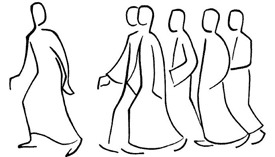 Annie Vallotton (1915-2013), 'Following Jesus,' illustration for the Good News Bible. ©American Bible Society. |
If "disciple" means "pupil, adherent" of a teacher or rabbi, Jesus' command and invitation for someone to be his disciple was, "Follow me." This was quite literal. His disciples went with him everywhere -- listening, asking, imitating, serving. For us in the twenty-first century, the following is figurative, but very real, to follow him and adopt his way of life as our own. Here are some of Jesus' invitations to follow:
"'Come, follow me,'14 Jesus said, 'and I will make you fishers of men.' At once they left their nets and followed him." (Mark 1:17--18)
"[Jesus] saw a man named Matthew sitting at the tax collector's booth. 'Follow me,' he told him, and Matthew got up and followed him." (Matthew 9:9)
Jesus himself clearly sees following him as core to being a disciple.
"Whoever wants to be my disciple15 must deny themselves and take up their cross daily and follow me." (Luke 9:23, NIV 2011)
"Follow/followed" is the verb akoloutheō, "come after, accompany someone," with transition to the figurative meaning, "to follow someone as a disciple, be a disciple, follow." The request to "follow me" means "be my disciple." We see this usage not only in the New Testament, but in classical Greek with Socrates and his students.16 When Jesus asked people to follow him, he meant it literally: be my disciple!
The Rich Young Ruler
I think of the rich young ruler who asked Jesus what he should do to inherit eternal life. The man was well-dressed, devout, earnest; he carefully observed the Mosaic law. Jesus reviews the man's flawless religious practices, then speaks to him with both affection and seriousness.
"21 Jesus looked at him and loved him. 'One thing you lack,' he said. 'Go, sell everything you have and give to the poor, and you will have treasure in heaven. Then come, follow me.'
22 At this the man's face fell. He went away sad, because he had great wealth." (Mark 10:21-22)
This man is invited by Jesus Son of God to follow him, to be with him, to hang out with him. He could have been one of the great disciples, a man with a legacy of many children in the Lord. But he passes it by because he would rather hang on to his wealth and position than follow Jesus.
Following and Repentance -- Unfollowing
When we follow Jesus, we also choose to un-follow something else. It is inevitable. We must turn away from something else to follow Jesus. He increasingly occupies our time and attention at the expense of our old way of life.
If this sounds a bit radical to you and to our common church-culture, that is a testament to how far we have fallen away from an understanding of what it really means to become a Christ-follower.
The decision to follow requires repentance, metanoia, which means to change your mind -- literally meta, "change" and nous, "mind."17
"'The time has come,' he said. 'The kingdom of God is near. Repent and believe the good news!'" (Mark 1:15)
There is no discipleship, no following, without repentance.
Q2. Why does following Jesus require leaving something else -- repentance or a change of mind and heart? What have you had to un-follow to follow Jesus in his way? If someone were to watch your life, what about you would indicate to them that you follow Jesus?
Followers of the Way (Acts 24:14)
Closely related to the term "follower," early Christians are referred to in the Book of Acts as "followers of the Way."18 The Greek word is hodos, "way, road, highway," here, "of the whole way of life from a moral and spiritual viewpoint, the way, teaching" in the most comprehensive sense.19
"... Any who belonged to the Way, whether men or women...." (Acts 9:2)
"He had been instructed in the way of the Lord." (Acts 18:25a)
"I persecuted this Way to the death." (Acts 22:4a)
"I admit that I worship the God of our fathers as a follower of the Way, which they call a sect." (Acts 24:14)
This designation recalls Jesus' words.
"I am the way, and the truth, and the life. No one comes to the Father except through me." (John 14:6)
"13 Enter by the narrow gate. For the gate is wide and the way is easy that leads to destruction, and those who enter by it are many. 14 For the gate is narrow and the way is hard that leads to life, and those who find it are few." (Matthew 7:13--14)
In the Book of Revelation, the 144,000 are those who "follow the Lamb wherever he goes" (Revelation 14:4). How closely do you follow?
3. Believer (ho pistos)
This brings us to a common descriptor of a disciple -- a believer, one who believes, who trusts in Jesus. This is usually from the adjective pistos, "faithful, believing" or the verb pisteuō, "to believe, trust."
Several times, followers of Jesus are termed "believers" in Acts and Paul's letters,20 but curiously, not in the Gospels.21 The Gospels indicate that some believe in Jesus because of his miracles, but don't follow closely (John 2:24; 10:38; Luke 8:13). James distinguishes between belief as intellectual assent and faith that changes the way we live.
"18b Show me your faith without deeds,
and I will show you my faith by what I do.
19 You believe that there is one God. Good! Even the demons believe
that -- and shudder." (James 2:18b-19)
As it is with English, the Greek word "to believe" (pisteuō) can describe all kinds of response. But to have saving faith one is "to entrust oneself to an entity in complete confidence, believe (in), trust, with implication of total commitment to the one who is trusted."22
Q3. What is the difference between a disciple, an adherent, and one who "believes in Jesus," or is there a difference? What is the difference between intellectual assent and an active following and trust?
4. Christian (christianos) and other words
The word "Christian" is christianos, "one who is associated with Christ, Christ-partisan, Christian."23 It occurs three times -- first in Antioch (Acts 11:26), then on the lips of King Herod Agrippa II (Acts 26:28), and finally by Peter (1 Peter 4:16).
Of course, there are other words: friends,24 servants,25 and others, but disciple, follower, believer, and Christian are the chief ones.
Which Word Best Conveys the Idea of Disciple Today?
We've now examined the four main New Testament words for disciple:
- "Disciple" (mathētēs) points to a disciple as a learner sitting under Rabbi Jesus.
- "Follower" (akolutheō) emphasizes the willingness to go where Jesus goes.
- "Believer" (ho pistos) underlines the idea of trusting Jesus.
- "Christian" (christianos) identifies us with the one we serve.
Of course, disciples have been called all sorts of things, including "Jesus freak," "fanatic," "nice person" -- and everything in between. But what is the best way to identify ourselves to others? I can't speak of cultural nuances for other regions than my own, but in America, I think:
- "Believer" is too broad to be useful, since for many it is often taken as the minimum -- intellectual assent that Jesus is the Christ. In Jesus' day, believing meant embracing and trusting in Jesus, but not so much today.
- "Christian" identifies someone's religion as compared to others, that is Christian vs. atheist, Muslim, Jewish, or Buddhist. But Christian is too broad a word by itself to identify one as devout or earnest without using modifiers. In addition, the world has seen lots of evil done by Christians in the name of Christ. The word's reputation has been sullied by its own people's behavior.
- "Disciple" is a word rich in meaning for me personally. It is also a word that has meaning in a secular context. But outside of Christian circles, it lacks much punch. "Disciple of Jesus" sounds a bit formal and standoffish.
- "Jesus-follower" or "follower of Jesus," in my opinion, is probably the least ambiguous description of a sincere disciple in our day. I recommend that you add "Jesus-follower" to your active vocabulary, since it sounds fresh and invites curiosity in the form of questions. "What religion are you?" "I am a Jesus-follower!"
1.3 The Necessity of Following Jesus
We've examined words used to describe disciples. But now let's look at the obvious. A Christian must actually follow Jesus. I was shocked by a bold statement by discipleship guru Bill Hull:
"The last fifty plus years we have preached a gospel that says, 'You can become a Christian and not follow Jesus.'"26
"We have separated conversion from discipleship, and we have made discipleship optional. We have a non-discipleship kind of gospel. "27
He contends that American Christianity has invented a kind of heresy of a two-tier Christianity.
- Believers. If you say the sinner's prayer and give yourself to Jesus, you are saved. Salvation is by grace, thus, attempting to follow Jesus and obey his commands is not necessary to salvation. So they say.
- Disciples. However, if you are particularly devout, you can take following Jesus seriously.
Jesus knew no two-tier system, nor did the Apostles Paul, Peter, and John who wrote the letters that make up most of the New Testament. Nor did the writer of Hebrews. Jesus teaches the very opposite in:
- The Parable of the Soils or Sower (Matthew 13:3-9, 18-23)
- The incident of the rich young ruler (Luke 18:18-30)
- His statement: "I never knew you" (Matthew 7:21-23).
Paul is quite clear that salvation is your portion only "if you continue in your faith" (Colossians 1:23; cf. 1 Corinthians 15:2; Hebrews 3:6; cf. 10:39; John 8:31). Hull concludes:
"Conversion and discipleship must be reunited in a discipleship gospel where discipleship and obedience are a natural part of grace, salvation, and what it means to be saved."
We'll examine a discipleship gospel further in Lesson 4.1.
Where Have We Gone Wrong?
As I've thought about how the heresy of the non-following Christian came about, I see four key concepts we need to get right. In the past, I've made some of these mistakes myself. These mistakes may seem subtle, but they send us in the wrong direction.
1. Belief. First, we confuse the word "believe" with "intellectual assent," whereas the word as Jesus and the apostles used it carries the fuller idea of "adhere to, trust in, rely on, and have faith" suggested in The Amplified Bible.28 Being a Christian is more than intellectual assent; it means trusting Jesus so much that he becomes your actual Leader in life.
Better than to use the word "believe" in our day, is speak of "trust in," "having faith in." Paul writes, "It is by grace you have been saved, through faith" (Ephesians 2:8-9). The promise of salvation by faith is for those whose faith in Jesus continues.29 Which leads us to grace.
2. Grace. Second, "grace" (charis) might be quickly defined as God's gift of salvation that is neither earned or deserved, dependent wholly upon God and not our actions.30 Our attempts at goodness and good deeds to try to earn God's favor have nothing to do with grace. However, God's grace and our faith work together; neither stands alone in terms of salvation (1 Peter 1:5). The attempt to separate God's grace toward us from the necessity of us continuing to trust in God leads to ruin.
3. Accept, receive. Third, in emphasizing salvation as a gift of God's grace, we use words like "accept" or "receive" a gift. Of course, salvation is a gift!31 But phrases or concepts like "accept Christ" and "receive Christ into your heart" are not found in the New Testament. More seriously, they don't include the essential ideas of repentance and of following Jesus as a disciple. Seldom do our presentations of the plan of salvation include the cost of discipleship.
4. Gospel. Fourth, we confuse the Plan of Salvation with the gospel itself. The Plan of Salvation is certainly part of the gospel, but not the whole gospel. (We'll examine what constitutes the "good news" of Jesus in Lesson 4.1.) The gospel we teach will determine the kinds of converts we produce.
We have made our evangelistic goalposts a person raising a hand at an invitation or praying the sinner's prayer. Instead, we need to help people repent, take hold of Jesus, surrender their lives to him, be baptized, and follow him for the rest of their lives.
Q4. What happens when you separate being a Christian (having salvation) from following Jesus? Does it result in the type of Christianity you see in the Book of Acts? If not, what is the result?
1.4 Analogies of Discipleship
The Gospels offer three powerful analogies of discipleship.32 An analogy is "a way of describing or explaining one thing by means of describing another with which it shares certain points or qualities."33 That doesn't mean that an analogy is somehow not real or actual, but that it expresses a spiritual truth by way of comparison to help us see a different side of the truth. Let's consider each of these three analogies of discipleship one by one to see what we can learn.
- Abiding in the Vine,
- Sitting at Jesus' feet, and
- Taking Jesus' yoke upon us.
1. Analogy of Abiding in the Vine (John 15:5)
Jesus' basic command is, "Follow me." The core action of a disciple is following Jesus. Essentially, it means to live with Jesus. Go where he goes. Stay where he says. Do what he does. Emulate, imitate him. My Bible study series titled "JesusWalk" is based on this idea of following Jesus, walking with Jesus as the core idea of being a disciple.
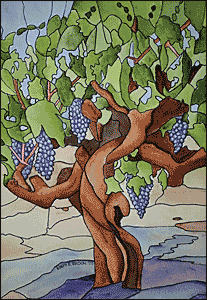 Ralph F. Wilson, 'I am the vine, you are the branches' (2025), original watercolor painting. |
Jesus taught his disciples about spending time -- and remaining -- with him through a parable of the vine.
"I am the true vine, and my Father is the gardener." (John 15:1)
I live a quarter of a mile from a vineyard and winery, thus I can observe the vines year-round. About January, a few months after the harvest, the vines are pruned back to produce a better harvest the next season. Grapes form on the new growth. Pruning is a vital part of the process of increasing fruitfulness. Jesus mentions it in verses 2 and 3. Then he talks about abiding.
"Abide in me, and I in you." (John 15:4a)
"Abide" (NRSV, ESV, KJV), "remain" (NIV) is menō, "remain, stay." It can be used of a location, "stay," often in the special sense of "to live, dwell, lodge." Here, it has the sense of someone who does not leave a certain realm or sphere: "remain, continue, abide."34 Jesus develops the idea in relationship to the vine.
"4 Abide in me, and I in you. As the branch cannot bear fruit by itself, unless it abides in the vine, neither can you, unless you abide in me. 5 I am the vine; you are the branches. Whoever abides in me and I in him, he it is that bears much fruit, for apart from me you can do nothing. 6 If anyone does not abide in me, he is thrown away like a branch and withers; and the branches are gathered, thrown into the fire, and burned." (John 15:4-6, ESV)
The branch draws its sustenance from the vine. If the connection is severed, it isn't long before the leaves begin to wither, the sap in new shoots dries up, and its cells die. Our life, our growth, our vitality is dependent upon our remaining closely attached to Jesus the Vine. That close, continuing attachment produces fruitfulness.
"This is to my Father's glory, that you bear much fruit, showing yourselves to be my disciples." (John 15:8)
This idea of remaining with Jesus is core to discipleship.
"He appointed twelve -- designating them apostles -- that they might be with him and that he might send them out to preach" (Mark 3:14)
When the apostles are called, one of their privileges -- and duties -- is to be with Jesus.
Nature Walks with the Ranger
 Ranger led nature walk. Image: US National Park Service. |
Staying close to Jesus is the essence of following him. I think back to nature walks with a park ranger at Yosemite National Park. We would gather at a trail head at the announced time. The ranger would wait a few minutes as people gathered -- some were always late. Finally, she would start out, talking about what we were seeing along the trail.
At first, the whole group would cluster around the ranger to listen. But inevitably, after a quarter of a mile or so, the group would begin to string out behind. A few would keep up with the ranger, listening to her and asking questions. A few yards back, perhaps still in earshot, were a few more, though not engaging the ranger directly. Quite a bit behind them would be the stragglers. Occasionally, the ranger would stop, point out some interesting tree or rock and, just about the time the stragglers would catch up, she would have completed her comments and would begin to walk towards the next trail stop. The whole group was following the ranger, but only a few could be called disciples, eager to learn from her. The rest followed from afar.
You could think of abiding as staying in the same proximity as Jesus. We must follow close, and, whatever we do, not stop following him. Without him, that essential contact, life dries up.
Q5. (John 15:1-8). What is the essential lesson of the Parable of the Vine and the Branches? What is the alternative to abiding in Jesus? What is the result of abiding? Of not abiding? How closely are you abiding in Jesus during a typical week?
2. Analogy of Sitting at Jesus' Feet (Luke 10:39)
A second image of a disciple as learner is seen in the phrase, "to sit at one's feet."
"After three days they found [the boy Jesus] in the temple, sitting among the teachers, listening to them and asking them questions." (Luke 2:46)
"They ... found the man from whom the demons had gone, sitting at the feet of Jesus, clothed and in his right mind." (Luke 8:35)
"I am a Jew, born in Tarsus in Cilicia, but brought up in this city, educated35 at the feet of Gamaliel." (Acts 22:3a, ESV)
In each of these passages you see rapt attention to the teacher.
Luke 10:38-42 records a poignant scene from Jesus' ministry that takes place where Jesus and his disciples are invited for dinner at the home of Lazarus, Mary, and Martha in the village of Bethany, just a mile or two outside of Jerusalem.
Martha is fixing dinner. Mary is not helping her to prepare the meal, the traditional role and responsibility of women in this culture. Instead, we read,
"Mary ... sat at the Lord's feet listening to what he said." (Luke 10:39)
Martha is "distracted"36 from Jesus' teaching by her work and resents Mary's irresponsibility. Instead of calling Mary again to help her, she resorts to embarrassing her in front of the Master. She even blames Jesus for allowing Mary to listen to the teaching and thus neglecting her responsibilities.
"Lord, don't you care that my sister has left me to do the work by myself? Tell her to help me." (verse 40)
Jesus' response is classic.
"Martha, Martha, you are worried and upset37 about many things, but only one thing is needed.38 Mary has chosen what is better, and it will not be taken away from her." (verses 41-42)
The lesson here is not that we shouldn't fulfill our responsibilities, but that focusing on Jesus and his teachings is more important than anything else. Nothing is more important than listening to Jesus and learning from him. Nothing!
I can remember times as the pastor of a relatively small church being so busy that I felt I didn't have as much time to spend with the Lord. How foolish! It is a matter of sorting out our priorities.
Disciples are eager to learn from Jesus.
Q6. (Luke 10:38-42). What is the lesson we disciples are to learn from Jesus' rebuke of Martha? What are signs that someone is following Mary's example? What are indications that someone is following Martha's example? Which tends to predominate in your life?
3. Analogy of Taking Jesus' Yoke upon Us (Matthew 11:28-30)
A third analogy of discipleship is "taking his yoke upon us." Matthew 11 concludes with Jesus' marvelous call to rest -- and a clear teaching about the nature of discipleship.
"Come to me,39 all you who are weary and burdened,40 and I will give you rest.41 Take my yoke upon you and learn from me, for I am gentle and humble42 in heart, and you will find rest for your souls.43 For my yoke is easy and my burden is light." (Matthew 11:28--30)
An important key to understanding this passage lies in the term "yoke."44 A yoke, of course, is a wooden bar shaped to fit across the necks of two oxen or other draft animals, enabling them to pull a plow or draw a load together. Humans, too, can carry more by fashioning a wooden yoke that spreads weight across the shoulders so you can carry two buckets, one hanging from each end of the yoke.
By the time the New Testament is written, however, the phrase is being used figuratively as well. "Yoke of the law" is a common phrase in Rabbinical teaching, meaning to take upon oneself the burden of obeying every command of the Mosaic Law. And the "yoke" -- at least as interpreted by the hyper-legalistic Pharisees -- is a very heavy burden indeed (Matthew 23:4). Peter calls it "a yoke ... that neither our fathers nor we have been able to bear?" (Acts 15:10). Paul refers to it a "yoke of slavery" (Galatians 5:1).
 A Dutch milkmaid carrying buckets using a yoke. Image: tochrom print from Marken Island, Netherlands (1890-1905), Library of Congress. Full image. |

So when Jesus says, "Take my yoke upon you," he is referring to committing oneself to seriously following and obeying Jesus himself, rather than the heavy burden of the minutiae of the Mosaic law and all the Pharisaic additions to it -- the so-called "oral law."
I find Jesus' words striking.
"Take my yoke upon you, and learn from me" (Matthew 11:29a)
He asks two things. First, "take my yoke upon you." That is, commit to obeying my teachings as your new approach to life, rather than devotion to religious actions and legalistic law-keeping.
His second statement, really the core phrase of this whole passage, is, "Learn from me." "Learn" is the verb manthanō, "to gain knowledge or skill by instruction, learn," as from a teacher.45 The Greek word for "disciple" (as you'll recall from Section 1.2.1 above) is the related noun mathētēs, "learner, pupil, disciple."46 Learning from Jesus is what disciples do -- by definition.
If the "yoke of the law" is burdensome, Jesus' way of life is different.
"For my yoke is easy,
and my burden is light." (Matthew 11:30)
He does have a yoke, but his yoke has two special characteristics:
1. Jesus' yoke is easy, that is, it doesn't cause discomfort, it is easy to wear.47 As I've studied human yokes, some are just long poles, perhaps flattened when they go over the shoulder. Others are carved carefully to fit individual specifications so they don't cut into the shoulders and cause excruciating pain with continued use. Jesus' yoke is formed especially for you, to fit your shoulders, to help you live your life.
2. Jesus' burden is light. Yes, there is a burden,48 but it is light. Jesus doesn't overload you nor is he a slavedriver. Oh, we can overload ourselves with tasks and responsibilities and spiritual observances that Jesus never intended. We can feel the lash of self-criticism when we fail to do it all. And sometimes we need the approval of others so much that we find it difficult to say, "No." But in this verse, we are assured that Jesus' burden will be light in weight.49
Q7. (Matthew 11:28-30) Have you committed yourself to obey Jesus' teachings? Are you continuously learning from him now, or has the learning relationship from Jesus himself evaporated in your life?
1.5 Jesus Expects His Disciples to Obey His Teachings
This leads us to the obvious. Jesus expects his disciples today to obey his teachings.
Sometimes Christians have the fantasy that they can be believers, but not really obey Jesus. We cloak it with truisms like, "I never claimed to be a saint," as if obedience is only expected of saints. "I'm not perfect." There are four Greek words that help us understand Jesus' expectation that we obey him.
1. Putting Jesus' Words into Practice (poieō)
Jesus challenges false discipleship. One day, in exasperation, Jesus responds to some phony show of piety with an incisive question:
"Why do you call me, 'Lord, Lord,' and do not do (poieō) what I say?" (Luke 6:46)
Is it really possible to call ourselves disciples at the same time as we are rebelling against the teachings of our Lord and Savior?
Jesus follows his question with the Parable of the Wise and Foolish Builders to illustrate his point.
47 I will show you what he is like who comes to me and hears my words and puts them into practice (poieō).48 He is like a man building a house, who dug down deep and laid the foundation on rock. When a flood came, the torrent struck that house but could not shake it, because it was well built. 49 But the one who hears my words and does not put them into practice is like a man who built a house on the ground without a foundation. The moment the torrent struck that house, it collapsed and its destruction was complete." (Luke 6:46--49)
"Put into practice" (NIV), "act on" (NRSV), "does" (ESV, KJV) translates the common verb poieō, "do, make," here, "do, keep, carry out, practice, commit."50 Hearing isn't enough. Obedience is necessary.
"21Not everyone who says to me, 'Lord, Lord,' will enter the kingdom of heaven, but the one who does (poieō) the will of my Father who is in heaven. 22 On that day many will say to me, 'Lord, Lord, did we not prophesy in your name, and cast out demons in your name, and do many mighty works in your name?' 23 And then will I declare to them, 'I never knew you; depart from me, you workers of lawlessness.'" (Matthew 7:21--23)
Those in Jesus' true family keep his commandments. Once, while he is teaching, he is told that his mother and brothers are outside.
"48 'Who is my mother, and who are my brothers?' 49 And stretching out his hand toward his disciples, he said, 'Here are my mother and my brothers! 50 For whoever does (poieō) the will of my Father in heaven is my brother and sister and mother.'" (Matthew 12:48-50)
If you're always resisting, you aren't really a "friend" of Jesus.
"You are my friends if you do (poieō) what I command you." (John 15:14)
2. Obeying (tēreō) Jesus' Commandments
Another series of Jesus' sayings include the verb tēreō, "guard," here, "to persist in obedience, keep, observe, fulfill, pay attention to."51 Jesus leaves no doubt about his expectation of obedience from his disciples.
In a context of Jesus' teaching about sending the Holy Spirit, he says,
"If you love me, you will keep (tēreō) my commandments." (John 14:15)
A few verses later, he says.
"21 Whoever has my commandments and keeps (tēreō) them, he it is who loves me. And he who loves me will be loved by my Father, and I will love him and manifest myself to him.... 23 If anyone loves me, he will keep (tēreō) my word, and my Father will love him, and we will come to him and make our home with him. 24 Whoever does not love me does not keep (tēreō) my words. And the word that you hear is not mine but the Father's who sent me." (John 14:21, 23-24)
Along with his Parable of the Vine and the Branches, Jesus says,
"If you keep (tēreō) my commandments, you will abide in my love, just as I have kept my Father's commandments and abide in his love. (John 15:10)
Jesus' last command involves "teaching them to obey (tēreō) everything I have commanded you" (Matthew 28:19).
We must not talk ourselves out of this. Grace is not some "Get-out-of-jail-free-card"52 that we can flash at St. Peter after living a disobedient life. Faith results in "good deeds" in the "obedience of faith" (Romans 16:26; Acts 6:7), in "obedience from the heart" (Romans 6:17). Lack of trust, lack of repentance results in rebellion against Jesus. Grace saves the repentant -- abundantly. But not the persistently disobedient. The New Testament strongly confirms this.53
3. Continuing (menō) in Jesus' Teachings
The Gospel of John uses a third verb to express obedience.
"31 To the Jews who had believed him, Jesus said, 'If you hold to (menō) my teaching, you are really my disciples. 32 Then you will know the truth, and the truth will set you free.'" (John 8:31--32, NIV)
"Hold to" (NIV), "abide in" (ESV), "continue in" (NRSV, KJV) is the verb menō, "remain, stay," that we examined in Section 1.4.1 regarding the branches remaining or abiding in the vine. It can mean to remain in a location, but here it has the extended meaning, "of someone who does not leave a certain realm or sphere, 'remain, continue, abide.'" Here, "continuing in his word" means to continue to believe and follow Jesus' teachings (also in 1 John 2:6).
We see compound versions of the verb menō in related New Testament passages:
"The one who endures (hypomenō54) to the end will be saved." (Matthew 24:13; cf. 10:22)
"Continue (epimenō55) in the faith." (Acts 14:22)
"Remain true (prosmenō56) to the Lord." (Acts 11:23)
"Continue (prosmenō) in the grace of God." (Acts 13:43)
"If you continue (epimenō) in your faith, established and firm, not moved from the hope held out in the gospel." (Colossians 1:23a)
"Continue (menō) in him." (1 John 2:28)
4. Holding Jesus' Word Firmly (katechō)
A fourth Greek word is used to encourage continuing in the faith -- katechō, "to adhere firmly to traditions, convictions, or beliefs, hold to, hold fast."57 It appears in the Parable of the Sower regarding God's word as the seed:
"As for that in the good soil, they ... hold it fast (katechō) in an honest and good heart, and bear fruit with patience." (Luke 8:15, ESV)
We also see katechō with this sense in the Epistles:
"By this gospel you are saved, if you hold firmly (katechō) to the word I preached to you. Otherwise, you have believed in vain." (1 Corinthians 15:2)
"But Christ is faithful as a son over God's house. And we are his house, if we hold on (katechō) to our courage and the hope of which we boast." (Hebrews 3:6; also 3:14; 10:39)
Grace When We Stumble (1 John 1:7-2:6)
This insistence upon obedience may make salvation seem impossible. I can't be perfectly obedient, you might say. I'll trip. I'll slip up. I'll fall. Why even try? Even Jesus' disciples ask, "Who then can be saved?" Jesus answers, "With man this is impossible, but with God all things are possible" (Matthew 19:25-26).
We don't have to do this by ourselves. Salvation is not man's work! We are not saved by being good, dear friends, because we can never be good enough! We're saved by Jesus' dying on the cross for our sins. We turn to him in faith, turn away from (repent of) our sins, and begin to follow Jesus. If we slip up -- and we will -- we confess our sins, and take hold of his hand to help us up and continue to follow him in the way.
At the beginning of 1 John, the Apostle John explains simply how this balance works. It is an extended passage, but worth our time, since it puts it all in balance.
"7 If we walk in the light, as he is in the light, we have fellowship with one another, and the blood of Jesus, his Son, purifies us from all sin.
8 If we claim to be without sin, we deceive ourselves and the truth is not in us. 9 If we confess our sins, he is faithful and just and will forgive us our sins and purify us from all unrighteousness....
2:1 My dear children, I write this to you so that you will not sin. But if anybody does sin, we have one who speaks to the Father in our defense -- Jesus Christ, the Righteous One. 2 He is the atoning sacrifice for our sins, and not only for ours but also for the sins of the whole world.
3 We know that we have come to know him if we obey his commands. 4 The man who says, 'I know him,' but does not do what he commands is a liar, and the truth is not in him. 5 But if anyone obeys his word, God's love is truly made complete in him. This is how we know we are in him: 6 Whoever claims to live in him must walk as Jesus did." (1 John 1:7-9; 2:1-6)
What is a disciple? One who follows Christ. What is the process of discipleship? In a nutshell, it is the process of learning to follow Jesus faithfully.
Q8. (1 John 1:7-9; 2:6) What is the difference between salvation by works and the necessity of obeying Jesus? Is there grace without repentance and active faith?
 Available in book formats: paperback, Kindle, PDF |
Before you can be a discipler, my friend, you must be a disciple. Being Jesus' disciple may seem like a high calling -- and it is! But it is in your grasp. Why? Because you are particularly righteous? No. Rather, because the Holy Spirit lives within you and promises to help you.
We've looked carefully at what it means to be a disciple of Jesus. Next, we'll examine how Jesus went about training his disciples.
Prayer
Jesus, I want to be Your disciple. I want to follow You well and enjoy walking with You on life's journey. I stumble sometimes and fall. But You pause, pick me up, hear my prayer, and then continue to lead on down the path you have chosen for me -- for us. I trust You, Jesus. I am following. I will follow You. In Your holy name, I pray. Amen.
Endnotes
[1] Mark 16:15; Luke 24:47-49; John 20:21.
[2] The verb "make disciples" (mathēteuō) is in the Aorist active imperative.
[3] Mathēteuō, BDAG 609, 2.
[4] Didaskō, BDAG 241, 2d. Paideuō, "educate," especially with discipline (BDAG 749) centers on training of a child (pais). It isn't usually used in relation to the training of disciples.
[5] Tēreō, BDAG 1002, 3.
[6] Entellō, BDAG 339. "Enjoin, command" (Liddell-Scott, 575).
[7] Mathētēs, BDAG 609, 2b. Mathētria is the feminine form, "(female) disciple," referring to Tabitha in Acts 9:36 (BDAG 610).
[8] Mathēteuō, BDAG 609, 2.
[9] Rab, TWOT #2984a.
[10] Mishnah, Pirkei Avoth 1:4.
[11] Comment on Avoth 1:4 in the Soncino Talmud (Soncino Press, 1935--1952), cited by Lois Tverberg, "Covered in the Dust of Your Rabbi: An Urban Legend?" Our Rabbi Jesus blog, January 27, 2012).
[12] Lois Tverberg, Walking in the Dust of Rabbi Jesus: How the Jewish Words of Jesus Can Change Your Life (Zondervan, 2013).
[13] The word "disciple" can also describe a larger circle of Jesus' followers, both male and female (Luke 6:17; 19:37; John 6:66; etc.). After the resurrection, the word "disciple" can almost equal the word "Christian" (Acts 11:26; 6:1f, 7; 9:19; 11:26, 29; 13:52; 14:21; 15:10; etc.).
[14] "Come, follow me" (NIV), "follow me" (ESV, NRSV), "come ye after me" (KJV) translate two words, the adjective deute, "Come here! Come on!" (BDAG 220) and the proposition opisō, "behind, after" a "marker of position behind an entity that precedes." In the transferred sense with the idea of coming after a person, opisō has the sense "'be an adherent/follower" (Matthew 16:24; Luke 9:23; 14:27). (BDAG 716, 2a).
[15] Literally, "Come after me." This translates two words, the common verb erchomai, "to come" and opisō which we examined above.
[16] Akoloutheō, BDAG 36, 3.
[17] Metanoia, BDAG 640.
[18] Acts 9:2; 19:23; 22:4; 24:14, 22.
[19] Hodos, BDAG 691, 3c.
[20] E.g. Acts 4:32-33, 5:14; 10:45; 15:5; 16:1, 15; 19:18; 1 Corinthians 7:12-13;14:22; 2 Corinthians 6:15; 1 Thessalonians 1:7; 2:10, 13; 1 Timothy 4:10, 12; 5:16; 6:2ab; Titus 1:6; 1 Peter 1:21.
[21] "Believe" is a favorite word for John, but not "believer."
[22] Pisteuo, BDAG 821, 2.
[23] Christianos, BDAG 1090.
[24] Disciple as a friend: John 15:15.
[25] Disciple as a servant: John 15:15; 12:26; 13:16.
[26] See, for example, Bill Hull and Ben Sobels, The Discipleship Gospel: What Jesus Preached -- We Must Follow (Him Publications, 2018), p. 113.
[27] Bill Hull, "The Great Divorce," video introduction to Substack: "No Longer a Bystander," April 5, 2023.
[28] John 6:29 in The Amplified Bible (Lockman Foundation, 1965, latest edition 2015).
[29]
For more on these questions, see my essay,
"A Brief Look at
TULIP Calvinism," an appendix to Grace: Favor for the Undeserving
(JesusWalk Publications, 2023)
(www.jesuswalk.com/grace/tulip-calvinism.htm).
[30] For more, see my study Grace: Favor for the Undeserving (JesusWalk Publications, 2023) (www.jesuswalk.com/grace/).
[31] Salvation is spoken of as a gift in many verses, such as, Ephesians 2:8-9; Romans 3:23-24; 6:23; 2 Corinthians 9:15; etc.
[32] Of course, since Jesus taught by parables, there are many other analogies that relate to disciples. For example, in the Parable of the Sower, all hear the word, but the only the good soil represents true disciples, who "with a noble and good heart ... hear the word, retain it, and by persevering produce a crop" (Luke 8:15). Elsewhere, true disciples are the servants who invest the master's money, are the servants who stay awake when the master comes home late, etc.
[33] "Analogy," Merriam-Webster.com.
[34] Menō, BDAG 631, 1bβ.
[35] "Educated" (ESV, NRSV), "trained" (NIV), "taught" (KJV) is paideuō, "educate" (BDAG 749, 1), from pais, "child."
[36] "Distracted" (NIV, ESV, NRSV), "cumbered" (KJV) is perispaō, "to have one's attention directed from one thing to another, become or be distracted, quite busy, overburdened" (BDAG 804, 2), from peri-, "all around" + spaō, "to draw."
[37] "Worried" (NIV, NRSV), "anxious" (ESV), "careful" (KJV) is merimnaō, "to be apprehensive, have anxiety, be anxious, be (unduly) concerned" (BDAG 632, 1). "Upset" (NIV), "troubled" (ESV, KJV), "distracted" (NRSV) is thorubazō, "be troubled/distracted" (BDAG 458).
[38] "Needed, need, needful" is the noun chreia, "necessity, need" (Thayer 670, 1), "that which should happen or be supplied because it is needed, need, what should be" (BDAG 1088, 1).
[39] "Come" is the adverb deute, "come here! Come on!" mostly as a hortatory particle with the plural (BDAG 220). As plural of deuro, "come hither!" Deuro is an adverb of place, "hither," with all verbs of motion. Used as an interjection, "come-on!" "come let us" (Liddell Scott).
[40] "Labor" (ESV, KJV), "are weary" (NIV, NRSV) is the present participle of kopiaō, "become weary/tired" or, perhaps, "to exert oneself physically, mentally, or spiritually, work hard, toil, strive, struggle" (BDAG 558, 1)."Heavy laden" (ESV, KJV), "burdened" (NIV), "are carrying heavy burdens" (NRSV) is the perfect passive participle of phortizō, "to load/burden" someone with something, more exactly, "cause someone to carry something," in imagery, of the burden of keeping the law (BDAG 1064).
[41] In verses 28-29 we see rest as both a verb and a noun. In verse 28, the verb "rest" is the future of anapauō, "to cause someone to gain relief from toil, cause to rest, give (someone) rest, refresh, revive" (BDAG 69, 1). In verse 29, the noun "rest" is anapausis, "cessation from wearisome activity for the sake of rest, rest, relief" (BDAG 69, 2).
[42] "Gentle" (NIV, ESV, NRSV), "meek" (KJV) is the adjective praus, "pertaining to not being overly impressed by a sense of one's self-importance, gentle, humble, considerate, meek in the older favorable sense" (BDAG 861). "Lowly" (ESV, KJV), "humble" (NIV, NRSV) is the adjective tapeinos, "pertaining to being unpretentious, humble" (BDAG 989, 3).
[43] "Souls" is the plural of the noun psychē, "seat and center of the inner human life in its many and varied aspects, soul," here, "as the seat and center of life that transcends the earthly" (BDAG 1099, 2d).
[44] "Yoke" is zygos, "a frame used to control working animals or, in the case of humans, to expedite the bearing of burdens, yoke," in our literature only figurative, of any burden (BDAG 429, 1). Gal 5:1; Acts 15:10.
[45] "Learn from" (ESV, NIV, NRSV), "learn of" (KJV) is the aorist imperative of manthanō with the preposition apo, "from." The verb means, "to gain knowledge and skill by instruction, learn" (BDAG 615, 1).
[46] Mathētēs, BDAG 609, 2b.
[47] "Easy" is the adjective chrēstos, "pertaining to that which causes no discomfort, easy," here, "easy to wear" (BDAG 1090, 1).
[48] "Burden" is the noun phortion (diminutive of phortos, "cargo"), "that which constitutes a load for transport, load," here, figuratively, "burden" (BDAG 1064, 2).
[49] "Light" is the adjective elaphros, "having little weight, light" in weight. Figurative, "easy to bear, insignificant" (2 Corinthians 4:17; BDAG 314, 1).
[50] Poieō, BDAG 840, 3a.
[51] Tēreō, BDAG 1002, 3.
[52] "Get Out of Jail Free" is a card used in the board game Monopoly (Parker Brothers, 1935; now Hasboro).
[53] 1 John 2:3-6; Romans 15:18; 2 Thessalonians 1:8; Hebrews 5:9; 1 Peter 1:22;1 Peter 4:17--18.
[54] "Stands firm" (NIV), "endures" (ESV, NRSV, KJV) is hypomenō, "to maintain a belief or course of action in the face of opposition, stand one's ground, hold out, endure" (BDAG 1039, 2).
[55] "Continue in" (ESV, NRSV, KJV), "remain true to" (NIV) is emmenō, "to persist in a state or enterprise, persevere in, stand by something." (BDAG 322, 2).
[56] Prosmenō, "to be steadfast in association, remain/stay with someone or something" (BDAG 883, 1).
[57] Katechō, BDAG 533, 2a.
Copyright © 2026, Ralph F. Wilson. <pastor joyfulheart.com> All rights reserved. A single copy of this article is free. Do not put this on a website. See legal, copyright, and reprint information.