


|
Old Testament
New Testament
Gospels
Acts
Paul's Letters
General Letters
Revelation
Topical Studies
Beginning the Journey (for new Christians). en Español

|
Old Testament
New Testament
Gospels
Acts
Paul's Letters
General Letters
Revelation
Topical Studies

|
Home
Bible Studies
Articles
Books
Podcasts
Search
Menu
Donate
About Us
Contact Us
FAQ
Sitemap


Free
E-mail Bible Study
 Names and Titles of God
Home | Bible Studies | Articles | Books | Podcasts | Search | Menu | Donate | About Us | FAQ | Contact Us
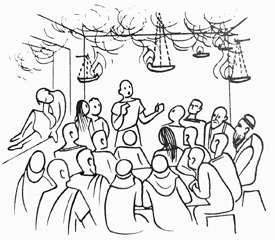 Annie Vallotton, 'Eutychus got sleepier and sleepier' (Acts 20:9), © American Bible Society. |
We've looked at ways we can reach out to Jesus each day. Now we turn to spiritual disciplines to practice at longer intervals.
6.1 Weekly Spiritual Practices
First, we'll examine some practices that are often exercised weekly.
- Community gathering
- Generous Giving
- Submission
- Service
- Fasting
1. Community Gathering
"On the Sabbath day he went into the synagogue, as was his custom."241 (Luke 4:16b; Acts 17:2)
Gathering with the faith community weekly was both a practice of Jesus, Paul, and the disciples. It was also practiced by the early church.
The Weekly Gathering of the Christian Community
Meeting on the "first day of the week" was the custom of all of Paul's congregations and gradually became the norm throughout Christendom. Luke records that the church at Troas met in the third story of a home.
"On the first day of the week we came together to break bread." (Acts 20:7)
It was the first day of the week on Hebrew calendars. 242 The point is gathering regularly!
The writer of Hebrews exhorts us:
"24 And let us consider how we may spur one another on toward love and good deeds. 25 Let us not give up meeting together, as some are in the habit243 of doing, but let us encourage one another -- and all the more as you see the Day approaching." (Hebrews 10:24-25)
We're exhorted not to "give up" (NIV), "neglect" (NRSV), or "forsake" (KJV) meeting together. The word engkataleipō is a strong one. It means, "to separate connection with someone or something, forsake, abandon, desert."244 It is the Greek word used in Jesus' prayer: "My God, my God, why have you forsaken me?" (Matthew 27:46). It is the word used in the firm promise later in Hebrews, "I will never leave you or forsake you" (Hebrews 13:5b based on Deuteronomy 31:6).
So often people attend or don't attend church based on whether it meets their own needs. That attitude is grossly selfish and contrary to the direct command of Scripture. Instead of going to church for our own sake, we should be attending to for God's sake -- to honor and worship God -- and for the sake of our Christian brothers and sisters -- to encourage them. When we abandon regular Christian fellowship, we dishonor God, hurt ourselves, and deprive other believers of the gifts and ministries God has given to us as a sacred trust for their benefit!
"... But let us encourage245 one another...." (Hebrews 10:25b)
Because of widespread disobedience to this command, the Christian movement in Europe and the United States is weak and flabby -- and declining.
Small Groups
An important spiritual discipline is being a regular part of a small group or small community of believers of some kind -- in addition to the regular church gathering! The larger the congregation, the greater the importance of small groups. Connection, accountability, and authentic Christian fellowship occur in weekly small gatherings. Here disciples are formed and flourish. This could be an adult Sunday school class or Bible study, a group of believers from different churches who meet regularly over coffee, a weekly meeting of pairs or triads, a team of Christians who serve together. Whatever form it takes, it is vital, since "life change happens best in community."246
We'll come back to the importance of community and small groups in Lesson 7.3.
2. Generous Giving
We are taught in Scripture to give to God's work regularly and proportionately. Your giving is probably best tied to when you get paid -- weekly, bi-weekly, monthly, etc. Paul mentions it as a weekly action.
"On the first day of every week, each one of you should set aside a sum of money in keeping with his income, saving it up, so that when I come no collections will have to be made." (1 Corinthians 16:2)
In this passage, Paul is talking about saving up for the great offering he is gathering from the churches in Asia, Greece, and Mesopotamia to relieve the poverty of the Jerusalem church. Paul encourages the believers to set aside247 money at home248 to make up the church's gift when he arrives in Corinth. Though they aren't the focus here, collections for the regular maintenance of the ministry of the temple, synagogue, etc. had been a Jewish practice for many centuries.
Giving in our verse has three attributes:
- Regular. The first day of the week is Paul's suggestion -- regular.249
- Proportionate. "In keeping with his income"250 is the principle of the tithe, which is 10% of one's income.
- Generous. The next verse talks about this money being a "gift" (KJV, "liberality," Greek charis). The giving comes from a generous heart, not because the believer is forced or unduly pressured to give.
A few verses later, Paul takes steps to ensure that this is a voluntary gift.
"Remember this: Whoever sows sparingly will also reap sparingly, and whoever sows generously will also reap generously. Each man should give what he has decided in his heart to give, not reluctantly or under compulsion, for God loves a cheerful251 giver." (2 Corinthians 9:6-7)
Paul compares giving to God's work as "sowing" with the expectation of receiving a "harvest." In other words, God will honor your giving by making it up to you. This goes back to the tithing promise through Malachi the prophet, where the tithe was used to support the temple and priestly ministry:
"'Bring the whole tithe into the storehouse, that there may be food in my house. Test me in this,' says the Lord Almighty, 'and see if I will not throw open the floodgates of heaven and pour out so much blessing that you will not have room enough for it.'" (Malachi 3:10)
Of course, Christians are not under an Old Testament law of tithing. Nor are we giving in order to get -- which is driven by greed (the motivating sin of the so-called Prosperity Gospel). But we are responding to a work of the Spirit in us; generosity is a fruit of the Spirit's work in us ("goodness"252 in the fruit of the Spirit, Galatians 5:22-23). And God is faithful to help us have enough to give further (2 Corinthians 9:10-11).
Generosity,253 especially towards the poor, is a hallmark of the primitive church.
"They received their food with glad and generous254 hearts, praising God and having favor with all the people." (Acts 2:47, ESV)
Over the decades, I have observed that surrendering one's money to the Lord is a vital step in growth as a disciple. So long as we hang on in unbelief of God's provision, we block growth. Taking this step produces a wonderful breakthrough in one's spiritual life.
3. Submission
Perhaps the spiritual discipline of submission fits here, since a church would typically meet weekly. It is an important spiritual discipline -- and one that our flesh rebels against!
"Obey255 your leaders and submit256 to them, for they are keeping watch over your souls, as those who will have to give an account. Let them do this with joy and not with groaning, for that would be of no advantage to you." (Hebrews 13:17, ESV)
I know that authority can be abused,257 but that possibility doesn't make it a likelihood nor a reason to avoid godly submission.
If you are a teenager and think you know everything, it is harder to learn from those who know better, like parents and teachers. But I've met some church members who have a heart every bit as rebellious as a teenager. Submission is for our own good.
Don't fight your church leaders, says the writer of Hebrews, rather submit to them. God can teach you something through them. Church leaders are accountable to God for you and it is God's plan to use them to help mature you.
The spiritual discipline of submission is closely related to the virtue of humility. Paul teaches both submission in family relationships as well as a mutual submission.
"Submit to one another out of reverence for Christ." (Ephesians 5:21)
Foster sees submission as part of self-denial, what he calls "the cross-life" (Mark 8:34).258
4. Service
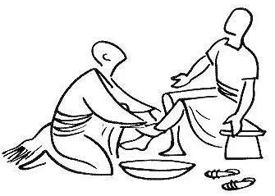 Annie Vallotton, 'Wash my hands and head too' (John 13.9). © American Bible Society. |
I've included the spiritual discipline of service under weekly spiritual practices for no real reason except to group it with the spiritual disciplines of generous giving and submission to which it is closely related.
Foster writes,
"As the cross is the sign of submission, so the towel is the sign of service."259
Jesus famously removes his outer clothing, wraps a towel around himself, takes a basin of water, and proceeds to wash his disciples' feet. Afterwards, he says,
"Now that I, your Lord and Teacher, have washed your feet, you also should wash one another's feet." (John 13:14)
Earlier, Jesus had taught them,
"Whoever wants to become great among you must
be your servant,
and whoever wants to be first must be slave of all.
For even the Son of Man did not come to be served, but to serve,
and to give his life as a ransom for many." (Mark 10:43-45)
Paul commands Timothy:
"Command them to do good, to be rich in good deeds, and to be generous and willing to share." (1 Timothy 6:18)
Dorcas (Tabitha) sets for us the powerful example of making clothing for the poor widows of Joppa (Acts 9:36-43). I have a friend whose spiritual gift is service; he volunteers for a county agency to install grab bars and ramps for senior citizens who have problems with mobility. What's the difference between a practice and a spiritual gift? Probably, one is more occasional than the other; the distinction is not really important.
As a Boy Scout, I learned the motto: "Do a good turn daily." It is a great way of acting out the spiritual discipline of serving others.
5. Fasting
I include fasting as a weekly practice, since that is the typical frequency for many disciples. A fast is "deliberate and sustained abstinence from all food for a specific period of time."260
Fasting in the Bible
In the Old Testament, fasting is often referred to as voluntarily "afflicting oneself" or "denying oneself."261
The Pharisees fasted twice a week on Mondays and Thursdays and boasted of it as a sign of their holiness (Matthew 6:16). John the Baptist's disciples also practiced fasting as part of their spirituality.
Did Jesus fast? Yes! On the Day of Atonement each year, all pious Jews fasted (Leviticus 23:32). Jesus fasts from food for 40 days in the Judean wilderness in preparation for his ministry. When he returns to Galilee, Luke notes that he comes "full of the Holy Spirit" (Luke 4:1, cf. verse 14 and 18). God's power is upon him.
Strangely, however, Jesus' disciples do not make a practice of regular fasting during their time with Jesus.
"18 Now John's disciples and the Pharisees were fasting. Some people came and asked Jesus, 'How is it that John's disciples and the disciples of the Pharisees are fasting, but yours are not?'
19 Jesus answered, 'How can the guests of the bridegroom fast while he is with them? They cannot, so long as they have him with them. 20 But the time will come when the bridegroom will be taken from them, and on that day they will fast.'" (Mark 2:18-20)
One passage is difficult. Regarding the disciples' failure to cast a demon out of a boy, the KJV text reads.
"This kind can come forth by nothing, but by prayer and fasting." (Mark 9:29, KJV)
Some of the earliest Greek manuscripts omit the words "and fasting,"262 Some scholars have taken this to mean that fasting is "a legitimate, though not obligatory, function of the Christian life."263 This statement doesn't go far enough. Let us consider the rest of the evidence.
1. Future time. Jesus foresees that his disciples will fast after he is no longer with them (Mark 2:20; Matthew 9:15; Luke 5:35).
2. Assumed practice. Jesus gives instructions about fasting, assuming that his hearers will fast.
"16 When you fast, do not look somber as the hypocrites do.... 17 But when you fast, put oil on your head and wash your face, 18 so that it will not be obvious to men that you are fasting, but only to your Father, who is unseen; and your Father, who sees what is done in secret, will reward you." (Matthew 6:16--18)
It would be strange for Jesus to instruct his disciples in how to properly fast, if it were not relevant to them or to us.
3. Leaders fast while seeking God in Antioch before Paul's First Missionary Journey.
"2 While they were worshiping the Lord and fasting, the Holy Spirit said, 'Set apart for me Barnabas and Saul....' 3 So after they had fasted and prayed, they placed their hands on them and sent them off." (Acts 13:2-3)264
4. Early Church Fathers. While there is little more in Acts or the Epistles about fasting, it is clear that the church adopts the practice of fasting quite early in its history. Fasting is mentioned in The Didache (80 to 110 AD), urging fasting for those preparing for baptism and encouraging fasting on Wednesdays (in commemoration of Jesus' betrayal) and on Fridays (in commemoration of Jesus' crucifixion).265 Tertullian (190 to 220 AD) writes an entire letter (On Fasting) to defend the Christian practice of fasting to defend against the criticisms of the Montanists.266
For nearly two thousand years Roman Catholic and Orthodox churches have encouraged their people to fast, especially during Lent as a way to prepare for Easter. Anglicans, Lutherans, and Methodists have encouraged fasting. In the last few decades, we are seeing a resurgence of fasting in Evangelical Christian circles.
What Are the Spiritual Benefits of Fasting?
What good is fasting? First, let's consider what fasting is not. Fasting is not a way to manipulate God into doing something for us or convince him of something. "I'll fast until you do this for me." Fasting is not transactional. Rather it involves humbling ourselves, seeking clarity in knowing him and determining his will. Fasting isn't about us; it is about God.
Here are some ways fasting has been used:
- To subdue the flesh, humble ourselves before God, and draw near to Him (Ps. 69:10; 35:13)
- To seek God's will and guidance (Acts 13:1-2).
- To express repentance and humility (Psalm 69:10; 2 Chronicles 20:3; Jonah 3).
- To intensify prayer and focus. For example, the prophetess Anna "never left the temple but worshiped night and day, fasting and praying" (Luke 2:37).
- To gain spiritual clarity and strength.
- To seek power to resist temptation and attack (Matthew 4:1-11).
- To seek deliverance for the oppressed (Isaiah 58:6).
- To seek revival of God's church (2 Chronicles 7:14).
- To seek breakthroughs in the spiritual realm.
- To prepare our hearts for major events like Lent prior to Easter.
The key idea is to practice self-denial and prioritize spiritual needs over physical desires in order to draw closer to God. Some promote fasting for its physical benefits. It may have some, but that's not the chief reason disciples fast.
Fasting from meat on Fridays has long been a practice of the Roman Catholic Church, especially during Lent. A number of disciples I know fast for two or three meals one day a week. In our day, some are fasting from cell phone use. Pray about this and see what God would lead you to do. I encourage you to enter into fasting as a tried-and-true form of Christian spirituality, not as a legalism, but as a way to draw closer to God.
Q27. What weekly spiritual disciplines are you practicing? What might you add to this to draw you closer to the Lord?
6.2 Monthly Spiritual Practices
My list of monthly spiritual practices is, of course, arbitrary. Some of these spiritual disciplines you'll practice more or less often.
-
The Lord's Supper or Eucharist
-
Scripture Memorization
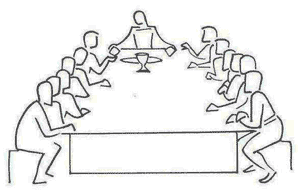 Annie Vallotton, 'This is my body' (Mark 14:22). © American Bible Society. |
1. The Lord's Supper or Eucharist
The Lord's Supper was probably practiced weekly in the early church. Under "weekly community gathering" (Section 6.1.1) we already saw Paul at Troas:
"On the first day of the week we came together to break bread." (Acts 20:7)
The term "breaking of bread" refers to having a meal, but sometimes, as here, it becomes a technical term for partaking of the Lord's Supper together. However, the primitive church just after Pentecost may have celebrated the Lord's Supper more often than weekly (Acts 2:42, 46).
Some churches today partake of the Eucharist or Lord's Supper as the centerpiece of each service. Other churches might celebrate it monthly, some less often. Whatever your church's practice, approach the Lord's Supper as a holy spiritual discipline, an opportunity to draw closer to Christ and experience his presence in a special way. If you'd like to probe further into the meaning, see my study, Lord's Supper: Meditations for Disciples on the Eucharist or Communion (JesusWalk Publications, 2011; www.jesuswalk.com/lords-supper/).
2. Scripture Memorization
I'm treating Scripture memorization as a monthly practice, since you might select a new verse to memorize each month. Our discipleship group goes over the verse-of-the-month together weekly. The psalmist says:
"I have stored up267
your word in my heart,
that I might not sin against you." (Psalm 119:11, ESV)
It's pretty obvious from the many quotations in the Gospels and Acts that Jesus and the apostles practice Scripture memorization.
Scripture memorization is a subset of meditation on the Word (Lesson 5.3.4). As you go over the verse and its various parts, you begin to understand it better. But further, Scripture memory helps to (1) renew your mind (Romans 12:2), (2) provide you guidance and wisdom, (3) comfort you in trials, (4) help you overcome temptation and sin, (5) enhance your prayer life, and (6) make you more effective in ministry to others.
The Navigators see Scripture memory as a primary means of building disciples. Navigators' founder Dawson Trotman developed the classic Topical Memory System (NavPress) in 1928. I've found it useful. The current version consists of 60 Bible verses to memorize in multiple translations, sorted by themes. It is available as a pack of cards or as an app for your phone.
6.3 Annual Spiritual Practices
Now let's consider some annual spiritual practices.
-
Retreats
-
Celebration, Church Feast Days
1. Retreats
Jesus often steps away from the crowds for spiritual renewal.
"Jesus often withdrew to lonely places and prayed." (Luke 5:16)
We looked at solitude as daily practice (Lesson 5.3.1); solitude is also closely related to the spiritual discipline of retreat.
Immediately after Jesus hears that John has been beheaded, he invites his disciples to join him in a strategic withdrawal to Bethsaida (which is followed by the Feeding of the 5,000). As you study the accounts in the various Gospels, it becomes clear that this retreat or getting away serves several purposes:
- Mourning. Jesus is shaken by the brutal murder of his cousin. The disciples, several of whom had followed John, are shaken, as well. They need to get away.
- Training. The Twelve have just returned from their preaching mission, so this is a time of debriefing, of listening to their stories, and teaching in response to their experiences (Mark 6:30).
- Rest. The Twelve are tired from their mission and need rest away from the pressure of the crowds and continual demands of ministry (Mark 6:31).
- Protection. With Herod newly-emboldened after executing John the Baptist, getting out of public view is wise. Later, Jesus deliberately withdraws when threatened with arrest and death (John 7:1-2; 10:39-40; 11:54). He knows he will be martyred, but he chooses the time and place.
Many churches in our day have a tradition of staff retreats, annual church camps, as well as regional conferences. These can be of great spiritual benefit.
Some Christians groups have a tradition of individual or solo retreats. Roman Catholic monasteries and convents sometimes offer retreats for individuals as well as groups. Christian camps can serve as a venue for retreats.
While I pastored in the San Fernando Valley of Los Angeles in the 1970s and '80s, Jack Hayford led the nearby Church on the Way of Van Nuys. Though he pastored a very large church and was in constant demand as a speaker and denominational leader, Hayford had a practice of getting away to the San Bernardino Mountains at least one day a month for a personal retreat to seek the Lord. That is how he was able to keep his spiritual edge sharp amidst all his responsibilities.
2. Celebration, Church Feast Days
God called the Jewish people to gather in Jerusalem three times a year for annual celebrations:
- Passover, Feast of Unleavened Bread (Pesach).
- Feast of Booths/Tabernacles or Ingathering (Sukkot).
- Feast of Weeks, First Fruits, Harvest, Pentecost (Shavuot).268
In addition to these, they celebrated the Feast of Trumpets, the solemn Day of Atonement (Yom Kippur), as well as Sabbaths and new moons.
In discipleship literature, the word "celebration" is sometimes used to describe what I call the spiritual discipline of praise (Lesson 5.3.2). However, the word "celebrate" in English Bibles usually translates Hebrew ḥāgag, "to celebrate, keep (hold) a feast."269
The Christian Church has a long history of major feast days of celebration.
- Christmas (preceded by the season of Advent)
- Easter (preceded by the season of Lent)
- Pentecost (50 days after Easter)
In addition, many congregations celebrate special days having to do with their history -- Reformation Day, Thanksgiving, saints' days, etc.
While some people want to do away with all celebrations -- even individual birthdays -- I believe it is much better to breathe spiritual life into holidays by reclaiming them according to the Scriptures and the main doctrines of the Church. Preparatory seasons give an opportunity to seek God in special ways through Lent and Advent readings. Restructure your celebration of Church holidays in ways that invigorate your spirit rather than deplete both you and your bank account!
We haven't exhausted all the possible spiritual disciplines or practices. Simplicity is stressed by the Society of Friends. The Daily Examen is encouraged by St. Ignatius of Loyola and the Jesuits, and can be quite powerful. We could name more, but we'll stop here.
Q28. What monthly and annual spiritual disciplines do you currently practice? How might you enrich your relationship with God by adding another spiritual discipline?
6.4 Developing a "Rule of Life" or "Trellis"
A pattern of spiritual practices is sometimes called a "rule of life," a commitment to live your life in a particular way. Such a rule of life was developed in monastic settings, as we'll see in a moment.
Household Rules
You already have a rule of life whether or not you call it that. Every one of us has predictable patterns or routines, ways you do things in your home.
When I was child growing up in a devout Christian household, my parents had a rule of life that set the tone for us, though we didn't call it that.
- Pray as a family before eating a meal. Hold hands, bow your head, close your eyes. Say "Amen" at the end of the prayer.
- Pray with mom or dad before going to bed.
- Go to Sunday school and church on Sunday, dressed in your Sunday best, having taken a bath or shower the night before.
- Don't use swear words. I can remember getting my mouth washed out with soap -- but only once!
- Be obedient to your parents.
You get the idea. By example, Jesus teaches his disciples a new rule of life, a way of living centered on loving God and loving people.
Peter Scazzero describes it this way:
"Very simply, a rule of life is an intentional, conscious plan to keep God at the center of everything we do.... I am inviting you to a robust rule of life that will enable you to be theologically sane and emotionally and spiritually grounded so that you can provide leadership for those around you."270
The Rule of St. Benedict
St. Benedict of Nursia (480-547 AD) is often given credit for instituting a rule of life, though I expect elements of it predate him. The Rule of St. Benedict is a book of precepts written in Latin about 530 AD. It spells out detailed rules for how monks are to live together in a community under the authority of an abbot.271 At a time when the Roman empire was falling apart and religion was at a low ebb, many earnest people were attracted to this strict monastic way of life in their quest for God and for the salvation of their souls. Since then, Benedict's Rule has been adopted and modified by many religious orders, even lay orders and organizations.
When you read the Rule of St. Benedict, you find that a great deal of it is how to manage and regulate (regula) a community, individual chores, correct offences, etc. Many of the details are practical, not all that spiritual.
However, contained in this 100-page Rule of St. Benedict, is a very spiritual element -- often known as "The Daily Office" (which we saw in Lesson 5.2.5). It prescribes a daily pattern of seven periods of corporate prayer and unison reading (or chanting) the Psalms and other Scriptures every two or three hours throughout the day (and night). The monks would chant together through the entire Psalter of 150 psalms each week.
The Rule of St. Benedict was widely adopted to provide the monastic movement with a balance and healthy rhythm of rest, work, prayer, and relationships.272 While Protestants may not understand or appreciate the monastic movement, it helped sustain the Church through the "Dark Ages," provided training for pastors, and was responsible for the salvation of Ireland, England and Scotland, and the re-evangelization of Europe, to name a few accomplishments.
Few people outside of communal groups, such as a monastery, can live such a structured life. However, by selecting and practicing a balanced group spiritual disciplines, we can develop structure and direction for our spiritual growth. Each of us can and should develop a rule of life -- a collection of spiritual practices -- that help us encounter the Lord and so become more like him.
A Church Rule of Life
The church I attend, Rock Harbor Covenant Church in Rocklin, California, has sought for more than a decade to lead its people into serious commitment as disciples. Setting discipleship as our church's "operating system," Pastor Greg Krieger is encouraging participation in the "Rock Harbor Rule of Life":
- Go to church (Hebrews 12:24-25)
- Memorize Scripture (Psalm 119:11)
- Give generously (Matthew 6:21)
- Pray daily (Daniel 6:10). This includes reading a psalm a day.
- Fast weekly (Matthew 6:17-18)
None is mandatory, but are reinforced from the pulpit. Gradually people are finding a way to enter into one or several of them as a way of following the Lord. We are seeing gradual adoption across the whole church body.
A Spiritual Trellis
An analogy that has gained traction in certain Christian circles is the image of a trellis, a frame or structure that supports the growth of climbing plants.
For example, a grape trellis typically consists of posts connected by one to four wires that support the weight of the vines and fruit. Trellising aids pruning, helps control canopy growth, enhances air circulation, and improves grape quality, producing a richer harvest.
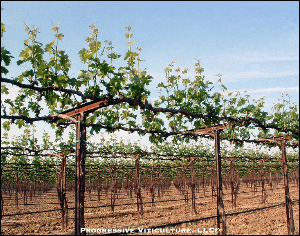 Typical grape trellis. Photo: Stan Grant, Progressive Viticulture, LLC. Used by permission. Larger image. |

A spiritual trellis refers to intentional structures, habits, or routines, such as daily prayer, Scripture study, and community, that support a believer's growth in Christ (John 15:1-9). The word "trellis" is roughly equivalent to the phrase "rule of life."
As related to spiritual growth, the trellis image does not seem to be an ancient one, but was popularized by Colin Marshall and Tony Payne in their book The Trellis and the Vine (Matthias Media, 2013).273 In contemporary Christian spirituality, the trellis has become a symbolic metaphor for a rule of life.
Q29. Pause now and write down a spiritual rule of life for yourself, perhaps in a journal. It would include a group of spiritual disciplines you select -- continually, daily, weekly, etc. It might also include healthy habits such as exercise, etc. This rule of life or trellis will help stimulate wonderful growth in Christ as you develop it before the Lord. Feel free to modify this later by adding and subtracting elements, until you get to a place that works for you as you walk with the Lord.
6.5 Dangers of Spiritual Disciplines
Of course, like anything else in our lives, misuse of spiritual disciplines can cause problems.
1. Mindlessness. One danger of intercessory prayer or Scripture reading, for example, is that you know a prayer or passage of Scripture so well that you can say it or read it with your mind elsewhere. It can become an unthinking routine. When we sense this is happening, it is time to make some changes -- at least for a time -- to make our spiritual practices more mindful. For example, rather than reading the Psalms silently, I now chant them aloud, and find it helps me from skimming the text. I also pray aloud in my private devotions, not so God will hear me, but to keep my own mind fully engaged.
2. Externalism. A closely related danger is participation, but with my heart not really in it. It can become an outward action (or performance) without my heart-seeking an actual personal encounter with Jesus. This is not uncommon. When we recognize what is going on, we repent, ask forgiveness, and move forward again.
3. Pride in how spiritual I am lurks nearby to snag me. In the Sermon on the Mount, Jesus talks about the pride-filled spiritual disciples of the Pharisees:
"Be careful not to do your 'acts of righteousness' before men, to be seen by them. If you do, you will have no reward from your Father in heaven." (Matthew 6:1)
Don't stop praying. Don't stop fasting. Jesus isn't saying that. Rather:
"When you pray, go into your room ... When you fast, put oil on your head ... to your Father, who is unseen; and your Father, who sees what is done in secret, will reward you." (Matthew 6:6, 17)
We aren't to practice spiritual disciplines to impress people with our spirituality. Don Whitney notes:
"That was the great error of the Pharisees. They felt by doing these things they were godly. No, [spiritual disciplines] are means to godliness. Rightly motivated, they are the means to godliness."274
4. Manipulation. We are not to practice spiritual disciplines to impress God, to try to curry his favor or fast in order to force or manipulate God into doing something. We can't put God into our debt by pious acts. He won't love you more if you do 50 spiritual push-ups.
5. Atonement. When we practice spiritual disciplines to atone for our sins, we begin to think we can earn forgiveness ourselves and bypass the need for Christ's death on the cross for all our sins. Penance, in orthodox Catholic and Eastern Orthodox doctrine, are acts that demonstrate repentance and contrition, not acts that atone for our sins. But in the minds of some, this distinction can be blurred.
6. Legalism. Another common trap is legalism. We get busy and forget to pray one morning and then feel like we have committed some grave sin. Remember, spiritual disciplines are not laws to perform, but opportunities to open our soul to Jesus. Spiritual disciplines are tools, not holy objects in and of themselves.
7. Self-interest. Finally, we can focus on spiritual disciplines for what we can get out of it. An example might be giving a tithe in order to get more money dumped on us. Or trying to please God so we will get more rewards in heaven -- which we'll explore in a moment. Suffice it to say, if our motives are selfish, they're not going to help us much in this life or in the next.
However, more dangerous than all these is spiritual sloth -- the opposite of practicing spiritual disciplines, coming only seldom before the Lord.
Q30. Which spiritual temptations have you experienced as you've practiced spiritual disciplines? What do you need to change to get on a healthier footing?
Do Spiritual Disciplines Accrue a Reward?
Is there some kind of tangible reward for practicing spiritual disciplines. The short answer is, "Yes," but let's be very careful here.
"Be careful not to do your 'acts of righteousness' before men, to be seen by them. If you do, you will have no reward from your Father in heaven." (Matthew 6:1)
Later, we read
"... Your Father, who sees what is done in secret, will reward you." (Matthew 6:4, 18)
In this passage (Matthew 6:1-18), "acts of righteousness" (NIV) or "piety" (NRSV)275 seem to be the overarching idea that includes (1) giving alms to the poor (Matthew 6:2-4), (2) prayer (Matthew 6:5-15), and (3) fasting (Matthew 6:16-18). Each of them results in the Father "rewarding"276 the devout person who practices these without ostentation, but to please God. Giving to the poor can result in "treasure in heaven."277 Does this mean that we are "earning" God's favor by almsgiving, prayer, and fasting? No, God's favor or grace (charis, "favor, grace") is entirely his to give -- by definition! It cannot be merited or deserved.
We don't really understand what the rewards in heaven God has for us. We don't have good reference points for heaven. Is this some kind of material wealth or credit, or accrued favor? Is it more responsibility in honored positions of "reigning with Christ" in his Kingdom? Maybe.
It comes down to motive. In our passage, the Pharisees are seeking public recognition, and lose out on pleasing God or receiving any reward from him. When we do good actions for the wrong motive, we lose our reward -- that is Jesus' message here. If we do spiritual disciplines in order to get rewards or "brownie points" with God, that is the wrong motive. If our motive is to earn something for ourselves, that is a selfish motive, not an altruistic one. Many a person has tried to manipulate or to get something from the opposite sex by saying the words, "I love you." God sees through all that.
Yes, we know God rewards his servants. But if we work for reward in some transactional sense, we lose. God's Kingdom is about giving, not getting. It is about love -- a relational motivation -- about drawing close to the Lord we love.
For the present time, it is much more helpful for us to view the rewards for spiritual disciplines in relational terms. He loves us and we love him. God's very real rewards in the present are a sense of his presence, his peace, and his smile on us. We love him, and when we please him, it gives us joy. We look forward to his approval.
"Well done, good and faithful servant....
Come and share your master's happiness" (Matthew 25:23).
Spiritual disciplines help open up our souls to face-time with the God we love.
 Available in book formats: paperback, Kindle, PDF |
Having said all that, spiritual disciplines are essential to spiritual growth. If we carefully select some spiritual disciplines to add to our life -- to our rule of life or trellis -- we will grow in the Lord. If we don't, we won't. It is that simple. As I've said before, growth does not come from the spiritual disciplines themselves, it comes from God. The disciplines open up spaces for us to encounter God who transforms us.
Prayer
Father, increase in our hearts the desire to seek You, to know You, to serve You, to delight You. Guide us, we pray, to select spiritual disciplines that will help us to draw closer to You, not as legalisms to obey, but windows to open heaven to our souls. Let our souls get fat feasting in Your presence. In Jesus' name, we pray. Amen.
Endnotes
[242] While our Seventh Day Adventist brothers and sisters meet on the Sabbath out of reverence for the Old Testament command "remember the Sabbath day" (Exodus 20:8-11), nearly everyone else from the days of the early church to our own on has gathered on Sundays in honor of Jesus' resurrection on Sunday morning, called in Revelation, "the Lord's Day" (Revelation 1:10). Arguments for and against worship on Sundays are outlined in the Wikipedia article, "The Lord's Day" and "Sabbath in Christianity."
[243] "Habit" (NIV, ESV, NRSV), "manner" (KJV) is ethos (from which we get our English word "ethos"), a usual or customary manner of behavior, habit, usage" (BDAG 277, 1). The English word "ethos" means "the distinguishing character, sentiment, moral nature, or guiding beliefs of a person, group, or institution" (Merriam-Webster.com).
[244] Engkataleipō, BDAG 273.
[245] Parakaleō, "to urge thoroughly, appeal to urge, exhort, encourage," literally "to call to one's side" (BDAG 764-765.
[246] REVEAL study, p. 275. "Spiritual community is vital for everyone's spiritual growth. So we shifted our emphasis from getting everyone into a small group to getting everyone involved in a spiritual community" (informal mentoring relationships, spiritual friendships, 'rogue' [vs. official] small groups, etc.).
[247] "Set aside" (NIV), "put aside"(ESV, NRSV), "lay by him" (KJV) is the very common verb tithēmi, "put, place," here, as a commercial technical term, "to lay aside/deposit (money), put aside, store up, deposit" (BDAG 1004, 2). The accompanying Greek phrase par' heautō, means, "at home." Para, "at/by (the side of), beside, near, with," in someone's house (BDAG 757, B1bα).
[248] "Saving it up" (NIV), "save" (NRSV), "store up" (ESV), "in store" (KJV) is thēsaurizō (from which we get our word "thesaurus"), "to keep some material thing safe by storing it, lay up, store up, gather, save something" (BDAG 456, 1).
[249] The community would meet on the first day of the week, but here the offering is saved up at home.
[250] "In keeping with his income" (NIV), "as he may prosper" (ESV), "whatever extra you earn" (NRSV), "as God hath prospered him" (KJV) is two words in Greek. (1) The adverb kathōs, "as," here, "of extent or degree to which, as, to the degree that" (BDAG 494, 2); and (2) the verb euporeō, "to prosper financially, have plenty, be well off" (BDAG 410), in the same word group as euporia, "prosperity," and euporos, "well off."
[251] "Cheerful" is hilaros (from which we get our word, "hilarious"), "pertaining to being full of cheer, cheerful, glad, happy" (BDAG 473).
[252] "Goodness" is agathōsynē, "positive moral quality characterized specially by interest in the welfare of others, (1) 'goodness,' (2) here 'generosity'" (BDAG 4b).
[253] Hebrews 13:16; Luke 6:38; Proverbs 19:17; Mark 12:44.
[254] "Generous" (ESV, NRSV), "sincere" (NIV), "singleness" (KJV) is aphelotēs, "simplicity" of heart (BDAG 155), "unworldliness (Liddell-Scott 288).
[255] "Obey" is peithō, "cause to come to a particular point of view or course of action," then, passive, "to be won over as the result of persuasion, here, "obey, follow" (BDAG 792, 3b). Also used in this sense in Romans 2:8; Galatians 5:7; James 3:3.
[256] "Submit" is hypeikō, originally, "withdraw, give way to," here, "to yield to someone's authority, yield give way, submit" (BDAG 1030), from hypo, "under" + eikō, "give way, retire."
[257] Richard Foster asserts: "Of all the Spiritual Disciplines, none has been more abused than the Discipline of submission. Somehow the human species has an extraordinary knack for taking the best teaching and turning it to the worst ends." (Celebration, p. 96). Foster says, "Revolutionary subordination would command us to live in submission to human authorities until it becomes destructive" (p. 108).
[258] Foster, Celebration. He sees seven acts of submission: (1) to the Triune God, (2) to the Scripture, (3) to our family, (4) to our neighbors, (5) to the believing community, (6) to the broken and despised, and (7) to the needs of the world.
[259] Foster, Celebration, p. 110.
[260] R. K. Harrison, "Fast," ISBE, 2:284.
[261] In Leviticus 16:29, "afflict yourselves" (ESV, NRSV), "afflict your souls" (KJV), "deny yourselves" (NIV) the verb is the Piel of ʿānâ, "afflict, oppress, humble." The idea of the verb is "to force," or "to try to force submission," and "to punish or inflict pain upon," mostly in the Piel (Leonard J. Coppes, ʿānâ III, TWOT #1652; Holladay, ʿānâ II, 277, Piel 1).
[262] The words "and fasting" are omitted in early representatives of the Alexandrian and Western early Greek texts. Metzger (p. 85) gives the reading "by prayer" (omitting "and fasting") an {A} "virtually certain" level of reliability. He says, "In light of the increasing emphasis in the early church on the necessity of fasting, it is understandable that [and fasting] is a gloss that found its way into most witnesses." The words "by prayer" are omitted in א B 0274 k; Clement of Alexandria. The words are included in א2 P45 vid A C D L and many others.
[263] R. K. Harrison, "Fast," ISBE 2:284.
[264] Paul tells the Corinthian church about his struggles, "with fastings many" (KJV), "... I have known hunger and thirst and have often gone without food; I have been cold and naked." (2 Corinthians 11:27, NIV). "Gone without food" is nēsteia, which can mean "going hungry," but also "the act of going without food for a devotional or cultic purpose, fast" (BDAG 671).
[265] The Didache, chapters 7 and 8.
[266] Clement of Alexandria, Stromata 6.12, only a slight mention of fasting.
[267] "Stored up" (ESV), "hidden/hid" (NIV, KJV), "treasured" (NRSV) is the Qal perfect of ṣāpan, "hide," here, "store up, treasure" (Holladay 309, 3). The root means "to conceal something with a definite purpose.... It also connotes storing or treasuring things on account of their value" (John E. Harley, TWOT #1953).
[268] Deuteronomy 16:16-17; Exodus 23:14-17; 34:22-23.
[269] Carl Philip Weber, TWOT #1602. The basic idea of this root is 'keep a feast' or 'celebrate a holiday' but the word usually refers to the three main pilgrimage-feasts of Israel" . In the New Testament we see the word euphrainō, "to be glad or delighted, be glad, enjoy oneself, rejoice, celebrate." Then "to observe a special occasion with festivity, celebrate" (BDAG 414-415, meanings 2 and 3. Luke 15:23, etc.).
[270] Peter Scazzero, Instagram, no date (https://www.instagram.com/reels/DEx-4DwopPf/). Scazzero is the author of The Emotionally Healthy Church (Zondervan, 2003) and Emotionally Healthy Spirituality (Zondervan, 2006).
[271] Here is a sampling of the Rule of St. Benedict: obedience to the abbot, silence, humility (outlined in twelve points), the Divine Office seven times both day and night, reverent prayer, no personal ownership of possessions, daily work for the communal good of the monastery community, hospitality, simple clothing, etc. You can download and read a 32-page PDF English translation of the Rule of St. Benedict from the Monks of Solemes website. https://www.solesmes.com/sites/default/files/upload/pdf/rule_of_st_benedict.pdf
[272] A balanced and healthy rhythm of rest, work, prayer, and relationships is promoted by Peter Scazzero. Other "rules of life" that provide instructions for a happy, holy life that have been influential in the Church have included Thomas à Kempis, The Imitation of Christ (1427), Dialogues by Francois Fénelon (1651), and A Devout and Holy Life by William Law (1729).
[273] Some claim that the idea of trellis is derived from the Latin word regula in Rule of Life (regula vitae), though I think this unlikely. The Latin noun regula means "straightedge, rule, pattern, model, spiritual principle," and is said by some to be an ancient term for a trellis, a support for a vine. However, the use of regula for a trellis in ancient times is difficult to document.
[274] Don Whitney, "What Are Spiritual Disciplines," DesiringGod.org website, no date (https://www.desiringgod.org/interviews/what-are-spiritual-disciplines).
[275] "Acts of righteousness" (NIV), "righteousness" (ESV), "piety" (NRSV), "alms" (KJV) is the noun dikaiosynē, "righteousness," here, participation in righteous, "righteous deeds" (BDAG 248, 3b).
[276] The noun "reward" is misthos, "pay, wages," here, "recognition (mostly by God) for the moral quality of an action, recompense" (BDAG 653, 2a). The verb "will reward you" is apodidōmai, "give out," here, "to recompense, whether in a good or bad sense, render, reward, recompense" (BDAG 110, 4). The word is used in this sense in 1 Corinthians 9:8, 14, 17; Matthew 5:12, 46; 6:1, 2, 5, 16; 10:41b, 42 (and parallels); 2 John 8; Revelation 11:18. In 1 Corinthians 9:17-18 Paul expects a "reward" (misthos) for preaching the gospel free of charge, which would be forfeited if he allowed the Corinthians to support him.
The Bible talks about reward (misthos) for faithful service (1 Corinthians 3:14-15) from God, who on the final day God will give his praise or approval from God who sees the heart. In 1 Corinthians 4:5, this praise is "commendation" (ESV, NRSV), "praise" (NIV, KJV) is epainos, "the act of expressing admiration or approval, praise, approval, recognition," here from God (Romans 2:29; 1 Corinthians 4:5), 1 Peter 1:7) (BDAG 357, 1aβ).
[277] "Treasure in heaven," uses the noun thēsauros (from which we get our word "thesaurus"), that which is stored up, "treasure" (BDAG 456, 2b). Matthew 19:21 = Mark 10:21 = Luke 18:22 (rich young ruler); Matthew 6:20 = Luke 12:33 (by giving to the poor), 1 Timothy 6:19.
Copyright © 2026, Ralph F. Wilson. <pastor joyfulheart.com> All rights reserved. A single copy of this article is free. Do not put this on a website. See legal, copyright, and reprint information.