


|
Old Testament
New Testament
Gospels
Acts
Paul's Letters
General Letters
Revelation
Topical Studies
Beginning the Journey (for new Christians). en Español

|
Old Testament
New Testament
Gospels
Acts
Paul's Letters
General Letters
Revelation
Topical Studies

|
Home
Bible Studies
Articles
Books
Podcasts
Search
Menu
Donate
About Us
Contact Us
FAQ
Sitemap


42. The Harvest is Plentiful but the Laborers Few (Luke 10:1-8)
Free
E-mail Bible Study
 Experiencing the Psalms
Home | Bible Studies | Articles | Books | Podcasts | Search | Menu | Donate | About Us | FAQ | Contact Us
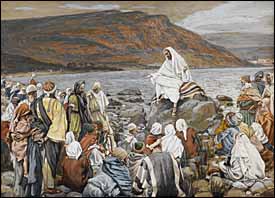 James J. Tissot, 'Jesus Teaches the People by the Sea' (1886-94), gouache on gray wove paper, 6.7 x 9.25 in., Brooklyn Museum, New York. |
"1 After this the Lord appointed seventy-two others and sent them two by two ahead of him to every town and place where he was about to go. 2 He told them, 'The harvest is plentiful, but the workers are few. Ask the Lord of the harvest, therefore, to send out workers into his harvest field. 3 Go! I am sending you out like lambs among wolves. 4 Do not take a purse or bag or sandals; and do not greet anyone on the road. 5 When you enter a house, first say, "Peace to this house." 6 If a man of peace is there, your peace will rest on him; if not, it will return to you. 7 Stay in that house, eating and drinking whatever they give you, for the worker deserves his wages. Do not move around from house to house.'" (Luke 10:1-8)
Seventy or Seventy-two? (Luke 10:1a)
We know that many, many were following Jesus. Now as he heads toward Jerusalem there are many towns that have not heard him or the message of the Kingdom. Instead of six teams of Apostles, now there are thirty-five (or maybe thirty-six) teams of two.
This is one of those instances where there is some confusion about which number is right -- 70 or 72. As you may recall from my essay, "An Introduction to Textual Criticism" in the Appendix, scholars examine both external evidence -- the various early Greek manuscripts -- and internal evidence, to reason why one wording or another might be the original. The manuscripts are nearly evenly divided between 70 and 72. But when you ask, Which is the more "difficult" wording, it would have to be "72." The number 70 occurs many times in the Septuagint and in Christian tradition, while the number 72 occurs rarely. Thus it is more likely that the original 72 was "normalized" to 70 rather than the other way around. The Editorial Committee of the United Bible Societies' Greek New Testament gives it a rating of {C}, "somewhat probable,"364 and the NIV includes 72 in the text, while the NASB, RSV, and NRSV prefer 70. Of course, it doesn't matter much at all whether it is 70 or 72, but I am used to referring to "The Sending Out of the Seventy."
Jesus may have chosen the number for symbolic reasons, just as the Twelve represent the Twelve Tribes of Israel you find:
- 70 elders of Israel (Exodus 24:1; Numbers 11:16f, 24f)
- 70 members of the Sanhedrin
- 70 nations reckoned to be in the world (Genesis 10, Hebrew), or 72 according to the Greek Septuagint translation
I think that the number is selected by Jesus to prefigure the evangelization of the whole non-Jewish world.365
He Sent Them Two by Two (Luke 10:1b)
"After this the Lord appointed seventy-two others and sent them two by two ahead of him to every town and place where he was about to go." (10:1)
As Jesus did earlier with the Twelve (Mark 6:7), Jesus sends the Seventy out in pairs, a pattern later followed by Paul and Barnabas, Paul and Silas, Barnabas and Mark, and other early missionaries. It's not that missionaries should never go alone, but travelling in pairs is safer, provides more encouragement, and uses the spiritual gifts of the pair rather than just a single missioner.
Even today, churches begun by a team of two church planters or more have a greater chance of success, and probably can grow to a larger size more quickly. It's tough and can be very discouraging being a solo church planter -- or missionary.
To Every Town ... Where He Was About to Go (Luke 10:1c)
Notice the purpose for these teams: "[The Lord] sent them ... ahead of him to every town and place where he was about to go" (10:1c). Their message is the same as for the Twelve,
"Heal the sick who are there and tell them, 'The kingdom of God is near you.'" (10:9)
Though we aren't told of a specific empowerment to cast out demons, Jesus may have given that, too, since they report in with excitement, "Even the demons submit to us in your name" (10:17).
Jesus is moving south into Judea, into a new area that isn't familiar with his message of the imminence of the Kingdom of God. Nor can he go everywhere himself. Perhaps these teams are to seek out receptive towns where they know Jesus' message will be received, so later Jesus can visit those and not waste his time with those that reject his message. These Seventy disciples have an awesome responsibility, "He who listens to you listens to me; he who rejects you rejects me; but he who rejects me rejects him who sent me" (10:16). It may be that villages which reject one of these gospel teams will never afterward have a chance to hear Jesus himself, we don't know.
We see here an example of pre-evangelism, that is, preparation in order that the hearers might be more receptive to the ministry Jesus would bring himself later on. James F. Engel, a widely-known marketing specialist and long-time professor of marketing at Eastern College, developed the so-called Engel Scale that describes the spiritual-decision process.366
- -8 Awareness of Supreme Being but no effective knowledge of gospel
- -7 Initial awareness of gospel
- -6 Awareness of the fundamentals of the gospel
- -5 Grasp of implications of the gospel
- -4 Positive attitude toward the gospel
- -3 Personal problem recognition
- -2 DECISION TO ACT
- -1 Repentance and faith in Christ
- NEW CREATURE
- +1 Post-decision evaluation
- +2 Incorporation into body
- +3 Conceptual and behavioral growth: Communion with God, Stewardship, Reproduction
On this scale, Jewish villages were probably between -7 and -5. They had a belief in the true God, and an expectation of the Messiah coming to restore the Kingdom to Israel. Seed had been sown faithfully by the prophets of Israel for centuries. Now the people needed to be moved through knowledge of the present Kingdom of God in all its power to belief in Jesus, to repentance and faith and forgiveness. The pairs of proclaimers going from village to village will accelerate this process, while later, Jesus himself would continue it and bring many to faith. Some people are so receptive that they can move from -8 to faith in Christ in a single session, but for most it is a process:
"Faith comes from hearing the message, and the message is heard through the word of Christ." (Romans 10:17)
The Harvest Is Plentiful (Luke 10:2a)
"He told them, 'The harvest is plentiful, but the workers are few.'" (10:2a)
In the agrarian economy of Palestine, harvest was an ever-present reality. It isn't surprising that the idea of harvest is used not only for bringing men and women to faith in Christ, but also for a final gathering of God's people at the end of the age. See, for example, Matthew 13:39 and Revelation 14:15. But here, Jesus has in mind an immediate harvest.
So often we look at people with natural eyes; Jesus looks at their spiritual readiness and sees the people of Judea as if they are a huge harvest almost ready to be harvested. Nearly ripe.
Fields are typically planted so that the whole field will become ripe about the same time. Seldom would you go into a field or orchard for selective picking. Rather, when the field is ripe you'd bring in harvesters and reap the whole field at one time.
A Harvest Even in Samaria (John 4)
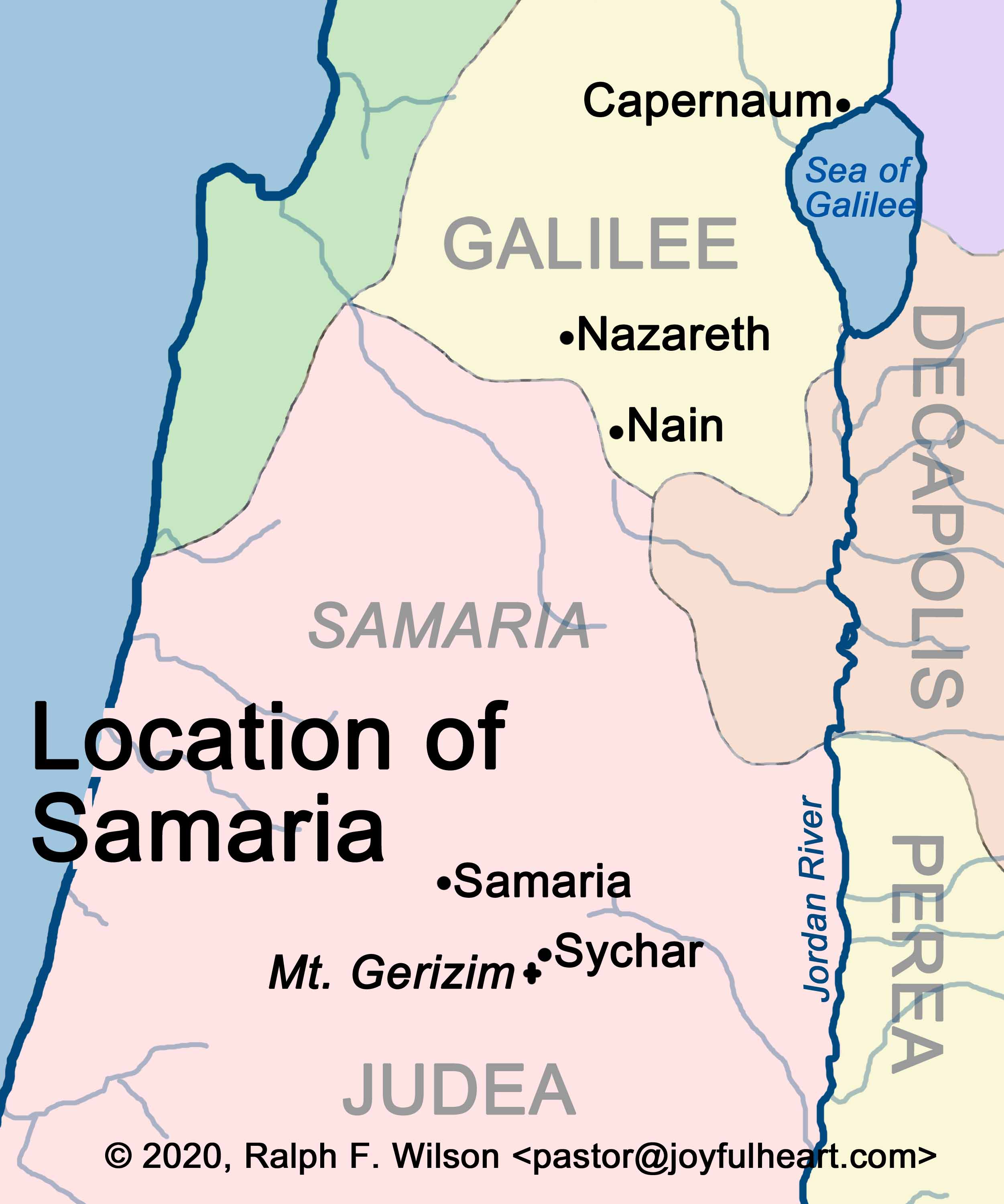 Location of Sychar in Samaria (larger map) |
While the disciples might hate the Samaritans, Jesus sees a harvest among them.
"Do you not say, 'Four months more and then the harvest'? I tell you, open your eyes and look at the fields! They are ripe for harvest. Even now the reaper draws his wages, even now he harvests the crop for eternal life, so that the sower and the reaper may be glad together. Thus the saying 'One sows and another reaps' is true. I sent you to reap what you have not worked for. Others have done the hard work, and you have reaped the benefits of their labor." (John 4:35-38)
In the Samaritan village of Sychar, Jesus began his teaching outside of town at the well with a woman and ended up staying two days, bringing many in the village to faith (John 4:40-42).
How do you view the harvest in your community? Perhaps all you can see are the immorality and apostasy that might be represented by the Woman at the Well, but a word from Jesus can turn resistance to openness, unbelief to enthusiastic faith. The answer is in his word and in his power.
The Workers Are Few (Luke 10:2b)
"He told them, 'The harvest is plentiful, but the workers are few. Ask the Lord of the harvest, therefore, to send out workers into his harvest field.'" (10:2)
When I read that the workers are few, I grieve. Where I live, at the edge of California's Central Valley, having too few workers at harvest time can be a disaster. The crop can rot in the field unless workers are available at the right time, and are willing to work very hard for this concentrated harvest season. Farmers rest in the winter, but the long summer harvest season often sees them working night and day. It is hot, sweaty, muscle-aching work. And many avoid this kind of intense labor.
Fortunately, Jesus' workforce is growing. From 12 to now 70, but it is hard enough to find committed workers. Too many people make excuses. Just prior to the Sending Out of the Seventy, as Jesus is assembling his laborers, we read:
"He said to another man, 'Follow me.'
But the man replied, 'Lord, first let me go and bury my father.'
Jesus said to him, 'Let the dead bury their own dead, but you go and proclaim
the kingdom of God.'" (9:59-60)
If you were to look at the average Christian congregation, how many of the members are actually involved in the church's harvesting activities? In America, at least, it seems that many are involved in what meets their needs and their children's needs, but shy away from a mission to meet others' needs. We have an abundance of churches, but few workers -- and perhaps few actual disciples.
Disciples, you see, are those who follow Jesus in his work, who deny themselves, take up their cross daily, and follow him. Their discipleship is not a matter of their own comfort but of Jesus' mission. So when I read that "the workers are few," I grieve. I have seen this. Jesus seeks to recruit you as a worker in his harvest, not just as an adherent or church-attender.
Ask the Lord of the Harvest to Send Out Workers (Luke 10:2c)
But immediately Jesus gives his answer to the problem of too few workers -- prayer.
"Ask the Lord of the harvest, therefore, to send out workers into his harvest field." (10:2c)
Why does Jesus say this to his disciples now? It isn't their problem, it is his. Jesus shares with his disciples the answer of prayer because soon they will be the harvest foremen in need of workers. They need to know how to deal with this in some other way than beating up on the believers by manipulation and guilt-trips.
The word translated "send out" in this verse is noteworthy. In Greek the word is ekballō. At the root level, the word means "drive out, expel,' literally, 'throw out' more or less forcibly." Secondarily, the connotation of force recedes with the meaning 'send out.'"367 The root word ballō, "to throw," is a violent word, the basis of the English word "ballistic."
How does this process work? Often it comes by responding to an inner call from God. An inner sense that God himself wants you to be involved in an aspect of his work. I've done a lot of recruiting of Christian workers as a pastor. I've found that those who stick it out are the ones who do so from a sense of calling, rather than having their arm twisted or doing a favor to me or another leader.
Prayer must be our prime recruitment technique, preceding any other invitation to the work. That is Jesus' pattern, too. Before he appoints the Twelve Apostles, he spends the night in prayer (6:12). Who is "the Lord of the harvest"? God. What does "ask" mean in relation to God? Pray. Jesus recruits and calls the first disciples. Now he is teaching his disciples how the process works, the importance of prayer so that the workers have the realization that God himself is thrusting them out as laborers. Human leaders may be the instrument, but God is the moving force. Ultimately, it is the Lord of the harvest who sends men and women out as workers, not the foreman. The foreman merely directs the workers that the master hires and sends.
A Sense of Calling
What does a sense of calling look like? The Apostle Paul wrote,
"When I preach the gospel, I cannot boast, for I am compelled to preach. Woe to me if I do not preach the gospel!" (1 Corinthians 9:16)
Sometimes we make an arbitrary distinction between the clergy and the laity. We use words like "vocation" (from the Latin word for "calling") to describe a career path in the ministry. We do need Christian leaders who can serve full-time in their ministry, but, frankly, pastors are no more called than you are to ministry. That is to say, both you and a professional minister are called by God to serve him in whatever capacity he chooses. Often I meet people who say to me, "When I was younger I felt God was calling me into the ministry, but now it's too late for me." No, it is not! The harvest is plentiful all around you. And whether you are a full-time Christian worker or a "tent-maker" to earn a living, like Paul was sometimes (Acts 18:3), you are no less called.
My dear disciple friend, are you a laborer in the harvest? Do you work in Jesus' missions out of a sense of personal calling, or out of duty or obligation to a human leader or organization? I encourage you to talk to God yourself. Ask him about what he has for you to do. Get it from God himself, if possible, and then expect it to be confirmed by your Christian brothers and sisters, and by fruitfulness in what he is calling you to do.
Like Lambs among Wolves (Luke 10:3)
"Go! I am sending you out like lambs among wolves." (10:3)
Jesus warns the Seventy of the danger of their mission. Matthew adds, "so be wise as serpents and innocent as doves" (Matthew 10:16). We will not survive long as Christian workers unless we stay very close to the Shepherd for our protection and strength. We are not supermen. We are very vulnerable to Satan's attack, and therefore we must continually rely upon Jesus' strength rather than our own.
No Purse nor Bag nor Sandals nor Greeting (Luke 10:4)
"Do not take a purse or bag or sandals; and do not greet anyone on the road." (10:4)
As in the Sending Out of the Twelve (9:3), Jesus places strict limits on how the Seventy should equip themselves for their journey. This is both a training mission and the "real thing." They must learn dependence upon God for their supply.
- No purse. They aren't to bring money to supply all their needs, but trust God to supply.
- No bag. They are to travel light.
- No sandals. There is no second pair of sandals. They are to travel very light.
When Jesus instructs them "do not greet anyone on the road," he is not telling them to be rude or impolite. Oriental greetings were important, long, and time-consuming. Have you ever been on an errand, and just dropped by someone's house to pick up something, when you are invited to come in and have a cup of coffee? It's awkward. To refuse isn't very gracious, but you know that if you come in for coffee, an hour will be gone, and you won't get done what you had intended.
I say this by way of illustration in my own culture. If the disciples were to effusively greet everyone they met on the road, they wouldn't get to their destination to do the real work they were called to do, to proclaim the good news. The instruction, "Do not greet anyone on the road," is intended to remind them of the urgency of their mission. They are not to be sidetracked by the "good" that may prevent them from accomplishing the "best."
When I have a task that is unfamiliar to me or may cause me some difficulty, my normal human reaction is to first do other things that I enjoy. I've spent days procrastinating before I'll begin an important task. Jesus is saying, Don't fall into that trap. Your mission is urgent. You can't afford to consume time in lesser activities.
Your Shalom Will Rest on Him (Luke 10:5-6)
"When you enter a house, first say, 'Peace to this house.' If a man of peace is there, your peace will rest on him; if not, it will return to you." (10:5-6)
We'll look more closely at this passage next week. Essentially, Jesus is saying that if the householder is a person receptive to the gospel of salvation, then its peace and blessing will rest upon him. If not, the blessing returns to the disciples who offered the gift and blessing.
Eat What Is Set before You (Luke 10:7-8)
"Stay in that house, eating and drinking whatever they give you, for the worker deserves his wages. Do not move around from house to house. When you enter a town and are welcomed, eat what is set before you." (10:7-8)
Similar to the instructions Jesus gave when he sent out the Twelve, once the Seventy missioners find a household that will receive them, they are to remain there, and not move around from house to house (9:4). They are not to seek to improve their lodging and meals by moving to houses with better fare. The household where they are welcomed is to remain their base of operations in that town until they leave. Instead of concentrating on improving their lot, they are to preach the Gospel, fulfill their mission, and then move on.
Twice Jesus admonishes them about eating:
"... eating and drinking whatever they give
you..." (10:7)
" ... eat what is set before you." (10:8)
I see two intentions. First, they are to be content with what they are given. Some households are poor, others are wealthier. But disciples must be content. They are offered sustenance, not luxury.
Second, however, I think Jesus may be cautioning them not to be picky about the ceremonial cleanness of the food they are offered. Some Jewish homes will be very strict in their dietary observance, others less so. While this second point is not directly stated in the Gospels (except, perhaps, at Mark 7:19), the phrase is echoed by Paul with that meaning:
"If some unbeliever invites you to a meal and you want to go, eat whatever is put before you without raising questions of conscience" (1 Corinthians 10:27).
This probably wasn't much of an issue while the disciples were preaching in Jewish towns and villages, as they presumably were to do on this mission (Matthew 10:5-6). But when the mission extended to the Samaritans and Gentiles, then this directive assumed a greater importance.
The Worker Deserves His Wages (Luke 10:7b)
"Stay in that house, eating and drinking whatever they give you, for the worker deserves his wages." (10:7)
The clause about wages is interesting. The Greek word is misthos, "remuneration for work done, pay, wages."368 Luke couples it with the Greek word axios, "pertaining to being correspondingly fitting or appropriate, worthy, fit, deserving."369 Jesus begins the analogy of the harvest with the concept of workers or laborers that the farmer, "the Lord of the Harvest," will send out to harvest his crop. A just owner always pays his workers promptly, for their pay is owed to them (Leviticus 19:13; Deuteronomy 24:14-15; 25:4; Malachi 3:5; James 5:4).
Jesus is assuring his disciples that they are not to feel bad about eating someone else's food, that it is only fair -- it is their wages for their labor in the harvest. They aren't to take advantage and seek to manipulate their stay to include the very finest. But they are deserving of sustenance, just like any other laborer.
Paul quotes this passage to extend the idea of payment to elders or pastors of local congregations.
"The elders who direct the affairs of the church well are worthy of double honor, especially those whose work is preaching and teaching. For the Scripture says, 'Do not muzzle the ox while it is treading out the grain,' and 'The worker deserves his wages.'" (1 Timothy 5:17-18)
In 1 Corinthians 9:4-18 Paul discusses his right to food and drink, even though he has chosen to waive it in order to offer the Gospel free of charge. I believe it is important that Christian churches take Jesus' command seriously as it relates to their pastors.370
Eyes to See the Harvest Jesus Sees
Jesus describes the region into which he is sending the Seventy as a harvest field.
What are we disciples intended to learn from Jesus' words in this passage? I believe he wants his disciples to look at the big picture, to humanity as a ripe harvest, waiting only sufficient workers to bring it in. We are to see ourselves as willing workers in this harvest, not to shy away or make excuses why we are unwilling to undertake hard labor. And we are to pray for more workers, we are to petition the Lord of the Harvest to send out workers into his harvest.
Prayer
Oh, Lord of the Harvest, send forth laborers into your harvest. Send me, I pray, and my brother and sister disciples in the JesusWalk together. Raise us up as an army of harvesters on your behalf. Give me rest when I'm exhausted from the labor, and food when I'm hungry. When I'm discouraged, please encourage me afresh. But grant to me and my colleagues on the Way the immense privilege of being your laborer in your harvest. In Jesus' name, I pray. Amen.
Key Verse
"The harvest is plentiful, but the workers are few. Ask the Lord of the harvest, therefore, to send out workers into his harvest field." (Luke 10:2)
Questions
Click on the link below to discuss on the forum one or more of the questions
that follow -- your choice.
https://www.joyfulheart.com/forums/topic/1958-42-harvest/
- Why does Jesus pair up the disciples as he sends them out? (10:1) What application does this have today?
- What are the strategic purposes behind Jesus' decision to send out the Seventy? What is he trying to accomplish?
- In what sense is the harvest plentiful in Jesus' day? (10:2a) Is the harvest plentiful in your area of the world? How do you determine that?
- Why are the workers few? (10:2b) What kinds of things have kept you in the past from being active in the harvest?
- Why is God the main recruiter? What is our instruction when we need more workers? (10:2c)
- What kind of "wages" does God offer harvesters today for their labor? (10:7)
 Lessons compiled in 805-page book in paperback, Kindle, & PDF. |
Endnotes
[364] Metzger, q.v.
[365] Karl Heinrich Rengstorf, hepta, ktl., TDNT 2:634-635.
[366] Adapted from James F. Engel and Wilbert Norton, What's Gone Wrong With the Harvest? A Communication Strategy for the Church and World Evangelization (Zondervan, 1977), p. 45.
[367] Shorter Lexicon, pp. 58-59
[368] Misthos, BDAG 653, 1.
[369] Axios, BDAG 93, 2a.
[370] You can read more about the Scripture teaching in my article, "Does Your Church Run a Spiritual Sweatshop?" https://www.joyfulheart.com/church/sweatshop.htm
Copyright © 2026, Ralph F. Wilson. <pastor joyfulheart.com> All rights reserved. A single copy of this article is free. Do not put this on a website. See legal, copyright, and reprint information.
 To be notified about future articles, stories, and Bible studies, why don't you subscribe to our free newsletter, The Joyful Heart, by placing your e-mail address in the box below. We respect your