


|
Old Testament
New Testament
Gospels
Acts
Paul's Letters
General Letters
Revelation
Topical Studies
Beginning the Journey (for new Christians). en Español

|
Old Testament
New Testament
Gospels
Acts
Paul's Letters
General Letters
Revelation
Topical Studies

|
Home
Bible Studies
Articles
Books
Podcasts
Search
Menu
Donate
About Us
Contact Us
FAQ
Sitemap

Free
E-mail Bible Study
 Names and Titles of God
Home | Bible Studies | Articles | Books | Podcasts | Search | Menu | Donate | About Us | FAQ | Contact Us
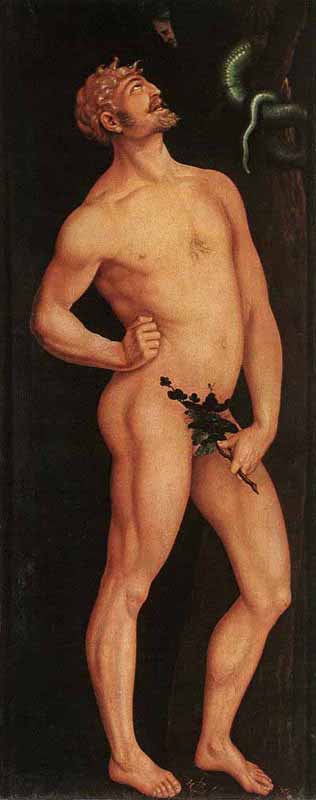
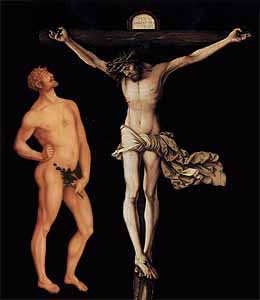 "Adam and Christ," a composite by the author of two paintings by Hans Bauldung Grien (Austrian painter, 1484/85-1545), "Adam" (1520-23, left), Museum of Fine Arts, Budapest (Szepmuveseti Muzeum); and "Crucifixion" (1512, right), Linden panel, 152 x 104 cm, Staatliche Museen, Berlin. Larger image of Adam and Christ composite. |
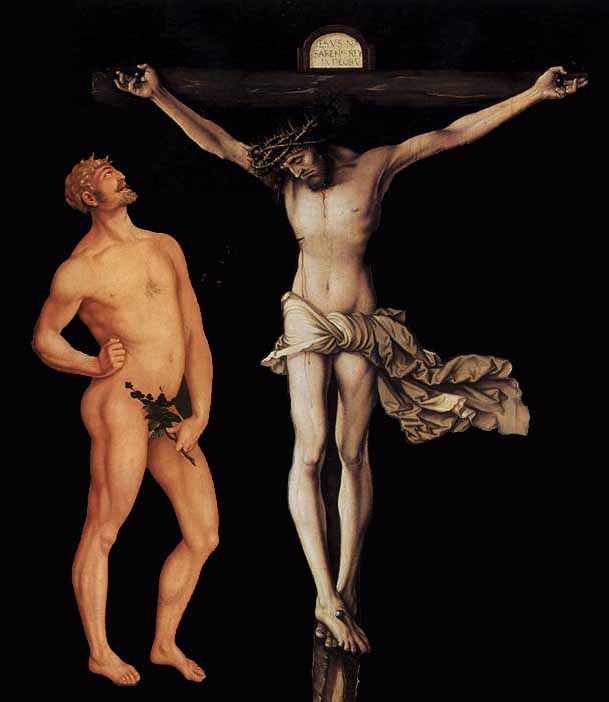
15 But the gift is not like the trespass. For if the many died by the trespass of the one man, how much more did God's grace and the gift that came by the grace of the one man, Jesus Christ, overflow to the many! 16 Again, the gift of God is not like the result of the one man's sin: The judgment followed one sin and brought condemnation, but the gift followed many trespasses and brought justification. 17 For if, by the trespass of the one man, death reigned through that one man, how much more will those who receive God's abundant provision of grace and of the gift of righteousness reign in life through the one man, Jesus Christ.
18 Consequently, just as the result of one trespass was condemnation for all men, so also the result of one act of righteousness was justification that brings life for all men. 19 For just as through the disobedience of the one man the many were made sinners, so also through the obedience of the one man the many will be made righteous.
20 The law was added so that the trespass might increase. But where sin increased, grace increased all the more, 21 so that, just as sin reigned in death, so also grace might reign through righteousness to bring eternal life through Jesus Christ our Lord.
6:1 What shall we say, then? Shall we go on sinning so that grace may increase? 2 By no means! We died to sin; how can we live in it any longer? 3 Or don't you know that all of us who were baptized into Christ Jesus were baptized into his death? 4 We were therefore buried with him through baptism into death in order that, just as Christ was raised from the dead through the glory of the Father, we too may live a new life. 5 If we have been united with him like this in his death, we will certainly also be united with him in his resurrection." (5:12-6:5)
| Big Concept 2. We are united with Christ so solidly that we are "in him," we are "part of the Body of Christ" and he is our Head. This is true to such a degree spiritually, that when Christ died on Golgotha, it is as if we died with him. This affects how we see ourselves -- and our sin. |
Have you ever wondered how it is fair and just that Jesus died for your sins instead of you? This chapter gives an answer. Have you ever wondered what it really meant to be "in Christ"? Here's perhaps the best explanation in all of Scripture of the nature of our union with Christ.
But let me warn you, these are difficult concepts for us to understand, especially for those of us immersed in a Western world view. Paul's discourse on the relationship of Adam to Christ may seem irrelevant to you, but hang in there. You'll find that it will begin to make sense, especially when we come to understanding baptism (6:2-4).
Sin and Death Came through Our Progenitor Adam (5:12)
12 "Therefore, just as sin entered the world through one man, and death through sin, and in this way death came49 to all men, because all sinned." (5:12)
The Bible calls the first human "Adam" and tells his story in Genesis 2 and 3. In Hebrew, the word 'ādām is the generic word for "human, humankind" (as opposed to 'îsh which refers specifically to man as male gender).50 Paul draws on the implications of Adam's actions to all of his descendents. You know the story.
 William Blake (1757-1827), detail from "Eve Tempted by the Serpent," tempera. England, late 18th century. Larger image. |
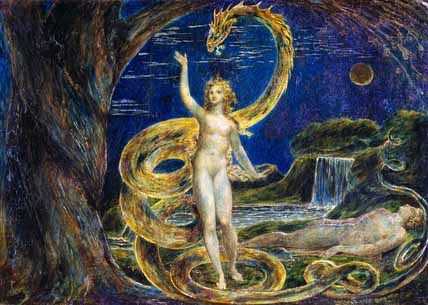
- Man is created "good" (Genesis 1:31) and he enjoys a precious fellowship with God (Genesis 3:8-9). Adam is innocent but he is not like a robot. He possesses the freedom, as we do, to choose right and wrong, though up until the time of his sin, he has believed what God tells him and has chosen to act in accordance with this belief.
- Satan, disguised as a serpent, deceives Adam and Eve into thinking that by disobeying God he can become like God himself (Genesis 3:4-5). Adam and Eve believe Satan's deception more than they believe God's Word, and give in to this temptation. It is an ancient story, but one that has played itself out in our own lives many times.
- Because of Adam's unbelief and resulting sin, the Word of God comes to pass in Adam: "When you eat of it you will surely die" (Genesis 2:17). Death doesn't come immediately, but something changes. As a result of Adam's fall and God's curse on the earth (Genesis 3:17), the entire creation enters into a cycle of life, death, and decay. One day, after many years, Adam dies. And because we are his descendents, we are subject to death as well.
Death Came to all Men, because All Sinned (5:12b)
Verse 12 concludes:
"...and in this way death came to all men, because all sinned." (5:12)
This can be understood in two ways. Just be aware that the easiest explanation may not be the one that Paul is teaching here.
- "All sinned," that is, everyone sins on his own. He doesn't need Adam to do it for him. The key verse here would be: "For all have sinned and fall short of the glory of God" (3:23). And certainly this is true. As the Apostle John puts it, "If we claim to be without sin, we deceive ourselves and the truth is not in us" (1 John 1:8). This explanation makes sense to us and accords with our own experience. For reasons I'll explain, however, I don't think that this is what Paul is saying here. I think he is saying:
- "All sinned" since they are united with Adam who sinned. Adam's sin taints us and his punishment affects us. You could say that when Adam sinned, we sinned, since we are one with Adam.51
I know that the first explanation is more digestible to most of us. But if that is what Paul means, why does he use the Aorist tense ("sinned," single point in past time) instead of the Imperfect tense ("have sinned and still sin," past time with a continuous sense), which would suit that meaning better?
I believe Paul is introducing a Semitic concept mostly foreign to Western thinking, that one person acts for the group and that one person's actions profoundly affect the fortunes of the entire group. Let me try to explain the difficult concept that underlies this passage.
The Patriarch Affects His Descendants
Many times in scripture we see promises made to patriarchs that affect their descendants. For example:
To Isaac: "I will bless you and will increase the number of your descendants for the sake of my servant Abraham." (Genesis 26:24)
"For the sake of his servant David, the LORD was not willing to destroy Judah. He had promised to maintain a lamp for David and his descendants forever." (2 Kings 8:19)
Very frequently the entire nation is referred to by the name of the patriarch or as the "house" of the ancestor.
"How can I give you up, Ephraim? How can I hand you over, Israel?" (Hosea 11:8)
"The Lord God will give him the throne of his father David, and he will reign over the house of Jacob forever." (Luke 1:32-33)
One Person Acts for or Represents the Entire Group
In a number of places in the Old Testament, one person's actions profoundly affect the entire group. For example:
- Achan's sin of greed and disobedience affects the whole nation (Joshua 7).
- David's action in taking a census brings judgment upon Israel (2 Samuel 24).
But more than just affecting a group, we sometimes see a person acting for an entire group. David's action to avert severe judgment is made for the entire kingdom.
We see this in our own day. A king declares war, thus committing all the young men in his country and those of allied nations to risk their lives as soldiers. A president breaks the terms of a treaty, thereby plunging his nation into war.
The ancient story of David and Goliath (1 Samuel 17) recounts an individual contest in which the destiny of entire armies and nations is vested by proxy in the winner -- a battle between champions that determines the outcome.
| Q1. What kinds of circumstances in modern life can you
think of where a single person acts for an entire group? In what ways
are members of the group tied to this person? http://www.joyfulheart.com/forums/index.php?showtopic=796
|
Struggling for Terminology
With this background we can begin to see the role of the First Adam and the Second Adam described in this passage. (The phrase "Second Adam" or "Last Adam" comes from a related passage in 1 Corinthians 15:45.) We don't really have a single appropriate word to describe this phenomenon.
- Representative may come close,52 defined in English as: "one that represents another as agent, deputy, substitute, or delegate usually being invested with the authority of the principal."53 In our culture we see such concepts in "power of attorney" and "proxy," as well as an ambassador who speaks and acts for an entire government.
- Solidarity carries this a step further as, "unity (as of a group or class) that produces or is based on community of interests, objectives, and standards."54 Though we often use "solidarity" in a political sense, in our passage the idea is used in a physical and spiritual sense.55 F.F. Bruce notes that, "It is not simply because Adam is the ancestor of mankind that all are said to have sinned in his sin (otherwise it might be argued that because Abraham believed God all his descendents were automatically involved in his belief); it is because Adam is mankind."56 We are in solidarity with Adam. We are in solidarity with Christ.
- Head is found in the Old and New Testaments based on a physical
analogy. Christ is seen as the heavenly head of a new body, a new humanity.57.
If we are part of this "body of Christ," then we are "in Christ," and the
actions and blessings of the head affect us as part of the body. In Rabbinic
Judaism of the time you sometimes see phrases such as "head of the
priesthood" or Adam as the "head of all created things."58
Systematic theologians use the term "federal headship" of Adam and Christ, by which they mean the representation of a group united under a federation or covenant. In Christian theology, this has been referred to as a "covenant of works" under Adam and the "covenant of grace" under Christ.59 - Corporate Personality is an anthropological term introduced in
the 1930s by British scholar H. Wheeler Robinson.60
J.R. Porter defines the concept this way: "'Corporate personality' may be
taken to imply that, in certain spheres and on certain occasions, the
individual is considered as indistinguishable from the group to which he
belongs. In the words of Wheeler Robinson, 'corporate personality means ...
the treatment of the family, the clan, or the nation, as the unit in place
of the individual.' Equally, whatever the individual does is considered as
being done by the whole group, and the group is necessarily involved in the
consequences of his action."61
However, more recent studies suggest that the term may not be appropriate here at all.62
An Especially American Difficulty
Americans especially struggle with these concepts because our history is so rich in a belief in independence and a celebration of Yankee individualism. Our mythical ideal is "every man for himself" against the elements, and we delight in a person improving his economic condition by his own hard work and ingenuity. How different, for example, from an Asian view of the subservience of the individual to the needs of the group, especially one's family and the honor of one's ancestors. We chafe under ideas of solidarity and headship because of our own cultural values. But just because we struggle to grasp the concept doesn't mean that it is invalid. We must stretch to understand -- but that's okay.
Sin Reigns with and without the Law (5:13-14)
Now let's get back to the text.
13 "For before the law was given, sin was in the world. But sin is not taken into account when there is no law. 14 Nevertheless, death reigned from the time of Adam to the time of Moses, even over those who did not sin by breaking a command, as did Adam, who was a pattern of the one to come." (5:13-14)
Paul is writing for Jewish Christians who revered the law, so he pauses to mention the role of law with sin. We'll consider this in more detail in Romans 7.
In verse 13, he acknowledges that sin existed along with its resultant death, even before the law was given through Moses. It was not "taken into account" as a deliberate transgression of the law, however.63 Paul picks up this theme in verse 20 again:
"The law was added so that the trespass might increase." (5:20)
In other words, the law was given to Moses to make man's sin more visible and stand out in stark relief from righteousness.
| Q2. (Romans 5:13, 20) What is Paul saying in these
verses? Can there be sin without law? In what sense does the "trespass
increase" (5:20) when the law is present? http://www.joyfulheart.com/forums/index.php?showtopic=797
|
Note in verse 14 that Paul calls Adam a "pattern" (NIV), "type" (NRSV, NASB), or "figure" (KJV) of Christ to come. This is the noun tupos (sometimes transliterated as typos), from the verb tuptō, "to strike." The basic meaning denotes "the impress" of a blow, then "form," with nuances such as "mark, mold, outline, figure," as when coins are minted from an original die. In 5:14 it carries the idea of "advance presentations" or "type" of a similar one to come.64
The Doctrine of Original Sin
Verse 19 reads: "Through the disobedience of the one man the many were made sinners... " (5:19a).
Let's pause here a moment to consider the Doctrine of Original Sin. This doctrine was drawn from our passage and developed from St. Augustine's statement, "The deliberate sin of the first man is the cause of original sin."65 In Catholic theology:
"Original sin may be taken to mean: (1) the sin that Adam committed; (2) a consequence of this first sin, the hereditary stain with which we are born on account of our origin or descent from Adam."66
Perhaps a more helpful terminology might be "inherited sin" and "inherited corruption."67 Adam's fall resulted in the corruption of the nature of all of us. Instead of being "good," we are now broken, flawed at the deepest levels. There is a mixture of both good and bad. You may think that this is not fair, but it represents reality as we know it. We have enough of our own sins to damn us without Adam's, so who are we to complain about the unfairness of Adam's sin?
Christ, the Second Adam (5:15-19)
Now Paul begins to compare and contrast the heads of two races, the First
Adam, or physical ancestor, and the Second Adam, Christ our risen Lord, spelled
out in greater detail in 1 Corinthians 15:44-49. The idea of two Adams was
circulating among Jews in the first century AD -- the fall of the earthly Adam
(the "first Adam") and a preexistent heavenly Adam.68
Paul drew on this concept to make his point. Look at the comparisons he makes.
| Adam | Christ |
| "15 But the gift is not like the trespass. | |
| For if the many died by the trespass of the one man, | how much more did God's grace and the gift that came by the grace of the one man, Jesus Christ, overflow to the many! |
| 16 Again, the gift of God is not like the result of the one man's sin: | |
| The judgment followed one sin and brought condemnation, | but the gift followed many trespasses and brought justification. |
| 17 For if, by the trespass of the one man, death reigned through that one man, | how much more will those who receive God's abundant provision of grace and of the gift of righteousness reign in life through the one man, Jesus Christ. |
| 18 Consequently, just as the result of one trespass was condemnation for all men, | so also the result of one act of righteousness was justification that brings life for all men. |
| 19 For just as through the disobedience of the one man the many were made sinners, | so also through the obedience of the one man the many will be made righteous. |
| Q3. (Romans 5:15-19) By what right does Adam represent
all humankind? By what right does Christ become head of all who become
his disciples? If Christ is not our "representative" or "head," how can
his death for sins be effective for us? http://www.joyfulheart.com/forums/index.php?showtopic=798
|
Resurrection through the "Last Adam" (1 Corinthians 15:45-49)
Paul makes a similar contrast in 1 Corinthians 15:45-49 between Adam as the progenitor of the "natural body" and Christ as the progenitor of the "spiritual body." In his famous passage on the resurrection of the body on the Last Day, Paul writes:
| Adam | Christ |
| 45 So it is written: "The first man Adam became a living being"; | the last Adam, a life-giving spirit.... |
| 47 The first man was of the dust of the earth, | the second man from heaven. |
| 48 As was the earthly man, so are those who are of the earth; | and as is the man from heaven, so also are those who are of heaven. |
| 49 And just as we have borne the likeness of the earthly man, | so shall we bear the likeness of the man from heaven. (1 Corinthians 15:45-49) |
In 1 Corinthians 15 45-49 Paul is talking about this same contrast between the First Adam and the Second Adam as he does in Romans 5. Paul has laid a strong conceptual base in Romans 5 for our redemption and blessings in Christ. Now he is ready to apply these truths to human lives.
The Law Spotlights and Increases Sin (5:20-6:2a)
Here are the transition verses:
20 "The law was added so that the trespass might increase. But where sin increased, grace increased all the more, 21 so that, just as sin reigned in death, so also grace might reign through righteousness to bring eternal life through Jesus Christ our Lord. 6:1 What shall we say, then? Shall we go on sinning so that grace may increase? 2 By no means!" (5:20-6:2a)
Paul has been talking about abundant sin and more abundant grace. But now he pauses. Does that mean that we can sin without regard to the result? Paul's enemies probably would misunderstand what he was saying and try to cast him as soft on sin. There were some in the church known as antinomians (from anti-, "against" + nomos, "law"), who felt under no obligation to obey any moral or ethical law. Carried to an extreme, some might see Paul's teaching as an excuse to keep on sinning. Paul makes it clear that this isn't what he has in mind at all. His point is that to "continue69 in sin" (KJV, NRSV) would be to persist in our old lifestyle of sinning70 when the era of the "old" person is over.
We Have Been United with Christ (6:2b-5)
In 6:2-5, Paul ties our union with Christ to baptism. In this lesson we'll talk about union with Christ, since it is vital that we understand this point. In the next lesson we'll explore baptism and its implications more fully.
2b "We died to sin; how can we live in it any longer? 3 Or don't you know that all of us who were baptized into Christ Jesus were baptized into his death? 4 We were therefore buried with him through baptism into death in order that, just as Christ was raised from the dead through the glory of the Father, we too may live a new life. 5 If we have been united with him like this in his death, we will certainly also be united with him in his resurrection." (Romans 6:2b-5)
We Died to Sin! (6:2)
"We died to sin," Paul insists. "How can we live in it any longer?" He contrasts the past with the present.
"Died"71 is in the Greek Aorist tense, which refers to a past event that took place at a particular point in time, not a repeating event that continued in the past. Paul is saying that we died at a particular historical point. It is done. Finished. A fact.
"Live"72 is in the present tense, which expresses a continuous action in the present. Paul employs an interesting phrase: "Live in sin." He isn't referring to living together without being married (though that would be included). Rather he uses the preposition en in the sense of "close association," especially "under the control of, under the influence of, in close association with."73
So what does Paul mean when he says, "We died to sin"? The short answer is that we, through baptism, have been united with Christ's death. Just as "all sinned" in Adam (5:12), so "we died to sin" in Christ (6:2).
The Concept of Union with Christ Is Basic to Paul's Theology
Once you understand this concept of union with Christ, you begin to see it throughout Paul's letters. Consider the how Paul's concepts relate to being united with Christ, the Second Adam.
See in Figure 1 how the various concepts of unity with Christ relate to this idea of Christ the Representative or the Second Adam. We are:
- "in Christ"
- "members of the body of Christ"
- "baptized into the body of Christ"
- "buried with Christ in baptism"
- "died" or "crucified with Christ"
These concepts all draw upon the same truth -- that we have been united with Christ.
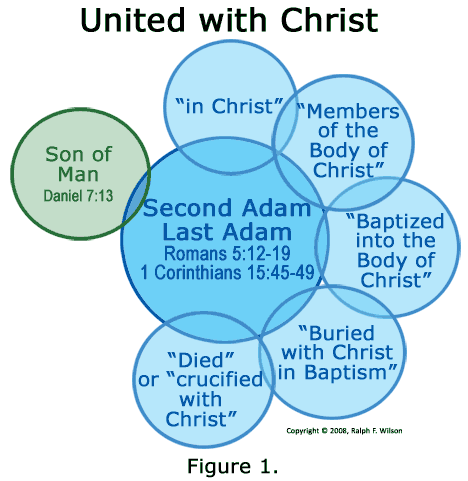
You can study this more deeply in Appendix 2. "The Concept of Union with Christ Is Basic to Paul's Theology." http://www.jesuswalk.com/christ-power/union-with-christ-second-adam.htm
We are "In Christ"
Our union with Christ is obviously spiritual rather than physical. But that doesn't make it unreal. Paul speaks of our union with Christ's death as a spiritual reality, not just a figure, analogy, metaphor, or symbol for something else.
 Available in paperback, Kindle, and PDF book formats. |
Christ as Head died for the sins of all. Now those who are "in Christ," whose lives are "hid with Christ in God" (Colossians 3:3) are redeemed. We stand before God "in Christ" as part of his body, his bride, redeemed at great cost and made holy. We are "complete in him" (Colossians 2:10, KJV, NASB).
Another implication of our being "in Christ" is the necessity of love as the primary virtue of Christians. Since we are together "in Christ," rivalry is silly. We are one! "By this all men will know that you are my disciples, if you love one another" (John 13:35).
In a very real sense when Christ died on the cross two millennia ago I died there, too -- and so did you. His death is my death, since I am united to him. Christ died; I died.
| Q4. (Romans 6:2-5) According to this passage, at what
point do we move from being under the headship of Adam to the headship
of Christ? Is there anything we must do to bring about this change in
headship? What are the implications of us having died with Christ? http://www.joyfulheart.com/forums/index.php?showtopic=799
|
We do know this for sure: We have been united with Christ at a very deep level. We are "in Christ." This has brought about a radical change in us and in our relationship to our old life and to sin. We are now "joined at the hip" to Christ -- and to one another. The implications of this union are staggering.
Prayer
Lord Jesus, I have been joined to you to the degree that I am one with you. I don't understand this fully, but I ask you to work in me the full power and consequence of that union. Let it utterly transform the way I live, think, and act. In Jesus' name, I pray. Amen.
Big Concept
We are united with Christ so solidly that we are "in him," we are "part of the Body of Christ" and he is our Head. This is true to such a degree spiritually, that when Christ died on Golgotha, it is as if we died with him. This affects how we see ourselves -- and our sin.
Key Verses
"Consequently, just as the result of one trespass was condemnation for all men, so also the result of one act of righteousness was justification that brings life for all men." (Romans 5:18)
References
49. Dierchomai, "to pass through, go through" (BDAG 244, 1bβ).
Copyright © 2026, Ralph F. Wilson. <pastor joyfulheart.com> All rights reserved. A single copy of this article is free. Do not put this on a website. See legal, copyright, and reprint information.