


|
Old Testament
New Testament
Gospels
Acts
Paul's Letters
General Letters
Revelation
Topical Studies
Beginning the Journey (for new Christians). en Español

|
Old Testament
New Testament
Gospels
Acts
Paul's Letters
General Letters
Revelation
Topical Studies

|
Home
Bible Studies
Articles
Books
Podcasts
Search
Menu
Donate
About Us
Contact Us
FAQ
Sitemap

Appendix 2. The Concept of Union with Christ Is Basic to Paul's Theology
by Dr. Ralph F. Wilson
Free
E-mail Bible Study
 Names and Titles of God
Home | Bible Studies | Articles | Books | Podcasts | Search | Menu | Donate | About Us | FAQ | Contact Us
Once you understand this concept of union with Christ, you begin to see it throughout Paul's letters. Consider the how Paul's concepts relate to being united with Christ, the Second Adam.
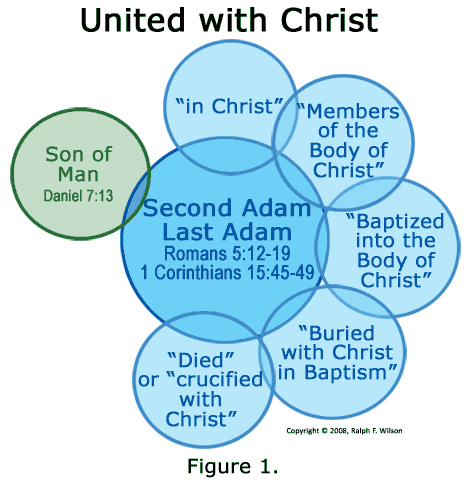
"In Christ" is found nearly 90 times in Paul's letters. For example, "Therefore, if anyone is in Christ, he is a new creation; the old has gone, the new has come!" (2 Corinthians 5:17). To be "in Christ" means to be one with him and incorporated in him, so that God sees us "in Christ" rather than on our own without Christ. This concept fits very comfortably with being united with and identified with Christ as the Second Adam.
"Members of the Body of Christ" is a familiar concept to describe our relationship to Christ. For example, "Now you are the body of Christ, and each one of you is a part of it" (1 Corinthians 12:27) and "so that the body of Christ may be built up" (Ephesians 4:12). We are parts of his body in the same way that we are joined to the Second Adam and are united with him. While the concepts are not identical, they are clearly related to each other. The body is primarily Christ himself, and then only his church by extension, because they have been united to him.
"Baptized into the Body of Christ" is also part of this concept. "For we were all baptized by one Spirit into one body -- whether Jews or Greeks, slave or free -- and we were all given the one Spirit to drink" (1 Corinthians 12:13). Salvation brought about by the Holy Spirit and culminating in water baptism and the fullness of the Spirit. This concept is similar to, though not identical to the idea of being united to Christ by being buried with him in baptism.
"Buried with Christ in baptism." We see this concept twice in Paul's letters:
" 3 Or don't you know that all of us who were baptized into Christ Jesus were baptized into his death? 4 We were therefore buried with him through baptism into death in order that, just as Christ was raised from the dead through the glory of the Father, we too may live a new life. 5 If we have been united with him like this in his death, we will certainly also be united with him in his resurrection." (Romans 6:3-5)
"... Having been buried with him in baptism and raised with him through your faith in the power of God, who raised him from the dead." (Colossians 2:12)
The burial in baptism is the characteristic mark of uniting ourselves with him.
"Died with" or "crucified with Christ." A number of times Paul makes reference to the fact that since we are united with Christ as the Second Adam, then his death on the cross of Calvary becomes our death, too. When we understand this concept that his historical death = our death, then several otherwise incomprehensible verses begin to make sense. Notice the characteristic Aorist past tense, signifying a single point of action that took place in the past.*
| Death with Christ or Crucifixion with Christ | "For Christ's love compels us, because we
are convinced that one died for all, and therefore all died." (2
Corinthians 5:14) "For through the law I died to the law so that I might live for God. I have been crucified with Christ and I no longer live, but Christ lives in me. The life I live in the body, I live by faith in the Son of God, who loved me and gave himself for me." (Galatians 2:19-20) "May I never boast except in the cross of our Lord Jesus Christ, through which the world has been crucified to me, and I to the world." (Galatians 6:14) "For you died, and your life is now hidden with Christ in God." (Colossians 3:3) "Since you died with Christ to the basic principles of this world, why, as though you still belonged to it, do you submit to its rules?" (Colossians 2:20) "Here is a trustworthy saying: If we died with him, we will also live with him." (2 Timothy 2:11) |
| Death to sin | Since Christ died "for sin" and "to sin" on
the cross, so we share in this death to sin: "We died to sin; how can we live in it any longer?" (Romans 6:2) "... Because anyone who has died has been freed from sin. " (Romans 6:7) "The death [Christ] died, he died to sin once for all; but the life he lives, he lives to God." (Romans 6:10) "In the same way, count yourselves dead to sin but alive to God in Christ Jesus." (Romans 6:11) |
| Death to the law | Another way Paul expresses this to his
Jewish Christian audience is as death to the law that declared their
sinfulness. Because we are united to Christ, when Christ died for our
sins, we also died to the law. "So, my brothers, you also died to the law through the body of Christ, that you might belong to another, to him who was raised from the dead, in order that we might bear fruit to God." (Romans 7:4) "But now, by dying to what once bound us [the law], we have been released from the law so that we serve in the new way of the Spirit, and not in the old way of the written code." (Romans 7:6) "19 For through the law I died to the law so that I might live for God. 20 I have been crucified with Christ and I no longer live, but Christ lives in me. The life I live in the body, I live by faith in the Son of God, who loved me and gave himself for me." (Galatians 2:19-20) |
Available in paperback, Kindle, and PDF book formats. |
I know that this is a difficult concept, especially for Westerners, to grasp. But the essential idea is this. When we put our faith in Christ (marked by baptism), we become united to Christ. He, rather than Adam, is now our "head." So what is true for Christ our Leader is now true for us. When he died on Calvary's cross, we died.
_____________
* Not all of the following verses use the Aorist tense, though this tense is found in most of these verses. This concept is explored in detail in "2. United to Christ, the Second Adam (5:12-6:5)," part of the Christ Powered Life (Romans 5-8) series.
Copyright © 2026, Ralph F. Wilson. <pastor joyfulheart.com> All rights reserved. A single copy of this article is free. Do not put this on a website. See legal, copyright, and reprint information.