


|
Old Testament
New Testament
Gospels
Acts
Paul's Letters
General Letters
Revelation
Topical Studies
Beginning the Journey (for new Christians). en Español

|
Old Testament
New Testament
Gospels
Acts
Paul's Letters
General Letters
Revelation
Topical Studies

|
Home
Bible Studies
Articles
Books
Podcasts
Search
Menu
Donate
About Us
Contact Us
FAQ
Sitemap

Free
E-mail Bible Study
 Names and Titles of God
Home | Bible Studies | Articles | Books | Podcasts | Search | Menu | Donate | About Us | FAQ | Contact Us
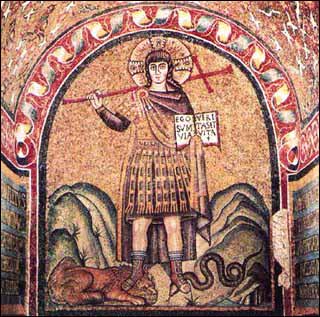 "Christus Victor" (late fifth or early sixth-century), mosaic, Chapel of the Archbishop, Ravenna. Under Christ's feet you see the lion and the serpent, enemies mentioned in Psalm 91:13 -- a sign of victory. |
31 What, then, shall we say in response to this? If God is for us, who can be against us? 32 He who did not spare his own Son, but gave him up for us all -- how will he not also, along with him, graciously give us all things? 33 Who will bring any charge against those whom God has chosen? It is God who justifies. 34 Who is he that condemns? Christ Jesus, who died -- more than that, who was raised to life -- is at the right hand of God and is also interceding for us. 35 Who shall separate us from the love of Christ? Shall trouble or hardship or persecution or famine or nakedness or danger or sword? 36 As it is written:
'For your sake we face death all day long;
we are considered as sheep to be slaughtered.'
37 No, in all these things we are more than conquerors through him who loved us. 38 For I am convinced that neither death nor life, neither angels nor demons, neither the present nor the future, nor any powers, 39 neither height nor depth, nor anything else in all creation, will be able to separate us from the love of God that is in Christ Jesus our Lord." (Romans 8:28-39)
| Big Concept 8. Though we Christians go through all sorts of struggles and persecutions now, God is still in charge. Nothing can turn away his intense love for us. And on the Last Day when we stand before his throne we will hear his final word of pardon and feel the embrace of his love. |
The final glorious sweep of Paul's vision now bring us to a place of understanding that in spite of the circumstances we may be going through, we are truly victors. None of these things can take away our most precious treasure, God's enduring love for us. When you are discouraged, this is the passage to encourage you.
In All Things God Works! (8:28)
The passage begins where we left off in the last lesson, with the assurance of God working in spite of our sufferings. The passage is rendered a bit differently in various translations:
"And we know that all things work together for good to them that love God, to them who are the called according to his purpose." (KJV)
"We know that all things work together for good for those who love God, who are called according to his purpose." (NRSV)
"And we know that in all things God works for the good of those who love him, who have been called according to his purpose." (NIV)
"And we know that God causes all things to work together for good to those who love God, to those who are called according to His purpose." (NASB)
The main issue in translating this verse is to identify the subject of the sentence. It could be either:
- All things work together, or
- He (God) works all things together.
In most ancient Greek texts, the word "God" is implied, not present specifically.198 Grammatically, panta ("all things") could be either the subject (nominative) or the object (accusative). Since this is true, the subject of the sentence must be determined by context, not by grammar. However, since "God" or "the Spirit" are the subjects of the surrounding sentences, it seems unlikely that "all things" should be the subject here. And even those who see "all things" as the subject don not propose that things work together for good only by their own accord, without God's intervention. So the translation "God works" or "God causes ... to work together" seems to me to be the best choice here.
What It Does Not Mean
What does this verse teach then? Let's begin by noting some things that it does not teach:
"Que sera, sera, whatever will be, will be." The lyrics of this 1956 song by Jay Livingston and Ray Evans express a kind of fatalism that is foreign to the Bible. There is a brand of Christianity, however, that is so fixed on predestination -- that all things are already determined -- that it results in a kind of passivism and fatalistic attitude.
This view is captured best for me in a story from the beginnings of the Protestant missionary movement. At a meeting of ministers in England in 1786, William Carey (1761-1834) argued that it was the duty of all Christians to spread the Gospel throughout the world. A hyper-Calvinist pastor J. R. Ryland, is said to have retorted, "Young man, sit down; when God pleases to convert the heathen, he will do it without your aid and mine." Carey later went on to be the first Protestant missionary to India.
Certainly we believe that God is able to predestine or predetermine events. If he couldn't, he wouldn't be God. And clearly, the Bible teaches predestination, as in verse 29. But when our view of predestination breeds passivity or fatalism in us, we've got it wrong.
"It must be God's will." Many pious Christians believe this and find comfort in it. It isn't really based on Scripture, however, but on the philosophical argument that since God is all powerful, then anything that occurs is at least allowed by God to happen, if not actively caused to happen by God. I accept the argument, but I don't believe that it proves that everything that happens is God's will. For example:
"The Pharisees and experts in the law rejected God's purpose for themselves, because they had not been baptized by John." (Luke 7:30)
"(The Lord) is patient with you, not wanting anyone to perish, but everyone to come to repentance." (2 Peter 3:9)
The Bible teaches that Satan, one of God's powerful angels, rebelled against God, was cast out of heaven, and is challenging God's sovereignty here on earth. In a final battle, Satan will be vanquished by the Messiah, and God will bring in a reign of righteousness and justice in a new heavens and a new earth.
Understanding Satan as a real entity who causes evil in the world is much more in keeping with the Word of God than a denial of his very existence. If you don't understand or accept the conflict between good and evil, between God and the devil, then you're left with the wrong conclusion that God somehow causes evil.
In a war there are casualties. In time of war there is destruction. In many places in the New Testament, especially in the book of Revelation, this conflict is characterized in terms of battle and all out war. There is a final battle coming -- and our side wins. But the culmination is not yet.
To make sense out of life, we must be able to say about evil, "An enemy has done this" (Matthew 13:28). "Why?" is the natural question when a crisis occurs. Why did God allow it? Most of the time our answer must be, "We don't know." More helpful questions are: "What should I do now?" and "What can I learn from this?"
When we reject passivity and fatalism as well as a naïve assumption that everything that happens is God's will, then we can begin to understand the power of what Romans 8:28 actually does teach.
God Actively Works All Things for Our Good (8:28)
"And we know that in all things God works for199 the good of those who love him, who have been called according to his purpose." (8:28, NIV)
Let's consider the verb sunergeō, "works" (NIV) or "works together" (KJV). It means "to engage in cooperative endeavor, work together with, assist, help."200 We get our word "synergy" from this word. My father used to say, "God never does just one thing." Satan may attack on one front, but God is able to work in a multitude of ways to bring about "good" (agathos), "that which is beneficial or helpful."201
Probably the best example in the entire Bible is found in the life of Joseph, of coat-of-many-colors fame. Because he was his father's favorite and acted somewhat superior on his own account, his brothers hated him. When he was 17, they ambushed him and sold him into slavery to Midianite traders, who eventually resold him in Egypt. You know the story. Through a series of circumstances ("worked together" by God) he becomes second to Pharaoh over all Egypt. When even his brothers fall under his power and then realize who he is, they are terrified for their lives. Joseph tells them:
"I am your brother Joseph, the one you sold into Egypt! And now, do not be distressed and do not be angry with yourselves for selling me here, because it was to save lives that God sent me ahead of you. ...But God sent me ahead of you to preserve for you a remnant on earth and to save your lives by a great deliverance. So then, it was not you who sent me here, but God. He made me father to Pharaoh, lord of his entire household and ruler of all Egypt." (Genesis 45:4-5, 7-8)
"You intended to harm me, but God intended it for good to accomplish what is now being done, the saving of many lives." (Genesis 50:20)
God is able to turn evil into good. In early church times when Christians were being killed for their faith across the Roman Empire, the Church flourished rather than being crushed. Tertullian observed, "The blood of the martyrs is the seed of the Church."202
God is the Creator. He is able to not only initiate events, but respond creatively to evil attacks. He is able to turn evil back on itself and bring ultimate victory. As Robert Schuller was fond of saying, "He turns stumbling blocks into stepping stones."
The Focus of God's Goodness (8:28)
"And we know that in all things God works for the good of those who love him, who have been called according to his purpose." (8:28, NIV)
The focus of God's working together all things for good is not universal. The promise is very specific and has two qualifications:
- Those who love God. The promise is not for the uncommitted or unheeding. It is for those who "have a warm regard for" God, who "cherish, have affection for" him.203
- Those who are called according to his purpose. The promise is for those who have been "called." The adjective klētos means, "pertaining to being invited, called, invited."204 But the idea here is not just election or calling, but "effectual calling," that is, those who have heard the call and responded positively to the invitation -- believers, followers, disciples. God's "purpose" here is próthesis, "that which is planned in advance, plan, purpose, resolve, will."205
But the promise in verse 28 has as its clear object those who love him and who have responded to his call. Can he arrange circumstances for those who are not yet believers, but whom he knows will come to him? Of course. In fact, verse 29 suggests that some of these people are in mind.
| Q1. (Romans 8:28) What is the actual promise contained
in verse 28? What does this promise mean? Put it in your own words. What
are the two qualifications to the recipients of this promise? How does
verse 28 give you hope? http://www.joyfulheart.com/forums/index.php?showtopic=826
|
Foreknowledge and Predestination (8:29a)
This calling and purpose is laid out further in verse 29:
"For those God foreknew he also predestined to be conformed to the likeness of his Son, that he might be the firstborn among many brothers." (8:29)
"Foreknew" is proginōskō, which means, "to know beforehand or in advance, have foreknowledge (of)."206 On philosophical or theological grounds some scholars nearly equate foreknowledge with predestination. But as Vincent argues,
"It does not mean foreordain. It signifies prescience, not pre-election. 'It is God's being aware in His plan, by means of which, before the subjects are destined by Him to salvation, He knows whom He has to destine thereto' (Meyer)."207
Of course, there are those who argue that that God cannot foreknow the events which he has not yet predetermined to happen. But that is speculation, not based on the actual meaning of the word.
"Predestined" (NIV, NRSV) or "predestinate" (KJV) is prohorizō, "decide upon beforehand, predetermine."208 I've heard people say that they don't believe in predestination. Since the Bible clearly teaches predestination, I think what they really mean is that they don't believe in what is called "double predestination," that God not only knows those who will be saved and damned, but predestines some to be saved and others to be damned.209 That God would decide for us but then hold us responsible for our actions doesn't seem to make sense.
On the other hand, it is clear that our salvation is dependent upon God's grace, God's choosing, and God's great love toward us. In Ephesians, Paul says, "He chose us in him before the creation of the world..." (Ephesians 1:4). None of us is saved by his or her own efforts, but solely because the Father graciously drew us to himself (John 6:44). No matter what you call it, we are here because of God's will, working, and gracious choice. Barrett concludes,
"Predestination is the most comfortable of all Christian doctrines if men will accept it in its biblical form and not attempt to pry into it with questions which it does not set out to answer. It is ...the final statement of the truth that justification, and, in the end, salvation also, are by grace alone and through faith alone."210
I've heard all the speculative arguments and scripture for both sides of this issue. And here's where I end up. I believe that God knows all things ahead of time and that God predetermines events. Whether God predetermines all events, I don't know, though he certainly can if he chooses to. I do know that Jesus called people to follow him. Many did respond while others resisted the call. The New Testament is full of invitations and moral exhortations, presupposing that we are free (at least to some degree) to respond positively, or fail to respond, and that we are responsible for our decisions.
And that is where I leave it. I agree with Isaiah's prophecy:
"For my thoughts are not your thoughts,
neither are your ways my ways,"
declares the LORD.
As the heavens are higher than the earth,
so are my ways higher than your ways
and my thoughts than your thoughts." (Isaiah 55:8-9)
God does his predestination thing in ways I don't understand. But he calls me to follow him, be obedient, and seek to move forward the kingdom of God here on earth in ways that I am coming to understand. I am to invite people to Christ without worrying about whether they are predestined or not. That's God's concern, not mine.
Ultimately, Paul teaches predestination here to remind me that I am not on my own in the cosmos. That God knew me, chose me beforehand, and is working out his purposes for me. What an amazing truth! Praise God for his grace.
Conformed to Jesus (8:29)
This passage focuses on God's purpose for those who have been saved:
"For those God foreknew he also predestined to be conformed to the likeness of his Son, that he might be the firstborn among many brothers." (8:29)
Our destiny is to become like Jesus, to be conformed to his image. "Conformed" is summorphos, "pertaining to having a similar form, nature, or style, similar in form" as to something.211 "Image" (eikōn) can have several related connotations: 1. "likeness, portrait," 2. that which has the same form as something else, "living image," 3. that which represents something else in terms of basic form and features, "form, appearance." In 8:29 the third definition is most appropriate.212
God's purpose is to save us and then to shape us into Christ's very image and character. Probably one of the reasons that struggle and conflict are still with us is that they are wonderful vehicles of producing change in us. We are in a crucible of change, with the result that Christ is seen more and more clearly in us because we are becoming like him.
Firstborn among Many Brothers (8:29b)
Let's come back to the verse one more time to catch its final flourish:
"For those God foreknew he also predestined to be conformed to the likeness of his Son, that he might be the firstborn among many brothers." (8:29)
Remember the theme of being sons and daughters of God earlier in Romans 8? Here it is again. It is God's plan that we are changed in character so that we take on the family resemblance, that people can see that we are brothers213 and sisters of Jesus himself. Yes, he is unique and special as the firstborn,214 but we are his brothers and sisters. Wow! What an honor!
| Q2. (Romans 8:29) What does it mean to "be conformed to
the likeness of his Son"? In practical terms, what does that involve in
our lives? Why does Paul support this statement with ideas of our
destiny? Why does he support this with ideas of brotherhood with Jesus? http://www.joyfulheart.com/forums/index.php?showtopic=827
|
Predestined, Called, Justified, Glorified (8:30)
"And those he predestined, he also called; those he called, he also justified; those he justified, he also glorified." (8:30)
Now we see a string of verbs (all in the Aorist tense) that indicate the inevitable march of God's various gracious and unilateral actions toward us that he has determined to find completion in us:
- "Predestined," "to determine ahead of time," which we discussed on verse 29.
- "Called," "to invite to salvation," also discussed above.
- "Justified" is dikaioō, "to render a favorable verdict, vindicate," especially, "be acquitted, be pronounced and treated as righteous."215 We studied this in Lesson 1 on 5:1.
- "Glorified" is doxazō, "to cause to have splendid greatness, clothe in splendor, glorify," of the glory that comes in the next life.216 We considered this in the previous lesson on 8:18. Glorification refers to our resurrection on the Last Day, the final consummation of God's saving purpose.217
This is God's work, not yours. You are not on your own. As Paul writes elsewhere, "It is God who works in you to will and to act according to his good purpose" (Philippians 2:13). You were a twinkle in your Father's eye -- call that "foreknowledge." You are his planned for and chosen child, destined for his own glory. He has invested heavily in your future! Praise God!
God Is For You! (8:31)
Why does Paul say these things so boldly? Because we sometimes feel quite insecure in our salvation. We may feel guilty, discouraged, hopeless. We sometimes imagine (by the devil's suggestion) that our salvation is so fragile that a single grievous sin would be enough to blow it all away and leave us lost and undone. No! Salvation through the gruesome cross of Christ's death is by no means so fragile that mere man can undo it!
This is certainly a wonderful statement of the security of the believer. Paul isn't dealing here with the reality that some fall away as Paul himself (Colossians 1:23), Jesus (Matthew 13:1-23), John (1 John 2:19), the writer of Hebrews (Hebrews 3:12-14; 6:4-9) do elsewhere in the New Testament. Rather he is declaring in the strongest terms possible the powerful, positive, keeping power of God for those whose eyes are fixed on Christ.
Listen to these words with your heart and let them stick in your soul. They are intended to reassure and comfort you!
"What, then, shall we say in response to this? If God is for us, who can be against us?" (8:31)
God has staked his most precious Son to secure your salvation. So God is "for"218 you, he has taken your side against all foes -- the world, the flesh, and the devil.
In the Mafia, you become a "made man" when the boss accepts you into his organization. In business, your career path can be bright if someone at the highest levels of the company uses influence on your behalf. In all areas of life there are powerful men and women, who can just say the word to their assistants, and in so doing bring much good to their friends, or grief to their enemies. They are so placed that they can back up their words with powerful actions.
That is the import of these words: "If God is for us, who can be against219 us?" (8:31b). His word is final. No enemy has near the power of our God, certainly not Satan, who is a mere created being.
The Father Didn't Spare Even His Only Son (8:32)
As evidence -- if you still need it -- that God will show you favor on the Day of Judgment, consider what God has already done:
"He who did not spare his own Son, but gave him up for220 us all -- how will he not also, along with him, graciously give us all things?" (8:32)
Let's pause here to meditate on this word "spare" (NIV, KJV) or "withhold" (NRSV). The Greek verb is pheidomai, "to save from loss or discomfort, spare."221 How can a loving Father, if he has it in his power, not spare his only Son from the agony, pain, and demeaning treatment that Jesus suffered at the hands of the self-promoting chief priests, the calculating Pharisees, a politically inspired miscarriage of justice by a local symbol of Roman law, and the cruelty of violence-loving Roman soldiers? It is hardly imaginable. It seems to make the loving Father not nearly so loving. He could have prevented this travesty of justice.
In this concept is the very power and paradox of the Gospel. Consider these verses. God says to Abraham on Mt. Moriah,
"Do not lay a hand on the boy. Do not do anything to him. Now I know that you fear God, because you have not withheld from me your son, your only son." (Genesis 22:12)
"For God so loved the world that he gave his one and only Son, that whoever believes in him shall not perish but have eternal life." (John 3:16)
"But God demonstrates his own love for us in this: While we were still sinners, Christ died for us." (Romans 5:8)
"God made him who had no sin to be sin for us, so that in him we might become the righteousness of God." (2 Corinthians 5:21)
"This is love: not that we loved God, but that he loved us and sent his Son as an atoning sacrifice for our sins." (1 John 4:10)
This is the very heart of the Gospel. Skeptics and atheists may rail against Christianity for the sometimes sad history of the Church. But before this kind of love, they have nothing to say.
"He ...did not spare his own Son, but gave him up for us all." (8:30a)
The second important verb in our verse is "gave up" (NIV, NRSV) or "delivered up" (KJV, NASB). Paradidomai means "to hand over, turn over, give up a person," as a technical term of police and courts, "hand over into the custody of." When the word appears by itself, as it does here, it carries the meaning, "hand over to suffering, death, punishment."222
So, Paul concludes, if our Father, who is the omnipotent God of the universe, goes to this unimaginable extreme to procure our salvation, he is not about to lose us now.
Freely Giving Us All Things (8:32b)
But salvation isn't really about delivering us from our deserved sentence of eternal death. It is really about God showing us eternal blessings forever. Consider the verse one more time.
"He who did not spare his own Son, but gave him up for us all -- how will he not also, along with him, graciously give us all things?" (8:32)
This word "graciously give" (NIV), "give" (NRSV), or "freely give" (KJV, NASB) is charizomai, "to give freely as a favor, give graciously."223 The word is not talking about giving us what we're due or giving us something that is actually ours. It means to give something entirely as a favor, out of grace. Our worthiness -- praise God -- has nothing to do with the gift. "Freely give" is what the word means.
Notice also that this gift of "all things" is not given to us as individuals in isolation, but "along with him," along with Christ, and along with our brothers and sisters. Remember, "We are heirs of God and co-heirs with Christ..." (8:17).
One other passage comes to mind, in this very context of gracious giving:
"And God raised us up with Christ and seated us with him in the heavenly realms in Christ Jesus, in order that in the coming ages he might show the incomparable riches of his grace, expressed in his kindness to us in Christ Jesus." (Ephesians 2:6-7)
Do you know the joy of watching a friend unwrap a present you've given her for her birthday? You can hardly wait to see the expression on her face of surprise and enjoyment. God is like that, too. He is waiting to watch us unwrap "the incomparable riches of his grace" in the ages to come.
| Q3. (Romans 8:31-32) What is the significance of the
statement: "If God is for us, who can be against us?" Who might our
enemies be? What is the evidence presented that God is for us? How does
this statement make you feel? How does it affect hope? How does it allow
you to act? What might: "...graciously give us all things" refer to? http://www.joyfulheart.com/forums/index.php?showtopic=828
|
No Charge Will Stick against Us (8:33-34)
Now we turn to the courtroom scene at the Last Judgment (Revelation 20:11-15; also Romans 14:10; 2 Corinthians 5:10), the judgment that we fear so much. On that day, all the books will be opened, everything will be seen that we have tried to hide all our lives. We will be charged and convicted and we will be undone. Or will we?
"33 Who will bring any charge224 against those whom God has chosen225? It is God who justifies. 34 Who is he that condemns? Christ Jesus, who died -- more than that, who was raised to life -- is at the right hand of God and is also interceding for us." (8:33-34)
Paul looks at the possibilities of who might charge us for our sins:
- God the Father. No, he is the one who justifies, or declares us righteous,226 according to verse 30.
- Christ Jesus. No, he is the one who (a) died for us and was raised and (b) is now interceding227 for us at the right hand of God (8:34). The Apostle John speaks of him in language suggesting that Jesus is our defense lawyer, interceding and pleading our case for us before the Judge: "If anyone does sin, we have an advocate with the Father, Jesus Christ the righteous..." (1 John 2:1b).
- Satan isn't even mentioned here. Why? Because prior to the Great White Throne Judgment in Revelation (assuming St. John is relating events in chronological order), Satan is finally defeated and thrown into the lake of fire (Revelation 20:10). Satan might have had access to God at one time to accuse men (Job 1:9; 2:4 and Zechariah 3:1). But now "the accuser of our brethren is cast down, who accused them before our God day and night" (Revelation 12:10b, KJV). Praise God! At the Last Judgment, Satan's accusing voice will be silent.
So there's no one to accuse you -- and don't go parroting Satan's accusations to beat your own self up. You have nothing to say. Your Advocate speaks for you. In this court, no one will pass a sentence of condemnation228 on you. You've been declared justified with no one to deny it or question it. You are "home free" -- literally!
No One Can Separate Us from Christ's Love for Us (8:35-36)
Paul concludes this passage with a glorious hymn of love:
"35 Who shall separate us from the love of Christ? Shall trouble or hardship or persecution or famine or nakedness or danger or sword? 36 As it is written:
'For your sake we face death all day
long;
we are considered as sheep to be slaughtered.'" (Romans 8:35-36)
The other day I spoke with a person who had been down with pneumonia. "God was punishing me," he said. I seriously doubt this. Some people see every problem and difficulty as a sign of God's disfavor. Wrong!
An enemy has done this. Martin Luther characterized it this way in his immortal hymn, "A Mighty Fortress Is Our God":
"... Our helper He, amid the flood of mortal ills
prevailing:
For still our ancient foe doth seek to work us woe;
His craft and power are great, and, armed with cruel hate,
On earth is not his equal."
We are still living in a war zone. But none of these things have power to drive a wedge between us and God. "Separate" is chōrizō, "to cause separation through the use of space between, divide, separate."229 If we allow hardship to cause us to wrongly doubt God's love we might feel far from God. But the feeling is a phantom, a lie. No problem can cause any actual division whatsoever between you and God's love for you. For he is the one who did not spare his own Son, so that he might save you.
So let's look at the list of candidates that might try to make us think that God doesn't love us:
- "Tribulation" (KJV), "trouble" (NIV), "hardship" (NRSV) is thlipsis, "trouble that inflicts distress, oppression, affliction, tribulation."230
- "Hardship" (NIV), "distress" (NRSV, KJV), is stenochoria, literally, "narrowness of place, a narrow space," then figuratively, "a set of stressful circumstances, distress, difficulty, anguish, trouble."231
- "Persecution" is diōgmos, "a program or process designed to harass and oppress someone, persecution."232
- "Famine" is limos, "hunger" as well as "scarcity of harvest, famine."233
- "Nakedness" is gumnotēs, literally, "nakedness," but here probably carries the idea of "being without adequate clothing, with connotation of destitution."234
- "Peril" (KJV), "danger" (NIV) is kindunos, "danger, risk.235
- "Sword" is machaira. The word refers to a sword or dagger. But here the word is used to convey the idea of violent death.236
At the mention of sword and the violent death it represents, Paul pauses to take a breath and reflect on Psalm 44:22.
"For your sake we face death all day long;
we are considered as sheep to be slaughtered."
God's people in this passage weren't suffering because they had sinned, but for the very reason that they were being faithful to God. The sufferings of Christians, like those of Christ, had been foretold in Scripture, Paul reminds us. They aren't some new, out-of-the-blue phenomenon nor are they somehow a sign of God's disfavor. Perhaps this passage was prompted by word that the Roman church was experiencing persecution at this very time. We don't know.
We Are More than Conquerors (8:37)
Now let's look at the final verses in the chapter:
37 "No, in all these things we are more than conquerors through him who loved us. 38 For I am convinced that neither death nor life, neither angels nor demons, neither the present nor the future, nor any powers, 39 neither height nor depth, nor anything else in all creation, will be able to separate us from the love of God that is in Christ Jesus our Lord." (Romans 8:37-39)
How can a person be more than a conqueror? I wonder. After conquering, what else is there? After some research I conclude that the familiar translation "we are more than conquerors" (KJV, NIV, NRSV) introduces this type of question rather than it being in the original Greek word. Hupernikaō means "prevail completely,"237 from huper or hyper, "over, above, beyond, excess of measure"238 + nikaō, "to conquer, have victory." Probably the translation that brings out the idea of the Greek word best is the New American Standard Bible, "we overwhelmingly conquer."
Yes, in this life we suffer troubles, hardships, afflictions, even persecution and threat of death. But even in these things "we overwhelmingly conquer." As St. John records the angelic declaration in Revelation, announcing the casting down of Satan:
"They overcame him by the blood of the Lamb
and by the word of their testimony;
they did not love their lives so much
as to shrink from death." (Revelation 12:11)
Satan's servants may even kill us, but they cannot turn us from loving our Jesus.
One of the most moving scenes recorded in early Christian literature is the martyrdom of Polycarp, Bishop of Smyrna. During a period of intense persecution in 155 AD, this venerable saint and leader of the Church in that city -- now an elderly man -- was hauled before a Roman magistrate who insisted that he deny Christ. He was threatened with death by lions, then to be burned alive, but he would not deny Christ. Church historian Eusebius records:
"When the magistrate pressed him, and said, 'Swear, and I will release you; revile Christ,' Polycarp said, 'Eighty-six years have I been serving him, and he has done me no wrong; how then can I blaspheme my King who saved me?'"239
Finally, the proconsul sent his herald to proclaim three times in the midst of the stadium: "Polycarp has confessed that he is a Christian." And the old man is delivered to the flames.
Who conquered whom? Did the Christ-haters actually get the victory by killing an elderly Christian man? Hardly. Polycarp "overwhelmingly conquered" that day as his unshaken testimony rang out across the stadium. Indeed, even persecution and death are not a defeat.
"In all these things we overwhelmingly conquer through Him who loved us." (8:37, NASB)
Paul looked ahead to predictions of his own capture and martyrdom as he spoke to the Ephesian elders:
"But none of these things move me, neither count I my life dear unto myself, so that I might finish my course with joy, and the ministry, which I have received of the Lord Jesus, to testify the gospel of the grace of God." (Acts 20:24, KJV)
Nothing Can Separate Us from the Love of God (8:38-39)
Paul has taken us up the mountain to see the view, the big picture. And we have paused at a vista point for a couple of verses to reflect on martyrdom. But now on to the summit. Paul concludes this glorious hymn with a torrent of denials flowing one after another:
38 "For I am convinced that
neither death nor life,
neither angels nor demons,
neither the present nor the future,
nor any powers,
39 neither height nor depth,
nor anything else in all creation,
will be able to separate us from the love of God that is in Christ Jesus our
Lord." (Romans 8:38-39)
Oh, to be "persuaded" (KJV) or "convinced" (NIV, NRSV) like this! The word is peithō, which means here, "to attain certainty in reference to something, be convinced, certain."240 We have a lock on love -- and nothing can sever that bond. Why? Because this love is maintained by God himself.
 Available in paperback, Kindle, and PDF book formats. |
His love is solid no matter what life throws at us.
His love survives our death.
The most powerful of heavenly beings can't crack this safe.
Nothing in the present.
Nothing in the future.
You can't fall low enough or rise high enough to escape his love.
Nothing.
Nothing.
Not anything else in all creation will be able to separate us from the love of God that is in Christ Jesus our Lord!
Hallelujah! Amen.
| Q4. (Romans 8:35-36) What kinds of perils were the
early Roman Christians likely exposed to? What kinds of perils are
Christians exposed to today? How does this passage reassure us? In what
sense do we Christians "overwhelmingly conquer" (NASB) despite the
obstacles we face? http://www.joyfulheart.com/forums/index.php?showtopic=829
|
Prayer
Father, thank you for the resilience of the love you have for us. I pray that you would help me and my brothers and sisters to relax in the knowledge of your love for us -- and love you back -- forever and ever. In Jesus' name, we pray. Amen.
Big Concept
Though we Christians go through all sorts of struggles and persecutions now, God is still in charge. Nothing can turn away his intense love for us. And on the Last Day when we stand before his throne we will hear his final word of pardon and feel the embrace of his love.
Key Verses
"And we know that in all things God works for the good of those who love him, who have been called according to his purpose." (Romans 8:28)
"For those God foreknew he also predestined to be conformed to the likeness of his Son, that he might be the firstborn among many brothers." (Romans 8:29)
"What, then, shall we say in response to this? If God is for us, who can be against us?" (Romans 8:31)
"No, in all these things we are more than conquerors through him who loved us." (Romans 8:37)
"For I am convinced that neither death nor life, neither angels nor demons, neither the present nor the future, nor any powers, neither height nor depth, nor anything else in all creation, will be able to separate us from the love of God that is in Christ Jesus our Lord." (Romans 8:38-39)
References
Copyright © 2026, Ralph F. Wilson. <pastor joyfulheart.com> All rights reserved. A single copy of this article is free. Do not put this on a website. See legal, copyright, and reprint information.