


|
Old Testament
New Testament
Gospels
Acts
Paul's Letters
General Letters
Revelation
Topical Studies
Beginning the Journey (for new Christians). en Español

|
Old Testament
New Testament
Gospels
Acts
Paul's Letters
General Letters
Revelation
Topical Studies

|
Home
Bible Studies
Articles
Books
Podcasts
Search
Menu
Donate
About Us
Contact Us
FAQ
Sitemap

Free
E-mail Bible Study
 Experiencing the Psalms
Home | Bible Studies | Articles | Books | Podcasts | Search | Menu | Donate | About Us | FAQ | Contact Us
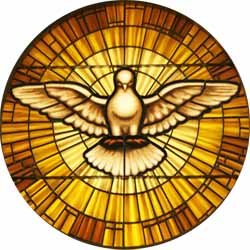 Holy Spirit Window in Cathedral Basilica of St. Francis of Assisi, Santa Fe, New Mexico. |
5 Those who live according to the sinful nature have their minds set on what that nature desires; but those who live in accordance with the Spirit have their minds set on what the Spirit desires. 6 The mind of sinful man is death, but the mind controlled by the Spirit is life and peace; 7 the sinful mind is hostile to God. It does not submit to God's law, nor can it do so. 8 Those controlled by the sinful nature cannot please God.
9 You, however, are controlled not by the sinful nature but by the Spirit, if the Spirit of God lives in you. And if anyone does not have the Spirit of Christ, he does not belong to Christ. 10 But if Christ is in you, your body is dead because of sin, yet your spirit is alive because of righteousness. 11 And if the Spirit of him who raised Jesus from the dead is living in you, he who raised Christ from the dead will also give life to your mortal bodies through his Spirit, who lives in you.
12 Therefore, brothers, we have an obligation -- but it is not to the sinful nature, to live according to it. 13 For if you live according to the sinful nature, you will die; but if by the Spirit you put to death the misdeeds of the body, you will live, 14 because those who are led by the Spirit of God are sons of God. 15 For you did not receive a spirit that makes you a slave again to fear, but you received the Spirit of sonship. And by him we cry, "Abba, Father." 16 The Spirit himself testifies with our spirit that we are God's children. 17 Now if we are children, then we are heirs -- heirs of God and co-heirs with Christ, if indeed we share in his sufferings in order that we may also share in his glory. (Romans 8:1-17)
| Big Concept 6. When we become Christians, the Holy Spirit comes to live in us in all his power -- really! When we turn our attention to him rather than to our own devices, he gives us the power we need to have victory over sin. |
Now we come to the answer to the Christian's struggle with sin -- the Holy Spirit. Several times already in this letter Paul has hinted that in the Spirit lie the solutions to our problem:
"... Circumcision is circumcision of the heart, by the Spirit, not by the written code." (2:29)
"... God has poured out his love into our hearts by the Holy Spirit, whom he has given us." (5:5)
"... We have been released from the law so that we serve in the new way of the Spirit, and not in the old way of the written code." (7:6)
In chapter 8, Paul uses the term "Spirit" with reference to the Holy Spirit 19 times in the scope of 39 verses. In today's lesson we learn how to live and walk in the Spirit. These words are not just tired Christian jargon. They contain the answer!
Paul had concluded chapter 7 in utter frustration:
24" What a wretched man I am! Who will rescue me from this body of death? 25 Thanks be to God -- through Jesus Christ our Lord! So then, I myself in my mind am a slave to God's law, but in the sinful nature a slave to the law of sin." (7:24-25)
Joined to Christ, Set Free from Sin and Death (8:1-4)
Now Paul makes a transition from the combination of the law and the flesh, to life in the Spirit of God. Something new has occurred:
1 "Therefore, there is now no condemnation for those who are in Christ Jesus, 2 because through Christ Jesus the law of the Spirit of life set me free from the law of sin and death." (8:1-2)
Notice the phrase "in Christ Jesus." This refers to us being joined to and united with Christ, the Second Adam, which we explored thoroughly in Romans 5 and 6. The Greek preposition is en, which here carries the meaning "under the control of, under the influence of, in close association with."143 Since we are now joined to Christ, his power now frees us from the power of sin and death.
Because we are now united with Christ, we are no longer under sentence of condemnation. "Condemnation" (katakrima) refers to "judicial pronouncement upon a guilty person, condemnation, punishment, penalty." Danker, Arndt, and Gingrich translate this phrase, "There is no death-sentence for those who are in Christ Jesus."144 Under the law, we were condemned in "this body of death" (7:24). But "in Christ Jesus," that is, joined to the Second Adam, we had died to the law (7:4, 6).
"For the law of the Spirit of life in Christ Jesus has set you free from the law of sin and of death." (8:2, NRSV)
We are under a different law145 now, "the law of the Spirit of life" (8:2). The phrase means the law that results in life, in contrast to the law that results in sin and death.
And we have been "set free" already -- Aorist tense, an action which took place at a particular time in the past. The verb eleutheroō means "to cause someone to be freed from domination, free, set free."146 The concept comes from Classical Greek, describing those who are politically free, citizens of free city-states. It also carries the idea of freedom from slavery.147
The Law, Weakened by the Flesh, Is Powerless to Save (8:3a)
Now Paul reiterates the theme he developed in chapter 7 of the weakness of the law.
"For what the law was powerless to do in that it was weakened by the sinful nature, God did by sending his own Son...." (8:3)
It's not the law that is to blame. The law is holy and righteous and good (7:12). The problem is with us, with the "sinful nature" (NIV) or "flesh" (KJV, NRSV, NASB) that has controlled humankind. The word "flesh" (KJV, NRSV, NASB) or "sinful man" (sarx) appears twice in verse 3 in the sense of the human body capable of sin. In verse 4, however, it takes on the special sense of "the unregenerate and sinful nature," as a motivational source in opposition to the Spirit of God, the rebellious human nature and human value systems that stand in opposition to God's value system.148 Flesh appears at least 13 times149 in the first 13 verses of Romans 8 as Paul contrasts the flesh with the Spirit.
Salvation through Christ Jesus (8:3b-4a)
We'll look at this in a few moments. But first, let's examine what Christ did on the cross:
3 "For what the law was powerless to do in that it was weakened150 by the sinful nature, God did by sending his own Son in the likeness of sinful man (sarx) to be a sin offering. And so he condemned sin in sinful man (sarx), 4 in order that the righteous requirements of the law might be fully met in us, who do not live according to the sinful nature (sarx) but according to the Spirit." (8:3-4)
Paul declares that Jesus came in the "likeness"151 of sinful man, rather than as sinful man himself. Jesus had a body like us and was capable of sin, but he didn't sin (2 Corinthians 5:21; 1 Peter 2:22; Hebrews 4:15; 7:26; 1 John 3:5) nor lose his essential divine nature (Philippians 2:6). But in taking on our sin on the cross, God did two things:
- Condemned mankind for sin with the sentence of death. Katakrinō means "pronounce a sentence on after determination of guilt."152God doesn't ignore the awfulness of our sin. Rather he takes it at full value and condemns it.
- Made his own Son a sin offering or atonement for our sin.153
Thus the just requirement of the law154 of punishment for sin is fully met.155 How can this be righteous? you ask. How is it right for one man to die for another?
The answer lies in the fact that Jesus the Messiah was not a mere man. He was the Son of God and anointed by God for this purpose. Remember Romans 5:12-21? As the First Adam was the head over the human race, Christ has been appointed by God to be the Second Adam, the head over all who put their faith in him.
So it is just. Jesus fully bore our own sins on the cross. And we are united with him in such a way that when he died on the cross, we died (6:2). That is the wonderful meaning of being "in Christ," united with Christ, included in Christ!
| Q1. (Romans 8:3-4) Why can't obedience to the law save
us? What is the weak link? What then does it take to save us? http://www.joyfulheart.com/forums/index.php?showtopic=815
|
Walking in the Spirit (8:4b)
Notice how we Christians are differentiated in a new way:
"...Who do not live according to the sinful nature (sarx) but according to the Spirit." (8: 4b)
"Live" (NIV) or "walk" (KJV, NRSV) is peripateō, "walk," here by figurative extension, it means "to conduct one's life, comport oneself, behave, live as a habit of conduct."156 We either conduct our lives in conformity to157 the way of the flesh or in conformity to the way of the Spirit. The first is the old life of Adam trapped by the flesh. The second is the new life of the Messiah, who by the Spirit, has "set us free from the law of sin and death" (8:1).
Just what does it mean to "walk in the Spirit"? We hear the phrase piously used, based on this verse and Galatians 5:16-18, but too often we don't really understand what it means. If you get nothing else from this study, seek to understand this -- what it means to walk by the Spirit!
What Controls and Directs Your Mind? (8:5-8)
Paul has introduced these two ways of living -- by the flesh or by the Spirit. Now he begins to spell out the implications and results of a life given over to the flesh or to the Spirit.
5 "For those who live according to the flesh set their minds on the things of the flesh, but those who live according to the Spirit set their minds on the things of the Spirit. 6 To set the mind on the flesh is death, but to set the mind on the Spirit is life and peace." (Romans 8:5-6, NRSV)
"Have their minds set on" is the verb phroneō, "to think," which means here, "to give careful consideration to something, to set one's mind on, be intent on," with the added connotation, 'to take someone's side, espouse someone's cause."158 Verse 6 uses a related word, phronēma, "the faculty of fixing one's mind on something, way of thinking, mind(-set)."159
How we live out our lives depends upon where we set our mind -- as well as what we fill our mind with. The more we expose our mind to the ungodly values around us, the more we weaken our essential mindset of following the Lord at all times and in all circumstances.
One of the dangers of the various media we're exposed to -- television, Internet, radio, news media, etc. -- is that many of them come with a strong bias toward values that are antithetical to Christ. What's more, many of these media purposely intend to sway us to their point of view. Hours of immersion in media that are unfriendly to Christ will tend to erode our mindset so that we approach life in the flesh, rather than in the Spirit. It is a very real danger we must be aware of and resist. Paul tells us:
"Their end is destruction; their god is the belly; and their glory is in their shame; their minds are set (phroneō) on earthly things." (Philippians 3:19, NRSV)
We can't live as hermits, isolating ourselves from our culture and the unbelievers around us. Nor are we to avoid friendships with unbelievers -- Jesus didn't. But we cannot befriend their point of view. We cannot shift our own values into "neutral" while we are around them. We must be who we are. We must be authentic Christians in their presence, rather than chameleons who blend into the prevailing environment and its values. We must live with integrity, with love for those around us. But we must also live with our minds firmly fixed on Christ and our hearts listening for the voice of the Spirit.
"Set your minds (phroneō) on things above, not on earthly things. For you died, and your life is now hidden with Christ in God." (Colossians 3:2-3)
There's an old African American spiritual based on Isaiah 26:3 (KJV) that underscores this conviction.
"Oh, I'm a-walkin' and a-talkin' with my mind
Stayed on Jesus..."
The Flesh Harbors Hostility toward God (8:7-8)
7 "For this reason the mind that is set on the flesh is hostile to God; it does not submit to God's law -- indeed it cannot, 8 and those who are in the flesh cannot please God." (8:7-8, NRSV)
We cannot follow the flesh without a certain "hostility" towards God. The person who has embraced a carnal lifestyle comes to resent those who live righteously. Some may admire Christian commitment, but for others the resentment at righteousness shows up in active persecution of committed Christians. The mindset is "hostile" (NIV, NRSV, NASB). The Greek noun is echthra, "enmity,"160 as indicated in the KJV translation. The Apostle James minces no words:
"Adulterers! Do you not know that friendship with the world is enmity with God? Therefore whoever wishes to be a friend of the world becomes an enemy of God." (James 4:4)
They were hostile to the Son of God; they will be hostile to us, as well. This hostility is because they refuse to submit themselves to God and his ways. "Submit" (NIV, NRSV) or "be subject" (KJV), "subject itself" (NASB), is the verb hupotassō, in the passive or perhaps middle (reflexive) voice, "subject oneself, be subjected or subordinated, obey."161
"For this reason the mind that is set on the flesh is hostile to God; it does not submit to God's law -- indeed it cannot." (8:7)
Verse 8 considers this from another angle -- pleasing God:
"... And those who are in the flesh cannot please God." (8:8)
"Please" is the verb areskō, "to give pleasure/satisfaction, please, accommodate."162 We are so caught up in pleasing ourselves, that we give little thought to actually bringing pleasure to God. Enoch pleased the Lord (Hebrews 11:5). David was a man after God's own heart (1 Samuel 13:14; Acts 13:22). Job's integrity brought great joy to his Creator (Job 1:8; 2:3). We can bring joy to God, also, if we will live by the Spirit rather than in the flesh (John 8:29; 1 Corinthians 7:32; Philippians 4:18; Colossians 1:10; 3:20; 1 Thessalonians 4:1; Hebrews 11:5-6; 13:21; 1 John 3:22).
The Contrast between a Mindset of Flesh vs. Spirit (8:5-8)
Just what does it mean to "set one's mind" on the flesh or on the Spirit? Perhaps the best passage to illuminate this is Paul's famous teaching in Galatians 5:16-25, which I will quote in full, since it is so helpful in this regard:
16 "So I say, live by the Spirit, and you will not gratify the desires of the sinful nature. 17 For the sinful nature desires what is contrary to the Spirit, and the Spirit what is contrary to the sinful nature. They are in conflict with each other, so that you do not do what you want. 18 But if you are led by the Spirit, you are not under law.
19 "The acts of the sinful nature ("flesh," sarx) are obvious: sexual immorality, impurity and debauchery; 20 idolatry and witchcraft; hatred, discord, jealousy, fits of rage, selfish ambition, dissensions, factions 21 and envy; drunkenness, orgies, and the like. I warn you, as I did before, that those who live like this will not inherit the kingdom of God.
22 "But the fruit of the Spirit is love, joy, peace, patience, kindness, goodness, faithfulness, 23 gentleness and self-control. Against such things there is no law. 24 Those who belong to Christ Jesus have crucified the sinful nature with its passions and desires. 25 Since we live by the Spirit, let us keep in step with the Spirit." (Galatians 5:16-25)
Paul is not talking here about morality so much as setting ourselves to follow the person of the Holy Spirit in our lives. Yes, this involves saying yes to righteousness and no to evil, but more than morality, it is following the Person of the Spirit. Listening to his voice, following his lead, avoiding what we know is not godly, embracing those traits which are godly. When we do this, our lives will bear fruit which gives evidence of the chief motivating force in our lives.
Remember, the Spirit is not primarily a morality or philosophy of life, He is the Third Person of the Trinity. Let us be very clear. This is more than a Christian mindset and worldview. This is a mind set on listening to, trusting in, and following the Spirit of Christ.
| Q2. (Romans 8:5-6) Exactly what does it mean to set
your mind on the things of the Spirit? How do you do this? How can you
recognize when the things you're setting your mind on relate to your
sinful nature? How much of this is deliberate? How much is habit? What
part does the Holy Spirit have it this? Or is this primarily right
living by force of will? http://www.joyfulheart.com/forums/index.php?showtopic=816
|
The Life-Giving Spirit Frees Us from Bondage to the Flesh (8:9)
9 "You, however, are controlled not by the sinful nature but by the Spirit, if the Spirit of God lives in you. And if anyone does not have the Spirit of Christ, he does not belong to Christ. " (8:9, NIV)
The NIV offers a fascinating and accurate translation of verse 9. Compare the NIV with the more literal NRSV:
"You, however, are controlled not by the sinful nature but by the Spirit, if the Spirit of God lives in you." (8:9a, NIV)
"But you are not in the flesh; you are in the Spirit, since163 the Spirit of God dwells in you." (8:9a, NRSV)
This preposition en, used so often in Paul's letters and John's writings for the phrase "in Christ," carries this idea of controlling influence: "under the control of, under the influence of, in close association with."164 The NIV translation of this verse brings out this connotation most powerfully.
How are we "in the Spirit"? Because the Spirit of God actually lives in us! Wow! The verb is oikeō, related to oikos, the word for "house." Oikeō means, "to reside in a place, live, dwell."165 We see this idea several times:
"... The Spirit of God lives (oikeō) in you." (8:9b)
"And if the Spirit of him who raised Jesus from the dead is living (oikeō) in you...." (8:11a)
"Don't you know that you yourselves are God's temple and that God's Spirit lives (oikeō) in you?" (1 Corinthians 3:16)
"... Guard it with the help of the Holy Spirit who lives (enoikeō) in us." (1 Timothy 1:14)
We've used these terms so much that it no longer registers. But pause for a moment to consider the difference that God works in us by living in us by his Spirit.
We are not controlled by the flesh! Paul argues insistently. We are controlled by the Spirit since the Spirit himself dwells in us as would a welcome guest in our home.
The Essential Spirit (8:9c)
Indeed, the presence of the Spirit living in us is the essential mark of a Christian:
"And if anyone does not have the Spirit of Christ, he does not belong to Christ." (8:9c)
This is a bold, categorical statement. It is either true or it is not true. There is no in between ground. It is also a sad declaration. What a tragedy for a person to go through life without belonging to Christ! The Holy Spirit is Christ's quintessential gift (Acts 2:38; 10:45), called "the heavenly gift" (Hebrews 6:4). With the Spirit we can plumb the depths of God, know the mind of Christ (1 Corinthians 2:10-16). Without the Holy Spirit we are "without hope and without God in the world" (Ephesians 2:13, NIV).
I want us to be aware, however, that sometimes Christians might say about another believer, "Jim hasn't received the Spirit." Or Mary isn't Spirit-filled." This is careless, sloppy, and dangerous terminology if it intended to describe genuine Christians. The Scripture is very clear that all genuine Christians have received the Spirit. Indeed, as verse 9c indicates: "If anyone does not have the Spirit of Christ, he does not belong to Christ" (8:9c).
Rather than use the term "receive the Spirit" or "Spirit-filled" without qualification, it might be better to say, "Jim hasn't yet received the gift of tongues" or "Mary hasn't had an experience of the overflowing of the Spirit."166
| Q3. (Romans 8:9) Is it possible to be a Christian
without the Holy Spirit residing in us? What is the difference (if any)
between the indwelling of the Spirit and the fullness of the Spirit? How
do we remain "full" of the Spirit? http://www.joyfulheart.com/forums/index.php?showtopic=817
|
The Spirit -- the Promise of Resurrection (8:10-11)
10 "But if Christ is in you, your body is dead because of sin, yet your spirit is alive because of righteousness. 11 And if the Spirit of him who raised Jesus from the dead is living in you, he who raised Christ from the dead will also give life to your mortal bodies through his Spirit, who lives in you." (8:10-11)
In verses 10 and 11 Paul is talking about mortality and immortality. "Your body is dead because of sin" (8:10a) no doubt refers to our mortality due to Adam's sin (Genesis 2:17; 3:19; Romans 5:12; Hebrews 9:27). But our spirit is another matter. "Yet your spirit is alive because of righteousness" (8:10b). Paul writes to the Corinthian church, "The first man Adam became a living being; the last Adam, a life-giving spirit" (1 Corinthians 15:45).
God raised Jesus from the dead, Paul continues. So God's Spirit will also raise our mortal bodies at the final resurrection. As Jesus said to Martha about her dead brother Lazarus:
"I am the resurrection and the life. He who believes in me will live, even though he dies; and whoever lives and believes in me will never die." (John 11:25-26)
I have heard some try to argue that the Spirit giving life to our mortal bodies is teaching healing by prayer. But while I believe in and have experienced healing by prayer, I don't think that is Paul's meaning here. The context is clearly the resurrection of our bodies.
The Spirit Sets Us Free from the Necessity to Sin (8:12)
Paul concludes this section with a bold statement:
"Therefore, brothers, we have an obligation -- but it is not to the sinful nature, to live according to it." (8:12)
I've heard thousands of people utter the timeless adage that everyone sins and has to sin. But Paul is saying the opposite here -- if we can hear it. The key is understanding the word "an obligation" (NIV), "under obligation" (NASB), "debtors" (KJV, NRSV). The Greek noun is opheiletēs, "debtor." The root idea is one who is a debtor in a monetary sense, and must pay back the debt or face rather serious consequences -- debtor's prison in Biblical times, foreclosure or seizure of property in our own. But Paul uses this word in a moral or social sense, "one under obligation, one liable for."167
In other words, he is saying, we don't have to live according to the flesh. We no longer have to sin. We have been set free by Christ from slavery to sin, or the compulsion of sin. The person living in the flesh is characterized by these words:
"I see in my members another law at war with the law of my mind, making me captive to the law of sin that dwells in my members." (Romans 7:23)
But this cry of the "wretched man" (7:24) is not the last word. Who will rescue me? he asks. The answer is the Spirit:
"For the law of the Spirit of life in Christ Jesus has set you free from the law of sin and of death." (8:2)
Do we sometimes fall into sin? Yes, sometimes, according to 1 John 1:8. But not because we have to or are compelled to! I know this runs counter to what many people teach. But the scripture teaches that we are not addicts to sin. Rather the death of Christ has set us free from sin's power over us. And his strong Spirit within us leads unto righteousness.
In our lives we've spent way too long pursuing the works of the flesh (Galatians 5:19-21). Now we are destined to pursue the things of the Spirit and reap its fruit: "Love, joy, peace, patience, kindness, goodness, faithfulness, gentleness, and self-control" (Galatians 5:22-23).
| Q4. (Romans 8:12) Do we have to sin? Are we compelled
to sin? Is it possible to live for two hours of wakefulness without
sinning? Four hours? One day? Two days? Where do we Christians get such
a defeatist attitude towards sin? From Scripture? http://www.joyfulheart.com/forums/index.php?showtopic=818
|
Putting to Death the Misdeeds of the Body (8:13)
13 For if you live according to the sinful nature, you will die; but if by the Spirit you put to death the misdeeds of the body, you will live, 14 because those who are led by the Spirit of God are sons of God." (8:13-14)
Now comes a famous passage about conquering sin. The KJV puts it this way:
"If ye through the Spirit do mortify the deeds of the body, ye shall live." (8:13b)
Exactly what does this consist of? Is this a life-long marathon of self-denial and harsh self-discipline? Yes and no. The answer revolves around two ideas: (1) "by the Spirit" and (2) "mortify."
"Mortify" (KJV) or "put to death" (NIV, NRSV) is thanatoō, "put to death, kill," then by extension, "to cause total cessation of an activity, put to death, extirpate."168
Here denominational and traditional styles affect how we battle sin. Different saints have approached this differently at various times in their lives, depending upon their spiritual maturity. While I know that this is an unfair caricature, let me outline two approaches:
- Fighting the tendency to sin directly by self-denial, force of will, and harsh physical discipline.
- Focusing instead on the life of the Spirit.
In Galatians, Paul words the same concept this way:
"Those who belong to Christ Jesus have crucified the sinful nature with its passions and desires. Since we live by the Spirit, let us keep in step with the Spirit." (Galatians 5:24-25)
In Ephesians Paul describes it as a simultaneous and deliberate taking off and putting on:
"You were taught, with regard to your former way of life, to put off your old self, which is being corrupted by its deceitful desires; to be made new in the attitude of your minds; and to put on the new self, created to be like God in true righteousness and holiness." (Ephesians 4:22-24)
Being Led by the Spirit (8:14)
Yes, the Christian life clearly involves repentance and self-denial. No denying that. But the key to living is more than force of will against the evil. It is learning to "walk in the Spirit" (Galatians 5:23) or be "led by the Spirit."
"Those who are led by the Spirit of God are sons of God." (8:14)
Both of these refer to spiritual life through a figurative use of words that relate physical movement -- walk, being led.
We looked at the word "walk" (peripateō) above under verse 4. "Lead" is agō, "to direct the movement of an object from one position to another." Here it refers to moral or spiritual leadership and is in the passive, meaning, "to be led, allow oneself to be led."169 Paul writes of being led by the Spirit again in Galatians 5:18.
While in other places Paul uses military and fighting images to refer to his battle with the devil and persecutors, here the images of walking and being led are gentle images of following -- following the One who invited his disciples many times in the Gospels to "Follow me...." (Matthew 4:19 and others).
A related idea which Paul introduced in Romans 6 is obedience:
"Don't you know that when you offer yourselves to someone to obey him as slaves, you are slaves to the one whom you obey -- whether you are slaves to sin, which leads to death, or to obedience, which leads to righteousness?" (6:16)
Walking with, following, being led, submitting, and obeying all involve an absence of resistance to Christ. Of laying down our arms and ending our rebellion. They all involve acknowledging that the tour guide is truly in charge. Our task is not to strike out on our own, but to allow ourselves to be led. Over time, being led leads to a trusting, personal relationship with the Guide. We get used to hearing his voice and recognizing when we're straying off the path. If living the Christian life can best be compared to allowing ourselves to be led by the Spirit, then we can do this!
| Q5. (Romans 8:13-14) What does it mean to "mortify" or
"put to death" the deeds of the body by the Spirit? What would it look
like to watch a person do this? What does it mean to be "led" by the
Spirit? What does this look like in actual practice? How do "putting to
death" and being "led" by the Spirit fit together? How much of this is
the Spirit and how much is us? http://www.joyfulheart.com/forums/index.php?showtopic=819
|
Children and Heirs Who Cry by the Spirit, "Abba, Father"
This passage concludes with a wonderful reflection on this relationship with God brought about by the Spirit:
15 "For you did not receive a spirit that makes you a slave again to fear, but you received the Spirit of sonship. And by him we cry, "Abba, Father." 16 The Spirit himself testifies with our spirit that we are God's children. 17 Now if we are children, then we are heirs -- heirs of God and co-heirs with Christ, if indeed we share in his sufferings in order that we may also share in his glory." (Romans 8:15-17)
We'll consider the idea of adoption and sonship more deeply in the next lesson. But for now, consider the wonderful Holy Spirit inside us that prompts our calling out to God: "Abba, Father," even "Dad." The word here is not the formal Greek word for "father," but an Aramaic word, "Abba," used in the intimate family setting to speak to one's dad.170 It is this love for God and the trust in him that the Spirit prompts in us. The Spirit can be felt in us as we call out to God.
The Testimony of the Spirit (8:16)
Now we come to the Holy Spirit's direct influence on our lives to assure us of our salvation.
"The Spirit himself testifies with our spirit that we are God's children." (8:16)
The verb is summartureō, "to bear witness with," then "to provide supporting evidence by testifying, confirm, support by testimony,"171 as a legal witness to the facts. Paul uses the word twice elsewhere in Romans with regard to the confirmatory witness of the conscience (2:15; 9:1). In some way the Holy Spirit acts upon our own personal spirit to cause it to cry out as would a child to its father, "Abba."
This verse provides the basis for the Doctrine of the Witness of the Spirit or the Internal Testimony of the Spirit, that God witnesses directly to the heart of the believer by giving an assurance that the believer is in fact saved, regenerate, and a child of God (1 Corinthians 2:1-6; John 16:13-15; 1 Thessalonians 1:5; 1 John 2:20, 27; 4:13).
Calvin sees this assurance as part of the essence of faith and one of the essentials of salvation, "a conviction which asks not for reasons ... the conviction which revelation from heaven alone can produce."172 John Wesley, whose "heart was strangely warmed" at his conversion, defined it this way:
"By the testimony of the Spirit, I mean, an inward impression on the soul, whereby the Spirit of God immediately and directly witnesses to my spirit, that I am a child of God; that Jesus Christ hath loved me, and given himself for me; that all my sins are blotted out, and I, even I, am reconciled to God."173
Fanny Crosby wrote about this in her much beloved song "Blessed Assurance" based on verses 16-17:
"Blessed assurance, Jesus is mine!
O what a foretaste of glory divine!
Heir of salvation, purchase of God,
Born of His Spirit, washed in His blood."174
Dear friend, it is quite possible that you have never experienced this kind of "blessed assurance." Distorted doctrine can rob us. Some branches of Christianity teach a kind of rationalistic faith that has little to do with personal experience. In other cases a legalistic approach to Christianity and a failure to comprehend the wonderful grace of God, the free gift of forgiveness, can keep us tortured with guilt and insecurity, and bereft of assurance.
God desires to put in your heart an assurance of salvation through this witness of the Spirit. Yes, this is "mystical," if you will, but it is clearly taught in Scripture here and elsewhere, and is for you.
If you have this assurance of salvation, praise God! If you don't, seek God earnestly to find this place of rest in God, for it is your birthright. And as you seek God you may even enter into a wonderful salvation and walk with the Spirit that you've never known before.
| Q6. (Romans 8:15-16) How does the Holy Spirit inspire
us to pray "Abba, Father"? What is the significance of us referring to
God as our Dad? What happens in our lives if we don't have some kind of
personal assurance of our salvation? How do we receive this kind of
personal assurance? http://www.joyfulheart.com/forums/index.php?showtopic=820
|
 Available in paperback, Kindle, and PDF book formats. |
The Christian faith is a God adventure. Jesus has given us the Holy Spirit to empower us to combat sin (Galatians 5:16-18), to reveal to us the mind of Christ (1 Corinthians 2:9-16), to release in us spiritual gifts to build up the body of Christ (1 Corinthians 12:1-11), to teach us and remind us of Jesus' teaching (John 14:26), to guide us into all truth (John 16:13), to lead us on our spiritual journey day by day (Romans 8:14), and much, much more.
Dear friend, step out and walk this journey with full exuberance and confidence in your Guide. You never know what the path will bring. All you know is that some day it will lead you home.
Prayer
Father, thank you for the Holy Spirit in our lives. I feel like we have just scratched the surface in understanding how to walk by the Spirit, to hear the Spirit, to live in the power of the Spirit. Teach us more, Father. Guide us so that we don't miss out on this wonderful portion of our inheritance in this life. Thank you for testifying within us that you love us and call us your children. In Jesus' name we glorify you and celebrate your love. Amen.
Big Concept
When we become Christians, the Holy Spirit comes to live in us in all his power -- really! When we turn our attention to him rather than to our own devices, he gives us the power we need to have victory over sin.
Key Verses
"Therefore, there is now no condemnation for those who are in Christ Jesus, because through Christ Jesus the law of the Spirit of life set me free from the law of sin and death." (Romans 8:1-2)
"You, however, are controlled not by the sinful nature but by the Spirit, if the Spirit of God lives in you. And if anyone does not have the Spirit of Christ, he does not belong to Christ." (Romans 8:9)
"Those who are led by the Spirit of God are sons of God." (Romans 8:14)
"For you did not receive a spirit that makes you a slave again to fear, but you received the Spirit of sonship. And by him we cry, 'Abba, Father.' The Spirit himself testifies with our spirit that we are God's children." (Romans 8:15-16)
"Now if we are children, then we are heirs -- heirs of God and co-heirs with Christ, if indeed we share in his sufferings in order that we may also share in his glory." (Romans 8:17)
References
Copyright © 2026, Ralph F. Wilson. <pastor joyfulheart.com> All rights reserved. A single copy of this article is free. Do not put this on a website. See legal, copyright, and reprint information.