


|
Old Testament
New Testament
Gospels
Acts
Paul's Letters
General Letters
Revelation
Topical Studies
Beginning the Journey (for new Christians). en Español

|
Old Testament
New Testament
Gospels
Acts
Paul's Letters
General Letters
Revelation
Topical Studies

|
Home
Bible Studies
Articles
Books
Podcasts
Search
Menu
Donate
About Us
Contact Us
FAQ
Sitemap

Free
E-mail Bible Study
 Experiencing the Psalms
Home | Bible Studies | Articles | Books | Podcasts | Search | Menu | Donate | About Us | FAQ | Contact Us
|
|
Author
Paul's Letter to the Romans begins:
1 "Paul, a servant of Christ Jesus, called to be an apostle and set apart for the gospel of God ...6 To all in Rome who are loved by God and called to be saints..." (Romans 1:1, 6a)There has never been any serious dispute that this letter is a genuine epistle from the hand of Paul the Apostle.
Rome in the Mid First Century
To understand Paul's letter, however, we need to consider his readers.
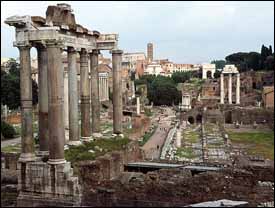
Rome was the richest and most cosmopolitan city in Paul's
day, the center of a huge empire that funneled riches -- and slaves -- to the
capital city. There were perhaps 1 million people, about a third of them
slaves.
In Paul's day, Rome was ruled by several emperors:
|
Tiberius |
14-37 AD |
|
Gaius ("Caligula") |
37-41 AD |
|
Claudius |
41-54 AD |
|
Nero |
54-68 AD |
Religion in Rome
The state religion involved ritual worship of the various Roman gods, with temples dedicated in honor of various deities scattered over the entire city. Unlike Christianity, Roman religion knew nothing of a personal relationship with the gods. Rather, if you followed the rituals correctly, a contract would be made that obtained the 'peace of the gods.'
Jews were originally brought to Rome as slaves. In the civil war that began in 49 BC, Jews in Rome and throughout the Mediterranean supported Julius Caesar against Pompey. As a result, Judaism was granted the status of a legal religion by the victor Julius Caesar and later Augustus. The Jews had become quite influential by Paul's time and Rome had a significant Jewish community -- a population of at least 40,000 during the first century AD. Historians know the names of at least ten synagogues in Rome.1
Christianity in Rome
Though we have no records, Christianity probably came to Rome early. Luke records on the Day of Pentecost the presence of "visitors from Rome (both Jews and converts to Judaism)"(Acts 2:10-11), who probably carried their new faith home with them. Christianity began in Rome as a sect of Judaism.
The Christian message eventually caused considerable uproar within the Jewish community. Ancient Roman historian Suetonius records, "Since the Jews constantly made disturbances at the instigation of Chrestus,2 [Claudius] expelled them from Rome."3 We read that in Corinth, Paul "met a Jew named Aquila, a native of Pontus, who had recently come from Italy with his wife Priscilla, because Claudius had ordered all the Jews to leave Rome" (Acts 18:1-2). But the expulsion was probably only temporary. This took place about 49 AD, so the church in Rome seems to have been established fairly early.4
Though the Roman church in Paul's time was largely Gentile (Romans 1:13-15; 11:13), it probably retained an ethnically Jewish presence. Paul's Letter to the Romans deals clearly with God's relationship to both Gentiles and Jews. In our passage, for example, Paul takes pains to explain the role of the law, an obvious issue in a church containing Christians of both Jewish and Gentile backgrounds.
Chronology of Paul's Apostolic Career
Though the exact dates elude us, here is an approximate chronology of Paul's apostolic career, give or take a year or two. Precision in such a chronology is impossible, of course, but it doesn't really affect the message. At least it gives you a mental overview in which to place this letter.
|
Dates only |
|
|
1-10 AD |
Born to a religiously observant Jewish family in Tarsus in Cilicia |
|
20-30 |
Studies under Rabbi Gamaliel in Jerusalem |
|
27 |
Crucifixion of Christ |
|
29-34 |
Persecutes of the Church |
|
34 |
Converted at Damascus, |
|
34-37 |
Spends time in the Arabian desert |
|
37 |
First Jerusalem Visit, meets Peter, James, and Barnabas |
|
37-43 |
Stays in his hometown of Tarsus |
|
43 |
Co-ministry with Barnabas in Antioch |
|
47-48 |
First Missionary Journey |
|
48 |
Second Visit to Jerusalem, Famine Relief |
|
48-50 |
Second Missionary Journey, Macedonia |
|
50-51 |
Ministry in Corinth, 18 months |
|
53-54 |
Ministry in Ephesus, 2 years |
|
55-56 |
Wrote Letter to the Romans |
|
56-57 |
Journey to Jerusalem with collection |
|
57-59 |
Arrest in Jerusalem, imprisoned in Caesarea 2 years. |
|
59-60 |
Trial before Festus, voyage to Rome |
|
60-62 |
Imprisoned in Rome, 2 years. Execution.5 |
Paul seems to have written Romans from Corinth during the three months he spent in Greece before continuing on to Jerusalem (Acts 20:1-2).
Purpose of Paul's Letter to the Romans
Paul seems to have written this letter with several purposes in mind:
- To establish a support base. Because Paul was planning to continue his missionary effort to Spain, he needed a church in the western Mediterranean that he could use as a jumping off point. He wrote: "I plan to do so when I go to Spain. I hope to visit you while passing through and to have you assist me on my journey there, after I have enjoyed your company for a while" (Romans 15:24, see also verse 28).
- To heal divisions within the Roman church. The latter part of the letter especially seems to be pastoral in nature (14:1-15:6), seeking to bring together factions within the body. Though there was already a maturing church in Rome (15:14), Paul felt he could help them in their struggles.
- To clarify his teaching of the Gospel. Paul perceived that his understanding of the Gospel was being maligned, so he felt a need to clarify and expound his teaching. Our passage, Romans 5-8 is part of this clear explanation of the Gospel and of the Christian life.6.
Why Study Romans 5-8?
So why study four chapters from the middle of this book? Doesn't that separate us from the overall context? Yes, to a degree this kind of study could skew us in a wrong direction if we're not careful. But the same argument could be made for studying any passage or book of the Bible without reading the whole Book. We'll do our best to see its truths in the context of the rest of the scripture.
From a practical standpoint, however, an in-depth study of the entire Letter to the Romans is a daunting task that would take many months.
So we've focused on four chapters that may well change your life. Disciples throughout the centuries have found that these core chapters 5 through 8 provide tremendous help in learning to live the Christian life.
Why Study Romans 5 along with Chapters 6 through 8?
Paul's instruction about living the Christian life actually starts in chapter 6. Is it really necessary to study chapter 5 along with chapters 6 through 8? Yes!
Actually, when I began to prepare this study, I did plan to study only chapters 6-8. What I discovered was that Paul's teaching on having died with Christ in 6:1-11 is so different from our normal Western mindset, that it is impossible to grasp without first understanding Romans 5:12-21 and its concept of the headship of Christ. What's more, Romans 5:1-11 is a wonderful introduction to the grace of God and our great salvation. So grouping together chapters 5 to 8 seems to capture the core of Paul's teaching on the Christian life. Indeed, these chapters are among the most beloved chapters in the New Testament.
What Did Paul Say in Chapters 1-4?
When you jump into a book at chapter 5, you know you've missed the introduction. So let me catch you up to date. Here is a synopsis of each of the chapters so far:
Chapter 1 |
God is rightly angry at men and women who not only disbelieve in their Creator, but suppress the truth about him, and practice all kinds of perverted acts. They are subject to eternal death. |
Chapter 2 |
And there's no excuse. It's not knowing the law, but obeying it that counts, so both Jew and Gentile are on an equal footing as sinners before God. |
Chapter 3 |
The fact is that all have sinned, Jew and Gentile alike, and need rescue. Praise God, Jesus Christ is our atoning sacrifice, and through him we are made right with God. This righteousness comes through faith, apart from law. |
Chapter 4 |
The key example is Abraham, who believed God and his faith "was credited to him as righteousness." |
How to Study Romans
As you prepare to study Romans, I encourage you to read the entire letter through in only one or two sittings. Then concentrate on our passage Romans 5-8. Read and re-read it time and again. In a notebook, write down what you are seeing as you seek to make this passage your own. Don't rely on my notes to explain it to you; study it on your own. Ask questions that occur to you and write them down. Then read looking to find the answers. In this way you'll do more than take a course. You'll really learn the message of Romans 5 through 8 for yourself.
Participate in the Online Forum
This book began as an online Bible study, so you'll be able to take advantage of the interactive aspects of that study by reading others' answers to questions in the online Forum and posting your own, if you like. The URL to the Forum will be found right under each question.
If you're new to these online Bible studies, you'll need to register at the Forum. To keep from getting confused, why don't you Read the Instructions for the Forum. It will explain exactly how to register (www.joyfulheart.com/forums/instructions.htm). There are important Guidelines for sharing on the Forum (www.jesuswalk.com/admin/pu_forum_guidelines.htm). In short:
- No denomination or religion bashing.
- Practice a loving spirit.
- Comments may be removed in the future
- Stay on topic.
- Be discrete. Don't give out your e-mail address or share things too personal.
 Available in paperback, Kindle, and PDF book formats. |
Once you've registered for the Forum you can introduce yourself to others in this study.
Whether or not you decide to participate online, do take time to answer the discussion questions in each chapter. They're designed to stimulate your thinking to help you grasp the most important points in each lesson.
The object of Bible study, after all, is not intellectual curiosity, but change. Our goal is to learn God's word through his Apostle Paul, so that our lives might be transformed and we might "be conformed to the likeness of his Son."
References
Copyright © 2026, Ralph F. Wilson. <pastor joyfulheart.com> All rights reserved. A single copy of this article is free. Do not put this on a website. See legal, copyright, and reprint information.