


|
Old Testament
New Testament
Gospels
Acts
Paul's Letters
General Letters
Revelation
Topical Studies
Beginning the Journey (for new Christians). en Español

|
Old Testament
New Testament
Gospels
Acts
Paul's Letters
General Letters
Revelation
Topical Studies

|
Home
Bible Studies
Articles
Books
Podcasts
Search
Menu
Donate
About Us
Contact Us
FAQ
Sitemap


9. Conquering the Transjordan and Moses' Death (Numbers 20-27; Deuteronomy 32, 34)
by Dr. Ralph F. Wilson| Audio (25:20)
Free
E-mail Bible Study
 Experiencing the Psalms
Home | Bible Studies | Articles | Books | Podcasts | Search | Menu | Donate | About Us | FAQ | Contact Us
|
|
A. Moses and Aaron Displease the Lord (Numbers 20)
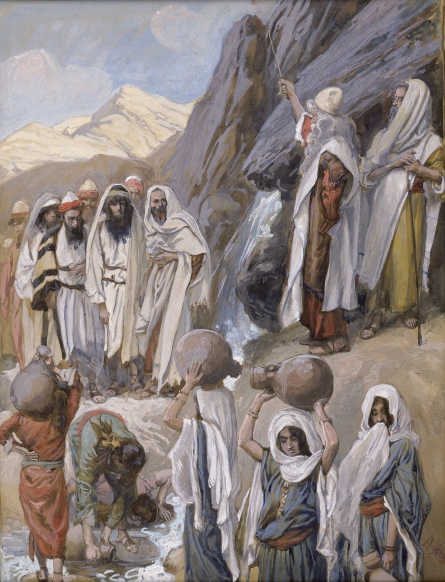
Moses Strikes the Rock at Kadesh and Is Disciplined (Numbers 20:1-13)
Before at Kadesh, there had been plenty of water due to the strong springs there.2 But this time when they arrive, the water has dried up. This precipitates a now-familiar crisis, this time with the children of those who had crossed the Red Sea some 40 years previously.
"2 Now there was no water for the community, and the people gathered in opposition to Moses and Aaron. 3 They quarreled with Moses and said, 'If only we had died when our brothers fell dead before the LORD! 4 Why did you bring the LORD's community into this desert, that we and our livestock should die here? 5 Why did you bring us up out of Egypt to this terrible place? It has no grain or figs, grapevines or pomegranates. And there is no water to drink!'" (Numbers 20:2-5)
The glory of the Lord appears to Moses and Aaron, a sign of the Lord's anger as before (Numbers 12:5; 14:10; 16:19, 42). The Lord gives Moses very clear instructions.
"8 Take the staff, and you and your brother Aaron gather the assembly together. Speak to that rock before their eyes and it will pour out its water." (Numbers 20:8a)
Early in the Exodus, Moses had brought water from a rock before by striking it in the presence of the elders (Exodus 17:6). But this time, the Lord tells him to speak to it, rod in hand. Normally, Moses is careful to do exactly what the Lord tells him, but this time he is angry at the people gathered to watch.
"10 He and Aaron gathered the assembly together in front of the rock and Moses said to them, 'Listen, you rebels, must we bring you water out of this rock?'11 Then Moses raised his arm and struck the rock twice with his staff. Water gushed out, and the community and their livestock drank." (Numbers 20:10-11)
The Lord doesn't shame Moses and Aaron before the people; he honors their leadership publicly. Privately, however, the Lord rebukes them:
"Because you did not trust in me enough to honor me as holy3 in the sight of the Israelites, you will not bring this community into the land I give them." (Numbers 20:12)
Later in Numbers we read:
"Both of you rebelled against (mārâ) my command at the waters of Meribah." (Numbers 20:24)
"Both of you disobeyed (mārâ) my command to honor me as holy before their eyes." (Numbers 27:14)
"Disobeyed" (NIV), "rebelled" (KJV, NRSV) is mārâ, "be rebellious against, disobedient towards."4 The psalmist wrote about this incident, as well:
"By the waters of Meribah they angered
the LORD,
and trouble came to Moses because of them;
for they rebelled against the Spirit of God,
and rash words5 came from Moses' lips." (Psalm 106:32-33)
What did Moses and Aaron do so wrong that they were denied entrance to the Promised Land? The nature of Moses' and Aaron's sin is two-fold:
- Disobedience. They disobeyed God's instructions to speak to the rock. Instead they struck the rock and spoke to the people, as though they possessed the power to produce water from the rock.
- Not sanctifying God. When Moses and Aaron used the word "we" (Numbers 20:10), rather than giving God glory by declaring God's act of power, it had the effect of compromising divine holiness, which was an unpardonable act of insubordination.6
How did this disobedience count as unbelief? Certainly, Moses' striking the rock was an act of faith in God's power on his behalf, even though it was arrogant. Nevertheless, while obedience shows faith and trust, disobedience shows disregard for God's word and is an act of rebellion, of breaking faith with God. We are so quick to justify our own rebellion against God's commands that it is hard to understand Moses' sins.
The leadership lesson is that if we are to lead God's people, we must learn to obey exactly what God says -- no more and no less. We are not independent leaders, but lead on God's behalf. When we err, we must immediately repent and seek God's forgiveness and mercy -- something that we don't read that Moses or Aaron did. When we leaders walk in arrogance, we are on shaky ground with God!
|
Q1. (Numbers 20:1-13) What did God tell
Moses to do to bring water out of the rock? What did Moses actually
do? In what way did he sin? What emotions and attitudes were behind
his sin, do you think? What must leaders do when they sin in these
ways?
|
B. Conflict with the People of the Land (Numbers 20-25)
Conflicts with Edom and Arad (Numbers 20:14-21:3)
Now it is time to leave Kadesh, which has served as a base for the Israelites for many years in their desert wanderings. They are now moving to position themselves to enter the Promised Land. But the kingdom of Edom lies in their path along the King's Highway, the main north-south road east of the Dead Sea and the Jordan River.
"14 Moses sent messengers from Kadesh to the king of Edom, saying: 'This is what your brother Israel says: You know about all the hardships that have come upon us.... Now we are here at Kadesh, a town on the edge of your territory. 17 Please let us pass through your country. We will not go through any field or vineyard, or drink water from any well. We will travel along the king's highway and not turn to the right or to the left until we have passed through your territory." (Numbers 20:14-17)
But the king of Edom refuses them permission and sends his army to challenge them. Moses decides it prudent not to take this route. Nevertheless, the Israelites leave Kadesh and move to Mount Hor,7 very close to Edom. Here Aaron dies and Eleazar his son takes his place as high priest (Numbers 20:22-29).
From Mount Hor, the Israelites continue east where they are attacked by the king of Arad, an ancient Canaanite city identified with Tell Arad. The Israelites destroy Arad's army and their towns (Numbers 21:1-3).
Vipers Attack the Israelites (Numbers 21:4-9)
The journey continues as the Israelites swing to the south to avoid entering Edomite territory. But as they encounter difficulties, they begin to complain, sounding just like their fathers before them. The problem is familiar: lack of water and manna, which they've grown to hate (as in Numbers 11:6):
"4b But the people grew impatient8 on the way; 5 they spoke against God and against Moses, and said, 'Why have you brought us up out of Egypt to die in the desert? There is no bread! There is no water! And we detest this miserable9 food!'" (Numbers 21:4b-5)
|
|
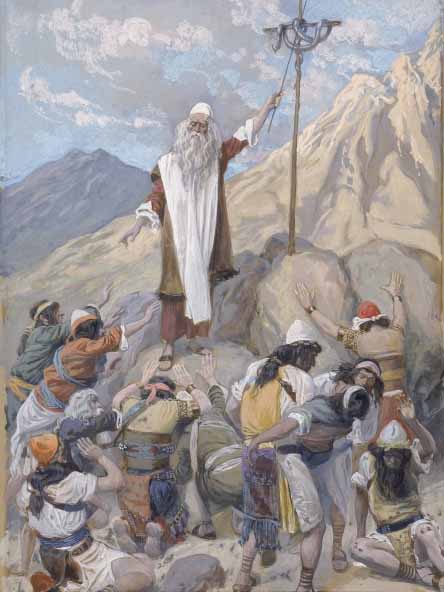
This time, however, they complain openly about God and criticize his provision of food, rather than blame their problems on Moses only. Moses doesn't answer them. But God punishes their rebelliousness with poisonous snakes that strike terror into the multitude.
"6 Then the LORD sent venomous snakes10 among them; they bit the people and many Israelites died. 7 The people came to Moses and said, 'We sinned when we spoke against the LORD and against you. Pray that the LORD will take the snakes away from us.' So Moses prayed for the people." (Numbers 21:6-7)
The people complain against both Moses and the Lord, but when they're in trouble, they confess their sins and they turn to Moses to intercede with the Lord on their behalf.11 God gives Moses a curious instruction to stimulate the people's faith.12
"8 The LORD said to Moses, 'Make a snake and put it up on a pole; anyone who is bitten can look at it and live.'9 So Moses made a bronze snake and put it up on a pole.13 Then when anyone was bitten by a snake and looked at the bronze snake, he lived. (Numbers 21:8-9)
Keil comments,
"The Lord helped them, in such a way, however, that the reception of help was made to depend on the faith of the people.... Whoever then of the persons bitten by the poisonous serpents looked at the brazen serpent with faith in the promise of God, lived, that is, recovered from the serpent's bite.... It was ... intended as a figurative representation of the poisonous serpents, rendered harmless by the mercy of God."14
Jesus compared the snake lifted up in the wilderness to himself being lifted up on the cross -- that those who look on him with faith live.
"Just as Moses lifted up the snake in the desert, so the Son of Man must be lifted up, that everyone who believes in him may have eternal life." (John 3:14-15)
|
Q2. (Numbers 21:4-9; John 3:14-15) What
precipitated the plague of snakes? Is being impatient with God's
provision a sin? Why or why not? What are the points of comparison
between the bronze snake in the desert and Christ on the cross?
|
Conquering Kingdoms East of the Jordan (Numbers 21:10-35)
|
|
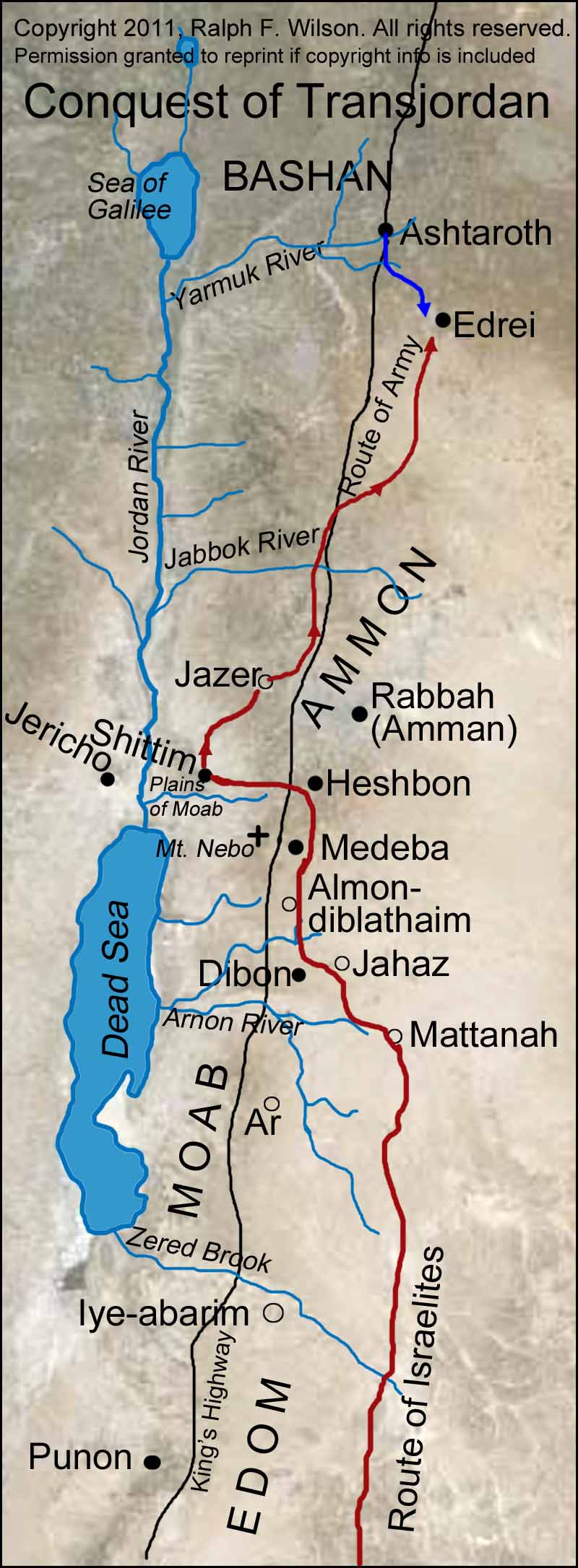
Now the Israelites travelled east of the King's Highway in order to avoid a conflict with Edom, then headed north into Moabite territory. Moses sends messengers to Sihon, king of the Amorites, to assure him of their peaceful intentions, but Sihon musters his army against Israel and fights them at Jahez. Israel is victorious.
"24 Israel, however, put him to the sword and took over his land from the Arnon to the Jabbok.... 25 Israel captured all the cities of the Amorites and occupied them, including Heshbon and all its surrounding settlements. 26 Heshbon was the city of Sihon king of the Amorites, who had fought against the former king of Moab and had taken from him all his land as far as the Arnon.... 31 So Israel settled in the land of the Amorites." (Numbers 20:24-25, 31)
Next the Israelite army travels north towards Bashan, the present-day Golan Heights area, east of the Sea of Galilee. Og, king of Bashan, meets them for battle at Edrei. They, too, are defeated, leaving the Israelites in control of all the land north of the Arnon River, east of the Jordan. The Israelites now camp at the plains of Moab along the Jordan River, across from Jericho.
Balak Hires Balaam to Curse Israel (Numbers 22-24)
The Moabites who live east of the Dead Sea are terrified of such a huge number of people. They say to their Midianite allies,
"This horde is going to lick up everything around us, as an ox licks up the grass of the field." (Numbers 22:4)
To curse the Israelites, Balak, king of Moab, summons a prophet-for-hire named Balaam, who lives near the Euphrates River. Balaam hears from God, from Yahweh, though he is not obedient from the heart. Though God has told him that he must not curse them, eventually he goes to Moab to see if he can earn a handsome fee.
As he goes, Balaam's ass sees the angel of the Lord standing in the road with a drawn sword, but Balaam is so spiritually blind that he cannot see it himself, and beats his donkey. Finally that ass speaks to him; only then can Balaam see the danger.
When he finally arrives in Moab, Balak takes him to various vista points where he can see the Israelite camp and curse them. But each time, instead of cursing, Balaam blesses the Israelites. Balaam finally returns home.
Israelite Men Sin with Moabite Women (Numbers 25)
|
|
Though he would not curse Israel, however, Balaam's counsel brings its own kind of curse to God's people. We read in the Book of Revelation:
"You have people there who hold to the teaching of Balaam, who taught Balak to entice the Israelites to sin by eating food sacrificed to idols and by committing sexual immorality." (Revelation 2:14)
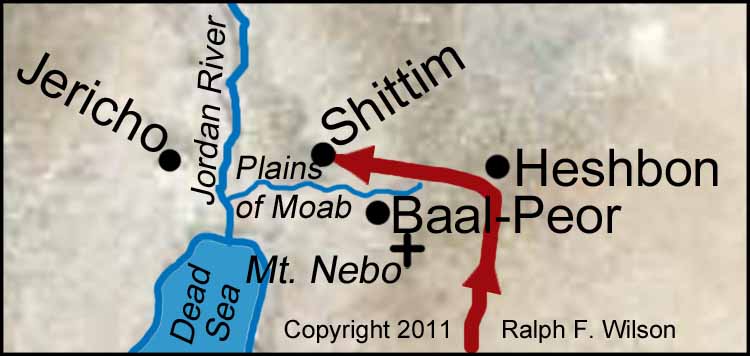
Peor is a town near to Shittim on the plain of Moab where the Israelites are encamped.
1 While Israel was staying in Shittim, the men began to indulge in sexual immorality with Moabite women, 2 who invited them to the sacrifices to their gods. The people ate and bowed down before these gods. 3 So Israel joined in worshiping the Baal of Peor. And the LORD's anger burned against them." (Numbers 25:1-3)
A plague from the Lord strikes Israel. But the sinners act so brazenly that an Israelite brings a Midianite woman into his tent in full sight of Moses.
"7 When Phinehas son of Eleazar, the son of Aaron, the priest, saw this, he left the assembly, took a spear in his hand 8 and followed the Israelite into the tent. He drove the spear through both of them -- through the Israelite and into the woman's body. Then the plague against the Israelites was stopped; 9 but those who died in the plague numbered 24,000." (Numbers 25:7-9)
Phinehas is rewarded for his zeal to honor the Lord by "a covenant of a lasting priesthood" (Numbers 25:13). Psalm 106 commemorates this act to defend Yahweh's honor.
"They yoked themselves to the Baal of
Peor
and ate sacrifices offered to lifeless gods;
They provoked the LORD to anger by their wicked deeds,
and a plague broke out among them.
But Phinehas stood up and intervened,
and the plague was checked.
This was credited to him as righteousness
for endless generations to come." (Psalm 106:28-30)
Israel then goes to war against the Midianites who "deceived you in the affair of Peor" (Numbers 25:18).
|
Q3. (Numbers 25; Revelation 2:14) Though
Balaam wouldn't prophesy evil against Israel, he was willing to
counsel the Moabites how to hurt Israel. How did Balaam's counsel
lead Israel into sin? Why was Aaron's grandson Phinheas so honored
for his action? What was his reward? Why are we so often zealous to
defend the rights of God's enemies and so slow to defend God's
honor?
|
The Census (Numbers 26)
Now Moses and Eleazar, Aaron's son and successor as high priest, take a census of the nation (except for the Levites), counting 601,730 males over 20. The Scripture records the evaluation.
"64 Not one of them was among those counted by Moses and Aaron the priest when they counted the Israelites in the Desert of Sinai. 65 For the LORD had told those Israelites they would surely die in the desert, and not one of them was left except Caleb son of Jephunneh and Joshua son of Nun." (Numbers 26:64-65)
God's prophecy at Kadesh has been fulfilled. Now the people are ready to enter the Promised Land -- all except Moses. His final acts are to commission his successor and to remind the people about the Covenant.
C. Succession (Numbers 27; Deuteronomy 32, 34)
Commissioning of Joshua (Numbers 27:12-18)
Moses says to the Lord,
16 "May the LORD, the God of the spirits of all mankind, appoint a man over this community 17 to go out and come in before them, one who will lead them out and bring them in, so the LORD's people will not be like sheep without a shepherd." (Numbers 27:16)
So the Lord directs him to publicly lay his hands on and commission his longtime aide, Joshua, "a man in whom is the Spirit" (Numbers 27:18).
The Song of Moses, Blessings, and Death (Deuteronomy 32)
Now Moses recounts before the assembled people the Covenant and its laws, which comprises most of the book of Deuteronomy. Finally, he recites for them a song, the Song of Moses, recounting their past and future in measured Hebrew poetic form. It is a long psalm, but here are a few excerpts, beginning with praise of Yahweh:
"3 I will proclaim the name of
the LORD.
Oh, praise the greatness of our God!
4 He is the Rock, his works are perfect,
and all his ways are just.
A faithful God who does no wrong,
upright and just is he." (Deuteronomy 32:3-4)
Then Moses recounts Israel's apostasy.
"5 They have acted corruptly
toward him;
to their shame they are no longer his children,
but a warped and crooked generation.
6 Is this the way you repay the LORD,
O foolish and unwise people?
Is he not your Father, your Creator,
who made you and formed you?" (32:5-6)
He reminds them of his tender care for Israel.
"In a desert land he found him,
in a barren and howling waste.
He shielded him and cared for him;
he guarded him as the apple of his eye,
like an eagle that stirs up its nest
and hovers over its young,
that spreads its wings to catch them
and carries them on its pinions.
The LORD alone led him;
no foreign god was with him." (32:10-12)
Now he warns them prophetically of future apostasy.
"Jeshurun grew fat and kicked;
filled with food, he became heavy and sleek.
He abandoned the God who made him
and rejected the Rock his Savior.
They made him jealous with their foreign gods
and angered him with their detestable idols.
They sacrificed to demons, which are not God--
gods they had not known,
gods that recently appeared,
gods your fathers did not fear." (32:15-17)
After a sad time of turning to other gods, the Lord will again take them up and fight against their enemies.
"The LORD will judge his people
and have compassion on his servants
when he sees their strength is gone
and no one is left, slave or free." (32:36)
"See now that I myself am He!
There is no god besides me.
I put to death and I bring to life,
I have wounded and I will heal,
and no one can deliver out of my hand." (32:39)
"Rejoice, O nations, with his people,
for he will avenge the blood of his servants;
he will take vengeance on his enemies
and make atonement for his land and people." (32:43)
Jesus Christ, a descendent of the tribe of Judah, is the one whom God sends to make this atonement!
Moses concludes with a charge to the people.
"Take to heart all the words I have solemnly declared to you this day, so that you may command your children to obey carefully all the words of this law. 47 They are not just idle words for you -- they are your life. By them you will live long in the land you are crossing the Jordan to possess." (32:46-48)
The Death of Moses
When Moses' speech and song before the people were completed -- on the same day -- God tells him how he will die on Mount Nebo, within sight of Canaan, but never to enter it,
"51 because ... you broke faith with me in the presence of the Israelites at the waters of Meribah Kadesh in the Desert of Zin and because you did not uphold my holiness among the Israelites. 52 Therefore, you will see the land only from a distance; you will not enter the land I am giving to the people of Israel." (Deuteronomy 32:51-52)
|
|
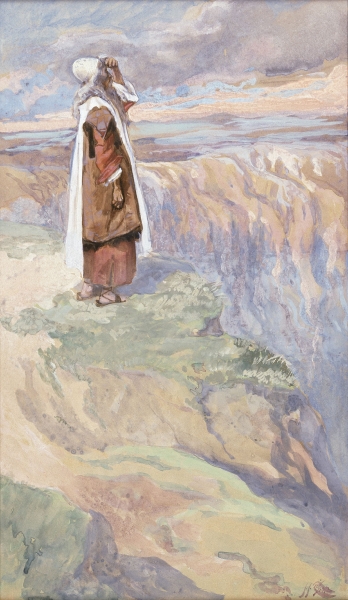
So Moses climbs Mount Nebo, to the top of the Pisgah range. The Lord shows him the whole land and says:
"This is the land I promised on oath to Abraham, Isaac and Jacob when I said, 'I will give it to your descendants.' I have let you see it with your eyes, but you will not cross over into it." (Deuteronomy 35:4)
God shows Moses the promise of the land that he has had a part in fulfilling for God. Moses has done his part in God's great plan, and then he dies. And that, dear friends, concludes the story of Moses, the reluctant leader. The scripture records:
"And Moses the servant of the LORD died there in Moab, as the LORD had said. He buried him in Moab, in the valley opposite Beth Peor, but to this day no one knows where his grave is. 7 Moses was a hundred and twenty years old when he died, yet his eyes were not weak nor his strength gone." (Deuteronomy 34:5-6)
 Available as an e-book and paperback |
Moses didn't want to lead Israel, but God chose him. Moses wasn't a perfect man. His anger got him in trouble more than once. But God selected him to serve, because God chooses imperfect men and women to serve him. He gives them his strength as they lean on him. He gives them his direction as they listen for his voice. And they make a difference in the lives of countless of God's children, because, though perhaps they are reluctant, yet they are obedient to serve.
May Moses' simple epitaph be ours when we die and are taken on to glory:
Moses, the servant of the Lord!
|
Q4. What about Moses' strengths have
inspired you? What about his weaknesses have been a warning to you?
If there is one primary thing God has taught you from Moses' life
that you seek to apply to yours, what is it?
|
Prayer
Thank you, Lord, for the privilege of studying Moses, your reluctant leader. I've been reluctant at times. Forgive me, Lord. Sometimes I've gone ahead in my own "wisdom" and "strength" and fallen on my face. Teach me, Lord. May my ears hunger to hear your voice. May I be patient enough to wait upon you until you show me the way you are leading me and your people. Glorify yourself through me and my brothers and sisters who have been studying with me. In Jesus' name, I pray. Amen.
References
1. Ashley, Numbers, p. 380.
2. Kadesh is almost certainly to be identified with Ain el-Qudeirat in the Wadi el-Ain of the northern Sinai. "The vegetation near Ain el-Qudeirat and its ample supply of water suit very well the topographical requirements of the wilderness narratives" (R.K. Harrison, "Kadesh," ISBE 3:1-2). Ain el-Qudeirat is the richest spring in the Sinai, having a flow of about 40 cubic meters per hour (Moshe Dothan, "The Fortress at Kadesh-Barnea," Israel Exploration Journal, 1965, pp. 134-51).
3. "Honor as holy" (NIV), "show my holiness" (NRSV), "sanctify" (KJV) is qādash in the Hiphil stem, "regard, or treat, as sacred, hallow" (BDB 872).
4. Victor P. Hamilton, mārâ, TWOT #1242. Both Numbers 20:24 and 27:14 are in the Qal stem.
5. "Rash words" (NIV, NRSV), "spake unadvisedly" is bāṭāʾ, "speak rashly, thoughtlessly" (Proverbs 12:18; Leviticus 5:4; BDB 104).
6. Harrison, Numbers, p. 267, citing P.J. Budd, Numbers, pp. 218-219; L.J. Dubois, Beacon Bible Commentary, p. 458. Since, in the Bible the rock is a symbol of God himself (Psalm 18:2; 31:3; 42:9; 1 Corinthians 10:4), so some think that striking it may indicate sacrilege (Wenham, Numbers, p. 151, citing J. de Vaulx, Les Nombres (Sources Bibliques, 1972) p. 223).
7. The actual location of Mount Hor is unknown, but was considered in Edomite territory. Josephus identified Mount Edom as Jebel Nebi Harim near Petra. But a more likely location might be Jebel Madura, about 15 miles northeast of Kadesh at the edge of Edom's territory (Harrison, Numbers, p. 272).
8. "Impatient" (NIV, NRSV), "discouraged" (KJV) is qāṣar, "be short, impatient, vexed, grieved." The root designates something that is short (Jack P. Lewis, TWOT #2061).
9. "Miserable" (NIV), "loath" (KJV) is qûṣ (which we saw in Exodus 1:12, Lesson 1, footnote 2), "feel a loathing, abhorrence, sickening dread" (BDB 880), "feel a disgust for" (Holladay, pp. 316-317).
10. "Venomous" (NIV), "poisonous" (NRSV), "fiery" (KJV) is śārāp, from śārap, "to burn" ... "The fire of these serpents was in the burning pain of the injected venom and the flying [Isaiah 14:29; 30:6] is doubtless a reference to the incredibly swift strike of the snake (NIV 'darting snakes')" (R. Laird Harris, TWOT #2292a). Of the 25 species of snakes in Palestine and Syria, four have a deadly bite, but it's difficult to know which species is indicated here (A.E. Day and G.D. Jordan, "Serpent," ISBE 4:417-418).
11. See Numbers 11:2; 12:11-13; 14:40.
12. Rather than continuing to be an object to stimulate faith, in times of apostasy the bronze serpent was worshipped as a god and was destroyed during Hezekiah's revival (2 Kings 18:4).
13. Nēs, "standard, ensign, signal, sign," then "standard," as pole. (BDB 652, 2). This "standard-bearing pole," is literally the word for "sign" both in the Masoretic text and in the Septuagint (Raymond F. Brown, Gospel of John (Anchor Bible; Doubleday, 1966) 1:133).
14. Keil and Delitzsch, Vol 1, Numbers, pp. 139-140.
Copyright © 2026, Ralph F. Wilson. <pastor joyfulheart.com> All rights reserved. A single copy of this article is free. Do not put this on a website. See legal, copyright, and reprint information.
 To be notified about future articles, stories, and Bible studies, why don't you subscribe to our free newsletter, The Joyful Heart, by placing your e-mail address in the box below. We respect your