


|
Old Testament
New Testament
Gospels
Acts
Paul's Letters
General Letters
Revelation
Topical Studies
Beginning the Journey (for new Christians). en Español

|
Old Testament
New Testament
Gospels
Acts
Paul's Letters
General Letters
Revelation
Topical Studies

|
Home
Bible Studies
Articles
Books
Podcasts
Search
Menu
Donate
About Us
Contact Us
FAQ
Sitemap

7. The Tabernacle, Priesthood, and Sacrifices (Exodus 20-31, 35-40; Leviticus 1-17; Numbers 6-10)
by Dr. Ralph F. Wilson| Audio (52:57)
Free
E-mail Bible Study
 Experiencing the Psalms
Home | Bible Studies | Articles | Books | Podcasts | Search | Menu | Donate | About Us | FAQ | Contact Us
|
|
There's no way we can do justice to these many chapters in just one lesson, but let's look and then draw some lessons for ourselves. Because of the nature of the material, we'll be skipping around. For example, the laws aren't all grouped together, nor are the descriptions of the tabernacle, priestly garments, and the sacrifices.
A. The Kingdom of God
The key unifying concept to grasp is that Yahweh is Israel's King. The law, the tabernacle, and the priesthood all relate to worshipping Yahweh as King. Three passages from the Pentateuch make it clear that Israel considers Yahweh its King. First, the Song of Moses after crossing the Red Sea::
"The LORD will reign for ever and ever." (Exodus 15:18)
"Reign" is mālak, "'to reign,' that is, to be and exercise functions of a monarch."1 Also:
"The LORD their God is with them;
the shout2 of the King is among them." (Numbers 23:21)
"He was king over Jeshurun3
when the leaders of the people assembled,
along with the tribes of Israel." (Deuteronomy 33:5)
In Lesson 5, we studied the giving of the Covenant, which has a number of parallels to a Suzerain Vassal Treaty. The Suzerain or Great King or King of kings makes treaties with kingdoms under him, and in return for obedience and subservience, offers protection and aid. But in this particular case, Israel is the King's favorite of all the kingdoms on earth.
"5 Now if you obey me fully and keep my covenant, then out of all nations you will be my treasured possession. Although the whole earth is mine, 6 you will be for me a kingdom of priests and a holy nation." (Exodus 19:5-6)
Yahweh's Presence in the Midst of His People (Numbers 2:1-3:39)
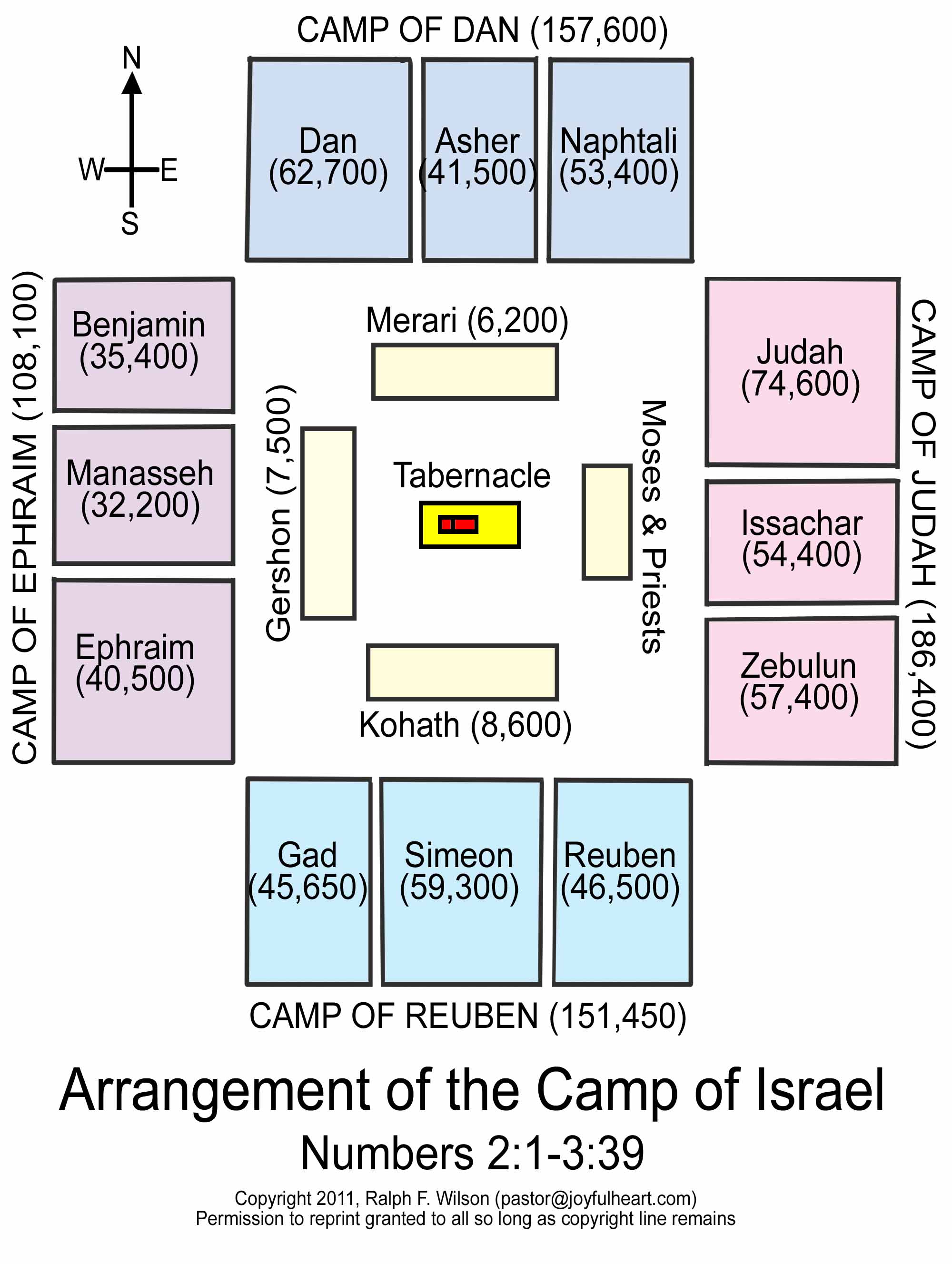
No other nation has this special relationship. Instead of being an absent Suzerain, this Great King chooses to live in the midst of his special people -- in a tabernacle or travelling throne room made to his specifications. In the face of the people's sin, Moses had interceded with God for his forgiveness and grace that God's presence might continue in their midst. Indeed, God in their midst is Israel's only distinctive as a nation (Exodus 33:2-3, 12-17, Lesson 6).
The very organization of Israel's camp reflected this truth according to Numbers 2:1-3:39. God's presence dwelt in the tabernacle. The priests and Levites were camped closest. Each clan of Levites had its own responsibilities for the tabernacle and its furniture. Then arrayed around them were the twelve tribes, each in its assigned position and order of march, when the camp got ready to move.
Yahweh's Presence is with his people, in their very center. The same principle should apply to the church today. Christ is not only the theoretical Head of the congregation, he is also to be central in everything we do. Christ in our very midst is what makes the church different from any group of people on earth. At its core, the church is not merely a human organization, but one energized by the Spirit of Christ!
|
Q1. (Numbers 2:1-3:39) Why was the camp of
the Israelites laid out as it was? What did this layout teach the
Israelites? Why were the Levites and priests camped closer than the
other tribes??
|
B. The Laws of the Covenant
Through Moses, Yahweh is also the Lawgiver (James 4:12; Isaiah 33:22). Though it is called "the Law of Moses" or "Mosaic Law," it is clearly God's law given through Moses. Certainly, as the Great Suzerain, Yahweh imposes his own laws upon Israel as part of the terms of the Covenant.
Does this mean that the Mosaic Law is designed for all cultures at all times, that it is the one perfect law of God? That's a question that we New Covenant Christians need to explore..
Jesus came to fulfill the Law, not to abolish it (Matthew 5:17-18). One way to view the Law is as:
- The civil law that governed the nation Israel,
- The religious law that detailed the sacrifices and temple ceremonies required for the forgiveness of sin, and
- The moral law, underlying principles such as those found in the Ten Commandments.
1. Civil Law
The civil law contained in the Pentateuch describes property rights, civil liability, and inheritance. Obviously most of the laws given in Exodus and Leviticus are designed to outline the way Israel should conduct itself as a theocratic nation, that is, a nation governed by Yahweh (theos, "God"+ kratia, "rule"). However, the writer of Hebrews tells us:
"By calling this covenant 'new,' he has made the first one obsolete; and what is obsolete and aging will soon disappear." (Hebrews 8:13)
"They are only a matter of food and drink and various ceremonial washings -- external regulations applying until the time of the new order." (Hebrews 9:10))
The theocracy of Israel finally passed away when the last king of Judah was deposed and the nation was taken into exile. Never again was Israel an independent nation, except for a brief period under the Maccabees. When the people returned from exile, they did so as vassals of the Persians, later the Greeks, and still later the Romans. Only for brief periods did Israel exist as an independently governed nation. The Kingdom of God had seemingly come to an end.
But that Kingdom was fulfilled in Jesus himself. When the Jewish leaders rejected King Jesus, the kingdom was removed from Israel. Jesus said,
"Therefore I tell you that the kingdom of God will be taken away from you and given to a people who will produce its fruit" (Matthew 21:43).
Outside this specific context of the theocracy of Israel, most of the laws don't really apply in other government settings, though many of the principles provide the basis for our tradition of laws in Europe and America.
2. Religious or Ceremonial Law
Exodus and Leviticus describe in great detail the construction of a tabernacle (later, the temple) and the sacrifices required to atone for sin. "Without the shedding of blood there is no forgiveness of sins," we are reminded in Hebrews 9:22b. But the New Testament describes how Jesus, as "the Lamb of God that takes away the sin of the world" (John 1:29), poured out his blood for the forgiveness of sins (Matthew 26:28), once for all and for all time (Hebrews 10:10). The Letter to the Hebrews explains how Jesus is the fulfillment of the Law. So in himself, Jesus fulfilled the religious or ceremonial law.
3. Moral Law
The final kind of law is what we might call the moral law, those moral principles that endure from one age to another. We find them, for example, in the Ten Commandments. "Thou shalt not kill ... thou shalt not commit adultery ... thou shalt not steal ... thou shalt not bear false witness against your neighbor ...."In the Shema we read,
"Hear, O Israel: The Lord our God, the Lord is one. Love the Lord your God with all your heart and with all your soul and with all your strength." (Deuteronomy 6:4-5)
"Love your neighbor as yourself." (Leviticus 19:18)
Jesus said,
"All the Law and the Prophets hang on these two commandments." (Matthew 22:40)
More than anything else, Jesus sent us his Holy Spirit to energize our lives. The Spirit makes the law obsolete.
"By dying to what once bound us, we have been released from the law so that we serve in the new way of the Spirit, and not in the old way of the written code." (Romans 7:6)
"If you are led by the Spirit, you are not under law." (Galatians 5:18)
Is the Mosaic Law Binding on Christians?
The Moral Law certainly hasn't changed. Of the Ten Commandments, the only one which is not commanded of Christians is Sabbath keeping, though this is disputed by my Seventh Day Adventist brothers and sisters. Certainly, the principle of rest is seen in the life of Jesus. But observance of the Seventh Day was not imposed by the Jerusalem Council on Gentile Christians (Acts 15:23-29). In fact, Paul warns the Colossian church that was having problems with Jewish teachers:
"Therefore do not let anyone judge you by what you eat or drink, or with regard to a religious festival, a New Moon celebration or a Sabbath day." (Colossians 2:16)
With the exception of the Sabbath commandment, all the rest of the Ten Commandments are reiterated in New Testament lists of sins.4
Jesus came to fulfill the Kingdom his Father had established, to fulfill the Law his Father had instituted, and to live out in his life the quality of life to which the Law aspired. "I didn't come to abolish the Law and the Prophets," Jesus said, "but to fulfill them" (Matthew 5:17). And Jesus did fulfill them all -- by his life, by his sacrificial death, by instituting a New Covenant, by his Messiahship to reign under his Father, by his resurrection, and by sending the Spirit.
C. Tabernacle
While Jesus fulfilled the religious and ceremonial law, when you understand the Jewish institutions and ceremonies, you have a much greater realization of and appreciation for what Christ has done. First, we'll examine the tabernacle..
As we saw in Lesson 5, the first "tent of meeting" was a simple tent that Moses pitched outside the camp, the place where Moses routinely spent time in God's presence, so intensely that his face would glow (Exodus 33:7-11).
But God revealed to Moses on Mount Sinai the details of how the tabernacle of Yahweh was to be constructed under the Covenant that formerly recognized Yahweh the Suzerain-Protector of Israel. He was to dwell in their midst in an elaborate tent as might a desert monarch..
The keys to understanding the tabernacle are two-fold:
- It is the throne-room and precincts of the King's dwelling.
- Moses received the exact pattern on Mount Sinai to be reproduced by skilled craftsmen, detail by detail.
"Make this tabernacle and all its furnishings exactly like the pattern I will show you." (Exodus 25:9, 40)
The writer of Hebrews makes the point that the Tabernacle in the Wilderness was not the primary place God dwelt, but an earthly representation of God's dwelling in heaven.
"They serve at a sanctuary that is a copy and shadow of what is in heaven. This is why Moses was warned when he was about to build the tabernacle: 'See to it that you make everything according to the pattern shown you on the mountain.'" (Hebrews 8:5)
Craftsmen and Materials
The Holy Spirit came upon two men, Bezalel and Oholiab, with the artistic ability, craftsmanship, and capability to supervise those who built the structures and fashioned the furniture and related utensils (Exodus 31:1-5). The materials were supplied by the offerings of the people.
"Everyone who was willing and whose heart moved him came and brought an offering to the LORD for the work on the Tent of Meeting, for all its service, and for the sacred garments. All who were willing, men and women alike, came and brought gold jewelry of all kinds.... They all presented their gold as a wave offering to the LORD...." (Exodus 35:21-22)
The response was overwhelming! For example, nearly one ton of gold was offered (Exodus 38:24) before Moses called for a halt to the offering (Exodus 36:6-7).
Three Names for the Tabernacle
The Tabernacle in the Wilderness is known by three terms in Scripture, each of which refers to a different aspect of its significance:
- Sanctuary emphasizes the sacredness or holiness of the place. This is the most common designation, miqdāsh, "holy place, sanctuary, chapel, hallowed part," from qādash, "to be hallowed, holy, sanctified," the state of that which belongs to the sphere of the sacred, distinguished from the common or profane. Later this word is used to describe Solomon's temple.5
- Tabernacle, literally, "tent, dwelling," emphasizes the nearness and closeness of God's presence dwelling with the Israelites in the midst of their camp.6
- Tent of Meeting, emphasizing that function of being a place of "meeting" between God and his people.7
The Tabernacle Itself (Exodus 26-27)
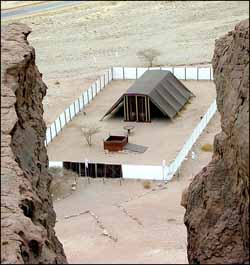
The tent itself was a fairly elaborate affair -- compared to modern-day camping tents, at least. It was designed to be grand enough to be the portable earthly dwelling place of Yahweh. Assuming that a cubit (the measurement from the elbow to the finger tips) is about 18 inches, the dimensions of the tabernacle were 45 feet long, 15 feet wide, and 15 feet high (13.7 m. x 4.5 m. x 4.5 m.; Exodus 26:15-30). It was divided into two rooms -- the Holy of Holies, where the ark was kept (the inner sanctum, which was a 15 foot cube), and the Holy Place, where the priests tended the table of showbread, the lampstand, and the altar of incense. The tabernacle seems to have been constructed of a series of acacia-wood8] frames9 set side by side, covered with gold leaf, set into silver bases. The tabernacle was draped with four separate coverings, made in panels and fastened together with gold and bronze clasps. From the inside out they were:
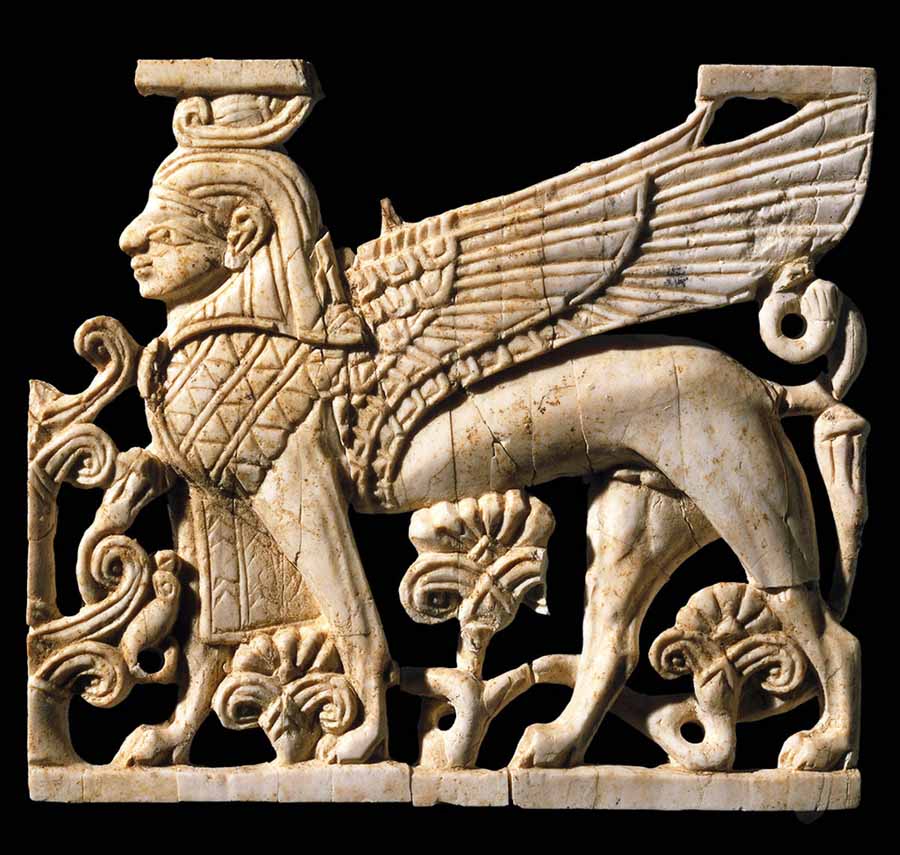 Cherubim are probably similar to the sphinx or winged bulls or lions found in the Ancient Near East. Striding sphinx. Phoenician, 899-700 B.C. From Nimrud, ivory, 6.9 cm x 7.75 cm. The Trustees of the British Museum. Larger image. |
- Tapestry, beautiful tapestry that decorated the inside of the
tabernacle, visible on the ceiling and walls from within:
"... curtains of finely twisted linen and blue, purple and scarlet yarn, with cherubim worked into them by a skilled craftsman" (Exodus 26:1). - Goat's Hair, spun and woven goat's hair, the material commonly used for making tents. It was probably nearly black, the first protective covering over the expensive tapestry.
- Ram Skins Dyed Red were next.10
- Hides, on the outside of the tabernacle, were apparently from sea cows, dugongs, or dolphins.11 They provided protection against the sun, rain, and frost.
The tapestry featured cherubim (kerûb), supernatural winged creatures whose duty was to guard and protect. It is apparently similar to a sphinx, examples of which have been found throughout the Ancient Near East. The Assyrians and Babylonians had large winged bulls and lions to provide protection to the king in grand palaces.12
The tabernacle or tent was located in a sacred courtyard measuring 150 feet by 75 feet, separated from the common areas by a 7.5 foot high curtain of finely-twisted white linen (Exodus 27:9-19).
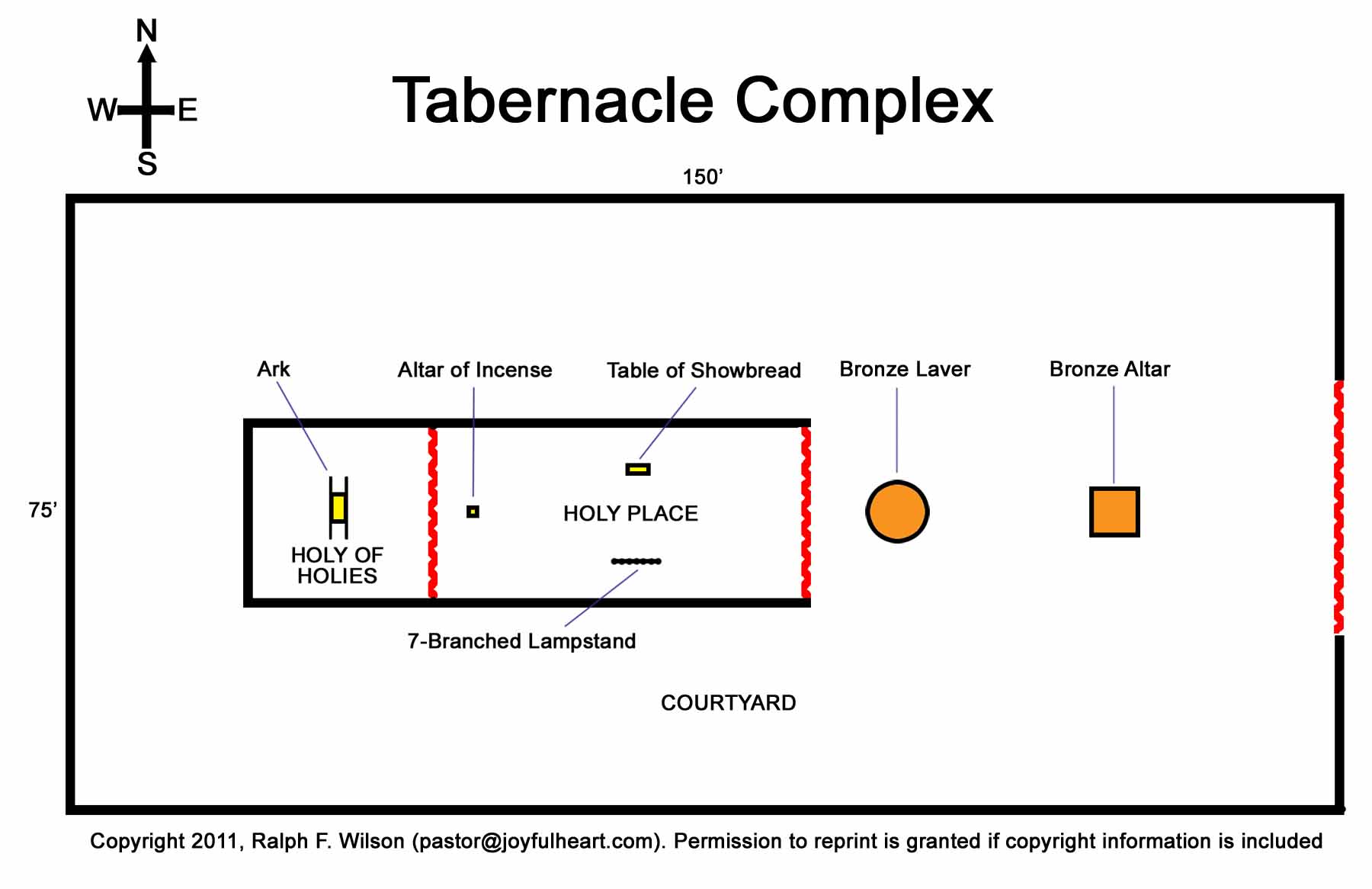
Many teachers have been tempted to spiritualize the tabernacle and its materials. Ram skins died red covering the tabernacle is too good to pass up; of course, it represents sacrifice, they say. I remember a pastor saying, "Bronze speaks of judgment," but I've looked in vain in Scripture to find a convincing passage. However, the function of the pieces of furniture in the courtyard and tabernacle proper can teach us some important lessons about worship, as we'll see in a moment.
It is clear that there is a gradation in metals used the closer you get to the ark. While bronze is used in the courtyard area for outside furniture, silver is used in the bases of the tabernacle frames, while gold covers the ark and other furniture within the tent. There is also a gradation of holiness. Common people could be involved in fellowship sacrifices within the courtyard, priests could enter the Holy Place, but only the high priest could enter the Holy of Holies -- and even then only once a year.
Tabernacle Furniture (Exodus 25, 27, 30)
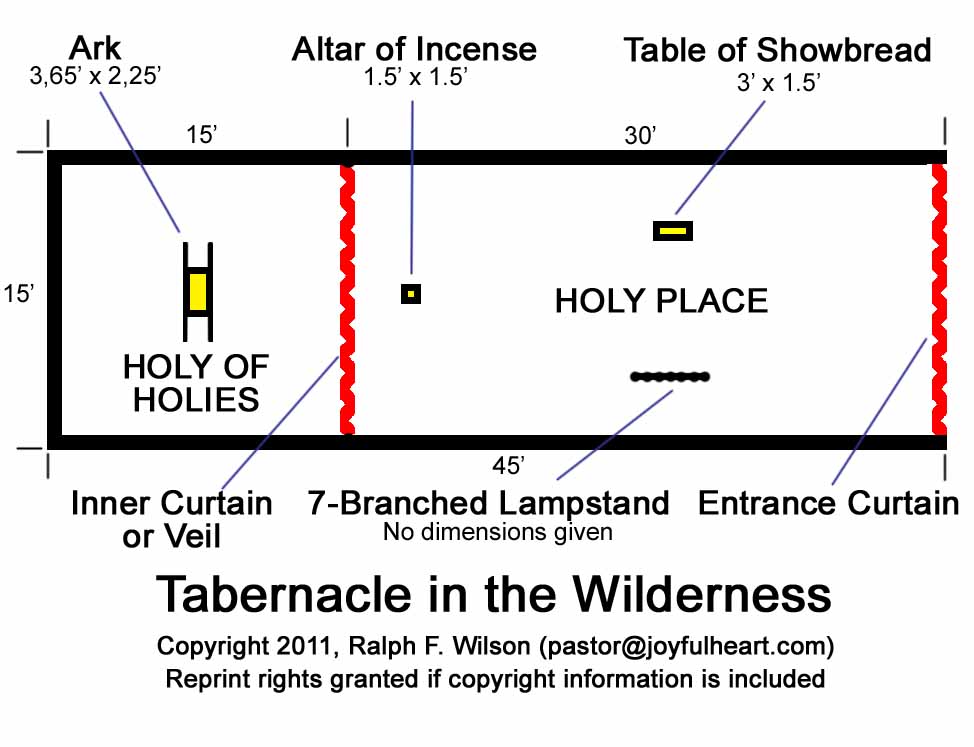
Let's look briefly at the tabernacle furniture -- all very functional. Each piece was fitted with rings and poles so it could be carried by the Levites when the camp moved. Beginning from the gate of the courtyard:
- Altar of Burnt Offering. The altar was an acacia wood box covered with bronze sheets, about 7.5 feet square and 4.5 feet high, topped by a grate, filled with earth, with horns at each corner. Here offerings were made to the Lord, both animals and grain.
- Bronze Laver or Basin. This was a basin made of solid bronze set on a bronze stand. It was filled with water for the priests to wash their hands and feet before making an offering or entering the tabernacle. No dimensions are given in the Bible.
- Table of Showbread. "The bread of the Presence" (NIV, NRSV), "shewbread" (KJV) is literally "bread before the face."13 The table made of acacia-wood, plated in gold, measuring 3 feet by 1.5 feet and 2.25 feet high. It bore 12 flat loaves of bread, one for each of the tribes, which were refreshed weekly. It symbolized providing food for the King in their midst.
- 7-Branched Lampstand. The lampstand elevated seven oil lamps high enough to illuminate the entire Holy Place. The lamps were probably open saucers with a wick draped over a lip formed in one end of the vessel burning olive oil. The lamps were to remain lit always. No dimensions are given for the lampstand.
- Altar of Incense. This altar is 1.5 feet square and about 3 feet high, with horns on each corner, and made of acacia-wood, plated with gold. It was used to burn sweet-smelling incense in the presence of the Lord, as might be burned in the presence of an earthly monarch.
- Ark of the Covenant (Exodus 25:10-22). The ark in the Holy of
Holies was the most holy object of all, a gold-covered acacia-wood chest
(dimensions 3.75 by 2.25 feet and 2.25 feet high) that served as the portable
throne of Yahweh. The top lid made of pure gold and called the "atonement
cover" (NIV), "mercy seat" (NRSV, KJV), is the Hebrew noun kappōret, literally,
"performance of reconciliation or atonement"14 or "place of atonement," from kāpar, "make an atonement, make
reconciliation."15 At each end of the cover was a solid gold cherub. These cherubim faced
each other with their "wings spread upward, overshadowing the cover" (Exodus
25:20). Kitchen says these were "possibly winged sphinxes, such that the box
was base and footstool and the cherubs a throne for the invisible deity."16 The idea that this was a throne is supported by several verses:
"There, above the cover between the two cherubim that are over the ark of the Testimony, I will meet with you and give you all my commands for the Israelites." (Exodus 25:22, cf. Numbers 7:89)
"... The ark of the covenant of the LORD Almighty, who is enthroned17 between the cherubim." (1 Samuel 4:4 and elsewhere)
The ark contained the tablets of the Ten Commandments called the Testimony or Covenant. At various times it also contained a pot of manna (Exodus 16:33; Hebrews 9:4) and Aaron's rod that budded (Numbers 17:10).
|
Q2. (Exodus 25:10-22) What is the
significance of the Ark in the Holy of Holies? What did it
represent? Why was it considered so holy? If no one really sat upon
it, why was it so important?
|
Completing the Tabernacle (Exodus 39-40)
Exodus provides a great deal of detail about the construction of the tabernacle. When you see the scope of preparing the frames, coverings, tapestries, posts, sockets, furniture, as well as all the necessary incense, anointing oils, priests' garments, and utensils for the service in the tabernacle, you can see how large a task it was.
But when the job was complete, Moses took a careful tour to make sure everything had been done correctly.
"Moses inspected the work and saw that they had done it just as the LORD had commanded. So Moses blessed them." (Exodus 39:43)
Moses had delegated the specialized work of preparing this desert sanctuary. Now he inspected it. Proper delegation includes accountability at appropriate intervals.
The tabernacle was erected on the first day of the second year of the Israelites' sojourn in the wilderness (Exodus 40:17).
The Cloud and the Glory (Exodus 40:34-38)
As soon as the tabernacle was erected -- apparently even before it was dedicated -- God entered his dwelling.
"34 Then the cloud covered the Tent of Meeting, and the glory of the LORD filled the tabernacle. 35 Moses could not enter the Tent of Meeting because the cloud had settled upon it, and the glory of the LORD filled the tabernacle." (Exodus 40:34-35)
Can you imagine what that was like? Whoosh! The cloud of God's direction moves over the tent and the Shekinah glory of God fills the tent in overwhelming Presence -- so much that Moses couldn't enter until later (Numbers 7:89).
Dedicating the Tabernacle
The priests (Leviticus 8) and Levites (Numbers 8:5-26) were consecrated. The tabernacle and all its accoutrements are dedicated (Numbers 7), and the ministry in the tabernacle begins for the first time. At the end of the dedication ceremony, we read:
"Moses and Aaron then went into the Tent of Meeting. When they came out, they blessed the people; and the glory of the LORD appeared to all the people. Fire came out from the presence of the LORD and consumed the burnt offering and the fat portions on the altar. And when all the people saw it, they shouted for joy and fell facedown." (Leviticus 9:23-24)
Flow of Worship in the Tabernacle
As I've thought about the order of objects as one enters the tabernacle complex from its entrance on the east, I see a progression as one approaches the very presence of God, a progression that is typical of Christian worship as well as Old Testament worship. Since the High Priest was the only person who could enter the Holy Place, we'll use him as our example of worship.
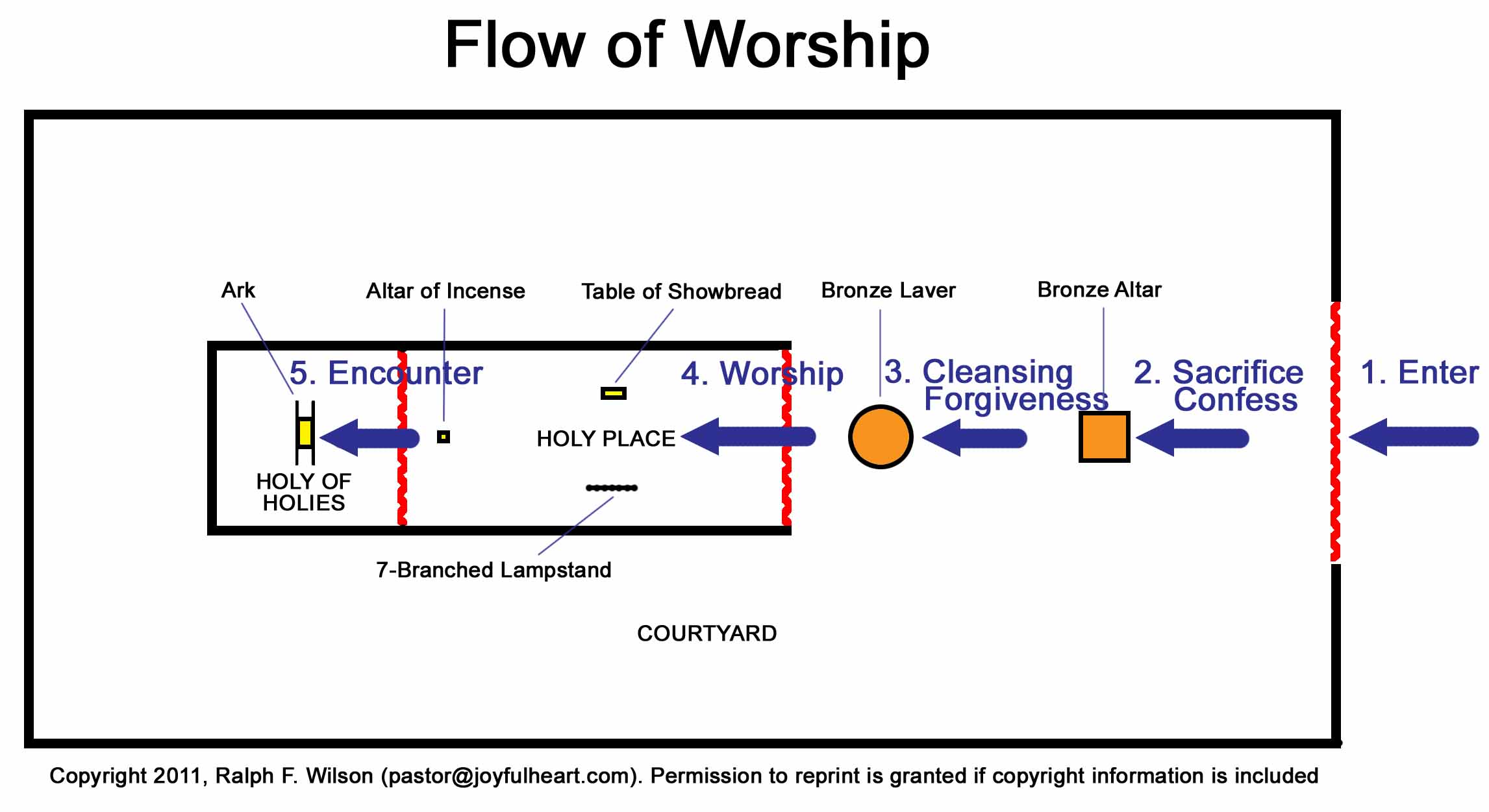
- Entering. We enter into prayer to begin to seek God and draw near to him.
- Sacrifice and confession of sin are represented by the bronze altar where sacrifices for sin were made. Christ is our sacrifice since our sin has caused an estrangement from God. As we confess our sins in humility and look with faith to his sacrifice for us on the cross, we connect with his grace and atonement.
- Cleansing and forgiveness are represented by the bronze laver or basin. We receive his forgiveness and cleansing by faith with thankfulness.
- Worship is the next step. As the priests tended the lamps, the table, and the altar of incense, we offer regular thanksgiving and praise to God in the Holy Place, as a sweet fragrance before him.
- Encounter with God in the Holy of Holies is the ultimate goal. We hear this in Moses' plea, "Show me your glory" (Exodus 33:18) and in Paul's cry, "that I may know him" (Philippians 3:10). Before him in the Holy of Holies, our words are no longer necessary as we bask in his presence and look forward to the day in the City of God when we shall "see his face" (Revelation 22:4)! Come soon, Lord Jesus!
|
Q3. What does the arrangement of the
furniture, the tabernacle, and the courtyard teach us about worship?
Why do you come to the bronze altar and the laver or basin before
you reach the tent itself?
|
D. The Priests, Levites, and Sacrifices
Prior to Sinai, we've seen a few priests -- Melchizedek and Jethro -- but for the most part, sacrifices were offered by a patriarch on behalf of his family. However, as the nation of Israel was formed in the wilderness at the foot of Mount Sinai, God set up a specific pattern for atonement from sin, so that the people encamped around him might be cleansed from their sins and remain a holy people.
Priests
Priest in Hebrew is kōhen, from which we get the common Jewish surname "Cohen." The etymology of the word is obscure.18 The priests were charged with ministering to the Lord, first and foremost. Daily they offered sacrifices, burned incense in the Holy Place, and tended the lamps on the lampstand. Weekly they renewed the bread of the Presence and ate the old loaves. Their first focus was on God.
But their second focus was on the people of Israel. The priests attended all of the sacrifices in the tabernacle, catching the blood as the animal died, offering a portion on the altar, and eating the portion assigned to the priests. It was hard work!
Levites
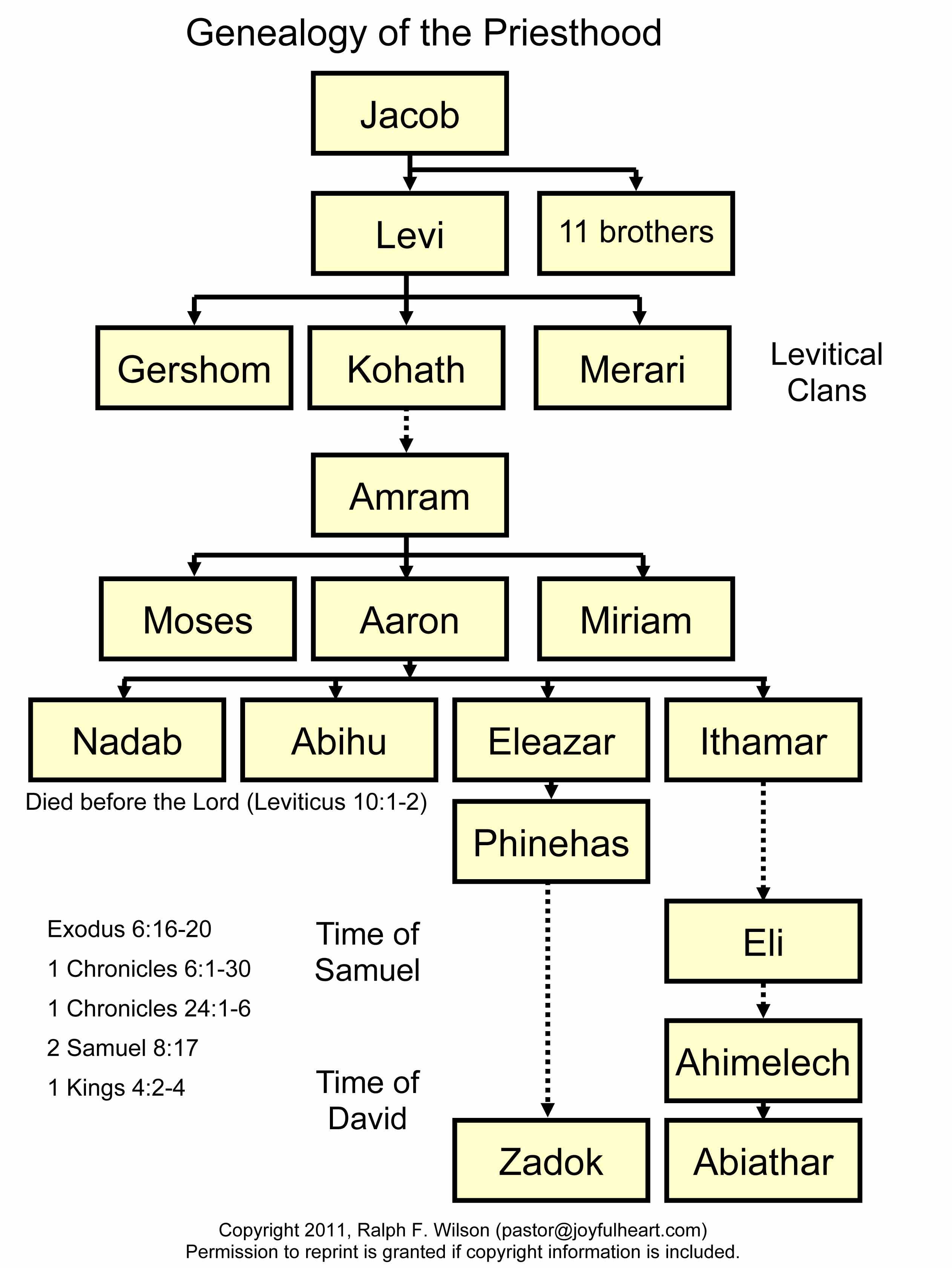
The workers in the tabernacle consisted of two groups: priests and Levites. Levites were all those who were part of the tribe of Levi. The priests were part of the tribe of Levi also, but were in addition descendants of Aaron, Moses' brother. It's confusing. All priests were Levites, but not all Levites were priests.
During the Exodus, the Levites had particular duties in setting up and taking down the tabernacle, preparing it for transport, and actually carrying the ark and other furniture (Numbers 3). It is possible that they had some duties as tabernacle staff as well (Deuteronomy 18:1; 17:9). During the period of the Judges, they may have officiated at other legitimate altars to Yahweh besides the one at Shiloh (Judges 17-18). We're just not sure.19 The present-day Jewish surnames "Levi" and "Levine" come from this tribal name.
Tithing
The priests and Levites were to receive no inheritance in the Promised Land; rather they would be supported by the tithes of the people. The Lord told Moses:
"I give to the Levites all the tithes in Israel as their inheritance in return for the work they do while serving at the Tent of Meeting." (Numbers 18:21)
Then one tenth of their tithe was to be given to the priests to help support their families (Numbers 18:26). In addition, the priests received a portion of the sacrifices and grain offerings for their families to eat (Numbers 18:8-20).
Throughout the history of Israel after this, when the nation's faith was strong, the tithe was available to support the ministry, but when it was weak, revival was necessary to restore the practice of tithing (2 Chronicles 2:2-10). In Malachi's day, the Lord renewed the command -- and the accompanying promise:
"'Bring the whole tithe into the storehouse, that there may be food in my house. Test me in this,' says the LORD Almighty, 'and see if I will not throw open the floodgates of heaven and pour out so much blessing that you will not have room enough for it." (Malachi 3:10)
Jesus certainly paid tithes. And while he said little about tithing (Luke 11:42), Paul applied the principle to New Testament ministers:
"Don't you know that those who work in the temple get their food from the temple, and those who serve at the altar share in what is offered on the altar? In the same way, the Lord has commanded that those who preach the gospel should receive their living from the gospel." (1 Corinthians 9:13-14)
Priestly Garments (Exodus 28 and 39, Leviticus 8:7-9)
The priests wore special garments20 that distinguished them from the people, "to give them dignity and honor" (Exodus 28:40). Here they are, working from the outside in:
|
|
High Priest |
Regular Priests |
|
Sacred crown of gold, engraved with the words: "Holy to the Lord."21 |
High priest only |
None |
|
Turban of linen, different types |
Miṣnepet22 |
Migbāʿâ23 |
|
Breastpiece, colorful, like the ephod, with 12 stones representing the 12 tribes, plus a pocket in which to put the Urim and Thummim, which seem to be lots used to seek God's will. |
High priest only |
None |
|
Ephod, "a sleeveless linen waistcoat"24 worn over the robe.25 |
Ephod made with gold; blue, purple and scarlet yarn; and finely-twisted linen. |
Plain linen ephod,26 at least in David's time. |
|
Robe27 of the ephod, made of blue cloth, the hem with alternating embroidered pomegranates and gold bells. |
High priest only |
None |
|
Sash28 |
Embroidered sash |
Regular sash |
|
Tunic, linen, ankle-length29 |
Perhaps checkered.30 |
Plain white linen |
|
Breeches, linen |
Fine-twisted linen |
Regular linen |
|
Footwear |
None |
None |
The Aaronic Blessing (Numbers 6:22-27)
One of the ministries of the priests was to bless the people of Israel with these words:
"The LORD bless you and keep31 you;
the LORD make his face shine upon you
and be gracious32 to you;
the LORD turn his face toward you
and give you peace." (Numbers 6:24-26)
This blessing uses the idea of "face" twice. In the Ancient Near East to see one's face was to experience a person's immediate presence. To make one's face "shine" indicates metaphorically "a cheerful face expressing good will."33 May God smile upon you. "To lift up one's face" or countenance towards a person meant to give them full attention and, presumably, grant them what they ask.
God explains through Moses, "So they will put34 my name on the Israelites, and I will bless them" (Numbers 6:27). Speaking the divine name of Yahweh over the people will have the effect of conferring his authority and blessings upon them. This gives us some idea of the power of the Name. Similarly, in the New Testament:
"Therefore God exalted him to the highest place and gave him the name that is above every name, that at the name of Jesus every knee should bow, in heaven and on earth and under the earth." (Philippians 2:9-10).
What a privilege we have speaking the Name over people and blessing them!
The Sacrifices
Much of Leviticus involves a detailed explanation of the various sacrifices offered in the tabernacle. We see five major kinds of offerings:35
- Burnt Offering (Leviticus 1; 6:8-13). In all the other offerings only a portion was offered and the rest was eaten by the priests as part of the atonement. But in the burnt offering, the entire sacrifice is consumed on the altar, not just a part. This offering is designed to make atonement for the offerer's sin. We'll look at it in detail below.
- Grain Offering (Leviticus 2; 6:14-23). It is an offering or gift to God from one's crops. A portion is kept by the priests for their share.
- Peace or Fellowship Offering (Leviticus 3; 7:11-34). This
offering was accompanied by the communal celebration of the worshippers who
shared in the meat of the offering. There are three sub-types:
- A thank offering was an expression of thanks for deliverance or blessings granted.
- A votive sacrifice was offered to give thanks for a blessing or deliverance following a vow.
- The freewill sacrifice was joyously and willingly presented to express a general thankfulness to God, with no specific deliverance in mind.
- Sin (Purification) Offering (Leviticus 4:1-5:1; 6:24-30). The sin offering and guilt offering are very similar. The primary purpose of the sin offering is to purify people from an unwitting sin. The priest must partake of this offering as part of the atonement (Leviticus 10:17).
- Guilt (Reparation) Offering (Leviticus 5:14-6:7). The guilt offering differs in that a restitution is required -- either to God or to another person -- in addition to the sacrifice. The primary purpose was to make atonement for desecration or mishandling of sacred things.
Repentance Is Necessary
It's important to realize that the sacrifices were more than bare ritual; they were God's means of atonement for sin. But to be effectual, they must be accompanied by a sincere repentance. Sacrifice without real repentance has always been repugnant to God; just as Christians who sin flagrantly because they know God will forgive them is a travesty of grace. The Lord spoke through the prophet Isaiah:
"'The multitude of your sacrifices
-- what are they to me?' says the LORD.
'I have more than enough of burnt offerings,
of rams and the fat of fattened animals;
I have no pleasure
in the blood of bulls and lambs and goats....
Stop bringing meaningless offerings!....
Your hands are full of blood;
wash and make yourselves clean.
Take your evil deeds out of my sight!
Stop doing wrong, learn to do right!
Seek justice, encourage the oppressed.
Defend the cause of the fatherless,
plead the case of the widow.'"
(Isaiah 1:11,13, 15b-17)
God calls us to be a holy people for whom holiness becomes a new way of life, rather than rebellion and sin as the norm. The sacrifice of Christ for our sins is designed to do what we cannot do -- cleanse ourselves from sin. But he expects us to repent and cooperate with the Holy Spirit to change our hearts -- and our behavior! Yes, his forgiveness is always there for us when we sin, but he calls us to a far better way of life! The apostle John wrote:
"My dear children, I write this to you so that you will not sin. But if anybody does sin, we have one who speaks to the Father in our defense -- Jesus Christ, the Righteous One. He is the atoning sacrifice for our sins, and not only for ours but also for the sins of the whole world." (1 John 2:1-2)
Special Sacrifices
It is important to be aware of three special types of sacrifices -- though, of course, there are many details we must skip for lack of time.
- Morning and Evening Sacrifices (Exodus 28:38-39; Numbers 28:1-8). One lamb to be offered as a burnt offering in the morning, another at twilight. There were also Sabbath offerings and monthly offerings.
- Passover offerings were a special kind of fellowship offering, in which the family ate the lamb that was sacrificed (Exodus 12; Numbers 9; Deuteronomy 16). You'll find more details on the Passover in Lesson 3.
-
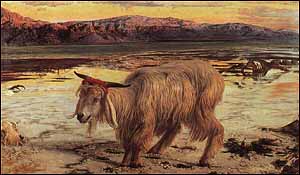
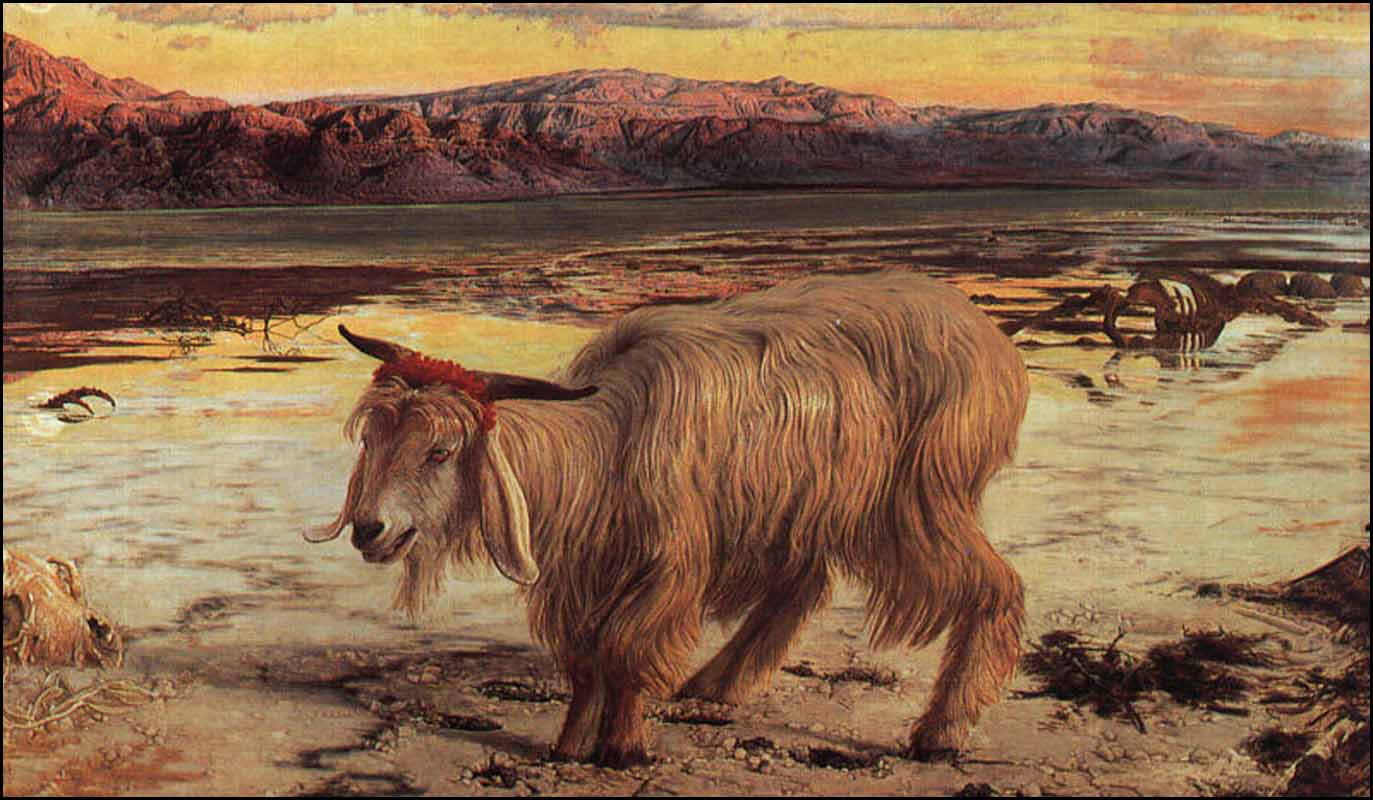
William Holman Hunt (English Pre-Raphaelite painter, 1827-1910), "The Scapegoat" (1854), oil on canvas, Lady Lever Art Gallery, Merseyside, UK. Larger image. - Day of Atonement (Yom Kippur, Leviticus 16) is the day each
year when the high priest seeks atonement for the sins of the whole nation.
First, he sacrifices a bull to make atonement for his own sins. Then from
two goats, one is selected to be a sin offering for the nation. The blood of
both the bull and the goat is sprinkled on the mercy seat of the ark in the
Holy of Holies. Then the high priest turns to the scapegoat.
"He is to lay both hands on the head of the live goat and confess over it all the wickedness and rebellion of the Israelites -- all their sins -- and put them on the goat's head. He shall send the goat away into the desert in the care of a man appointed for the task. The goat will carry on itself all their sins to a solitary place; and the man shall release it in the desert." (Leviticus 16:21-22)
This mission of carrying on oneself the sins of the people is fulfilled in Jesus. Christ is our scapegoat.
"He himself bore our sins in his body on the tree, so that we might die to sins and live for righteousness; by his wounds you have been healed." (1 Peter 2:24)
Steps in a Burnt Offering (Leviticus 1:3-9)
I think it is useful to study briefly a typical burnt offering to atone for a person's sins. The details concerning this offering are found in Leviticus 1:3-9. Notice these steps:
- Sacrifice is without defect (verse 3). We can't pawn off on God a substandard animal; it must be perfect. And because it is without defect, it is expensive for the worshipper. Sin is costly -- that's one of the messages of sacrifice. Of course, Christ is the ultimate sacrifice. We have been redeemed "with the precious blood of Christ, a lamb without blemish or defect" (1 Peter 1:19).
- Offerer lays his hand on head of animal (verse 4). Laying on of hands is accompanied by confession (as in Leviticus 16:21), and involves imparting one's sins to the animal that God has accepted as a substitute. This is the basis of the concept of the Substitutionary Atonement. In this case, God accepts from us the death of a lesser being for a greater. But the sacrifice that God provides for us is the Greater for the lesser.
- Offerer slaughters the animal (verse 5a). The priest doesn't do the killing here; it is at the hands of the sinner himself -- a graphic reminder of the appropriate penalty for our sin and rebellion against God.
- Priest collects the blood and sprinkles it against the altar
(verse 5b). While the animal is being killed by slitting its throat, a
priest holds a basin to collect the blood, then sprinkles it against the
altar to make atonement.
"For the life of a creature is in the blood, and I have given it to you to make atonement for yourselves on the altar; it is the blood that makes atonement for one's life." (Leviticus 17:11) - Offerer skins and cuts the sacrifice in pieces (verse 6). Offering a sacrifice involves the sinner in getting up close and personal with the process. It isn't pretty!
- Priest puts the pieces of the sacrifice on the altar (verses 7-8). The priest arranges the wood and the sacrifice on the wood.
- Sacrifice is completely consumed on the altar (verse 9). None of this burnt offering goes to the priest36 -- it is all offered to the Lord on behalf of the sinner.
When I've taught about sacrifice, I've found it useful to ask for a volunteer from the class, get him down on all fours, and demonstrate the steps involved. It makes it more real when I get out my pocketknife and a bowl to collect his blood!
|
Q4. (Leviticus 1:3-9) In the burnt offering
for an individual's sin: What is the significance of the offerer
laying his hand on the animal's head? Why do you think the offerer
is to slay the sacrifice rather than having the priest do it? How is the animal's
blood significant in sacrifice? In what ways does Jesus' sacrifice
on the cross fulfill all of this?
|
Priests Participate in the Sacrifice (Leviticus 10)
One of the sad incidents that relates to the tabernacle was the death of Aaron's older sons, Nadab and Abihu, who "offered unauthorized fire before the LORD, contrary to his command" (Leviticus 10:1). They both died before the Lord for the sacrilege, possibly committed when they were drunk (Leviticus 10:9).37 Moses cites the importance of recognizing God's holiness -- especially for those who approach God as priests!
"Among those who approach me
I will show myself holy;
in the sight of all the people
I will be honored.38 " (Leviticus 10:3)
Aaron and his remaining sons, Eleazar and Ithamar, are in shock following the deaths. They neglect the remainder of the procedures for offering sacrifice, in particular, partaking of a part of the sacrifice, which was their obligation as priests. Moses rebukes Aaron's sons for this infraction of the rules God had given through him for conducting the sacrifice:
"Why didn't you eat the sin offering in the sanctuary area? It is most holy; it was given to you to take away the guilt of the community by making atonement for them before the LORD. Since its blood was not taken into the Holy Place, you should have eaten the goat in the sanctuary area, as I commanded." (Leviticus 10:17-18)
Moses doesn't want more deaths to occur because the remaining priests aren't careful to keep God's commandments. But Aaron replies:
"Today they sacrificed their sin offering and their burnt offering before the LORD, but such things as this have happened to me. Would the LORD have been pleased if I had eaten the sin offering today?" (Leviticus 10:19)
Aaron bares his humanity -- his hurt and anger and bitterness over his two sons who had lost their lives. Just keeping the rules while struggling with a bitter heart would not have pleased God, he says.
The Scripture records: "When Moses heard this, he was satisfied" (Leviticus 10:20). Moses acknowledges the truth of Aaron's words and doesn't insist further.
As I reflect on this story, several lessons occur to me.
- God demands holiness and obedience from his servants. In our
day we have little understanding of God's holiness, and might even accuse
people who contend for holiness as judgmental. Much of the Book of Leviticus
involves learning and appreciating God's holiness.
"I am the LORD your God; consecrate yourselves and be holy, because I am holy.... I am the LORD who brought you up out of Egypt to be your God; therefore be holy, because I am holy." (Leviticus 11:44-45)
- God demands a pure heart from those who make offerings to him.
Aaron understood this, to his credit -- and Moses accepted it. We see the
same principle in Jesus' teaching:
"If you are offering your gift at the altar and there remember that your brother has something against you, leave your gift there in front of the altar. First go and be reconciled to your brother; then come and offer your gift." (Matthew 5:23-24; cf. Mark 11:25)
- God shows mercy when he sees in us a desire to please him, even if we haven't kept all the rules -- but we mustn't presume upon his mercy. Moses recognized this and didn't trouble Aaron further about his transgression.
- The priests are partakers of the altar -- as part of the atonement. We see an echo of this with reference to the Lord's Supper in the context of eating food offered to idols:
"Is not the cup of thanksgiving for which we give thanks a participation39 in the blood of Christ? And is not the bread that we break a participation in the body of Christ? ... Consider the people of Israel: Do not those who eat the sacrifices participate in the altar?" (1 Corinthians 10:16, 18)
Dear friends, this passage reminds us that when we partake of the Lord's Supper, we are one with Christ's sacrifice for us on the cross!
There is so much more that could be said about the tabernacle, the priesthood, and the sacrifices, but hopefully this lesson has given you an overview of the worship in the wilderness, and later, in the temple.
The Cloud above the Tabernacle (Numbers 9:15-23)
The tabernacle in the midst of Israel's camp reflected the Presence of Yahweh in their midst -- displayed by the presence of the pillar of cloud by day and the pillar of fire by night.
"15 On the day the tabernacle was set up, the cloud covered the tabernacle, the tent of the covenant; and from evening until morning it was over the tabernacle, having the appearance of fire. 16 It was always so: the cloud covered it by day and the appearance of fire by night. 17 Whenever the cloud lifted from over the tent, then the Israelites would set out; and in the place where the cloud settled down, there the Israelites would camp." (Numbers 9:15-17)
The pillar of cloud -- God's presence -- guided them on their journey -- as you and I seek him to guide us today. We don't know the next leg of the journey, but we are secure as we obediently follow the Lord where he leads us.
The Israelites spent a year camped at Mt. Sinai as Moses received the laws from God, the people entered into covenant with Yahweh, and actually built the tabernacle he had prescribed for his dwelling. Now it was time to leave Sinai and continue the journey toward the Promised Land -- and the cloud lifted.
"In the second year, in the second month, on the twentieth day of the month, the cloud lifted from over the tabernacle of the covenant. Then the Israelites set out by stages from the wilderness of Sinai, and the cloud settled down in the wilderness of Paran." (Numbers 10:11-12)
Scripture records:
Whenever the ark set out, Moses would say,
"Arise, O LORD, let your
enemies be scattered,
and your foes flee before you."
And whenever it came to rest, he would say,
'Return, O LORD
of the ten thousand thousands of Israel.'" (Numbers 10:35-36)
The nation of Israel had been formed under God. And Yahweh went with them -- led them -- on their journey. The tabernacle was his dwelling in their midst. The priests tended the holy things, and offered sacrifices to seek forgiveness and maintain the nation as a holy people that could continue in God's presence.
All these things -- tabernacle, priests, and sacrifices -- were types and shadows of the true reality that God would bring through Christ, who is both our high priest and our sacrifice.
"The Holy Spirit was showing by this that the way into the Most Holy Place had not yet been disclosed as long as the first tabernacle was still standing....
 Available as an e-book and paperback |
When Christ came as high priest of the good things that are already here, he went through the greater and more perfect tabernacle that is not man-made, that is to say, not a part of this creation. He did not enter by means of the blood of goats and calves; but he entered the Most Holy Place once for all by his own blood, having obtained eternal redemption." (Hebrews 9:8, 11-12)
Prayer
Lord, in the tabernacle we learn a great deal about holiness, atonement, and worship. Help us to love you so much that we will live holy lives before you. Give us a hunger to seek your presence and worship you in the beauty of your holiness. Change our lives.! Fill us with yourself, we pray, in Jesus' name. Amen.
References
1. Robert D. Culver, mālak, TWOT #1199.
2. "Shout" (NIV, KJV), "acclaimed" (NRSV) is terûʿâ, here, "human shout (of joy)" (Ashley, Numbers, P. 479), from rûaʿ, "to raise a noise" by shouting or with an instrument" (William White, TWOT #2135). The idea is that wherever the King goes, his people acclaim him with shouts, such as with English monarchy, the customary shout would be, "Long live the king!"
3. Jeshurun is yeshurûn, an honorific title for Israel, meaning something like "upright one" (Thompson, Deuteronomy, p. 308). Also used in Deuteronomy 32:15; 33:26; Isaiah 44:2.
4. Mark 7:21-23; Romans 13:9; 1 Corinthians 6:9-10; Galatians 5:19-21; Colossians 3:5-8; 1 Timothy 1:9-10; etc.
5. Thomas E. McComiskey, qādash, TWOT #1990f.
6. Mishkān, "dwelling place, tabernacle," from shākan, "to dwell" (Victor P. Hamilton, shākan, TWOT #2387c). The term "shekinah" comes from this same root, speaking of the glorious presence of God.
7. This phrase consists of two words: ʾŌhel is the common word for "dwelling, home, tabernacle, tent," referring originally to the animal skin or goat's hair dwelling of nomadic people (Jack P. Lewis, ʾōhel, TWOT #32a). Môʿēd means "appointed place, place of assembly" (Jack P. Lewis, môʿēd, TWOT #878b).
8. Most probably, Old Testament references to acacia ("shittim," KJV, cf. Hebrew shiṭṭâ) are to Acacia seyal, which grow in the Jordan Valley as well as certain places in the Sinai Peninsula. Though commonly found as shrubs, under favorable conditions they can grow as tall as 25 feet. The orange-brown wood is very durable (R.K. Harrison, "Acacia," ISBE 1:22).
9. "Frames" (NIV, NRSV), "boards" (KJV) is qeresh, "plank" (Holladay, p. 326). Boards or planks indicating a solid construction would mean that the embroidered inner covering would not be able to show through. Also the weight would be prohibitive for a portable structure. Recent commentators see these as frames, in keeping with more recent archaeological discoveries. In the tomb of Queen Hetepheres (mother of Khufu, builder of the great pyramid about 2,600 BC), was found a disassembled portable tent that had once enclosed the queen's bedchamber. It consisted of a gold-covered wooden framework, as did several other Egyptian finds. Texts from Mari and Ugarit describe similar portable tent frames (Kitchen, Reliability, pp. 275-279; also Averbeck, DOTP, p. 818-819).
10. Ram skins died red are known from later Arab portable shrines (Averbeck, DOTP, p. 823).
11. The word is taḥash. " Since the badger is rarely if ever seen in Sinai, and since Arabic tuh̠as "dolphin," seems to be cognate to Hebrew taḥash, most recent commentators translate the Hebrew word as "dolphin, porpoise, dugong" or the like. The bottle-nosed dolphin (Tursiops truncatus) is found in the eastern Mediterranean, while the dugong (Dugong dugong) is plentiful in the Red Sea and the Gulf of Aqaba, the skin of the latter is still used by Bedouin to make sandals" (Ronald F. Youngblood, taḥash, TWOT #2503).
12. R.K. Harrison, "Cherubim," ISBE 1:642-643.
13. The face was used to indicate God's presence. When God spoke to Moses "face-to-face" (Exodus 33:11) the idiom indicated intimacy. Aaron's blessing, which we'll study shortly, uses facial metaphors for God's presence and blessing.
14. Kappōret, Holladay, p. 163.
15. R. Laird Harris, kappōret, TWOT #1023c.
16. Kitchen, Reliability, p. 280.
17. Yāshab, "sit" (Holladay, p. 146). This phrase is also found in 2 Samuel 6:2 = 1 Chron. 13:6; 2 Kings 19:15; and Psalm 99:1.
18. J. Barton Payne, kōhen, TWOT #959a.
19. D.A. Garrett, "Levi, Levites," DOTP, pp. 519-522. See also Wayne O. McCready, "Priests and Levites," ISBE 3:965-970.
20. Cornelius Van Dam, "Priestly Clothing," DOTP, pp. 643-646.
21. "Diadem" (NIV), "crown" (NRSV, KJV) is nēzer, "separation, consecration crown," from nāzar, "separate, consecrate (oneself)" (Thomas E. McComiskey, nāzar, TWOT #1340a).
22. Miṣnepet, "turban" (KJV "mitre" ), the distinctive headgear of the high priest, from ṣānap "to wrap around" (Charles L. Feinberg, ṣānap, TWOT #1940a).
23. "Turban, headgear" (KJV "bonnet" ), perhaps convex in shape. Related words are translated "hill," "cup, bowl," and "bud." Use only of the priests' headgear (Victor P. Hamilton, TWOT #309c). "Head-band" (Holladay, p. 181).
24. Leona Glidden Running, "Garments," ISBE 2:405, VII, B.
25. Leviticus 8:7.
26. 1 Samuel 2:18; 22:18.
27. Meʿîl, "robe, cloak, mantle." Like a shawl there was a hole in the middle, hence to be pulled over the head. It was also worn by men of repute (Victor P. Hamilton, TWOT #1230b).
28. "Sash" (NIV, NRSV), "girdle" (KJV) is ʾabnēṭ. "Josephus affords some details of the girdle as used in his day. It was wrapped around the chest and after a number of twinings it was tied, hanging freely to the ankles. Such was the girdle which the high priest wore while performing no service. While he was offering sacrifices, in order to allow greater freedom of movement, he threw the sash to the left and wore it over his shoulder" (Josephus, Antiquities 3.7.2). (Charles L. Feinberg, TWOT #256a).
29. Kuttōnet, "tunic, a long shirtlike garment, usually of linen." From Akkadian kitinnu or kitintu, "a linen garment made from kitū linen" (TWOT #1058a).
30. Exodus 28:4 the tunic is described with the word tashbēṣ, "woven work," from shābāṣ, "to weave in checkered or plaited work" (TWOT #2320c). Perhaps "checkered work" (Holladay, p. 396).
31. "Keep" is shāmar, "keep, guard, observe, give heed," with the root idea of "to exercise great care over." Here it has the idea of "to guard, take care of" (TWOT #2414).
32. Ḥānan, "depicts a heartfelt response by someone who has something to give to one who has a need," "an action from a superior to an inferior who has no real claim for gracious treatment" (Edwin Yamauchi, TWOT #694).
33. Herbert Wolf, ʾôr, TWOT #52.
34. "Put" is śûm, "put, place something somewhere" (Gary G. Cohen, TWOT #2243).
35. Richard E. Averbeck, "Sacrifices and Offerings," DOTP, pp. 706-733. Eugene E. Carpenter, "Sacrifices and Offerings in the OT," ISBE 4:260-273.
36. The hide, however, goes to the priest (Leviticus 7:8).
37. An analysis of the nature of their sin can be found in Harrison, Leviticus, pp. 108-111.
38. Kābēd, "glorified" (KJV, NRSV).
39. "Participation" (NIV), "sharing" (NRSV), "communion" (KJV) is koinōnia, "participation, sharing" in something (BDAG 553, 4), "the share which one has in anything, participation" (Thayer, p. 352, 1), from koinos, "common."
Copyright © 2026, Ralph F. Wilson. <pastor joyfulheart.com> All rights reserved. A single copy of this article is free. Do not put this on a website. See legal, copyright, and reprint information.
 To be notified about future articles, stories, and Bible studies, why don't you subscribe to our free newsletter, The Joyful Heart, by placing your e-mail address in the box below. We respect your