|
Old Testament
New Testament
Gospels
Acts
Paul's Letters
General Letters
Revelation
Topical Studies
Beginning the Journey (for new Christians). en Español

|
Old Testament
New Testament
Gospels
Acts
Paul's Letters
General Letters
Revelation
Topical Studies

|
Home
Bible Studies
Articles
Books
Podcasts
Search
Menu
Donate
About Us
Contact Us
FAQ
Sitemap

Free
E-mail Bible Study
 The Discipleship Process
Home |
Bible Studies |
Articles |
Books |
Podcasts |
Search |
Menu |
Donate |
About Us |
FAQ |
Contact Us
The Discipleship Process
Home |
Bible Studies |
Articles |
Books |
Podcasts |
Search |
Menu |
Donate |
About Us |
FAQ |
Contact Us
|
|
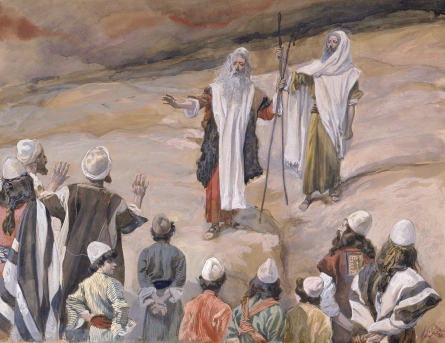
At long last, the people of Israel arrive at the very spot where God had met Moses in the burning bush a year or so before.
"1 In the third month after the Israelites left Egypt -- on the very day -- they came to the Desert of Sinai. 2 After they set out from Rephidim, they entered the Desert of Sinai, and Israel camped there in the desert in front of the mountain." (Exodus 19:1-2)
A. Invitation to the Covenant (Exodus 19:1-9)
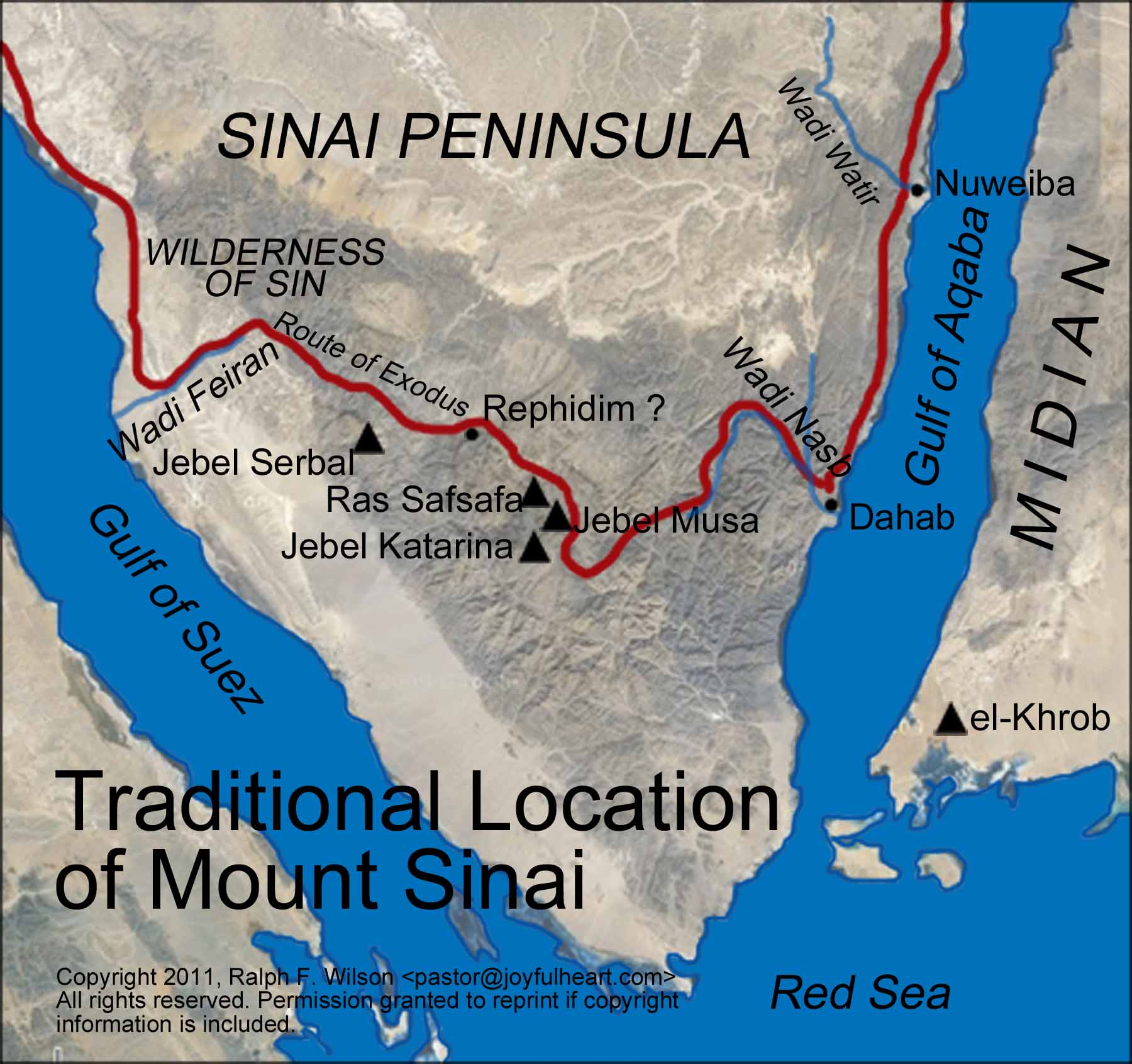
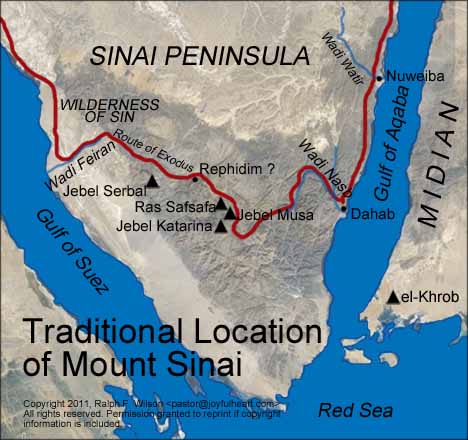 Traditional area for the location of Mt. Sinai, probably either Jebel Musa or Jebel Serbal. Larger map. |
Invitation to a Unique Covenant Relationship (Exodus 19:3-6)
We'll spend quite a bit of time on two verses (verse 5 and 6) filled with themes that echo through the Old and New Testaments, and down to our own day.
"3 Then Moses went up to God, and the LORD called to him from the mountain and said, 'This is what you are to say to the house of Jacob and what you are to tell the people of Israel:
"4 You yourselves have seen what I did to Egypt, and how I carried you on eagles'wings1 and brought you to myself. 5 Now if you obey me fully and keep my covenant, then out of all nations you will be my treasured possession. Although the whole earth is mine, 6 you will be for me a kingdom of priests and a holy nation."
These are the words you are to speak to the Israelites.'" (Exodus 19:3-6)
Let's look at the key phrases one by one.
Requirement: Keeping the Covenant (Exodus 19:5a)
The covenant is mentioned extensively in Genesis where God makes a covenant with Abraham,2 renewed with Isaac and Jacob. This patriarchal covenant is referred to in Exodus 2:24 and 6:4-5 as the reason God is delivering the descendants of the patriarchs. But now it is time for the people themselves to make a proper covenant with God.
The word "covenant" is the Hebrew noun berit. Between nations it is a "treaty, alliance of friendship." Between individuals it is "a pledge or agreement, with obligation between a monarch and subjects: a constitution." Between God and man it is "a covenant accompanied by signs, sacrifices, and a solemn oath that sealed the relationship with promises of blessing for keeping the covenant and curses for breaking it."3 Here in Exodus, God makes a covenant with his people as a nation, on the pattern of the suzerain-vassal treaties found in the Ancient Near East.
In the Ancient Near East suzerain-vassal treaties were commonplace. A great king (suzerain) would conquer weaker kingdoms and extract pledges of allegiance -- and annual tribute -- from their kings (vassals). In return, the suzerain had an obligation to protect vassal kingdoms in case they were attacked. The suzerain was known as the king of kings -- the king of all the other kings. In the Near East pantheon of gods there would be one that would be seen as superior to the others, the god of gods.
The Old Testament teaches clearly that Yahweh is the true King of Israel.4 It is no accident then that the giving of the law at Mt. Sinai has clear parallels to a Suzerain-Vassal treaty, by which a powerful monarch sets up a treaty with a less powerful nation, confirmed by written covenants as well as sacrifices, blessings, cursings, etc.5
These treaties or covenants typically included elements that seem to appear especially in the fuller account given of these events in Deuteronomy:
- Preamble (1:1-5)
- Historical prologue (1:6-4:40)
- General stipulations (5:1-11:32)
- Specific stipulations (12:1-26:15)
- Blessings and curses (27:1-28:68)
- Witnesses (30:19; 31:19; 32:1-43)6
Our account in Exodus truncates this outline, but the historical roots of the covenant are quite clear. As a great king, a suzerain, Yahweh covenants with Israel to be their King and Protector. Yahweh is the high King, the great King, the King of kings and the Lord of lords. In Lesson 7 we'll see that the tabernacle in the wilderness is the portable home of Yahweh in the midst of his people. The courtyard defines the royal precincts, the tent is his abode, and the mercy seat of the Ark of the Covenant is his throne.
Scholars trace a number of covenants in the Bible. When the covenant in our passage is referred to, it is called the Mosaic Covenant (given through Moses) or the Sinaitic Covenant (given at Mt. Sinai), or, when contrasted with the New Covenant through Jesus, it is called the Old Covenant.
In our passage, God tells the people:
"Now if you obey me fully and keep my covenant, then...." (Exodus 19:5a)
Keeping covenant obligations is the requirement placed upon the people, and they accept it in the Covenant in Exodus 24:7-8.
Here are the steps involved in making this covenant at Sinai, as outlined in Exodus 19-24:
- Israel arrives at Sinai and encamps (19:1-2)
- God announces his intention to covenant with Israel and the people agree (19:3-9)
- Preparations prior to the third day, washing clothes, consecration (19:10-15)
- Assembly before Mt. Sinai on the third day (19:16-25)
- Proclamation of the Ten Commandments (20:1-17)
- Further laws and stipulations of the covenant (20:18-23:19)
- Promise of the Land (23:20-33)
- Reading the Book of the Covenant and sprinkling with blood (24:1-11)
God's Treasured Possession, Personal Property, Chosen People (Exodus 19:5)
This is clearly a conditional covenant. But the benefits of the covenant are awe-inspiring!
"Now if you obey me fully and keep my
covenant,
then out of all nations you will be my treasured possession." (Exodus
19:5)
"Treasured possession" (NIV, NRSV), "peculiar treasure" (KJV), "personal possession" (New Jerusalem Bible) is a single word: segullâ. The basic meaning of this noun is "personal property."7 Imagine being considered by God as his own very personal and dear possession! The word occurs several other key places in the Old Testament:
"For you are a people holy to the LORD
your God.
Out of all the peoples on the face of the earth,
the LORD has chosen you to be his treasured possession." (Deuteronomy
14:2)
"And the LORD has declared this day that
you are his people,
his treasured possession as he promised,
and that you are to keep all his commands." (Deuteronomy 26:18)
"For the LORD has chosen Jacob to be his
own,
Israel to be his treasured possession." (Psalm 135:4)
"A scroll of remembrance was written in
his presence
concerning those who feared the LORD and honored his name.
'They will be mine,' says the LORD Almighty,
'in the day when I make up my treasured possession.'"
(Malachi 3:16b-17, KJV "when I make up his jewels")
The immense privilege of being God's chosen people became a source of national pride for Israel, causing them to despise the Gentiles, rather than becoming a source of humility and awe as intended. In the New Testament, this privilege of being God's special people is opened to all who trust in Jesus the Messiah!
"... Jesus Christ, who gave himself for us to redeem us from all wickedness and to purify for himself a people that are his very own, eager to do what is good." (Titus 2:13b-14)
"But you are a chosen people, a royal priesthood, a holy nation, a people belonging to God,8 that you may declare the praises of him who called you out of darkness into his wonderful light." (1 Peter 2:9)
|
Q1. (Exodus 19:5; 1 Peter 2:9) From an
emotional standpoint, what does it feel like to take out and look
over one of your treasured possessions? How was the idea of
"treasured possession" fulfilled in Israel? What does it feel like
to be God's treasured possession -- as we Christians clearly are
according to 1 Peter 2:9?
|
A Kingdom of Priests (Exodus 19:6a)
The next phrase we'll examine is "a kingdom of priests."
"5b Although the whole earth is mine, 6 you will be for me a kingdom of priests and a holy nation." (Exodus 19:5b-6)
This phrase "kingdom of priests" (NIV, KJV), "priestly kingdom" (NRSV) is fascinating. What does God mean here? "Kingdom" is mamlākâ, "kingdom," 9 from melek, "king." Of course, a kingdom assumes a king, since no other form of government was known in the Ancient Near East. 10 Yahweh is the King, as we'll see in Lesson 7.
Priests of foreign gods, of course, were known in both Mesopotamia and Egypt. Prior to this in the Pentateuch both Melekizedek (Genesis 14:18) and Jethro (Exodus 3:1; 18:1-2) have been mentioned as priests who worshipped the true God. But there was no group within Israel selected to be priests, as yet. So what does "priest" mean in this context? Cole suggests,
"Presumably the basic thought is of a group set apart peculiarly for God's possession and service, with free access to His presence. The thought of acting as God's representative for, and to, the other nations of the world cannot be ruled out. Whether realized at the time or not, this was to be the mission of Israel (Genesis 12:3)."11
Israel, then, is either (1) a kingdom consisting of priests -- people, set apart to God (that is "holy"), who relate to God directly and serve him, or (2) "royal priests," a cadre of priests belonging to Yahweh the King. Either way, it is a position of great privilege and access.
This idea is echoed in the New Testament, and became the basis of Martin Luther's teaching of the "priesthood of believers."
"But you are a chosen people, a royal priesthood, a holy nation, a people belonging to God, that you may declare the praises of him who called you out of darkness into his wonderful light." (1 Peter 2:9)
|
Q2. (Exodus 19:6; 1 Peter 2:9) What did
priests do in the Old Testament? In what sense are you a priest? How
do you function as a priest? In what sense are you a "royal" priest?
In what areas can your personal priestly function improve?
|
A Holy Nation (Exodus 19:6b)
Finally, we see the phrase "a holy nation" both in Exodus 19:6b and 1 Peter 2:9. Nation is gôy, which is used especially to refer to "specifically defined political, ethnic or territorial groups of people without intending to ascribe a specific religious or moral connotation."12 Only later the gôyim are "the nations, the Gentiles." The concept of being "holy" (Hebrew qādôsh; Greek hagios) is used extensively in both the Old and New Testaments.
"The adjective qādôsh denominates that which is intrinsically sacred or which has been admitted to the sphere of the sacred by divine rite or cultic act. It connotes that which is distinct from the common or profane."13
Those who are holy have been set apart from the common or ordinary to be sacred, devoted to, belonging exclusively to the holy God. Because they are holy, they are not to contaminate themselves with worship of other gods or practices that are forbidden by God.
|
Q3. (Exodus 19:6; 1 Peter 2:9) In what
sense is Israel a "holy" nation? What does it mean to be holy? Why
do you think that personal holiness is de-emphasized in our time?
|
Identity Statement (Exodus 19:5-6)
"5 Now if you obey me fully and keep my covenant, then out of all nations you will be my treasured possession. Although the whole earth is mine, 6 you will be for me a kingdom of priests and a holy nation." (Exodus 19:5-6)
These descriptors define the covenant people and become for us a kind of identity statement as well as an ideal.
- God's special, personal possession
- Priests to God who form the basis of his kingdom
- Holy nation, set apart for his service exclusively
What a calling! Sadly, the Israelites did not live up to this high calling. That remained for fulfillment under the New Covenant that was to come with Jesus the Messiah.
Initial Agreement to Enter into Covenant (Exodus 19:7-8a)
Moses has apparently ascended Mt. Sinai and received these words from God to speak to Israel. Now he returns.
"7 So Moses went back and summoned the elders of the people and set before them all the words the LORD had commanded him to speak. 8 The people all responded together, 'We will do everything the LORD has said.'" (Exodus 19:7-8a)
The response is unanimous: "We will do everything the LORD has said," that is, we want to enter into covenant and will obey whatever stipulations the Lord requires.
Moses the Go-Between (Exodus 19:8b-9a)
Moses is acting like the go-between here, a kind of mediator, carrying messages back and forth between the Lord and the people.
"So Moses brought their answer back to the LORD. 9 The LORD said to Moses, 'I am going to come to you in a dense cloud, so that the people will hear me speaking with you and will always put their trust in you.'" (Exodus 19:8b-9a)
There's a leadership lesson here. People will trust leaders who they believe are talking to God and who hear from God! This can be faked. This can be phony. But I believe that people can smell out the fake and phony. Though a leader's prayer time needs to be private and non-ostentatious, yet there will be an outflow from it that will touch and impact the congregation.
As a ten-year-old boy I can remember my Presbyterian pastor, who would give an invitation to receive Christ at the close of the service each Sunday at our small, tourist-area church. One Sunday, when no one responded to the invitation immediately, he said to us: "This morning God told me that six will come forward. We'll just wait for you." He waited -- and the six came. There I was, a young boy seeing a man of God who prays and listens to God. I trusted the pastor because I knew he heard from God.
Leader, are you willing to pay the price Moses paid to hear from God? If you do, God will anoint your leadership with his sign of approval before the people.
B. Preparing for the Covenant (Exodus 19:10-25)
Consecrate the People (Exodus 19:10-11)
"10 And the LORD said to Moses, 'Go to the people and consecrate them today and tomorrow. Have them wash their clothes 11 and be ready by the third day, because on that day the LORD will come down on Mount Sinai in the sight of all the people'... 14 After Moses had gone down the mountain to the people, he consecrated them, and they washed their clothes. 15 Then he said to the people, 'Prepare yourselves for the third day. Abstain from sexual relations.'" (Exodus 19:10-11, 14-15)
The word "consecrate" (NIV, NRSV), "sanctify" (KJV) is qādash, "to be holy." In the Piel stem, it has the causative sense, "to make holy, to sanctify, to consecrate."
The idea of holiness is prominent especially in Exodus, Leviticus, Numbers, and Deuteronomy. God is pure, holy, full of glory. To approach God, man must prepare himself. To be a Levite (as we'll see in Lesson 7), a man must live differently. To be a priest, the bar was higher and required a higher level of holy living. To be high priest, the standard was even higher.
In Protestant circles especially, we have blurred the line between the clergy and the laity, and this isn't all bad. Indeed, we are all priests. But with this blurred line we have come to believe that spiritual leaders are no different than anyone else, that there are no special qualifications, and that the standard of behavior for leaders is no greater than for the members of the congregation. This is wrong and unscriptural!
"Here is a trustworthy saying: If anyone sets his heart on being an overseer, he desires a noble task. Now the overseer must be above reproach...." (1 Timothy 3:1-2a)
Here are some of the ways men and women are told to prepare themselves for holy encounters, that is, to be sanctified or consecrated:
- Take off one's shoes (Exodus 3:5; Joshua 5:15)
- Wash one's clothes and sometimes one's body (Exodus 19:10, 14; Leviticus 16:26, 28; Numbers 8:21; 19:7)
- Abstain from food, fast (Leviticus 16:29; 23:27)
- Abstain from sexual relations (Exodus 19:15)
- Offer sacrifices for atonement for sin (Exodus 12:7; Leviticus 1; etc.)
- Confess one's sins (Leviticus 16:21; 26:40)
- Act justly and keep the moral laws (Exodus 20; Micah 6:8)
- Keep the Sabbath
- Keep other rules of ritual purity
Is there anything wrong with food? No. Is there anything wrong with wearing shoes? Of course not. Is it morally wrong to go without a shower?
Do taking these actions actually make you holy? No, but they are gestures of contrition and desire to make oneself right before God. Ultimately, we are helpless to atone for our own sins, but these are signs and symbols of our allegiance to the Lord. Take the Sabbath, for example:
"... This is a sign between me and you throughout your generations, given in order that you may know that I, the LORD, sanctify you." (Exodus 31:13)
Regardless of our position, we cannot remain passive about our sins. We must recognize who we are before the Lord's holiness and be humble. The New Testament also shows believers taking special steps to sanctify themselves before the Lord (1 Corinthians 7:5; Acts 18:18; 21:23; Matthew 6:16). Nevertheless, we acknowledge the truth that we are accepted before the Lord by his grace, not our works (Ephesians 2:8-10). We hold two truths side by side:
- The Lord sanctifies us: "You shall be for me ... a holy nation." (Exodus 19:6)
- We sanctify ourselves: "Prepare yourselves...." (Exodus 19:15)
The role of the leader is to call people to prepare their hearts and lives before the Lord and to live holy lives -- and for the leader to model this lifestyle before the people. The people are to hold high standards of holiness as a community as they live their lives before the Lord and one another.
The People Witness the Lord at the Mountain (Exodus 19:16-21)
"On the morning of the third day there was thunder and lightning, with a thick cloud over the mountain, and a very loud trumpet blast. Everyone in the camp trembled." (Exodus 19:16)
The purpose of this was to put the fear of God in the people, so that they might not treat God casually -- or Moses, his servant.
"18 When the people saw the thunder and lightning and heard the trumpet and saw the mountain in smoke, they trembled with fear. They stayed at a distance 19 and said to Moses, 'Speak to us yourself and we will listen. But do not have God speak to us or we will die.'
20 Moses said to the people, 'Do not be afraid. God has come to test you, so that the fear of God will be with you to keep you from sinning.'21 The people remained at a distance, while Moses approached the thick darkness where God was." (Exodus 20:18-21)
It is sad to observe that, in their fear, the people reject their own role as priests before the Lord (Exodus 19:5-6). Rather they say to Moses:
"Speak to us yourself and we will listen. But do not have God speak to us or we will die." (Exodus 20:19)
What a tragedy! We must fear God in the sense that we are afraid to displease him by sinful actions. But we are not to let terror rule the relationship. The Apostle John says:
"There is no fear in love. But perfect love drives out fear, because fear has to do with punishment. The one who fears is not made perfect in love." (1 John 4:18)
I believe that a healthy fear of God is a necessary step in a disciple's life. I have a rule when driving: don't mess with large trucks and buses -- they are so large they can flatten my car in a split second! Healthy fear is good, but it is not the ultimate step. That step is love. We find that love for God is a much more powerful motivator for keeping from sin than fear ever was.
C. Requirements of the Covenant (Exodus 20-23)
The Ten Commandments and Book of the Covenant (Exodus 20-23)
Moses and Aaron are on the mountain when the Lord gives what are known as the Ten Commandments (Exodus 34:28; Deuteronomy 4:13; 10:4-5). We won't take time to look at each of these here.
But note that these commandments are the core of the covenant being made between God and the people of Israel. They are "the words of the covenant" (Exodus 34:28) and are referred to as "the covenant" itself (Deuteronomy 4:13). When they are eventually written on tablets of stone, they are placed in the ark (Deuteronomy 10:5), which is subsequently known as "the ark of the covenant" (Numbers 10:33; 14:44; Deuteronomy 10:8; 31:9, 25-26).
The Book of the Covenant (Exodus 20-23)
The Ten Commandments are primarily moral principles that form the basis of our actions. In Exodus 21-23 God gives Moses civil and religious laws to govern the nation of Israel.
"3 When Moses went and told the people all the LORD's words and laws, they responded with one voice, 'Everything the LORD has said we will do.' 4 Moses then wrote down everything the LORD had said." (Exodus 24:3-4)
The people formally and unanimously accept these terms of the covenant. Based on that initial acceptance, Moses prepares the covenant documents in writing for a public reading later.
It is strange that some scholars deny that Moses was the author of the five "Books of Moses," the Pentateuch, the Torah. Moses was an educated man, capable of reading and writing, and is clearly described as "writing" God's words down. These commandments were not orally transmitted, only to be recorded generations later (as some historical sections of the Bible probably were), but written down soon after they were given on Mt. Sinai. While the hands of other editors are visible in the Pentateuch, much of it is no doubt Moses' own work, or that of the scribes to whom he personally dictated the material God had given him.
D. Confirming the Covenant (Exodus 24)
The Formal Ratification of the Covenant (Exodus 24:4-8)
The next day, sacrifices are prepared by the "young Israelite men," 14 both burnt offerings and fellowship offerings:
"4 He got up early the next morning and built an altar at the foot of the mountain and set up twelve stone pillars representing the twelve tribes of Israel. 5 Then he sent young Israelite men, and they offered burnt offerings and sacrificed young bulls as fellowship offerings to the LORD. 6 Moses took half of the blood and put it in bowls, and the other half he sprinkled on the altar." (Exodus 24:4-6)
Though the significance of the blood is spelled out more clearly in Leviticus 17:11, even here the blood is set apart for a special purpose to consecrate the people. Blood was also shed in ratifying the Abrahamic Covenant (Genesis 15:9-18), as was common in Ancient Near Eastern covenants.
Now Moses reads from the "Book of the Covenant," the Ten Commandments and ordinances that Moses had told the people about previously (Exodus 24:3-4). That was preliminary; this is the formal acceptance of a written covenant.
"Then he took the Book of the Covenant and read it to the people. They responded, 'We will do everything the LORD has said; we will obey.'" (Exodus 24:7)
The Blood of the Covenant (Exodus 24:8)
"Moses then took the blood, sprinkled it on the people and said, 'This is the blood of the covenant that the LORD has made with you in accordance with all these words.'" (Exodus 24:8)
This significance of the blood in the making of the covenant is mentioned in the New Testament by the writer of Hebrews in chapter 9:
"18 The first covenant was not put into effect without blood.
19 When Moses had proclaimed every commandment of the law to all the people, he took the blood of calves, together with water, scarlet wool and branches of hyssop, and sprinkled the scroll and all the people. 20 He said, 'This is the blood of the covenant, which God has commanded you to keep.'
21 In the same way, he sprinkled with the blood both the tabernacle and everything used in its ceremonies. 22 In fact, the law requires that nearly everything be cleansed with blood, and without the shedding of blood there is no forgiveness." (Hebrews 9:18-22)
Now that we have seen the holiness of the blood of the covenant, how much more special are Jesus' words at the Last Supper when he held up a cup and said to his disciples:
"27b Drink from it, all of you. 28 This is my blood of the covenant, which is poured out for many for the forgiveness of sins." (Matthew 26:27b-28)
The Old Covenant and the New Covenant
The Old Covenant which God brought through Moses anchored the people of Israel to God for more than 1,200 years. But even while it was in effect, God speaks through his prophet Jeremiah about its replacement in this famous passage:
31 "'The time is coming,' declares the LORD,
'when I will make a new covenant
with the house of Israel and with the house of Judah.
32 It will not be like the covenant I made with their forefathers
when I took them by the hand to lead them out of Egypt,
because they broke my covenant,
though I was a husband to them,' declares the LORD.
33 'This is the covenant I
will make
with the house of Israel after that time,' declares the LORD.
'I will put my law in their minds and write it on their hearts.
I will be their God, and they will be my people.
34 No longer will a man teach his neighbor, or a man his brother,
saying,
"Know the LORD," because they will all know me,
from the least of them to the greatest,' declares the LORD.
'For I will forgive their wickedness
and will remember their sins no more.'" (Jeremiah 31:31-34)
The final covenant, the New Covenant brought in through Jesus, was the fulfillment -- not made by "the blood of bulls and goats" (Hebrews 10:4) which is not really adequate to take away sins (Hebrews 10:4), but made by his own blood, "the precious blood of Christ, a lamb without blemish or defect" (1 Peter 1:19).
|
Q4. (Exodus 24:8; Matthew 26:27-28) What is
the function of the "blood of the covenant" in Exodus? What is the
"blood of the covenant" in the New Testament? How is the Old
Covenant similar to the New Covenant? How are they different?
|
Eating and Drinking on the Mountain (Exodus 24:9-11)
Now the future priests (Aaron and his older sons) and the seventy elders of Israel go up on the mountain where they are given a vision of God.
"9 Moses and Aaron, Nadab and Abihu, and the seventy elders of Israel went up 10 and saw the God of Israel. Under his feet was something like a pavement made of sapphire, clear15 as the sky itself. 11 But God did not raise his hand against these leaders of the Israelites; they saw God, and they ate and drank." (Exodus 24:9-11)
This is a theophany, an appearance of God. Did they see God himself? No, according to Jesus (John 1:18; 6:46). But like others they see a manifestation of God that makes them believers, so they can better lead the people.
There is real significance in eating and drinking together on the mountain. This is a kind of covenant meal with God (the Suzerain) and representatives of the vassal nation: Moses (leader), Aaron and his sons (priests), and the 70 elders.16
Moses Ascends the Mountain for Forty Days (Exodus 24:12, 18)
Now Moses goes up the mountain with only Joshua as his companion and assistant.
"12 The LORD said to Moses, 'Come up to me on the mountain and stay here, and I will give you the tablets of stone, with the law and commands I have written for their instruction.' 13 Then Moses set out with Joshua his aide, and Moses went up on the mountain of God.
.... 18 Then Moses entered the cloud as he went on up the mountain. And he stayed on the mountain forty days and forty nights." (Exodus 24:12-13, 18)
During this time, God reveals to him the "pattern" for the tabernacle and its furniture and the priests' garments (Exodus 25-30) that we'll look at in Lesson 7. Finally, this long session with God concludes:
"When the LORD finished speaking to Moses on Mount Sinai, he gave him the two tablets of the Testimony, the tablets of stone inscribed by the finger of God." (Exodus 31:18)
This expression, "the finger of God," is very evocative, if not anthropomorphic. We see it in Exodus 8:19 and Luke 11:20 to describe the very work of God himself in a situation.
The Covenant is the basis of Israel's relationship to God, just as the New Covenant is the basis of our relationship to God through Jesus Christ.
Dear friend, have you accepted the Covenant that God wants to make with you? Are you willing to be his personal possession? Are you willing to be his priest? Are you willing to be his holy subject? Are you willing to participate in his cross by eating and drinking of the New Covenant in his body and blood? If this is a new experience for you, Jesus is calling you to follow him on a new pathway that leads to glory.
It is an awesome and solemn privilege to enter into and continue in a relationship with the Living God!
 Available as an e-book and paperback |
We conclude with a benediction from the Book of Hebrews:
"May the God of peace, who through the blood of the eternal covenant brought back from the dead our Lord Jesus, that great Shepherd of the sheep, equip you with everything good for doing his will, and may he work in us what is pleasing to him, through Jesus Christ, to whom be glory for ever and ever. Amen." (Hebrews 13:20-21)
Prayer
Father, thank you for this immense privilege of being called to know you and walk with you as your special and holy emissaries and priests. We are not qualified in ourselves, but you have made us holy and worthy through the blood of the everlasting covenant. In the name of Jesus Christ our Savior and Lord, we thank you. Amen.
References
1. The eagle referred to is probably the Palestinian vulture (Cole, Exodus, p. 144). "Wing" is the "appendage of a bird with which it flies, denoting speed as well as protection." (John N. Oswalt, kānāp, TWOT 1003a). Here, the reference seems to be to protection, as in Deut 32:10b-11.
3. Elmer B. Smick, berit, TWOT #282a.
4. Numbers 23:21; 1 Samuel 8:7; 12:12; Psalm 24:8-10; 29:10; 74:12; Isaiah 6:5; 33:22; Zephaniah 3:15; Zechariah 14:16-17.
5. J.A. Thompson, The Ancient Near Eastern Treaties and the Old Testament (London: The Tyndale Press, 1964).
6. G.E. Mendenhall (Law and Covenant in Israel and the Ancient Near East (Presbyterian Board of Colportage of Western Pennsylvania, 1955) developed this understanding of Deuteronomy. See Richard A. Taylor, "Form Criticism," DOTP 340. Paul R. Williamson, "Covenant," DOTP 139-155. M.W. Chavalas, "Moses," DOTP 577. Peter C. Craigie (The Book of Deuteronomy (New International Commentary on the Old Testament; Eerdmans, 1976), pp. 79-83) sees an Egyptian background to the Deuteronomic covenant.
7. R.D. Patterson, segūllâ, TWOT #1460a.
8. In both these New Testament passages KJV version famously translates the phrase as "a peculiar people," using "peculiar" in the sense of "special, particular" rather than "eccentric, queer."
9. Mamlākâ occurs about 115 times in the Old Testament, as (1) "kingdom, dominion," (2) "royal power" or "dignity," (3) "king," and (4) theologically at 2 Chronicles 29:11 (Holladay, Lexicon, p. 199); (1) "kingdom, realm" (mainly), then (2) "sovereignty, dominion," and finally (3) "reign" (BDB 575).
10. Childs (Exodus, p. 342) sums up the consensus of the study of the syntax and meaning of this expression: "'Priests'is an attribute of 'kingdom'as 'holy'is an attribute of 'nation'" (citing W.L. Moran, "A Kingdom of Priests,"The Bible in Current Catholic Thought (New York, 1962), pp. 7-20).
11. Cole, Exodus, p. 145.
12. Gerard Van Gronigen, gwh, TWOT #326e.
13. Thomas E. McComiskey, qādash, TWOT #1990b.
14. Perhaps these are the "priests" mentioned in Exodus 19:22-24 prior to the ordination of the Aaronic priesthood in Exodus 28-29.
15. The pavement that was both "made of sapphire" and yet "clear" reminds us somewhat of other revelations (Revelation 21:11, 18, 21). In a word, the vision was indescribable in human terms.
16. This kind of covenant meal seems to be occurring at Genesis 14:18; Exodus 18:12; and, of course, Passover, and the Lord's Supper.
Copyright © 2026, Ralph F. Wilson. <pastor joyfulheart.com> All rights reserved. A single copy of this article is free. Do not put this on a website. See legal, copyright, and reprint information.
 To be notified about future articles, stories, and Bible studies, why don't you subscribe to our free newsletter, The Joyful Heart, by placing your e-mail address in the box below. We respect your