|
Old Testament
New Testament
Gospels
Acts
Paul's Letters
General Letters
Revelation
Topical Studies
Beginning the Journey (for new Christians). en Español

|
Old Testament
New Testament
Gospels
Acts
Paul's Letters
General Letters
Revelation
Topical Studies

|
Home
Bible Studies
Articles
Books
Podcasts
Search
Menu
Donate
About Us
Contact Us
FAQ
Sitemap


Free
E-mail Bible Study
 Experiencing the Psalms
Home | Bible Studies | Articles | Books | Podcasts | Search | Menu | Donate | About Us | FAQ | Contact Us
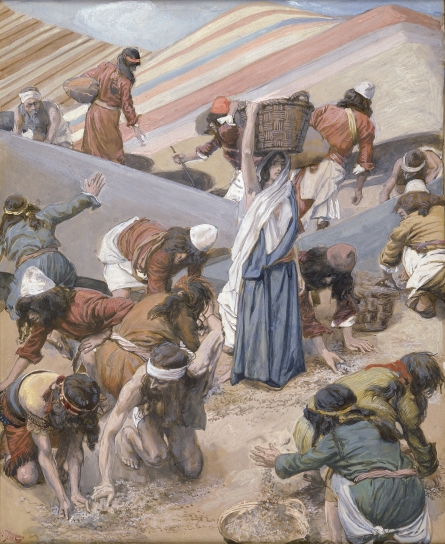
 James J. Tissot, "The Gathering of the Manna" (1896-1900), watercolor, Jewish Museum, New York. Larger image. |
Moses' leadership has got the people out of Egypt. But now the hardships of leading the people through a desert sojourn will challenge him to his limit. Moses, you remember, was familiar with life in the desert; he had been a shepherd in the Sinai wilderness for 40 years when he served his father-in-law, Jethro. But the people of Israel were used to an agrarian life in the well-watered Nile delta. The desert was new and terrifying to them.
A. Grumbling (Exodus 15:22-17:7)
Finding Drinkable Water at Marah (Exodus 15:22-25a)
The first crisis they met in the desert was -- predictably -- thirst. They found water, but it was bitter -- unpalatable to drink -- perhaps brackish, alkaline water.
Notice what Moses does. He seeks the Lord, literally, he "cried out" to the Lord. The Hebrew verb suggests an urgency and desperation in Moses' plea.1 Often leaders see themselves as problem-solvers rather than pray-ers. Moses calls on God and God gives him the solution.
He throws a piece of wood into the water and the water becomes drinkable. There are various theories about how the wood might have reacted chemically with the salts or a pungent wood might cover the mineral taste to make the water palatable. One author suggests that barberry has this effect.2 But the result was that the people could now drink the water, and this new company of refugees from Egypt was saved from dying of thirst.
Grumbling, Complaining, Murmuring, and Quarreling against Leaders
"So the people grumbled against Moses, saying, 'What are we to drink?'" (Exodus 15:24)
Complaining, quarrelling, fractious people begin to wag their tongues with Moses as the target. This is the first of many such crises that Moses the leader has to meet. But perhaps the greater leadership crisis is the kind of rebellion that surfaces when people are afraid or frustrated. This is the first instance of a Hebrew word that we meet several times in Exodus and Numbers.
"Grumble" (NIV), "complain" (NRSV), "murmur" (KJV) is lîn, which means, "to murmur, rebel (against)."3 Here, the people complained to their leader, "What are we to drink?" In later episodes, they seem to hold Moses responsible for every problem: "You brought us out here, now we'll die! What are you going to do about it?"
This complaining behavior clusters around a number of incidents during the Exodus. Several occur in this week's lesson. We'll consider others in Lesson 8 and Lesson 9.
|
Scripture |
Summary |
Motivation |
|
Exodus 5:21 |
Your demands to Pharaoh have made us a stench to him, demanding bricks without supplying straw. |
Fear of punishment |
|
Exodus 14:11-12 |
You brought us to die in wilderness |
Fear of dying in battle |
|
Exodus 15:24 |
Grumbling. Water is bitter at Marah. "What shall we drink?" |
Fear of dying of thirst |
|
Exodus 16:2, 7-9, 12 |
Grumbling. "We'll Starve to death!" Recalled pots of meat in Egypt. |
Fear of dying of starvation |
|
Exodus 17:3 |
At Rephidim, Moses strikes the rock at God's command. |
Fear of dying of thirst |
|
Numbers 11:1-6 |
Complaints4 about their hardships. Tired of manna, craved other food, instigated by the "rabble." |
Dissatisfaction with manna |
|
Numbers 14:2, 27, 29, 36-37; Deuteronomy 1:27 and Psalm 106:25 (rāgan5 ) |
Fear of war in Canaan after the report of the 10 unbelieving spies. "We'll fall by the sword. Our wives and children will be taken as plunder." There is talk of selecting another leader. The 10 spies are struck down by the Lord for spreading a bad, unbelieving report. |
Fear of death and slavery |
|
Numbers 16:11, 41; 17:5, 10 |
Korah rebels against Moses and the God-ordained Aaronic priesthood. Moses is also blamed when the leaders of rebellion are struck down by God. |
Envy of Moses' leadership |
|
Numbers 20:1-13 |
At Kadesh the people "gather in opposition against"6 and "quarreled"7 with Moses (also Exodus 17:2). Moses strikes the rock in anger rather than speaking to it as God instructed -- and is punished by failing to enter the Promised Land. |
Fear of dying of thirst |
|
Numbers 21:4-9 |
Impatience, short-tempered, discouraged.8 Rebels accuse Moses of bringing them out of Egypt to die of thirst and starvation. They detest manna. Punished by poisonous snakes. Set up of bronze serpent on which they look and live. |
Impatience with difficult conditions |
As you examine the table of dissent above, you see that one of the chief causes is fear, the root of which is unbelief. Asaph the psalmist lays bare the problem in these excerpts from Psalm 78 that recount Israel's sojourn in the wilderness:
They forgot what he had done,
the wonders he had shown them....
But they continued to sin against him,
rebelling in the desert against the Most High....
When the LORD heard them, he was very
angry;
his fire broke out against Jacob,
and his wrath rose against Israel,
for they did not believe in God
or trust in his deliverance....
In spite of all this, they kept on
sinning;
in spite of his wonders,
they did not believe. (Psalm 78:11, 17, 21-22, 32)
Christian congregations can be afflicted with unbelief in the twenty-first century just as seriously as were the Israelites in Moses' day. They can also become discouraged with their troubles and get involved in leadership takeovers. Like Israel, churches can become nests of criticism and unbelief. They can be bastions of the status quo and resistant to a journey of faith that takes them into uncharted territory. Paul warns us Christians rather clearly:
"And do not grumble,9 as some of them did -- and were killed by the destroying angel." (1 Corinthians 10:10)
It's pretty obvious that Moses was affected by the criticism; he didn't ignore it. The question is: How did he respond to it? Was his response spiritual or unspiritual? We'll be looking carefully at these incidents as we come to them, learning from his wisdom -- and from his mistakes.
|
Q1. (Exodus 15:24) What are the reasons
that people grumble and complain? How do fear and faith relate to
grumbling? What symptoms of grumbling do you see in your own life?
What should you do about it?
|
None of These Diseases (Exodus 15:26)
At Marah, where the brackish water was made sweet, God makes the people a wonderful promise:
"If you listen carefully to the voice of the LORD your God and do what is right in his eyes, if you pay attention to his commands and keep all his decrees, I will not bring on you any of the diseases I brought on the Egyptians, for I am the LORD, who heals you." (Exodus 15: 26)
"Diseases" is maḥalâ, "disease, sickness," from the root, ḥālâ, "to be(come) sick or faint." Often, no distinction need be made between "sick" or "weak," the latter resulting from the former. "To be sick" can come from physical injury or wounding: by beating, from battle wounds, from a fall. It is used in a general sense for illness, regardless of cause, sometimes leading to death.10
"Heals" is rāpāʾ, "heal, make healthful." The root is used of healing physical conditions and diseases, barrenness, sores and boils, as well as making bad water drinkable and broken pots usable.11
So what do the "diseases I brought on the Egyptians" have to do with the undrinkable water at Marah? The plagues upon the Egyptians were literally "blows" upon them, that gradually brought the nation to its knees. So probably, the reference here is to the plague of blood that made the Egyptians' water undrinkable.
The promise is wonderful -- and conditional. Notice that this promise is not made to individuals (contrary to what teachers sometimes tell us), but to the nation of Israel as a whole. If you Israelites will listen and obey God, he will keep you healthy and make you whole, and keep you from disasters (like the plagues upon Egypt) that will weaken and destroy you.
It's not that I disbelieve promises of healing for today. I do believe in miracles of healing in our time! Certainly gifts of healings are promised in the New Testament (1 Corinthians 12:9, 28, 30), elders are instructed to anoint the sick and pray for healing (James 5:14-16), and we are told to expect signs and wonders to accompany believers in Messiah Jesus -- including healing (Mark 16:18). But it is important to understand the healing promises that are given us in their proper context.
Unfortunately, the Israelites did not listen and obey, so we are unable to see the fulfillment of this promise in their lives.
Grumbling about Food (Exodus 16:2-3)
By now, the supplies of food they had brought with them from Egypt were exhausted and desert fare was too meager to feed this large a group of people.
"2 In the desert the whole community grumbled against Moses and Aaron. 3 The Israelites said to them, 'If only we had died by the LORD's hand in Egypt! There we sat around pots of meat and ate all the food we wanted, but you have brought us out into this desert to starve this entire assembly to death.'" (Exodus 16:2-3)
They remember the "fleshpots" (NRSV, KJV) or "pots of meat" (NIV)12 and imagined that in Egypt they had eaten "all the food we wanted"-- surely an exaggeration! Strange, how attractive hard bondage seemed when the Israelites faced starvation. They longed for the "good old days." They accused Moses of bringing them into the desert with the purpose "to starve this entire assembly to death."
Grumbling against the Lord, not Moses (Exodus 16:7b-8)
"'[The Lord] has heard your grumbling against him. Who are we, that you should grumble against us?' Moses also said, 'You will know that it was the LORD when he gives you meat to eat in the evening and all the bread you want in the morning, because he has heard your grumbling against him. Who are we? You are not grumbling against us, but against the LORD.'" (Exodus 16:7b-8)
As we saw in Lesson 3 (Exodus 14:11-12), people complaining to the leader about their conditions are really complaining about God's provision for them! Samuel faced the same problem when the people clamored for a king to be over them.
"6 When they said, 'Give us a king to lead us,' this displeased Samuel; so he prayed to the LORD. 7 And the LORD told him: 'Listen to all that the people are saying to you; it is not you they have rejected, but they have rejected me as their king. 8 As they have done from the day I brought them up out of Egypt until this day, forsaking me and serving other gods, so they are doing to you.'" (1 Samuel 8:6-8)
Sometimes leaders gather the criticism to themselves without realizing that it is really the Lord that the people are criticizing. Both Moses and Samuel had to learn a simple leadership lesson: It's not about you, it's about God. Jesus himself said,
"He who listens to you listens to me; he who rejects you rejects me; but he who rejects me rejects him who sent me." (Luke 10:16)
"Remember the words I spoke to you: 'No servant is greater than his master.' If they persecuted me, they will persecute you also. If they obeyed my teaching, they will obey yours also." (John 15:20-21)
|
Q2. (Exodus 16:7-8) Why can grumbling
against a leader really be a symptom of grumbling against the Lord?
Are there any cases where this might not be true? Why do
leaders tend to take complaints so personally? What does it take to
learn that "it's not about you."
|
The Glory of the Lord Revealed (Exodus 16:6-12)
When you complain to God, you face him in all his awesomeness.
"In the morning you will see the glory of the LORD, because he has heard your grumbling against him.... While Aaron was speaking to the whole Israelite community, they looked toward the desert, and there was the glory of the LORD appearing in the cloud." (Exodus 16:7, 10)
The word "glory" is kābôd, from the verb kābēd, "to be honorable, glorious," which we discussed in Lesson 3 above at Exodus 14:4, 17-18. The root idea is "to be heavy, weighty." That transitions to a "weighty" person in society, someone who is honorable, impressive, worthy of respect. The word "gravitas" carries this sense.13
But the idea of "glory" in both the Old and New Testaments also carries the idea of brilliant shining light.
- Moses' shining face is veiled after speaking with the Lord "face to face" (Exodus 34:29-35; 2 Corinthians 3:13).
- At Jesus' transfiguration "his face shone like the sun and his clothes became as white as the light" (Matthew 17:22; Mark 9:2-3; Luke 9:29).
- In Revelation the Son of Man's face "was like the sun shining in all its brilliance" (Revelation 1:16; cf. 10:1).
- In Revelation's depiction of heaven, "the city has no need of sun or moon to shine on it, for the glory of God is its light, and its lamp is the Lamb." (Revelation 21:23; cf. Isaiah 60:19-20).
Thus, "the glory of the LORD appearing in the cloud" (Exodus 16:10) must have been more than the pillar of cloud that had remained with the Israelite camp continuously and which they had gotten used to. Keil sees it as "a flash of light bursting forth from the cloud, and revealing the majesty of God."14
This phenomenon of the glory of the Lord appearing happens several times in conjunction with the people's complaints, as it does here. In our passage, the glory of the Lord is to build the people's faith and to emphasize that the Lord can work miracles even in the desert. Often, however, the appearance of God's glory comes with severe judgment:
- When the people accept the bad report of the 10 spies (Numbers 14:10).
- At the rebellion of Korah against Moses' authority (Numbers 16:19, 42).
- At the people's complaint about no water (Numbers 20:6).
God's presence is nothing to be trifled with! Childs comments, "In all the wilderness stories, people complain, men dispute, but finally God himself appears and brings the matter to a halt with a decisive judgment."15
Scholars use two words to describe these phenomena:
- Theophany16 is a theological term used to describe a visible manifestation of God, a self-disclosure of the deity.
- Shekinah17 was used by later Jews to describe the glory of God's presence.
God's Provision of Quail and Manna (Exodus 16)
Moses had known this day would come when hunger would overtake them. God knew, too, and was prepared ahead of time with a solution: manna.
"Then the LORD said to Moses, 'I will rain down bread from heaven for you. The people are to go out each day and gather enough for that day." (Exodus 16:4)
The giving of manna for food is intricately entwined with God teaching the Israelites to observe the Sabbath, resting on the seventh day, since manna appeared every other day except the seventh day. We're not going to study that aspect here, just observe that God provided food for them -- both quail ("meat") and manna ("bread"). The provision of quail took place just twice that we know of -- here and Numbers 11:31-32. But the manna continued for forty years until they entered the Promised Land.
"13 That evening quail came and covered the camp, and in the morning there was a layer of dew around the camp. 14 When the dew was gone, thin flakes like frost on the ground appeared on the desert floor. 15 When the Israelites saw it, they said to each other, 'What is it?' For they did not know what it was. Moses said to them, 'It is the bread the LORD has given you to eat.'" (Exodus 16:13-15)
Exactly what was the manna? The word "manna" came from the Israelites' question in verse 15: "What is it?" Hebrew mān hû', from mâ, "what" + hû', "it." Below I've compiled the other descriptions of manna given in the Bible:
"31 The people of Israel called the bread manna. It was white like coriander seed and tasted like wafers made with honey." (Exodus 16:31)
"7 The manna was like coriander seed and looked like resin. 8 The people went around gathering it, and then ground it in a handmill or crushed it in a mortar. They cooked it in a pot or made it into cakes. And it tasted like something made with olive oil. 9 When the dew settled on the camp at night, the manna also came down." (Numbers 11:7-9)
Frankly, we don't know any more than that. I've heard speculations that it is linked with "secretions of the tamarisk tree (Tamarix gallica) that forms small, yellowish-white balls that are very sweet. The substance melts in the heat of the sun."18 However, this doesn't jive with the description as flakes, the timing of manna's appearance, or its ability to feed a large number of people in the desert for years on end.
This was clearly a supernatural phenomenon, God's provision for his people that was given as long as they needed it -- whether they appreciated it or not -- for forty years.
35 The Israelites ate manna forty years, until they came to a land that was settled; they ate manna until they reached the border of Canaan." (Exodus 16:35)
"10 On the evening of the fourteenth day of the month, while camped at Gilgal on the plains of Jericho, the Israelites celebrated the Passover. 11 The day after the Passover, that very day, they ate some of the produce of the land: unleavened bread and roasted grain. 12 The manna stopped the day after they ate this food from the land; there was no longer any manna for the Israelites, but that year they ate of the produce of Canaan." (Joshua 5:10-12)
|
Q3. (Exodus 16) Why did God provide manna
for the people? Why did the manna finally cease? Why do you think
that the people gradually began to take the manna for granted? What
provision of God are you taking for granted?
|
The People Grumble about Water (Exodus 17:1-7)
For people living in the desert, the need for food and water was a continual concern.
"They camped at Rephidim, but there was no water for the people to drink." (Exodus 17:1b)
Following the pillar of cloud and fire, the people stopped to camp at Rephidim, a waterless place. God was the Leader, not Moses, but they blame Moses for the problem. They are so angry they are ready to murder Moses by stoning. Moses refers them back to the Lord.
"2 So they quarreled19 with Moses and said, 'Give us water to drink.' Moses replied, 'Why do you quarrel with me? Why do you put the LORD to the test20 ?'
3 But the people were thirsty for water there, and they grumbled against Moses. They said, 'Why did you bring us up out of Egypt to make us and our children and livestock die of thirst?'" (Exodus 17:2-3)
Here again we see that when people blame and complain to God's leaders about a situation, they are actually questioning the faithfulness of God himself. It is unbelief that we often see in the outspoken, but spiritually immature, people in our congregations. Now Moses does the right thing. He brings the problem to God!
"Then Moses cried out to the LORD, 'What am I to do with these people? They are almost ready to stone me.'" (Exodus 17:4)
Then God gives Moses specific instructions on how to get water.
5 The LORD answered Moses, 'Walk on ahead of the people. Take with you some of the elders of Israel and take in your hand the staff with which you struck the Nile, and go. 6 I will stand there before you by the rock at Horeb.21 Strike the rock, and water will come out of it for the people to drink.'
So Moses did this in the sight of the elders of Israel. 7 And he called the place Massah and Meribah because the Israelites quarreled and because they tested the LORD saying, 'Is the LORD among us or not?'" (Exodus 17:2-7)
The psalmist wrote of these times:
"He spread out a cloud as a covering,
and a fire to give light at night.
They asked, and he brought them quail
and satisfied them with the bread of heaven.
He opened the rock, and water gushed out;
like a river it flowed in the desert." (Psalm 105:39-41)
Including the Elders and Officers (Exodus 17:5-7)
Another leadership principle we see in verses 5 and 6 is the importance of working with the existing leadership of the group, here the tribal leaders known as "elders." In the book of Exodus, Moses honors the elders a number of times:
- Reporting God's promises to the Israelite elders in Egypt after God appeared to him (Exodus 3:16, 18; 4:29)
- Passing instructions through the elders concerning the coming Passover (Exodus 12:21)
- Striking the rock at Rephidim (Exodus 17:5-6)
- Eating of the sacrifices with the elders and Jethro (Exodus 18:12)
- Selecting capable men to serve as judges and officers (Exodus 18:21-26)
- Communicating the Lord's words regarding the Covenant at Sinai (Exodus 19:7)
- Climbing Mt. Sinai where they "saw God" and "ate and drank" in his presence (Exodus 24:1-9)
In Numbers:
- The elders receive some of the Spirit that is on Moses and they prophesy (Numbers 11:16-30)
- The elders accompany Moses at the rebellion of Korah when the rebels are to be punished (Numbers 16:25)
Moses is clearly the chief leader, served by lieutenants Aaron and Joshua, but he honors the leaders of the people and tries to act in concert with them. To oust all the existing and accepted leadership and try to lead without them is usually a recipe for disaster.22
Double References to Water and Quail Miracles
One factor that complicates interpreting the events of the Exodus is the
existence of similar accounts in Numbers. Do they represent the same event
or a different, similar one?
|
Miracle of the Quail |
Exodus 16:13 |
Numbers 11:31-34 |
|
Water from the Rock |
Exodus 17:1-7 |
Numbers 20:1-13 |
If you study the Pentateuch carefully, you can discern the presence of different sources that were pieced together by a final editor to form the first five books of the Bible as we have them today. In the Introduction, I discussed the JEDP Documentary Hypothesis that traces four strands. In recent years this complex theory has been discredited, but that doesn't negate the likelihood that there were various sources that were combined to form the present text.
So are these two separate incidents? I think you'll agree that they are separate as we study their parallels in Lesson 8 and Lesson 9. It doesn't seem unlikely that flocks of quail would find themselves in a desert Israelite camp twice in 40 years. Nor is it unlikely that the people would be desperate for water twice in their sojourn. It's just that nicknames for the locations are the same -- Meribah, "quarreling," and Massah, "putting to the test." Notice that the second incident is differentiated from the first by the term Meribah Kadesh (Numbers 27:14; Deuteronomy 32:51).
B. Battle (Exodus 17:8-16)
Fighting the Amalekites (Exodus 17:8-16)
Now Israel sees war. The Amalekites were a nomadic tribe that lived throughout the area. They raided the Israelites while they camped there, trying to drive off these newcomers who were competing with them for water and pasture for their animals.
After the Amalekites attacked, warriors were selected to serve under Joshua's generalship to fight them off. Moses goes to a hilltop with the "staff of God" in his hands.
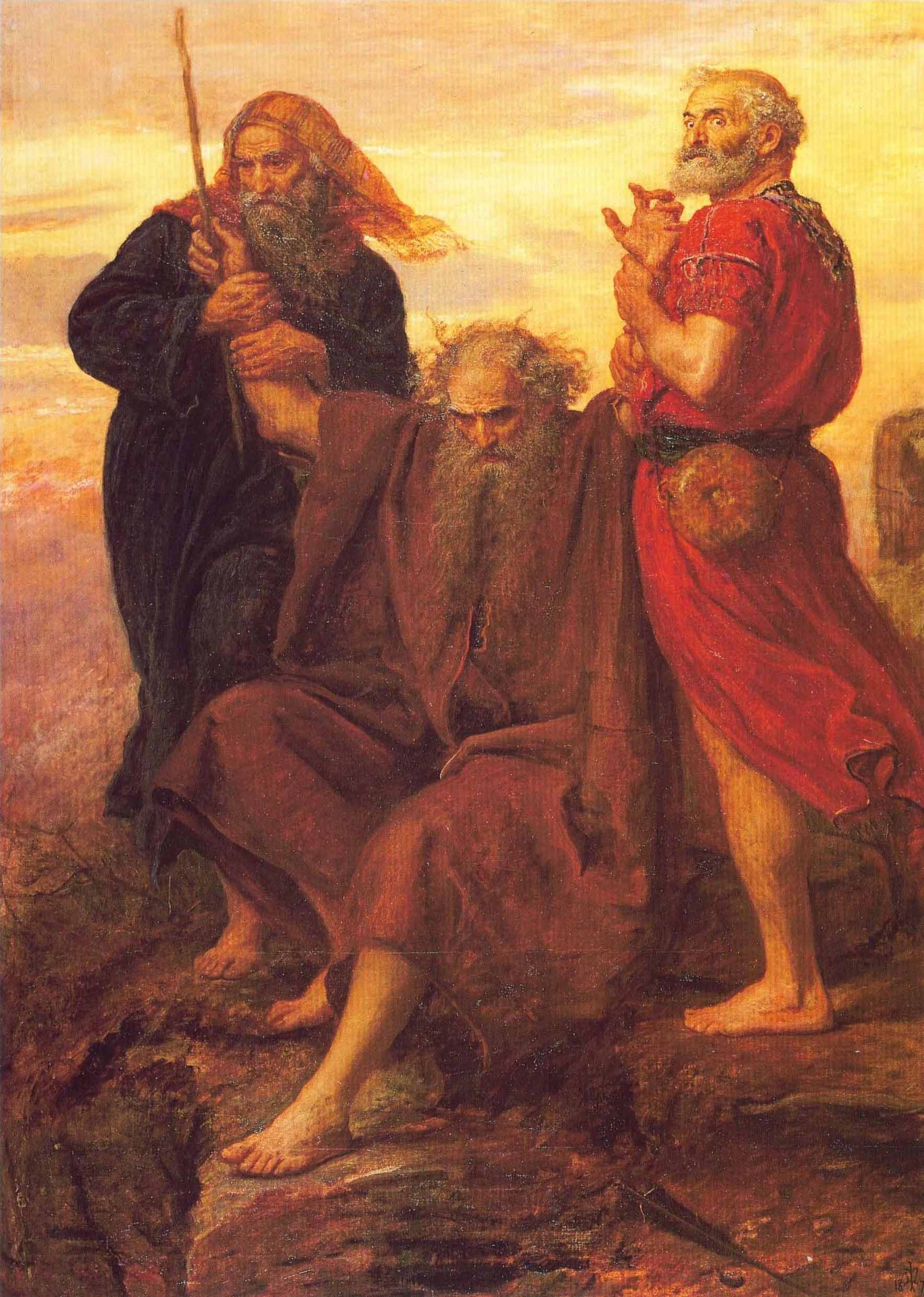
"10 So Joshua fought the Amalekites as Moses had ordered, and Moses, Aaron and Hur went to the top of the hill. 11 As long as Moses held up his hands, the Israelites were winning, but whenever he lowered his hands, the Amalekites were winning.
12 When Moses' hands grew tired, they took a stone and put it under him and he sat on it. Aaron and Hur held his hands up -- one on one side, one on the other -- so that his hands remained steady till sunset. 13 So Joshua overcame the Amalekite army with the sword." (Exodus 17:8-11)
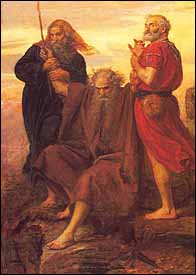 John Everett Millais (English Pre-Raphaelite painter, 1829-1896), "Victory, O Lord" (1871), oil on canvas, Manchester City Gallery. It pictures Aaron and Hur holding up Moses' hands until the battle is won. Larger image. |
Just like for the plagues on Egypt, parting the waters of the Red Sea, and bringing water from a rock, the "Rod of God" is used in battle to direct God's power against the enemy. It is a sign of lifting up his hands to God's throne, seeking God's might (Exodus 17:16a).
The leadership lesson is that sometimes we need others to help us as we lead and sustain us as we serve God. Moses allowed Aaron and Hur to keep his hands lifted up throughout the long battle. Rather than being a lonely mission, leadership is better accomplished by a leadership team working towards a single objective.
Yahweh Is My Banner (Exodus 17:15-16a)
Moses' staff serves as a rallying signal to the troops fighting below. The "Staff of God" becomes the name of an altar that Moses builds to commemorate the victory.
"Moses built an altar and called it The LORD is my Banner. He said, 'For hands were lifted up to the throne23 of the LORD.'"(Exodus 17:15-16a)
Banner is the Hebrew noun nēs (nissi is the first person possessive, "my banner"). It is apparently derived from a root meaning "raised, displayed, prominent. "It means "signal pole, standard, ensign, banner, sign" used in war to signal the troops and rally them in battle.2 In this instance, perhaps "signal pole" might be a better translation than "banner," because Moses was using his rod as a rallying point for the troops. But since troops in all but the most modern warfare used flags as rallying points, perhaps "banner" conveys the idea effectively to our time.
You may remember the story of Francis Scott Key's
national anthem,
"The Star Spangled Banner." In the War of 1812, battle raged as a British
warship shelled one broadside after another against Fort McHenry defending
Baltimore. It wasn't immediately apparent to Francis Scott Key if the
American fort had been taken or not, whether or not the colors had been
struck. Finally, from the light of battle he could see that the flag still
flying:
".... And the rockets' red glare, the
bombs bursting in air,
Gave proof through the night that our flag was still there."
It's that kind of sentiment that Moses expressed toward Yahweh himself at the battle with the Amalekites. Of course, Yahweh-nissi was a name given to an altar, not a name used to address God in Scripture. But the name is closely associated with Yahweh, in that it describes one of his characteristics -- Yahweh my banner, the one I look to in battle as my rallying point. The staff in Moses' hands, the "rod of God" was that pole or standard lifted high that won the battle for Israel -- Yahweh-nissi.
C. Jethro (Exodus 18)
Jethro Learns about Yahweh (Exodus 18:1-12)
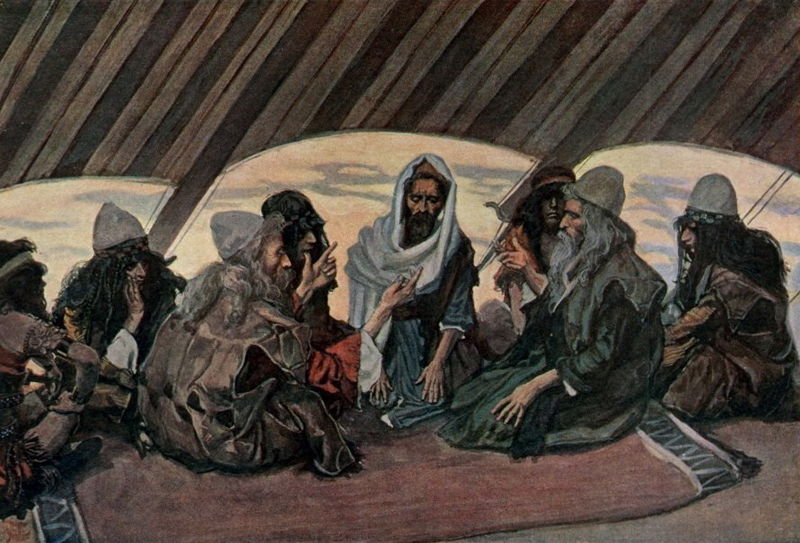
Having heard how God had delivered Israel from Egypt, Moses' father-in-law Jethro comes to meet him near Mt. Sinai. Moses tells him the exploits of Yahweh to deliver the people and Jethro comes to faith in Yahweh.
"10 He said, 'Praise be to the LORD, who rescued you from the hand of the Egyptians and of Pharaoh, and who rescued the people from the hand of the Egyptians.
11 Now I know that the LORD is greater than all other gods, for he did this to those who had treated Israel arrogantly.'" (Exodus 18:10-11)
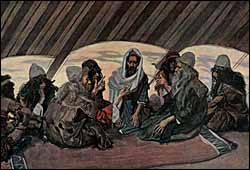 James J. Tissot, "Jethro and Moses" (1896-1900), watercolor, Jewish Museum, New York. Larger image. |
"Then Jethro, Moses' father-in-law, brought a burnt offering and other sacrifices to God, and Aaron came with all the elders of Israel to eat bread with Moses' father-in-law in the presence of God." (Exodus 18:12)
Of course, this was before the worship of Yahweh was structured around consecrated priests and worship at the tabernacle and later at the temple. But Jethro, a new convert to Yahweh worship -- through Moses' testimony -- is the priest here, and he leads the sacrifice.
Jethro Teaches Moses to Delegate Responsibility (Exodus 18:13-27)
Perhaps the most obvious leadership lesson in the Bible is the one Moses learns from his father-in-law Jethro. It begins, as with many of our lessons, by observations on how difficult our task as leaders seems to be. Jethro watches as Moses fulfills his responsibility to bring justice as cases are brought before him as leader.
Why did Moses do this all by himself? Tradition. Acting as judge was a common role that kings performed in many ancient Near Eastern cultures. King David performed this role (2 Samuel 15:2) as did Solomon (1 Kings 3:16-28). Allowing access to the top ruler was a wonderful tradition. But in an unorganized government, it was consuming and draining. Jethro tells him:
"17b What you are doing is not good. 18 You and these people who come to you will only wear yourselves out. The work is too heavy for you; you cannot handle it alone.
19 Listen now to me and I will give you some advice, and may God be with you. You must be the people's representative before God and bring their disputes to him. 20 Teach them the decrees and laws, and show them the way to live and the duties they are to perform." (Exodus 18:17b-20)
He is suggesting a role-change for Moses. Instead of being the main judge, he is to become the top judge in a judicial infrastructure. Moses is to teach the law and train capable people who can then judge run-of-the-mill cases.
"21 But select capable men from all the people -- men who fear God, trustworthy men who hate dishonest gain -- and appoint them as officials over thousands, hundreds, fifties and tens. 22 Have them serve as judges for the people at all times, but have them bring every difficult case to you; the simple cases they can decide themselves. That will make your load lighter, because they will share it with you.
23 If you do this and God so commands, you will be able to stand the strain, and all these people will go home satisfied." (Exodus 18:21-23)
Notice the qualifications in verse 21.
- Capable.
- God-fearing, that is, those who revere God.
- Honest, trustworthy, who not only refuse bribes, but hate the very idea.
- Accountable. They share the task with Moses, rather than displacing him. Moses remains the ultimate judge in the system.
Learning to Delegate
It's not uncommon for Christian leaders to have a Messiah-complex and think that they are indispensable. It feels good to the ego to be needed! Such leaders feel they must do everything and make all the decisions. But when they do so, they limit the size of their ministry. A single full-time pastor can care for perhaps 150 members in a small congregation. But for a church to grow beyond that, the pastor must grow beyond being a shepherd, and learn to be a rancher who gets the work done through ranch hands.
To his credit, Moses didn't respond to Jethro, "What makes you think you know everything? You've never had to lead more than a tribe, let alone a nation! Who do you think you are?" Rather, Moses humbled himself and was able to learn -- even from his father-in-law.
The role of New Testament leaders is not to do the work of ministry all by themselves, but to teach, train, and equip others to do the work of the ministry.
"The gifts he gave were that some would be apostles, some prophets, some evangelists, some pastors and teachers, to equip the saints for the work of ministry, for building up the body of Christ...." (Ephesians 4:11-12, NRSV)
It is important, however, in observing this lesson in delegation, to take note that Moses doesn't abdicate his role as leader, nor does he give up his overall authority. He handles the hard cases. Later, when the tabernacle is being built, Moses delegates the day-to-day construction and direction of craftsmen to Bazalel and Oholiab (Exodus 31:1-6), but Moses is the one who received the vision on the mountain. He is responsible to see that everything is done "exactly like the pattern" that God has shown him (Exodus 25:9, 40). At the end of construction he inspects the work to make sure they followed the instructions that he had received and passed on to them (Exodus 39:43). Delegation requires accountability.
Delegating to the 70 Elders (Numbers 11:10-30)
While we are on the topic of delegating, let's skip ahead to a later time when Moses is struggling again under the burden of leadership. He has delegated the judicial functions of his office, but not the day-to-day execution of decision-making. He is burned out. He hears the people crying for food and just can't handle it any more. He says to the Lord:
"14 I cannot carry all these people by myself; the burden is too heavy for me. 15 If this is how you are going to treat me, put me to death right now -- if I have found favor in your eyes -- and do not let me face my own ruin." (Numbers 11:14-15)
Instead of rebuking him for his petulance, God understands him and lets it pass. He instructs Moses:
"16 Gather for me seventy of the elders of Israel, whom you know to be the elders of the people and officers over them; bring them to the tent of meeting, and have them take their place there with you. 17 I will come down and talk with you there; and I will take some of the spirit that is on you and put it on them; and they shall bear the burden of the people along with you so that you will not bear it all by yourself." (Numbers 11:16-17)
Moses' job is to gather accredited leaders from the various tribes -- people who are recognized leaders -- and gather them together at the tabernacle. God does the rest.
"Then the LORD came down in the cloud and spoke to him, and took some of the spirit that was on him and put it on the seventy elders; and when the spirit rested upon them, they prophesied. But they did not do so again." (Numbers 11:25)
God puts his Holy Spirit on the elders to equip them to share Moses' ministry. But observe that their experience of prophecy (a sign of the coming of the Spirit23 ) was not continuous, but only an initial experience. Moses own experience of God as the nation's prophet (Deuteronomy 34:10) was continuous. When Joshua wants to quench the Spirit on a couple of leaders who didn't make it to the meeting, but who were prophesying in the camp, Moses says poignantly,
"Are you jealous for my sake? I wish that all the LORD's people were prophets and that the LORD would put his Spirit on them!" (Numbers 11:29)
By these words, Moses looks forward to the Day of Pentecost when the Spirit is poured out on all.
The leadership lesson is that we can't do the work of God adequately by just competency and recognition as leaders. We must possess the Spirit of God!
"While staying with them, [Jesus] ordered them not to leave Jerusalem, but to wait there for the promise of the Father. 'This,' he said, 'is what you have heard from me; for John baptized with water, but you will be baptized with the Holy Spirit not many days from now.'" (Acts 1:4-5; cf. Luke 24:49)
We can learn a lot from studying secular leadership. But there's a limit. Secular leadership relies on human wisdom to make decision. Christian leadership combines natural wisdom with listening to what the Holy Spirit says. Christian leadership relies on God's direction and his power to accomplish the task. Never forget that!
|
Q4. (Exodus 18:13-27; Numbers 11:10-30) Why
do you think it took Moses so long to delegate his judicial role to
others? What were the qualifications of these judges? How is Moses' role similar to the role of leaders in Ephesians 4:11-12? What is
the importance of the anointing of the Spirit in Christian
leadership?
|
 Available as an e-book and paperback |
Leadership is never easy -- and sometimes not much fun at all! The leader must take upon himself the loneliness of office, the criticisms of the people, the responsibility to remain steady during the battle, the care of the people, and the task of training and delegating authority to leaders under him. This is why the author of Hebrews says:
"Obey your leaders and submit to their authority. They keep watch over you as men who must give an account. Obey them so that their work will be a joy, not a burden, for that would be of no advantage to you." (Hebrews 13:17)
Prayer
Heavenly Father, we come to you with the heavy task of leading your people. We pray for our leaders. Give them wisdom, faith, stamina, and courage. When they are weak, strengthen them. When they are discouraged, bless them with renewed vision and faith. In Jesus' name, we pray. Amen.
References
1. Sāʿaq, "cry, cry for help, call." The root means, "to call out for help under great distress or to utter an exclamation in great excitement" (John E. Hartley, TWOT #1947).
2. Cole (Exodus, p. 129) cites S.R. Driver, Exodus (1911) who refers to De Lesseps who mentioned that modern Arabs used the barberry bush. Cole says, "No doubt the need was to find some pungent or aromatic shrub whose flavor would cover the mineral taste and make the water palatable."
3. Lîn, TWOT #1097.
4. ʾAnan, "complain, murmur" (BDB 59).
5. Rāgan, "murmur, whisper" is used in two ways in the Old Testament: (1) "murmur (rebelliously)" (Psalm 106:25; Deuteronomy 1:27) and (2) "whisper (maliciously), backbite, slander," used in the Proverbs (BDB 832).
6. The verb qāhal conveys the idea of assembling (without regard to purpose). In the Niphal stem (as here), it carries the reflexive idea of a group assembling themselves (Jack P. Lewis, TWOT #1991). It is used with the preposition 'al, "against."
7. "Quarreled" (NIV, NRSV), "chode" (KJV) is rîb, "strive, contend." The idea of physical combat is primary, but here has transitioned to verbal combat, "to quarrel, to chide one another" (Robert D. Culver, TWOT #2159).
8. "Become impatient" (NIV, NRSV), "be discouraged" (KJV) is qāṣar, "be impatient, vexed, grieved," from a root that means "be short." In some passages the root means "discouragement," "vexation" (Judges 10:16; 16:16; Job 21:4), or "loathing" (Zechariah 11:8 ) (Jack P. Lewis, TWOT #2061).
9. "Grumble" (NIV), "complain" (NRSV), "murmur" is Greek gongyzō, "to express oneself in low tones of disapprobation, grumble, murmur" (BDAG 204, 1).
10. Carl Philip Weber, ḥālâ, TWOT #655 b and c.
11. William White, rāpāʾ, TWOT #2196.
12. "Pot" is sîrâ, "one of six kinds of cooking utensils, spoken of pots, pans, cauldrons, or basins. Probably made of bronze or earthenware" ("Fleshpots," ISBE 2:315). "Meat" (NIV), "flesh" (NRSV, KJV) is bāśār, "animal musculature" (John N. Oswalt, TWOT #291a).
13. "Gravitas," from Latin, "high seriousness (as in a person's bearing or in the treatment of a subject)" (Merriam-Webster's 11th Collegiate Dictionary (1993).
14. Keil and Delitzsch, Exodus, p. 66 (commenting on Exodus 16:10)
15. Childs, Exodus, p. 288.
16. From Greek theos, "God"+ phanō, "to appear." R.K. Harrison, Numbers (Baker, 1992), p. 212; George A.F. Knight, "Theophany," ISBE 4:827-831; M.F. Rooker, "Theophany," DOTP, pp. 859-864.
17. From Hebrew shākan, "settle, dwell, inhabit."
18. G. Lloyd Carr, "Manna," ISBE 3:239-240.
19. "Quarrelled" (NIV, NRSV), "found fault" (RSV), "did chide" (KJV) is rîb, "strive, contend," the root of merîbâ, "strife, contention," that became one of the names for this place in verse 7. The idea of physical combat is primary with this word, but here it carries the idea of verbal combat, "to quarrel, to chide one another" (Robert D. Culver, TWOT #2159 and #2159c).
20. "Put to the test" (NIV), "test" (NRSV), "tempt" (KJV) is nāsâ, which, "in most contexts ... has the idea of testing or proving the quality of someone or something, often through adversity or hardship." It is the root of massâ, which became the other name for the place in verse 7 (Marvin R. Wilson, nāsâ, TWOT #1373 and #1373a).
21. Why "Horeb" appears here is a mystery, since Horeb is usually associated with Mt. Sinai. Rephidim (wherever it was) was the last stop before Mt. Sinai (Exodus 19:1-2; Numbers 33:15; see Exodus 18:5). Perhaps the general area was referred to as Horeb, not just the mountain. We just don't know.
22. However, Israel's leaders don't always listen, as in the period after Pharaoh had rebuffed Moses' initial requests. "Moses reported [God's promises] to the Israelites, but they did not listen to him because of their discouragement and cruel bondage" (Exodus 6:9). At the bad report of the 10 spies, the elders don't rally to support Moses and the Lord. As a result the people spend 38 more years in the desert.
23. Childs, Exodus, pp. 311-312 argues that in verse 16, "throne" (kēs) should be emended to "banner" (nēs) due to a probable textual corruption, in order to make better sense of the verse (adopted by the RSV and NRSV). However as it is read, it is a difficult verse to understand completely.
24. Marvin R. Wilson, nāsas, TWOT #1379a. "In the Old Testament, nēs generally means a rallying point or standard which drew people together for some common action or for the communication of important information. This usually happened on a high or conspicuous place within the camp or community. There, a signal pole, sometimes with an ensign attached, could be raised as a point of focus or object of hope.... Realizing that the LORD was the Banner around which Israel had rallied, Moses called the altar Jehovah-nissi (the LORD is my banner)."
25. 1 Samuel 10:5-6, 10; 19:20-24; Joel 2:28-29; Acts 2:17-18; 10:44-45; 19:6.
Copyright © 2026, Ralph F. Wilson. <pastor joyfulheart.com> All rights reserved. A single copy of this article is free. Do not put this on a website. See legal, copyright, and reprint information.
 To be notified about future articles, stories, and Bible studies, why don't you subscribe to our free newsletter, The Joyful Heart, by placing your e-mail address in the box below. We respect your