|
Old Testament
New Testament
Gospels
Acts
Paul's Letters
General Letters
Revelation
Topical Studies
Beginning the Journey (for new Christians). en Español

|
Old Testament
New Testament
Gospels
Acts
Paul's Letters
General Letters
Revelation
Topical Studies

|
Home
Bible Studies
Articles
Books
Podcasts
Search
Menu
Donate
About Us
Contact Us
FAQ
Sitemap


Free
E-mail Bible Study
 Names and Titles of God
Home | Bible Studies | Articles | Books | Podcasts | Search | Menu | Donate | About Us | FAQ | Contact Us
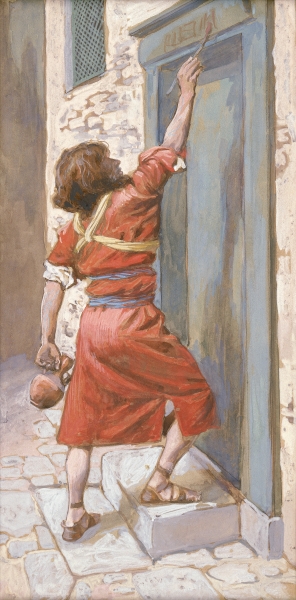
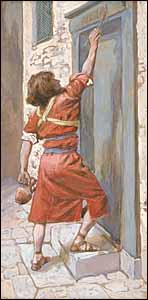 James J. Tissot, "The Signs on the Door" (1896-1900), watercolor, Jewish Museum, New York. Larger image. |
The months of confrontation and plagues have come to a close as an eerie calm seems to exist between Pharaoh and Moses. After nine plagues, Pharaoh has told Moses never to appear before him again. Moses knows that the tenth plague will be the last and will result in Israel's freedom.
A. Passover (Exodus 12:1-28)
A Lamb for Every Household (Exodus 12:1-6)
Now Moses seeks the Lord to get instructions for the final phase of the deliverance from Egypt.
The Lord's instructions are very specific. A male lamb without defect is indicated for every grouping that Passover night. Notice that these lambs are to be selected from the flock several days ahead of time -- ten days after the first day of the month, which began on a new moon.1 The evening of the fourteenth day of the month, then, will be the full moon, characteristic of Passover ever since.
The Blood of the Passover (Exodus 12:7)
The animals are to be slaughtered and then prepared for the Passover meal. But the blood is to be handled in a very special way on this night.
"7 Then they are to take some of the blood and put it on the sides and tops of the doorframes of the houses where they eat the lambs.... 13 The blood will be a sign for you on the houses where you are; and when I see the blood, I will pass over you." (Exodus 12:7, 13)
The word "Passover" is found in Exodus 12:11, 21, 26, 43, 48; 34:25. What does it mean? The word is pesaḥ, is traditionally derived from pāsaḥ, "to pass over," and interpreted as "the merciful passing over of a destructive power."2
What Kind of Sacrifice Is the Paschal Lamb?
Just what kind of sacrifice is the initial Paschal lamb offered prior to the Exodus? Five offerings were performed in the tabernacle and, later, in the temple.3 Of these, the sacrifice of the Passover lamb bears some resemblance to the peace or fellowship offering, in which a piece of meat is offered before the Lord and to the priests. The remainder of the sacrifice is eaten by the offerer and his family as a kind of celebration meal -- similar to the celebration meal of the Passover. The initial Passover offering seems to be a consecration or setting apart of the people within each household who partook of the sacrifice.4
Israel's sin doesn't seem to be in the forefront; rather, the lamb seems to be a kind of substitute or interposition for the firstborn males and animals in the household. However, there may be some idea of expiation or purification present, since hyssop is used to smear the blood (Exodus 12:22).5 Some Rabbinical writings refer to the redemptive effect of the blood of the Passover lamb.6
Christ Our Paschal Lamb
The early church certainly saw Jesus as fulfilling the Passover lamb.
Paul: "Christ, our Passover lamb, has been sacrificed." (1 Corinthians 5:7)
John the Baptist: "Look, the Lamb of God, who takes away the sin of the world." (John 1:29)
Peter: "You were redeemed ... with the precious blood of Christ, a lamb without blemish or defect." (1 Peter 1:18-19)
We Christians are participants in Christ's blood through the Lord's Supper, says St. Paul (1 Corinthians 10:16). And because our names are written in the Lamb's book of life (Revelation 13:8), we are not condemned for our sins (Revelation 20:12, 15). God's wrath "passes over" us! Hallelujah!
|
Q1. (1 Corinthians 5:7;
John 1:29; 1 Peter 1:18-19) In what sense is Christ our Passover
Lamb? In what sense are we marked with his blood? In what sense does
God's judgment pass over us because of Christ's blood?
|
Commemorating the Passover (Exodus 12:14-20)
Passover is of particular interest to Christians because it is the basis of the original Last Supper Jesus had with his disciples on the night in which he was betrayed.7 While our focus is on Moses himself, not all the institutions of Israel, let's look briefly at the elements of Passover contained in our passage.8
- Passover Lamb. As noted above, the Passover or Paschal lamb is sacrificed. In ancient times, before the institution of the Levitical priesthood, each head of the household performed the sacrifice himself. By Jesus' day the slaughter of the Passover lambs took place in the temple by priests. The lamb is a sacrifice, a substitute for the firstborn who is redeemed. In the language of Exodus, the Lord says, "Israel is my firstborn son" (Exodus 4:22), so in a sense, the Passover lamb is a substitute given for all of God's people, Israel. Christ is our Passover lamb (1 Corinthians 5:7), whose blood was shed to redeem us.
- Unleavened Bread. Since this was the Israelites' final meal prior to fleeing from Egypt -- and took place at night before the day's bread was made -- "the people took their dough before the yeast was added, and carried it on their shoulders in kneading troughs wrapped in clothing" (Exodus 12:34). So in commemoration, for a week called the Feast of Unleavened Bread, the Jews remove yeast from their homes and eat unleavened bread (Exodus 12:14-20).
- Bitter Herbs.9 Later Judaism associated the bitter herbs with the hardness of the Israelites' oppression. "They made their lives bitter with hard labor ... the Egyptians used them ruthlessly" (Exodus 1:14).
Passover was to be celebrated year after year as a commemoration or remembrance of the Lord's deliverance. Moses instructed the people:
"And when your children ask you, 'What does this ceremony mean to you?' then tell them, 'It is the Passover sacrifice10 to the LORD, who passed over the houses of the Israelites in Egypt and spared our homes when he struck down the Egyptians.'" (Exodus 12:27)
To this day, every Passover, the youngest child in the household has the responsibility to ask, "Why is this night different from all other nights?" Then the story of God's deliverance is told once again to the next generation. In the same way, the Lord's Supper is to be a feast of remembrance, so that we never forget the Lord's great salvation through the cross.
Final Preparations for Passover Night (Exodus 12:21)
The Lord had given Moses specific instructions for the Passover that he had conveyed to the people. But now the time was at hand. Moses summons the elders for the final instructions.
"21 ... Go at once and select the animals for your families and slaughter the Passover lamb. 22 Take a bunch of hyssop, dip it into the blood in the basin and put some of the blood on the top and on both sides of the doorframe. Not one of you shall go out the door of his house until morning. 23 When the LORD goes through the land to strike down the Egyptians, he will see the blood on the top and sides of the doorframe and will pass over that doorway, and he will not permit the destroyer to enter your houses and strike you down." (Exodus 12:21-23)
Fortunately, "The Israelites did just what the LORD commanded Moses and Aaron" (12:28), as if their lives depended on it -- as they did!
B. Leaving Egypt (Exodus 12:29-36)
The Tenth Plague, the Slaying of the Firstborn (Exodus 12:29-33)
Now came the final plague:
"29 At midnight the LORD struck down all the firstborn in Egypt, from the firstborn of Pharaoh, who sat on the throne, to the firstborn of the prisoner, who was in the dungeon, and the firstborn of all the livestock as well. 30 Pharaoh and all his officials and all the Egyptians got up during the night, and there was loud wailing in Egypt, for there was not a house without someone dead." (Exodus 12:29-30)
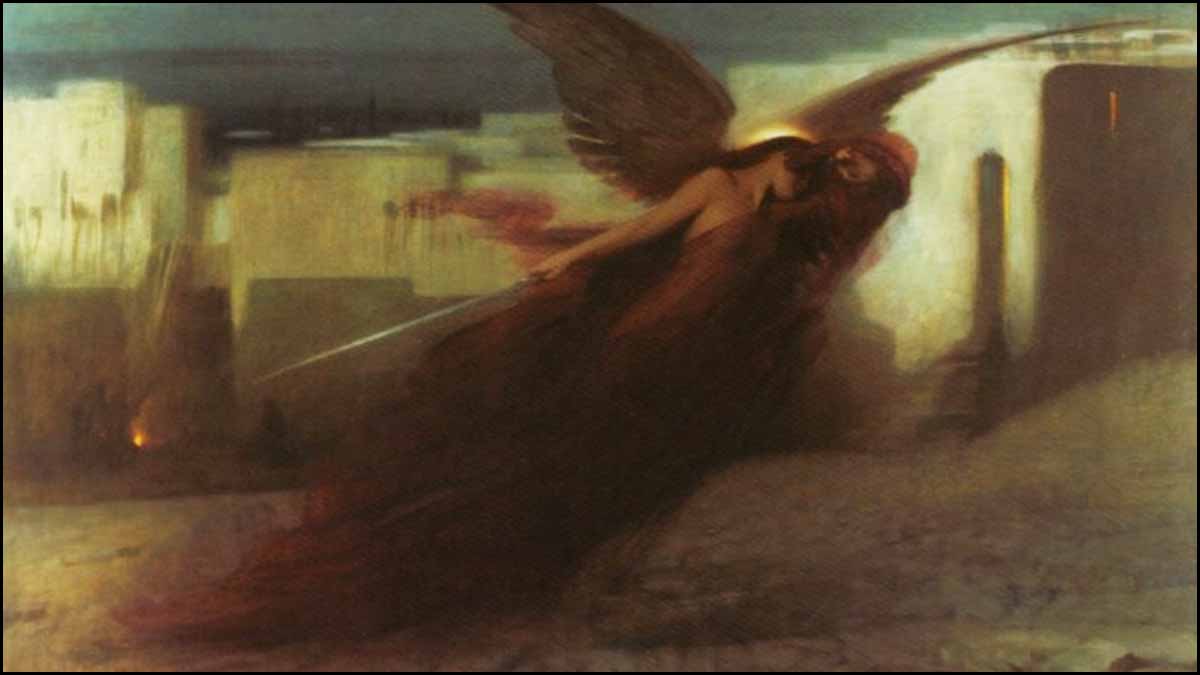
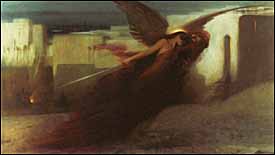 Arthur Hacker (English Pre-Raphaelite painter, 1858-1919), "And There Was a Great Cry in Egypt" (1897), oil on canvas, 90.2 x 153.7 cm, private collection. Larger image. |
The slaughter was carried out by "the destroyer," 11 elsewhere referred to as the "angel of the Lord"12 or the destroying angel.13 This figure was later popularized in Judaism and Christianity as the "angel of death."
No Egyptian household was untouched that night, not even Pharaoh's. Pharaoh summons Moses and commands the Israelites to leave immediately with all their flocks and herds. You can sense the pain in his poignant request, "and also bless me" (12:32b).
Plundering the Egyptians (Exodus 12:35-36)
Among the Israelites, no son had been lost. They were fed, packed, and ready to leave. So when the word came, there was just one more thing to do.
"35 The Israelites did as Moses instructed and asked the Egyptians for articles of silver and gold and for clothing. 36 The LORD had made the Egyptians favorably disposed toward the people, and they gave them what they asked for; so they plundered14 the Egyptians." (Exodus 12:35-36)
It might seem crass to ask families in the middle of the night, families that are in deep mourning for their sons, to give them jewelry, gold, and garments. But to the Egyptians, that was a small price to pay to get rid of this people, who were seen as the reason that Egypt was being ruined, and so they gave their valuables and the Israelites left.
But this had been God's plan from the beginning when he had told Abraham (Genesis 15:13-14) and later Moses (Exodus 3:21-22) that this would come to pass. Perhaps the justice was that the Egyptians, who had bled the Israelites dry with slavery and hard labor, now paid them back at the last. And God had a use for the gold and silver, for it would later be given to decorate the tabernacle in the wilderness!
C. On the Move (Exodus 12:37-51)
The Israelites Begin Their Journey (Exodus 12:37-40)
Now the long-anticipated Exodus begins. Read carefully this paragraph:
"7 The Israelites journeyed from Rameses to Succoth. There were about six hundred thousand men on foot, besides women and children. 38 Many other people went up with them, as well as large droves of livestock, both flocks and herds.... 40 Now the length of time the Israelite people lived in Egypt was 430 years. 41 At the end of the 430 years, to the very day, all the LORD's divisions left Egypt. 42 Because the LORD kept vigil that night to bring them out of Egypt, on this night all the Israelites are to keep vigil to honor the LORD for the generations to come." (Exodus 12:37-42)
We learn several things from this paragraph.
- Route. The Israelites were primarily living in the area around the store-city of Rameses and travelled to Succoth. We examine their what we think was their route in greater detail in Appendix 2.
- Number of Israelites. The text indicates 600,000 men, plus women and children. That probably means upwards of 2 million people were involved in the Exodus. While some have questioned the plausibility of this number, we'll use it for our study.
- Time in Egypt. This completed 430 years from the time Jacob entered Egypt, corresponding to the 400 years God had told Abraham (Genesis 15:13). Probably for about 30 years when Joseph was ruler, the Israelites were treated well.
- God's army. In the phrase "all the LORD's divisions left Egypt" we see a word that relates to armies (cf. Exodus 7:4;12:51).15 The narrator tells us, "The Israelites went up out of Egypt armed for battle" (13:18b). Their weapons may have been primitive compared to the Egyptians -- probably mainly staffs -- but they went out with a warrior spirit, not as slaves "with their tail between their legs."
- Heterogeneous group.16 Not only Israelites left Egypt, but with them large numbers of other oppressed peoples. Later these "rabble" cause some trouble (Numbers 11:4; Leviticus 24:10-11).17
- Night Watch. Notice how this paragraph concludes; "the LORD kept vigil that night to bring them out of Egypt" (12:42).18 The Lord took great care to pass over or to guard his people from the destroyer and bring them through what must have been a terrifying night!
The Lord Brought the Israelites Out of Egypt (Exodus 12:50-51)
Exodus chapter 12 ends with these two verses:
"50 All the Israelites did just what the LORD had commanded Moses and Aaron. 51 And on that very day the LORD brought the Israelites out of Egypt by their divisions." (Exodus 12:50-51)
The people's deliverance is founded on two elements mentioned in verse 50:
- Moses and Aaron obeyed what God had commanded them.
- The people obeyed what Moses and Aaron commanded them.
The KJV renders the Hebrew quite literally:
"Thus did all the children of Israel; as the LORD commanded Moses and Aaron, so did19 they." (Exodus 12:50, KJV)
Very often in the Pentateuch, the people are expected to act on, follow through on, obey what God has said. It is the key to receiving God's blessing.
Leaders must listen to God for direction and then act on that direction. But a real kind of "followership" is required of the people, too. When they recognize and follow Moses, God blesses them. But when they bicker and balk and refuse to recognize God's leadership behind Moses, disaster follows. We leaders can blame ourselves for people not following us -- and sometimes it is our fault from impatience and lack of skill in leading -- but ultimately, following God-appointed leaders is the people's responsibility. We cannot do that for them.
|
Q2. (Exodus 12:50) Why was obedience so important to the
people's deliverance? Why is obedience so important to our
deliverance from "sin, the flesh, and the devil"? Is there any
discipleship without obedience? Does a person who says he believes
in Jesus but doesn't obey him have real
faith?
|
The Pillar of Cloud and the Pillar of Fire (Exodus 13:21-22)
Up until now the people of Israel saw the mighty plagues in response to Moses' meetings with Pharaoh and they obeyed his commands for preparation, for Passover, for asking for jewelry from their neighbors, and for the actual embarkation. But for the next part of the journey, Moses is not their only guide. There is a pillar of cloud by day, and a pillar of fire by night.
"21 By day the LORD went ahead of them in a pillar of cloud to guide them on their way and by night in a pillar of fire to give them light, so that they could travel by day or night. 22 Neither the pillar of cloud by day nor the pillar of fire by night left its place in front of the people." (Exodus 13:21-22)
"Pillar" is ʿammûd, "pillar, column, post," a common word for the pillars supporting buildings, from the verb ʿāmad, "to stand."20 We see it mentioned a number of places in the Pentateuch and referred to elsewhere in the Bible.21 We'll discuss it more later.
You and I would often like the clarity of this pillar, to both authenticate our ministry before others and to set the direction clearly for the people. But as the story of the Exodus unfolds, we observe that the continual presence of this pillar of cloud and fire in the camp of Israel doesn't mean that Moses' leadership was easy. The people grumbling against Moses was actually a grumbling against the Lord, whom Moses represented (Exodus 16:8; See 1 Samuel 8:7-8).
The Desert Route (Exodus 13:17-18a)
But God didn't lead them on the easiest path! By far the fastest and direct route between Egypt and Canaan is north to the Mediterranean Sea, and then along a well-developed road on the Philistine coast, technically, the north Sinai Mediterranean coast road. If the Israelites were to travel 10 miles a day, they could have reached Canaan in just a few days.
However, the well-traveled Road to the Philistines had two drawbacks:
- The presence of military garrisons. Since this road was the most natural place that Egypt's enemies would use to invade the country, it was heavily fortified.22 To travel along the "easiest" route would guarantee that the Israelites would "face war."
- Nation-building time needed. After 400 years in Egypt, and the final years in forced slavery, Israel was not a unified nation, but a loosely confederated group of twelve tribes led by elders. Before Israel would be ready to enter the Promised Land and conquer its inhabitants, it would have to meet God, submit to his leadership, and learn to work together under the leadership of an overall leader: Moses and, later, Joshua. You can't shortcut the time it takes to mature.
Location of the Red Sea (yām sûp)
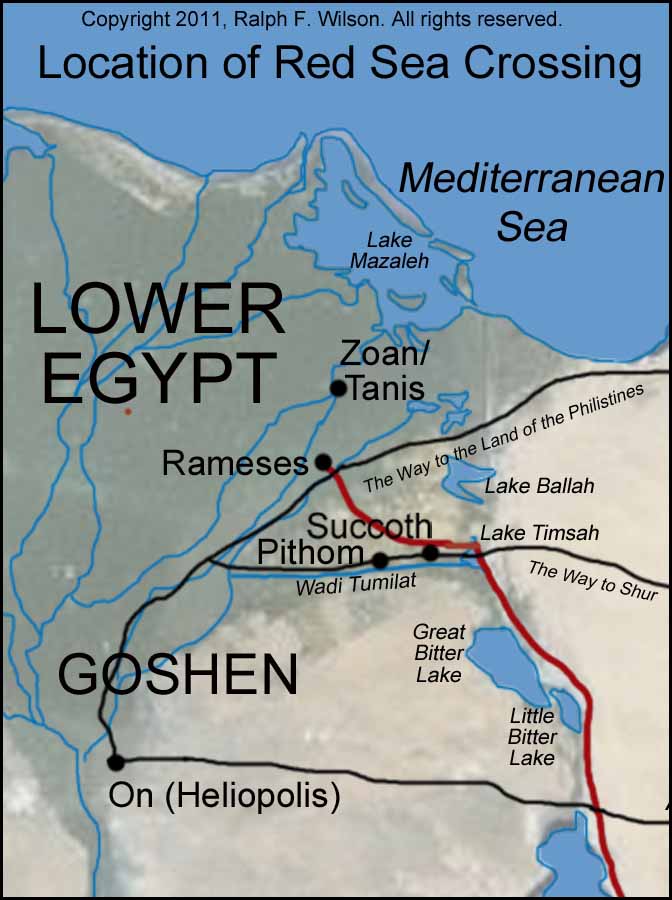
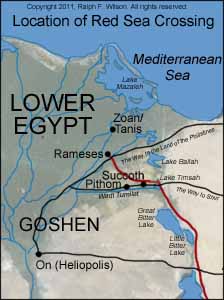 Proposed route of the Exodus and 'Reed Sea' crossing from Rameses to the Red Sea. Larger image. |
We just don't know the exact location of the body of water identified in the text as the "Red Sea," since the Hebrew phrase yām sûp is a term used in the Old Testament to identify a number of different bodies of water. Yām is used in the Old Testament over 300 times to refer to "sea" and about 70 times for "west" or "westward."23 The word sûp means "reed, waterplant," a general term for marsh plants.24
No doubt the "Red Sea" (literally "Reed Sea," yām sûp) refers to some body of water east of the Nile delta, probably either at Lake Timsah or at the Great Bitter Lake, both of which lie along the present route of the Suez Canal. You can explore this further in Appendix 2 - The Route of the Exodus.
D. Pharaoh Pursues (Exodus 14:1-14)
Encamping West of the Sea (Exodus 14:1-4)
"1 Then the LORD said to Moses, 2 'Tell the Israelites to turn back.... They are to encamp by the sea.... 3 Pharaoh will think, 'The Israelites are wandering around the land in confusion, hemmed in by the desert.' 4 And I will harden Pharaoh's heart, and he will pursue them." (Exodus 14:1-4a)
It's fascinating to see Yahweh's strategy: to have the Israelites "turn back" (NIV, NRSV), "turn" (KJV)25 in order to appear that they are confused and directionless, a tempting target to attract the ruthless and hardhearted Pharaoh and his armies.
If Moses were to use Israel as bait, we would call it irresponsible, since his main task would be to deliver the people of Israel from Egypt in the fastest possible way. But for Yahweh to do so, with his pillar of cloud and fire to lead them, it is entirely appropriate. Yahweh is not risking the people, but he has an additional objective: to humble Pharaoh and the gods of Egypt in the process of delivering the Israelites.
Pharaoh Rises to the Bait (Exodus 14:5-9)
As devastated as Egypt has become through the Ten Plagues, Pharaoh can't resist bringing the Israelites back. He and his officials are greedy.
"The LORD hardened the heart of Pharaoh king of Egypt, so that he pursued the Israelites, who were marching out boldly.26 The Egyptians -- all Pharaoh's horses and chariots, horsemen and troops -- pursued the Israelites and overtook them...." (14:8-9)
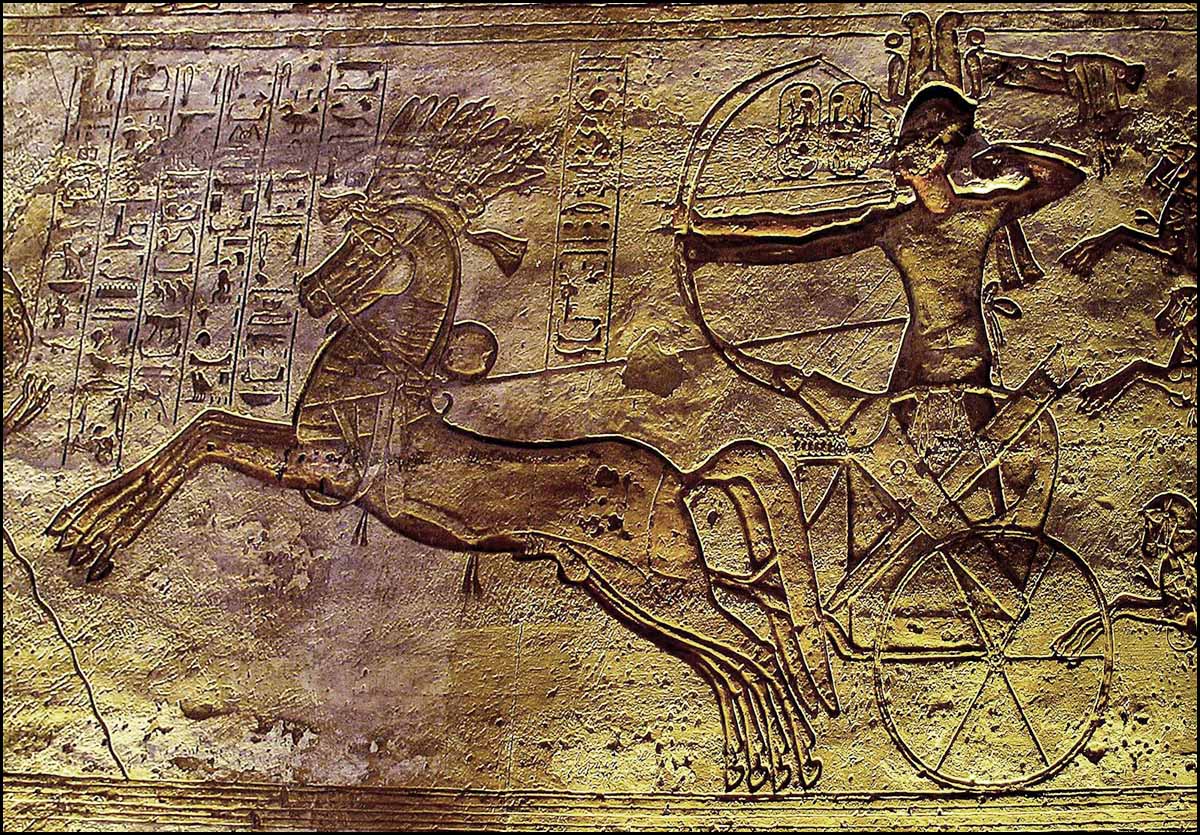
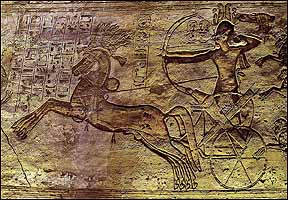 Rameses II and chariot at the Battle of Kadesh (1274 BC). Relief inside his Abu Simbel temple, Nubia, Southern Egypt. Larger image. |
A chariot army is a terrifying weapon of war in ancient Egypt. While chariots aren't very useful in the Judean hills that the Israelites will eventually claim as their homeland, they are chillingly effective in the flat delta plain of Egypt, as well as the flat coastal plains bordering the Mediterranean.
In a field action, a chariot division usually delivered the first strike, to be followed by infantry advancing to exploit a tactical success. The largest chariot battle ever fought took place about 1274 BC at the Battle of Kadesh in Syria, when Rameses II attacked the Hittites, a battle involving perhaps 5,000 to 6,000 chariots.
An Egyptian light chariot contained one driver and one fighter, usually armed with a bow. The chariot is fast and deadly -- all of the fear factor of cavalry, but with the added accuracy of a stable shooting platform, with room to store additional arrows (and short spears when the arrows were exhausted).
Blaming the Leader -- Again! (Exodus 14:10-12)
Pharaoh's pairs of horses thundering towards the Israelites threw them into panic.
"10 As Pharaoh approached, the Israelites looked up, and there were the Egyptians, marching after them. They were terrified and cried out to the LORD.
11 They said to Moses, 'Was it because there were no graves in Egypt that you brought us to the desert to die? What have you done to us by bringing us out of Egypt? 12 Didn't we say to you in Egypt, "Leave us alone; let us serve the Egyptians"? It would have been better for us to serve the Egyptians than to die in the desert!'" (Exodus 14:10-12)
To their credit, the Israelites "cried out to the LORD" (14:10b) as they had during their oppression in Egypt (2:23-24). But they make the mistake of blaming their leader for the problem -- as if Moses is leading on his own, rather than following carefully what the Lord tells him to do. They say:
- Since we have to die, we would rather die in Egypt where we were comfortable, rather than in this desolate desert.
- We told you to leave us alone, but you wouldn't listen.
- It would have been better to remain slaves than die in the desert.
I learned a lesson very early in my ministry, that when people praise me I must understand that they are praising God working within me -- and that I must pass that praise onto him, rather than keep it for myself to puff me up. What it has taken me much longer to learn is that, if I am leading for God, people's criticisms of me are actually criticisms of God's leadership through me -- and that I must pass that criticism on to him and not keep it for myself to eat at me.
Moses Encourages the People (Exodus 14:13-14)
Moses doesn't waste his time answering their petty criticisms. Instead, he reaffirms to them the Lord's victory and tells them how to respond:
"13 Moses answered the people, 'Do not be afraid. Stand firm and you will see the deliverance the LORD will bring you today. The Egyptians you see today you will never see again. 14 The LORD will fight for you; you need only to be still.'" (Exodus 14:13-14)
This is one of the classic encouragements in the entire Bible! Notice that Moses offers three commands (to direct their activity) and makes three faith assertions (to bolster their faith).
Commands:
- Do not be afraid. Fear is their central weakness. We see this command especially on the lips of angels and Jesus in the Gospels.
- Stand firm.27 The opposite would be to run from the opposing army's forces. Recall Paul's command:
-
"Put on the full armor of God, so that when the day of evil comes, you may be able to stand your ground, and after you have done everything, to stand. Stand firm then...." (Ephesians 6:13-14a)
- Be still.28 Stop whining!
Faith Assertions:
- You will see the deliverance29 the Lord will bring.
- You won't see the Egyptians ever again.
- The Lord will fight30 for you!
Moses' ministry here is one of command and of reassurance -- making faith statements in the hearing of the people so they would believe God rather than be panicked by their situation.
Again and again we see this theme: the Lord does battle on behalf of
Israel.31 What is unique here is that the Israelites themselves don't have to fight at
all -- all the fighting is done by the Lord. In most cases, however, the
Israelites fight, but have a power-assist from the Most High God. When the
Israelites have crossed the Red Sea, this theme is celebrated in a mighty
song, declaring, "Yahweh is a warrior" (Exodus 15:3).
|
Q3. (Exodus 14:11-14)
Why do the people blame Moses for the advancing Egyptian army? What
motivates their fear? Who are the people really blaming? How does
Moses respond to their blame and fear? Why doesn't Moses defend
himself from their unfair criticism? How do the people respond to
Moses' words?
|
E. Crossing the Red Sea (Exodus 14:15-31)
The People March through the Red Sea (Exodus 14:15-16, 21-22)
After comforting and encouraging the people, Moses has been crying out to God himself in intercessory prayer.
"15 Then the LORD said to Moses, 'Why are you crying out to me? Tell the Israelites to move on. 16 Raise your staff and stretch out your hand over the sea to divide the water so that the Israelites can go through the sea on dry ground.'" (Exodus 14:15-16)
Dear friends, there is a time a time for everything (Ecclesiastes 3:1-8) -- a time to pray and cry out to God, and a time to act decisively in order that the prayer might be answered. A time to take your stand, and a time to move on. This is such a time!32
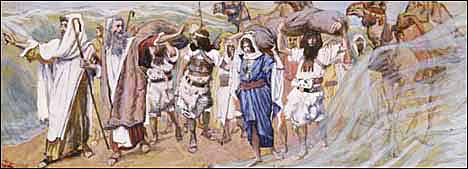
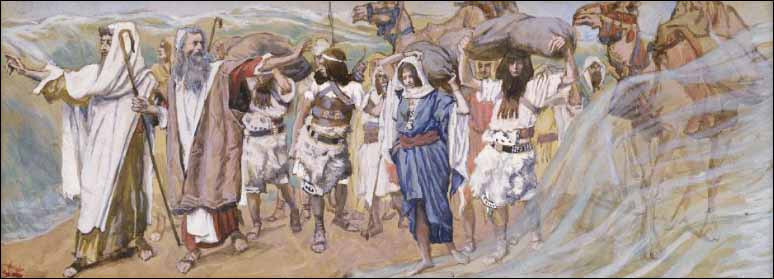
James
J. Tissot, "The Waters Are Divided" (1896-1900), watercolor, Jewish
Museum, New York.
Larger
image.
When Moses lifts his staff, an extension of his hand (14:16, 21, 27), God acts by moving the "angel of God" to a position between Israel and her enemies:
"19 Then the angel of God, who had been traveling in front of Israel's army, withdrew and went behind them. The pillar of cloud also moved from in front and stood behind them, 20 coming between the armies of Egypt and Israel. Throughout the night the cloud brought darkness to the one side and light to the other side; so neither went near the other all night long." (Exodus 14:19-20)
An unseen angel33 of God has been protecting them. Notice in verse 19 that the angel is differentiated from the pillar of cloud and fire, though the pillar follows the angel. The pillar effectively separates the two armies during the night, serving as darkness to the Egyptians and light to the Israelites.
At Moses' gesture with his hand (and staff, see verse 16), "a strong east wind," presumably off the desert to the east, divides the water with a wall of water on each side (14:21-22). How a normal wind could make a wall34 of water to the right and left, we just don't know. Perhaps this is a kind of narrow, directed blast. If these were reedy salt marshes with a soft bottom, the wind would serve to dry them out enough so that the Israelites could cross without sinking into the muck.35 Like other miracles that are one-of-a-kind events that God brings about, it's difficult to describe them in terms of things we understand.
Gaining Glory over the Egyptians (Exodus 14:4, 17-18)
One of the themes of this part of Exodus is God "gaining glory" or "getting honor" over the Egyptians. It's a difficult concept for us to grasp, but since it is central here and elsewhere in the Old Testament, let's spend some time to understand it.
"And I will harden Pharaoh's heart, and he will pursue them. But I will gain glory for myself through Pharaoh and all his army, and the Egyptians will know that I am the LORD." (Exodus 14:4)
"17 I will harden the hearts of the Egyptians so that they will go in after them. And I will gain glory through Pharaoh and all his army, through his chariots and his horsemen. 18 The Egyptians will know that I am the LORD when I gain glory through Pharaoh, his chariots and his horsemen." (Exodus 14:17-18)
The Exodus may seem to us to be about delivering a large group of people from slavery. But if that's all we see, we're missing an important theme -- the glory of Yahweh. This verb "gain glory" (NIV, NRSV), "get honor" (KJV) is the verb kābēd, here in the Niphal stem. The basic meaning of the root is "to be heavy, weighty," extending to the figurative idea of a "weighty" person in society, someone who is honorable, impressive, noteworthy, worthy of respect. Common translations are to be "honorable, honored, glorious, glorified."36
Up to the time of Moses, the name Yahweh had been relatively unknown (Exodus 6:2-3). When Moses tells Pharaoh that Yahweh says, "Let my people go," Pharaoh replies, "Who is Yahweh, that I should obey him and let Israel go? I do not know Yahweh and I will not let Israel go." (Exodus 5:2).
According to the Egyptian religion, Pharaoh himself is a god; why should he give any regard to the supposedly inferior God of his slaves? Pharaoh mocked the Lord! His heart was arrogant and hard towards God. But after his army's Red Sea disaster, he mocked no more.
We humans often view the pursuit of glory as vain and unworthy; we must be humble. However, God is divine! He is King of the universe! For a petty Pharaoh to defy the Living God must be answered with power, or God's reputation will not be respected among the nations.
More than that, unless Yahweh soundly defeats the Egyptian oppressors, he cannot gain the full faith and allegiance of his people. They have lived under slavery and oppression for hundreds of years. They have been beaten into submission and have a low view of themselves and their God compared to their respect for Egypt and its gods that seem superior. The revelation of God's glory in defeating Egypt is important for the sake of the Egyptians and the Israelites.
But seeing God's glory demands responsible action from the people. Later, when the people of Israel balk at entering the Promised Land, God tells them.
"21 As surely as I live and as surely as the glory of the LORD fills the whole earth, 22 not one of the men who saw my glory and the miraculous signs I performed in Egypt and in the desert ... will ever see the land I promised on oath to their forefathers. No one who has treated me with contempt will ever see it." (Numbers 14:21-23)
God's awesome glory demands faith and obedience!
Leaders, too, have a responsibility in the face of God's glory. We must not take it for ourselves. Through Isaiah, the Lord says:
"I am the LORD; that is my name!
I will not give my glory to another
or my praise to idols." (Isaiah 42:8)
"For my own sake,
for my own sake, I do this.
How can I let myself be defamed?
I will not yield my glory to another." (Isaiah 48:11)
Twice, in Exodus, we see the term "my glory" (Exodus 29:43; 33:22). It is not ours, but God's. When he acts powerfully through our ministries, we must acknowledge that the power is his, not ours.
We ourselves are created to glorify God. That is our purpose.
"... Everyone who is called by my name,
whom I created for my glory,
whom I formed and made." (Isaiah 43:7)
"... in order that we, who were the first
to hope in Christ,
might be for the praise of his glory." (Ephesians 1:12)
"And I, because of their
actions and their imaginations,
am about to come and gather all nations and tongues,
and they will come and see my glory.
I will set a sign among them,
and I will send some of those who survive to the nations ...
that have not heard of my fame or seen my glory.
They will proclaim my glory among the nations." (Isaiah 66:18-19)
"Father, I want those you have given me
to be with me where I am, and to see my glory,
the glory you have given me
because you loved me before the creation of the world." (John 17:24)
"What if he did this to make the riches of his glory known to the objects of his mercy, whom he prepared in advance for glory" (Romans 9:23)
|
Q4. (Exodus 14:4,
17-18) Why is God's glory important in the Exodus? How is
recognition of his glory important to faith? To holiness? To
reverence? What happens when leaders take for themselves the credit
and glory that should go only to God? How can leaders keep
themselves from pride?
|
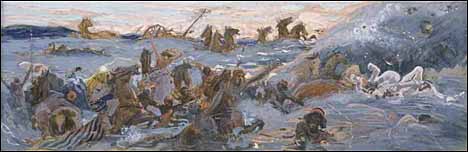
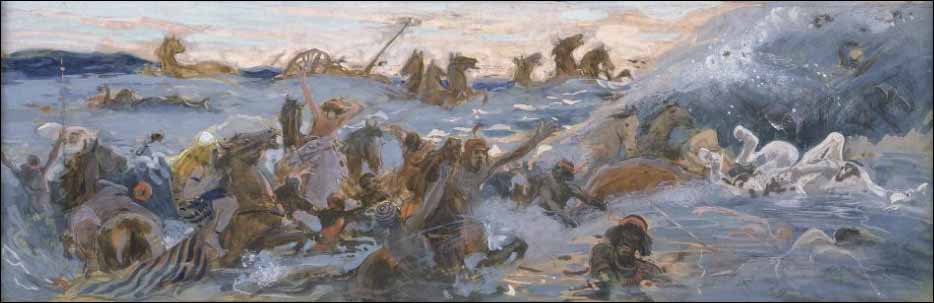
James
J. Tissot, "The Egyptians Are Destroyed" (1896-1900), watercolor,
Jewish Museum, New York.
Larger
image.
The Destruction of Pharaoh's Army (Exodus 14:23-30)
Now the Egyptians' stubbornness and hard hearts cause their doom.
"24 During the last watch of the night the LORD looked down from the pillar of fire and cloud at the Egyptian army and threw it into confusion. 25 He made the wheels of their chariots come off so that they had difficulty driving. And the Egyptians said, 'Let's get away from the Israelites! The LORD is fighting for them against Egypt.'
... 27 Moses stretched out his hand over the sea, and at daybreak the sea went back to its place. The Egyptians were fleeing toward it, and the LORD swept them into the sea.... 30 That day the LORD saved Israel from the hands of the Egyptians, and Israel saw the Egyptians lying dead on the shore." (Exodus 14:24-25, 27, 30)
Look what result this had on the Israelites:
"And when the Israelites saw the great power the LORD displayed against the Egyptians, the people feared the LORD and put their trust in him and in Moses his servant." (Exodus 14:31)
Why did the Lord wipe out so many Egyptian soldiers in this operation? Four answers may help us:
- Protection. So long as Pharaoh's army is intact, the Israelites are not safe from attack. God has crushed their enemy.
- Glory. Until now, Pharaoh and the Egyptians had acted disrespectfully towards God. No more. Yahweh is now honored and glorified as a great God who has defeated the gods of Egypt.
- Faith. The people of Israel themselves had believed in the might of Egypt over Yahweh's ability to save them. Now they "feared the LORD and put their trust in him" (Exodus 14:31). The Lord is engaged in nation-building. To have people trust in their God is the first step in making a covenant with him at Mt. Sinai.
- Leadership. Moses, too, benefits from God's visible power. As the Lord's servant, the people trust in him, as well. He is now able to lead more effectively than before.
F. Celebration (Exodus 15:1-21)
The Song of Moses (Exodus 15:1-19)
Chapter 15 begins, "Then Moses and the Israelites sang this song to the LORD...."What follows is a poetic psalm, much like the psalms in our Book of Psalms, that show all the elements of Hebrew poetry.37 We can't cover it all, but here are the main elements. It begins:
"I will sing to the LORD,
for he is highly exalted.38
The horse and its rider39
he has hurled into the sea.
2 The LORD is my strength and my song;
he has become my salvation.
He is my God, and I will praise him,
my father's God, and I will exalt him." (15:1-2)
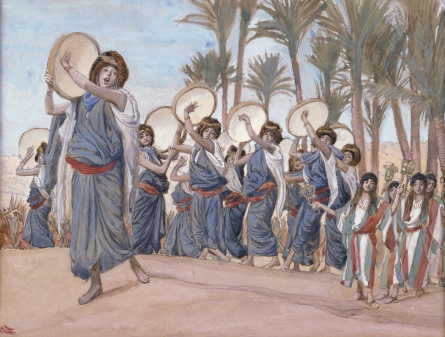
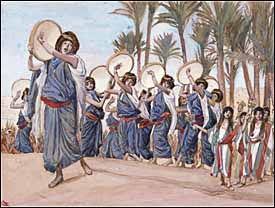 James J. Tissot, "The Songs of Joy" (1896-1900), watercolor, Jewish Museum, New York. Larger image. |
The next stanza praises Yahweh as a great warrior, and recounts his exploits over Egypt's army. What follows is a reflection on this unique, one-of-a-kind God who has given victory:
"11 Who among the gods is like
you, O LORD?
Who is like you --
majestic40 in holiness,
awesome41 in glory,42
working wonders43 ?
12 You stretched out your
right hand
and the earth swallowed them.
13 In your unfailing love44
you will lead the people you have redeemed.45
In your strength you will guide46 them to your holy dwelling."
(15:11-13)
The song concludes looking forward to entering the Promised Land and arriving at God's dwelling place. In its final line it praises the Lord who will reign forever as the King of Israel:
"The LORD will reign47 for ever and ever." (15:18)
The Song of Miriam (Exodus 15:20-21)
 Available as an e-book and paperback |
The section concludes with a song sung by the women and led by Moses' sister Miriam, who is called "the prophetess" here, recapping the first two lines of the Song of Moses (15:1-2)
20 Then Miriam the prophetess, Aaron's sister, took a tambourine in her hand, and all the women followed her, with tambourines and dancing. 21 Miriam sang to them:
"Sing to the
LORD,
for he is highly exalted.
The horse and its rider he has hurled into the sea." (Exodus 15:20-21)
Prayer
Lord, thank you for your amazing triumph at the Red Sea. It defied the power of the most powerful nation on earth and formed a people who would trust and follow you, even in deserts. Thank you for Moses' steady leadership through intense pressure. Give me that kind of fortitude to lead your people as well. In Jesus' name, I pray. Amen.
References
1. Donn F. Morgan, "Calendar," ISBE 1:575. The Hebrew word for "month," hōdesh, also means "new moon."
2. Victor P. Hamilton, pāsaḥ, TWOT #1786.
3. Richard E. Averbeck, "Sacrifices and Offerings," DOTP 706-773. There are similarities between the original Passover act of placing blood on the doorpost and lintel and the ordination of priests, where blood is placed on the priest's ear, right thumb, and right big toe as an act of consecration (Leviticus 8:23-24).
4. Richard Averbeck, telephone conversation, 3/5/03. The term "passover sacrifice" occurs in Exodus 12:27, with similar references in Exodus 23:18 and 34:25. The Hebrew noun zebach, "sacrifice" is a generic noun often linked with offerings or burnt offerings. The verb zābach is mainly used of killing animals for sacrifice (Herbert Wolf, zābach, TWOT #525a).
5. Keil and Delitzsch, Commentary on the Old Testament: Pentateuch, 2:13-14: "Sprinkling with hyssop is never prescribed in the law, except in connection with purification in the sense of expiation (Leviticus 14:4, 6, 49, 51; Numbers 19:18-19; cf. Psalm 51:7)."
6. Jeremias, Eucharistic Words, p. 146, n. 4, cites Pirqe R. 'Eli'ezer 29 (14d); Pesahim 10:6 attributed to Rabbi Akiba, early second century, quoted in I. Howard Marshall, Last Supper and Lord's Supper (Eerdmans, 1980), p. 168, fn. 2.)
7. For more on this, including dating of the Last Supper, see my book Lord's Supper: Communion and Eucharist Meditations for Disciples (JesusWalk Publications, 2006).
8. Later Jews include other elements in the celebration, as well, such as four cups of wine, which became the basis of Jesus' saying, "This is my blood of the covenant, which is poured out for many for the forgiveness of sins" (Matthew 26:28). Other later elements of the Seder plate include charoset, sweet, brown, pebbly paste of fruits and nuts, representing the mortar used by the Jewish slaves to build the storehouses of Egypt; and a roasted egg, symbolizing the festival sacrifice that was offered in the Temple in Jerusalem and was then eaten as part of the meal on Seder night.
9. The word is mārōr, "bitterness, bitter herb," from mārar, "be bitter, strengthen" (Victor P. Hamilton, mārar, TWOT #1248e).
10. Zebaḥ, "sacrifice," the generic noun often linked with offerings or burnt offerings (Herbert Wolf, TWOT #525a)
11. Exodus 12:23; Hebrews 11:28. "Destroyer" is mashḥît, "destruction, destroyer," the Hiphil participle of shāḥat, "destroy, corrupt.... The most familiar usage will be in connection with the angel of destruction at the Passover (Exodus 12:23), 'the destroyer.' He is the messenger entrusted with the execution of God's vengeance" (Victor P. Hamilton, TWOT #2370).
12. 2 Kings 19:35; 2 Samuel 24:16; 1 Chronicles 21:15; 2 Chronicles 32:21.
13. 1 Corinthians 10:10.
14. "Plunder" (NIV, NRSV), "spoiled" (KJV) is nāṣal. "An Arabic cognate confirms the judgment that its basic physical sense is one of drawing out or pulling out. While the Niphal is invariably used with the force of 'be delivered, saved' or 'to escape' (i.e. 'deliver oneself'; literally, 'tear oneself away'), the Piel may express 'strip off' (a garment; cf. 2 Chronicles 20:25; Exodus 3:22)...."So the Egyptians are literally "stripped" (Milton C. Fisher, TWOT #1404).
15. "Divisions" (NIV), "companies" (NRSV), "hosts" (KJV) is ṣābāʾ, which has to do with fighting. It has also a wider use in the sense of rendering service (John E. Hartley, TWOT #1865b). One of the chief titles of God is "Yahweh/LORD of hosts," (ṣebā'ôt) as Martin Luther's "A Mighty Fortress Is Our God" puts it, "Lord Sabbaoth his name / from age to age the same / and he will win the victory."
16. "Many other people went up with them" (NIV), "mixed crowd" (NRSV), "mixed multitude" (KJV) uses ʿēreb, "mixture, mixed company, a heterogeneous body attached to a people" (BDB 786).
17. "Rabble" (NIV, NRSV), "mixt multitude" (KJV) is ʾasapsup, "collection, rabble, "the motley collection of people who followed Israel from Egypt, from ʾāsap, "gather." (Charles L. Feinberg, TWOT #140f).
18. "Keep vigil" (NIV), "vigil" (NRSV), "observed" (KJV) is shimmūr, "night watch," from shāmar, "keep, guard, observe, give heed," with the basic idea of "to exercise great care over." (TWOT #2414).
19. "Did" is ʿāśâ, "do, fashion, accomplish," here used with a strong sense of acting with a sense of "ethical obligation." "Aside from the numerous occurrences of the meaning 'do'or 'make' in a general sense, ʿasâ is often used with the sense of ethical obligation. The covenant people were frequently commanded to 'do' all that God had commanded (Exodus 23:22; Leviticus 19:37; Deut. 6:18, etc.). The numerous contexts in which this concept occurs attest to the importance of an ethical response to God which goes beyond mere mental abstraction and which is translatable into obedience which is evidenced in demonstrable act" (Tomas E. McComiskey, ʿāśâ, TWOT #1708).
20. Ronald B. Allen, ʿāmad, TWOT #1637c.
21. Exodus 14:19-24; 40:34-38; Numbers 9:15-23; 10:34; 14:14; Deuteronomy 1:33; Nehemiah 9:12, 19; Psalm 78:14; 99:7; 105:39; Isaiah 4:5-6; 1 Corinthians 10:1-2.
22. Archaeological and manuscript evidence indicate that the road between Pelusium and Gaza was dotted with perhaps ten additional forts (Kitchen, Reliability, pp. 266-267).
23. Paul R. Gilchrist, yām, TWOT #871a.
24. R.D. Patterson, sûp, TWOT #1479. Used, for example, in Exodus 2:3, 5; Isaiah 19:6; Jonah 2:5.
25. The basic meaning of shûb is " (re)turn." In a theological sense it is used for repentance, "turning one's heart to the Lord." (Victor P. Hamilton, shûb, TWOT #2340).
26. "Boldly" (NIV, NRSV), "with a high hand" (KJV) is an idiom that uses the term rāmam, "high," which might refer to arrogance, but here to self-confidence and boldness. The event is recounted later: "The children of Israel went out with an high hand in the sight of all the Egyptians" (Numbers 33:3, KJV).
27. The verb is yāṣab, "stand, set or station oneself, present oneself." In a military sense, it means to take one's position to prepare to battle one's opponent (1 Samuel 17:16; Jeremiah 46:4) (Paul R. Gilchrist, yāṣab, TWOT #894).
28. The verb is ḥārēsh, "be silent, speechless, deaf." The basic idea is of non-communication, expressed by either not speaking or not hearing (Leon J. Wood, ḥārēsh, TWOT #761).
29. "Deliverance" (NIV, NRSV), "salvation" (KJV) is yeshûʿâ (the root of Jesus' given name), from the verb yāshaʿ. "The root meaning in Arabic is 'make wide' or 'make sufficient'; this root is in contrast to ṣārar, "narrow," which means 'be restricted' or 'cause distress.' That which is wide connotes freedom from distress and the ability to pursue one's own objectives. To move from distress to safety requires deliverance" (John E. Harley, yāshaʿ, TWOT #929b). Rather than being boxed in between the Egyptians and the sea, they will soon be free to move where they desire.
30. "Fight" is lāḥam, "fight, do battle" (Walter C. Kaiser, lāḥam, TWOT #1104).
31. Exodus 14:25; Deuteronomy 1:30; 3:22; Joshua 10:14, 42; Jeremiah 21:5; Nehemiah 4:14; 2 Chronicles 20:29.
32. I've heard about sermons contending that God rebukes Moses for praying when he should be leading. But I don't think that's warranted. Moses has listened to God, moved the people of Israel in accordance with God's direction, and quieted the people. Now he is continuing his ministry of intercessory prayer, waiting for the timing of God's strategy to come to fruition. When it does, God calls Moses from his prayer to a period of action.
33. The word "angel" is malʾāk, "messenger, representative, courtier, angel." These were to carry a message, to perform some other specific commission, and to represent more or less officially the one sending him. The term can be used of both human and supernatural messengers (Andrew Bowling, malʾāk, TWOT #1068a).
34. "Wall" is ḥômâ, the common noun used for the wall of a house or of a city (BDB 327).
35. "Dry land" is actually a single word in Hebrew, yabbāshâ, The primary meaning of the root yābēsh is "to be or become dry without moisture from necessary or normal fluids." Yabbāshâ is used to describe "dry land" in contrast with a body of water, such as Jonah being vomited up on "dry land," that is, the beach. It also used to describe the miracles of the parting of the Red Sea and of the Jordan River at the Conquest (Joshua 2:10; 4:23; Psalm 74:15; Nehemiah 9:11).
36. John N. Oswalt, kābēd, TWOT #943.
37. For more on Hebrew poetic forms, see my book, Experiencing the Psalms (JesusWalk, 2010).
38. "Highly exalted" (NIV), "triumphed gloriously" (NRSV, KJV) is gāʾâ, "rise up, grow up, be exalted in triumph," with the root idea of "to rise." In the Songs of Moses and of Miriam, the verb is doubled using a Hebrew grammatical idiom where the finite verb preceded by infinitive absolute of the same verb, causing the idea to be intensified. So "to exalt" becomes "to exalt highly or greatly," "to triumph" becomes "to triumph gloriously" (Victor P. Hamilton, TWOT #299).
39. "Rider" is rākab, "to mount and ride, ride." Related words are rekeb, "chariot, chariotry" and rakkāb, "driver, charioteer, "so the song is likely referring to the Egyptians riding the chariots.
40. "Majestic" (NIV, NRSV), "glorious" (KJV) is ʾādar, "to be majestic... this root connotes that which is superior to something else, and, therefore, that which is majestic" (Leonard J. Coppes, TWOT #28).
41. "Awesome" (NIV, NRSV), "fearful" (KJV) is yārēʾ, "fear, be afraid, revere.... The Niphal participle [as here] is frequently used to describe things as 'terrible,' 'awesome,' or 'terrifying.' This is a good example of the gerundive character of the Niphal participle, 'to be feared'" (Andrew Bowling, TWOT #907).
42. "Glory" (NIV), "splendor" (NRSV), "praises" (KJV) is tehillâ, "praise, praiseworthy deeds," from hālal, "praise, boast" (the root of our word, "Hallelujah"). This noun represents the results of hālal as well as divine acts which merit that activity (Leonard J. Coppes, TWOT #500c).
43. "Wonders" is peleʾ, "wonders," from pālāʾ, "to be marvelous, wonderful." In the Bible the root plʾ refers to things that are unusual, beyond human capabilities. As such, it awakens astonishment (plʾ) in man (Victor P. Hamilton, TWOT #1768a).
44. "Unfailing love" (NIV), "steadfast love" (NRSV), "mercy" (KJV) is hesed, "kindness, lovingkindness, mercy." This is more than faithfulness to covenant, as some have claimed. It is the Old Testament equivalent of "God is love" (R. Laird Harris, TWOT #698a).
45. "Redeemed" is gāʾal, "redeem, avenge, revenge, ransom, do the part of a kinsman" (R. Laird Harris, TWOT #300). God takes on our case as would a kinsman with a family obligation towards one in trouble.
46. "Guide/guided" is nāhal, "lead with care," the root denoting, "a shepherd's loving concerned leading of his flock" (Leonard J. Coppes, TWOT #1312).
47. "Reign" is mālak, "to reign," that is, to be and exercise functions of a monarch, whether male (king) or female (queen) (Robert D. Culver, TWOT #1199).
Copyright © 2026, Ralph F. Wilson. <pastor joyfulheart.com> All rights reserved. A single copy of this article is free. Do not put this on a website. See legal, copyright, and reprint information.
 To be notified about future articles, stories, and Bible studies, why don't you subscribe to our free newsletter, The Joyful Heart, by placing your e-mail address in the box below. We respect your