|
Old Testament
New Testament
Gospels
Acts
Paul's Letters
General Letters
Revelation
Topical Studies
Beginning the Journey (for new Christians). en Español

|
Old Testament
New Testament
Gospels
Acts
Paul's Letters
General Letters
Revelation
Topical Studies

|
Home
Bible Studies
Articles
Books
Podcasts
Search
Menu
Donate
About Us
Contact Us
FAQ
Sitemap


1. The Birth and Call of Moses (Exodus 1-4)
by Dr. Ralph F. WilsonAudio (25:28)
Free
E-mail Bible Study
 The Discipleship Process
Home |
Bible Studies |
Articles |
Books |
Podcasts |
Search |
Menu |
Donate |
About Us |
FAQ |
Contact Us
The Discipleship Process
Home |
Bible Studies |
Articles |
Books |
Podcasts |
Search |
Menu |
Donate |
About Us |
FAQ |
Contact Us
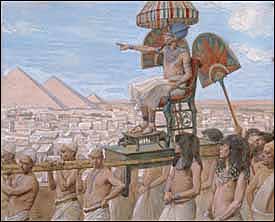 James J. Tissot, "Pharaoh Notes the Importance of the Jewish People" (1896-1900), watercolor, Jewish Museum, New York. The pyramids in the background aren't accurate, however, since the largest were at Giza, far south of Pi-Rameses. Larger image. |
The Book of Exodus begins with a recital of the names of the patriarchs, the sons of Jacob, who had gone to Egypt centuries before when Joseph had been at the pinnacle of power as second to Pharaoh over all Egypt. But now things had changed.
A. Introduction (Exodus 1:1-22)
The Pharaoh Who Knew Not Joseph (Exodus 1:6-10)
The family that had emigrated with 70 members (1:5) had now become a multitude.
"The Israelites were fruitful and multiplied greatly and became exceedingly numerous, so that the land was filled with them." (Exodus 1:7)
I see two ongoing themes in this chapter:
- Increase and
- Oppression
The text uses the phrase "multiplied greatly" (NIV), "were prolific" (NRSV), "increased abundantly" (KJV). The Hebrew word is interesting -- shāraṣ, "teem, swarm,"1 the same word used to describe the swarm of frogs that overtook Egypt in the second plague (Exodus 8:3). The Israelites were everywhere in Goshen!
This increase caused fear among the Egyptian leaders. Since the Israelites hadn't been assimilated and didn't consider themselves as Egyptians, Pharaoh feared that such a large group could pose an internal security threat in time of war. Verse 12 uses the word "dread."2 If Egypt were attacked by an enemy at their front, the Israelites might use the opportunity to (1) fight against the Egyptian army from behind and then (2) escape from the country.
The Pharaoh, who reigned centuries after Joseph's time, concluded that a new policy towards the Israelites was required. He would "deal shrewdly" (NIV, NRSV) or "deal wisely" (KJV) with them strictly in the Egyptians'self-interest.3
Instead of allowing them relative freedom as subsistence farmers, their freedoms would be curtailed. Pharaoh began a policy of systematic oppression and forced labor.
Oppressing the Israelites (Exodus 1:11-14)
The oppression or affliction4 escalated as the threat the Israelites posed became more apparent, as verse 14 tells us.
- Construction projects with forced labor under slave masters.5 Their labor built the empire's storage or supply depot cities6 at Pithom and Rameses.
- Brick7 making, described in Exodus 5:7. These bricks, which built the buildings, were made of the clay along the Nile mixed with straw and stubble to add strength, and then joined to other bricks with mortar.8
- Field labor.
None of this was voluntary or paid labor. It was the ancient institution of tribute or corvee that involved service for a superior power -- a feudal lord, a king, or a foreign ruler.9 It left precious little time to till their own fields and eke out a living for their families. Life was exceedingly bitter (1:14).
This was not a mild oppression. This was a full-out subjugation of a people into slavery. In verse 14b, it says, "In all their hard labor the Egyptians used them ruthlessly."10 Harshness, severity was the rule of the day.
Killing the Male Babies (Exodus 1:15-23)
Harsh oppression may have kept the Israelites under better control to prevent a rebellion, but their numbers kept increasing. To stop this, Pharaoh ordered the midwives to kill the male babies. When this didn't work, he decreed that all boy babies be exposed as infants and left to die.
B. Infancy (Exodus 2:1-10)
The Birth of Moses (Exodus 2:1-4)
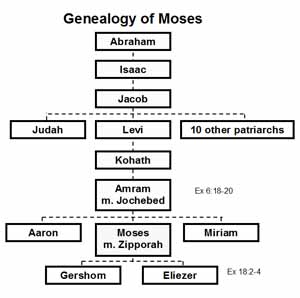
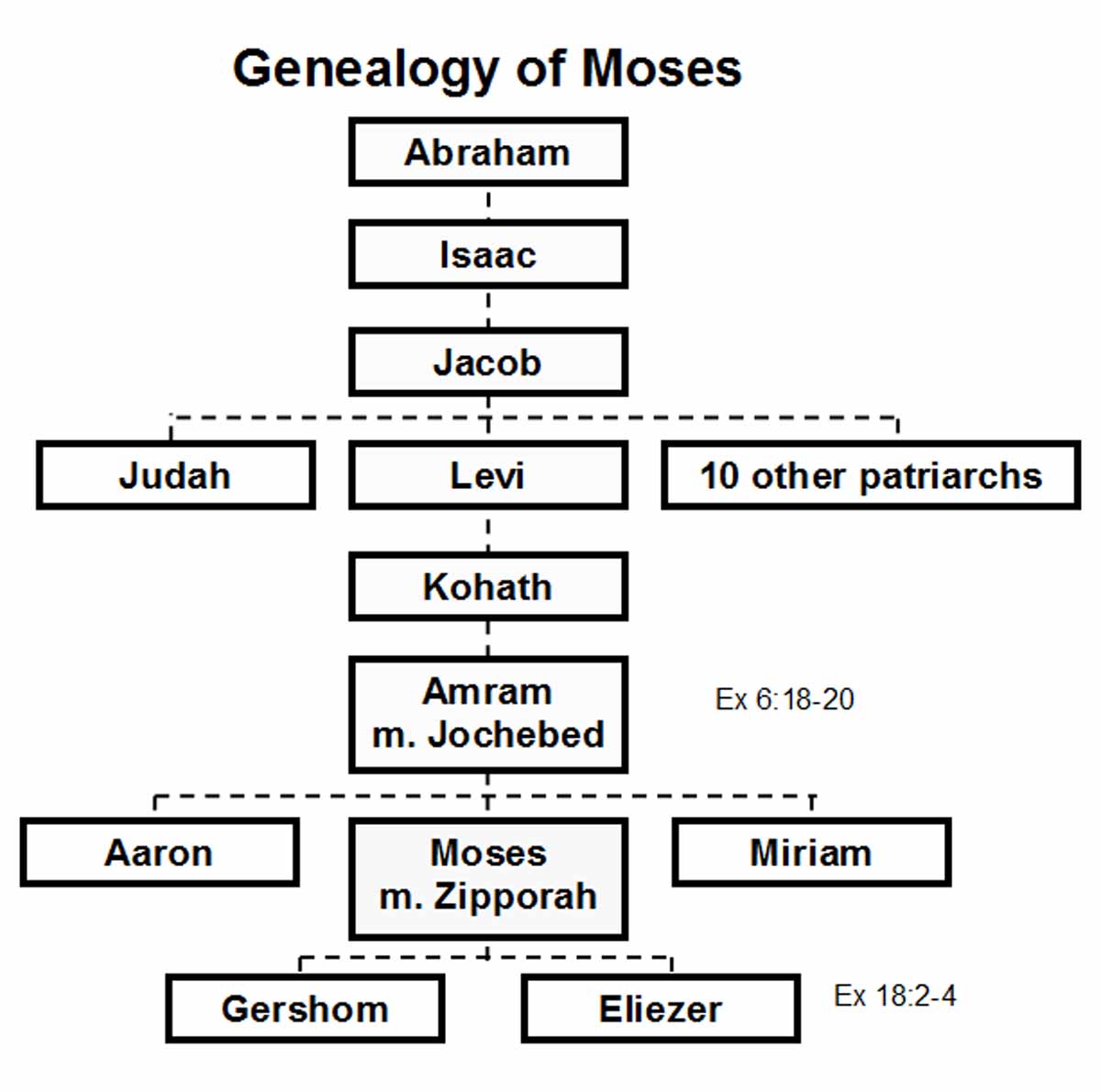
In verse 1 we learn that Moses is a descendant of Levi, one of the 12 sons of Jacob. Exodus 6:20 gives Moses' and Aaron's parents as Amram and Jochebed, who is his father's younger sister. The weight of Pharaoh's edict is heavy upon this couple. Jochebed sees Moses as all mothers see their sons -- "a fine child"!12
She can't expose him, but neither can she keep him. So she weaves a basket13 for him from the reeds,14 then waterproofs it with tar15 and pitch so that it won't leak. She obeys the letter of the law, but sends her daughter Miriam to watch over the floating basket, deliberately placed among the reeds16 along the Nile where one of Pharaoh's daughters was known to bathe.17
Moses Is Adopted by Pharaoh's Daughter (Exodus 2:5-10)
So God arranged for Moses to be raised in his earliest years in his mother's and father's home. This way he got a clear idea who he was -- that he was a Hebrew, a descendent of Abraham, Isaac, and Jacob.
If the Pharaoh at the time is Rameses II (and we can't be sure) then this daughter is one of 60 daughters. She may have lived in one of his numerous hunting lodges scattered over the delta area.18 Harrison sees her as the adolescent offspring of one of the pharaohs by a concubine or some lesser paramour, and not one of the chief princesses of full royal blood.19 If so, Moses didn't necessarily grow up in the royal palace as a royal prince, but he certainly benefited from his status as an adopted royal. In Acts we read:
"When he was placed outside, Pharaoh's daughter took him and brought him up as her own son. Moses was educated20 in all the wisdom of the Egyptians and was powerful in speech and action." (Acts 7:21-22)
C. Moses the Activist (Exodus 2:11-22)
Moses Commits Murder (Exodus 2:11-15a)
Moses is now about 40 (Acts 7:23) and seems to have adopted the arrogance of a member of the ruling class. The next incident tells us a lot about his character.
"One day, after Moses had grown up, he went out to where his own people were and watched them at their hard labor. He saw an Egyptian beating a Hebrew, one of his own people. Glancing this way and that and seeing no one, he killed the Egyptian and hid him in the sand." (Exodus 2:11-12)
Moses, of course, wasn't seen by most as a Hebrew, but a prince of Pharaoh's family. He has a predictable reaction when he sees his countrymen being abused. "Beating" (NIV, NRSV), "smiting" (KJV) in verse 11 is the same Hebrew word as "killed" (NIV, NRSV), "slew" (KJV) in verse 12 -- nākâ, "smite, strike, hit, beat, slay, kill. "It can vary from a single stroke, to a beating, to mean even "strike dead."21
Moses' response is interesting. He doesn't seek legal justice in Pharaoh's court. Rather, "glancing this way and that," provides his own rough but illegal justice. This suggests several things about Moses:
- He identifies himself as a Hebrew.
- He has a strong sense of basic justice.
- He is willing to take charge of a situation, a man of action. On this occasion he is decisive, perhaps to the point of being rash. But he is not a timid man.
- He is physically strong.
- He seems to have no sense yet of acting for God.
But he is not seen as a leader or even having authority by his own people. Here's the take-charge leader asserting himself again, but his authority isn't recognized. I would guess that he was well-known among the Hebrews as "one of our people made good," but his intervention in this quarrel doesn't seem to be appreciated. He may be a prince in Egypt, but that doesn't win him real respect among his own people. They question Moses' right to be either a ruler22 or judge23 over them.
Leadership Is Influence
Pause here for a moment. Moses is a member of the ruling class, but not a ruler. Why? He has neither office nor influence among those he seeks to lead. We often mistake holding a leadership position or office as "leadership." You can impose your will if you hold an office, perhaps, but is that leading?
John C. Maxwell, in his classic 21 Irrefutable Laws of Leadership, asserts that leadership is influence, pure and simple.24 Many a pastor has come to a church expecting to be the congregation's leader, only to find that the real leaders, the people who call the shots, are a couple of the old-time members who everyone in the congregation turns to -- even if they no longer have any official leadership role.
Moses is influential later because he has encountered God and is able to speak with an authority and miracles that are recognized by his peers.
Is leadership a part of a person's personal charisma or can it be learned? There are people who are "natural leaders," of course, who carry themselves as leaders and whose leadership is accepted by those around them, even if they're new to a situation. But notice that Moses was not one of these. He emerged as a leader as he was transformed by God. You can learn to be a leader -- and if you're already a "natural leader," you can become a better leader.
At this point, however, Moses is clearly not a "natural leader." He has no response to his countrymen's challenge, "Who are you?" Moreover, he is suddenly frightened -- frightened enough to run25 for his life. Dear friends, there is a time for everything under heaven. Jesus and his apostles knew when it was time for a strategic retreat also.26
You may have fled from situations in your life. But don't think that this is the end of you as a leader. God has a way of retooling and equipping his leaders for future tasks. God hasn't given up on you!
|
This and subsequent discussion questions allow you to interact with the concepts presented in the lesson. There are often no "right answers," since some questions are thought or application questions. But sometimes the "answer" will be found in my notes that precede the question. The questions are not "graded," but may shared in an online forum with others who are taking this study. If you haven't registered for the Forum yet, do so now using these instructions. Read the Instructions for the Forum. Then post your answer to the Forum page in the URL following the question. Q1. (Exodus 2:11-15a)
What do we learn about Moses' motivations, character, and leadership
ability from the incident of him killing the cruel Egyptian
taskmaster? What positive things do you see in his character? What
negative things do you discern?
|
Moses Flees to Midian and Delivers Jethro's Daughters (Exodus 2:15-17)
|
|
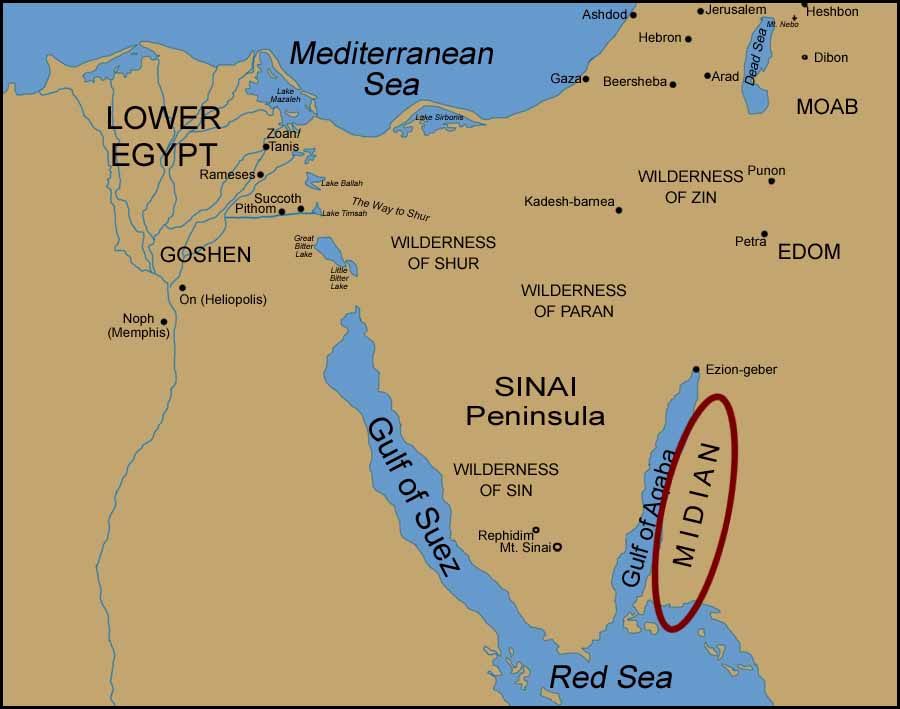
Where is Midian? Probably east of the Gulf of Aqaba or in the eastern Sinai peninsula.27
Moses stops by a well -- doubtless near a settlement, and a great place for this wanderer to meet people. As he is there, shepherds -- young, beautiful shepherd girls -- are watering their father's flock. The shepherds would lower down into the well a pot or jar, let it fill, then pull it up and pour the water into troughs where the sheep could drink. Now Moses watches while some male shepherds push their way in and threaten28 the girls who got there first.
"Some shepherds came along and drove them away, but Moses got up and came to their rescue and watered their flock." (Exodus 2:17)
Moses has just gotten in trouble trying to see justice done in Egypt. Now he takes it upon himself to fight off these bullies. This may mean that Moses is physically strong, but more likely it means that he is just assertive. It's likely that these male shepherds are young -- older children or teenagers -- and not very confident in the face of a grown man, an Egyptian, threatening them with his staff.
Moses not only "came to their rescue," 29 but finished watering the girls' flock himself -- a menial task you would not expect a grown man to perform in this culture!
Middle Eastern Hospitality (Exodus 2:18-22)
Now we meet a man who will be linked to Moses' future success -- Jethro, here called Reuel. The girls' father asks them why they didn't invite the man into their home. In our culture, it would be very wrong for girls to invite a strange man home. But in the Middle East, strangers are treated well -- especially strangers who assist in time of danger. To fail to offer hospitality is a grievous social breach. The father rebukes his daughters.
So they run back to the well to fetch the stranger and bring him home. The father then extends the invitation and finally offers his daughter to Moses in marriage.30
The father is identified as a "priest of Midian" (Exodus 2:16), a designation marking him as a person of status with a strongly religious role in the hierarchy of Midianite society.31 Moses' father-in-law is identified by several names in the Bible,32 but for the most part in Exodus, he is known by the name Jethro.
D. The Call of Moses (Exodus 2:23-4:17)
God Hears His People's Cry (Exodus 2:23-25)
Moses' life can be roughly divided into three periods, each about 40 years.33 Here's one way to describe his life:
|
1. Prince of Egypt |
Proud in man's knowledge and status |
40 yrs |
|
2. Shepherd in Midian |
Humbled and molded by God |
40 yrs |
|
3. Leader |
Obedient servant |
40 yrs |
By the time the third phase of Moses' life begins, he is about 80 years of age. He has been a humble shepherd for half his life, far away from the hustle and bustle of Egyptian society and culture. For the most part, his life has been quiet, solitary, out in the desert pastures, except when he is home in his family's tent.
So far, the narrator has offered an introduction to Moses' character. But now the real story of the Exodus begins.
"23 During that long period, the king of Egypt died. The Israelites groaned in their slavery and cried out, and their cry for help because of their slavery went up to God. 24 God heard their groaning and he remembered his covenant with Abraham, with Isaac and with Jacob. 25 So God looked on the Israelites and was concerned about them." (Exodus 2:23-25)
Notice three things from these verses:
- God's compassion.34 The Exodus isn't about Moses at all. It is about God's compassion and plan. God is the main player in the story. Moses is only his servant -- a great servant, but still only a servant.
- God's faithfulness. God has made promises to Abraham and his descendants called covenants. He is faithful to keep his promises!
- Sustained prayer. The deliverance took place through anguished prayer35 to God. God hears our prayers and answers them. All significant revivals have taken place as a result of consistent, urgent prayer before God for help. Don't give up, even if it seems like God isn't answering immediately!
The Burning Bush (Exodus 3:1-5)
Now God begins his plan in answer to the prayers of the Israelites. He appears to Moses. Wide-ranging shepherds had probably seen shrub fires lit by lightning strikes. But this bush wasn't consumed.36 Moses came closer to see if he could find an explanation for this phenomenon.
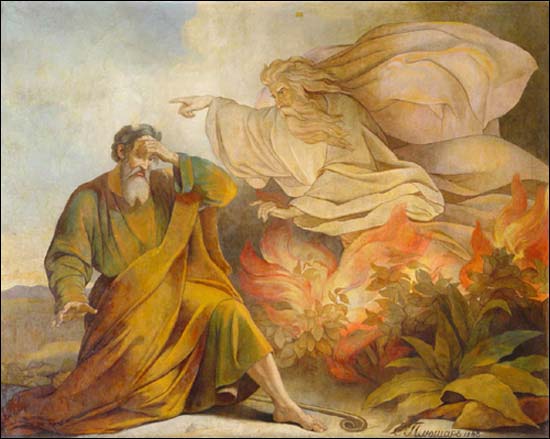
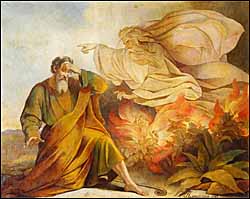 Eugene Pluchart (French painter, 1809-1880), "God Appears to Moses in Burning Bush" (1848), St. Isaac of Dalmatia Cathedral, St. Petersburg. Larger image. |
The narrator tells us that this was "the angel of the LORD," who appears elsewhere in the Pentateuch. Often the "angel of the LORD" is referred to earlier in the passage, while later in same the passage the person speaking is identified as the LORD (Yahweh) himself.37 The angel "appears"38 here in the flame itself, not as a person. Elsewhere, God appears as a "consuming fire," 39 and his "glory" as a brightness that cannot be looked at with the naked eye. The tongues of fire (flames) that appeared over the believers on the Day of Pentecost typify the presence of God in his Holy Spirit.
God attracts Moses' attention with the flames. Now he calls to him, with his voice coming from the burning bush. God calls40 Moses by name, and Moses answers. Then God informs him of the holiness41 of the place and instructs him to act appropriately by taking off his sandals.42
God's Promise (Exodus 3:6-9)
"7 The LORD said, 'I have indeed seen the misery of my people in Egypt. I have heard them crying out because of their slave drivers, and I am concerned about their suffering. 8 So I have come down to rescue them from the hand of the Egyptians and to bring them up out of that land into a good and spacious land, a land flowing with milk and honey....'" (Exodus 3:7-8)
God's message to Moses out of the burning bush is four-fold:
- Seeing. I have seen my people's misery and oppression.
- Hearing. I have heard their cries and prayers.
- Rescuing. I will rescue them.43
- Giving. I will bring them into a land that I will give them.
This is a wonderful promise, the fulfillment of the covenant that God had spoken to Abraham and the patriarchs hundreds of years previously.44
Moses' Call (Exodus 3:10-12)
"So now, go. I am sending you to Pharaoh to bring my people the Israelites out of Egypt." (Exodus 3:10)
After stating the promise, God explains that he is appointing45 Moses to achieve this promise. When God appoints you and gives you a mission, you don't question -- you go!
But Moses questions God: "Who am I, that I should go...?"This statement and others in Moses' running dispute with God in Exodus 3-4 indicate a profound humility. Later, the Scripture explains,
"Now Moses was a very humble46 man, more humble than anyone else on the face of the earth." (Numbers 12:3)
Moses had experienced a kind of brokenness. As a prince of Egypt he operated with a sense of entitlement and arrogance because of both his place in the ruling class of society and his superior education. But 40 years before he had fled from Egypt as a common criminal. Now he was a lowly shepherd at age 80, watching flocks that were not even his own. "Who am I?" asks Moses.
But his question also betrays a lack of faith. He assumes that he must carry out this task by himself. Nothing could be further from the truth. God says to him, "I will be with you" (Exodus 3:12a). This profound promise from God has encouraged God's people throughout the ages.47 If we can believe that God is with us, on the basis of that faith, we can do anything God asks of us. Nothing will be impossible to us!
|
Q2. (Exodus 3:10-12) Does Moses' response
to God's call reflect a low self image, true humility, or lack of
faith? How does God reassure him? How does God reassure us when we
are called to impossible situations?
|
God Reveals Himself as Yahweh (Exodus 3:13-15)
"13 Moses said to God, 'Suppose I go to the Israelites and say to them, "The God of your fathers has sent me to you," and they ask me, "What is his name?" Then what shall I tell them?' 14 God said to Moses, 'I AM WHO I AM. This is what you are to say to the Israelites: "I AM has sent me to you."'" (Exodus 3:13-14)
Moses asks for God's name and is given a new revelation of God as the Great I Am, "I AM WHO I AM." This idea of One who is always present and eternally existent seems to be the etymological basis of God's revealed name Yahweh, from the Hebrew verb meaning "to be." We see echoes of it in the New Testament, as well.
"Jesus Christ is the same yesterday and today and forever." (Hebrews 13:8)
"'I am the Alpha and the Omega,'' says the Lord God, 'who is, and who was, and who is to come, the Almighty.'" (Revelation 1:8)
I discuss the name Yahweh in detail in another study in this series.48
Directions and Signs (Exodus 3:16-22; 4:1-9)
Now God gives Moses specific instructions: "Go, assemble the elders of Israel and say to them...." (Exodus 3:16). He gives Moses the message to give to them and to Pharaoh, as well as promises of deliverance and a new land. But Moses still protests:
"What if they do not believe me or listen to me and say, 'The LORD did not appear to you'?" (Exodus 4:1)
The Lord shows him how his staff can turn into a snake. When put into his cloak, his hand becomes leprous, and is then restored. Turning water into blood is a third sign.
Send Someone Else (Exodus 4:10-17)
Now Moses complains about lack of eloquence.49 God's answer: I will help you. Consider God's amazing promise:
"I will be with your mouth, and teach you what you are to say." (Exodus 4:12)
God promises to take care of Moses' inadequacies in public speaking. Even more important, he promises to coach50 him on what to say -- help with both delivery and content! And still, Moses tries to wriggle out of the call.
Ever since God had called him, Moses had come up with a series of excuses and "what ifs," plus another fear revealed in verse 19:
- Who am I? (3:11-12)
- What if they ask your Name? (3:13-15)
- What if they don't believe me? (4:1-9)
- But I'm not eloquent (4:10-12)
- People will kill me (4:19)
Each of these God has answered. But now, after God has peeled back each of his excuses, Moses comes to the underlying reason: he just doesn't want to do it! God responds with anger!51
"13 But Moses said, 'O Lord, please send someone else to do it.'14 Then the LORD's anger burned against Moses...." (Exodus 4:13-14a)
|
Q3. (Exodus 4:13-14a) Why is God angry with Moses? What is
Moses' basic sin? Unbelief, fear, or disobedience? Do you think the Lord
has ever been angry with you? How did Moses appease God's anger?
|
In spite of his anger, God provides a second way to convince Moses to take the assignment -- his brother Aaron. As I ponder Moses' chutzpah in resisting God, I am amazed at God's grace in spite of his anger. God is not rigid. He is willing to work with us and find ways to fill in for our weaknesses, so that he can use our strengths.
E. Moses Obeys God (Exodus 4:18-31)
Convinced and rebuked, Moses makes plans to returns to Egypt. On the long trip back, the Lord explains what will happen. Pharaoh will not give in right away, God says, but don't be afraid, this is part of a plan. God tells him ahead of time so Moses won't be as discouraged when the deliverance drags on and on.
The Circumcision of Moses' Son Gershom (Exodus 4:24-26)
An incident occurs on Moses trip back to Egypt that is difficult to understand.
"24 At a lodging place on the way, the LORD met [Moses] and was about to kill him. 25 But Zipporah took a flint knife, cut off her son's foreskin and touched [Moses'] feet with it. 'Surely you are a bridegroom of blood to me,' she said. 26 So the LORD let him alone. (At that time she said 'bridegroom of blood,' referring to circumcision.)" (Exodus 4:24-26)
There are dozens of theories about the meaning of the passage. What makes the most sense to me is that Moses had neglected circumcision (of Gershom and perhaps of himself), in accordance with the ancient rite revealed to Abraham as a sign of the Covenant (Genesis 17:9-14), and this neglect arouses God's anger. At any rate, God stops him while they are at an overnight desert camp. Zipporah intervenes, takes a flint knife, circumcises Gershom, and then apparently touches Moses' genitals with it. "Feet" (regel) here is likely a euphemism for male genitalia, as in Isaiah 7:20 (with reference to pubic hair) and in Judges 3:24 and 1 Samuel 24:3 (with reference to relieving oneself).52After this rite has been performed, God backs off from his threat to Moses.
Of course, this doesn't answer all our questions. Why does Zipporah touch Moses' genitals with Gershom's foreskin? It's possible that Moses himself hasn't been circumcised as a baby, or fully circumcised as an adult. Egyptian circumcision, performed on adults, was only a partial circumcision. Perhaps Gershom's circumcision is being vicariously transferred to Moses by touching his penis.53And what do Zipporah's words mean: "Bridegroom of blood"? Scholars have speculated that in Midian culture, circumcision was performed at puberty as a premarital rite, and that Zipporah's words echo this.54But it is merely speculation. We don't really know.
The point seems to be that only those who have been circumcised will escape God's judgment -- especially God's judgment upon the Egyptians in Egypt (Exodus 12:44-49; Joshua 5:5). When Zipporah's rite has been completed, God allows Moses and his family to continue to Egypt.
Fortunately this obscure event isn't important to the primary story of Moses' character and ministry.
Moses Returns to Egypt (Exodus 4:18-31)
As Moses is returning to Egypt, God calls Aaron too. They meet at Mt. Horeb, "the mountain of God," where Moses lets Aaron know what his part will be as divine spokesman. When they arrive in Egypt, they go together to the leaders of God's people, the elders. Aaron knows these men, but it is likely that Moses does not. Moses is terrified, but does what he is told.
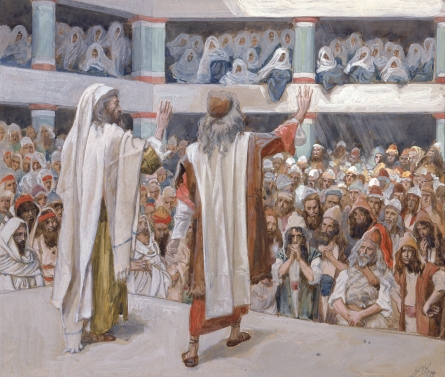
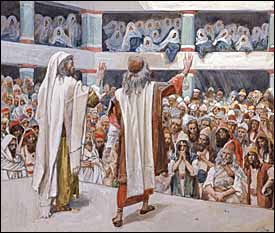 James J. Tissot, "Moses and Aaron Speak to the People" (1896-1900), watercolor, Jewish Museum, New York. Larger image. |
Notice that before the elders, Moses doesn't point to himself, but to the Lord. His message is that God has heard the Israelites' prayers and has compassion on them. The result is faith and thankfulness on the part of the elders, evidenced by worship. The elders' worship is described by two words, qādad, "bow down," 52 and the Eshtafel stem of ḥāwâ, "prostrate oneself, worship,"53 demonstrating their deep submission to Yahweh who had loved them and heard their prayers.
God has done what Moses had doubted could happen -- that people would really believe him and take him seriously. I can almost hear God's thoughts echoed by his Son centuries later:
"You of little faith, why are you so
afraid?" (Matthew 8:26)
"You of little faith, why did you doubt?" (Matthew 14:31)
 Available as an e-book and paperback |
Moses has taken the first steps and learned some important lessons. But what God will ask him to do in days to come builds on this earlier reluctant obedience. Moses doesn't begin as a man of great faith, but gradually God builds faith within him, and as he operates in that faith, he becomes a leader whom God can use.
|
Q4. Why are we so afraid to obey God when
he puts on our heart to do something decisive? How are we to deal
with fear when we feel it? What is the relationship of fear to
courage? Why is courage required in leaders and disciples?
|
Prayer
Father, we have felt doubt and fear, just like Moses. Forgive us for our unbelief. Forgive us for being so slow to obey. Build your faith in us, so that you can use us to do mighty things that are part of your plan for us. With confidence in your faithful work in us, we pray in Jesus' name. Amen.
References
1. Shāraṣ, BDB 1056.
2. "Dread" (NIV, NRSV), "be grieved" (KJV) is qûṣ, "feel a loathing, abhorrence, sickening dread" (BDB 880), "feel a disgust for," here "feel a horror of." (Holladay, pp. 316-317).
3. Hākam, "be wise, act wise(ly)." "The essential idea of ḥākam represents a manner of thinking and attitude concerning life's experiences; including matters of general interest and basic morality. These concerns relate to prudence in secular affairs, skills in the arts, moral sensitivity, and experience in the ways of the Lord" (Louis Goldberg, TWOT #647).
4. "Oppressed" (NIV, NRSV), "afflicted" (KJV) in 1:11 is ʿānâ, with the primary meaning of "to force," or "to try to force submission," and "to punish or inflict pain upon." Here, "afflict, oppress, humble" (Leonard J. Coppes, TWOT #1652).
5. "Slave masters" (NIV), "taskmasters" (KJV) is mas, body of forced laborers, task-workers, labor-band or gang," here, of chief of mas, "gang-overseers" (BDB 586, 2a).
6. "Store cities" (NIV), "treasure cities" (KJV), "supply cities" (NRSV) translates "city" (ʿîr) plus miskenôt, "storage house, magazine," designating a place of service, particularly storage cities (1 Kings 9:19; 2 Chronicles 16:4; 17:12) (R.D. Patterson, miskenôt, TWOT #1494a).
7. "Brick" is lebēnâ, "brick, tile," from the whiteness of clay or the light color of sun-baked bricks. (BDB 526).
8. "Mortar" is ḥōmer, "Cement, mortar, clay." This noun was also a term for the reddish clay of that area, particularly Palestine (Gerhard Van Granigen, TWOT #683d).
9. G. Lloyd Carr, mas, TWOT #1218.
10. "Ruthlessly" (NIV, cf. NRSV), "with rigor" (KJV) in verses 13 and 14 is perek, "harshness, severity" (BDB 827).
12. "Fine" (NIV, NRSV), "goodly" (KJV) is ṭôb, which refers to "good" or "goodness" in its broadest senses." It can mean, "good, pleasant, beautiful, delightful, glad, joyful, precious, correct, righteous," or it could mean "happy" (Andrew Bowling, TWOT #793a).
13. "Basket" (NIV, NRSV), "ark" (KJV) is tēbâ, "ark," properly, "chest, box." It is the same word used for Noah's ark.
14. "Papyrus" (NIV, NRSV), "bulrushes" (KJV) is gōmeʾ, "rush, reed, papyrus" (BDB 167).
15. "Tar" (NIV), "bitumen" (NRSV), "slime" (KJV) is ḥēmār, "bitumen, asphalt" (BDB 330).
16. "Reeds" (NIV, NRSV), "flags" (KJV) is sûp, "reeds, rushes" (BDB 693).
17. Scholars have drawn attention to the fact that a similar story was told centuries later about the Assyrian ruler Sargon. Whether it draws upon the Moses story, we don't know. The Legend of Sargon, a much-later neo-Assyrian text from the seventh century BC. Sargon was an Akkadian emperor (reigned c. 2270 to 2215 BC) who conquered the Sumerian city-states.
18. Cole, Exodus, p. 58; Harrison (Intro, p. 575) cites R.A. Caminos, Literary Fragments in the Hieratic Script (1956), pp. 19ff.
19. Harrison, Intro, p. 575.
20. Harrison observes, "Children of the harîm [harem], especially male princes, were frequently educated under the supervision of the harîm overseer, and at a rather later date the princes were educated by the priestly caste in reading and writing, the transcription of classical texts, civil administration, and in certain physical accomplishments" (Harrison, Intro, p. 575, citing F.L. Griffiths and P.E. Newberry, El Bersheh (1894), II, p. 40).
21. Marvin R. Wilson, nākâ, TWOT #1364.
22. "Ruler" is śar, from the verb śārar, "rule, reign, act as a prince, govern." The noun can refer to leaders and chieftains, military commanders, as well as various ranks of government officials, nobles, and courtiers (Gary G. Cohen, śārar, TWOT #2295a).
23. "Judge" is the verb shāpaṭ, "to judge, govern." It's the most common word for governing in the Old Testament, and the term for the series "judges" who ruled as leaders in Israel between Joshua and Saul (Robert D. Culver, shāpaṭ, TWOT #2443).
24. John C. Maxwell, The 21 Irrefutable Laws of Leadership (Thomas Nelson, 1998, revised 2007).
25. "Fled" is bāraḥ, "to go or pass through, and to flee or hurry." It occurs mostly in narratives, referring to flight from an enemy (Earl S. Kalland, TWOT #248).
26. Luke 4:30; John 8:59; 10:39; Acts 8:1; 12:17; 14:6; etc.
27. George E. Mendenhall, "Midian," ABD 4:815-818; T.V. Brisco, "Midian," TDNT 3:349-351.
28. "Drive away" is gārash, which can mean variously, "cast up, drive out/away, divorce, expel, put away, thrust out, trouble" (TWOT #388).
29. "Came to the rescue" (NIV), "came to the defense" (NRSV), "helped" (KJV) is the verb yāshaʿ, in the Hiphil stem, "save, deliver, give victory, help." The noun form of this word is yeshûʿâ, "salvation," from which the names Joshua and Jesus are derived. Moses is the girls' savior. This prefigures Yahweh's salvation that Moses brings to the whole people of Israel at the Red Sea (Exodus 14:13).
30. It's likely that Moses came with no bride price, like Jacob when he wanted to marry Rachel, Laban's daughter (Genesis 29:14-30). So Moses, like his ancestor Jacob, is later employed by Jethro as a far-ranging shepherd, taking this father-in-law's flock far afield to find pasture (Exodus 3:1).
31. Hughes, "Jethro," DOTP, p. 467.
32. Reuel (reʿûʾēl, "friend of God"; Exodus 2:18); Jethro (yitrô, "his excellence"; Exodus 3:1; 4:18; 18:1-12); Hobab (ḥōbāb, "cherished," Judges 4:11). In Numbers 10:29, Hobab is said to be the son of Raguel the Midianite. W.F. Albright saw Reuel as a clan name and Jethro as his proper name, with Numbers 10:29-32 explained by a misvocalization of the Hebrew text, which should have been ḥōtēn, "son-in-law" referring to Moses (W.F. Albright, "Jethro, Hobab, and Ruel," CBQ 25 (1963) 1-11, cited by P.E. Hughes, "Jethro," DOTP, pp. 467-469).
33. Exodus 7:7; Acts 7:23-24, 29-30, 36; Numbers 32:13; Deuteronomy 34:7. Forty years may be a literal number (Deuteronomy 2:14), but often it is used as a round number used for a relatively long period of time, specifically, the traditional number of years in a generation (Judges 3:11; 5:31; 8:28; 1 Samuel 4:18; etc.). In the Exodus, 40 years is the period of time that it took for one generation to die out and to be replaced by a new one. A sense of completeness or maturity is attached to the number. A man was considered to reach full adulthood at 40 (Joshua 14:7; 2 Samuel 2:10). See Bruce C. Birch, "Number," TDNT 3:558.
34. "Was concerned" (NIV), "took notice" (NRSV), "had respect unto" (KJV), is the very common verb yādaʿ, "to know." Here it is used in the sense of "most intimate acquaintance with" (Paul R. Gilchrist, TWOT #848).
35. "Groaned" (NIV, NRSV), "sighed" (KJV) is ʾānaḥ, "sigh, groan, gasp" from mental or physical distress" (Charles L. Feinberg, TWOT #127). "Cried" is zāʿaq, "to cry for help in time of distress... In the Qal stem [as here], the word is used almost exclusively in reference to a cry from a disturbed heart, in need of some kind of help. The cry is not in summons of another, but an expression of the need felt. Most frequently, the cry is directed to God" (Judges 6:6-7; Leon J. Wood, TWOT #570).
36. "Burn up" (NIV, NRSV), "consume" (KJV) is ʾākal, "to eat, consume, devour, burn up" (Jack B. Scott, TWOT #85).
37. Genesis 16:7-13 (revealed to Hagar); 22:15-16 (to Abraham on Mt. Moriah); Numbers 22:22-35 (to Balaam); Judges 6:11-22 (to Gideon); Judges 13:3-21 (to Sampson's parents); as well as to Elijah, Elisha, etc.
38. "Appeared" is the common verb rāʾâ, "see, look at." Here in the Niphal stem, it carries the passive idea, "to be seen or to reveal oneself" (Robert D. Culver, TWOT #2095).
39. Exodus 24:17; Deuteronomy 4:24, 36; Hebrews 12:18, 29.
40. "Called" is qārāʾ, "call, call out." "The root qrʾ denotes primarily the enunciation of a specific vocable or message. In the case of the latter usage it is customarily addressed to a specific recipient and is intended to elicit a specific response (hence, it may be translated 'proclaim, invite')" (Leonard J. Coppes, TWOT #2063).
41. "Holy" is qōdesh, "apartness, holiness, sacredness, hallowed, holy." "The noun qōdesh connotes the concept of "holiness," i.e. the essential nature of that which belongs to the sphere of the sacred and which is thus distinct from the common or profane" (Thomas E. McComiskey, TWOT #1990a).
42. Naʿal is the generic Hebrew word for footwear, either a shoe or a sandal. David M. Howard, Jr., "Shoe, Sandal," ISBE 4:491-492. Holy places in the Old Testament are seen in the tabernacle precincts where priests are obliged to take off their regular clothing and wear priestly garments that have been consecrated to God (Exodus 28-29). Apparently, the priests went about their duties barefoot. When Joshua meets "the commander of the LORD's army" outside of Jericho, he, too, is told, "Take off your sandals, for the place where you are standing is holy" (Joshua 5:15). Jacob was awed by his vision of angels ascending to and from heaven, senses the holiness of the place, and said, "How awesome is this place! This is none other than the house of God ... the gate of heaven" (Genesis 28:16-17).
43. "Rescue" (NIV), "deliver" (NRSV, KJV) is nāṣal, "deliver, rescue, save." An Arabic cognate verb indicates that the basic meaning is one of "drawing out or pulling out" (Milton C. Fisher, TWOT #1404).
44. Genesis 13:14-18; 15:14; 50:24; etc.
45. "Sending/send" in verse 10 is shālaḥ, which is often used where God is sending people on an official mission as his envoys or representatives (for example, Isaiah 6:8; Jeremiah 1:7; etc.). (Hermann J. Austel, TWOT #2394). The corresponding Greek word in the New Testament is apostellō, from which we get our word "apostle," which means, "one who is sent."
46. "Humble" (NIV, NRSV), "meek" (KJV) is ʿânâv, from ʿānâ, "afflict, oppress, humble," with the primary meaning "to force" or "to try to force submission." The adjective "stresses the moral and spiritual condition of the godly as the goal of affliction implying that this state is joined with a suffering life rather than with one of worldly happiness and abundance" (Leonard J. Coppes, TWOT #1652a).
47. Exodus 4:12, 15; Genesis 31:3; Deuteronomy 31:23; Joshua 1:5; Isaiah 41:10; 43:2; Matthew 28:20; Romans 8:31; Hebrews 13:5.
48. Ralph F. Wilson, Names and Titles of God (JesusWalk Publications, 2010).
49. Dābār, "speech, word." The phrase is literally, "I have never been a man of words" (NASB, margin).
50. Yârâʾ, "teach" (Hiphil). A related word tôrâ or Torah is "teaching."
51. "Burned" (NIV), "was kindled" (NRSV, KJV) is ḥārâ. "This word is related to a rare Aramaic root meaning 'to cause fire to burn,' and to an Arabic root meaning 'burning sensation,' in the throat, etc." In Hebrew, ḥārâ is always used in conjunction with anger and with related words is found 139 times in the Old Testament (Leon J. Wood, TWOT #736).
52. William White, regel, TWOT #2113a. See Durham, Exodus, p. 58.
53. Durham, Exodus, p. 58, citing J.M. Sasson, "Circumcision in the Ancient Near East," Journal of Biblical Literature [1966] 473-474. So also Paul R. Williamson, "Circumcision," DOTP, p. 124.
54. Durham, Exodus, p. 58. Durham speculates that Zipporah circumcises not Moses, "who would have been temporarily incapacitated by the surgery" (Genesis 34:18-31), but Gershom, and then vicariously transfers the effect of the rite to Moses.
55. "This root refers to the bowing of one's head accompanying and emphasizing obeisance" (Leonard J. Coppes, qādad, TWOT #1985).
56. This word is cognate with the Ugaritic ḥwy "to bow down" and originally meant to prostrate oneself on the ground (Nehemiah 8:6; Edwin Yamauchi, ḥāwâ, TWOT #619).
Copyright © 2026, Ralph F. Wilson. <pastor joyfulheart.com> All rights reserved. A single copy of this article is free. Do not put this on a website. See legal, copyright, and reprint information.
 To be notified about future articles, stories, and Bible studies, why don't you subscribe to our free newsletter, The Joyful Heart, by placing your e-mail address in the box below. We respect your