


|
Old Testament
New Testament
Gospels
Acts
Paul's Letters
General Letters
Revelation
Topical Studies
Beginning the Journey (for new Christians). en Español

|
Old Testament
New Testament
Gospels
Acts
Paul's Letters
General Letters
Revelation
Topical Studies

|
Home
Bible Studies
Articles
Books
Podcasts
Search
Menu
Donate
About Us
Contact Us
FAQ
Sitemap

#5. The Triumphant Lamb We Worship (Revelation 5:1-14)
by Dr. Ralph F. Wilsonhttps://www.jesuswalk.com/lamb/lamb_5worship.htm
Audio (25:30)
Part of JesusWalk -- Behold the Lamb of God
Free
E-mail Bible Study
 Experiencing the Psalms
Home | Bible Studies | Articles | Books | Podcasts | Search | Menu | Donate | About Us | FAQ | Contact Us
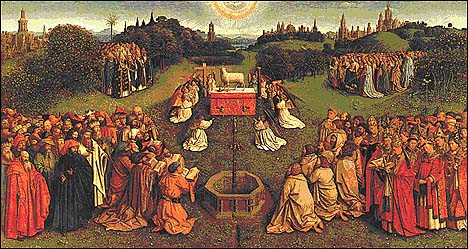
"Adoration of the Lamb," by Jan van Eyck
(1432), oil on wood, Ghent altarpiece, Cathedral of St. Bavo,
Ghent.
Revelation 5:1-14
5:1 Then I saw in the right hand of him who sat on the throne a scroll with writing on both sides and sealed with seven seals. 2 And I saw a mighty angel proclaiming in a loud voice, "Who is worthy to break the seals and open the scroll?" 3 But no one in heaven or on earth or under the earth could open the scroll or even look inside it. 4 I wept and wept because no one was found who was worthy to open the scroll or look inside. 5 Then one of the elders said to me, "Do not weep! See, the Lion of the tribe of Judah, the Root of David, has triumphed. He is able to open the scroll and its seven seals."
6 Then I saw a Lamb, looking as if it had been slain, standing in the center of the throne, encircled by the four living creatures and the elders. He had seven horns and seven eyes, which are the seven spirits of God sent out into all the earth. 7 He came and took the scroll from the right hand of him who sat on the throne. 8 And when he had taken it, the four living creatures and the twenty-four elders fell down before the Lamb. Each one had a harp and they were holding golden bowls full of incense, which are the prayers of the saints. 9 And they sang a new song:
"You are worthy to take the scroll
and to open its seals,
because you were slain,
and with your blood you purchased men for God
from every tribe and language and people and nation.
10 You have made them to be a kingdom and priests to serve our God,
and they will reign on the earth."11 Then I looked and heard the voice of many angels, numbering thousands upon thousands, and ten thousand times ten thousand. They encircled the throne and the living creatures and the elders. 12 In a loud voice they sang:
"Worthy is the Lamb, who was slain,
to receive power and wealth and wisdom and strength
and honor and glory and praise!"13 Then I heard every creature in heaven and on earth and under the earth and on the sea, and all that is in them, singing:
"To him who sits on the throne and to the Lamb
be praise and honor and glory and power,
for ever and ever!"14 The four living creatures said, "Amen," and the elders fell down and worshiped.
Over the past four weeks we've been studying various aspects of atonement and redemption brought about by the Lamb of God. In this final week we examine a passage where we see some of the same themes, but with a special note of victory, joy, and finality. The suffering and pain are past and the Lamb that was slain now stands -- he has been raised on high.
An Introduction to the Book of Revelation
If you've ever read the Book of Revelation you know that it is full of symbols -- beasts and elders, angels and that great serpent -- all manner of interesting creatures. Some people read the Book of Revelation to figure out the time of Jesus' return. But in Chapter 5, that isn't our concern. We want to catch a glimpse of the far side of redemption. Fasten your seatbelt and take a trip with me into the heavenly throne room.
The Book of Revelation, often called the Apocalypse or the Revelation of St. John, is written by John, in exile on the Island of Patmos off the west coast of Asia Minor (modern-day Turkey). Though there are lots of theories about the author's identity, early tradition is unanimous that Revelation was written by John the Apostle, which is my tentative conclusion, as well. It was probably written late in the reign of Emperor Domitian (81-96 AD), about 95 AD. John writes of a revelation of last things shown to him by Jesus Christ (1:1).
Revelation (Greek apocalypse) is written in an entirely different literary style than the rest of the Bible, with the exception of parts of the Old Testament Book of Daniel. This genre, known as apocalyptic literature, includes such elements as forecasts of spiritual turmoil, mythical images rich in symbolism and composite character, and long cycles of discourse.1 But don't mistake symbolism for uncertainty, as if the meaning is up for grabs. John uses symbols to communicate his vision of heaven and the exalted Christ, a vision that is inexpressible in human language.
The first three chapters picture the exalted Christ and give his encouragement and warnings to the seven churches of Asia. In chapter 4, John is summoned up to heaven, where he sees the throne of God surrounded by 24 elders and four living creatures. We pick up the narrative of John's vision in Chapter 5. I am resisting the temptation to comment on every element in chapter 5; I'm reserving my focus for the character and activity of the Lamb.
The Scroll with Seven Seals (5:1-4)
God on the throne holds a scroll sealed with seven seals, but no one is found worthy to break the seals and open the scroll. Scholars have debated whether this is a bound book (sometimes called a codex) or a scroll. The Greek word biblion could mean either. Upon consideration, I think it refers to a scroll. In ancient days some legal documents (such as wills) were witnessed by seven different witnesses and each of the seven would attach his own personal seal in sealing wax, each attached to one of the seven threads wrapped around the testament. The purpose of this was to make sure that no one could open the document undetected until it was officially opened at the appropriate time. The contents of this scroll in Revelation 5 are probably either (1) a deed which conveys the promise of the kingdom of God to mankind, or (2) a testament which bestows the kingdom as God's covenant promise -- which amount to the same thing. But no one is found "worthy", that is, "able" (5:6), to open the seals, since whoever opens the scroll must have the power to execute what is written in it.2 The key question in this section is "Who is worthy?" (5.2). The Greek word is axios, "pertaining to being correspondingly fitting or appropriate, worthy, fit, deserving."3 There is weeping because no one is found worthy or able.
The Lion Who Is the Lamb (5:5)
Suddenly, one of the elders says:
"See, the Lion of the tribe of Judah, the Root of David, has triumphed...." (Revelation 5:5)
Who is he talking about?
"The Lion of the tribe of Judah" refers to Jacob's ancient prophecy over his son Judah (Genesis 49:8-12), picturing Judah as "a lion's cub" and a "crouching lion," from whose tribe, the Jews believed, would come the Messiah:
"The scepter will not depart from Judah,
nor the ruler's staff from between his feet,
until he comes to whom it belongs
and the obedience of the nations is his." (Genesis 49:10)
"The Root of David" is a reference to Isaiah's prophecy:
"A shoot will come up from the stump of Jesse;
from his roots a Branch will bear fruit....In that day the Root of Jesse will stand as a banner for the peoples; the nations will rally to him, and his place of rest will be glorious." (Isaiah 11:1, 10)
Jesse is the father of King David, from whose descendents the Messiah would come.
Notice the verb in this sentence: "the Lion of the tribe of Judah, the Root of David, has triumphed." The Greek verb is nikaō, "to win in the face of obstacles, be victor, conquer, overcome, prevail." (Nike shoes get their name from the Greek word for victory.)4 When Jesus said on the cross "It is finished!" (John 19:30) and was then raised from the dead on the third day, the victory over sin and death was complete.
| Q1. (Revelation 5:5) Why is the Lamb
called "the Lion of the tribe of Judah" and "the Root of
David"? What do these titles signify about him? https://www.joyfulheart.com/forums/index.php?showtopic=71
|
The Slain Lamb Standing (5:6)
We expect triumph from lions, not from lambs, but when this glorious "Lion of the tribe of Judah, the Root of David," is announced, John sees a lamb instead. The Lion is the Lamb, an amazing and deliberate juxtaposition of might and meekness:5
"Then I saw a Lamb, looking as if it had been slain, standing in the center of the throne, encircled by the four living creatures and the elders. He had seven horns and seven eyes, which are the seven spirits of God sent out into all the earth." (Revelation 5:6)
See what the description tells us:
- The Lamb is obviously a symbol for Jesus Christ himself, whom John the Baptist had proclaimed, "The Lamb of God, who takes away the sin of the world" (John 1:29). But this is no ordinary lamb.
- Appearing to have been slain , his wounds were visible in this vision. A sacrificial lamb would have been slain by having his throat cut. It reminds me of the line, "those wounds, yet visible above...." in the hymn "Crown Him with Many Crowns" (see below). Yet somehow, this Lamb who has been slain has triumphed -- just how he has triumphed we'll see as the vision unfolds.
- The Lamb is standing (Greek histēmi, Perfect tense) in the midst of the throne and the elders. Though he had been slain, he is now standing and lives -- an clear allusion to Jesus' resurrection from the dead.
- The Lamb has seven horns . In the Old Testament horns signify power, probably from the demonstration of might when two horned rams would fight (Deuteronomy 33:17). Seven is a number that often expresses the idea of completeness or perfection, so seven horns indicates complete might and strength. This is reflected in the Gospels by the risen Christ declaring, "All authority in heaven and on earth has been given to me" (Matthew 28:18).
- The Lamb has seven eyes -- a bit grotesque if you take this literally. But seven eyes indicate that the Lamb sees fully, completely. The slain Lamb that stands is all powerful and all knowing -- omnipotent and omniscient.
|
|
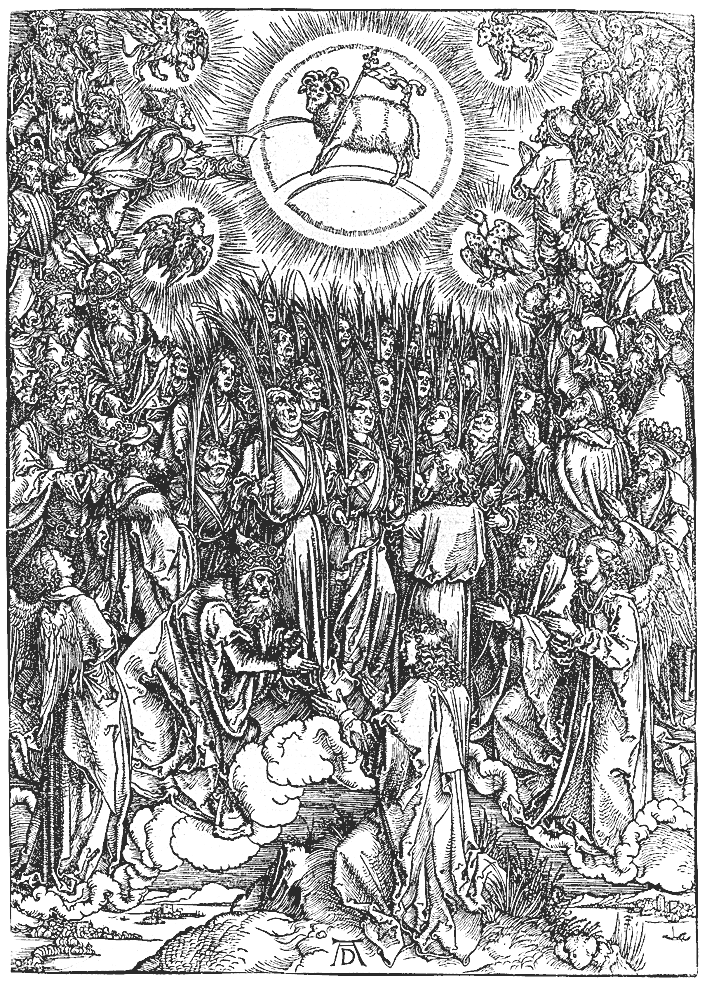
One of my favorite artistic illustrations of this scene of the Lamb standing in the throne room of heaven is a woodcut by Albrecht Dürer, "Adoration of the Lamb." His literal image of the slain lamb with seven horns and seven eyes appears a bit bizarre, but it is Dürer's direct way of conveying the same symbolism to those who view his work. A victorious Lamb bearing a flag with a cross is known in Christian symbolism as the Agnus Dei, Latin for "the Lamb of God." Surrounding the Lamb are crowds of worshippers bearing palm branches.
Q2. (Revelation 5:6) Decode (that is,
identify) each of the following symbols that relate to the
Lamb:
To summarize, then, the Lamb has the qualities of being of .... https://www.joyfulheart.com/forums/index.php?showtopic=72
|
Worshiping the Lamb Who Is Worthy (5:7-8)
Worship is due this Lamb. Falling prostrate before a king or deity is worship, humbling oneself before One who is greater.
"The four living creatures and the twenty-four elders fell down before the Lamb. Each one had a harp and they were holding golden bowls full of incense, which are the prayers of the saints." (Revelation 5:8)
Sometimes I hear people make fun of harps, white robes, and clouds on which to sit and dangle one's feet. But if you consider the harp a kind of guitar with the elders singing praise choruses to the Lamb, maybe you can relate better to this scene. The 24 elders hold in their hands 24 golden bowls6 filled with the prayers of God's people, symbolized as incense rising in a sweet smell before the throne as it is burned.
You and I may not be there in this heavenly enthronement ceremony, but our prayers are, valued with golden bowls that bear our petitions before the Lord. Our prayers are not forgotten, but heard in the very presence of the Almighty God on high!
God's people are referred to as "saints." The Greek adjective hagios bears the root meaning "pertaining to being dedicated or consecrated to the service of God, dedicated to God, holy, sacred, that is, reserved for God and God's service." Referring to people, it means, "the holy ones, believers, loyal followers, saints," speaking of Christians as consecrated to God.7 We are not called saints because we are perfect, but because we have been made holy by Christ, sanctified, set apart for God's own service and use. You and I are these holy ones, dedicated to God himself.
A Song of Redemption (5:9-10)
The song the elders sing is a "new song," one not heard before. It is sung upon the occasion of enthroning the triumphant, conquering Lamb. Examine the words with me, for the song explains the basis of the Lamb's worthiness to open the scroll and execute its kingdom, its promises, and the awesome events leading up to the end.
"And they sang a new song:
'You are worthy to take the scroll
and to open its seals,
because (hoti) you were slain
and with your blood you purchased (agorazō) men for God
from every tribe and language and people and nation.
You have made them to be a kingdom and priests to serve our God,
and they will reign on the earth.'" (Revelation 5:9-10)
The song explains the Lamb's worthiness with a clause beginning with the Greek conjunction hoti, used here as a "marker of causality, subordinating, because, since."8 The Lamb is able to execute God's plan for the Last Days because he was slain and with the blood produced by his own sacrificial death, presumably, he "purchased men for God."
"Purchased" (NIV), "ransomed" (NRSV), and "redeemed" (KJV) translate the Greek verb agorazō. In terms of things, it means "to acquire things or services in exchange for money, buy, purchase." With regards to persons it means "to secure the rights to someone by paying a price, buy, acquire as property."9
Notice that John the Revelator does not provide a theory of the atonement, per se, but states matter of factly, that by the Lamb's blood he redeemed enslaved men and now owns them as his servants, his saints, his set-apart people. How? We're not told. Why? He doesn't say at this point. But for this victorious feat, the Lamb is worshipped and praised.
And what of the redeemed? Who are they? Not just God's chosen people, the Jews, but now from every tribe, language, people, and nation (ethnē) -- throngs of people from around the globe are purchased for God.
| Q3. (Revelation 5:5) What has the Lamb
done to "triumph" and so become worthy to take the scroll and
open its seals? (Hint: See the "for" or "because" clause in
5:9 for the answer.) https://www.joyfulheart.com/forums/index.php?showtopic=73
|
A Song of Praise (5:11-12)
Now the millions of angels sing a second song in praise to the Lamb:
"Worthy is the Lamb, who was slain,
to receive power and wealth and wisdom and strength
and honor and glory and praise!" (Revelation 5:12)
They sing, not just to the Lamb, but to "the Lamb who was slain." Not only is he worthy to open the scroll and break its seals, he is also worthy of praise in his own right. When you add up the number of elements of praise found in this song of praise, and you'll grasp the truth conveyed here, that the Lamb is worthy of all praise -- seven-fold perfect, fulfilled, complete praise!
A Song to the Divine Lamb (5:13-14)
The third song of praise is not sung by just the 24 elders or millions of angels. This song is sung by every creature or created thing (human, animal, vegetable, mineral?) in both heaven and earth, the underworld and the mysterious deep.
"Then I heard every creature in heaven and on earth and under the earth and on the sea, and all that is in them, singing:'To him who sits on the throne and to the Lamb
be praise and honor and glory and power,
for ever and ever!'The four living creatures said, 'Amen,' and the elders fell down and worshiped." (Revelation 5:13-14)
Notice that this worship is directed toward both "him who sits on the throne," that is, God the Father (in Trinitarian terminology), but also to the Lamb.
"Worshipped" in verse 14 is the Greek verb proskuneō, "to express in attitude or gesture one's complete dependence on or submission to a high authority figure, (fall down and) worship, do obeisance to, prostrate oneself before, do reverence to...."10
Isn't it sacrilege for a creature to receive praise along with God? Yes. But the Lamb is no creature. He is God -- God the Son. As Paul writes:
"Who, being in very nature God...
he humbled himself
and became obedient to death --
even death on a cross!
Therefore God exalted him to the highest place
and gave him the name that is above every name,
that at the name of Jesus every knee should bow,
in heaven and on earth and under the earth,
and every tongue confess that Jesus Christ is Lord,
to the glory of God the Father." (Philippians 2:6, 8b-11)
Now God has highly exalted him. Every knee is bowing and every tongue -- "every creature in heaven and on earth and under the earth and on the sea" -- is confessing that Jesus Christ is Lord. And God the Father receives glory from it, too, since the Father and the Son are One. Notice that these songs of praise in Revelation 5 teach us that not only God the Father, but Jesus the Son, is also to be worshipped and praised.
| Q4. (5:13-14) What does it tell us about
the status of the Lamb that he is worshipped alongside "him
who sits on the throne"? https://www.joyfulheart.com/forums/index.php?showtopic=75
|
 Five-week Bible study for the Lent or Easter season, Lamb of God, is available in PDF, Kindle, and paperback. Videos are available on YouTube. |
Jesus, "the Lamb of God, who takes away the sin of the world" -- and your sin as well as mine -- this Jesus is worthy of our worship and praise. In Revelation 5, heaven can't seem to restrain itself. It breaks out in songs of praises to the Lamb again and again. As we come to know and appreciate Jesus the Lamb of God, we too will desire to praise him more and more.
This coming Easter, join your voices with multitudes who sing the great song of praise:
"Crown him with many crowns, the Lamb upon his throne,
Hark! how the heavenly anthem drowns all music but its own.
Awake, my soul, and sing of him who died for thee,
and hail him as thy matchless King through all eternity."Crown him the Lord of love! behold his hands and side,
those wounds, yet visible above, in beauty glorified...."
Concluding:
"All hail, Redeemer, hail! For thou hast died for me;
thy praise shall never, never fail throughout eternity."11
Behold, the Lamb of God, who takes away the sin of the world!
Prayer
Oh, Lamb of God, we do worship you with other saints of God around the world. You have redeemed us by your death and resurrection, and now we are yours. Not unwilling slaves, but servants out of love and respect and honor and everlasting gratitude. We love you, Lord Jesus, and lift up your name as Holy! Holy! Holy! Amen. Hallelujah!
Key Verses
"You are worthy to take the scroll
and to open its seals,
because you were slain,
and with your blood you purchased men for God
from every tribe and language and people and nation.
You have made them to be a kingdom and priests to serve our God,
and they will reign on the earth." (Revelation 5:9-10)
References
- Dale C. Allison, Jr., "Apocalyptic," DJG 17-20.
- G.R. Beasley-Murray, The Book of Revelation (New Century Bible Commentary; Revised Edition; Eerdmans, 1978), p. 123.
- Axios, BDAG 93-94.
- Nikaō, BDAG 673.
- The lion and lamb appear together elsewhere in apocalyptic literature in the Testament of Joseph 19:8-9 -- "And all the beasts rushed against him (the lamb), and the lamb overcame them, and destroyed them and trod them underfoot. And because of him the angels and men rejoiced, and all the land ... His kingdom is an everlasting kingdom, which shall not pass away." In this text, probably dated in the first century BC, the lion is a Messiah from Judah, while the lamb is a Messiah from Aaron. The lion and lamb in this passage are not contrasting figures, but variant symbols of one idea, the all prevailing Messiah. (Beasley-Murray, pp. 124-125).
- "Bowls" is the Greek noun phialē which refers specifically to a bowl used in offerings (BDAG 1055).
- Hagios, BDAG 10-11.
- Hoti, BDAG 731-732.
- Agorazō, BDAG 14. See also Morris, Apostolic Preaching, pp. 50-52.
- Proskuneō, BDAG 882-883.
- "Crown Him with Many Crowns," words by Matthew Bridges (1800-1894), an Anglican and later Roman Catholic, and Godfrey Thring (1823-1903) who added the final stanza, "Crown him the Lord of Life...."
Copyright © 2026, Ralph F. Wilson. <pastor joyfulheart.com> All rights reserved. A single copy of this article is free. Do not put this on a website. See legal, copyright, and reprint information.
 To be notified about future articles, stories, and Bible studies, why don't you subscribe to our free newsletter, The Joyful Heart, by placing your e-mail address in the box below. We respect your