


|
Old Testament
New Testament
Gospels
Acts
Paul's Letters
General Letters
Revelation
Topical Studies
Beginning the Journey (for new Christians). en Español

|
Old Testament
New Testament
Gospels
Acts
Paul's Letters
General Letters
Revelation
Topical Studies

|
Home
Bible Studies
Articles
Books
Podcasts
Search
Menu
Donate
About Us
Contact Us
FAQ
Sitemap


Free
E-mail Bible Study
 Names and Titles of God
Home | Bible Studies | Articles | Books | Podcasts | Search | Menu | Donate | About Us | FAQ | Contact Us
|
|
6 You see, at just the right time, when we were still powerless, Christ died for the ungodly. 7 Very rarely will anyone die for a righteous man, though for a good man someone might possibly dare to die. 8 But God demonstrates his own love for us in this: While we were still sinners, Christ died for us.
9 Since we have now been justified by his blood, how much more shall we be saved from God's wrath through him! 10 For if, when we were God's enemies, we were reconciled to him through the death of his Son, how much more, having been reconciled, shall we be saved through his life! 11 Not only is this so, but we also rejoice in God through our Lord Jesus Christ, through whom we have now received reconciliation." (Romans 5:1-11)
| Big Concept 1. God has embraced us with his love and favor far beyond any measure. And he did it while we were still his enemies. So now that we are saved, we are assured that he won't give up on us in the future. We truly are at peace with God! We can relax in this kind of love and just enjoy him. |
As we begin our study of Romans 5-8, I am intrigued to find that Paul both begins and ends this classic exposition on Christian living with a powerful statement of assurance.
He begins by assuring us that since God saved us while we were still enemies and unworthy sinners, he will certainly carry through this salvation by Christ's life in us (5:8, 10). We are at peace with God! (5:1)
Then he concludes in the final verses of chapter 8 with a resounding assurance that at the judgment throne of God, no one will speak a word of condemnation against us (8:33-34). Nothing, absolutely nothing, can separate us from God's love expressed to us in Jesus Christ (8:35-39)!
Why do we need such assurance? Because in chapters 6, 7, and 8 Paul talks about an earnest approach to finding consistent victory over sin. But Paul knows from personal experience that we don't learn overnight to walk with Christ consistently.
As we struggle with temptations to sin, we face discouragement and self-doubt. When we fail, Satan bombards us with despair, condemnation, and self-loathing. And, if you're like me, you suck up and internalize Satan's lies, which then result in insecurity and doubt.
Yes, there can be victory in the Christian life. That's why we're studying these chapters. But the transition from a "flesh"-directed life to a Spirit-led life requires huge changes in our belief system as well as completely different habits of thinking and living. We learn as babies learn to walk; from falling pretty often in the beginning.
So if we are to learn genuine Christian living, then we must do so grounded in a profound assurance that we are secure in Christ. This isn't a performance-based or conditional salvation. It is a full salvation bought by Christ's own blood.
So we begin with an assurance of peace with God.
Justified Through Faith (5:1)
1 "Therefore, since we have been justified through faith, we have peace with God through our Lord Jesus Christ, 2 through whom we have gained access by faith into this grace in which we now stand. And we rejoice in the hope of the glory of God." (5:1-2)
Paul has just spent a chapter talking about Abraham, the father of the Hebrew people, who was declared righteous by God not by his "works" or actions, but simply by believing God. The key verse, quoted from Genesis 15:6, is:
"Abraham believed God, and it was accounted to him for righteousness." (Romans 4:3)
Paul argues in 5:1, therefore, that since Abraham was accounted righteous because of his faith, then "we have been justified by faith" also. Let's examine these two important words that are at the heart of the gospel -- "justify" and "faith."
I suppose if there were one word that would sum up the message of Romans it would be "justified."
"Justify" is dikaioō, used in the sense of "to render a favorable verdict, vindicate." Here in the Aorist tense, passive voice, it means to "be acquitted, be pronounced and treated as righteous."7 The word, of course, comes from the court room, where the declaration "not guilty" or "pardoned" sets a person free from legal turmoil and an impending sentence of punishment by imprisonment or death. "Justify" occurs frequently in the first part of Romans.8 When someone is justified, he is not only declared righteous, he becomes righteous, and receives the divine gift of righteousness through faith in Christ. Instead of being considered on the "wrong side" of God, he is now pardoned, and the threat of condemnation goes away. He or she now has a righteous standing so far as God is concerned. He or she is declared righteous.
"Faith," pistis, is the means of our justification. A short definition is perhaps best: "trust, reliance." It is specifically a "state of believing on the basis of the reliability of the one trusted, trust, confidence." Faith is used in the active sense = 'believing." It doesn't refer to mere intellectual assent. Rather, faith involves a "firm commitment" of trust.9
Because this concept of faith is so important, Paul repeats it twice in the first two verses of chapter 5:
"... Justified through faith...." (verse 1)
"... Gained access by faith...." (verse 2)
We trust in what Christ has done for us and the promises and commitments he has made to us and, as a result, we are declared righteous by God. We are "justified."
|
Q1. (Romans 5:1-2) According to verses 1-2, faith is a key to salvation.
For Abraham (4:3), what was the relationship between faith and
justification? For us (5:1-2), what is the relationship between faith
and justification? In your own words, what does it mean to be justified? http://www.joyfulheart.com/forums/index.php?showtopic=792
|
Peace with God (5:1)
Now let's see what this has to do with peace.
"Therefore, since we have been justified through faith, we have peace with God through our Lord Jesus Christ." (5:1)
"Peace," eirēnē, describes the result of our justification. The word means, "a state of concord, peace, harmony," between governments. Since peace will be an essential characteristic of the messianic kingdom, Christian thought also frequently regards eirēnē as nearly synonymous with messianic salvation itself (Isaiah 52:7).10
We were once God's enemies (5:10) -- that is, we resisted God's rule over our lives, occasionally in active rebellion, but often in passive resistance. We may not have seemed like open enemies, but we certainly did not bear him full allegiance in our heart of hearts. And God knew of the resistance within us.
But now we are at peace with him, and more importantly, he with us. God has brought about peace with us who used to be his secret enemies. Another term for ending this estrangement is "reconciliation," a concept we'll examine in verses 10 and 11.
Notice carefully that this peace is "through" (dia) Jesus.11 He is the one who brings about the peace, not we.
Title: the Lord Jesus Christ
Notice one more point, often overlooked as we read casually -- the title bestowed on Jesus:
| Lord | Kurios means "owner, lord, master."12 The Hebrew equivalent adonai was read by Jews to substitute for Yahweh whenever it appeared in the Old Testament. "Lord" speaks of Christ's divinity. |
| Jesus | This name given by the angel means "Yah(weh) saves." "Jesus" speaks of Christ's mission of salvation. |
| Christ | Christos is the Greek form of the Hebrew māshîaḥ, "Anointed One, Messiah." "Christ" speaks of Jesus' authority and commission from the Father. |
Together, these words constitute a title of honor and wonder.
Access to God's Favor (5:2a)
The first verse celebrates the peace we have through Jesus. The second verse identifies some of the other benefits brought by Christ:
"...Our Lord Jesus Christ, through whom we have gained access by faith into this grace in which we now stand. And we rejoice in the hope of the glory of God." (5:1b-2)
Several important words here spell out for us the blessings that God has for us.
"Access," prosagōgē, means "a way of approach, access."13 You know how many barriers there are between you and a movie star, a president, a monarch, a corporate CEO. You just can't get in unless you are someone or know someone. Through faith in Christ we have gained full access to God's presence and favor. Several additional verses refer to this amazing freedom of approach that we possess in Christ.
"I am the way, and the truth, and the life; no one comes to the Father, but through Me." (John 14:6)
"Through [Christ] we both have our access in one Spirit to the Father." (Ephesians 2:18)
"In [Christ] we have boldness and confident access through faith in Him." (Ephesians 3:12)
"Let us then approach the throne of grace with confidence, so that we may receive mercy and find grace to help us in our time of need." (Hebrews 4:16)
"Since therefore, brethren, we have confidence to enter the holy place by the blood of Jesus." (Hebrews 10:19)
What wonderful access we enjoy into God's favor or grace.
"Grace," here means simply "favor," the favor of God. Charis refers to a "practical application of goodwill, (a sign of) favor, gracious deed or gift, benefaction."14 We don't deserve grace. Rather we deserve the opposite: God's disfavor and wrath. But through faith in what Christ did for us on the cross, we receive God's grace, his unmerited favor. We now walk within the realm of his favor towards us and his blessings upon us. Amazing!
"Stand" is histēmi, is here with the connotation, "to be in a condition or state, stand or be in something."15 This "grace in which we now stand," refers not to what we deserve, but our standing or condition before God. Sometimes we sin and feel overcome with guilt. We think that God is angry at us and will punish us. But we still stand in a place of grace or favor before our Father. Our standing doesn't change, since it was created by an act of God's righteousness, not by our own righteousness.
Our Hope of the Glory of God (5:2b)
Christians look back to what Christ has done, but we live very much in the present and look to the future.
"And we rejoice in the hope of the glory of God." (5:2b)
In English we sometimes use the word "hope" in the sense of a fond desire for the future, which may or may not come to pass. However, the word in Greek is much more certain.
"Hope," elpis, is "the looking forward to something with some reason for confidence respecting fulfillment, hope, expectation," especially pertaining to matters spoken of in God's promises.16 It is often translated as "eager expectation," that is, a future event that we fully expect and can hardly wait to occur. The word is more fully explored in Romans 8:24-25. Hope is one of three remaining virtues when all else has past: "faith, hope, and love" (1 Corinthians 13:13). In our passage, the focus of our hope is "the glory of God." What does this mean?
"Glory" is doxa, which here seems to have two connotations: (1) "the condition of being bright or shining, brightness, splendor, radiance" and (2) "honor as enhancement or recognition of status or performance, fame, recognition, renown, honor, prestige."17 So we are looking forward to being in the presence of God in all his glory in heaven. Glory for us also includes our resurrection at Christ's return.
While hope is used many times in the New Testament, we see hope in the context of future glory in three particular passages:
"...Christ in you, the hope of glory." (Colossians 1:27)
"...While we wait for the blessed hope -- the glorious appearing of our great God and Savior, Jesus Christ...." (Titus 2:13)
"[Christ] has given us new birth into a living hope through the resurrection of Jesus Christ from the dead, and into an inheritance that can never perish, spoil or fade -- kept in heaven for you...." (1 Peter 1:3-4)
Sometimes Christians are accused of believing in "pie-in-the-sky-when-we-die-by-and-by." Or being "too heavenly minded to be any earthly good." Those are cheap shots! Every person who has made a positive mark on history has had the ability to see the goal beyond the present, even in the face of many adversities, even a goal which is some distance in the future. Having our eyes on the distant but very sure goal is the mark of maturity and strength in a person, not weakness.
Men and women of the world look to an eventual reward here on earth. But we who live in the realm of the Spirit have our eye on the prize in the spiritual realm. We don't just hope in glory as a private belief. We boast openly about it. "Rejoice" (NIV), "boast" (NRSV), or "glory in" (KJV) is kauchēma, "to take pride in something, boast, glory."18
Causes for Rejoicing (5:3-4)
We may have trouble and distress around us. But we rejoice in a very sure future beyond these transitory circumstances -- the glory of God that we will share some day.
"And we rejoice in the hope of the glory of God. 3 Not only so, but we also rejoice in our sufferings, because we know that suffering produces perseverance; 4 perseverance, character; and character, hope." (5:2b-4)
"Sufferings" (NIV, NRSV) or "tribulations" (KJV) translates thlipsis, which means literally "pressing, pressure." It is used frequently in the metaphorical sense, "trouble that inflicts distress, oppression, affliction, tribulation."19 When we're suffering, we tend to hunker down and withdraw. But God uses suffering as a classroom to develop his character in us, specifically:
- Perseverance
- Character
- Hope
"Perseverance" (NIV), "endurance" (NRSV), or "patience" (KJV) is hupomonē, "the capacity to hold out or bear up in the face of difficulty, patience, endurance, fortitude, steadfastness, perseverance."20 Hupomonē is naturally a basic attitude of New Testament believers in view of the eschatological orientation of their faith. It is this kind of long-suffering endurance, the long view, that undergirds our hope. As we brag on God in spite of our troubles, God produces21 in us the fruit of the Spirit of patience or long-suffering.22
"Character" (NIV, NRSV) or "experience" (KJV) is dokimē, the second element of this triad. The word originally referred to "a testing process, test, ordeal." But by extension it also refers to "the experience of going through a test with special reference to the result, standing a test, character."23 Barrett translates it as "tried character."24 When we were younger and not yet fully formed, we may have wondered how some Christian saints seemed to have gained such firm convictions. But the longer we walk in the Spirit -- sometimes in the most difficult of circumstances -- God works in us that tried character that is a distinguishing trait of Jesus' disciples.
"Hope" is the third element that God builds in us through tribulation. Instead of occasionally glancing forward, our hope enables us to know why we are who we are and we know where we are going.
Nor does this firm hope disappoint25 us. The tribulations we experience disillusion us with the world we once loved. The writer of Hebrews says concerning Abraham,
"For he was looking forward to the city with foundations, whose architect and builder is God ... for he has prepared a city for them." (Hebrews 11:10, 16)
We find our hope solid and we see fulfillments of his promises along the way.
|
Q2. (Romans 5:2-5) According to this passage why should we rejoice in
our sufferings and tribulations? One by one, what is the importance to
our lives of perseverance, tried character, and hope? http://www.joyfulheart.com/forums/index.php?showtopic=793
|
God's Love Poured into Our Hearts by the Spirit (5:5)
Now Paul continues:
"And hope does not disappoint us, because God has poured out his love into our hearts by the Holy Spirit, whom he has given us." (5:5b)
"Poured out" (NIV, NRSV) or "shed abroad" (KJV) is ekcheō, which has the basic meaning, "cause to be emitted in quantity, pour out." Here it has the figurative meaning, "cause to fully experience, pour out."26 We're used to the image of the Holy Spirit being poured out by God upon believers (Acts 2:17-18, 33; 10:45) from Joel 2:28-29. This is similar, but in our passage, love is being poured out into our hearts by the Holy Spirit.
"Love" (agapē), of course, is a fruit of the Spirit. When the Holy Spirit comes in power, he comes with love -- love for the Father and love for other human beings. The word agapē wasn't often used in secular Greek prior to the New Testament. However, the apostles filled the word with a particular Christian meaning, "the quality of warm regard for and interest in another, esteem, affection, regard, love."27 Agapē love, unlike other forms of love, is self-less love. Unlike erotic love, for example, it is focused on the needs and welfare of the object of that love, not on meeting one's own needs for love.
The Holy Spirit is the source of this quality of love. Agapē love is not meritorious. It is a gift that comes along with the Spirit who has been "given"28 to us believers.
Our hope of glory and resurrection does not disappoint us, because the Holy Spirit -- God's presence with us -- is a taste, a down payment, a deposit, an earnest (arrabōn, 2 Corinthians 1:22; 5:5; Ephesians 1:14) of the full presence of God which we will experience on the Day of the Lord. We taste now in part; we will drink fully on that Day.
Wow! This is rich. We could quit right here and be fed, but it gets better.
Christ Died for Us Sinners (5:6-8)
Sometimes I suspect that we're just too sinful, that God won't really accept us after all. Paul speaks to that fear directly in this passage:
"You see, at just the right time,29 when we were still powerless, Christ died for the ungodly." (5:6)
Before we had any taste of God's working in our lives, when we were "without hope, and without God in the world" (Ephesians 2:12), Paul describes us as "powerless" (NIV), "weak" (NRSV), or "without strength" (KJV). The word is asthenēs, "of that which lacks strength." Here it means "weak ... helpless" in a moral sense.30 We are also described as "ungodly," asebēs, "irreverent, impious, ungodly."31 Jesus died for us when we were at our worst. Now Paul goes on to make his point:
7 "Very rarely32 will anyone die for a righteous man, though33 for a good man someone might possibly dare34 to die. 8 But God demonstrates his own love for us in this: While we were still35 sinners, Christ died for us." (8:7-8)
He didn't die for us because we were either righteous36 or even relatively good.37 Rather we are "sinners" pure and simple -- sinners who are lost. We had missed the mark -- even the best of us.
Sometimes, I think, we harbor that secret fear that surfaces when we have really "blown it," sinned miserably, that God is disgusted with us and will throw us out. How can we ever deserve God's blessings and glory and love when we recognize in ourselves "a wretch like me" (in John Newton's words in the song "Amazing Grace")? I've felt that way, and I daresay that you have, too.
Here's the good news and Paul's main point here: Jesus died for our sins when we were at our worst. Now that we are (usually) acting better, he is not about to discard us as unworthy garbage when we mess up. As we'll see in chapter 8, we have been adopted as sons and daughters. Just like any good parent, misbehavior is not cause for turning us out into the street. Misbehavior is, however, cause for discipline and training in righteousness.
|
Q3. (Romans 5:6, 8) Why is it so important to embrace the truth that
"Christ died for the ungodly" (5:6), that "Christ died for sinners"
(5:8)? According to 5:8, did Christ die for us at our best or at our
worst? How does this give us assurance against the devil's lies about us
being too bad to forgive? http://www.joyfulheart.com/forums/index.php?showtopic=794
|
The Cross Demonstrates God's Love for You and Me (5:8)
Consider Romans 5:8 especially. Meditate on it. It has blessed millions of your brothers and sisters. Memorize it in your favorite version:
"But God demonstrates his own love for us in this: While we were still sinners, Christ died for us." (5:8)
As we dwell on this verse, let's consider two more words.
"Demonstrates" (NIV), "proves" (NRSV), "commendeth" (KJV) is sunistēmi, which means here, "to provide evidence of a personal characteristic or claim through action, demonstrate, show, bring out something.38
|
|

Look at the cross. It demonstrates a holy truth in the most graphic and ugly manner. God has gone beyond the limit of what is appropriate or expected. He sent his Son to the cross because he loves you. God knows every evil, misguided, malignant, unkind, foul, and embarrassing sin in your entire history. The bloody, scarred cross is proof of God's love for you. There is no sin you can commit that the Son of God did not atone for on that cross.
"But God demonstrates his own love for us in this: While we were still sinners, Christ died for us." (5:8)
The second word is short: "for" (huper). It is "a marker indicating that an activity or event is in some entity's interest, for, in behalf of, for the sake of someone or something."39 This important preposition is used several times in this passage, once in verse 6, twice in verse 7, and once in verse 8.
6 "You see, at just the right time, when we were still powerless, Christ died for the ungodly. 7 Very rarely will anyone die for a righteous man, though for a good man someone might possibly dare to die. 8 But God demonstrates his own love for us in this: While we were still sinners, Christ died for us." (5:6-8)
Christ didn't die as an act of martyrdom to make a last heroic statement to his followers. He died for you, on your behalf. For me, on my behalf. For us, on our behalf. As he told his disciples before the cross was yet on their radar:
"For even the Son of Man did not come to be served, but to serve, and to give his life as a ransom for40 many." (Mark 10:45)
Justified, Reconciled, and Rescued (5:9-10)
|
|

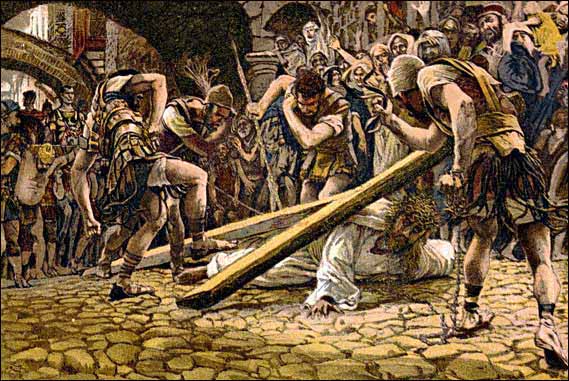
Now Paul draws his point even more strongly:
9 "Since we have now been justified by his blood, how much more41 shall we be saved from God's wrath through him! 10 For if, when we were God's enemies, we were reconciled to him through the death of his Son, how much more, having been reconciled, shall we be saved through42 his life!" (Romans 5:9-10)
The most difficult part, Paul implies, has already taken place: we have been justified ("made or declared righteous") by means of his blood (blood here represents Christ's death). Now the easy part, to be saved or rescued43 from God's wrath in future judgment that results in condemnation.44 There is no condemnation for those who have been made right with God through Jesus! (8:1). It is God's work entirely!
Why is this true? Paul spells it out further. Once, he says, we were God's enemies, hostile towards God, hating him.45 But now we have been reconciled. The word is katallassō, "the exchange of hostility for a friendly relationship, to reconcile someone to someone."46 Instead of estrangement and hostility on both sides, now there is harmony. Now there is friendship. Now there is free access into God's awesome presence. Now there is "peace with God through our Lord Jesus Christ" (5:1).
Even more than reconciliation brought about by his death, Paul says, we shall be saved by his life -- since he is now alive and intercedes for us! (8:34). Our salvation from sin has been settled by his death on the cross. Praise God. But it doesn't stop there. Christ's life through the power of the Holy Spirit works salvation in us now, that sanctification that brings about in us the character of Christ. We'll study much more about this in days to come.
|
Q4. (Romans 5:9-10) What does "reconciliation" mean? Why is
reconciliation with God necessary? We understand our having been saved
by Jesus' death (5:10a, past tense). In what sense are we being saved
(5:10b, present tense) by his life? What is Jesus doing for us in the
present? http://www.joyfulheart.com/forums/index.php?showtopic=795
|
Rejoicing in God (5:11)
 Available in paperback, Kindle, and PDF book formats. |
All this gives us great joy.
"Not only is this so, but we also rejoice in God through our Lord Jesus Christ, through whom we have now received reconciliation." (5:11)
Now, instead of living in terror before God, we rejoice in him, we boast about him, we brag on our God.47 And we do it with a relaxed enjoyment of the reconciliation48 we have experienced.
Paul begins our study of the Christ Powered Life with a strong statement of assurance of our salvation. Now, rather than worry about our salvation, we bask in reconciliation -- and rejoice. That is the joy of life we have in Christ Jesus!
Prayer
Thank you, O Lord, for making peace with us. You have brought us life and hope and joy. And your awesome peace mission is not one of oppression and exploitation, but one of love. We were your enemies by our sins and you reconciled us and won us over! Praise you! In Jesus' name we offer thanks. Amen.
Big Concept
God has embraced us with his love and favor far beyond any measure. And he did it while were still his enemies. So now that we are saved, we are assured that he won't give up on us in the future. We truly are at peace with God! We can relax in this kind of love and just enjoy him.
Key Verses
"Therefore, since we have been justified through faith, we have peace with God through our Lord Jesus Christ." (Romans 5:1)
"But God demonstrates his own love for us in this: While we were still sinners, Christ died for us." (Romans 5:8)
References
Copyright © 2026, Ralph F. Wilson. <pastor joyfulheart.com> All rights reserved. A single copy of this article is free. Do not put this on a website. See legal, copyright, and reprint information.