|
Old Testament
New Testament
Gospels
Acts
Paul's Letters
General Letters
Revelation
Topical Studies
Beginning the Journey (for new Christians). en Español

|
Old Testament
New Testament
Gospels
Acts
Paul's Letters
General Letters
Revelation
Topical Studies

|
Home
Bible Studies
Articles
Books
Podcasts
Search
Menu
Donate
About Us
Contact Us
FAQ
Sitemap


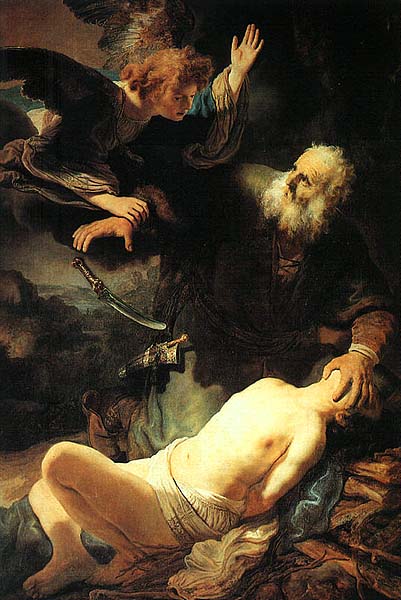
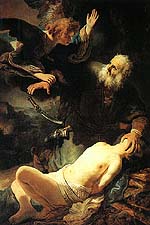 Harmensz Rembrandt van Rijn (Dutch painter, 1606-1669), 'Sacrifice of Isaac' (1635), oil on canvas, Hermitage Museum, St. Petersburg, Russia. Larger image. |
The more I meditate on Abraham offering his son Isaac on Mt. Moriah, the more amazing it seems. Abraham has come to the point in his spiritual journey of radical and immediate obedience to the word of God. He is an exemplar and inspiration to disciples of all ages.
God Requires Abraham's Only and Beloved Son (22:1-2)
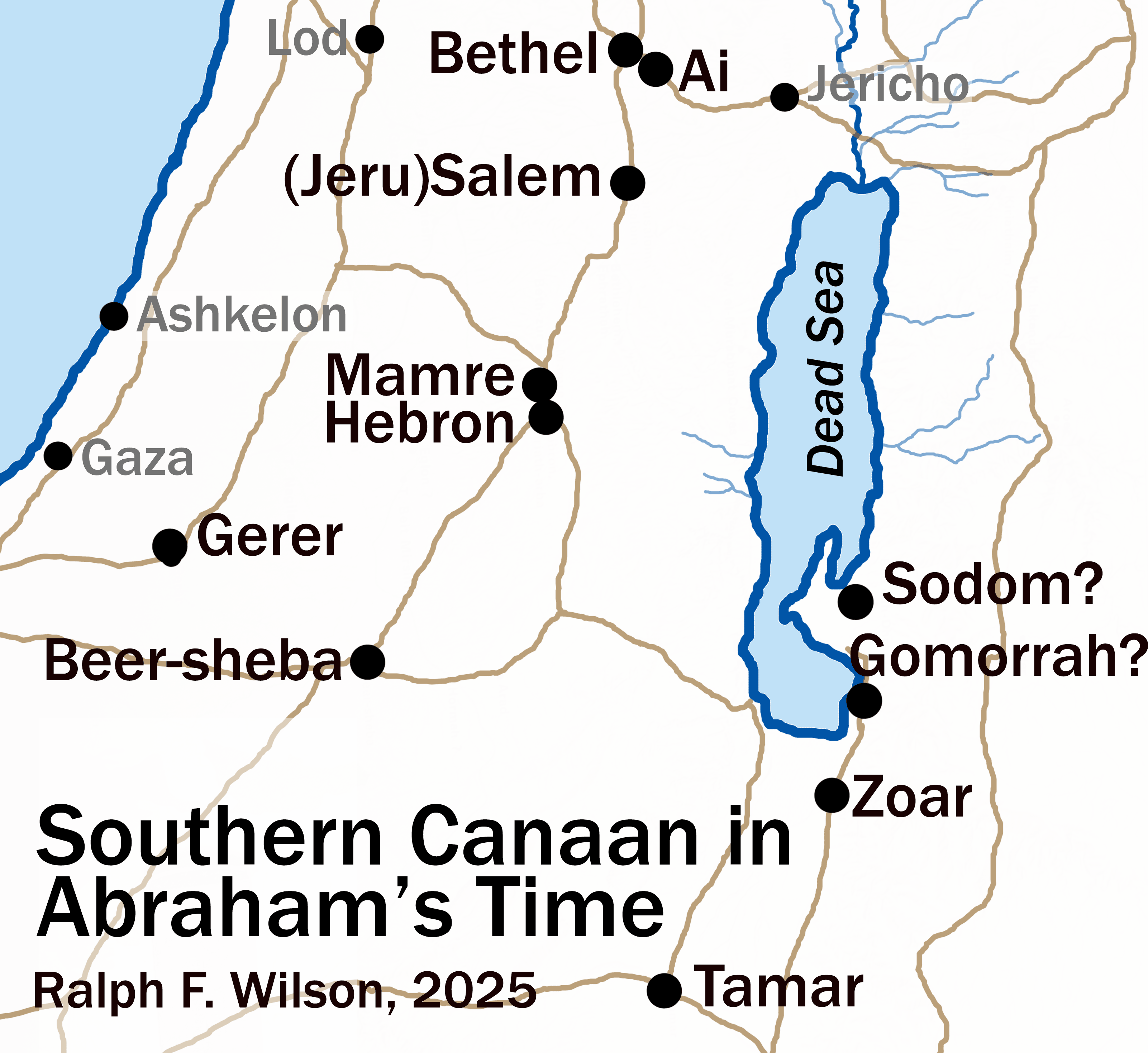
Abraham is living near a well at Beer-sheba on the edge of the Negev desert at the southern extremity of Canaan (20:33-34; 22:19). Here in Beer-sheba he had "called upon the name of the LORD, the Eternal God" (21:33) and here in Beer-sheba God speaks to him a fearful word.
"Some time later God tested Abraham. He said to him, 'Abraham!'
'Here I am,'225 he replied.
Then God said, 'Take your son, your only son, Isaac, whom you love, and go to the region of Moriah. Sacrifice him there as a burnt offering on one of the mountains I will tell you about.'" (22:1-2)
There is no mistake about Who this is who is speaking to him.226 Abraham has heard God's voice many times during his lifetime. He knows the voice. It is not the voice of an enemy, but a friend. But the message must have brought agony to Abraham's heart. We'll discuss the word "tested" (Hebrew nāsā) in verse 1 in a few minutes.
Abraham's son Isaac is probably just a young boy. I imagine him to be eight or nine, though the Scripture doesn't tell us. Abraham's heart has been broken when he sent away his firstborn son Ishmael at Sarah's insistence (21:10-11). Now Abraham has watched Isaac grow from being a toddler into a young boy. In Isaac, all the promises of God to Abraham find their focus -- blessing and descendants and the land. He is the miracle-son of Sarah at 90 and Abraham at 100. How can God ask for him now?
The angel seems to speak in measured cadence as he utters the dread words: 'Take your son, your only son, Isaac, whom you love ...." God describes Isaac in two ways:
- Your only son. "Only" is the Hebrew adjective yāhīd, means "only, only begotten." In this context yāhīd refers to an only child.227 Though Isaac is Abraham's second son, he has sent away Ishmael, his firstborn. As far as he and God are concerned, Isaac is the only one.
- Isaac whom you love. "Love" is the Hebrew verb 'āhēb. This general word for "love" or "like" is used in many contexts. Here it describes love between human beings, such as the love of father for son.228 This lad holds all the hopes and dreams and affection of his aged parents.
A "burnt offering" (Hebrew 'ōlā) commonly burned the entire sacrifice on the altar. Hundreds of years later, in the Mosaic law, God prescribes other offerings of which only part is burned and the rest is eaten by the worshippers. But the burnt offering is consumed completely. Rather than "burnt offering," Lloyd Carr suggests that "whole offering would be a better rendering in English to convey the theology of the 'ōlā," since it involved offering the whole to God.229
Human Sacrifice in the Ancient Near East
Human sacrifice was not unknown in the ancient Near East, though early examples of it are rare. A "substitute king" seems to have been sacrificed in Mesopotamia at the end of his brief "reign."230 Prisoners or foreigners were sacrificed at the dawn of Egyptian history, but the practice died out early.231 While skeletons of infant children have been found buried in the floors of Palestinian houses, this doesn't prove child sacrifice. But human sacrifice does seem to have been practiced by the "Sea Peoples" who settled along the coast -- Phoenicians and Canaanites. In the sanctuary of Tanit at Carthage, archaeologists have discovered urns containing burnt bones of lambs and goats, and more often, of children, where the sacrifice of the finest children is attested in 310 BC.232 Two steles from Malta from the seventh or sixth century BC indicate that child sacrifice was practiced. Philo of Byblos says that the Phoenicians had an ancient custom -- "they offered their dearest children in a way full of mystery" when danger threatened the nation.233 In Bible times, the King of Moab offered his son as a burnt offering when his capital was under siege (2 Kings 3:27).
This Canaanite and Phoenician practice came into Israel under apostate kings when Ahaz "made his son pass through the fire" (2 Kings 16:3) and Manasseh did the same (2 Kings 21:6). The custom was probably fairly widespread, since it prompted condemnations of the practice in the Bible.234
But Abraham didn't have the benefit of God's revelation to Moses and the prophets, of the Old Testament scriptures. All he knew was that child sacrifice was practiced by some of the Canaanites. Instead of being morally incensed by the practice (as we are, with our knowledge of God's revealed will), Abraham had no option but to believe that God seriously demanded that he sacrifice his son as a "burnt offering," that is, a sacrifice that is fully consumed by the fire upon the altar.
And so Abraham prepared to go to "the region of Moriah." In the only other occurrence of this place name in the Old Testament it refers to Jerusalem, a city built upon several hills on the ridge of the north-south mountain chain.
"Then Solomon began to build the temple of the Lord in Jerusalem on Mount Moriah, where the Lord had appeared to his father David. It was on the threshing floor of Araunah the Jebusite, the place provided by David" (2 Chronicles 3:1).
We're not sure what the name Moriah means, but it may be something like "my teacher is Yah" or "the land which is the king's."235
Abraham Heads for Mt. Moriah (22:3-5)
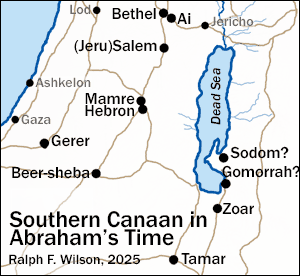 South Canaan in Abraham's Time. Larger map. |
To Abraham's credit, when God told him to offer his son Isaac, he didn't put it off. He began his journey "early the next morning."
"Early the next morning Abraham got up and saddled his donkey. He took with him two of his servants and his son Isaac. When he had cut enough wood for the burnt offering, he set out for the place God had told him about. On the third day Abraham looked up and saw the place in the distance. He said to his servants, 'Stay here with the donkey while I and the boy go over there. We will worship and then we will come back to you.'" (22:3-5)
"The third day" is about right for a trip from Beer-sheba to Jerusalem, a journey of about 50 miles. He leaves his servants behind with the donkey and tells them that he and the boy will go and worship. "Worship" is the Hebrew verb hāwā, "bow down, prostrate oneself, worship."236
Observe Abraham's confident promise: "We will worship and then we will come back to you" (22:5). While Abraham is fully prepared to offer Isaac, he also is confident that God will keep the promises that Isaac himself will be heir to the covenant and have descendants.237 Here is obedient faith in action.
The writer of Hebrews reflects on the quality of Abraham's faith:
"By faith Abraham, when God tested him, offered Isaac as a sacrifice. He who had received the promises was about to sacrifice his one and only son, even though God had said to him, 'It is through Isaac that your offspring will be reckoned.' Abraham reasoned that God could raise the dead, and figuratively speaking, he did receive Isaac back from death." (Hebrews 11:17-19)
But this was no play-acting for Abraham, no "slam-dunk." He fully intended obey God -- but at the same time there were those promises pointing to Isaac. Somehow, he hoped and prayed, God would intervene.
God Will Provide the Lamb (22:6-9)
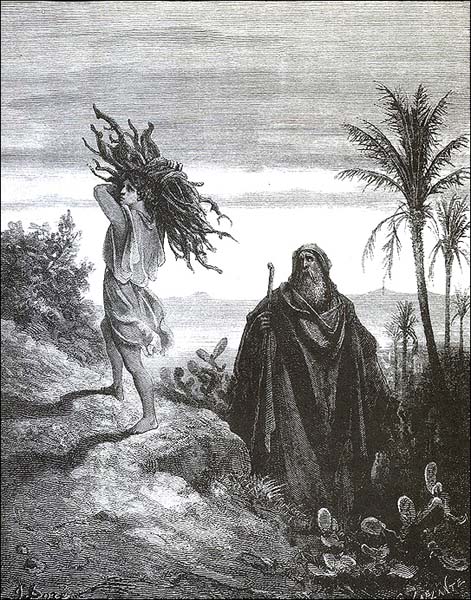
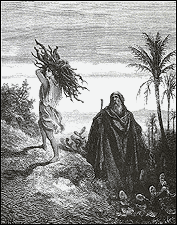 Gustav Doré (French illustrator 1832-1883), captures some of the poignancy and fearfulness of the situation in his etching, "Abraham and Isaac climb Mt. Moriah" (1866). Larger image. |
Isaac was old enough to sense something amiss.
"Abraham took the wood for
the burnt offering and placed it on his son Isaac, and he himself carried the
fire and the knife. As the two of them went on together, Isaac spoke up and
said to his father Abraham, 'Father?'
'Yes, my son?' Abraham replied.
'The fire and wood are here,' Isaac said, 'but where is the lamb for the burnt
offering?'
Abraham answered, 'God himself will provide the lamb for the burnt offering, my
son.' And the two of them went on together." (22:6-9)
Abraham answers Isaac's questions with the only answer he can hope for, "God himself will provide the lamb for the burnt offering, my son." On yir'eh, "provide," see verse 14 below.
Abraham Prepares to Sacrifice His Son (22:9-10)
"When they reached the place God had told him about, Abraham built an altar there and arranged the wood on it. He bound his son Isaac and laid him on the altar, on top of the wood. Then he reached out his hand and took the knife to slay his son." (22:11-12)
The narrator explains how Abraham methodically proceeds:
- Builds an altar, either an earthen altar or one made of stones (on altars, see Lesson 1, Genesis 12:7).
- Arranges the wood on the altar.
- Binds Isaac, probably with leather thongs.
- Lays him on the altar. Abraham picks up his son Isaac, his only son, and sets him on the wood.
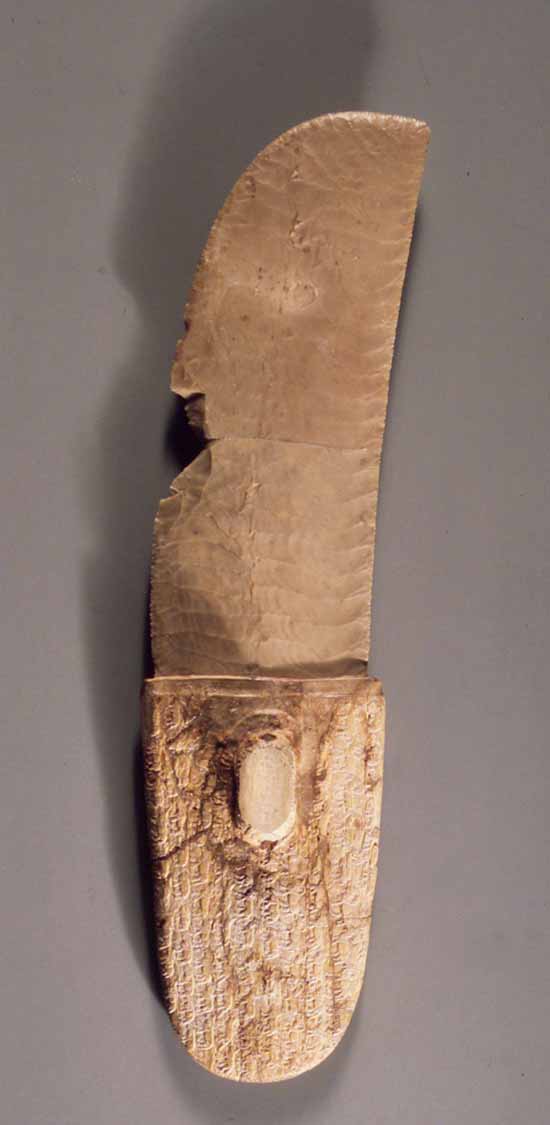
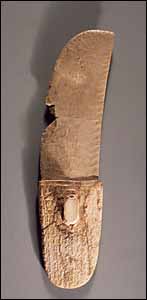 Flint knife with elephant ivory handle, 2-3/8 x 13/16 x 9-1/8 inches, ca. 3300-3100 BC, from Abu Zaidan near Luxor, Egypt. Brooklyn Museum. Larger image. |
Abraham's "knife" (Hebrew ma'ăkelet) may have been metal -- this is the Middle Bronze Age, after all. But I think it is more likely a flint knife. Archaeologists have found flint knives used alongside of metal knives for centuries, since flint kept its edge better than copper or iron. Abraham is certainly wealthy enough to afford a metal knife, but as
a shepherd, he would need, I suspect, a sharp flint knife rather than a decorative, but duller, metal blade.238
Abraham reaches for the knife. "Slay" (NIV, KJV) or "kill" (NRSV) is the Hebrew verb shāhat, "kill, slaughter." Rabbinic sources indicate that an animal to be sacrificed was killed in "the swiftest and most painless way possible, by cutting horizontally across the throat in an uninterrupted movement."239 In a moment, that is exactly what Abraham will do -- to his son!
The Angel Restrains Abraham (22:11-12)
But just before that point, the angel -- who now speaks with the voice of Yahweh -- stops Abraham.
"But the angel of the Lord
called out to him from heaven, 'Abraham! Abraham!'
'Here I am,' he replied.
'Do not lay a hand240
on the boy,' he said. 'Do not do anything to him. Now I know that you fear God,
because you have not withheld from me your son, your only son.'" (22:11-12)
The repetition of his name -- "Abraham, Abraham" -- suggests the urgency of the angel's message, and recalls other urgent calls from God -- "Moses, Moses" (Exodus 3:4), "Samuel, Samuel" (1 Samuel 3:4), "Saul, Saul" (Acts 9:4).241 God stops him from slaying his son, and then encourages him that he has passed the test.
God's Testing and Forming of His Servants
Yahweh says, "Now I know that you fear God," that is, he is committed to God. One who fears God stands in awe of God and lives with practical righteousness and piety, obeying, walking in the Lord's ways.242
But doesn't the omnipotent God -- "the LORD, God Most High, Creator of heaven and earth" (14:22) -- have foreknowledge of how Abraham will respond? Of course. This is not a theological textbook but a story. Professor Sheriffs comments:
"It would be unfair to Hebrew storytelling to ask it to turn into an academic treatise on God's sovereignty and human freedom. Rather, this story is the story of a journey with God, sometimes told from God's perspective -- as in the narrator's opening words -- and sometimes told from the human participant's perspective."243
In verse 1 the narrator uses the word "tested" (NIV, NRSV) to describe this event, the Hebrew verb nāsā, "test, try, prove." In most contexts this word has the idea of "testing or proving the quality of someone or something, often through diversity or hardship." It should be translated in this context, "prove, test, put to the test" rather than "tempt" (KJV) or "entice to do wrong" (James 1:13-14). "Such testing by God, however, was not without intent. It was to refine the character of man that he might walk more closely in God's ways."244 Several times in the Old Testament, the idea of testing is combined with refining metals, such as silver or gold.245 God uses the events we face to challenge and strengthen our faith, to grow our spiritual muscles in the same way that physical workouts challenge existing muscle fibers and cause them to regrow even stronger. James exhorts us:
"Consider it pure joy, my brothers, whenever you face trials of many kinds, because you know that the testing of your faith develops perseverance." (James 1:2-3)
Paul writes:
"For our light and momentary troubles are achieving for us an eternal glory that far outweighs them all." (2 Corinthians 4:17)
God also tests us in order to show off our character to others. Job doesn't understand why he was suffering, but in God's eyes, his faithfulness is a showpiece of character that Satan's attacks cannot undermine. Abraham's faith on Mt. Moriah has inspired countless generations to a faith in God and a commitment to God that goes beyond the ordinary. As we deal with life's struggles, we are scrutinized by the world around us, who are hoping against hope to see a person of character remain true to God even through pain and struggle. Our actions speak much louder at such times than our words ever can (Matthew 5:13-16). And our confidence in God and words of testimony after such a trial of our faith bring glory to God.
But in the midst of trials, we wonder Why? We seek to find meaning in our trials. Sometimes, as in Abraham's case, God explains a bit of the purpose. At other times, we just don't know, but we continue to trust that in this circumstance God will fulfill his word: "And we know that in all things God works for the good of those who love him, who have been called according to his purpose" (Romans 8:28).
Q1. What effect does Satan want trials to have in our life? What effect does God want them to have? The effect really depends upon how we respond to the trial. Have you ever been through a trial that strengthens and invigorates you at the end? Have any of your trials inspired others or have you been inspired by another's trial?
The Significance of Abraham's Faith
Abraham's act of faith is awesome. Young Isaac is Abraham's only future, yet he is willing to entrust his future to God. Luter and Klouda observe:
"Abraham's willingness to relinquish Isaac expresses his dependence on the Lord himself, not just on the divine promise alone. Abraham recognizes his son Isaac as a gift ultimately belonging to God, and the fulfillment of the Lord's covenant promises as a privilege, not a right."246
God leads Abraham -- as he brings many of his servants today -- to the point of offering to God everything he possesses so that he hopes in God alone -- only to receive back, sanctified and blessed, what he has offered. Herein lies the paradox of true discipleship:
"For whoever wants to save his life will lose it, but whoever loses his life for me and for the gospel will save it." (Mark 8:35)
Jesus also said:
"The hour has come for the Son of Man to be glorified. I tell you the truth, unless a kernel of wheat falls to the ground and dies, it remains only a single seed. But if it dies, it produces many seeds. The man who loves his life will lose it, while the man who hates his life in this world will keep it for eternal life." (John 12:23-25)
I think of the old Gospel hymn:
"All to Jesus I surrender,
all to Him I freely give.
I will ever love and trust Him, in his service daily live.
I surrender all, I surrender
all,
All to Jesus I surrender. I surrender all."247
When we are afraid to trust God with our future, we are to be pitied. Abraham offers everything he is and has to God and receives an unfathomable blessing.
Q2. Can we really know God until we can trust him with our whole lives? Have you surrendered your life to Jesus Christ? If not, why not now? If you have, what has that surrender entailed for you? How has God blessed you in return?
Jehovah-Jireh, The Lord Will Provide (22:13-14)
God stops him from sacrificing Isaac on the altar, but not from worship:
"Abraham looked up and there in a thicket he saw a ram caught by its horns. He went over and took the ram and sacrificed it as a burnt offering instead of his son. So Abraham called that place The Lord Will Provide (Yahweh-yir'eh). And to this day it is said, 'On the mountain of the Lord it will be provided.'" (22:13-14)
God provides a male sheep for the sacrifice,248 just as Abraham had told Isaac that he would. "Provide" is the Hebrew verb is yir'eh from the root rā'eh, "to see." Literally, it reads, "God will see for himself the sheep."249 This word yir'eh, "will see, will provide" becomes the basis of Abraham's choice of a name for this place in verse 14, Yahweh-yir'eh, ("Jehovah-jireh," KJV), "The LORD Will Provide."
God promises many, many times in the Scripture that he will provide for his people. In the wilderness after the Exodus, God provided manna and clothing, protection and water (Deuteronomy 8:3; Nehemiah 9:15). Psalm 23:1 reminds us, "The LORD is my shepherd, I shall not be in want." Two New Testament examples are:
"But seek ye first the kingdom of God, and his righteousness; and all these things shall be added unto you." (Matthew 6:33, KJV)
"And my God will meet all your needs according to his glorious riches in Christ Jesus." (Philippians 4:19)
From that day forward, Abraham remembered the name he had given that mountain top -- Jehovah-jireh, Yahweh-yir'eh, "The LORD Will Provide."
Q3. (Genesis 22:14) How have you learned to trust God to provide for you? How has he provided for you in the past? What are you facing right now that will require God to be your Provider, your Jehovah-Jireh?
I Will Surely Bless You (22:15-19)
After God intervenes, he reaffirms his promises to Abraham with a powerful oath and declaration:
"The angel of the Lord called to Abraham from heaven a second time and said, 'I swear by myself, declares the Lord, that because you have done this and have not withheld your son, your only son, I will surely bless you and make your descendants as numerous as the stars in the sky and as the sand on the seashore. Your descendants will take possession of the cities of their enemies, and through your offspring all nations on earth will be blessed, because you have obeyed me.'
Then Abraham returned to his servants, and they set off together for Beersheba. And Abraham stayed in Beersheba." (22:15-19)
"Swear" is the verb sheba' that we saw in chapter 21. Humans swear by what is most holy and sacred to them. Here Yahweh swears by himself (22:15). The writer of Hebrews comments on this verse saying: "When God made his promise to Abraham, since there was no one greater for him to swear by, he swore by himself" (Hebrews 6:13).250
Not only does God swear by himself, but the promises themselves are stated unequivocally. "Surely" (NIV) and "indeed" (NRSV) translate the emphatic sense created in Hebrew by repeating the words "bless" (bārak) and "multiply" (rābā):
"That in blessing I will bless thee and in multiplying I will multiply thy seed...." (KJV).
The promises themselves we have seen before, but here they are collected together. I have arranged them so that you can see the structure of the promises.
Because you have done this
- I will most emphatically bless you.
- I will most emphatically multiply your descendants
- As numerous as the stars in the sky
- and the sand on the seashore.
- Your descendants will take possession of the "gates" (KJV) or "cities" (NIV) of their enemies -- that is, possess the "land" that God had promised Abraham previously.
- Through your seed will all nations on the earth be blessed
Because you obeyed me.
Analogy to God Giving His Only Begotten Son
It is difficult for Christians to consider the story of Abraham being willing to offer Isaac without seeing strong analogies to the sacrifice of Jesus on the cross.
- "Take your son, your only son..." (22:2). In the New Testament we read: "For God so loved the world, that he gave his only begotten Son, that whosoever believes in him shall not perish, but have everlasting life" (John 3:16).
- "...Whom you love" (22:2). Twice God's voice designates Jesus as his "Beloved Son" or "my Son, whom I love" (Matthew 3:17; 17:5). In the Parable of the Vineyard, the owner (who represents God) sends his "beloved son" (who represents Jesus; Luke 20:13).
- On a mountain "in the region of Moriah" (22:2). 2 Chronicles 3:1 designates Mount Moriah as "the threshing floor of Araunah the Jebusite," which became the site of the temple and, later, the present-day site of the Dome of the Rock (Qubbat al-Sakhra). This Muslim mosque is built over the holy place where Islam teaches that Abraham sacrificed his son Ishmael (not Isaac). Golgotha was not on this exact site, but close by (in "the region of Moriah").
- "God himself will provide the lamb for the burnt offering" (22:8). Jesus is designated several times as "the Lamb of God" (John 1:29, 36), especially in the Book of Revelation.251
It is difficult to escape the conclusion that this story of Abraham is like an acted-out prophecy of the unimaginable -- the Heavenly Father who offers his only Son, the Son whom he loves, on the cross, as a Lamb that only he can provide, to accomplish what only he can accomplish -- to take away the sin of the world.
Abraham's anguish and resolve help us to understand just a tiny bit our Heavenly Father's love for us and his determination to save us, whatever the cost.
Q4. How does Abraham's near sacrifice of his beloved, only son Isaac help you understand better Jesus' crucifixion?
Lessons for Disciples
 Available as PDF, Kindle, and paperback books. |
This passage contains some of the most basic and difficult lessons that disciples can and must learn:
- God calls us to give everything we have to God -- and we must obey.
- Where God requires of us, he also blesses us.
- When we trust him, God will provide for every need we have. He is "The Lord Who Provides."
- God's love for us is immeasurably great, that he would sacrifice his only Son for our sins.
Prayer
Thank you, Father, for your immense graciousness to us in giving us your Son, your Only Son, Jesus, as the sacrifice for our sins. How can we say "Thank you" in any adequate way? Help us to trust you as did your servant Abraham, with the things most precious to us. We thank you for your blessing of grace, unearned and undeserved. In Jesus' name, we pray. Amen.
Key Verses
"Take your son, your only son, Isaac, whom you love, and go to the region of Moriah. Sacrifice him there as a burnt offering on one of the mountains I will tell you about." (22:2)
"God himself will provide the lamb for the burnt offering, my son." (22:8)
"Do not lay a hand on the boy,' he said. 'Do not do anything to him. Now I know that you fear God, because you have not withheld from me your son, your only son." (Genesis 22:12)
Endnotes
[225] Hebrew interjection hinnēh, "look!, see!" It is used mainly used to emphasize the information following it (Carl Philip Weber, TWOT #510a).
[226] In verse 2 in the Hebrew text there is a definite article in front of elohim, so it could be translated "the God." The narrator wants it to be abundantly clear that "The God," Abraham's God spoke to him. It didn't come from his own mind or imagination (Hamilton, Genesis 2:100).
[227] Paul R. Gilchrist, yāhīd, TWOT #858a.
[228] Robert L. Allen, 'āhēb, TWOT #29.
[229] G. Lloyd Carr, 'ōlā," TWOT #1624c.
[230] De Vaux, Ancient Israel, 2:435.
[231] De Vaux 2:441.
[232] Cited in a text of Diodorus Siculus, Biblioth. Hist. XX, 14.
[233] Cited in Eusebius, Praeparatio Evangelica i.10.21, 34, 44. See also Porphyry, De abstin. II 56. Cited by De Vaux 2:445-446. Also John Day, "Canaan, Religion of," ABD 1:834.
[234] Leviticus 18:21; 20:2-5; Deuteronomy 18:10; 2 Kings 17:17; 21:6; 2 Chronicles 28:3; 23:10; Psalm 106:37-38; Jeremiah 19:4-5; 32:35.
[235] Hamilton, Genesis 2:102-103.
[236] Edwin Yamauchi, TWOT #619. The verb hāwā is found exclusively in the Eshtaphal stem from its cognates with Ugaritic. Formerly it was analyzed as a Hithpael of shāhā.
[237] Genesis 17:19, 21; 21:12
[238] Roland K. Harrison, "Flint," ISBE 2:315; EB Pollard, "Knife," ISBE 3:46-47; Jack B. Scott, ma'ăkelet TWOT #85e. Flint knives were used when the Israelites were circumcised just prior to the Battle of Jericho (Joshua 5:2), four centuries after Abraham.
[239] Victor P. Hamilton, shāhat, TWOT #2362.
[240] The phrase "lay (a hand) on" (NIV) is the same verb as "reached out (his hand)." "Stretched forth" (KJV) or "reached out" (NIV, NRSV) in verse 10 and "lay (your hand on)" in verse 12 translate the Hebrew verb shālah, here, "to stretch out, extend," of a hand or a rod (Hermann J. Austel, TWOT #2394).
[241] Hamilton, Genesis 2:111-112.
[242] In the phrase "fear God," "fear" is the Hebrew noun yārē', "fearing, afraid" as in "God-fearer." The emphasis here isn't on terror as much as awe or reverence. A "God-fearer" will express his awe in practical righteousness or piety, obeying, walking in the Lord's ways (Andrew Bowling, TWOT #907a).
[243] Deryck C.T. Sheriffs, "Testing," DOTP 830-834.
[244] Marvin R. Wilson, TWOT #1373. See also Walter Schneider, Colin Brown, and Hermann Haarbeck, "Tempt, Test, Approve," Dictionary of New Testament Theology (Zondervan, 1978) 3:798-810; Craig L. Blomberg, "Test," ISBE 4:795-796.
[245] Jeremiah 6:27; 9:7; Zechariah 13:9.
[246] A. Boyd Luter and Sheri L. Klouda, "Isaac," DOTP 448.
[247] Hymn: "I Surrender All." Words: Judson W. Van DeVenter (1896); music: Winfield S. Weeden (1896).
[248] "Ram" ('ayil) is a male sheep. Since one ram to 10 female lambs is typical in raising sheep, the males were commonly used for meat and sacrifices, while the females were kept for the next generation (Herbert Wolf, TWOT #45d).
[249] Yir'eh is also used in the sense "to provide" in the word of the LORD through the prophet Samuel, "I have provided me a king among his sons" (1 Samuel 16:1, KJV, NRSV). (Hamilton, Genesis 2:98, note 8.; Robert D. Culver, TWOT #2095).
[250] Compare Hebrews 6:13 to Isaiah 45:23; Jeremiah 49:13; 51:14; Amos 6:8.
[251] Revelation 5:6-13; 6:1, 16; 7:9-10, 14, 17; 12:11; 13:8; 14:1, 4, 10; 15:3; 17:14; 19:7, 9; 21:9, 14, 22-23, 27-22:3. For more on this, see my book Lamb of God (JesusWalk, 2011, www.jesuswalk.com/books/lamb.htm).
Copyright © 2026, Ralph F. Wilson. <pastor joyfulheart.com> All rights reserved. A single copy of this article is free. Do not put this on a website. See legal, copyright, and reprint information.
 To be notified about future articles, stories, and Bible studies, why don't you subscribe to our free newsletter, The Joyful Heart, by placing your e-mail address in the box below. We respect your