


|
Old Testament
New Testament
Gospels
Acts
Paul's Letters
General Letters
Revelation
Topical Studies
Beginning the Journey (for new Christians). en Español

|
Old Testament
New Testament
Gospels
Acts
Paul's Letters
General Letters
Revelation
Topical Studies

|
Home
Bible Studies
Articles
Books
Podcasts
Search
Menu
Donate
About Us
Contact Us
FAQ
Sitemap


4. My God, My God, Why Have You Forsaken Me? (Mark 15:34)
by Dr. Ralph F. Wilson
Audio (17:07)
Free
E-mail Bible Study
 Experiencing the Psalms
Home | Bible Studies | Articles | Books | Podcasts | Search | Menu | Donate | About Us | FAQ | Contact Us
|
|
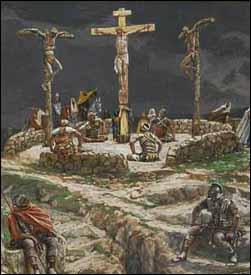
"33 At the sixth hour darkness came over the whole land until the ninth hour. 34 And at the ninth hour Jesus cried out in a loud voice, 'Eloi, Eloi, lama sabachthani?' -- which means, 'My God, my God, why have you forsaken me?' 35 When some of those standing near heard this, they said, 'Listen, he's calling Elijah.'" (Mark 15:33-35; also Matthew 27:45-47)
At the very center of the Seven Last Words, the Fourth Word is probably both Jesus' lowest point as well as a theological high point of the crucifixion. We'll spend a bit longer seeking to understand its implications.
The early crowds have long ago dispersed and the long time of waiting for death had begun. An eerie darkness has descended upon the entire area, a crushing gloom.
Six Hours on the Cross
The criminals on either side are still alive -- and might have lived for days on the cross. But Jesus is not so strong. He has somehow endured a cruel scourging that would have killed lesser men. He has lost a lot of blood, even before climbing the hill to Golgotha and having his hands and feet nailed to the rough cross.
Mark tells us, "It was the third hour27 when they crucified him" (Mark 15:25). Sometime after the crucifixion took place, Luke tells us: "It was now about the sixth hour, and darkness came over the whole land until the ninth hour" (Luke 23:44).28 Jesus lasts only six hours.
Darkness over the Land
When darkness falls, something changes.
"It was now about the sixth hour, and darkness came over the whole land until the ninth hour, for the sun stopped shining...." (Luke 23:44-45a)
An African-American spiritual asks: "Were you there when the sun refused to shine?" Why the darkness? The word rendered "stopped shining" (NIV), "failed" (NRSV), "was darkened" (KJV) is ekleipō (from which we get our English word "eclipsed"). It means to "fail, give out, die out."29
An eclipse has taken place not so long ago on November 24, 29 AD, but what takes place this day is no natural eclipse. A normal eclipse would have been physically impossible during the time of the full moon on which Passover falls. We aren't told how it happens. The darkening may have been caused locally by a hamsin or sirocco wind.30 We just don't know.
Throughout Jerusalem -- and especially in this killing ground -- the darkness is felt, heavy and foreboding. But what does the darkness mean? What is its significance? There are probably several possibilities and levels of meaning:
1. A symbol of moral darkness, "when darkness reigns" (Luke 22:53).31
2. A fulfillment of prophecy.
"The sun will be turned to darkness
and the moon to blood
before the coming of the great and dreadful day of the LORD." (Joel 2:31)
"'In that day,' declares the Sovereign LORD,
'I will make the sun go down at noon
and darken the earth in broad daylight.
I will turn your religious feasts into mourning
and all your singing into weeping.
I will make all of you wear sackcloth
and shave your heads.
I will make that time like mourning for an only son
and the end of it like a bitter day.'" (Amos 8:9-10)
3. A portent of the death of a king. Philo, a first century AD Jewish writer, saw supernatural eclipses as "indications either of the impending death of some king or of the destruction of some city."32
4. The Father's anger at how his only begotten Son is being treated:
"The rising sun will be darkened
and the moon will not give its light.
I will punish the world for its evil,
the wicked for their sins.
I will put an end to the arrogance of the haughty
and will humble the pride of the ruthless." (Isaiah 13:10b-11)
5. The Father's judgment on the sins of the world being borne on Christ's shoulders as he hangs on the cross. This best fits my understanding of what was taking place at that time. The Lamb of God was bearing in himself the sins of the world!
A Darkness that Can Be Felt
The darkness was palpable, "a darkness that could be felt," reminiscent of the darkness over the land of Egypt in the Ninth Plague:
"Then the LORD said to Moses, 'Stretch out your hand toward the sky so that darkness will spread over Egypt -- darkness that can be felt.' So Moses stretched out his hand toward the sky, and total darkness covered all Egypt for three days." (Exodus 10:21-22)
I don't think the similarity between the three days and the three hours is accidental.
Crying in a Loud Voice
Now in deep torment:
"Jesus cried out in a loud voice" (Mark 15:34; Matthew 27:46)
Mark uses the verb boaō to describe this cry: "to use one's voice at high volume, call, shout, cry out." It can be used of emotionally charged cries of joy or of excited crowds, but especially "of pleading petitions or anguished outcries." 33 It is used of a man begging Jesus to heal his son (Luke 9:38), of the desperate blind man who will not be silenced, but cries, "Jesus, Son of David, have mercy on me!" Luke 18:38), and of the shrieks of people as evil spirits leave them (Acts 8:7). It is also used of the voice crying in the wilderness: "Prepare the way of the Lord!" (Isaiah 40:3; Matthew 3:3, etc.).
Eloi, Eloi, My God, My God!
In the Fourth Word from the cross, Jesus is quoting the first verse of Psalm 22, a psalm full of predictions of his crucifixion:
"34 And at the ninth hour Jesus cried out in a loud voice, 'Eloi,34 Eloi, lama sabachthani?' -- which means, 'My God, my God, why have you forsaken me?' 35 When some of those standing near heard this, they said, 'Listen, he's calling Elijah.'" (Mark 15:34-35)
Some of those listening seem to have mistaken the call of "Eloi" with a call for Elijah.35 Elijah was considered by Judaism of the time as one who would come in the Last Days to be a helper in time of need, to save the righteous.36
It is noteworthy that this is the only time that Jesus addresses "God" this way in prayer. In all his other recorded prayers he uses the term "Father," probably reflecting the intimate form Abba. But here in his hour of greatest desolation, he addresses God as would any other supplicant. This doesn't represent loss of faith. The fact that he is praying, "My God," shows that he still trusts God. But the intimacy of fellowship seems to have been broken. There is a loss of contact.37 Jesus can no longer feel his Father's presence.
Why Have You Forsaken Me?
"Forsaken" is a hard word for us to even think about. In Greek it is enkataleipō, "to separate connection with someone or something, forsake, abandon, desert."38 We are so steeped in the promises from the Old and New Testaments to the contrary:39
"I will never leave you or forsake you." (Hebrews 13:5, NRSV)
But clearly, Jesus senses that he is utterly forsaken by God.
Attempts to Mitigate the Cry of Desolation
Doesn't Jesus' forsakenness somehow suggest that he wasn't divine after all? How could Jesus as Son of God be separated from the Father? Isn't this an oxymoron?
Some have tried to lessen the incongruity by suggesting that by calling out the first words of Psalm 22 Jesus is calling attention to the entire psalm, which ends on an upswing of hope and triumph in verses 22-31.
It is true that in ancient times before the Psalms were numbered, a particular psalm would be referred to by its first line. And much of Psalm 22 obviously pre-figures the elements of Jesus' crucifixion. But to suggest that by speaking the first verse of Psalm 22 Jesus was actually signaling the hope and triumph with which the Psalm ends twists the obvious meaning of Jesus' cry. 40
The phrase "Jesus cried out in a loud voice" makes it clear that this is a very real prayer reflecting the agony of the Cup drunk to its very dregs on the cross.
"My God, my God, why have you forsaken me?
Why are you so far from saving me,
so far from the words of my groaning?" (Psalm 22:1)
Why Is Jesus Cut Off from God?
The question, "Why is Jesus cut off from God?" reveals the quandary that we're in. It suggests a division in the Trinity itself -- which is unthinkable! We have no theology to explain or describe it. But cut off, Jesus is. Why?
A verse from the Old Testament helps us understand:
"But your iniquities have separated you from
your God;
your sins have hidden his face from you,
so that he will not hear." (Isaiah 59:2)
God is holy and righteous, so much so that unholy men are in danger if they try to draw close to him -- "For the LORD your God is a consuming fire" (Deuteronomy 4:24; cf. Hebrews 12:29). We must keep our distance. Our sins and iniquities have caused a separation between us and God -- a great gulf or chasm between us. The Hebrew verb is bādal, "divide, separate, sever."41 That he has "hidden his face from you" (Isaiah 59:2b) means that we can't experience communion with him or sense his presence in our lives. "He will not hear" (Isaiah 59:2c).
The Lamb of God
But what does this have to do with the sinless Jesus? Paul explains:
"God made him who had no sin to be sin for us, so that in him we might become the righteousness of God." (2 Corinthians 5:21)
Jesus is forsaken by God because he has taken our sins upon him. He is atoning for our sins. He is, "the Lamb of God, who takes away the sin of the world." (John 1:29). John is probably referring to Jesus as the ultimate Paschal or Passover Lamb, a sacrifice made on behalf of the whole world (Exodus 12:1-13).42
The Garden of Gethsemane
Jesus' struggle to complete the Father's plan of redemption intensifies in the Garden of Gethsemane, the night before Jesus is crucified. Luke describes the scene:
"[Jesus] withdrew about a stone's throw beyond [his disciples], knelt down and prayed, 'Father, if you are willing, take this cup from me; yet not my will, but yours be done.' ... And being in anguish, he prayed more earnestly, and his sweat was like drops of blood falling to the ground." (Luke 22:41-42, 44)
The "cup" is used as a figurative expression for "destiny." Several times in the Bible we read of drinking a cup of suffering and judgment.43 Jesus refers to drinking "the cup the Father has given me" (John 18:11; Matthew 20:22; 26:39; Mark 14:36).
Jesus' "cup," however, wasn't death, even death on the cross. His "cup" is the requirement that the holy Jesus bear our unholy sins and, as a result, receive in himself the judgment and punishment of God for our sins.
Jesus knows that the cross would mean separation from God. He struggles hard against it. Yet in the end, he prays, "Not my will, but yours be done" (Luke 22:42). He has made his decision.
The Darkness, the Horror, and the Forsakenness
Now the horror and magnitude of this "cup" come in full fury as the darkness of God's judgment grows heavy and he feels the Father's comforting presence sucked away. He who has been with the Father from all eternity is now utterly alone!
The Father's focus at this hour is severe judgment upon the sins Jesus is bearing.
Jesus' agonizing cry, "My God, My God, why have you forsaken me," enables us just a tiny glimpse of what it must have cost Jesus to die for our sins. Our forgiveness is not free, dear friends, neither for the Father nor for the Son. It wrenches them apart and puts them on opposite sides -- as enemies -- if only for a little while.
Jesus' agonizing saying from the cross teaches us something about how much the Father and Son both love us -- so much that that they are willing to sever for a time their love for each other. Now, perhaps, we can understand better the Fourth Word from the cross:
"My God, my God, why have you forsaken me?" (Mark 15:34b)
A song springs forth in my consciousness, the chorus of a Charles Wesley hymn familiar from my youth:
"Amazing love! How can it be,
That Thou, my God, shouldst die for me?"44
Prayer
Father, Lord Jesus, how can we ever thank You enough. In the face of such determined and sacrificial love, our paltry and vacillating love seems so unworthy. Teach us, teach me, to love You as You love me. Help us to be both able and willing to understand the costliness of real love as You do. In your holy name we humbly come, kneel at your feet, and pray. Amen.
Question for Personal Meditation
Q4. (Mark 15:34) What does Jesus' Fourth
Word from the cross teach us about faith? About commitment? About love? What
effect should this understanding have on our lives?
|
Questions for Group Discussion
- How long was Jesus on the cross? In what way did the period seem to change about half-way through? (Mark 15:25, 33-34)
- Why do you think the sun stopped shining? What did it signify? (Mark 15:33)
- What does the loudness of Jesus' voice tell us about his mental and emotional states? (Mark 15:34)
- What is the significance of Mark 15:34 including a quotation from Psalm 22?
- In what sense was Jesus forsaken? Why must he be forsaken at this time? (Mark 15:34)
- What was the "cup" that Jesus accepted in the Garden of Gethsemane? (Luke 22:41-44)
- In what way does this Fourth Word reveal love? (Mark 15:34)
References
27. Lane (Mark, p. 566-567) sees John's timing more credible than Mark's. Without any manuscript evidence Lane rejects Mark's "third hour" as probably "a gloss inserted by an early reviser." Others see more plausible an early trial with the crucifixion beginning around 9 a.m. and reaching a new phase between noon and 3 p.m. (France, Matthew, p. 1063, footnote 3).
28. The Jews measured time from sunrise, approximately 6 am. John tells us that Jesus' trial before Pilate took place about the sixth hour (John 19:14). There have been various attempts to reconcile this with the times given in the Synoptic hours. Based on two examples, Brook Foss Westcott (The Gospel According to St. John), put forward the theory that Roman time was counted from midnight, rather than the Jewish calculation of the hours from sunrise. But there seems to be no strong evidence to support this claim. For a discussion see Morris, John, pp. 800-801, footnote 34.
29. Ekleipō, BDAG 306. Luke's diction is standard for description of an eclipse in ancient Greek literature.
30. Marshall, Luke, p. 875.
31. Darkness is a symbol of ignorance, spiritual blindness, and evil (for example, Luke 1:79; 11:34; and often in the Gospel of John).
32. Philo, De Providentia 2.50.
33. Boaō, BDAG 180, 1b. Matthew uses the related verb anaboaō, "cry out" (BDAG 59). The word is also used of Elizabeth's prophetic cry upon seeing Mary (Luke 1:42).
34. In Mark, "Eloi" is formed from two Aramaic words, El, "God" + pronoun suffix "my." Brown (Death, pp. 1051-1058) provides a detailed analysis of the underlying language of this verse in Aramaic, Hebrew, and transliteration in Greek.
35. "Elijah" would have been pronounced "'Ēliyyâ" or perhaps even "'Ēli" in a shortened version (S.C. Layton, Zeitschrift für die alttestamentliche Wissenschaft 108 (1996) 611-12, cited by France, Matthew, p. 1077, fn. 19).
36. Joachim Jeremias, "Hēl(e)ias," TDNT 2:928-941.
37. R.T. France says, "This shout expresses not a loss of faith, but a (temporary) loss of contact" (France, Matthew, p. 1077).
38. Enkataleipō, BDAG 273, 2. The Hebrew equivalent in Psalm 22:1 is ʿāzab, "to depart, to abandon, and to loose" (Carl Schultz, ʿāzab, TWOT #1549).
39. Joshua 1:5; Deuteronomy 31:6, 8; 1 Chronicles 28:20.
40. Lane says, "The sharp edge of this word must not be blunted. Jesus' cry of dereliction is the inevitable sequel to the horror which he had experienced in the Garden of Gethsemane" (Mark, p. 572).
41. Hiphil stem, Thomas E. McComisky, bādal, TWOT #203; BDB 95.
42. You can learn more about the sacrifice for sin in my study
Behold, the Lamb of God
(2007), chapter 1,
"The Lamb of God:
Basic Concepts of Sacrifice."
43. Isaiah 51:17, 22; Lamentations 4:21; Psalm 11:6; 75:8; Revelation 14:10; 16:19; 18:6.
44. "And Can It Be that I Should Gain?" words: Charles Wesley (1738), music: "Sagina," Thomas Campbell (1825). The full words and tune are available on HymnTime.com.
Copyright © 2026, Ralph F. Wilson. <pastor joyfulheart.com> All rights reserved. A single copy of this article is free. Do not put this on a website. See legal, copyright, and reprint information.