
|
Old Testament
New Testament
Gospels
Acts
Paul's Letters
General Letters
Revelation
Topical Studies
Beginning the Journey (for new Christians). en Español

|
Old Testament
New Testament
Gospels
Acts
Paul's Letters
General Letters
Revelation
Topical Studies

|
Home
Bible Studies
Articles
Books
Podcasts
Search
Menu
Donate
About Us
Contact Us
FAQ
Sitemap


Declaring Yahweh's Greatness (1 Chronicles 29:10-16)
by Dr. Ralph F. Wilsonhttps://www.jesuswalk.com/psalms/exalting-1-chron-29.htm
Free
E-mail Bible Study
 The Discipleship Process
Home |
Bible Studies |
Articles |
Books |
Podcasts |
Search |
Menu |
Donate |
About Us |
FAQ |
Contact Us
The Discipleship Process
Home |
Bible Studies |
Articles |
Books |
Podcasts |
Search |
Menu |
Donate |
About Us |
FAQ |
Contact Us
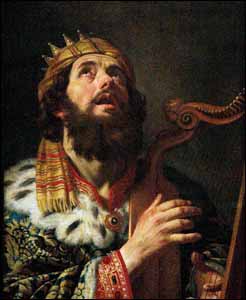 Gerrit van Honthorst (1590-1656), 'King David Playing the Harp' (1611), 82x65cm, Centraal Museum, Utrecht, Holland. Larger image. |
One of the ways we praise God is to recount his glories and attributes. We ascribe or attribute to God; we speak his greatness aloud. We see this in Psalm 96:7-8 -- "Ascribe1 to the Lord glory and strength...." as well as Psalm 29:1-2. In Revelation, the heavenly beings recount God's attributes in the heavenly throne room (Revelation 5:12-13; 7:12). This appears in the traditional form of the Lord's Prayer:
"For yours is the kingdom and the power and the glory forever!"2
In my Quiet Time I sometimes speak out words of God's greatness. Perhaps the greatest example of this kind of worship is found in David's prayer (1 Chronicles 29:10-16), as he rejoices over the success of a fundraising event for the proposed temple that Solomon would build.
Currently, I am working on memorizing a portion of this for use in my own personal devotions. One way for me to meditate on it is to go over the key words to better understand them. Why don't you come along on this journey as we contemplate God's word together. Pause here to look up the passage in your Bible, then follow along.
Structure of David's Prayer
As you look at David's prayer, you can discern a simple structure:
- Praise, blessing of Yahweh (verse 10)
- Attributes of Yahweh (verse 11)
- Yahweh as the dispenser of all power and wealth (verse 12)
- Praise and thanks to God (verse 13)
- Reflections (verses 14-16)
1. Praise, Blessing of Yahweh (verse 10)
First, I notice that this praise is directed to Yahweh, as indicated by the capital letters in most translations.3 This is God's own name, revealed to the patriarchs and especially to Moses.4 He is the "God5 of our father Israel" and is eternally existent -- "from everlasting to everlasting."
"Praise be to you, O LORD...." (NIV)
"Blessed are you, O LORD...." (ESV, NRSV, KJV)
The verb is bārak, "blessed." It is the first name of Barak Obama, 44th US President. To bless humans is "to endow with power for success, prosperity, fecundity, longevity, etc." To bless God is to praise him. Here, in the passive, God is to be praised or blessed.6
2. Attributes of Yahweh (verse 11)
Verse 11 recounts the attributions or glories of Yahweh. "Yours is ...." is literally, "of you, Yahweh," where the preposition lĕ indicates possession.7 Verse 11a includes five attributes of greatness.
"Yours, O LORD, is the greatness and the power
and the glory and the majesty and the splendor,
for everything in heaven and earth is yours.
Yours, O LORD, is the kingdom;
you are exalted as head over all. (1 Chronicles 29:11)
Greatness (gĕdûllâ)
"Greatness" (gĕdûllâ) is especially used in the Old Testament as an attribute of God. The root gādal is "used for physical growth as well as for the increase of things."8
Power (gĕbûrâ)
The noun gĕbûrâ, commonly translated "power" (NIV, ESV, NRSV, KJV) is "might" or "strength" referring especially to royal power. This derives from the verb gābar, "be mighty, have strength," commonly associated with warfare. It often has to do with the strength and vitality of the successful warrior.9
Glory (tipʾārâ)
"Glory" (NIV, ESV, NRSV, KJV), "splendor" (NJB), is the noun tipʾārâ, "beauty, glory, pride," from pāʾar (Piel), "to beautify/glorify."10 Often the word translated "glory" in the Old Testament is kāḇôḏ (as in verse 12), but not here.
Majesty, Victory (nēṣaḥ)
"Majesty" (NIV), "victory" (ESV, NRSV, KJV), "length of days" (NJB) is nēṣaḥ, "strength, victory, perpetuity" from nāṣaḥ, "to be perpetual, excel; be overseer." The word has a wide range of meaning, in the same way that the sun, source of earth's energy, conveys the dual notions of both light and durability. Thus "nāṣaḥ denotes both 'brilliance' (yielding the connotations 'preeminence, surpassing, glory, victory, leadership') and 'endurance' (supplying 'long-lasting, perpetual')."11
Splendor, Majesty (hôd)
"Splendor" (NIV), "majesty" (ESV, NRSV, KJV) is hôd, "splendor, majesty, vigor, glory, honor." It can have the meanings of "weight, power, splendor, height, majesty." There are no related verbs in Hebrew or cognate languages, so we have to discern the meaning from how it is in used in various contexts. Seven times it appears alongside hādār, "majesty, honor."12
Yahweh Is Owner of All
"... for everything in heaven and earth is yours." (1 Chronicles 29:11b)
We'll come back to this basic truth in a moment, since it underlies the rest of the passage.
Ruling Power
"Yours, O LORD, is the kingdom;
you are exalted as head over all." (1 Chronicles 29:11c)
All rule is attributed to Yahweh. This verse shows Hebrew parallelism.
Line 1 attributes to him the kingdom (mamlākâ), "sovereignty," from melek, "king."13
Line 2 uses the idea of headship to express the same idea, "You are exalted14 as head over all." By extension, "head" (rōʾsh) has the idea of "chief, chief officer; head, leader."15
3. Yahweh as the Dispenser of All (verse 12)
Having stated in verse 11 all the attributes of this glorious God and ruler of all, in verse 12 David speaks of him as the Dispenser of all things. Notice the Hebrew parallelism again. Rulers dispense wealth and honor to their subjects as they see fit. So also they bestow titles, authority, and earthly power.
"Wealth and honor come from you;
you are the ruler of all things.
In your hands are strength and power
to exalt and give strength to all." (1 Chronicles 29:12)
Any wealth or riches16 that we possess comes from him. Any earthly honor17 comes from his hand. When we take credit for it we get into trouble. Recall God's warning through Moses,
"17 You may say to yourself, 'My power and the strength of my hands have produced this wealth for me.' 18 But remember the Lord your God, for it is he who gives you the ability to produce wealth...." " (Deuteronomy 8:17-18)
Likewise, from him, from his hands are distributed any strength18 or power19 we might possess.
4. Praise and Thanks to God (verse 13)
David closes his adulation with praise and thanksgiving.
"Now, our God, we give you thanks,20
and praise21
your glorious22
name." (1 Chronicles 29:13)
In Hebraic thought, "name" can be used to substitute for the person himself.
5. Reflections (verses 14-16)
David concludes by reflecting on the implications of God's greatness. "Who am I?" "Who are we?" to deserve all this? How is it that we are able to give such a generous gift to prepare for the temple? The answer is: it all comes from God!
"Everything comes from you,
and we have given you only what comes from your hand." (vs. 14)
We are utterly dependent upon You. Compared to You in Your eternity (verse 10), we are as transitory as aliens and travelers, like shadows that appear for only a short while and then are gone.
"We are aliens and strangers in your sight,
as were all our forefathers.
Our days on earth are like a shadow, without hope." (1 Chronicles 29:15)
David concludes that even the wealth they have been able to bring to the temple project is not really theirs at all.
"O Lord our God, as for all this abundance that we have provided for building you a temple for your Holy Name, it comes from your hand, and all of it belongs to you." (1 Chronicles 29:16)
You gave it. All of it. And all of it belongs to You anyway. We are mere stewards of Your wealth.
This whole prayer rises from deep humility. As we reflect on the prayer, it puts us in the place where we actually are -- utterly dependent upon him. Not a bad place. But a very dependent place. But that's appropriate, since the just shall live by faith, that is, trust in Yahweh day by day for our very life.
Prayer
Father, You are great. This passage helps me understand how small and dependent I am compared to Your infinite greatness. I do praise You and wonder in the blessings and grace You have poured out upon me. You are great and do great things! Holy is Your name! Amen.
Endnotes
[1] "Ascribe" (NIV, ESV, NRSV), "give" (KJV) is the verb yāhab, "give, ascribe." We see it in Psalm 29:1; 96:7-8 = 2 Chronicles 16:28-29; Deuteronomy 32:3. The English word "ascribe" with synonyms "attribute" or "credit" would suggest "inferring of cause, quality, authorship" (Webster). Hence the passages would demand everyone to acknowledge the Lord Yahweh as the great king and offer such ascription of glory and greatness as is commensurate with his majesty" (Paul R. Gilchrist, TWOT #849).
[2] The words, "for thine is the kingdom and the power and the glory of the Father and of the Son and of the Holy Spirit for ever. Amen" don't appear in some of the earliest manuscripts -- א B D Old Latin, f1 Tertullian Origin Cyprian. Metzger (p. 14) says, "an ascription, usually in a threefold form, was composed (perhaps on the basis of 1 Chronicles 29:11-13) in order to adapt the Prayer for liturgical use in the early church."
[3] The capital letters are curiously missing in the 1984 version of the NIV.
[4] Exodus 3:14-15.
[5] Elohim.
[6] The verb is the Qal passive participle. John N. Oswalt, bārak, TWOT #285; Holladay 49, Qal.
[7] Lĕ, TWOT #1063.
[8] Elmer B. Smick, gĕdûllâ, TWOT #315e.
[9] John N. Oswalt, gĕbûrâ, TWOT #310c. "Strength" (Holladay, 1c).
[10] Victor P. Hamilton, tipʾārâ, TWOT #1726b.
[11] Milton C. Fisher, nēṣaḥ, TWOT #1402a. Holladay (244) notes the ideas of (1) luster, glory (of God), (2) lastingness, and (3) (legal) successful.
[12] Victor P. Hamilton, hôd, TWOT #282a. Holladay, 77.
[13] Mamlākâ, TWOT #1199f.
[14] "Exalted" is the Hithpael participle of nāśāʾ, "lift, raise (high)" (TWOT #1421; Holladay 246).
[15] Rōʾsh, TWOT #2097; Holladay 329, 6.
[16] "Wealth" (NIV), "riches" (ESV, NRSV, KJV) is ʿōtser, "riches," from ʿātsar, "be rich" (TWOT #1714a).
[17] "Honor" (NIV) is the noun kābôd, "glory, honor" (TWOT #943e).
[18] "Strength" (NIV, NJB), "power" (ESV, NRSV, KJV) is kôaḥ, "strength, power, ability, might, force," that is, "capacity to act." When applied to God, it suggests his omnipotence (John N. Oswalt, TWOT #973a).
[19] "Power" (NIV, NJB), "might" (ESV, NRSV, KJV) is gĕbûrâ, "might," which we saw as an attribute of Yahweh in verse 11.
[20] "Thanks/thank" is the Hiphil participle of yādâ, "confess, praise, give thanks, thank" (TWOT #847).
[21] "Praise" is the Piel participle of hālal II, from which we get our word "Hallelujah" (literally, "praise to Yah(weh)"). The root has the idea "being sincerely and deeply thankful for and/or satisfied in lauding a superior quality(ies) or great, great act(s) of the object" (Leonard J. Coppes, TWOT #500).
[22] "Glorious" is tipʾārâ, "beauty, glory," which we saw in verse 11 as an attribute of God.
Copyright © 2026, Ralph F. Wilson. <pastor joyfulheart.com> All rights reserved. A single copy of this article is free. Do not put this on a website. See legal, copyright, and reprint information.
 To be notified about future articles, stories, and Bible studies, why don't you subscribe to our free newsletter, The Joyful Heart, by placing your e-mail address in the box below. We respect your