|
Old Testament
New Testament
Gospels
Acts
Paul's Letters
General Letters
Revelation
Topical Studies
Beginning the Journey (for new Christians). en Español

|
Old Testament
New Testament
Gospels
Acts
Paul's Letters
General Letters
Revelation
Topical Studies

|
Home
Bible Studies
Articles
Books
Podcasts
Search
Menu
Donate
About Us
Contact Us
FAQ
Sitemap


Free
E-mail Bible Study
 Names and Titles of God
Home | Bible Studies | Articles | Books | Podcasts | Search | Menu | Donate | About Us | FAQ | Contact Us
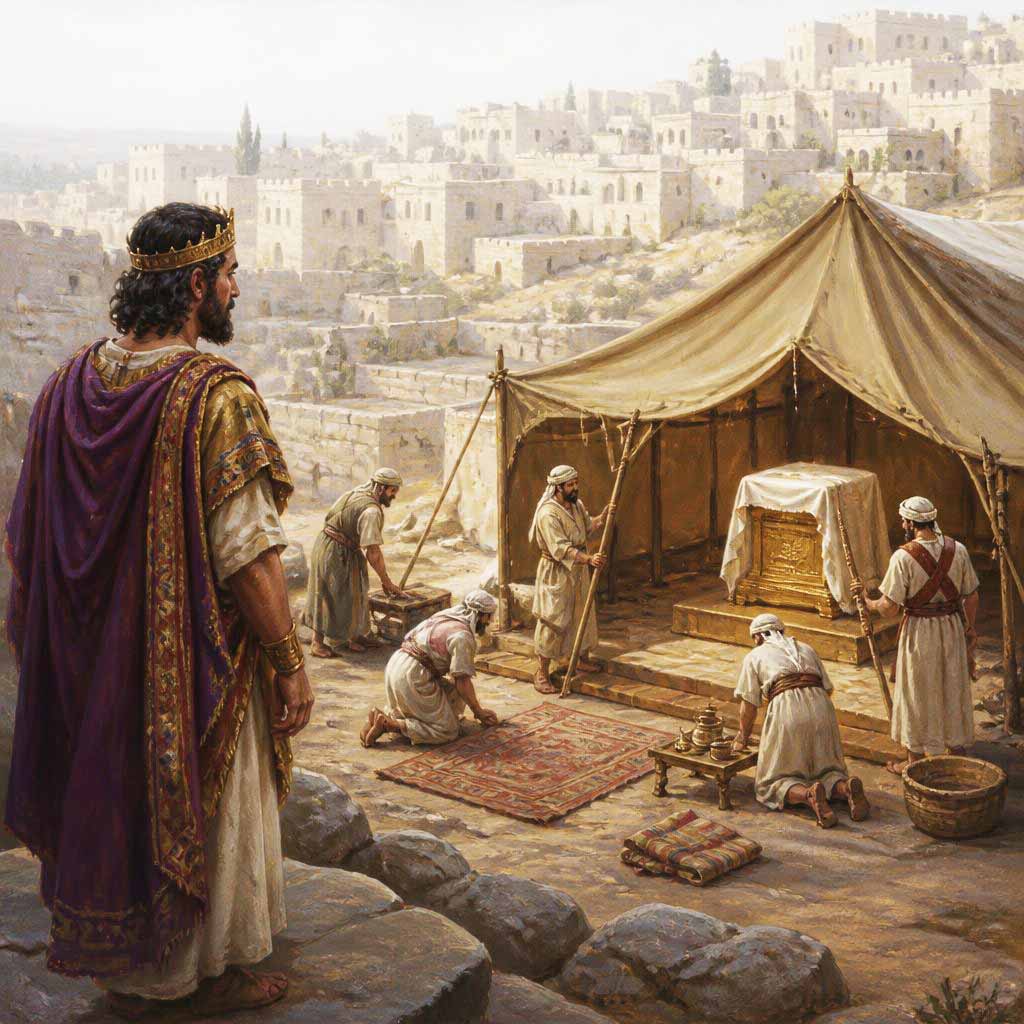
 David viewing the ark in the tent he pitched for it in Jerusalem (2 Samuel 6:17; 1 Chronicles 15:1). Image courtesy of Bible.art AI generated art. Free for non-commercial use. Larger image. |
As I was reading Psalm 27 the other morning, I was particularly struck by David's desire for intimacy with God where he speaks of the "house of God" and the "temple" in verse 4. But David had died a decade before the Temple of Solomon was completed. What's going on here?
I think I've found the answer. And I hope you're inspired by verses 4-6 like I am. (By the way, you can see a brief exposition of the entire psalm in my study Experiencing the Psalms, Lesson 2).
Take out your Bible and follow along with me. We'll start with verse 4.
"One thing I ask of the LORD,
this is what I seek:
that I may dwell in the house of the LORD
all the days of my life,
to gaze upon the beauty of the LORD
and to seek him in his temple." (Psalm 27:4)
Journeys of the Ark and the Tabernacle
Let's start with a brief review tracing the journeys of the tabernacle and ark that Moses constructs in the wilderness.
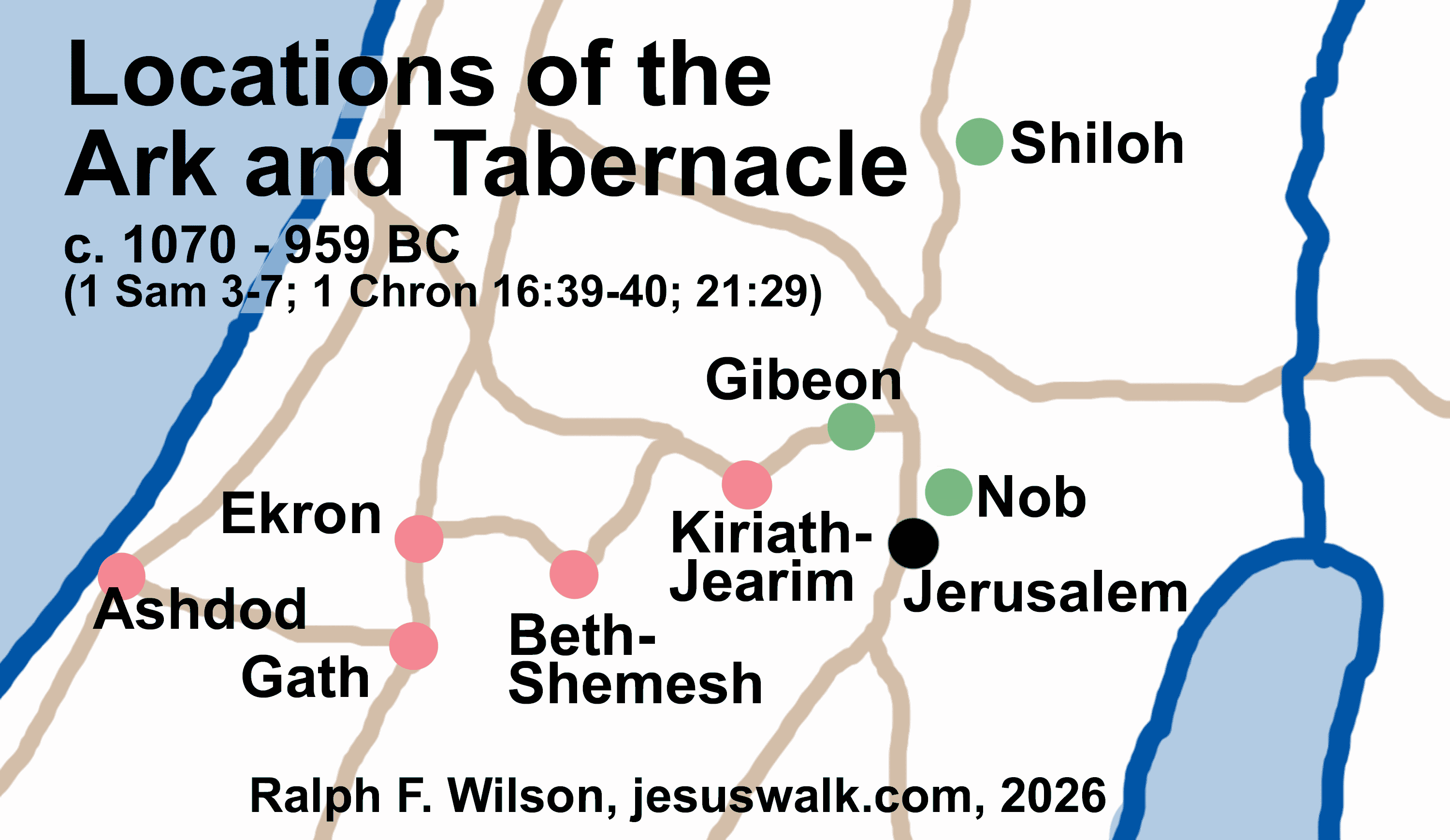
After Joshua crosses the Jordan into the Promised Land, the tabernacle is located at Shiloh for hundreds of years. Then, the sons of Eli the high priest foolishly take the ark with the army into battle. The Philistines win and capture the ark about 1080 to 1070 BC. For more than a century, the tabernacle and its altar remain separated from the ark. (For details, see my Journeys of the Ark and Tabernacle -- A Timeline).
 Locations of the ark and tabernacle from about 1070 BC when the ark is captured, until 959 BC when Solomon's Temple is dedicated. Pink dots indicate places the ark went after capture by the Philistines. Green dots indicate locations of the tabernacle. Larger map. |
But the story gets more complicated. After seven months retaining the ark in their own territory -- first in Ashdod, then Gath, then Ekron -- the Philistines send the ark back to Israel.1 For many decades the ark remains in Kiriath-Jearim. After David is crowned king over all Israel, he conquers Jerusalem and brings the ark into the old City of David, called Zion. There he places it in a special tent he has pitched for it. The tabernacle and altar remain in Gibeon, while the ark is in Jerusalem.
During most of David's reign, you would go to Gibeon to sacrifice (about 6 miles or 9 km. north of Jerusalem), but to spend time before the ark and its worship tent, you would go to Jerusalem. This continues until Solomon dedicates the Temple in 959 BC, when the ark and an altar for sacrifice are together again.2
Temple, Tabernacle, House of God (Psalm 27:4-6)
Now back to Psalm 27. We've established that David never worships Yahweh in the actual temple, which isn't built for a decade after he dies. So why does he use the words he does to identify God's dwelling in Psalm 27, some of which seem to describe a building?
- House of Yahweh (vs. 4b)
- His temple (vs. 4c)
- His dwelling (vs. 5a)
- The shelter of his tent (vs. 5b)
- His tabernacle (vs. 6)
Let's look at these one by one.
House (bayit , verse 4b)
"... That I may dwell in the house of the LORD" (Psalm 27:4b)
"House" (bayit) is the generic word for "house, household, home, palace." It is a general word used to describe a dwelling or habitation.3 "House" -- in the generic sense of "dwelling" -- is used of the tabernacle at Shiloh in the Book of Judges, even though it is literally a tent (1 Samuel 1:6-7; 24; 3:15). It is also used of the tent that David pitches for the ark in Jerusalem, even though it, too, is a tent (2 Samuel 12:20, 7:5-6). Thus, the place where God's presence "resides" on earth is spoken of as God's house. In the same way Jacob says about the place of his heavenly vision, "This is none other than the house of God; this is the gate of heaven" (Genesis 28:17).4
Temple (hēkāl , verse 4c)
"... To seek him in his temple." (Psalm 27:4c)
We think of "temple" as a building, but the Hebrew word (hêkāl) is broader than that. Originally, it referred to a king's living quarters, then "palace, temple, nave, sanctuary." The Tabernacle at Shiloh is referred to as a hēkāl by the author of Judges (1 Samuel 1:9; 3:3). The place of God's dwelling doesn't have to be a building for it to be called a temple.5
Dwelling, booth (sōk, verse 5a)
"He will keep me safe in his dwelling...." (Psalm 27:5a)
The word in verse 5 variously translated "dwelling" (NIV), "shelter" (ESV, NRSV), "pavilion" (KJV), "sanctuary" (NLT), "roof" (NJB) is the noun sōk, literally a "hut made of branches and mats, booth."6 A related word, sūkâ, "temporary abode," is used to name Sukkot, the Feast of Booths, celebrated by Jews each year who camp out in a temporary shelter for a week to commemorate their sojourn in the wilderness (Leviticus 23:34-36, 39-43).7
(Of course, the ancient saints all knew that the tabernacle and later temple are not the only places where the invisible God dwells (1 Kings 8:27). He is omnipresent.)
Tent, tabernacle (ʾōhel, verses 5b, 6b)
"He will hide me in the shelter of his tabernacle...." (verse 5b)
"At his tabernacle will I sacrifice with shouts of joy." (verse 6b)
The fourth description of God's dwelling place is ʾōhel. The basic meaning is "tent, tabernacle," but later, when people live in houses, it is used figuratively as "dwelling, home."8 Of course, the Tabernacle in the Wilderness (Exodus 26) was an elaborate tent, built extravagantly as would be the dwelling of a wealthy desert monarch, pitched in the very center of the Israelite camp.9 God is King! As we'll see in verse 5, David seems to use ʾōhel in its basic sense, "tent, dwelling," but in verse 6 he refers to worship in a holy tent or tabernacle.
I conclude:
- The words "house" and "temple" are not anachronisms in Psalm 27, but are properly used of worship in the Tabernacle and the Tent David pitched for the ark.
- Moreover, David is intensely interested in the place of God's presence.
With those matters clarified, let's start from verse 4, to dig into the passage and see what God is saying to us.
One Thing I Seek (Psalm 27:4a)
You can sense the intensity of David's desire for God.
"One thing I ask of the LORD,
this is what I seek...." (Psalm 27:4a)
One thing! I hunger and thirst for one thing, O God. One thing I seek.
We have many needs, many desires. For David, security from his enemies is a prominent theme in the Psalms. But even greater than security and provision, David asks Yahweh for one thing -- to be in his presence! In the same way, Jesus calls us to seek first God's kingdom and righteousness (Matthew 6:33).
Dwelling, Gazing, Seeking (Psalm 27:4)
Now let's move on to the various aspects of David's seeking.
"One thing I ask of the LORD,
this is what I seek:
that I may dwell in the house of the LORD
all the days of my life,
to gaze upon the beauty of the LORD
and to seek him in his temple." (Psalm 27:4)
In the psalm just previous to ours -- Psalm 26:8 -- David expresses a similar thought.
"I love10
the house (bayit) where you live,11
O LORD,
the place where your glory12
dwells."13
(Psalm 26:8, NIV)
Yes, we seek your glory, O Lord! (For more on this, see my study The Glorious Kingdom: A Disciple's Guide to Kingdom Glory and Authority, (JesusWalk Publications, 2017), where I trace the themes of glory and kingdom throughout the Bible (https://www.jesuswalk.com/glory/).
Psalm 84 echoes the same theme, though written by a Levite who may have actually worked and worshipped in Solomon's Temple.
"How lovely is your dwelling place,
O LORD Almighty!
My soul yearns, even faints,
for the courts of the Lord;
my heart and my flesh cry out
for the living God." (Psalm 84:1-2)14
In each of these instances, the writers are initially thinking of God's presence in physical and spatial terms, but the place, the worship structure becomes a symbol for the presence of God. The writers may admire the tabernacle or temple structure, but they love God who dwells therein.
Back in our passage, Psalm 27:4-6, David uses Hebrew parallelism to describe his singular desire for God's presence. Lines 1 and 2 of verse 4, talk about seeking intently. The next lines spell out three aspects of that seeking in terms related to God's dwelling.
| 1. | Dwell | in the house of Yahweh |
| 2. | Gaze | upon the beauty of Yahweh |
| 3. | Seek | Him in his temple |
These are not different desires. The grammar indicates that they outline three ways of saying the same thing.15
1. Dwell in the House of the Yahweh
David wants to dwell where God is.
"One thing I ask of the LORD,
this is what I seek:
that I may dwell in the house of the LORD
all the days of my life...." (Psalm 27:4)
"Dwell, live" translate the verb yāshab, "sit, remain, dwell."16 David isn't just interested in sitting for an hour or two. He would love to camp out in God's dwelling -- forever!
2. Behold the Beauty of Yahweh (Psalm 27:4)
David isn't content to just be there. He wants to encounter God in some way.
"... that I may dwell in the house of the LORD
all the days of my life,
to gaze upon the beauty of the LORD...." (Psalm 27:4)
"Gaze, behold" indicates "to look with desire, gratification."17 To look intensely. What does David hope to see? The "beauty of Yahweh." But God is invisible. If you can't visibly see him, how can you see his beauty?
The word "beauty" (nōʿam) here indicates "pleasantness, beauty, kindness, favor." It expresses the idea of God's "goodness, charm, loveliness."18 The NLT translates this as "delighting in the Lord's perfections," drawing on the idea of nōʿam as God's wonderful character qualities of goodness, kindness, loveliness.
Gazing on the Lord reminds me of Moses, who spends time talking with Yahweh "face to face" so much that his face glows! This troubles the Israelites so much that Moses wears a veil over his face after having been with God (Exodus 33:7-11; 34:29-35).
Paul uses this phenomenon to illustrate the life-changing effect of spending time before the Lord.
"And we all, with unveiled face, beholding the glory of the Lord, are being transformed into the same image from one degree of glory to another. For this comes from the Lord who is the Spirit." (2 Corinthians 3:18, ESV)
David longs to spend time beholding the beauty of the Lord. We, too, long to spend time before him so much that we glow with his presence visible upon us. Years ago, I had lunch in the beach town of Santa Cruz, California. A New Age hippie (perhaps stoned) came over to my table and said, "I love your aura, man!" I hope he meant Jesus.
Seek Him in the Temple of Yahweh (Psalm 27:4)
The third aspect of David's intense desire for the Lord is
"... to seek19 him in his temple." (Psalm 27:4)
As we noted above, David didn't live long enough to worship in Solomon's Temple, but calls the place of God's Presence the "temple," probably referring to the tent he has pitched for the ark.
David longs to consult with God, just as Jesus does when he gets up very early to talk to his Father and receive directions for the day (Mark 1:35-38). Later in verse 8 of Psalm 27 we read about "seeking God's face," that is, a desire for his very intimate Presence.20 Seeking isn't passive, like, "If God wants me, he knows where he can find me." Rather it is active, looking, seeking, diligence, like the lady in Jesus' Parable of the Lost Coin (Luke 15:8-10) who turns her house upside down looking for the missing silver coin. We long for intimacy with the Lord!
Hide in the Tabernacle of Yahweh (Psalm 27:5)
For David, God's Presence is not only his place of communing, but also his place of protection.
"For he will hide21 me in his
shelter22
in the day of trouble;23
he will conceal24
me under the cover of his tent;25
he will lift me high26
upon a rock." (Psalm 27:5, ESV)
Yahweh is David's hiding place, his refuge when trouble comes (Psalm 32:7; 91:1, 9). Here, in verse 5b, "tent" may be the generic sense of "tent, dwelling." But, as we'll see in a moment, "tent" in verse 6 refers to a particular tent.
I Will Exalt in the Lord (Psalm 27:6)
Verse 4 speaks of a quiet seeking, gazing, meditating in God's presence. Verse 6, on the other hand, describes David in full active mode -- exulting and praising in the presence of Yahweh.
"Then my head will be exalted
above the enemies who surround me;
at his tabernacle27
will I sacrifice28
with shouts of joy;29
I will sing and make music to the LORD." (Psalm 27:6, NIV)
God has lifted up his head, an Hebraic way of saying, "showing favor" over his enemies.30 And David's response is jubilant.
In this verse, "tent, tabernacle" is not generic, but refers to a specific tent -- either (1) the Tent that Moses constructed in the Wilderness which was at Nob and Gibeon during David's lifetime, or, more probably, (2) the tent David pitched for the ark in Jerusalem, which was a site of praise and worship (1 Chronicles 16:1-6).
While most modern translations have "sacrifice with shouts of joy," Peter Cragie contends that the sacrifice David refers to consists of a shout of joy.31 This sense is caught in the translations "sacrifices of joy" (KJV) and "sacrifices of acclaim" (NJB).
What We Learn from This Psalm
What do we learn from Psalm 27:4-6 that we can apply to our own worship? Several things.
1. Intensity.
"One thing I ask of the Lord!" David's hunger for God is real. He knows what he
wants -- more of God -- and he pursues this intently and intensely. He seeks God
with all his heart. Perhaps that is why God sees David, with all his flaws, as
a "man after his own heart" (1 Samuel 13:14; Acts 13:22).
Dear friend, do you seek God's presence with the same intensity as David? Or
for you is it more a matter of convenience?
2. God's Presence is primary. Dwelling in God's house, seeking him in his tent and temple are not really about the worship structure. They speak of a quest to know him better. I think of Moses who contends with God, who is rightly angry with the rebellion of his people before the golden calf. God tells Moses.
"You are a stiff-necked people. If I were to go with you even for a moment, I might destroy you." (Exodus 33:5)
Moses replies,
"If your Presence does not go with us, do not send us up from here." (Exodus 33:15)
Moses pleads, your Presence, O God, is the only thing that distinguishes us from the people of the world. I long for your presence! Without you leading us, we are hopeless! God replies, "I will do the very thing you ask" (Exodus 33:17).
Do you long for God's presence as did Moses and David? Or is spending time in his Presence a chore, boring, a rather casual experience that doesn't do that much for you? Repent of your lethargy and seek him afresh with all your heart.
3. Meditation. David asks, "to gaze upon the beauty of Yahweh," the invisible God. So often we fidget like bored little children if we aren't doing something all the time. Activity! But there is a time to meditate, to gaze, to be quiet and listen, to bask in his Presence.
"Be still and know that I am God." (Psalm 46:10)
4. Trust in difficult times. David always seems to be having one kind of trouble or another. Does that sound familiar? But David looks to the Lord to be his protection and his solution.
"He will hide me in his shelter in the day of trouble." (Psalm 27:5a, ESV).
Our God promises,
"I will never leave you nor forsake you" (Hebrews 13:5).
We are gradually learning not to panic, but to look to him to meet us in the crisis and carry us to the other side.
Jesus is on his way to Jairus's house to heal his daughter, when word comes that his daughter has died. Jesus reassures him, "Do not fear, only believe" (Mark 5:36), and goes on to raise the girl from the dead.
Later, Jesus comes to heal a boy afflicted with a convulsing spirit, where his disciples have failed to do so. The father, begins his petition, "If you can help...." Jesus responds, "What is this 'if you can' language?" He calls out the father's unbelief. "All things are possible for one who believes." The father responds immediately. "I believe; help my unbelief!" That's enough. Jesus heals the boy! (Mark 9:14-29)
God can help you in your difficult situation too. Don't despair. Don't panic. Put your trust in him and then watch. The answer may come in a way you don't expect.
5. Praise and thanksgiving. The Old Testament saints brought animal sacrifices for atonement. But in our passage David has learned to offer "sacrifices of joy" (KJV), sacrifices that consist of a joyful shout.
"I will sing and make music to the LORD." (Psalm 27:6)
Paul exhorts us:
"Sing and make music in your heart to the Lord, always giving thanks to God the Father for everything, in the name of our Lord Jesus Christ." (Ephesians 5:19b-20)
Like David, we are learning to come before the Lord, continually offering "the sacrifice of praise" (Hebrews 13:15).
Where is God speaking to you out of Psalm 27? Make this a day of turning, of change, and of joyful renewal of your relationship with the One who loves you with such an extreme intensity that his Son died in your place. God is so good!
Prayer
Father, our hearts so easily fluctuate from worry to passive belief. Fix our hearts, we pray, upon You afresh. We seek your Presence, O Lord. In Jesus' holy name, we pray. Amen.
End Notes
[1] 1 Samuel 6.
[2] 1 Kings 8:4. The tabernacle disappears from history at this point.
[3] Louis Goldberg, bayit, TWOT #241.
[4] The name of this location is Bethel, which means, literally, "house (beth) of God (El)."
[5] Leonard J. Coppes, hēkāl, TOWT #493. Coppes says, "In Psalm 27, the temporary structure where David placed the ark is called a house (bēt), a temple (hēkāl), a booth (skkâ), and a tent (ʾōhel)." It is also used to refer to the temples built by Solomon and Zerubbabel. Holladay notes that it is used to mean (1) palace, (2) temple, and (3) main room of the temple (Holladay 79).
[6] sōk, Holladay 256, 2. "In a figurative sense, it pictures God's protection for the one who comes to him for refuge (Psalm 5:11; cf. 91:4; 140:7; R. D. Patterson, sōk, TWOT #1492d).
[7] See Wikipedia article, "Sukkot."
[8] "Tent" (ESV, NRSV), "tabernacle" (NIV, KJV) is the noun ʾōhel, "tent, dwelling," (TWOT #32a), cf. the denominative verb ʾāhal, "to pitch a tent."
[9] You can learn more about the Tabernacle and its furnishings in my study of Moses: The Reluctant Leader (JesusWalk Publications, 2011), Lesson 7. https://www.jesuswalk.com/moses/7_tabernacle.htm).
[10] "Love" is the Qal perfect of ʾāhēb, "love, like, be in love." While the basic meaning doesn't vary much, the intensity of meaning ranges from God's infinite affection for his people to the carnal appetites of a lazy glutton (Robert L. Alden, TWOT #29).
[11] "Where you live/dwell" (NIV, NRSV), "habitation" (ESV, KJV), "sanctuary" (NLT), "beauty" (NJB) is the noun māʿôn, "dwelling, habitation," from ʿûn, "to dwell" (Carl Schultz, TWOT #1581a). Most frequently it designates the Lord's dwelling place, i.e. heaven (always qualified with the word "holy") and the temple (Ps 26:8). Finally, it portrays the Lord as a refuge for his people (Ps 71:3; 90:1; 91:9). "(1) "hidden den, lair," of lions (Nahum 2:12), jackals (Jeremiah 9:10); (2) "dwelling, habitation," specifically of God (Deuteronomy 26:15). The English noun "habitation" means "dwelling place" (Merriam-Webster.com, 2).
[12] "Glory" is kābôd, "glory, glorious, honor, honorable" (TWOT #943e).
[13] "Dwells/abides" is two words: (1) The noun māqōm, "place," from the verb qûm, "rise, arise, stand." "This mem preformative noun represents the physical location where something is or ought to be, i.e. its station" (Leonard J. Coppes, TWOT #1999h). (2) the noun mishkān, "tabernacle," from shākan, "to dwell, tabernacle." Mishkān refers to the portable sanctuary constructed by the Israelites in the wilderness. Holladay shows four meanings: (1) dwelling place, home" (Numbers 16:24), (2) = tomb, (3) dwelling-place, home of Yahweh" (Leviticus 15:31), (4) "= (central) sanctuary" (24x out of 130x), "tabernacle" (Exodus 25:9). (Holladay, 219).
[14] For an exposition of Psalm 84, see my study, "A Day in Your Courts," The Joyful Heart, November 5, 2020 (https://www.jesuswalk.com/psalms/psalm-84.htm).
[15] Each of these three sub-desires is marked grammatically in Hebrew by the infinitive construct. From a logical rather than grammatical standpoint, you could argue that David desires to dwell in God's presence, so that he can gaze upon the Lord and seek him.
[16] "Dwell" (NIV, ESV, KJV), "live" (NRSV, NLT) is the Qal infinitive construct of yāshab, "sit, remain, dwell" 1. to sit on anything; 2. to remain, stay, linger: 3. to dwell in a house, city, territory; and 4. of a place, city, or country being inhabited" (Walter C. Kaiser, TWOT #922). Holladay breaks it down: (1) sit down, (2) sit, = hold a meeting, (3) (4) "remain sitting" (Holladay 146).
[17] "Gaze" (NIV, ESV), "behold" (NRSV, KJV) is the Qal infinitive construct of ḥāzâ, "see, perceive," then, here, "look with desire, gratification" (Holladay 98, meaning 3 references our passage), which might explain the NLT paraphrase, "delighting in the Lord's perfections," though it is an interpretation that goes beyond what the text actually says. "Like the word "behold" in English, this word is employed almost exclusively in poetry or exalted prose.... Any word meaning to see with the eyes, the most vivid form of sensation, seems bound to be employed for almost any sensation (by eyes, ears, nose, tongue, skin) as well as any mental or spiritual perception" (Robert D. Culver, TWOT #633). Franz Delitzsch sees this as describing how David "beholds and feasts upon" with "a clinging, lingering, chained gaze" (Keil and Delitzsch, Old Testament Commentary, in loc.). Kidner notes that to behold and to inquire indicate "a preoccupation with God's person and his will. It is the essence of worship; indeed, of discipleship" (Kidner, Psalms 1-72, p. 121).
[18] "Beauty" is nōʿam, "pleasantness, beauty, kindness, favor," from the verb nāʿēm, "be pleasant, sweet, delightful, beautiful." In the cognate language Ugaratic, it is the normal word for good, "goodness, charm, loveliness" (Marvin R. Wilson, TWOT #1384a). "Kindness" (Holladay 240).
[19] "Seek" (NIV), "inquire" (ESV, NRSV, KJV), "meditating" (NLT) is the Piel infinitive of bāqar, "seek, inquire." "bāqar is found seven times in the Old Testament. Much more frequent are synonyms bāqash "seek," "secure," and dārash "seek," "study," "seek (i.e. pray to) a deity" (Elmer A. Martens, TWOT #274). Holladay sees the meanings: (1) cultic technical term 'undertake inspection of sacrifice'?, (2) (a) 'investigate' carefully, (b) 'grieve over'; (3) absolutely, 'consider' (Holladay 46).
[20] For more on "seeking God's face," see my expositions: "Seek His Face Continually (Psalm 105:4)" (https://www.joyfulheart.com/maturity/seek-his-face.htm); and "Seeking God Diligently (Isaiah 55:6-9)" (https://www.joyfulheart.com/maturity/seeking-god-diligently.htm).
[21] "Keep me safe" (NIV), "hide" (ESV, NRSV, KJV), "conceal" (NLT) is the Qal of ṣāpan, "hide, conceal" something with a definite purpose, either for protection or for sinister reasons (John E. Hartley, TWOT #1953).
[22] "Shelter" (NIV), "cover" (ESV, NRSV), "secret" (KJV), "sanctuary" (NLT) is the noun sēter, "hiding place" (TWOT #1151a; Holladay 261, 1), from the verb sātar, "hide, conceal."
[23] Trouble" is the feminine noun rāʿâ, "evil, misery, distress, injury, wickedness," cf. the denominative verb rāʿaʿ, "be bad, evil" (TWOT #2191c).
[24] "Hide" (NIV, KJV), "conceal" (ESV, NRSV) is the Hiphil of sātar, "hide, conceal" (TWOT #1151).
[25] "Tent" (ESV, NRSV), "tabernacle" (NIV, KJV) is the noun ʾōhel, "tent, dwelling," (TWOT #32a), cf. the denominative verb ʾāhal, "to pitch a tent."
[26] "Set high" (NIV, NRSV), "lift up" (ESV), "set up" (KJV), "place me out of reach" (NLT) is the polel of rûm, "lift someone high" (Holladay 335, polel 1).
[27] "Tabernacle" (NIV, KJV), "tent" (ESV, NRSV) is ʾōhel, "tent, dwelling" (TWOT #32a).
[28] "Sacrifice" (NIV) is literally two words, "offer sacrifices" (ESV, NRSV, NLT): "Offer" is the Qal of the verb zābaḥ, "sacrifice, slaughter," and (2) "sacrifice/s" is the plural of the noun zebaḥ, "sacrifice," derived from the same verb zābaḥ (TWOT #525a).
[29] "Shouts of joy" (NIV, ESV, NRSV, NLT), is tĕrûʿâ, "alarm," signal or sound of a trumpet, but here "shout (of joy)" (Holladay 395, 2), from the verb rūaʿ, "shout, raise a sound, cry out" (William White, TWOT #2135b). Note that the KJV and NJB combine the idea of sacrifice with the shout of joy: "sacrifices of joy" (KJV), "sacrifices of acclaim" (NJB).
[30] "Then my head will be exalted" reveals a Hebrew idiom. To lift up one's head was to show pride, but if Yahweh lifts it up, it is evidence of his favor (Psalm 3:3; 110:7; cf. Genesis 40:3, 19f; J. R. Price, "Head," ISBE 2:639).
[31] Craigie, Psalms 1-50, translation (p. 229) and footnote on 6c (p. 230).
Copyright © 2026, Ralph F. Wilson. <pastor joyfulheart.com> All rights reserved. A single copy of this article is free. Do not put this on a website. See legal, copyright, and reprint information.
 To be notified about future articles, stories, and Bible studies, why don't you subscribe to our free newsletter, The Joyful Heart, by placing your e-mail address in the box below. We respect your