


|
Old Testament
New Testament
Gospels
Acts
Paul's Letters
General Letters
Revelation
Topical Studies
Beginning the Journey (for new Christians). en Español

|
Old Testament
New Testament
Gospels
Acts
Paul's Letters
General Letters
Revelation
Topical Studies

|
Home
Bible Studies
Articles
Books
Podcasts
Search
Menu
Donate
About Us
Contact Us
FAQ
Sitemap


Free
E-mail Bible Study
 Names and Titles of God
Home | Bible Studies | Articles | Books | Podcasts | Search | Menu | Donate | About Us | FAQ | Contact Us
|
|
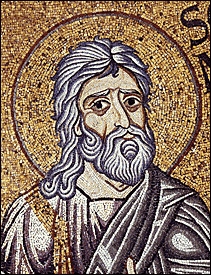
Does God really sing? Yes! We find it in the short Old Testament book of Zephaniah.
Zephaniah is a little-known prophet who calls Judah to repentance prior to the fall of Jerusalem and the Exile.1 But toward the end of his prophecy, we hear some beautiful words, intimate words, spoken from Yahweh to his chastened people who repent and turn back to him.
"16 On that day they will say to
Jerusalem,
‘Do not fear, O Zion;
do not let your hands hang limp.
17 The LORD your God is with you,
he is mighty to save.
He will take great delight in you,
he will quiet you with his love,
he will rejoice over you with singing.’" (Zephaniah 3:16-17)
Though these ancient words were originally written to God’s people as a whole, God hasn’t changed. I believe we can take them personally as an assurance today of God’s love for us as individuals.
Sadly, many believers are so overwhelmed by guilt and sorrow that they feel God doesn’t really approve of them, much less really love them. Ponder these verses, my friend, and see a side of God who has genuine love for you. Yes, you!
Do Not Fear (Zephaniah 3:16)
The first words are an exhortation not to fear, but to rise in faith.
"Do not fear, O Zion;
do not let your hands hang limp." (Zephaniah 3:16b)
Originally the name of the Jebusite stronghold of Jerusalem,2 Zion comes to refer to the whole city of Jerusalem, and then to the entire people of God. In our passage, the prophet tells God’s people, "Don’t be afraid." Your punishment is over; God is restoring you.
Sometimes, our discouragement is so acute that we can’t seem to lift a hand to do much of anything. God speaks to your discouragement:
"Do not let your hands hang limp." (Zephaniah 3:16b)
This is an Hebraic way of saying, "Take heart, be encouraged."3 We see a similar exhortation in the Letter to the Hebrews:
"Strengthen your feeble arms and weak knees.
Make level paths for your feet,
so that the lame may not be disabled,
but rather healed." (Hebrews 12:12-13)
Have you been immobilized by discouragement. Take heart, my friend, for your Father has a wonderful word of encouragement for you.
Yahweh’s Mighty Presence in Your Midst (Zephaniah 3:17a and b)
"The LORD your God is in your midst,
a mighty one who will save." (Zephaniah 3:17, ESV)
You may be weak, but there is one "in your midst,"4 right with you, closer than you can imagine. This One is described in three ways.5
1. Yahweh. Whenever you see "LORD" in capital letters in your Bible, it tells you that the underlying Hebrew word is the name God told Moses to use to refer to him: Yahweh. The name "Yahweh" (mispronounced "Jehovah"6) seems to be formed from the Hebrew verb "to be." Yahweh is the great I AM7 who is always existing -- in the past, in the present, in the future -- from eternity past to eternity forever! He is the Eternal One "who was and is and is to come."8 He is the Alpha and the Omega,9 the First and the Last.10 And, my friend, Yahweh, the Eternal God is in your midst. He is with you to lift you up!
2. Elohim (ʾĕlōhîm) is the second way God reveals himself here. Elohim (ʾĕlōhîm) is the plural of El (ʾēl), the generic term for God in the ancient tongues of the Middle East. Arabic Allāh derives from this. The plural form11 may express some kind of "plural of majesty."12 Perhaps it is a hint of God’s three-fold nature -- Father, Son, and Holy Spirit -- that is more fully revealed in the New Testament.13 Notice the personal reference here -- he is "your God."
3. Mighty Warrior (gibbôr).
"... a mighty one who will save." (Zephaniah 3:17b)
The word gibbôr can serve as an adjective, "mighty, strong, valiant," or, as a noun, "mighty man, warrior, hero (in battle), champion among the armed forces."14 You will recall Bible lists of David’s thirty "mighty men," ferocious champions among his elite troops, known for their military prowess and exploits.15 Here, Yahweh reveals himself as such a mighty Warrior. He is known for fighting on behalf of his people. Even when they are weak, he is strong.
"Who is this King of glory?
Yahweh strong and mighty,
Yahweh mighty in battle." (Psalm 24:8)
This Mighty One is not just with us to impress our enemies. He is:
"A mighty one who will save." (ESV)
He is committed to saving and rescuing16 those who are weak, who are under attack, who are at risk of being overwhelmed. Indeed, Jesus’ Hebrew name actually means, "Yahweh saves!" He saves you from the penalty of sin, he extracts you from the entanglements and power of sin over your life, and he will help you live with joy and victory day by day. He is a mighty Warrior who rescues you!
The Rejoicing Father (Zephaniah 3:17c)
Now we come to several tender lines in this prophecy:
"He will take great delight in you,
he will quiet you with his love,
he will rejoice over you with singing." (Zephaniah 3:17)
One of the most poignant scenes in all Scripture is Jesus’ Parable of the Prodigal Son (Luke 15:11-32). The younger son leaves home with his share of the family wealth, travels to a godless city far away, and within a few months spends every last penny in wild living. Soon he is crushed, destitute, desperate, hopeless. His only hope is to return home, humble himself, and seek employment as a servant on his father’s farm. And so he leaves the city and trudges up the familiar road home, not knowing what kind of reception he will receive.
But his father has been waiting for him, looking for him. And when he sees him plodding up the road to the house, the old father gets up, hitches up his robes, begins to run pell-mell down the hill, and throws his arms around his son. The boy begins his prepared speech about how he is unworthy, but the father brushes it away.
"This son of mine was dead and is alive again; he was lost and is found." (Luke 15:24)
They celebrate far into the night. The old man cannot contain himself with joy.
This is how I understand Zephaniah 3:17. Judah has sinned, but they will come home.17 And the Father can scarcely contain his joy.
"He will rejoice over you with gladness." (Zephaniah 3:17c, ESV, NRSV)
The verb "rejoice, take delight"18 should have been adequate to express the idea. But the prophet adds "with gladness" to multiply our understanding of our Father’s absolute delight. "The root denotes being glad or joyful with the whole disposition."19
The Father is beside himself with joy! Joy over you! Oh, yes, you, my friend. He delights in you!
God’s Quieting Love (Zephaniah 3:17d)
After the Father’s rejoicing, we find a strange pause.
"He will quiet20 you with his love...."21 (NIV)
Remember how the prodigal son begins to express his repentance and desire to be only a hired servant, and how the Father quiets him with a tight embrace and orders the servants to find a gold ring for his finger, a robe for his back, and a fatted calf for a celebration?
Sometimes we struggle to accept that God can really forgive us. We know our sin. We know that we don’t deserve pardon but rather punishment. No way do we deserve forgiveness! And so we continue to punish ourselves by wallowing in our guilt.
Let your Father quiet you with his love, my friend. Your unwillingness to accept his forgiveness at face value is unbelief, pure and simple. Immerse yourself in the powerful assertions of the Gospels until you come to believe in your heart that Jesus actually died for your sin. Believe it! Trust in his love. And quiet your self-condemnation by accepting his grace, his undeserved love for you.
"He will quiet you with his love...." (Zephaniah 3:17d)
God Sings over You (Zephaniah 3:17e)
The final line of this verse is startling:
"He will rejoice over you with singing." (Zephaniah 3:17e)
The Father has shown his utter delight with you. He has quieted your fears and wiped away your self-loathing. Now he sings. Yes, God sings! And not quietly, either.
The root of the word for "rejoice, exult" (gîl) suggests an enthusiastic expression of joy -- "to circle around," even to "shout with joy."22 The word (rinnâ) for "singing" suggests a ringing cry or shout of joy.23 This isn’t quiet singing. It is "loud singing" (ESV, NRSV). And you are the cause of the Father’s exultant singing, his "happy song" (NJB). It is because the Father is overcome with joy over you. He loves you. He sent his Son to die for you, to atone for all your sins, to redeem you!
"Yahweh your God is with you,
he is mighty to save.
He will take great delight in you,
he will quiet you with his love,
he will rejoice over you with singing." (Zephaniah 3:17)
These words, spoken to console and encourage God’s people thousands of years ago, give us an intimate glimpse into the Father’s tenderness toward his children. A tenderness and love he extends today toward me and toward you.
Prayer
Father, thank you for your immense and inexplicable love for us. Thank you for sending Jesus Messiah, your Mighty Warrior, to die on the cross for us and deliver us. Though it is beyond our full comprehending, we thank you. We receive your love. We believe it is for us. In Jesus’ precious name, we pray with great thanksgiving. Amen.
End Notes
[1] The ministry of the prophet Zephaniah is dated within the reign of King Josiah (Zephaniah 1:1; 640-609 BC). It is a period that includes the fall of Nineveh and the rise of Egypt and Babylon, but prior to the Exile of Judah to Babylon (597-587 BC). Zephaniah calls out Judah for its wickedness and idolatry (Zephaniah 1:4-13), declaring the coming of a "great day of the LORD" and punishment for their sins (1:14-18), followed by a call to repentance (2:1-3). He prophesies against Judah’s enemies: Philistia (2:4-7), Moab and Ammon (2:8-11), Cush (2:12), and Assyria (2:13-15). Then he turns to Jerusalem ("the city of oppressors") and its proud and wicked leaders upon whom God will pour out his wrath (3:1-11). Only a remnant will be left, the meek and the humble (3:12-13). This is fulfilled in 587 BC, when Jerusalem and the temple are destroyed and all but the poorest are taken to Babylon in Exile. Finally, Zephaniah calls upon the daughter of Zion to rejoice when God takes away her punishment, brings home those who have been scattered, and restores their fortunes (3:14-20). This is fulfilled in 538 BC, when the Persian king Cyrus decrees that the Jews may return and rebuild Jerusalem and the temple, which is completed in 516 BC (Books of Ezra and Nehemiah).
[2] 2 Samuel 5:6-10.
[3] "Hang limp" (NIV), "grow weak" (ESV, NRSV), "be slack" (KJV) is the Qal imperfect of rāpâ, "sink down, let drop, be disheartened" (TWOT #2198). "The hands relax, drop = one loses heart, courage" (Holladay 344, Qal 2).
[4] "With" (NIV), "in the midst" (ESV, NRSV, KJV) is qereb, "midst, among, inner part," both a noun and a preposition (TWOT #2066a). As a preposition, "in (the midst of)" (Holladay 324, 2).
[5] For more, see my study Names and Titles of God (JesusWalk Publications, 2006, 2026) (https://www.jesuswalk.com/names-god/).
[6] See my essay, "Correct Spelling and Pronunciation of Yahweh vs. Jehovah," Appendix 3 of my study Names and Titles of God (JesusWalk Publications, 2006, 2026) (https://www.jesuswalk.com/names-god/yahweh_jehovah.htm).
[7] Exodus 3:14; John 8:58.
[8] Revelation 1:8a.
[9] Revelation 1:8b.
[10] Isaiah 41:4; 44:6; 48:12.
[11]In Old Testament, Elohim is much more common (about 2,600 occurrences) to refer to God, than either El (about 250 times) or Eloah (about 55 times).
[12] Victor P. Hamilton, The Book of Genesis (New International Commentary on the Old Testament; Eerdmans, 1990, 1995), vol. 1, p. 408.
[13] See my article, "Four Reasons Why I Believe in the Trinity" (https://www.joyfulheart.com/scholar/trinity.htm).
[14] John N. Oswalt, gibbôr, TWOT #310b; Holladay 53, 2.
[15] 2 Samuel 23:8-38; 1 Chronicles 11:10-47.
[16] "Save" (NIV, ESV, KJV), "Savior" (NLT, NJB) is the Hiphil imperfect of the verb yāšaʿ, "help, save, rescue (someone in trouble)" (Holladay 147, Hiphil 2). "Mighty to save" (NIV), "is mighty. He will save" (KJV), "mighty one who will save" (ESV), "a warrior who gives victory" (NRSV), "mighty Savior" (NLT), "Warrior-Savior" (NJB is gibbôr, "1. Manly, vigorous," 2. "hero (in battle): champion," 3. Of king, Messiah, God (Holladay 53, 3). "Mighty man" (TWOT #310b).
[17] Zephaniah 3:20.
[18] "Rejoice" (ESV, NRSV, KJV, NJB), "take delight" (NIV, NLT) is the Qal imperfect of śûś, "rejoice, exalt." "Rejoice" (Holladay 350).
[19] "Gladness" (ESV, NRSV, NLT), "joy" (KJV), "happy song" (NJB) is the noun śimḥâ, "joy, mirth," from the verb śāmaḥ, śāmēaḥ, "rejoice." "The root denotes being glad or joyful with the whole disposition as indicated by its association with the heart, the soul, and with the lighting up of the eyes" (Bruce K. Waltke, TWOT #2268b). "Joy (both emotion and its manifestation)" (Holladay 353).
[20] "Quiet you" (NIV, ESV), "rest" (KJV), "calm your fears" (NLT), is the Hiphil of ḥārēš, II. "The basic idea is of non-communication, expressed by either not speaking or not hearing" (TWOT #761). Probably here, "silence" someone (Holladay 118, Hiphil 5). The translation "renew" (NRSV, Lexham, NJB) departs from the Hebrew text in favor of the ancient Septuagint and Syriac translations, perhaps because the translators can’t make sense of the idea of silencing.
[21] "Love" is ʾahăbâ, "love." The intensity of meaning ranges from God’s infinite affection for his people to the carnal appetites of a lazy glutton" (Robert L. Alden, TWOT #29c).
[22] "Rejoice" (NIV, KJV), "exult" (ESV, NRSV), is the Qal perfect of gîl, "rejoice, be glad." "Root meaning is ‘to circle around’ from which such ideas as ‘to circle in joy’ are readily derived. The root meaning is more applicable to vigorous, enthusiastic expressions of joy; but, in the OT, it and its derivatives serve as poetic and prophetic terms for various kinds of joy" (Jack P. Lewis, TWOT #346). "Technical term of Canaanite fertility cult language, ‘shriek ecstatically, shout with joy’" (Holladay 59, 2). Similarly, "I will rejoice (gîl) over Jerusalem, and take delight (śûś) in my people" (Isaiah 65:19a).
[23] "Singing" (NIV, KJV), "loud singing" (ESV, NRSV), "joyful songs" (NLT), "shouts of joy" (NJB) is noun rinnâ, from the verb rānan, "to cry out, shout for joy." "Ringing cry (of joy or sorrow)" (William White, TWOT #2179c). "Shout of joy" (Holladay 341, 1).
Copyright © 2026, Ralph F. Wilson. <pastor joyfulheart.com> All rights reserved. A single copy of this article is free. Do not put this on a website. See legal, copyright, and reprint information.