


|
Old Testament
New Testament
Gospels
Acts
Paul's Letters
General Letters
Revelation
Topical Studies
Beginning the Journey (for new Christians). en Español

|
Old Testament
New Testament
Gospels
Acts
Paul's Letters
General Letters
Revelation
Topical Studies

|
Home
Bible Studies
Articles
Books
Podcasts
Search
Menu
Donate
About Us
Contact Us
FAQ
Sitemap


Appendix 2. Various Approaches to Discipling (a conversation)
Free
E-mail Bible Study
 Names and Titles of God
Home | Bible Studies | Articles | Books | Podcasts | Search | Menu | Donate | About Us | FAQ | Contact Us
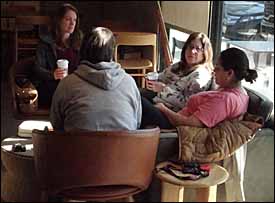 A women's discipleship group meeting Friday mornings at a Starbucks coffee shop. |
People are different. Our discipling styles are different. That's how God designed us.
The church I am a member of -- Rock Harbor Covenant Church in Rocklin, California -- has had a strong emphasis on discipleship for more than a decade. As a result, our church has developed a cadre of people who regularly disciple others, both individually and in small groups.
To expose my readers to different discipling styles, I gathered eleven active disciplers for a pair of Zoom meetings in late January 2026. I recorded the meetings, then transcribed, collated, and edited their responses. People are sharing in a casual, conversational style.
Special thanks to these participants: Kristin Crossan, Brittney Land, Chris Cluff, Sharon Krieger, Alicia Black, Kathy Stark, Chris Wilson, Suzanne Greene, Judy Schostag, Dave Pabalate, and Mika Strait.
If you read carefully, you'll discover that these people lead several different kinds of discipleship groups. In some cases, individuals lead more than one kind of group. I hope this conversation inspires you with ideas you can use to help your own discipling style become maximally effective.
I asked questions to guide the discussion, which provide this structure:
- Description of your group
- Spiritual disciplines or practices you are encouraging
- Leader teaching compared to group sharing
- The person you hope to form
- Changes in the discipler
1. Description of Your Group
Ralph: Tell us about your current group that you're working with -- or maybe an individual. What does your discipling look like? What are the elements of a typical session? How many people do you typically have?
Kristin: We meet on Tuesdays at a Starbucks coffee shop for about an hour and a half. There are usually between four to six high‑school girls. We usually start off with where they are seeing God. They talk about their lives and where they've seen God. Then we study a story in the Bible. Recently, we were going through Daniel. We end with a challenge where they can show God's love in some practical way. They come up with the ideas themselves. These girls have decided things like: "Today we're going to give compliments to people," or "Today we're going to open the door for someone," or do something kind. Their loving others is what God has asked us to do. They go out and love people, and then they come back the next week with stories of how things went.
What is my goal? Some are seniors. They have been walking with God for a long time, but they're about to blossom and move on. I want them to know that God loves them and that by seeing what God is doing in their lives right now, they can know He's real and move forward with confidence.
Brittney: I like to meet in the evenings with adults, because we are often so rushed during the day -- typically at one of our houses, if possible. Sometimes it's at the Gander Brewery or someplace open late so we don't feel like we have to rush off.
Structure‑wise, my sweet spot is four people, including myself. If it's just two, it's difficult because there's not a third person to say, "That doesn't work for me," or "That totally has worked for me." With more than two, accountability builds differently. Three people plus myself is great for time because we can devote more attention to each person's experience each week. Five is my max, including myself, because then it becomes more like a life group, and we end up having to cut people off or someone doesn't get a chance to share.
We schedule about an hour and a half. If it's a really chatty group at my house, I'm not going to kick them out after three hours. I've had them go really late. If it's a group that needs to wake up early, we end right at an hour and a half. It depends on the group.
The first meeting is setting up expectations. I open with prayer and then set expectations for the group. I ask a question of the week. For the first meeting, it might be: "Where do you find God? What's your experience with God right now in your life?" We share, and that takes most of the time. I also go through the commitments of the group: Why are we here? What are we doing? What's our commitment level? From there, we build each week.
By week six, we've noticed our intentional patterns. We've drawn up a rule of life -- what we want those patterns to be -- and we actively come back each week reporting on where we saw God and how our rule of life worked.
Chris Cluff: We meet Tuesday nights at 7 p.m. for about an hour and a half.
The structure is roughly a third, a third, and a third. For the first half hour, we talk about what's important in our lives and what's going on. We're building relationships as men. The second half hour is whatever we're studying, and that varies. We've found six weeks is a good time frame for a topic. During the last half hour, we talk about our prayer life -- what we need prayer for, what we can pray for each other -- and then we dive deeper into prayer.
We typically have four to five men. It's kind of a rotation of four people. If everybody shows up, it degrades the interaction. Like Brittney said, too small is a problem, too big is a problem. Four is the magic number, including me. We meet at Moksa Barrel House.
Sharon: It's been about a year and a half since I've been in a discipleship group. I prefer fewer people so everyone can share. We would meet at Starbucks and in our homes.
We start off with the rule of life. We have a weekly challenge, typically memorizing Scripture.
And we ask, "Where have you seen God lately?" One of our goals is to build the habit of identifying where you see God every day so it becomes like breathing. When people begin to identify God's presence without even thinking, it's a huge moment. That's one of the big blessings -- getting into that rhythm.
We talk about rules of life -- two in each of four areas: rest, work, prayer, and relationships. We focus on those and start with being purposeful. We identify two or three bullet points and build into them. We're doing these things already; the question is: Where is God in all this? We want to make sure we're not doing life without Him.
The person I'm currently working with, Nicole, is so on fire right now. It's awesome. The process is the same: defining a rule of life in those four areas, memorizing Scripture, and asking where you've seen God this week. We usually spend an hour.
Alicia: Michaela and I are meeting with high‑school girls. Four is a great number with Michaela and me, and then three girls -- one sophomore and two freshmen. It's a really good dynamic. They all have time to talk. It's so neat to be at that early stage of learning the disciplines.
For me personally, journaling every morning has been a long‑time practice. I read the Psalm of the Day and journal. Dave, the high‑school leader, gives all the kids a little black book where they're supposed to write down where they've seen God. We write on it: Be present and see details. It was cool that one of my own practices became part of the group. We encourage them to write where they've seen God that day, what's going on, and how they're bringing the kingdom into their world.
We met at Menchie's Frozen Yogurt for a while, but now that it's colder, we've been meeting at Panera Bread. We meet on Monday evenings for about an hour and fifteen minutes.
A lot of the time is them talking about their lives. Michaela is better than I am at steering them back to the goal. But because it's so early on, it's really about getting to know them, loving them, and meeting them where they're at. They have some great spiritual insights sometimes, which is wonderful.
We want to build a foundation of spiritual practices: going to church weekly, memorizing Scripture (which we just introduced last week), reading, looking to see where God is working, keeping track of that, and praying for each other. Especially with freshman girls, I just hope for that foundation right now. They're all going to Mexicali on the mission trip during Spring Break, and they're so excited. I'm excited to see how God is going to use that.
Kathy: There are four of us altogether, and we meet Friday mornings at Starbucks. The first half of our time is spent sharing what's going on in our lives -- where we've seen God and how we're doing spiritually. During the second half, we've been following the Sunday sermon notes and diving deeper into the message using the questions on the back of the handout. We also challenge one another in our spiritual practices.
Chris Wilson: The longest‑standing group I lead is a men's group of about twelve guys on the roster, though not all show up every week. The typical number is four, five, or six.
We have a routine. First, we talk about where we've seen God working in our lives that week. Then we go through a Scripture passage that was taught the previous Sunday at church, which allows us to dive deeper. I ask two questions:
- What does this passage teach us about God?
- What does this passage teach us about people?
From those two questions, we look at our own lives and challenge one another: How are we going to grow deeper in our relationship with God? How can we trust Him more in this area? How can we curb certain behaviors, temptations, or sins so we can become more like Jesus?
Throughout the week, we use a group text thread to keep each other accountable. At the end of our meeting, we share prayer needs. We also use the group text to check in and pray for one another whenever something comes up.
Just today I received a couple of texts -- both about family members going into the hospital -- guys reaching out to their brothers for prayer.
We meet at one of the attendee's homes because he needs to be there to watch his children while his wife is out. It guarantees at least two of us will always be present. We usually meet in someone's home.
We keep it to about one hour so the guys know exactly how much time to set aside. Men our age aren't always as talkative, so the one‑hour structure helps them engage while still respecting their schedules. Sometimes someone will come early to talk privately about something personal they're not ready to share with the whole group.
For whatever reason, they've chosen me as their leader, and they feel comfortable sharing deeply personal things with me.
Suzanne: I have several different ladies I meet with, and they're all at different stages. Some I've met with for five years. With them, our time is mostly checking in -- How are you doing? Are you memorizing Scripture? What's your verse? We talk about Bible study, life, and whatever is going on. It's very one‑on‑one and individualized. Sometimes we meet for two hours if it's been a while.
Then there are ladies I meet with weekly as we go through the Gospel of John. We meet at a coffee shop. I print out the chapter we're studying, and we read it together. There's no homework for those who aren't used to studying the Bible.
If I'm mentoring someone new, I always start with the Book of John. I think it's important that you know Jesus -- that you fall in love with Him. That's my main goal. And I want them to love the Bible and learn to feed themselves spiritually.
Judy: From September through May, I lead a group of ladies at my home on Wednesday mornings from 9:00 to 10:30. I make coffee, and we chat for a bit -- because ladies like to chat! Then we sit in a circle. Right now we're watching a video series on Gideon by Priscilla Shirer. There's homework in the book, and we go through each chapter, talking about what stood out, what it means to them, how it affects their personal lives, and how it draws them closer to Christ.
Then we share prayer requests. I pass around a small booklet at the beginning, and at the end I read the requests aloud. If something needs clarification, we talk about it. Then we each take the requests home and pray for them during the week.
We also have a group text where we reach out to each other -- especially around times like Christmas -- to share what's going on and pray for one another.
In the summertime, I lead a group of young moms. I hire a babysitter for the first hour and a half. We typically watch a video and discuss it. Then we have what I call "Study and Swim." When the study is over, the babysitters leave, and we all go out to the pool. The kids swim, and the moms talk. The kids love coming to Miss Judy's house, so the moms don't want to miss either!
I have one rule for all my groups: "What is spoken at Judy's house stays at Judy's house."
Mika: The group I'll share about is a couple of ladies I met with previously. We would get together and try different prayer experiences -- meditation, visualization, learning how to hear from God. We rotated who chose the practice for the next week. During a season of crisis, we went through the Book of Lamentations and learned how to write a lament. It was a really meaningful group. I led it, but everyone contributed as we learned to listen to God together. Our meetings lasted about an hour and a half.
For one‑on‑one ministry, I might meet with someone for up to two hours. We'd go out somewhere, or take a walk, or sit around my fire pit. I'm not a rigid, same‑place‑every‑week kind of person. I meet regularly, but the location is flexible -- walking the dog, grabbing coffee, sitting outside. It depends on the person and the evening.
Ralph: Dave, you're a worship pastor, and you work with high‑school kids, which is exciting. But what I really want to hear about is how you disciple people who are just beginning to move toward God. You run a gym, and a lot of people have come to church and to Christ through that. How does that work? Do you work with individuals, groups, or both?
Dave: I work with high‑school kids, individuals, and small groups of adults. The Great Commission says to go into all the world and make disciples and teach them everything Jesus taught us.
My basic thinking is: This is how I'm living. If you want what I have, then do the things I'm doing.
That's where I start. It doesn't have to be exact, but we talk about spiritual practices -- these are the practices that have helped me walk with Jesus the way I do. I'm not saying I'm better than anyone. I might just be a little further along. So I share what I've got.
In a group setting, I love the four‑to‑five range. I'm an intense person, and I ask very direct questions. If the group is bigger than five, people hide.
I like one‑on‑one too, but small groups are more time‑efficient. And when it comes to scheduling, I don't try to find a time that works for everyone. I say, "This is the time that works for me. If it works for you, join me."
In a group, there's peer pressure. If the others are doing the practices and you're not, you feel it. People either join in or they don't. And that's okay.
Honestly, I think a lot of people in my discipleship groups aren't yet committed followers of Christ. They're finding Christ. They like the spiritual practices. They like doing the things. And all the practices are really just posturing -- in a positive sense.
If you want to see God, you have to look for Him. You don't usually just bump into God. You need eyes to see. And if people don't know how to have those eyes, I say, "Here's how I've done it." And they say, "Okay, I'll go look."
2. Spiritual Disciplines or Practices You Are Encouraging
Ralph: Next question. What kinds of spiritual disciplines or practices are you encouraging people to adopt to help form them as disciples?
Alicia: You know, it's funny -- I have a practice of fasting, like Kristin mentioned earlier. I haven't actually talked to the girls about that yet because I don't think they're quite ready for it. But for me, fasting really helps keep my eyes open -- staying curious about what God is doing. I feel like that practice has helped me stay open to what God is trying to do in our group.
For the girls, we're focusing on early, basic things: going to church every week, praying every day, reading the Psalm of the Day, and trying to keep track in their journals of where they're seeing God. Hopefully every day -- though I know they're not quite there yet.
Kristin: We actually took an idea from Dave. Since we meet on Tuesdays, the girls fast from their cellphones and social media on Tuesdays -- from when they wake up until our meeting at 7 p.m., and even after we leave at 8. It doesn't always work because that's how they communicate, but it helps a little. They're all teenagers, so fasting from food isn't as meaningful -- they skip meals without thinking about it! We've also tried memorizing Scripture.
Kathy: The spiritual practices we're doing include memorizing Scripture, talking about fasting, and working through a variety of practices together. My hope is that we all become strong in these practices so we can, in turn, share them with others. All three of the women in my group are already discipling younger girls -- the high‑schoolers -- so they're already putting this into practice.
Each week I ask, "How are you doing with that? How's the memorization going?" We're good at some things and not so good at others, but we're working on them. That's why it's called a 'practice.'
Brittney: In the first meeting, I'm careful to set expectations early so people don't feel surprised or pressured later. When I invite someone, I ask: "Do you want to be part of a group that's intentional about spiritual practices, or are you just wanting to hang out and have coffee?" That helps me understand what they're looking for.
By the time we have our first meeting, I can say, "By week three or four, we're going to talk about our intentional patterns."
When we get there, we start by writing down what we're already doing in our lives -- before talking about what we want to add. Then I ask them to notice where they see God in those things during the week.
The next week, we write down our rule of life: the things we want to do or add. Every week we ask: "Where have you seen God? How are your patterns going?" That becomes the content of our meetings.
For example, someone might say, "I didn't realize I could fast for five hours! I tried it, and here's what happened." We celebrate those moments. The accountability comes from the joy of seeing growth.
Ralph: What relationship do you see between spiritual practices or patterns and spiritual growth?
Brittney: I had a girl call me once and ask, "Am I supposed to delete my astrology app?" I said, "I don't know -- what do you do with it?" She said she looked at it every day. I asked, "What do you look at first -- the app or the Psalm?" because that was one of our patterns.
She said, "I look at the astrology app first." I asked, "What do you think God is telling you?" She said, "I think I'm going to that instead of God." I asked, "So what are you going to do?" She said, "I think I have to delete it."
I didn't have to tell her. God was already prompting her -- through the silence she had committed to, and through comparing it with the Psalm she was reading. God put that on her heart.
Ralph: Sharon, do you think there's a direct causal relationship? And why?
Sharon: Oh, absolutely. Memorizing Scripture helps us not just read it, but apply it -- and share it with others. Sometimes it doesn't apply to us directly, but it might apply to someone we meet.
The spiritual practice of reading Scripture -- purposefully -- is where spiritual growth comes from. Growth comes from making sure God is part of everything we do. Over time, people see it. They're amazed at how they've grown and how God has worked in their lives.
When they start noticing God -- every day, without even trying -- that changes their spiritual life.
Dave: All my disciples have one of these small black books. I give one to all the guys and say: "If something happens that feels like a coincidence, or amazing, or like, 'What are the chances?' -- write it down. We'll share it next time."
It trains their eyes to see what God is doing.
A rule of life has four categories: work, rest, prayer, and relationships. We have intentional things we do daily and weekly. All the guys are supposed to do them.
We do a daily Psalm. We meet every Thursday at Taco Bell. We go to church. We observe Sabbath. We think that's important.
Ralph: On a scale of 1 to 10, how important are spiritual disciplines in forming a disciple?
Dave: Ten. Because we're lazy. You have to train yourself. You have to posture yourself -- open eyes, open ears, love your enemy. Jesus asks us to do very hard things.
Mika: I teach junior high in a Christian school. Every day I teach students how to hear from God and see God. Our number‑one practice is listening to a worship song and asking: "What is the theology of this song? What does it teach us about God? What does it teach us about how we respond to Him?"
Anyone I meet -- I want them to know two things: (1) they are deeply loved, and (2) we are called to love God and love others. It might look different than we expect.
Listening to music, prayer, reading Scripture -- those are spiritual disciplines. But I also try to teach alternative ways to engage the Spirit because one approach doesn't work for everyone.
You might be a 6 a.m. person; someone else might be a 10 a.m. person. How can you embrace how God made you? What rhythms fit you? Let's figure out who you are, who God is, and how He made you -- and then find rhythms that work for you. A lot of it is learning how to talk to God,
Judy: I think it's important to be in church every Sunday and to make that commitment to be there. We talk about how important prayer is in our daily lives, and how important it is to worship. Every morning, I take my dog outside, and I look at God's beauty. I thank Him for the trees, for the blue sky, for everything He has created. I'm so appreciative of that, and I try to bring that into my group -- to be worshipful.
We did a really great trial run of something we called Centering Ourselves in Christ. This was something I did in high school with my youth group. My youth pastor told us that every time we looked at the clock to see if class was almost over, we should thank God for something. I would say, "I love you, Jesus," and draw closer to Christ.
So our group took a month, and one day each week we set our phone alarms. Every hour we paused to pray and thank God for something we appreciated. It was neat to see lives being changed -- not only in my group, but in their families as well.
Suzanne: I sort of see spiritual disciplines as tools to help us know God better. Knowing God is vital. Many people go to church, but then they don't do anything during the week.
To know God, you need to spend time with Him and learn what He's like. Some people raise their hand to accept Christ, but they don't really know who they're accepting. They don't know Him. I try to get people into the book of John so they can see who Jesus is, what kinds of encounters He had, and what He's like.
First, reading the Bible. Scripture memory is really important in my life. Start small -- a verse a month, or a verse every couple of months. People say, "I can't memorize Scripture," but you can memorize one verse a month. And once you memorize it, it's not just about remembering it -- it's about meditating on it. Meditation is very important. Studying the Bible is important. And then sharing the gospel with someone else -- working on your testimony so you can share what God has done for you.
Chris Wilson: I have a love for Scripture. I love reading it and seeing the connections, seeing Jesus throughout all of it. For me, it develops a spirit of awe and thankfulness -- how great God is, how deep He is, what that means for who He is, what plans He has for my life, and how I can trust Him.
With my group, we read Scripture every week. And each year we have a challenge to hold each other accountable to a reading plan. Last year we read through the New Testament. This year we're doing the whole Bible again. I found a program with a devotional that shows how each part of Scripture points to Jesus. When we started, many of the guys had never read the Bible at all -- certainly not all the way through. Now they're more accustomed to it.
I also have a group of high‑school boys. We're starting them with reading the New Testament. Most of them haven't really read the Bible either. They come in excited: "Guess what? I read about Jesus today!" Or they come with questions: "I don't understand this." Then we get to talk about it and point to other Scriptures. For me, Scripture reading is the number‑one spiritual discipline. It's how we connect with God through His Word.
We also pray together. A lot of that is supporting one another. When something comes up, you don't handle it alone -- you bring it to the group, we pray, and then we wait expectantly to see what God will do. And God shows up. People see Him moving in their lives. The next time something happens, they remember: If God showed up last time, He'll show up this time.
Mika: Something I love to teach -- especially with my students -- is the book of John. We go through it every year, learning: Who is Jesus? How does He act? What does He do? What is His relationship with God? We want to see Him clearly so we can follow Him closely.
3. Leader Teaching Compared to Group Sharing
Ralph: Next question. How much of your discipling is teaching, and how much is group members discussing and sharing their lives? How much are you talking, and how much are they talking? How much is a shared experience?
Sharon: It's a shared experience. I'm not a teacher in that sense. We go through Scripture together, talk about how it relates to each of us, and learn from each other. If we have a question, we dig into it together.
Kristin: I'd say half and half. I'm trying to teach them -- I want them to learn something. We share life, but they're young, significantly younger than me. So I'm there to guide them and teach them. And if they have questions, we walk through them together.
Ralph: So you think teaching is part of what you need to do to help them grow?
Chris Cluff: In my groups, I'm probably leading or directing about a third of the time. The group occupies the other two‑thirds.
Kathy: It's definitely a shared experience. I ask the questions, but I don't feel like I'm doing any teaching. We're just sharing what God is teaching us, how He's showing up, and how we're doing with our spiritual practices. It's very shared.
Alicia: It's a lot of sharing -- the girls talking, and Michaela and I listening. We share parts of our own lives when it's appropriate. Recently we asked the girls, "What compelled you this week?" and one of them gave the coolest answer. So yes, it's a lot of them sharing.
Brittney: The 80/20 rule was drilled into me, so I stick with that. My 20% is helping them connect what they're saying to what God is doing. Maybe the first few meetings are heavier on explanation, but after that it's mostly me helping them get there.
Chris Wilson: I talk anywhere from 30 to 50% of the time, and the guys talk 50 to 70%. That grows as they get more comfortable.
When you first start a discipleship group, you talk more because they don't know what to say yet. But as you continue meeting, they open up. When they see their peers experiencing God, having insights, seeing God move, or understanding something about Jesus, they become more confident.
Suzanne: If I'm studying with someone who's never read the Bible before -- like going through the first four chapters of John -- I'm doing more talking because they don't know what to say. But if it's someone I've met with for a long time, they're doing most of the talking. It depends on the person. In a group, I try not to talk a lot.
Judy: Maybe 20% of the time I'm talking. I try to keep the conversation moving from one part of the book to the next, asking questions, bringing different people in, and -- because it's a group of women -- trying to keep one person from dominating.
Mika: My approach depends on the person and the moment. There needs to be a lot of listening -- really hearing what they're going through. And like Judy said, with a group of women, the hardest thing is often: Let's all stop giving advice.
4. The Person You Hope to Form
Ralph: If someone spent a year in your group, what kind of person do you think they would be likely to become?
Brittney: I had two different people in one of my groups -- one very religious and one not religious at all. At the end of our time, the more religious person said they had become less judgmental and more understanding that we can all listen to and hear God differently. They became less rigid about how others follow God.
The person who wasn't religious said they had become more understanding of people who are committed to spiritual practices -- because now they understood why practices are helpful.
To me, that's the fruit of people learning how to hear God. I've even called some of them for advice in my own life, and they bring back things we talked about in those groups.
I would hope that after a year, someone would be ready to lead in some way -- that they'd have a structure they can pass on, and that it wouldn't feel scary.
Kathy: I think they'd realize -- because they're doing their spiritual practices and focusing on their daily walk with God -- that they can see God working. They'd see how He's been working in their lives, in their families, and in those around them. They'd learn to hear God and grow into that.
Alicia: I hope they'd approach the people in their lives with kindness and curiosity instead of judgment. And that they'd ask, "How can I bring the kingdom into my little world?" instead of "What am I getting from these people?" Hopefully their spiritual life would change their perspective on daily living.
Kristin: They would know that God is real, and they'd have stories to tell about His work in their lives. And they'd know how to love others.
5. Changes in the Discipler
Ralph: What kinds of changes do you see in yourself as a result of your discipling ministry?
Kristin: It keeps me on my spiritual patterns and rule of life more easily because I have people on all sides providing accountability.
Chris Cluff: My search for curricula or topics to discuss has led me down some interesting paths. My charter is Christian men helping Christian men become better Christian men. So I'm trying to add Christ into our daily lives. I'm reading a lot more Scripture, and I'm putting Christ more forward in my life.
Alicia: When I was asked to lead this group, I prayed about it. I felt like God said it wouldn't be a burden -- it would be a gift. And that's exactly what it's been. It's not taking anything away; it's giving to me. It's a blessing. It brings me joy to watch spiritual growth and relationships forming in these girls. It's an added blessing to my life.
Brittney: This pushes me out of a "church mindset" and into a spiritual mindset. It's also forced me to be okay with not knowing why God says yes to some things and no to others. There are people I would have told, "Don't do that -- it's not good for you." But then God clearly led them through that situation and brought so much fruit from it. I was 100% wrong.
Just because something was wrong in my childhood doesn't mean it's wrong to God. This forces me to lean on God -- not just the doctrine I was raised with.
Kathy: Definitely the accountability. If I'm not doing these things, what business do I have challenging others to do them? And yes, a weekly commitment can feel burdensome at times, but it's been a joy. I love getting together with these ladies. It enriches my life.
Sharon: It holds me accountable too. I look forward to it every week. I think they did as well. I just spoke with someone I started discipling in October 2019. We still have discussions, even though I haven't discipled her for four years. Discipleship gives me tools to grow in my relationship with Christ -- rule of life, Scripture, "up‑in‑out," the Learning Circle. These things keep running through my mind. They help me stay accountable and continue to grow.
Chris Cluff: If you're asking people to follow you, it makes you look at your life and ask, "Is my life worth following?"
Suzanne: It's exciting to me when I'm with someone who has never read the Bible before. It's exhilarating. I love it. I've found my niche.
Judy: My kids are grown and moved away, so these young moms are like my kids. I love them and want to be a good example. I want those who follow in my footsteps to find me faithful in my walk.
Mika: Like Suzanne, I get really excited. I "nerd out" about Jesus and the Bible.
Ralph: I want to thank each one of you for what you do in the Lord. It's so important. You are functioning in the gifts God has given you. That's one reason you enjoy it and get excited -- because it fits who He made you to be. And since you're flowing in that, you get blessed. Thanks so much.
 Available in book formats: paperback, Kindle, PDF |
Wrap‑Up
Ralph: I'm going to ask our pastor, Greg Krieger, to conclude in prayer.
Greg: God, I thank You for these brothers and sisters. Thank You for those who are building into lives and giving models to follow. Help us to leave footsteps for others to find and follow. Help each of us to be steadfast, immovable, always abounding in the work of the Lord -- especially as it relates to discipleship -- knowing that our toil is not in vain. Into Your hands we commit our lives and the lives of those we are caring for -- the men and women, young and old, whom we are discipling. We commit them to You, in Jesus' name. Amen.
Copyright © 2026, Ralph F. Wilson. <pastor joyfulheart.com> All rights reserved. A single copy of this article is free. Do not put this on a website. See legal, copyright, and reprint information.