


|
Old Testament
New Testament
Gospels
Acts
Paul's Letters
General Letters
Revelation
Topical Studies
Beginning the Journey (for new Christians). en Español

|
Old Testament
New Testament
Gospels
Acts
Paul's Letters
General Letters
Revelation
Topical Studies

|
Home
Bible Studies
Articles
Books
Podcasts
Search
Menu
Donate
About Us
Contact Us
FAQ
Sitemap


Inspiration, Inerrancy, and Authority of Holy Scripture
by Dr. Ralph F. Wilson
Free
E-mail Bible Study
 Experiencing the Psalms
Home | Bible Studies | Articles | Books | Podcasts | Search | Menu | Donate | About Us | FAQ | Contact Us
 Let's pause here to consider an important doctrine: the
inspiration and inerrancy of Scripture, and discuss what we mean by these
terms. Of course, this doctrine is hotly debated and all Christians don't agree
on every detail, but it is worth discussing. However, in the short scope of
this lesson it is impossible to cover all the aspects in detail. For that, I
refer you to a one-volume systematic theology text or a book length treatment
of this subject. Two systematic theologies I have found helpful are: Millard J.
Erickson, Christian
Theology (Second Edition; Baker Academic, 1998), pp.
224-265; and Wayne Grudem, Systematic
Theology (Zondervan, 1994, 2000), pp. 47-140. I've
largely followed Erickson's discussion and conclusions here.
Let's pause here to consider an important doctrine: the
inspiration and inerrancy of Scripture, and discuss what we mean by these
terms. Of course, this doctrine is hotly debated and all Christians don't agree
on every detail, but it is worth discussing. However, in the short scope of
this lesson it is impossible to cover all the aspects in detail. For that, I
refer you to a one-volume systematic theology text or a book length treatment
of this subject. Two systematic theologies I have found helpful are: Millard J.
Erickson, Christian
Theology (Second Edition; Baker Academic, 1998), pp.
224-265; and Wayne Grudem, Systematic
Theology (Zondervan, 1994, 2000), pp. 47-140. I've
largely followed Erickson's discussion and conclusions here.
First, let's consider the parameters of this rather large subject. To understand inspiration we need to:o:
- Define what the Bible seems to mean by inspiration,
- Examine various theories of the nature of inspiration,
- Understand why the books in our Bibles are considered inspired,
- Consider the implications of inspiration on the inerrancy of the Bible, and
- Realize the implications of inspiration for the authority of the Bible
What Do We Mean by "Inspiration"?
Two verses in the New Testament directly discuss the idea of inspiration of Scripture.
"All Scripture is God-breathed and is useful for teaching, rebuking, correcting and training in righteousness, so that the man of God may be thoroughly equipped for every good work." (2 Timothy 3:16-17)
"No prophecy of Scripture came about by the prophet's own interpretation. For prophecy never had its origin in the will of man, but men spoke from God as they were carried along by the Holy Spirit." (2 Peter 1:20-21)
In addition, a number of verses from the mouths of Jesus and his apostles indicate how they viewed Scripture:
"David himself, speaking by the Holy Spirit, declared...." (Mark 12:36)
"The Scripture cannot be broken...." (John 10:35)
"Until heaven and earth disappear, not the smallest letter, not the least stroke of a pen, will by any means disappear from the Law until everything is accomplished." (Matthew 5:18)
"The Scripture had to be fulfilled which the Holy Spirit spoke long ago through the mouth of David ...." (Acts 1:16)
"But this is how God fulfilled what he had foretold through all the prophets...." (Acts 3:18)
"The prophets ... searched intently ... trying to find out the time and circumstances to which the Spirit of Christ in them was pointing when he predicted the sufferings of Christ and the glories that would follow." (1 Peter 1:11)
It is clear that Jesus and the apostles saw Scripture as divinely inspired. Millard J. Erickson defines this doctrine as follows:
"By inspiration of Scripture we mean that supernatural influence of the Holy Spirit on the Scripture writers which rendered their writings an accurate record of the revelation or which resulted in what they wrote actually being the Word of God."
Is Inspiration a Circular Argument?
But can't inspiration be considered a kind of circular argument? We believe that Scripture is God's Word because it claims to be that. And we believe its claims because Scripture is God's Word.
Yes, in a sense there is a circular argument. But consider that all arguments for absolute authority must ultimately appeal to that authority for proof, otherwise the authority would not be an absolute or highest authority. Moreover, circular arguments are not explicit; they are often hidden:
"My reason is my ultimate authority because it seems reasonable to me to make it so."
"I know there can be no ultimate authority because I do not know of any such ultimate authority."631
Having said this, the truth of the Bible is certainly supported by many other disciplines: such as history, archeology, sociology, and linguistics. They do not make it true, but they support its claim to truth. And in any court of law the defendant's testimony is duly considered as admissible along with other evidence. In addition, the Bible is persuasive because it is truthful; the Holy Spirit guides us into all truth (John 16:13). Many people have come to faith by reading the Bible as an historical document, allowing it to plead its own case, and -- becoming convinced of its truth -- have come to faith in Jesus Christ.
Theories of Inspiration
Erickson outlines five theories of inspiration:
- Intuition theory, that inspiration refers to a high degree of spiritual insight.
- Illumination theory, that inspiration refers to a heightening of one's normal powers.
- Dynamic theory, that inspiration involves a combination of divine and human elements in the process of inspiration and writing.
- Verbal theory, that the Holy Spirit's influence extends beyond the direction of thoughts to the selection of words used to convey the message.
- Dictation theory, that God actually dictated the Bible to the writers.632
Notice that these are theories, since the Scripture doesn't state specifically how the phenomenon of inspiration by the Holy Spirit actually operates -- only that what is written is inspired. However, from the various verses that allude to this process, I see both a dynamic and verbal inspiration of the Holy Spirit, without going as far as dictation (in most instances).
Inspiration of both Old and New Testaments
It is clear that when the New Testament speaks of the inspired Scriptures, it is referring to the Old Testament books -- the Law, the Prophets, and the Writings -- though sometimes "law" or "prophets" can be used to designate the entire body of Old Testament Scripture. The 37 books that make up the canon of Old Testament Scriptures were completed by about 435 BC and recognized by the rabbis as constituting the canon of Scripture within a couple hundred years, certainly by Jesus' time.
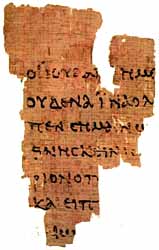 The Rylands Library Papyrus p52 is the earliest known New Testament manuscript. It measures 3.5" x 2.5", a fragment from a papyrus codex. It contains lines from the Gospel of John 18:31-33 in Greek on the front and John 18:37-38 on the back. It is dated ca. 125-160 AD. |
However, does our understanding of inspiration extend to the New Testament, as well? Yes. Clearly, Christians have regarded the teachings of Jesus as inspired! After all we believe Jesus to be God in the flesh.
The office of apostle, ones designated by Christ to found his church claimed an authority in the early church at least equal to the Old Testament prophets (2 Peter 3:2; Acts 5:2-4; 1 Corinthians 14:37; 2 Corinthians 13:3). Paul's writings are referred to by Peter in the same category as Holy Scripture.
"... Our dear brother Paul also wrote you with the wisdom that God gave him. He writes the same way in all his letters, speaking in them of these matters. His letters contain some things that are hard to understand, which ignorant and unstable people distort, as they do the other Scriptures, to their own destruction." (2 Peter 3:15-16)
Jesus' teaching, too, is referred to as Scripture in 1 Timothy 5:17-18, citing Jesus' teaching in Luke 10:7. The gospels and letters not written by apostles themselves were attested to as true by the apostles living at the time, and affirmed by the early church.
Inerrancy and Authority of Scripture
So the Scriptures of the Old and New Testament are inspired. Does that mean they are without error? Some kind of doctrine of inerrancy is a necessary corollary of the doctrine of inspiration: Since the Scriptures are inspired by God, they are true. Erickson defines the doctrine as follows:
"Inerrancy of Scripture is the doctrine that the Bible is fully truthful in all of its teachings."633
Though the word "inerrancy" wasn't used concerning Scripture until the last century, inerrancy has been the historical position of the church since earliest times. In stating such a doctrine, however, it is important to qualify the term. Erickson observes:
- Inerrancy pertains to what is affirmed or asserted, rather than what is merely reported.
- We must judge the truthfulness of Scripture in terms of its meaning in the cultural setting in which its statements were expressed.
- The Bible's assertions are fully true when judged in accordance with the purpose for which they were written.
- Reports of historical events and scientific matters are in phenomenal rather than technical language -- what appears to the eye rather than scientific explanations.
The Authority of Scripture
 Available in paperback, PDF, and Kindle formats. |
Because we believe the Bible is true in what it teaches, then it follows that it is authoritative. By authority, we mean the right to command belief and or action. Erickson says:
"By the authority of the Bible we mean that the Bible, as the expression of God's will to us, possesses the right supremely to define what we are to believe and how we are to conduct ourselves."634
Of course, there is much more that could be said. But this gives you in short scope what Jesus, the apostles, and prophets taught about the inspiration, truth, and authority of Scripture.
Endnotes
[631] This section in large part quotes from Wayne Grudem, Systematic Theology (Zondervan, 1994, 2000), pp. 78-80.
[632] Erickson, pp. 231-233.
[633] Erickson, p. 247.
[634] Erickson, p. 267.
Copyright © 2026, Ralph F. Wilson. <pastor joyfulheart.com> All rights reserved. A single copy of this article is free. Do not put this on a website. See legal, copyright, and reprint information.